Opinion
Modeling Infectious Disease in Mice: Co-Adaptation and
the Role of Host-Specific IFN
c
Responses
Jo¨rn Coers1*, Michael N. Starnbach1, Jonathan C. Howard2
1Department of Microbiology and Molecular Genetics, Harvard Medical School, Boston, Massachusetts, United States of America,2Institute for Genetics, University of Cologne, Cologne, Germany
The advantages of the mouse as a model organism in biomedical research are many. The molecular and genetic toolbox developed for the mouse over the last 100 years enables researchers to manipulate and study gene function in vivo almost at will. Time and time again, scientific findings obtained through the use of mouse models have proven to be relevant to human health. The field of immunology in particular has profited tremendously from the powers of the mouse model and much of our knowledge of the workings of the immune system is derived from studies performed in mice.
Yet all that glisters is not gold. Researchers have used the mouse exten-sively as a model organism to study the pathogenesis of human infections and found that it imperfectly recapitulates many aspects of infectious disease as seen in patients. In fact, mice generally appear to be highly resistant to infections with human-specific pathogens like HIV, Plas-modium falciparum, and Shigella flexneri, especially if the pathogen is administered through the natural route of infection. Of course, the inherent resistance of mice to highly adapted human pathogens should not be a surprise: because pathogens co-evolve with and adapt to their preferred host, their successful specialization often renders them highly dependent on their host species [1]. Such host tropism or host restriction limits the usefulness of the mouse as a model for infectious disease research. One approach to overcome the limitations of the mouse model could be to genetically engineer mice that closely resemble humans in all those aspects relevant for host–pathogen interactions. To assess how realistic this ambitious goal may be, we must first understand the underlying molecular causes for host restriction.
Species-Specific Immune Evasion by Pathogens Contributes to Host Tropism
For many infectious diseases, host restriction is at least in part based on the
inability of a pathogen to colonize the non-typical host effectively. Colonization often relies on species-specific interactions of microbial ligands with host cell recep-tors. For example, the bacterial effector internalin A expressed byListeria monocyto-genesbinds to the host E-cadherin receptor to mediate bacterial internalization, an essential step for the microbe to breach the intestinal epithelial barrier after oral ingestion [2]. A single amino acid change in the mouse ortholog of E-cadherin disrupts the interaction with internalin A and abrogates efficient bacterial invasion [2]. As a consequence, mice are relatively resistant to L. monocytogenes infections administered through the oral route. Transgenic mice expressing human E-caherin in the small intestine, on the other hand, are susceptible to oral infections with L. monocytogenes and develop enter-opathogenicity and systemic infections, thus truthfully recapitulating some aspects of human disease [3].
Additionally, host restriction may be caused by the failure of pathogens to deter immune assaults in the non-typical host. For bacterial pathogens, this principle has been beautifully described for the human-restricted pathogenNeisseria gonorrhoeae, the causative agent of gonorrhea. Outer membrane porin molecules of N. gonor-rhoeae can bind human but not rodent inhibitory molecules of the alternative and classical complement pathways, rendering gonococci resistant to complement-medi-ated killing by human serum but suscep-tible to rodent serum [4,5]. In contrast,
Yersinia pestis, a pathogen of both humans
and rodents, binds complement inhibitory molecules of either host species and evades both human and rodent serum-mediated killing [4]. This example illustrates a general principle: a pathogen must be able to endure or overcome innate immune responses that drastically interfere with its survival and/or transmission to another suitable host. Pathogens must, therefore, have evolved subversion strategies for all the innate immune mechanisms that, if unrestricted, would result in their demise. A pathogen will, of course, acquire immune evasion strategies only against antimicrobial responses active in the host species with which it has co-evolved. Highly adapted human pathogens would therefore be vulnerable to an antimicrobi-al immune pathway present in mice but absent from humans. Recent work on IFNc-activated host responses to intracel-lular pathogens has indentified a powerful cell-autonomous host defense system or-chestrated by a family of GTPases named p47 Immunity Related GTPase (IRG proteins) that is present in mice but appears to be largely absent from humans and may exert limited antimicrobial func-tions in humans compared to mice [6,7,8,9].
In Mice IRG Proteins Are Essential for IFNc-Induced
Resistance towards Various Pathogens
Activation of the mammalian innate immune system by the cytokine IFNcis
essential for host resistance to many
Citation:Coers J, Starnbach MN, Howard JC (2009) Modeling Infectious Disease in Mice: Co-Adaptation and the Role of Host-Specific IFNcResponses. PLoS Pathog 5(5): e1000333. doi:10.1371/journal.ppat.1000333
Editor:Glenn F. Rall, The Fox Chase Cancer Center, United States of America
PublishedMay 29, 2009
Copyright: ß2009 Coers et al. This is an open-access article distributed under the terms of the Creative Commons Attribution License, which permits unrestricted use, distribution, and reproduction in any medium, provided the original author and source are credited.
Funding:JC was supported by a Charles A. King Trust Postdoctoral Research Fellowship. MS was supported by NIH grants AI39558, AI062827, and a grant from Vertex Pharmaceuticals. JCH was supported by Deutsche Forschungsgemeinschaft grant SFB670.
pathogenic organisms. Although IFNc is
produced by specialized immune cells, its receptors are found on nearly all cells, where it activates diverse responses that enable host cells to ward off intracellular infections by bacterial, viral, and protozo-an pathogens [10,11]. A few of the responses and their mediators are now well characterized, in particular the pro-duction of nitric oxide, the propro-duction of oxygen radicals, and the depletion of intracellular tryptophan stores by, respec-tively, inducible nitric oxide synthase, phagocyte oxidase, and indoleamine 2,3-dioxygenase (IDO) [10,11]. However, it has been long known that these mecha-nisms cannot account for all the effects of the IFNc response that result in cell-autonomous resistance to intracellular pathogens. Recently, this void in our knowledge has been partly filled with the discovery that several members of the IRG gene family exercise highly effective anti-microbial activities directed at a diverse set of bacterial and protozoan pathogens. Several research groups have used a gene knockout approach in mice to study the function of select representatives of the IRG family in host resistance. So far, mice lackingIrgm1/Lrg-47,Irgm3/Igtp,Irgd/Irg-47,
and Irga6/Iigp1 have been reported and shown to display some dramatic susceptibil-ity phenotypes to several pathogens, high-lighting the essential role of the murine IRG system in resistance to many infectious agents [12,13,14].
Stark Differences Exist between the Murine and Human IRG Resistance Systems
In light of the importance of IRG-mediated immunity in mice, it was sur-prising to find that an IFNc-inducible IRG
system appears to be lacking in humans. In contrast to mice, which express as many as 18 separate IRG genes upon IFNc
stim-ulation, the human genome possess only two IRG genes,IRGCandIRGM, neither of which is IFN-inducible [6]. The re-stricted expression pattern of IRGC, detected only in male gonads in both mice and humans, suggests that it does not play a universal role in the innate immune response [6]. IRGM, on the other hand, is constitutively expressed in a number of human cell lines. However, the severe truncations of IRGM protein compared to mouse IRG proteins suggests that the human IRGM must be functionally distinct
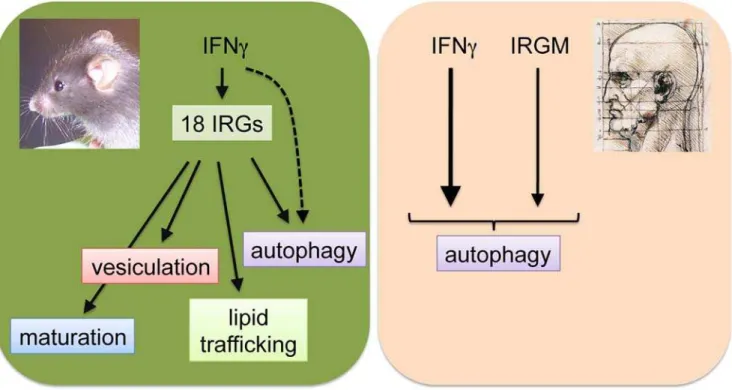
from its mouse orthologs [6]. Therefore, it was surprising that both human IRGM and mouse Irgm1 were reported to play a role in the induction of autophagy, a multi-purpose cellular process with antimicrobial activity [15,16,17]. Notwithstanding some potential overlap in function, mouse IRGs but not human IRGM have been implicat-ed in several additional antimicrobial activities other than autophagy, namely accelerated maturation of phagosomes, disintegration of pathogen-containing vac-uoles through vesiculation of vacuolar membranes, and the modification of lipid trafficking (Figure 1) [13,18,19,20]. Though a more careful analysis of the molecular activities of human IRGM will be required to draw any definitive conclu-sions, it seems as if the human IRG system has been stripped of most effector functions found in mice, with the exception of a regulatory role in autophagy. Whether any of these additional IRG-driven antimicro-bial activities that exist in mice are lacking in human cells is currently not known. It may very well be that the immune functions embodied by IRGs in mice have been preserved in humans but are executed by a different set of molecules, a principle that is exemplified by the convergent evolution of
Figure 1. The Mouse and Human IRG Resistance Systems Are Distinct.In mouse cells as many as 18 IRGs are being induced upon IFNc stimulation and mediate several antimicrobial activities, including the vesiculation of pathogen-containing vacuoles and accelerated maturation of phagosomes. Overexpression of mouse Irgm1 has also been shown to induce autophagy in macrophage-like RAW 264.7 cells [15], but so far no defect in autophagy in Irgm1 knockout macrophages has been reported. IFNcis likely to induce autophagy also in an IRG-independent manner. In contrast to mouse IRGs, human IRGM is not IFNc-inducible. IRGM has been shown to play a regulatory role in the execution of antimicrobial autophagy, but has not been associated with additional antimicrobial activities.
NK inhibitory receptors in mice and humans [21]. In this context, it is worth mentioning that some of the most strongly induced proteins in IFNc-activated cells
belong to another GTPase family, the p65 guanylate binding proteins (GBPs), which are highly conserved between mice and humans [22]. Remarkably, it has recently been shown that GBPs like IRGs localize to the parasitophorous vacuolar membrane surrounding the protozoal pathogen Toxo-plasma gondii[23]. Although the importance of this observation is presently unclear, it is suggestive of GBPs exerting immune effec-tor functions that may be related to the activities that have been described for IRG proteins.
IFNc-Induced Resistance
towards
Chlamydia trachomatis
Requires IDO-Dependent Tryptophan Depletion in Human Cells but IRG Responses in Mouse Cells
Strong support for the hypothesis that human IRGM exerts limited antimicrobial responses compared to the murine IRG system came from studies of the host response to the human intracellular bac-terial pathogen C. trachomatis. In human cells, IFNc-activated resistance to C. trachomatis depends predominantly on IDO-mediated tryptophan depletion [24,25]. Supplementing growth media with tryptophan, thus specifically neutral-izing the effect of IDO, completely reverses the growth inhibitory effect of IFNconC. trachomatisin most human cell
lines in spite of detectable IRGM expres-sion [6,24]. Based on the assumption that IDO and IRGM act in distinct pathways, these results strongly suggest that IRGM does not exert IFNc-dependent antimicro-bial effects towardsC. trachomatisin human cells. However, direct functional studies are required to decisively determine the role of IRGM in resistance toC. trachomatis
infections in human cells. In contrast to human cells, most mouse cells do not induce IDO expression upon IFNc
stim-ulation [24,26,27], and IDO-deficient mice display wild-type resistance to C. trachomatis infections [20]. Instead, mice require at least three IRG genes, Irgb10,
Irgm1, and Irgm3, for resistance to C. trachomatis infections both in vivo and in IFNc-stimulated cells in vitro [28,29].
Collectively, these studies show that the IRG system is essential for the innate immune response toC. trachomatisin mice, whereas IRGM appears to play no role in IFNc-induced cell-autonomous resistance
toC. trachomatisinfections in many, if not all, human cells.
Host-Adapted
Chlamydia
StrainsEvade the IFNcResponse
Specific to Their Respective Hosts
Because of the disparate effector func-tions of the human and mouse IFNc
response, it is expected that host-adapted pathogens for these two species should be equally divergent in their immune evasion strategies. In support of this hypothesis, we were recently able to show that the mouse-adapted strainChlamydia muridarum, but not its close relative C. trachomatis, can specif-ically evade IRG-mediated host resistance by blocking access of IRG proteins to the
Chlamydia-surrounding vacuolar mem-brane, the inclusion membrane [29]. On the other hand, and complementary to these results,C. trachomatisstrains isolated from the human urogenital tract, but not
C. muridarum, express tryptophan synthase, an enzyme capable of using exogenous indole for the synthesis of tryptophan [30,31]. The ability of C. trachomatis to use indole (probably generated by the local microbial flora of the genital tract) pro-videsC. trachomatiswith a lifeline to endure IDO-mediated tryptophan starvation, and this is potentially a key element in the establishment of persistent infections in humans [30]. The divergent counterim-mune mechanisms employed by the hu-man pathogen C. trachomatis and the mouse-adapted pathogen C. muridarum
clearly reflect the differences in the IFNc
responses of their respective hosts, a paradigm we expect to see recapitulated in other host–pathogen interactions.
Do Other Mouse-Adapted Pathogens Counteract the IRG Response?
IRG genes are found throughout the vertebrate subphylum, but their represen-tation is erratic: for instance, the genomes of zebrafish, rats, and dogs harbor IRGs, whereas the chicken genome is so far devoid of IRG genes [6]. We postulate here that pathogens adapted to IRG-deficient hosts (e.g., humans) are highly vulnerable to the antimicrobial effects of IRGs because these pathogens have not been under evolutionary pressure to ac-quire immune evasion strategies targeting IRG responses. Accordingly, the recent observation that the zoonotic pathogen
Chlamydia psittaci is highly susceptible to IRG responses in mice [32] makes perfect sense given that birds, the natural host of
C. psittaci, probably lack IRG genes [6]. Additionally, we postulate that intracellu-lar vacuointracellu-lar pathogens adapted to IRG-expressing hosts (e.g., mice) have evolved mechanisms to resist the IRG responses of their hosts, as demonstrated for C. mur-idarum. At a first glance this proposition seems to be in conflict with published work onT. gondii, a natural protozoal pathogen of mice, which has been shown to be susceptible to the IRG resistance system [12,13,14,18]. However, in all of these studies a naturally occurring avirulent type II strain ofT. gondiiwas used, while it has been recently shown that a virulent type I strain possesses an anti-IRG evasion strategy [33,34]. Why does such an avirulent T. gondii strain exist? It seems likely on general grounds that IRG immune evasion by virulent Toxoplasma
strains could decrease fitness of the pathogen because the IRG resistance system rescues the mouse from early mortality but does not prevent avirulent strains from establishing a chronic infec-tion. In contrast, type I strains cause early death in mice in spite of a functional IRG system, thus reducing the likelihood of successful transmission of Toxoplasmato a new host. Since Toxoplasma is also a remarkably promiscuous pathogen, infect-ing many different intermediate hosts that are prey to cats, it should also be considered that not all its polymorphic variants are necessarily adaptations to successful colonization of mice. Neverthe-less, it is clear that the IRG resistance mechanism is an important part of the co-adaptation between mice andToxoplasma. In contrast, IRG-mediated effects play no part in human resistance to Toxoplasma, while resistance via tryptophan depletion caused by IFN-induced IDO has been well documented (reviewed in [35]). Indeed, the striking virulence difference between
Genetically Engineered Mice as Models to Study Human Infectious Disease
The host specificity of a pathogen arises from continued selection over thousands or millions of years for adaptation to the ecological niche provided by the host species. When a pathogen is introduced into a non-typical host (i.e., a host the pathogen has not co-evolved with), the acquired molecular fine-tuning is lacking. Consequently, the outcome of an encoun-ter between a pathogen and a non-typical host differs in several aspects from the characteristics of an infection of a typical or natural host. Many combinations of host species with co-evolved pathogens lead to chronic infections with low path-ogen load and inefficient establishment of immunity. In contrast, experimental infec-tions of non-typical hosts often result in acute pathogenicity to the host, followed by complete clearance of the infection and rapid development of effective immunity
after a single exposure [37]. Given the striking differences between human infec-tions and the phenotypes displayed by mice exposed to the same human-adapted pathogens, it often becomes problematic to translate knowledge obtained in mouse studies to human diseases. Better animal models may provide a solution to this conundrum. Because chimpanzees are evolutionarily more closely related to humans, they are susceptible to many human pathogens and often display symp-toms similar to those seen during infection of humans. Nonetheless, genetic differenc-es still exist between humans and chim-panzees that affect host–pathogen interac-tions [4,38,39,40,41]. More importantly, there are ethical considerations as well as practical disadvantages inherent in pri-mate models (e.g., high costs), which argue against the widespread use of these animal models in infectious disease research. Mouse models that more closely resemble human disease could serve as an alterna-tive, though the establishment of such
models will be difficult. Indeed, the construction of a Mus homunculus for research in immunobiology may appear to be a Sysiphean task: each barrier broken will reveal the next. Moreover, for every pathogen a different set of obstacles will have to be tackled. However, it may not be necessary to mimic faithfully every aspect of the human system in a mouse model as long as some features have been humanized that are relevant to the scientific question being asked. For instance, replacing the IRG-mediated resistance system with the IDO-mediated resistance system in urogenital epithelial cells using a gene-targeted mouse model should enable us to study the role of IFNc -induced tryptophan depletion in the establishment of persistent C. trachomatis
genital infections. Though the creation of humanized mouse models for infectious disease will require substantial effort and resources, the long-term benefits of these new models would undoubtedly be enor-mous.
References
1. Brown NF, Wickham ME, Coombes BK, Finlay BB (2006) Crossing the line: selection and evolution of virulence traits. PLoS Pathog 2: e42. doi:10.1371/journal.ppat.0020042. 2. Cossart P, Pizarro-Cerda J, Lecuit M (2003)
Invasion of mammalian cells by Listeria mono-cytogenes: functional mimicry to subvert cellular functions. Trends Cell Biol 13: 23–31. 3. Lecuit M, Vandormael-Pournin S, Lefort J,
Huerre M, Gounon P, et al. (2001) A transgenic model for listeriosis: role of internalin in crossing the intestinal barrier. Science 292: 1722–1725. 4. Ngampasutadol J, Ram S, Blom AM, Jarva H,
Jerse AE, et al. (2005) Human C4b-binding protein selectively interacts with Neisseria gonor-rhoeae and results in species-specific infection. Proc Natl Acad Sci U S A 102: 17142–17147. 5. Ngampasutadol J, Ram S, Gulati S, Agarwal S,
Li C, et al. (2008) Human factor H interacts selectively with Neisseria gonorrhoeae and results in species-specific complement evasion. J Immunol 180: 3426–3435.
6. Bekpen C, Hunn JP, Rohde C, Parvanova I, Guethlein L, et al. (2005) The interferon-induc-ible p47 (IRG) GTPases in vertebrates: loss of the cell autonomous resistance mechanism in the human lineage. Genome Biol 6: R92. 7. MacMicking JD (2004) IFN-inducible GTPases
and immunity to intracellular pathogens. Trends Immunol 25: 601–609.
8. Martens S, Howard J (2006) The interferon-inducible GTPases. Annu Rev Cell Dev Biol 22: 559–589.
9. Taylor GA (2007) IRG proteins: key mediators of interferon-regulated host resistance to intracellu-lar pathogens. Cell Microbiol 9: 1099–1107. 10. Boehm U, Klamp T, Groot M, Howard JC
(1997) Cellular responses to interferon-gamma. Annu Rev Immunol 15: 749–795.
11. Schroder K, Hertzog PJ, Ravasi T, Hume DA (2004) Interferon-gamma: an overview of signals, mechanisms and functions. J Leukoc Biol 75: 163–189.
12. Collazo CM, Yap GS, Sempowski GD, Lusby KC, Tessarollo L, et al. (2001) Inactivation of LRG-47 and IRG-47 reveals a family of interferon gamma-inducible genes with essential,
pathogen-specific roles in resistance to infection. J Exp Med 194: 181–188.
13. Martens S, Parvanova I, Zerrahn J, Griffiths G, Schell G, et al. (2005) Disruption of Toxoplasma gondii parasitophorous vacuoles by the mouse p47-resistance GTPases. PLoS Pathog 1: e24. doi:10.1371/journal.ppat.0010024.
14. Taylor GA, Collazo CM, Yap GS, Nguyen K, Gregorio TA, et al. (2000) Pathogen-specific loss of host resistance in mice lacking the IFN-gamma-inducible gene IGTP. Proc Natl Acad Sci U S A 97: 751–755.
15. Gutierrez MG, Master SS, Singh SB, Taylor GA, Colombo MI, et al. (2004) Autophagy is a defense mechanism inhibiting BCG and Mycobacterium tuberculosis survival in infected macrophages. Cell 119: 753–766.
16. Singh SB, Davis AS, Taylor GA, Deretic V (2006) Human IRGM induces autophagy to eliminate intracellular mycobacteria. Science 313: 1438–1441. 17. McCarroll SA, Huett A, Kuballa P, Chilewski SD, Landry A, et al. (2008) Deletion polymorphism upstream of IRGM associated with altered IRGM expression and Crohn’s disease. Nat Genet. 18. Ling YM, Shaw MH, Ayala C, Coppens I,
Taylor GA, et al. (2006) Vacuolar and plasma membrane stripping and autophagic elimination of Toxoplasma gondii in primed effector macro-phages. J Exp Med 203: 2063–2071.
19. MacMicking JD, Taylor GA, McKinney JD (2003) Immune control of tuberculosis by IFN-gamma-inducible LRG-47. Science 302: 654–659. 20. Nelson DE, Virok DP, Wood H, Roshick C,
Johnson RM, et al. (2005) Chlamydial IFN-gamma immune evasion is linked to host infection tropism. Proc Natl Acad Sci U S A 102: 10658–10663.
21. Barten R, Torkar M, Haude A, Trowsdale J, Wilson MJ (2001) Divergent and convergent evolution of NK-cell receptors. Trends Immunol 22: 52–57.
22. Shenoy AR, Kim BH, Choi HP, Matsuzawa T, Tiwari S, et al. (2007) Emerging themes in IFN-gamma-induced macrophage immunity by the p47 and p65 GTPase families. Immunobiology 212: 771–784.
23. Degrandi D, Konermann C, Beuter-Gunia C, Kresse A, Wurthner J, et al. (2007) Extensive
characterization of IFN-induced GTPases mGBP1 to mGBP10 involved in host defense. J Immunol 179: 7729–7740.
24. Roshick C, Wood H, Caldwell HD, McClarty G (2006) Comparison of gamma interferon-mediat-ed antichlamydial defense mechanisms in human and mouse cells. Infect Immun 74: 225–238. 25. Thomas SM, Garrity LF, Brandt CR, Schobert CS,
Feng GS, et al. (1993) IFN-gamma-mediated anti-microbial response. Indoleamine 2,3-dioxygenase-deficient mutant host cells no longer inhibit intracel-lular Chlamydia spp. or Toxoplasma growth. J Immunol 150: 5529–5534.
26. Habara-Ohkubo A, Takikawa O, Yoshida R (1991) Cloning and expression of a cDNA encoding mouse indoleamine 2,3-dioxygenase. Gene 105: 221–227.
27. Murray HW, Szuro-Sudol A, Wellner D, Oca MJ, Granger AM, et al. (1989) Role of tryptophan degradation in respiratory burst-independent anti-microbial activity of gamma interferon-stimulated human macrophages. Infect Immun 57: 845–849. 28. Bernstein-Hanley I, Coers J, Balsara ZR, Taylor GA, Starnbach MN, et al. (2006) The p47 GTPases Igtp and Irgb10 map to the Chlamydia trachomatis susceptibility locus Ctrq-3 and mediate cellular resistance in mice. Proc Natl Acad Sci U S A 103: 14092–14097. 29. Coers J, Bernstein-Hanley I, Grotsky D,
Parvanova I, Howard JC, et al. (2008) Chlamydia muridarum evades growth restriction by the IFN-gamma-inducible host resistance factor Irgb10. J Immunol 180: 6237–6245.
30. Caldwell HD, Wood H, Crane D, Bailey R, Jones RB, et al. (2003) Polymorphisms in Chlamydia trachomatis tryptophan synthase genes differentiate between genital and ocular isolates. J Clin Invest 111: 1757–1769. 31. Read TD, Brunham RC, Shen C, Gill SR,
Heidelberg JF, et al. (2000) Genome sequences of Chlamydia trachomatis MoPn and Chlamydia pneumoniae AR39. Nucleic Acids Res 28: 1397–1406.
33. Zhao Y, Ferguson DJ, Wilson DC, Howard JC, Sibley LD, et al. (2009) Virulent Toxoplasma gondii evade immunity-related GTPase-mediated parasite vacuole disruption within primed mac-rophages. J Immunol 182: 3775–3781. 34. Zhao YO, Khaminets A, Hunn JP, Howard JC
(2009) Disruption of the Toxoplasma gondii parasitophorous vacuole by IFNgamma-inducible immunity-related GTPases (IRG proteins) trig-gers necrotic cell death. PLoS Pathog 5: e1000288. doi:10.1371/journal.ppat.1000288. 35. Konen-Waisman S, Howard JC (2007)
Cell-autonomous immunity to Toxoplasma gondii in mouse and man. Microbes Infect 9: 1652–1661.
36. Ajzenberg D, Cogne N, Paris L, Bessieres MH, Thulliez P, et al. (2002) Genotype of 86 Toxoplasma gondii isolates associated with hu-man congenital toxoplasmosis, and correlation with clinical findings. J Infect Dis 186: 684–689. 37. Druilhe P, Hagan P, Rook GA (2002) The importance of models of infection in the study of disease resistance. Trends Microbiol 10: S38–46.
38. Bogerd HP, Doehle BP, Wiegand HL, Cullen BR (2004) A single amino acid difference in the host APOBEC3G protein controls the primate species specificity of HIV type 1 virion infectivity factor. Proc Natl Acad Sci U S A 101: 3770–3774.
39. Kaiser SM, Malik HS, Emerman M (2007) Restriction of an extinct retrovirus by the human TRIM5alpha antiviral protein. Science 316: 1756–1758.
40. Martin MJ, Rayner JC, Gagneux P, Barnwell JW, Varki A (2005) Evolution of human-chimpanzee differences in malaria susceptibility: relationship to human genetic loss of N-glycolylneuraminic acid. Proc Natl Acad Sci U S A 102: 12819–12824. 41. Schrofelbauer B, Chen D, Landau NR (2004) A