Processing and Application of Ceramics 10 [4] (2016) 295–298 DOI: 10.2298/PAC1604295A
Short communication
Mechanical properties of ultra-high pressure sintered sphene
(CaTiSiO
5)
Eranezhuth Wasan Awin
1, Branko Matovi´c
2, Jelena Maletaški´c
2, Vladimir Urbanovich
3,
Ravi Kumar
1,∗1Materials Processing Section, Department of Metallurgical and Materials Engineering, Indian Institute of
Technology-Madras (IIT Madras), Chennai 600036, India
2Institute of Nuclear Sciences Vinca, Department of Materials Sciences, University of Belgrade, Serbia 3Scientific-Practical and Materials Research Center, NAS of Belarus, 19 P. Brovka Street, 220072 Minsk,
Belarus
Received 6 June 2016; Received in revised form 1 October 2016; Accepted 8 November 2016
Abstract
The investigation of nano-mechanical properties of sphene sintered under ultra-high pressures in the order of 4 GPa is done using indentation techniques. An indentation hardness of 6.6 GPa and reduced elastic modulus of 112.3 GPa is reported at maximum load of 7 mN. The material exhibits a high elastic recovery (∼59.1%) and the nature of deformation mechanism has been comprehended from the plastic work ratio. In addition, the fracture toughness of the material is also evaluated using indentation crack length method.
Keywords: mechanical properties, indentation, hardness, sintering
I. Introduction
Sphene (CaTiSiO5), a complex orthosilicate mineral, finds its use predominantly in radioactive waste immo-bilization [1]. The leaching studies performed on glass ceramic based CaSiTiO5 in an underground vault envi-ronment at the depth of 500–1000 m illustrated the ex-cellent durability of this material under these conditions [2]. Apart from being considered as a host material for radioactive nuclear waste, the material also finds use in the field of biomedical engineering. Earlier studies done to improve the osseointegration of Ti-6Al-4V with coat-ings such as hydroxyapatite (HAP) and calcium silicate (CaSiO3) have met with limited success due to their re-duced integration into the bone. The limitations of these coatings include slow rate of osseointegration and poor mechanical affixation. In recent years, coating of sphene on Ti-6Al-4V seems to have shown immense poten-tial with respect to chemical stability in addition to ad-hesion strength due to their similar thermal expansion
∗Corresponding author: tel:+91 44 2257 4777,
fax:+91 44 2257 4777, e-mail:[email protected]
coefficients in contrast to HAP and CaSiO3 coatings [3]. Research involving sphene/titania coatings started a decade ago and in one of the recent findings it was exemplified that the heat-treated sphene/titania coatings exhibited enhanced mechanical and corrosion resistance [4]. Recently, Pantic et al.[5] performed the synthesis and characterization of sphene sintered under the high pressure (4 GPa) and temperature (1200 °C). The sam-ple sintered at 1200 °C and at pressures in the order of 4.0 GPa showed the highest density. The microstructural characterization of the material revealed highly dense structure with no porosity. The Rietveld refinement and spectroscopic studies indicated structural phase transi-tion fromP21/atoA2/a. The investigation, however, was limited to structural characterization.
In this study, the mechanical stability of sphene sin-tered by means of high pressure synthesis (HPS) process was investigated via indentation studies. The properties such as hardness, elastic modulus, plastic work ratio as well as the fracture toughness were determined. To the best of our knowledge, these results have not been re-ported for HPS sphene elsewhere.
E.W. Awin et al./Processing and Application of Ceramics 10 [4] (2016) 295–298
Figure 1. Representative load-displacement curves (inset: SPM image of an indent; image size: 5×5µm) (a) and reduced elastic modulus with respect to load (b)
II. Experimental
Samples sintered at temperature of 1200 °C and under pressures of 4.0±0.2 GPa using a Bridgman high pres-sure apparatus were considered for investigation. The processing details on the high pressure synthesis (HPS) of the material can be found elsewhere [5].
Nanoindentation was performed using a Berkovich indenter and the loads were varied between 1 to 7 mN. The loading, holding and unloading time was set to 10 seconds for all the experiments. The area function cali-bration (25 indents) was done on standard fused quartz silica. The Oliver-Pharr method was used to calculate the hardness (H) and reduced elastic modulus (Er) from an average value of 10 indents [6]. The scanning probe microscope was used to capture the indent images. The fracture toughness (KIC) calculation was based on the formulation of Anstis [7].
III. Results and discussion
Figure 1a shows representative curves of displace-ment as a function of load as obtained from the nanoin-dentation experiments with a maximum penetration depth of∼200 nm at 7 mN. TheHandErwere derived from the following equations:
H= Pmax
A (1)
where,Pmax is the maximum load applied andAis the area function of the indenter.
The Er can be related to the sample elastic modulus via:
1 Er
= 1−υ
2
E +
1−υ2
i Ei
(2)
where, E and Ei are the elastic moduli of the sample and diamond Berkovich indenter respectively andυand
υi are their respective Poisson’s ratio. Ei,υ andυi are taken as 1140 GPa, 0.07 and 0.25 respectively. TheKIC
was calculated using Anstis equation (3):
KIC =0.016
E
r H
0.5 P
c1.5
(3)
where,Pis the load applied in the Vickers hardness test (3 kg) andcis the radius of the critical crack.
The variation ofHandErwith respect to indentation load is exemplified in Fig. 1b. The load had negligible effect on the nanohardness (H) values whereas the elas-tic modulus (Er) increased moderately with increase in load. At a peak load of 7 mN, the material displayedH andEof 6.6 and 112.3 GPa, respectively. It was interest-ing to observe that the deviation in hardness was mini-mal (well within the standard deviation) with increase in load from 1 mN to 7 mN. The mechanical properties de-termined on sphene/titania composite coatings revealed the H and E to be ∼5 and 100 GPa, respectively and have been attributed to the increase in H and E due to the formation of titania and sphene [4]. Recently, it has also been reported that high pressure/temperature compaction leads to porosity reduction by particle re-arrangement [5]. The enhancement in hardness in the present work could be attributed to the highly dense compact obtained after HPS process.
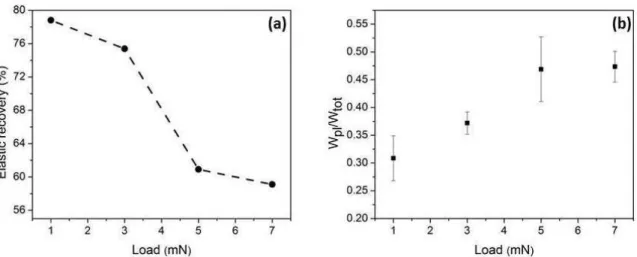
The elastic recovery (amount of energy released by the material after loading) and plasticity index (γ =
Wpl/Wt, where Wpl and Wt are the work done during the plastic deformation and the total work done, respec-tively) are two important parameters which can be deter-mined from the nanoindentation curves. The mechanical properties of biomaterials can be characterized using the above mentioned parameters which relate to the elastic and plastic energies associated with the nanoindentation [8]. The elastic recovery (R) is given by the equation (4) [9]:
R= hmax−hf
hmax
(4)
Upon the analysis of the unloading curve, the change inRwith indentation load was plotted in Fig. 2a and the
E.W. Awin et al./Processing and Application of Ceramics 10 [4] (2016) 295–298
Figure 2. Evolution of elastic recovery (a) and plastic work ratio (b) with indentation load
material showed a highRof∼59.1%. The quantitative analysis reported by Panticet al.[10] clearly accounts for 93.3% of sphene, 2.9% of perovskite and 3.8% of coesite for the samples sintered at 1200 °C. The high percentage of sphene as quantified by Reitveld refine-ment could be accounted for the high elastic recovery. The total work (Wt = We+Wpl) and the elastic work (We) done were calculated by accounting the area un-der the loading and unloading curve respectively. The plastic work done can be eventually deduced from the above equations. Greenwood and Williamson have pro-posed [11] a model in which it is indicated that ifγ >1, the material is predominantly plastic whereas ifγ <0.6, the material is said to deform elastically. The plastic work ratio values obtained in this case (Fig. 2b) suggest that plastic deformation has not been activated even at the maximum load. However at lower loads, the plastic work ratio decreased considerably (0.47–0.31) suggest-ing the deformation is purely elastic. The materials with high plasticity index are believed to endure high friction which ultimately leads to wear of the components in the long run [12]. Hence the material under investigation could be considered as a suitable replacement from a mechanical perspective for bone implants since the im-plants are not subjected to noticeable plastic strains.
The HPS sample exhibited a relatively high KIC value of 1.9±0.2 MPa·m1/2 in contrast to their coun-terparts such as HAP (1 MPa·m1/2) and CaSiO3 (0.5± 0.2 MPa·m1/2) indicating a possible potential use in biomedical applications [13,14]. Apart from this, the materials with highH/Eare said to possess high wear resistance [15] and the HPS sphene with aH/Eratio of around 0.059 is believed to be more wear resistant in contrast to the single crystal HAP (H=7 GPa andEr= 143.9 GPa) [16].
IV. Conclusions
The mechanical properties of high pressure com-pacted sphene were determined using nanoindentation. The material exhibited high hardness, high elastic
re-covery and lower elastic modulus which are character-istic features of materials considered for biomedical ap-plications. The plastic ratio was found to be less than 0.5 suggesting that the material deformed elastically at the maximum load. The fracture toughness value seems promising and material could be an effective replace-ment for the existing bioactive implant materials.
References
1. P.J. Hayward, E.V. Cecchetto, “Development of sphene-based glass ceramics tailored for Canadian waste disposal conditions”, pp. 91–97 inThe Scien-tific Basis for Nuclear Waste Management, Ed. S.J. Topp, Elsevier, New York, USA, 1992.
2. P.J. Hayward, F.E. Doern, E.V. Cecchetto, S.L. Mitchell, “Leaching studies of natural and synthetic titanite. A potential host for wastes from the repro-cessing of Canadian nuclear fuel”,Can. Mineral.,21 (1983) 611–623.
3. C. Wu, Y. Ramaswamy, A. Soeparto, H. Zreiqat, “Incorporation of titanium into calcium silicate im-proved their chemical stability and biological pro-perties”,J. Biomed. Mater. Res. A, 86(2008) 402– 410.
4. S. Cheng, W. Daqing, Z.Yu, “Mechanical and cor-rosion resistance of hydrophilic sphene/titania com-posite coatings on titanium and deposition and re-lease of cefazolin sodium/chitosan films”,Appl. Surf. Sci.,257(2011) 2657–2664.
5. J. Pantic, V. Urbanovich, V. Poharo-Logar, B. Jo-kic, M. Stojmenovic, A. Kremenovic, B. Matovic, “Synthesis and characterization of high-pressure and high temperature sphene (CaTiSiO5)”,Phys. Chem. Miner.,41(2014) 775–782.
6. W.C. Oliver, G.M. Pharr, “An improved technique for determining hardness and elastic modulus using load and displacement sensing indentation experi-ments”,J. Mater. Res.,7(1992) 1564–1584.
7. G.R. Anstis, P. Chantikul, B.R. Lawn, D.B. Mar-shall, “A critical evaluation of indentation techniques
E.W. Awin et al./Processing and Application of Ceramics 10 [4] (2016) 295–298
for measuring fracture toughness - I. Direct crack measurements”,J. Am. Ceram. Soc.,64(1981) 533– 538.
8. Y.V. Milman, “Plasticity characteristic obtained by indentation”,J. Phys. D. Appl. Phys.,41(2008) 1–9. 9. M.P. Johansson, H. Sjostrom, L. Hultman, “HREM and nanoindentation studies on BN:C films de-posited by reactive sputtering from a B4C target”, Vacuum,53(1999) 451–457.
10. J. Pantic, A. Kremenovic, A. Dosen, M. Prekajski, N. Stankovic, Z. Bascarevic, B. Matovic, “Influence of mechanical activation on sphene based ceramic ma-terial synthesis”,Ceram. Int.,39(2013) 483–488. 11. J.A. Greenwood, J.B.P. Williamson, “Contact of
nominally flat surfaces”,Proc. R. Soc. Lond. Series. A,295(1966) 300–319.
12. A. Nakajima, T. Mawatari, “Effects of surface topog-raphy and running-in upon rolling contact fatigue
life - Evaluation by plasticity index”,Tribol. Ser.,34 (1998) 291–299.
13. Y.-M. Kong, S. Kim, H.-E. Kim, I.-S, Lee, “Rein-forcement of hydroxyapatite bioceramic by addition of ZrO2 coated with Al2O3”,J. Am. Ceram. Soc.,82 (1999) 2963–2968.
14. Z. Songjue, W. Lianjun, J. Wan, Z. Jianfeng, C. Lidong, “Mechanical properties of CaSiO3/Ti3SiC2 composites and hydroxyapatite forming ability in simulated body”, Mater. Trans., 49 (2008) 2310– 2314.
15. A. Leyland, A. Matthews, “On the significance of the H/E ratio in wear control: a nanocomposite coating approach to optimised tribological behaviour”,Wear, 246(2000) 1–11.
16. S.S. Saeed, A.G. Karlis, “Micromechanical proper-ties of single crystal hydroxyapatite by nanoindenta-tion”,Acta. Biomater.,5(2009) 2206–2212.