Submitted13 September 2016 Accepted 17 January 2017 Published16 February 2017 Corresponding author Thomas Rattei,
Academic editor Todd Vision
Additional Information and Declarations can be found on page 20
DOI10.7717/peerj.2997
Copyright 2017 Zojer et al.
Distributed under
Creative Commons CC-BY 4.0
OPEN ACCESS
Variant profiling of evolving prokaryotic
populations
Markus Zojer1, Lisa N. Schuster2, Frederik Schulz3, Alexander Pfundner1, Matthias Horn2and Thomas Rattei1
1Department of Microbiology and Ecosystems Science, Division of Computational Systems Biology, University of Vienna, Vienna, Austria
2Department of Microbiology and Ecosystems Science, Division of Microbial Ecology, University of Vienna, Vienna, Austria
3DOE Joint Genome Institute, Lawrence Berkeley National Lab, Walnut Creek, CA, United States
ABSTRACT
Genomic heterogeneity of bacterial species is observed and studied in experimental evolution experiments and clinical diagnostics, and occurs as micro-diversity of natural habitats. The challenge for genome research is to accurately capture this heterogeneity with the currently used short sequencing reads. Recent advances in NGS technologies improved the speed and coverage and thus allowed for deep sequencing of bacterial populations. This facilitates the quantitative assessment of genomic heterogeneity, in-cluding low frequency alleles or haplotypes. However, false positive variant predictions due to sequencing errors and mapping artifacts of short reads need to be prevented. We therefore created VarCap, a workflow for the reliable prediction of different types of variants even at low frequencies. In order to predict SNPs, InDels and structural variations, we evaluated the sensitivity and accuracy of different software tools using synthetic read data. The results suggested that the best sensitivity could be reached by a union of different tools, however at the price of increased false positives. We identified possible reasons for false predictions and used this knowledge to improve the accuracy by post-filtering the predicted variants according to properties such as frequency, coverage, genomic environment/localization and co-localization with other variants. We observed that best precision was achieved by using an intersection of at least two tools per variant. This resulted in the reliable prediction of variants above a minimum relative abundance of 2%. VarCap is designed for being routinely used within experimental evolution experiments or for clinical diagnostics. The detected variants are reported as frequencies within a VCF file and as a graphical overview of the distribution of the different variant/allele/haplotype frequencies. The source code of VarCap is available athttps://github.com/ma2o/VarCap. In order to provide this workflow to a broad community, we implemeted VarCap on a Galaxy webserver, which is accessible athttp://galaxy.csb.univie.ac.at.
SubjectsBioinformatics, Computational Biology, Evolutionary Studies, Genomics, Microbiology
Keywords Experimental evolution, Variant calling, Microbial populations, Variant frequencies, SNPs, InDels, Structural variations, Galaxy, Next Generation Sequencing, Chlamydiae
INTRODUCTION
starting culture timepoint 1 timepoint n
generations
bottlenecks
S
u
b
p
o
p
u
la
ti
o
n
s
Figure 1 The dynamics of a bacterial population.Alternate alleles arise over successive generations. They encounter positive or negative selection and bottlenecks, which shape the diversity landscape of a population over time.
and dynamics under prevalent selective pressures. This approach is, for example, used in experimental evolution (EE) experiments (Barrick & Lenski, 2013) and studies of host— pathogen systems (Gardy et al., 2011;Bos et al., 2011;McElroy, Thomas & Luciani, 2014). Recent developments in Next-Generation-Sequencing (NGS) technologies allow for sequencing at high coverage within a short timeframe, however limited to short read length.
The classical approach of assembling genomes out of short DNA reads preferably recon-structs the most abundant genotype into genome contigs and scaffolds. In order to retrieve haplotype frequency information, reads need to be mapped onto the assembly or a reference genome. Variant calling is then performed on the alignment of the reads. The predicted variants can be phased into haplotypes or alleles if a whole haplotype reconstruction is not possible due to insufficient linkage of the variant sites. The variant prediction, however, can lead to false positives due to sequencing errors, such as InDels and substitutions. The reads may be misplaced during mapping due to their short length and thus can lead to false positive variant calls (Li, 2014). Sequencing errors can be partially reduced by quality filtering and error correction (Yang, Chockalingam & Aluru, 2013). As a consequence, the substitution error rate for Illumina could be decreased below one percent while InDel homopolymer errors showed to accumulate logarithmically with the length of the stretches
(Minoche, Dohm & Himmelbauer, 2011) and can thereby be reliably identified.
In evolving populations, we expect a heterogeneous mix of variant alleles (Fig. 1). Most of the genotyping studies of prokaryotes so far have been done by resequencing of clonal bac-terial cultures (Maharjan et al., 2013;Blount et al., 2012). The technique of deep sequencing of non-clonal populations, named Pool-seq, was mainly done for metagenomic profiling of communities (Qin et al., 2010) and only to a minor extend for the characterization of allele frequencies (Eyre et al., 2013;Khan et al., 2011;Köser et al., 2012;Pulido-Tamayo et
al., 2015). The genotyping of non-clonal variants in heterogeneous populations, however,
remains challenging (DePristo et al., 2011;Nielsen et al., 2011;Kofler & Schlötterer, 2014;
Pulido-Tamayo et al., 2015).
this is to integrate several variant calling software tools, which utilize different approaches for the detection of the different kinds of variants.
Commonly used tools to identify SNPs are SAMtools/bcftools and GATK (Li et al., 2009;
McKenna et al., 2010). These tools were developed with the assumption to detect variants
within diploid organisms, which limits their detection power for haploid prokaryotes. Therefore we also considered the more generic tool VarScan2 (Koboldt et al., 2012), which can predict SNP frequencies in low and high coverage data and some specialized tools for variant prediction within high coverage data, such as LoFreq-Star (Wilm et al., 2012), Breseq (Barrick et al., 2014) and FreeBayes (Garrison & Marth, 2012). Here we used Lofreq-Star, as a previously published evaluation showed it to be superior to Breseq in terms of sensitivity (Wilm et al., 2012). We also evaluated FreeBayes which is widely used in Pool-seq experiments for eukaryotes with known pool size but can also analyze a bacterial population with unknown pool size. The tools all work on read alignments or mpileup files and use read and mapping quality scores as well as strand bias filters to reliably detect SNPs. In addition SAMtools/bcftools and VarScan2 and FreeBayes can also be used to identify small InDels. Pindel (Ye et al., 2009) uses a pattern growth algorithm to detect small and large InDels from 1 bp up to 10 kb. Large InDels and structural variations (SV), such as translocations, duplications and inversions, are detected by Breakdancer and Delly (Chen et al., 2009a;
Rausch et al., 2012), as they make use of insert size deviations, paired end information and
split read information to find variations larger than 300 bp. As an alternative, Cortex_var
(Iqbal et al., 2012) does not rely on mapped reads but usesde novoassembled contigs,
which are compared to each other or to a reference in order to identify most kinds of variants. All those approaches have been designed for different degrees of zygosity, ranging from diploid genomes to multiploid populations with low abundant genotypes.
The genotyping of prokaryote populations in experimental evolution experiments is typically based on many NGS datasets with high coverage. There is therefore a demand for fully automated software for read mapping and variant calling, which is both sensitive and accurate, aware of low abundant subpopulations, and which considers all possible types of variants. To the best of our knowledge, no such software workflow has been published so far. In this study we have evaluated variant callers on synthetic data in order to determine and compare their sensitivity and accuracy. This allowed us to develop and validate VarCap, a workflow for accurate and sensitive genotyping of prokaryotic populations. Finally, we applied VarCap to a long-term experimental evolution experiment of a bacterial symbiont of amoebae.
METHODS
Creating synthetic variant genomes
typical properties as its genome size of 2.4 Mb is close to one of the main peaks in the bacte-rial and archaeal genome size distribution (Koonin & Wolf, 2008). For validation purposes, we additionally used 6 different organisms that we selected to represent the diversity of prokaryotic genomes regarding G+C contents and genome size.
Variant datasets were created by randomly inserting different types of variants into refer-ence genomes downloaded from the NCBI Refseq database (Pruitt et al., 2012) (Table S1). We used a SNP/InDel ratio of 10 for small InDels and 20 for all InDels, as SNP/InDel ratios for bacterial genomes were often reported between 15 and 20 (Moran, McLaughlin & Sorek,
2009;Chen et al., 2009b). We also included large InDels, because large insertions hereby
also mimic the process of horizontal gene transfer. As structural variations are reported to be crucial for bacterial genome evolution, we also added few translocation, duplication and inversion sites to challenge the detection software.
We created mixed types of datasets containing 135 variations, as well as datasets contain-ing one specific type of variant. The 135 variants of the mixed type dataset consisted of 100 SNPs, 10 small InDels, 10 large InDels and five translocations, five duplications (including one double duplication) and five inversions (Set: sim_135VAR,Table S1).
The 100 SNPs were placed as single SNPs and mutation hotspots. Therefore, the SNPs were positioned as single seeds, to which the other SNPs were randomly assigned with decreasing probability. The maximum number of SNPs within a hotspot was four, which were randomly placed within a distance of 4–60 bases. The size of the large InDels was randomly chosen between five and 2,000 nucleotides, while the size of translocations, duplications and inversions varied from 300 to 2,000 nucleotides. The datasets harboring only one type of variant contained either 100 SNPs, 100 small InDels, 100 large InDels, 50 translocations, 50 duplications or 50 inversions (Sets sim_100SNP, sim_100IndS, sim_100IndL, sim_50ITX, sim_50DUP, sim_50INV).
ALFSim is a genome evolution simulator and was used (Dalquen et al., 2012) to simulate the evolution of more distantly evolved subpopulations. Therefore, coding and intergenic nucleotide sequences according to the genome annotation were extracted from the genome reference fasta file. This extracted sequences served as input for ALFSim. From the ALFsim output, we selected a simulated subspecies having a nucleotide dissimilarity of 0.8% resulting in 21,000 SNPs, 100 InDels and three duplications. The resulting fasta file was used for read simulation, construction of a heterogeneous population and prediction of variants.
Sequencing read simulation
simulated reads from the original reference with simulated reads from the variant datasets. We created MAF of 40, 20, 10 and 4%.
Sequence read processing and mapping
The quality of the simulated reads was determined using FastQC (v0.10.0,Patel & Jain, 2012). The quality filtering and trimming of the simulated and the sequenced reads was done by Prinseq-lite (0.19.5,Schmieder & Edwards, 2011) and Trimmomatic (0.32,Bolger, Lohse & Usadel, 2014) and applied with the following settings: first a sliding window with size 10 removed any bases with lower quality than 20 starting from the 3′
side by cutting off the read part containing the low-quality bases. The sliding window approach has the advantage that low quality bases are also removed within the read and not only at the end (which is done, if read trimming is done only from the 3′
of 5′
end). We removed all reads shorter than 40 nt. To remove low quality reads, we discarded any read with an average Phred score below 30. Only read pairs were kept. These reads were mapped against the reference genome using bwa-mem (bwa-0.7.5a,Li, 2013;Li & Durbin, 2009) with standard settings and stored as bam files. For conversions from sam to bam files and from bam to fastq files (as Cortex_var input), we used SAMtools (0.1.18,Li et al., 2009) and Picard Tools (v1.92,
http://picard.sourceforge.net/).
Mapping artifacts
In order to emulate mismapped reads due to an incomplete reference genome, we mapped reads that were generated from an updated (newly assembled) reference genome back to the older and about 20 kB shorter version and to the current version. This dataset did not contain any simulated variants.
Variant calling
In order to assess true and false positive variant detection rates, artificial non-clonal populations containing SNPs, InDels and SV at abundances of 40%, 20%, 10% 5% and 2% were simulated. We used SAMtools/bcftools (0.1.18, Li et al., 2009), GATK-lite (Genome AnalysisTKLite-2.2-8, McKenna et al., 2010), VarScan2 (2.3.6, Koboldt
et al., 2012), LoFreq (0.6.1,Wilm et al., 2012) and LoFreq2 (lofreq-star 2.0.0 beta 1,
https://github.com/CSB5/lofreq). For the detection of small InDels we used VarScan2 and Pindel (024t,Ye et al., 2009). For large InDels and structural variations (SV) we used Pindel which is described to work well between on variations between 1 and 1,000 nt, breakdancer (breakdancer-1.1_2011_02_21,Chen et al., 2009a) and delly (0.0.11,Rausch et
al., 2012) (both start calling SV at 300 nt). Additionally, we used the assembler cortex_var
(CORTEX_release_v1.0.5.14,Iqbal et al., 2012), which can detect variations by comparing assembled contigs to a reference genome sequence. The sensitivity and precision of the combined workflow were calculated as: sensitivity =TP/(TP+FN), and precision= TP/(TP+FP). The TP, FP and FN are measured per variant, giving e.g., a SNP and a large deletion event the same weight.
Setting the minimum abundance for a variant
minimum absolute abundance (MAA). However, as read coverage slightly varies along the genome, we also used minimum relative abundance (MRA), which is the percentage of variant reads compared to the total coverage. So, a MAA of eight reads corresponds to a MRA of 2% at 400×total coverage.
Examining the similarity of repetitive regions
We used the edit distance in order to measure the similarity of repetitive regions. The edit distance measures the similarity of two sequences by counting the differences between them. This difference can be a substitution, insertion or deletion of a nucleotide. Therefore, an edit distance of one means that two sequences differ in either a substitution, insertion or deletion of a nucleotide.
Analysis of a long-term experimental evolution experiment
We applied the VarCap workflow to a long-term experimental evolution experiment in order to evaluate its performance on Illumina PE data. Two independent laboratory cultures of the amoeba symbiontProtochlamydia amoebophilawere subjected to NGS sequencing using the Illumina Genome Analyzer II platform (100 bp PE reads, 250 bp insert size, 3,000×coverage, 250 bp insert size) about nine years after its genome was initially sequenced by Sanger sequencing (Horn et al., 2004) (SRA:SRR5123091). For analysis, the obtained Illumina reads were randomly split into replicate read packages with 250-fold coverage each and utilized to detect variant sub-populations at different abundances.
PCR verification of variations
To verify the variations at positions 1339224, 1339720, and 1338568 in the genome ofP. amoebophilawe amplified the region 1338371-1339843 by PCR using the primers LS0003 5′
-AGCTGCATCATTTATCTTCTAG-3′
and LS0004 5′
-ATCAGTCCACCTACTATCATG-3′
. The obtained 1,472 bp fragment was cloned into the pCR4-TOPO vector (Invitrogen). Subsequently, 16 of the obtained colonies were picked, and the presence of variations in the cloned amplicons was checked. Clones were sequenced by Sanger sequencing with the primers T3 and T7. Similarly, 14 putative variations in a repetitive region between positions 1533689 and 1534636 were assessed using the primer pair LS0005 5′
-TCTCTAGCTCT TTCGCAAATTG-3′
and LS0006 5′
-CAGTGTTTAACTGGCTGAAAC-3′
.
A Galaxy instance of VarCap
RESULTS
Determination of methods capable of sensitive detection of low abundant variations
Evaluation strategy
At the moment, there is no software tool or method that could detect all different types of variants simultaneously which are relevant for prokaryotic genomes. Therefore, we separately evaluated variant detection tools for SNPs, InDels and structural variants (SV). Representative methods for these three targets were selected according to their underlying methodologies. In order to identify the variant calling tools that most sensitively and reliably detect low abundant variant, we initially utilized our most basic variation model (sim_135VAR). It incorporates examples of the typical and expected types of variations in microbial genomes, located in typical distances to each other. From these results, we constructed a preliminary software framework, which was used as basis for the further evaluations and improvements.
SNPs
Among the many available SNP calling software tools we have compared LoFreq-Star, Varscan2, GATK, SAMtools/bcftools, FreeBayes and Cortex_var. All of these tools, except Cortex_var, rely on the mapping of reads to a known reference. Cortex_var, instead,de novo assembles variant reads into contigs and thereby detects SNPs. SAMtools/bcftools and GATK were only designed for homozygous and heterozygous genomes (Yost et
al., 2013), whereas LoFreq-Star, Varscan2 and Cortex_var should be able to detect low
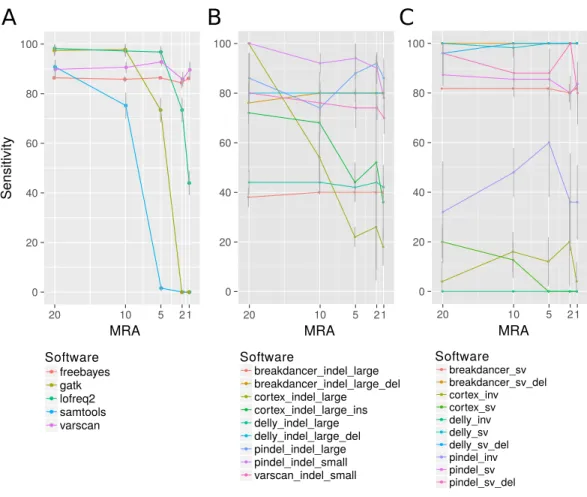
frequency variants from high coverage sequencing data. Variants were simulated at minor allele frequencies (MAF) of 40%, 20%, 10% and 4% and evaluated at minimum relative abundance (MRA) cutoffs of 20%, 10%, 5% and 2% accordingly. This means that ideally all variants present at and above those frequencies should be detected. At MRAs of 20% and 10%, variants were detected by all SNP calling software tools at a similar sensitivity (Fig. 2A). According to the expectations, the detection rate of GATK and SAMtools/bcftools was worse compared to the other programs when the MRA was reduced to 5%, 2% and 1% (Fig. 2A). At a low MRA of 1% LoFreq-Star shows less sensitivity than Varscan2. This is to be expected, as LoFreq-Star generates its own detection threshold based of coverage and quality to avoid FP and therefore detects no variants below that threshold (Fig. 2A). The price of the higher sensitivity of Varscan2 at MRA of 1%, however, comes at the price of elevated FP variant predictions. FreeBayes was able to detect variants at all MRAs with similar sensitivity (Fig. 2A). However, we observed FP at MRAs of 2% and 1% and therefore did not include this tool in further analysis.
InDels
● ● ● ● ● ● ● ● ● ● ● ● ● ● ● ● ● ● ● ● ● ● ● ● ● 100 80 60 40 20 0
20 10 5 2 1
MRA Sensitivity Software ● ● ● ● ● freebayes gatk lofreq2 samtools varscan Software ● ● ● ● ● ● ● ● ● ● ● ● ● ● ● ● ● ● ● ● ● ● ● ● ● ● ● ● ● ● ● ● ● ● ● ● ● ● ● ● ● ● ● ● ● ● ● ● ● ● ● ● ● ● breakdancer_indel_large breakdancer_indel_large_del cortex_indel_large cortex_indel_large_ins delly_indel_large delly_indel_large_del pindel_indel_large pindel_indel_small varscan_indel_small ● ● ● ● ● ● ● ● ● ● ● ● ● ● ● ● ● ● ● ● ● ● ● ● ● ● ● ● ● ● ● ● ● ● ● ●● ● ● ● ● ● ● ● ● ● ● ● ● ● ● ● ● ● ● ● ● ● ● ● breakdancer_sv breakdancer_sv_del cortex_inv cortex_sv delly_inv delly_sv delly_sv_del pindel_inv pindel_sv pindel_sv_del Software 100 80 60 40 20 0 100 80 60 40 20 0
20 10 5 2 1
MRA
20 10 5 2 1
MRA
A
B
C
Figure 2 Analysis of the detection rate of variants with regard to Minimum Relative Abundance (MRA), variant type and different variant calling software.It shows the detection rate of different SNP (A), InDels (small denotes small InDel, B) and SV callers (C) with respect to the MRA frequencies of 20, 10, 5, 2 and 1%. For Breakdancer, Pindel, Delly, and Cortex, two values are given: detection rate of all InDels and specific detection rate for deletion or insertion only.
positions of small and large InDels with base pair precision. Breakdancer and Delly are designed for the detection of InDels larger than 300 bp. They use paired end read infor-mation for InDel detection, therefore the position of the large InDels may not be reported at bp resolution. Cortex_var is expected to be less sensitive because of thede-novoassembly approach, however it can supply more information than the mapping approaches, including e.g., position, length and sequence of an insertion.
one of the only two tools that were able to detect large insertions. It detected one third of the large insertions and reported the inserted sequence, while Pindel detected the position of large insertions at a higher rate, but without revealing any details.
Structural variations (SV)
For the detection of SV, we used Pindel, Breakdancer and Delly, and we added Cortex_var specifically for inversion detection These programs differ slightly in their methodological approaches. We expected Delly to be superior to Breakdancer because of the additional split read alignment. Moreover, we expect a limitation of Pindel at larger rearrangements, because the pattern growth algorithm is used within defined limits (up to 10 kb). All tools should be able to detect inversions; however, they are reported as being harder to detect than other SVs. Breakdancer and Delly detected SV, like duplications and transpositions, regardless of the MRA with high sensitivity (>90%). As expected, the detection rate of Pindel
is lagging behind (80%) according to of the suggested internal limits of 10 kb. However, the pattern growth method of Pindel was more precise in terms of position and length of the SV as it always hit the exact starting position while Breakdancer and Delly can be off up to 70 bases (Fig. 2C). We additionally found that large InDels were called at the sites of translocations events (Fig. 2C). This is not entirely unexpected, as a translocation consists of an excision and the consecutive insertion of the excised genomic fragment. The excision can also be seen as a deletion of a fragment and is therefore a partial detection of a more complex type of variant.
Inversions, however, could only be detected at a minor fraction as break positions by Pindel (70% as break positions) and as inversion by Cortex_var (10%) (Fig. 2Cinv).
Selected software tools for VarCap
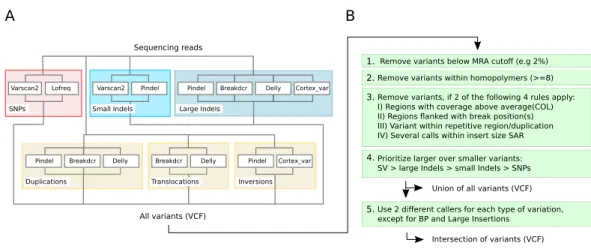
We use LoFreq-Star and Varscan2 for SNPs and Varscan2 and Pindel for small InDels for composing VarCap because they showed similar sensitivity although using different methodological approaches. For larger variants or SV, we observed that a combination of pattern growth, split read and paired end read information approaches, which are used by Pindel, results in high sensitivity. This method works well within defined limits (1–10 kb). By using only paired end information (Breakdancer), it is possible to detect larger variants at the cost of a lower length limit (300 bp) and a coarser resolution of the variant position. Cortex_var, however, was inferior in sensitivity but revealed more information about the detected variants by using ade-novoapproach. This information can be used to correctly identify the type, position, length or sequence of the variant. Therefore, we use Pindel, Breakdancer and Cortex_var for large InDels and Breakdancer, Delly, Pindel and Cortex_var for SV.
Sequencing reads
Varscan2 Lofreq
SNPs
Pindel Breakdcr
Large Indels
Varscan2 Pindel Delly Cortex_var
Pindel Breakdcr Delly Breakdcr Delly Pindel Cortex_var
Small Indels
All variants (VCF)
Duplications Translocations Inversions
Remove variants below MRA cuto! (e.g 2%)
Use 2 di!erent callers for each type of variation, except for BP and Large Insertions
Remove variants within homopolymers (>=8)
Remove variants, if 2 of the following 4 rules apply: I) Regions with coverage above average(COL) II) Regions "anked with break position(s) III) Variant within repetitive region/duplication IV) Several calls within insert size SAR
Prioritize larger over smaller variants: SV > large Indels > small Indels > SNPs
1.
5. 2. 3.
4.
Intersection of variants (VCF) Union of all variants (VCF)
A B
Figure 3 Detection capabilities of different tools at low frequencies.(A) shows the variant types that were successfully detected by the different software tools while (B) shows the post filtering steps to elim-inate false positives. The post filtering step generates 2 output files: one file includes the union of all vari-ants, while the other contains the intersection of variants (except break positions (BP) and large insertions, which are also reported as single calls).
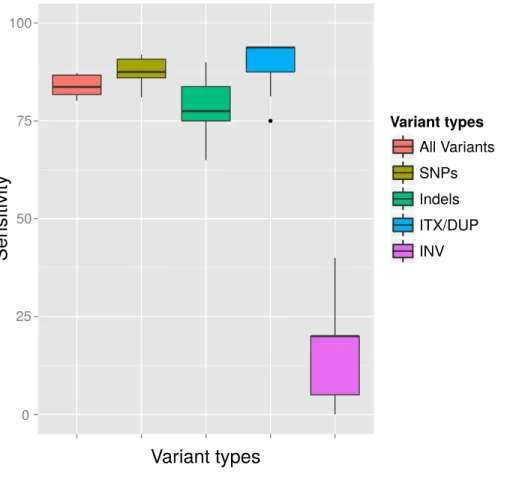
for SNP calling, as it showed low precision at MRAs of 2% and 1%. Taking together all selected software tools, we were able to detect all variants, except inversions, at a MRA of down to 2% with high sensitivity (Fig. 4).
VarCap—a variant calling workflow with high sensitivity and specificity
False positives due to sequencing errors
False positives occur due to sequencing errors, which are typically present at and below a rate of 1%, therefore we expect them to cause FP calls at and below this relative abundance. In order to study the influence of sequencing errors on different software detection tools, we analyzed seven differentially composed samples and focus on MRAs of 2% and 1% as this seems to be the critical boundary for FP prediction (mono_02-07). At a MRA of 2% we observed a false positive rate for SNPs, small InDels and Duplications of 0.5 to 1 FP per Megabase (Mb) (Fig. S2B: MRA 2). At a lower MRA of 1%, we observed an increase in FP (Table 1). At an MRA of 1%, we could nearly completely find all types of variants, except inversions, which we could identify at a rate of 95%. However, the false positive rate for SNPs increased to 80 FP per Mb, while the FP rate for other variants stayed below one FP per Mb (Figs. S2A,S2B: MRA 1). This clearly demonstrates that false positive SNPs are caused by sequencing errors, while the other types of variants stayed at the low rate (∼1FP/Mb).
In order to get more insights about the other FP, we examined them in detail at both MRAs. We found that FP of small InDels locate within repetitive regions of the genome. These regions are almost identical areas of the genome at a size that is longer than the insert size of the reads and have an edit distance of three or less. Due to their similarity, variant reads can be mapped to similar regions and cause FP calls there.
●
0 25 50
75
100
Variant types
Sensitivity
Variant types
All Variants
SNPs
Indels
ITX/DUP
INV
Figure 4 Average detection rates and standard deviation of all callers for variants simulated at a MAF of 4% and a MRA cutoff of 2%.The variant detection rates are shown in percent for all variants (ALL), only SNPs (SNP), only InDels (IND), duplications and translocations (ITX/DUP) and inversions (INV). The results show the expected sensitivity of VarCap, as we use a MRA of 2% as a default setting to avoid false positives.
Table 1 Detection sensitivity and precision of the combined workflow for a different number of callers and at different simulated minor allele frequencies (MAF) and minimum relative abundance (MRA) cutoffs.The table shows the numbers for the observed true positives (TP), false negatives (FN), false positives (FP), sensitivity and precision of the combined workflow at MRAs of 10, 5, 2 and 1% under the requirement that either one or two callers (Min Caller) had to confirm each variant.
20 10 139 2 0 0,986 1
10 5 137 4 0 0,972 1
4 2 138 3 0 0,979 1
1
4 1 141 0 1,238 1,000 0,102
20 10 135 6 0 0,957 1
10 5 133 8 0 0,943 1
4 2 133 8 0 0,943 1
2
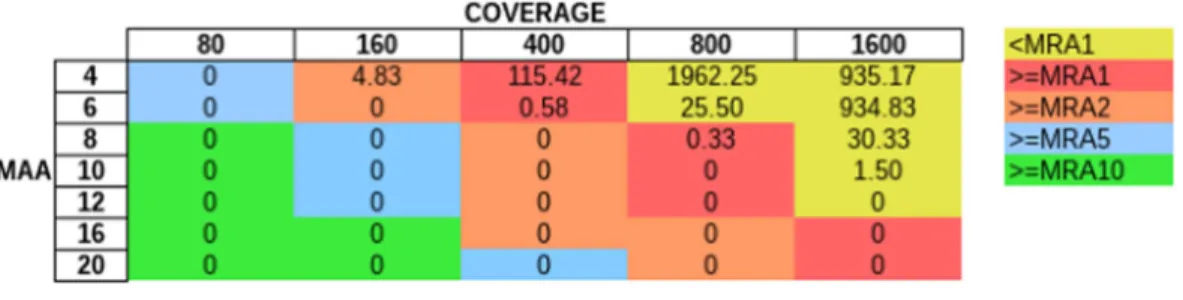
Figure 5 Influence of total coverage and MAA on FP rate.The table numbers show the FP per Megabase in context to coverage and MAA while the different colors indicate the corresponding MRA levels. We simulated MAFs of 20, 10, 4, 2 and 1% (using the sim_135VAR dataset) and detected at MAA cutoffs from four to 20 bases to support a variant.
coverage/MAA setting. we report the resulting calculated MRA. We report the FP rate as FP per Mb, as with this normalization step we are independent of the genome size. Otherwise a 4 Mb sized genome would produce twice as many FPs as a 2 Mb genome. We detected, that it is necessary to use an MAA cutoff in addition to an MRA cutoff to avoid FP calls at lower coverages (Fig. 5, see FP counts at MRA2 at coverage 160×).
FP due to mismapped reads
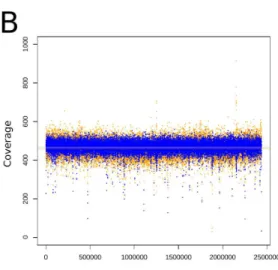
Mismapped reads have been reported as the cause of FP (Li, 2014). Therefore, incomplete reference genomes lead to reads getting mapped to similar regions and cause FP calls there. To review this finding at a MRA of 2%, we mapped reads without variants back onto an arti-ficially shortened reference genome. We observed∼180 FP SNPs/75 FP per Mb which were present at different abundances (20%, 8%, 3%) and grouped into hotspots (Fig. 6A). False positive variants were not observed when mapping the reads to the correct reference (Fig. 6B). This finding strongly supports our assumption that wrongly mapped reads cause FP variant calls. A closer investigation of the relevant regions revealed the presence of neighboring break positions, which may indicate both: either a larger structural variation or mismapped reads due to an incomplete reference genome.
To identify possible false positives due to mismapped reads, we implemented the follow-ing filterfollow-ing steps: As suggested in prior discussion of this topic (Li, 2014) we used the cover-age information at the variant sites to tag possible false positives. However, covercover-age infor-mation alone is too coarse for the resolution of low frequent FP. Therefore, we additionally monitor break positions that flank or reside at the variant positions to identify regions with mismapped reads. As all FP were present as small clusters or hotspots, we tagged regions that hosted more than 4 SNPs within a sliding window at the double length of the insert size and were accompanied by a break position (BP) as possible FP causing regions. With the application of these filters we could identify and exclude the FP calls (Fig. 6C).
Figure 6 Coverage plots of simulated and re-sequenced data.The simulated reads without variants were mapped back to an incomplete reference (A) and the complete reference (B). The blue circles denote the total coverage along the genome while the green diamonds show the coverage of the FP variants and the red circles the total coverage at the FP positions. As a comparison, we show the coverage distribution of sequenced reads against the complete reference in orange in the background of (B). The coverage peaks at 1,220,000 and 2,150,000 are due to additionally mapped mitochondrial reads. The light blue and orange lines show the average coverage distribution along the genome. A total of 149 of 154 of the FP from 6A could be tagged and filtered by the properties coverage (COV), within repetitive region (REP), within SNP accumulating region (SAR) and located close to a break position (BP) as shown in (C), the remaining five were single calls and thus eliminated by the constraint of two callers per variant.
Performance of combined post-processing and filtering in VarCap
We observed that a gain in variant calling sensitivity decreased the precision. Therefore, we added a post-filtering step to the workflow in order to eliminate possible FP. We incorpo-rated a post-processing step for each variant that aims to eliminate FP due to sequencing errors, repetitive regions, partially detected variants and mismapped reads due to reference incompleteness. As a consequence of the dissimilar variant detection rates of some methods, we decided to use more than one tool for each type of variant. In order to gain precision and robustness, for high confidence variants, we required an intersection of predictions per variant. Therefore, a variant call had to be supported by at least two different tools. This step further contributed to an improved precision at low MRA cutoffs (1%), while the detection rate was only slightly diminished (Table 1). This finding is backed up by a recent publication, which made a similar observation regarding the intersection of different tools (Kofler et al., 2016).
Genotyping of diverse synthetic prokaryotic populations
Detection rates in different genomes
Genomes exhibit different properties, such as G + C content and size, which could potentially affect the sensitivity and accuracy of variant calling. Therefore, we evaluated our variant calling workflow on six different genomes. These organisms consisted of five bacteria and one archaeon, with differing G+C content ranging from 26 to 72% as well as a differing genome size ranging from 0.68 to 8.66 Mb. The workflow was used with a MRA of 2% as well as at a MAA of eight reads supporting a variation. In concordance to our previous results we could detect most of the (simulated) variants (>90%). However, at a MRA of 2% we
could not observe any dependency on G+C content or genome size while the MAA of eight reads resulted in fewer variant detections at high G+C content and genome size (Fig. 7). This observation confirmed our previous observations to use a MRA as a general minimum cutoff for variant detection as it showed little influence to different genome properties. This, however, does not remove the need for a fixed MAA in case of low coverage regions.
Detection rates in a distantly evolved population
More distantly evolved populations may lead to a higher number of variants if they are under positive selection. This could affect the sensitivity of variant calling. Therefore, ALFSim (Dalquen et al., 2012) was used to simulate a more distantly evolved population by integrat-ing evolutionary changes (SNPs, InDels and duplications) into theP. amoebophilagenome. The evolved genome showed a similarity to the reference around 99%, as it contained around 21,000 SNPs, 100 InDels and three gene duplications.
26 32 35 50 65 72 80
84 88 92 96 100
MRA2 MAA8
GC content
S
e
n
s
it
iv
it
y
0.68 1.27 2.46 4.41 4.64 8.66
80 84 88 92 96 100
MRA2 MAA8
Genome size (Mb)
S
e
n
s
it
iv
it
y
A
B
Figure 7 Detection rate of variants in various genomes at minimum absolute and relative abundance.
The observed percentage of True Positives is shown for six organisms with differing GC content (A) and genome size (B). The total coverage is at 400×, the coverage of the subpopulation containing 135 variants is at 16×. No False Positives were observed at the MAA of eight and MRA of 2%.
0 25 50 75 100
SNP INDEL INDELS SV(DUP)
Types of Variants
Sensitivity
MRA
3
2
1
1 40 400
SNP INDEL INDELS SV(DUP)
Types of Variants
FP / Mb
MRA
3
2
1
1 40 200
SNP INDEL INDELS SV(DUP)
Types of Variants
FP / Mb
MRA
3
2
1
A
B
C
Figure 8 Observed detection rates of variants which were simulated using a genome evolution soft-ware (ALFSim) and detected at different minimum abundances.Simulated variants included SNPs, small InDels (INDELS), large InDels (INDEL) and structural variations (SV) as duplications (DUP). (A) shows the sensitivity at MRAs of 3%, 2% and 1%. (B) shows the False Positives for SNPs as counts per Megabase at the different MRAs. At these minimum abundances, no FP for InDels and SV were detected. (C) shows the FP per Megabase after filters have been applied. SNP, Single nucleotide polymorphism; IN-DEL, Large InDels; INDELS, Small Indels (<10nt); SV(DUP), Duplication.
Detecting variants in a real bacterial population after long term cultivation
Figure 9 Prevalence of variants within a long-term culture with respect to their MRAs.(A) shows the prevalence of variations at MRAs of 20%, 10%, 5% or 2%, which are visible in the four differently colored outer circles and the presence of repetitive regions within the reference genome (inner connective lines). (B) shows a more detailed view of the number of variations found at MRAs of 20%, 10%, 5% and 2%.
Table 2 Experimental validation of a subset of the predicted variations.Three variant positions at dif-ferent frequencies were amplified by PCR, cloned and Sanger sequenced for validation.
Position Frequency Clones total Clones supportive Sanger confirmed
1,338,568 28 16 6 Yes
1,339,720 11 16 2 Yes
1,339,224 4 16 1 Yes
DISCUSSION
Population genomics of microbes is most powerful if we meet the challenge of detecting all types of genomic variations even at low frequency. We therefore developed, evaluated and validated VarCap, a workflow that allowed us to reliably identify variants even within low abundant alleles.
Increasing sensitivity
We tested the capabilities of the relevant variant calling tools and observed substantial sensi-tivity differences between the different methods. In order to improve the overall sensisensi-tivity, we decided to integrate different tools for variant detection into a combined workflow, in which every variant can be detected by more than one caller.
Increasing precision
As more tools are likely to introduce more errors, we also optimized the overall precision. Detecting sequencing errors and mismapped reads was key to control the rate of false positives. When dealing with sequencing errors, we observed that for SNP detection a MRA cutoff of 2% was sufficient to keep a safety margin to false positives appearing at a MRA cutoff of 1%. Although we found, that a relative abundance cutoff (MRA) is superior to an absolute cutoff (MAA). We also observed that a MRA cutoff leads to FP if the read coverage is too low (<200×). Therefore, we also apply a fixed MAA cutoff of 8 reads to remove FP at low coverage positions. This implies, that for detecting a subpopulation present at a MAF of>2% we need a minimum sequencing coverage of 400×. Sequencing experiments should therefore aim for at least 500×to account for reads removed by quality filtering and fluctuations in coverage along the genome.
We could not detect any FP InDels within our simulated data but detected several spuri-ous InDels in homopolymer regions of the re-sequencing experiment. These are probably sequencing/PCR artifacts that are not introduced by read simulators. Based on our findings InDels below a MRA of 10% should be tagged as potentially false positive if they are located within a homopolymeric region (>8 bases).
of 20% above the average and/or (II) if there is a break position detected at or within read length of the variant site and/or (III) if they lie within a repeat region and/or (IV) if more than five variants lie within the length of one insert size. The efficiency for FP removal for each rule may differ among experiments as they dependent on organism, experiment setup, sequencing and reference quality. Therefore, we strongly suggest to use all rules in combination for a most flexible removal of FP predictions due to misplaced reads.
Intersection of predictions
We remove FP caused by sequencing errors, Fp due to homopolymer errors and FP due to misplaced reads for all variant calls generated by the different tools. Furthermore, for extracting high confidence variants, we performed an intersection of different tools per pre-dicted variant. Therefore we requested each variant to be confirmed by at least two callers, except for break positions, inversions and large insertions. Inversions and large insertions are harder to detect than other variants. Therefore, an intersection would further decrease their count. Break positions, on the other hand, do not lead to FP predictions. They just indicate problems in mapping, which can be due to structural variants or incomplete/distant references.
Limits of variant detection
We observed that insertions and especially inversions were harder to detect than the rest of the variations. This is not unexpected, as current methods for their prediction need sufficient support by reads, which may get lost at low frequencies. In the simulated evolution data, we missed the shortest duplication constantly. This may be related to a combination of callers working at their operational limits (300 bp) and a diverging evolution of the duplicated sequence due to newly introduced SNPs.
According to our results, we could establish rules for filtering out errors and help with the interpretation of different types of variations (e.g., SNP, duplications). Using these rules, we have built a fully automated workflow that reliably predicts rare variants in deep sequencing data.
CONCLUSION
We created VarCap, a fully automated workflow that allows scientists to rapidly predict variants within high coverage, short read paired end sequencing data. VarCap automatically performs quality filtering, mapping, variant calling and post-filtering of the predicted vari-ants. VarCap can be used for single organism as well as multi organism experiments as long as fASTA references are provided for the involved organisms (in multifasta format). In order to allow a broad community to use VarCap, we implemented VarCap within our Galaxy server, which is publicly available athttp://galaxy.csb.univie.ac.at. VarCap includes default parameter settings, derived from our evaluation experiments, to keep it as simple as possible for the user. The estimated runtimes for 2×0.5/1/2 Gb sized samples are around
to predict different allele frequencies in experimental evolution experiments, and it is able to detect and report the frequencies of multiple genotypes within clinical samples e.g., multiple infections.
ADDITIONAL INFORMATION AND DECLARATIONS
Funding
This work was funded by a grant from the European Research Council (ERC StG EVOCHLMY, grant no. 281633). The funders had no role in study design, data collection and analysis, decision to publish, or preparation of the manuscript.
Grant Disclosures
The following grant information was disclosed by the authors: European Research Council: 281633.
Competing Interests
Thomas Rattei is an Academic Editor for PeerJ.
Author Contributions
• Markus Zojer and Lisa N. Schuster conceived and designed the experiments, performed
the experiments, analyzed the data, contributed reagents/materials/analysis tools, wrote the paper, prepared figures and/or tables, reviewed drafts of the paper.
• Frederik Schulz and Alexander Pfundner conceived and designed the experiments,
performed the experiments, analyzed the data, contributed reagents/materials/analysis tools, wrote the paper, reviewed drafts of the paper.
• Matthias Horn and Thomas Rattei conceived and designed the experiments, analyzed
the data, wrote the paper, reviewed drafts of the paper.
Data Availability
The following information was supplied regarding data availability: Github:https://github.com/ma2o/VarCap.
Galaxy:http://galaxy.csb.univie.ac.at.
Supplemental Information
Supplemental information for this article can be found online athttp://dx.doi.org/10.7717/ peerj.2997#supplemental-information.
REFERENCES
Afgan E, Baker D, Van den Beek M, Blankenberg D, Bouvier D, Čech M, Chilton J, Clements D, Coraor N, Eberhard C, Grüning B, Guerler A, Hillman-Jackson J, Von kuster G, Rasche E, Soranzo N, Turaga N, Taylor J, Nekrutenko A, Goecks J. 2016.
Barrick JE, Colburn G, Deatherage DE, Traverse CC, Strand MD, Borges JJ, Knoester
DB, Reba A, Meyer AG. 2014.Identifying structural variation in haploid microbial
genomes from short-read resequencing data using breseq.BMC Genomics15:1039
DOI 10.1186/1471-2164-15-1039.
Barrick JE, Lenski RE. 2013.Genome dynamics during experimental evolution.Nature
Reviews. Genetics14:827–839 DOI 10.1038/nrg3564.
Blount ZD, Barrick JE, Davidson CJ, Lenski RE. 2012.Genomic analysis of a key
innovation in an experimentalEscherichia colipopulation.Nature489:513–518
DOI 10.1038/nature11514.
Bolger AM, Lohse M, Usadel B. 2014.Trimmomatic: a flexible trimmer for Illumina
sequence data.Bioinformatics30:2114–2120DOI 10.1093/bioinformatics/btu170.
Bos KI, Schuenemann VJ, Golding GB, Burbano HA, Waglechner N, Coombes BK, McPhee JB, DeWitte SN, Meyer M, Schmedes S, Wood J, Earn DJD, Herring DA,
Bauer P, Poinar HN, Krause J. 2011.A draft genome of Yersinia pestis from victims
of the Black Death.Nature478:506–510DOI 10.1038/nature10549.
Chen K, Wallis JW, McLellan MD, Larson DE, Kalicki JM, Pohl CS, McGrath SD, Wendl MC, Zhang Q, Locke DP, Shi X, Fulton RS, Ley TJ, Wilson RK, Ding L,
Mardis ER. 2009a.BreakDancer: an algorithm for high-resolution mapping of
genomic structural variation.Nature Methods6:677–681DOI 10.1038/nmeth.1363.
Chen J-Q, Wu Y, Yang H, Bergelson J, Kreitman M, Tian D. 2009b.Variation in the
ratio of nucleotide substitution and indel rates across genomes in mammals and bac-teria.Molecular Biology and Evolution26:1523–1531DOI 10.1093/molbev/msp063.
Cingolani P, Platts A, Wang LL, Coon M, Nguyen T, Wang L, Land SJ, Lu X, Ruden
DM. 2012.A program for annotating and predicting the effects of single nucleotide
polymorphisms, SnpEff: SNPs in the genome of Drosophila melanogaster strain w1118; iso-2; iso-3.Fly6:80–92DOI 10.4161/fly.19695.
Dalquen DA, Anisimova M, Gonnet GH, Dessimoz C. 2012.ALF–a simulation
framework for genome evolution.Molecular Biology and Evolution29:1115–1123
DOI 10.1093/molbev/msr268.
DePristo MA, Banks E, Poplin R, Garimella KV, Maguire JR, Hartl C, Philippakis AA, del Angel G, Rivas MA, Hanna M, McKenna A, Fennell TJ, Kernytsky AM,
Sivachenko AY, Cibulskis K, Gabriel SB, Altshuler D, Daly MJ. 2011.A framework
for variation discovery and genotyping using next-generation DNA sequencing data.
Nature Genetics43:491–498DOI 10.1038/ng.806.
DB, Green RE, Haussler D, Korf I, Paten B. 2011.Assemblathon 1: a competitive assessment of de novo short read assembly methods.Genome Research21:2224–2241
DOI 10.1101/gr.126599.111.
Eyre DW, Cule ML, Griffiths D, Crook DW, Peto TEA, Walker AS, Wilson DJ. 2013.
Detection of mixed infection from bacterial whole genome sequence data allows assessment of its role in clostridium difficile transmission.PLOS Computational Biology9:e1003059DOI 10.1371/journal.pcbi.1003059.
Gardy JL, Johnston JC, Sui SJH, Cook VJ, Shah L, Brodkin E, Rempel S, Moore R, Zhao Y, Holt R, Varhol R, Birol I, Lem M, Sharma MK, Elwood K, Jones SJM, Brinkman
FSL, Brunham RC, Tang P. 2011.Whole-genome sequencing and social-network
analysis of a tuberculosis outbreak.New England Journal of Medicine364:730–739
DOI 10.1056/NEJMoa1003176.
Garrison E, Marth G. 2012.Haplotype-based variant detection from short-read
sequenc-ing. ArXiv preprint.arXiv:1207.3907.
Horn M, Collingro A, Schmitz-Esser S, Beier CL, Purkhold U, Fartmann B, Brandt P, Nyakatura GJ, Droege M, Frishman D, Rattei T, Mewes H-W, Wagner M.
2004.Illuminating the evolutionary history of chlamydiae.Science304:728–730
DOI 10.1126/science.1096330.
Hu X, Yuan J, Shi Y, Lu J, Liu B, Li Z, Chen Y, Mu D, Zhang H, Li N, Yue Z, Bai F, Li H,
Fan W. 2012.pIRS: profile-based Illumina pair-end reads simulator.Bioinformatics
28:1533–1535DOI 10.1093/bioinformatics/bts187.
Iqbal Z, Caccamo M, Turner I, Flicek P, McVean G. 2012.De novo assembly and
genotyping of variants using colored de Bruijn graphs.Nature Genetics44:226–232
DOI 10.1038/ng.1028.
Khan AI, Dinh DM, Schneider D, Lenski RE, Cooper TF. 2011.Negative
epista-sis between beneficial mutations in an evolving bacterial population.Science
332:1193–1196DOI 10.1126/science.1203801.
Koboldt DC, Zhang Q, Larson DE, Shen D, McLellan MD, Lin L, Miller CA, Mardis
ER, Ding L, Wilson RK. 2012.VarScan 2: somatic mutation and copy number
alteration discovery in cancer by exome sequencing.Genome Research22:568–576
DOI 10.1101/gr.129684.111.
Kofler R, Langmüller AM, Nouhaud P, Otte KA, Schlötterer C. 2016.Suitability of
different mapping algorithms for genome-wide polymorphism scans with Pool-seq data.G3: Genes, Genomes, Geneticsg3.116.034488DOI 10.1534/g3.116.034488.
Kofler R, Schlötterer C. 2014.A guide for the design of evolve and resequencing studies.
Molecular Biology and Evolution31:474–483DOI 10.1093/molbev/mst221.
Koonin EV, Wolf YI. 2008.Genomics of bacteria and archaea: the emerging
dy-namic view of the prokaryotic world.Nucleic Acids Research36:6688–6719
DOI 10.1093/nar/gkn668.
Köser CU, Holden MTG, Ellington MJ, Cartwright EJP, Brown NM, Ogilvy-Stuart AL, Hsu LY, Chewapreecha C, Croucher NJ, Harris SR, Sanders M, Enright MC, Dougan G, Bentley SD, Parkhill J, Fraser LJ, Betley JR, Schulz-Trieglaff OB,
of a neonatal MRSA outbreak.New England Journal of Medicine366:2267–2275
DOI 10.1056/NEJMoa1109910.
Li H. 2013.Aligning sequence reads, clone sequences and assembly contigs with
BWA-MEM. ArXiv preprint.arXiv:1303:3997.
Li H. 2014.Toward better understanding of artifacts in variant calling from
high-coverage samples.Bioinformatics30:2843–2851DOI 10.1093/bioinformatics/btu356.
Li H, Durbin R. 2009.Fast and accurate short read alignment with Burrows-Wheeler
transform.Bioinformatics25:1754–1760DOI 10.1093/bioinformatics/btp324.
Li H, Handsaker B, Wysoker A, Fennell T, Ruan J, Homer N, Marth G, Abecasis G,
Durbin R. 2009.The sequence alignment/map format and SAMtools.Bioinformatics
25:2078–2079DOI 10.1093/bioinformatics/btp352.
Maharjan RP, Gaffé J, Plucain J, Schliep M, Wang L, Feng L, Tenaillon O, Ferenci
T, Schneider D. 2013.A case of adaptation through a mutation in a tandem
duplication during experimental evolution inEscherichia coli.BMC Genomics14:441
DOI 10.1186/1471-2164-14-441.
McElroy K, Thomas T, Luciani F. 2014.Deep sequencing of evolving pathogen
popu-lations: applications, errors, and bioinformatic solutions.Microbial Informatics and Experimentation4:1DOI 10.1186/2042-5783-4-1.
McKenna A, Hanna M, Banks E, Sivachenko A, Cibulskis K, Kernytsky A, Garimella K,
Altshuler D, Gabriel S, Daly M, DePristo MA. 2010.The genome analysis toolkit: a
mapreduce framework for analyzing next-generation DNA sequencing data.Genome Research20:1297–1303DOI 10.1101/gr.107524.110.
Minoche AE, Dohm JC, Himmelbauer H. 2011.Evaluation of genomic high-throughput
sequencing data generated on Illumina HiSeq and Genome Analyzer systems.
Genome Biology12(11):R112DOI 10.1186/gb-2011-12-11-r112.
Moran NA, McLaughlin HJ, Sorek R. 2009.The dynamics and time scale of ongoing
ge-nomic erosion in symbiotic bacteria.Science323:379–382
DOI 10.1126/science.1167140.
Nielsen R, Paul JS, Albrechtsen A, Song YS. 2011.Genotype and SNP calling
from next-generation sequencing data.Nature Reviews Genetics12:443–451
DOI 10.1038/nrg2986.
Patel RK, Jain M. 2012.NGS QC toolkit: a toolkit for quality control of next generation
sequencing data.PLOS ONE7:e30619DOI 10.1371/journal.pone.0030619.
Pruitt KD, Tatusova T, Brown GR, Maglott DR. 2012.NCBI reference sequences
(RefSeq): current status, new features and genome annotation policy.Nucleic Acids Research40:D130–D135DOI 10.1093/nar/gkr1079.
Pulido-Tamayo S, Sánchez-Rodríguez A, Swings T, Van den bergh B, Dubey A,
Steenackers H, Michiels J, Fostier J, Marchal K. 2015.Frequency-based haplotype
reconstruction from deep sequencing data of bacterial populations.Nucleic Acids Research43(16):e105DOI 10.1093/nar/gkv478.
Linneberg A, Nielsen HB, Pelletier E, Renault P, Sicheritz-Ponten T, Turner K, Zhu H, Yu C, Li S, Jian M, Zhou Y, Li Y, Zhang X, Li S, Qin N, Yang H, Wang J, Brunak S, Doré J, Guarner F, Kristiansen K, Pedersen O, Parkhill J, Weissenbach J, Antolin M, Artiguenave F, Blottiere H, Borruel N, Bruls T, Casellas F, Chervaux
C, Cultrone A, Delorme C, Denariaz G, Dervyn R, Forte M, Friss C. 2010.A human
gut microbial gene catalogue established by metagenomic sequencing.Nature
464:59–65DOI 10.1038/nature08821.
Rausch T, Zichner T, Schlattl A, Stütz AM, Benes V, Korbel JO. 2012.DELLY: structural
variant discovery by integrated paired-end and split-read analysis.Bioinformatics
28:i333–i339DOI 10.1093/bioinformatics/bts378.
Schmieder R, Edwards R. 2011.Quality control and preprocessing of metagenomic
datasets.Bioinformatics27(6):863–864DOI 10.1093/bioinformatics/btr026.
Wilm A, Aw PPK, Bertrand D, Yeo GHT, Ong SH, Wong CH, Khor CC, Petric R,
Hibberd ML, Nagarajan N. 2012.LoFreq: a sequence-quality aware, ultra-sensitive
variant caller for uncovering cell-population heterogeneity from high-throughput se-quencing datasets.Nucleic Acids Research40:11189–11201DOI 10.1093/nar/gks918.
Yang X, Chockalingam SP, Aluru S. 2013.A survey of error-correction
meth-ods for next-generation sequencing.Briefings in Bioinformatics14:56–66
DOI 10.1093/bib/bbs015.
Ye K, Schulz MH, Long Q, Apweiler R, Ning Z. 2009.Pindel: a pattern growth approach
to detect break points of large deletions and medium sized insertions from paired-end short reads.Bioinformatics25:2865–2871DOI 10.1093/bioinformatics/btp394.
Yost SE, Alakus H, Matsui H, Schwab RB, Jepsen K, Frazer KA, Harismendy O.
2013.Mutascope: sensitive detection of somatic mutations from deep amplicon