Contrastive elements in Romanian declarative
contours
Doina Jitc˘a
Abstract
The paper presents an intonational analysis of several Roma-nian declarative contours by using a functional account of the prosodic words and phrases at the communicative act level. The functional prosodic words and phrases transform the correspond-ing word(s) into constituents of communicative units. The into-national forms of communicative unit constituents bear functions at the information structure level. The intonational analysis has a functional description component which applies functions at in-formation structure level to constituents of communicative units at any level of the utterance tree.
Keywords: Communicative units; information structure, topic, focus.
1
Introduction
In this paper we analyze the Romanian utterances from the commu-nicative act perspective aiming to transform them into hierarchies of communicative units (CUs) each of them having their own Information Structure (IS). At the utterance level the intonation rebuilds (updates) the structure of the text by partially transferring the syntactic relations to the communicative level. The intonation contour of utterance trans-forms the word sequences into hierarchies of local and global relations between words, by using different prosodic marks for uttering them. Usually, intonational analyses are focused on identifying pitch accents, edge tones and break indices in order to characterize accentuation and phrasing elements and they are not interested in analysing hierarchies
c
of these relations between words, conveyed by prosody. These relations are communicative units at the utterance level. The characterization of communicative units can be made by information structure descrip-tions at each level of utterance tree hierarchy. We consider that prosody supports the communicative organization of utterances. Consequently, intonational analyses have to identify the communicative units and their functional elements at the information structure level.
In our previous works [8], [7], [9] we also treated hierarchies within utterances strictly at the intonational level as prosodic unit hierarchies but we observed that each prosodic phrase is produced by a tonal con-trast between two complementary functional constituents marked by certain types of melodic contours: e.g. PUSH function was related to constituent which reaches high target tone within the respective prosodic unit (on the accented syllables) and POP function was ap-plied to the tonal contrasted constituent having lower tonal target. We considered the PUSH constituents have function in pushing forward the communicative act but other discourse function has to be investigated and related to these contrasted elements.
In [9] we based the definition of prosodic units on the existence of a tonal contrast between these two paired constituents: PUSH and POP. That is different from the perspective of AM model implemented by ToBI system which relates the existence of prosodic units to break indices in their ends. We also introduced FOCUS function for seman-tic focused element annotation and thus, derived PUSH+FOCUS or POP+FOCUS functions result in our functional utterance descriptions. What it was not observed in our previous approach is the existence of two types of contrast within each prosodic unit: a tonal contrast be-tween target tones of the two paired constituents and another contrast between the slopes and shape of F0 contour variations within contrasted constituents. The second type of contrast supports the topic-focus in-formation structure and the former one is related to a second IS level that implies other discourse functions we named in this paper PUSH and POP function, respectively.
proper information structure (IS). Information Structure model has two levels related to the two types of contrasts. The Halliday’s IS model is also a two level model. It defines one IS level by the contrast between a foreground component (focus) and a background component of an information unit. We consider the focus-background IS descrip-tion is suitable in the particular case of a very prominent prosodic component vs. non-prominent prosodic element, but in the most gen-eral case the contrast is produced between a focus constituent and a topic constituent, both of them having moderate prominences [6].
The second IS level of the Halliday’s model refers to the theme and rheme aspects related to text organization. We consider the second IS level of our model has to be related to a certain aspect of the speech mechanism for supporting a certain discourse function and not to cer-tain aspects of text organization. The second IS level is supported at the intonational level by the contrast between target tones of paired constituents.
The paper presents an intonational analysis framework which in-cludes an information structure view and a phonological view in ut-terance partitioning. The first view takes into account the melodic contour shapes of elementary units (prosodic words) with their tar-get tone and slope and shape characterization and relates them to the functions they have within CUs. The second view takes into account the pitch events within the prosodic units in order to understand the phonological/phonetic implementation of the functional constituents. Consequently, we added a functional perspective to the AM model and to the ToBI system [12], [11], [10], [1] in order to understand and to describe the role of intonation at the communicative act level.
2
Functional categories at the communicative
act level
The intonational analysis presented in this paper transforms utterances into hierarchical CU structures which include local contrast at each CU level between the constituents marked with complementary functions. The topic and focus functions are two paired functions supported by the two constituents of one CU. The topic and focus function distri-bution between CU components conveys the role of the related words within different semantic and IS context: e.g. old vs. new informa-tion context. The topic-focus constituents can be marked by a slow vs. sharp pitch movements during their accented syllables or the fol-lowing non-accented syllables. The focus event may or may not be prosodically marked by a tonal prominence because a second IS level overlaps the topic-focus structure and focus realization is influenced by the distribution of PUSH or POP functions within the respective CU. In this paper we do not want to propose any significance to the PUSH and POP functions of the second IS level. We keep the name used in our previous papers and relate them to the tonal contrast be-tween the target tones of the two paired constituents of CU: PUSH function is applied to the component with the higher target tone and POP function – to the other one containing the tonal minimum.
The proposed analysis organises an utterance into a CU hierarchy which is composed of instances of a single type domain (CU domain). CU domain may be intonational phrase (IP) or intermediate phrase (ip) or Compound Prosodic Domain (CPD): compound of prosodic words, compound of ips or compound of IPs. CPD is introduced in [11] for denoting the prosodic domain of units of the same type as the prosodic domain of their constituents: e.g. two contrasted prosodic words may produce a CU which is not an ip but it can be considered a compound of prosodic words.
labels, respectively. Each constituent has two functions at the two IS levels and is annotated by a composed label resulted by linking two simple labels by “+” and enclosing them between round parentheses. Each CU is described by a sequence of two composed labels separated by slash.
Nested IS partitions can appear in our utterance partitioning due to the corresponding nested CUs instances within the utterance hierarchy.
3
A Functional analysis of Romanian
declara-tive contours
The sentences used for generating the declarative contours for the func-tional analysis were selected from [5], where they are used to exemplify the relation between focus, prosody and word order in Romanian. The statements as well as the questions which have elicited them were ut-tered by a female speaker.
3.1 Short broad focus statement
The intonation of a short neutral statement in Romanian has a rising-falling pattern in an asymmetrical form with a lower rising-falling pitch move-ment target tone than the tone in the beginning of the rising movemove-ment [3].
Fig. 1 illustrates the F0 contours of one neutral statement with a VO syntactic structure. It is the answers of the question (1).
Ce este zgomotul acesta? (1)
[What’s that noise?]
PL ˆANge coPIlul.
[The baby is crying.]
The slow fall during theH+L∗ pitch accent applies a topic function on the last word. Both words bear new information but the sentence-initial one bears the focus within the CU produced by the utterance. The contour in Fig. 1 is described in (2). In the indices position of each composed label we added a ToBI description of the corresponding melodic contour.
Figure 1. The F0 contour and the spectrogram of the utterance of the sentence PL ˆANge coPIlul. ‘The baby is crying.’
(P H+F)H∗/(P O+T)H+L∗L% (2) In this case the contrast within CU is produced by the abrupt rising pitch movement after the first accented syllable during the H∗ pitch accent and the slow falling pitch movement of the H+L∗ during the last prosodic word.
3.2 Neutral statement with old-new information struc-ture
The neutral statement (3) has a single word bearing new information (DANEZA ‘Danish’). The F0 contour extracted from an utterance of this sentence is illustrated in Fig. 2.
Ce limb˘a vorbe¸ste bine ? (3)
[Which language does he speak well?]
VorBES¸te BIne daNEza.
[He speaks Danish well]
The F0 contour of the initial prosodic word (PW) of the verb has a high target tone followed by an abrupt fall on the last non-accented syllable down to beginning low tone level. This melodic characteristic gives it a focus function within the CU which includes the verb and the adverbial bine ‘well’. Both verb and adverbial bear old information at the discourse level. At this local CU level, the verb is the focus element and the adverbial is the topic element. The topic function is signalled by the acoustic cue of slow rising pitch movement after the accented syllable. The end of pich movement is synchronized with the end of the last non-accented syllable.
The word daneza ‘Danish’ bears the new information at the dis-course level. Its F0 pattern has an abrupt falling pitch movement (H∗ pitch accent) and thus it carries the global focus at IS level. The high-est level of the last pitch accent within the utterance gives it a PUSH function at the global CU level. The functional description is given in relation (4).
Figure 2. The F0 contour and the spectrogram of the utterance of the sentence Vorbeste bine daneza. ‘He speaks Danish well’.
accent because it is related to the minimum tonal level of the utterance. This CU can be atomized and labelled by (P O+T). It is in contrast with (P H+F) constituent of the object daneza.
The contour presented in Fig. 2 confirms that in Romanian old-new information statements the focus corresponds to the word which bears new information [2].
3.3 Neutral all-new statement
The statement in (5) is a long all-new sentence with aSV O1O2
struc-ture. The communicative structure of the utterance consists of a two level hierarchy (two nested CUs) leading to local and global topic and focus events within the utterance.
Ce se ˆıntˆampl˘a ˆın buc˘at˘arie? (5) [What’s going on in the kitchen?]
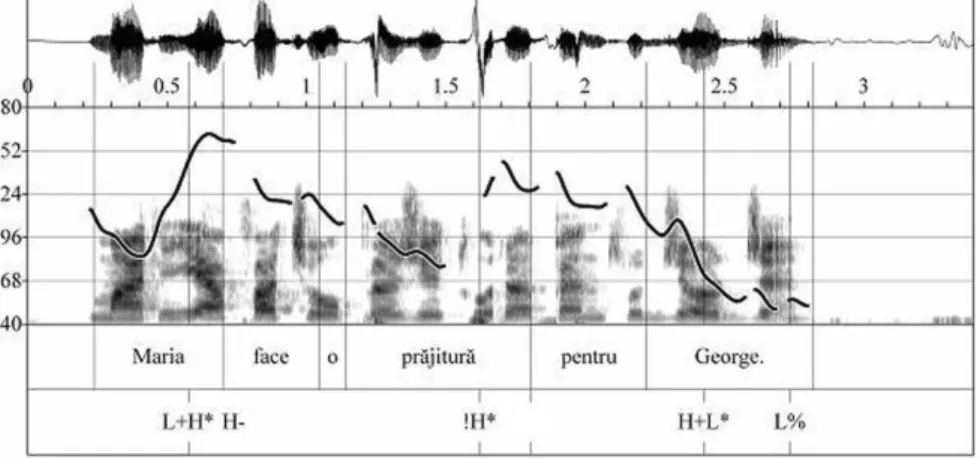
MaRIa face o pr˘ajiTUr˘a pentru GEORge. [Mary is baking a cake for George.] ‘
The F0 contour in Fig. 3 shows that the constituent of the subject
the global CU level. The topic function of the subject is encoded by theL+H∗pitch accent during its accented syllable and is located in a separate phrase (an intermediate phrase). In [5] it is also claimed that topic elements may be located in a separate phrase.
In the case of the utterance in Fig. 3 the first ip isolates the topic constituent and the global focus is located in the following complex constituent. In (6) the subject is annotated byT partial label (within P H+T label) and the complex constituent byF partial label (within P O+F label). The global PUSH function is due to the high target tone during the first accented syllable and global POP function is produced by the lowest target tone of the utterance during the last accented syllables.
Figure 3. The F0 contour and the spectrogram of the sentenceMaRIa FAce o pr˘ajiTUr˘a pentru GEORge.(‘Mary is baking a cake for George’)
{(P H +T)L+H∗H− /{{(P O+F)!H∗/(P H +T)H∗}(P H+T)/
{(P H +T)/(P O+F)H+L∗L%}P O+F}P O+F (6) The complex right constituent includes the verb, theO1 object and
It is compound by two complex constituents (CUs): i. the left CU of the verb and O1 object (face / o pr˘ajitur˘a); ii. the right CU of the
preposition pentru and the O2 object (George). The left CU contains
the topic at the local level of verbal phrase and the right CU contains the focus element. They are annotated byP H+T andP O+F labels, respectively, in (6) in the index position.
At its turn the left CU has a focus on the verb (face) due to the constant pitch level of its pitch movement. The noun bears a topic function marked by keeping high tone during the last syllable after the high target tone is reached. It also bears a PUSH function due to its highest target tone. The topic element ofO1 object is more prominent
and it bears the nuclear accent. Consequently, the left CU is also a P H+T constituent at the higher level of the verbal phrase.
The right CU (pentru / George) within the CU of the verbal phrase is a focus constituent and has the following two constituents: i. the preposition (pentru), which bears a topic function at this local level due to its slow downstepped pitch movement;O2object (George) which has
a focus function marked by the abrupt falling pitch movement. TheO2
object also bears a POP function due to its minimum tonal level. The nuclear function of the last accent ofO2 object gives a POP function to
the whole right part of the verbal phrase constituent. Thus, the higher level CU having the left CU and the right CU as constituents is the complementary P O+F constituent of the subject within the global utterance level.
As observed in [5] in Fig. 3 the contour is declining, with compres-sion of the pitch range. The last pitch accent is the nuclear accent of the utterance having the minimum level for its target tone.
These examples illustrate how complex utterances can be parti-tioned by means of a CU hierarchy. CUs are partiparti-tioned by their topic-focus and PUSH-POP information structure.
4
Conclusions
description of local and global communicative units. We introduced the term of communicative unit in order to relate it to information structure. CUs are units produced during cognitive process while the prosodic units are produced by information packaging process during the utterance of text. There are cases when CUs overlap prosodic phrases. This view permits a Romanian utterance analysis at the com-municative level in relation to the phonological events.
The goal of this paper is to present how utterances can be par-titioned into a hierarchy of communicative units. At each level CUs have their own topic-focus and PUSH-POP information structure. The topic and focus functions are discussed at the pragmatic level and we illustrate their relation to the semantic significance: e.g. in the state-ment (3) the word daneza is marked as global focus at the pragmatic level as it is described in (4) but it may be also thought as one element of a set of alternatives related to the question (3).
The PUSH and POP functions are discussed in this paper only at the pragmatic level and they are related to the contrast between the target tones of CU constituents. At the semantic level the PUSH and POP functions have to convey the aboutness principle formulated for IS at the text level. A pragmatic implementation of this function has to be found in the further work.
This utterance view of nested CUs and their corresponding nested partitions of Information Structure can potentially describe any ut-terance partitioning more accurately, based on its intonation contour interpretation. The logic of utterance organization can be understood by identifying all paired constituents, their hierarchical organization and their local and global information structure.
References
[1] M.E. Beckman, J. Hirschberg and S. Shattuck-Hufnagel, “The original ToBI system and the evolution of the ToBI framework,” inProsodic Typology. The Phonology of Intonation and Phrasing, S-A. Jun, Ed. Oxford: Oxford University Press, 2005, ch. 2, pp. 9–54.
[2] D. Chitoran, H. Parlog and J. Augerat,The sounds of English and Romanian, Bucure¸sti: Bucharest University Press, 1984, 158 p. [3] L. Dasc˘alu-Jinga, “Intonation in Romanian,” in Intonation
Sys-tems: A survey of twenty languages, D. Hrist and A. Di Cristo, Eds. Cambridge: Cambridge University Press, 1998, pp. 239–261. [4] S. Frota and P. Prieto, Eds. Intonational Variation in Romance.
Oxford: Oxford University Press, 2015, 500 p.
[5] E. G¨obbel, “On the Relation between Focus, Prosody and Word Order in Romanian,” inRomance Languages and Linguistic The-ory 2001, J. Quer, J. Schroten, M. Scorretti, P. Sleeman and E. Verheugd, Eds. Amsterdam/Philadelphia: John Benjamins, 2003, pp. 75–92. DOI: 10.1075/cilt.245.06gob.
[6] K. Von Heusinger, “Information structure and the partition of sentence meaning,” in Prague Linguistic Circle Papers: Travaux du cercle linguistique de Prague, (N.S. Volume 4), E. Hajiˇcov´a, P. Sgall, J. Hana and T. Hoskovec, Eds. John Benjamins Publishing Company, 2002, pp. 275–305.
[7] D. Jitca, V. Apopei and M. Jitca, “The F0 Contour Modelling as Functional Accentual Unit Sequences”, International Journal of Speech Technology, vol. 12, no. 2-3, Article:75, pp. 12–75, Nov., 2009. DOI/10.1007/s10772 -009-9055-3.
[8] D. Jitca and V. Apopei, “A Prosodic Control module for a Ro-manian TTS System, based on melodic contour dictionaries,” in
[9] D. Jitca, V. Apopei and M. Jitca, “How can a functional perspec-tive be used in intonation modelling,” inInternational Conference Speech Prosody, (Chicago, SUA), 2010.
[10] C. Gussenhoven, The Phonology of Tone and Intonation, Cam-bridge: Cambridge University Press, 2004.
[11] D. R. LADD, Intonational Phonology, Cambridge: Cambridge University Press, 2008.
[12] J. Pierrehumbert, “The Phonetics and Phonology of English In-tonation,” Ph.D. dissertation, Massachussets Institute of Technol-ogy, 1980.
Doina Jitc˘a Received July 27, 2016