Orientation of liquid crystalline
materials by using carbon
nanotubes
N.V.Kamanina
∗P.Ya.Vasilyev
†V.I.Studeonov
‡Abstract
The solution of some problems, where the initial black field is necessary for the regime of light transmission through the elec-trooptical organic nematic liquid crystal structures has been considered via a homeotropic alignment of liquid crystal molecules on the substrate covered by carbon nanotubes. The results of this investigation can be used to develop optical elements for displays with vertical orientations of nematic liquid crystal molecules (for example, for MVA-display technology).
Keywords: Liquid crystals; nanotechnology; carbon nanotubes; laser-matter interaction; interface; relief ; display application.
∗Vavilov State Optical Institute, 12 Birzhevaya Line, St. Petersburg, 199034,
Russia,Electrotechnical University ”LETI”, St. Petersburg, 197376, Russia, State Institute of Fine Mechanics and Optics ”ITMO”, St. Petersburg, 197101, Russi-aState Institute of Fine Mechanics and Optics ”ITMO”, St. Petersburg, 197101, Russia, e-mail: [email protected]
†Vavilov State Optical Institute, 12 Birzhevaya Line, St. Petersburg, 199034,
Russia
‡Vavilov State Optical Institute, 12 Birzhevaya Line, St. Petersburg, 199034,
Russia
T (twist deformation of NLC mesophase) configurations, which realize a planar orientation of the LC mesophase on the substrate surface with some aligning layers. However, the solution of specific problems, where the initial black field is necessary under the regime of light transmission through the electrooptical structure, requires a homeotropic alignment of LC molecules on the solid substrate.
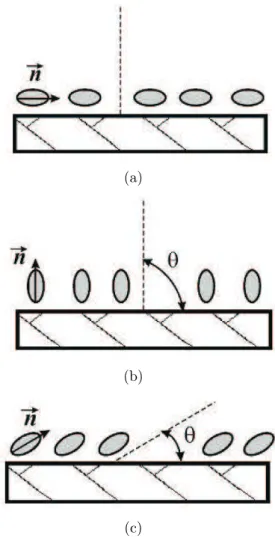
Figure 1 shows various types of alignments of LC molecules on a substrate surface, including planar (molecules are aligned parallel to the substrate surface, θ = 0, see Fig.1a), homeotropic (molecules are perpendicular to the substrate surface,θ = 90o
, see Fig.1b), and tilted (LC director is tilted at a certain angle, 0 < θ < 90o
, see Fig.1c) orientations of LC molecules.
A planar orientation can be achieved using some oxides and poly-mer alignment coatings, such as cerium oxide (CeO), silicon oxides (SiO, SiO2), germanium oxide (GeO), poly(vinyl alcohol), and
(a)
(b)
(c)
Figure 1: Orientation of LC molecules on a substrate surface in cases of (a)planar, (b) homeotropic, and (c) tilted alignment. (⃗n- LC director.)
The importance of determining the type of LC alignment is related to the fact that the anchoring energy of LC molecules on a substrate and the alignment conditions significantly influence all physical prop-erties of the LC mesophase and the electrooptical characteristics of related devices. For example, the free surface energy density Fs in
different values of anchoring energy and different conditions for choos-ing a compromise between viscoelastic and dielectric forces applied to the LC mesophase. Figure 1b shows the homeotropic alignment of LC molecules on a solid substrate. In crossed polarizers, light will not be transmitted through the cell for the vertical orientation of molecules relative to the analyzer in the absence of a bias voltage; application of the voltage leads to rotation of the LC dipoles by 90o
, after which the light is transmitted to form a bright spot on a screen.
In this paper, we propose a new method to obtain the homeotropic alignment of LC molecules, which is based on a relief formation on the glass (quartz) substrate using the deposition of carbon nanotubes (CNTs) and their additional orientation in an electric field. Moreover, as an additional step in this technology, the surface electromagnetic wave (SEW) treatment has been applied to efficiently improve the ob-tained carbon nanotubes relief. It should be mentioned in the paper that we have already found the increase of laser strength of ITO (struc-tures based on indium and stannum oxides) coatings covered with car-bon nanotubes (cf. [7]).
2
Experiment
with p−polarized radiation at a wavelength of 10.6µm and a power of 30W. CNTs were deposited on a substrate in the presence of an applied electric field with strength of ∼100−250V /cm. The spectral data in a 400–800 wavelength range were obtained using an SF-26 spectropho-tometer.
3
Discussion
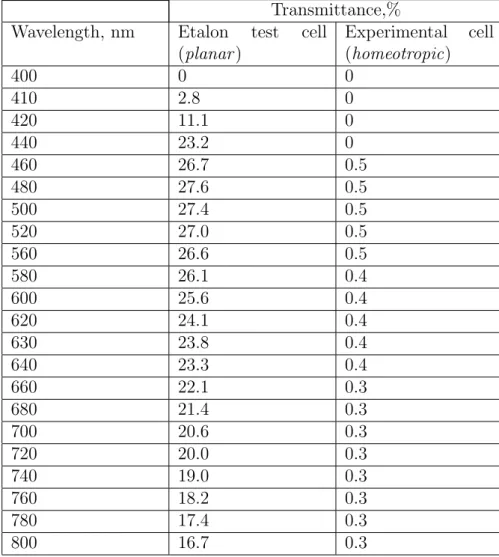
Figure 2 shows an atomic force microscopy (AFM) image of the typ-ical surface relief obtained using the proposed method. One can see that AFM images demonstrate the vertically aligned CNT relief (up-per figure) and their modification with laser treatment (lower figure). The grating with dimension coincided with laser wavelength has been obtained. LC dipoles have been oriented vertically following this relief. The homeotropic alignment of LC molecules was controlled using two sandwich-type cells with an LC mesophase confined between two glass plates. The reference cell represented a classical nematic LC structure, in which the alignment surfaces were prepared by rubbing. In the experimental cell, both alignment surfaces were prepared us-ing CNTs as described above. Spectral experiments with the second cell confirmed that a homeotropic alignment of the LC molecules was achieved. The results of these experiments are presented in the Table 1 in detail.
Table 1: Transmission of LC cells depended on method to orient the LC dipoles.
Transmittance,% Wavelength, nm Etalon test cell
(planar)
Experimental cell (homeotropic)
400 0 0
410 2.8 0
420 11.1 0
440 23.2 0
460 26.7 0.5
480 27.6 0.5
500 27.4 0.5
520 27.0 0.5
560 26.6 0.5
580 26.1 0.4
600 25.6 0.4
620 24.1 0.4
630 23.8 0.4
640 23.3 0.4
660 22.1 0.3
680 21.4 0.3
700 20.6 0.3
720 20.0 0.3
740 19.0 0.3
760 18.2 0.3
780 17.4 0.3
800 16.7 0.3
4
Conclusion
nanoob-Acknowledgments
The work is supported by Russian Foundation for Basic Researches (grant #10-03-00916, 2010-2012, and by Vavilov State Optical Institute (grant “Perspectiva”, 2010-2011).
References
[1] A. A. Vasil’ev, D. Kasasent, I. N. Kompanets, and A. V. Parfenov, Spatial Light Modulators, Radio i Svyaz’, Moscow, 1987.
[2] B.S. Lowans, B. Bates, R.G.H. Greer, J. Aiken, Binary phase modulation properties of a programmable liquid-crystal television display, Appl. Opt., 31, (1992),7393–7395.
[3] N.V. Kamanina, L.N. Soms, and A.A. Tarasov, Correction of phase aberrations by the holographic method using liquid-crystal spatial light modulators, Opt. Spectrosc., 68, (1990),403–404.
[4] V.I.Tsoi, A.V.Tarasishin, V.V.Belyaev, S.M. Trofimov, Modeling of the diffraction of light by structures with spatial periodicity of the optical parameters of the substance and of the surface relief, Journal of Optical technology, 70, (2003),465-469.
[6] G.M.Zharkova, A.S.Sonin, Liquid crystal composites, Novosibirsk, “Nauka”, 1994 [in Russian].
[7] N.V. Kamanina, P.Ya. Vasilyev, A.I. Vangonen, V.I. Studeonov, Yu.E. Usanov, F. Kajzar, Andre-Jean Attias, Photophysics of or-ganic structures doped with nanoobjects: Optical limiting, switch-ing and laser strength, Molecular Crystals and Liquid Crystals,
485, (2008), 197–206.
Razmatra se reˇsenje nekih problema gde je potrebno poˇcetno crno polje za reˇzim prolaska svetlosti kroz elektrooptiˇcki organsko nematski teˇcni kristal kroz homeotropno redjanje molekula teˇcnih kristala na podlozi pokrivenoj nano cevima. Rezultati ovog istraˇzivanja mogu se koristiti za razvoj optiˇckih elemenata u monitorima sa vertikalnim orijentacijama molekula nematskih teˇcnih kristala (kao kod, recimo, MVA-displej tehnologije).