Palanisamy.P
et al. IRJP 2012, 3 (1)
Page 150
INTERNATIONAL RESEARCH JOURNAL OF PHARMACY
www.irjponline.com
ISSN 2230
–
8407
Research Article
PRELIMINARY PHYTOCHEMICAL EVALUATION OF WHOLE PLANT EXTRACT OF
DIPTERACANTHUS PROSTRATUS NEES
Palanisamy.P*
1, B.Jayakar
1, M.V.Kumuthavalli
1, Yoganath Kumar
2, K.R.Srinath
3 1Vinayaka Missions College of Pharmacy, Vinayaka Mission University, Salem, Tamilnadu, India 2
Trainee Research Associate - Pharmacokinetics/Biostatistics, Axis Clinicals Ltd, Hyderabad, Andhra Pradesh, India 3
Campbell University, North Carolina, USA-27506
Article Received on: 17/11/11 Revised on: 20/12/11 Approved for publication: 21/01/12
*Email: [email protected]
ABSTRACT
Dipteracanthus prostratus is an prostrate perennial herb. It is a small straggling, much branched herb it is purple at the nodes, internodes are long and hairy. It
used as anti-cancer, hypoglycemic, anti-inflammatory and Diuretics. The present study was carried out to preliminary phytochemical evaluation of whole plant of Dipeteracanthus prostratus nees. The study includes preparation of different extracts by successive solvent extraction for detail analysis. Fluorescence analysis of different successive extract and powder were noted under UV light and normal ordinary light, which signifies there characteristics. Preliminary qualitative chemical test for different extract shows the presence of alkaloids, glycosides, fixed oil and fats, phenolic compounds, protein and amino acids, tannins, gum and mucilage, flavonoids and carbohydrates.
KEY WORDS:Dipteracanthus prostratus, preliminary phytochemical, successive solvent extraction.
INTRODUCTION
Though the traditional Indian system of medicine has a long history of use, they lacked adequate scientific documentation, particularly in light modern scientific knowledge1.
Dipteracanthus prostratus Nees (Acanthaceace) is an important medicinal plant and popularly known as black weed. It is found in It is a species growing widely in India and Australia. It is a prostrate perennial herb. It is a small straggling, much branched herb it is purple at the nodes, internodes are long and hairy. The Leaves are ovate or elliptic, acute hairy, entire with narrow base. The flowers bloom in August-September to October. The flowers are normally sessile, axillary’s, solitary or few together. Pale blue to light violet and occasionally white in colour, braceoles like leaves but smaller. Calyx are par title and hairy. Corolla are infundibulate form with narrow tube. Capsules are many seeded2-4. It is believed to be Anti-cancer against the epidermis of the Naso-pharynx region and slightly hypoglycemic, Anti-Inflammatory. The weed may be potent Diuretics. It contains alkaloid, glycosides, fixed oil and fats, phenolic compounds, protein and amino acids, tannins, gum and mucilage, flavonoids and carbohydrates5. The present study is designed to explore the preliminary phytochemical and physicochemical analysis of Dipteracanthus prostratus
whole plant, which is responsible for its pharmacological properties.
MATERIAL AND METHODS
The fresh whole plant of Dipteracanthus prostratus Nees were collected in the month of January 2011 from Salem district, Tamilnadu, India. The plant was identified and authenticated by the botanist Mr. A Balasubramanian (consultant central siddha research) Executive Director ABS botanical garden, Salem, Tamilnadu.
Preparation of crude drug for extraction
The authenticated fresh whole plant were dried under shade and used for the preparation of extract. These whole plant was coarsely powdered with the help of mechanical grinder
and passed through sieve no.60. The powder was stored in an airtight container for further use.
Preparation of the Extracts6-9 Method of extraction
Continuous hot percolation (successive solvent extraction) process by using soxhlet apparatus and cold maceration method.
Materials
i. Soxhlet apparatus. ii. Petroleum ether (60-800C)
iii. Chloroform iv. Acetone
v. Ethanol (95 % v/v)
vi. Distilled water with chloroform (0.25%)
vii. Shade dried coarse powder of Dipteracanthus prostratus Nees.
Extraction Procedure Petroleum ether extract
The shade dried coarsely powdered whole plant of
Dipteracanthus prostratus Nees (1 kg) was extracted with petroleum ether (60-80°C) until the extraction was completed. After completion of extraction, the solvent was removed by distillation. Dark green colour residue was obtained. The residue was then stored in dessicator.
Chloroform extract
The marc left after petroleum ether extraction was dried and then extracted with chloroform (55-56°C), until the extraction was completed. After completion of extraction, the solvent was removed by distillation. Dark greenish yellow colour residue was obtained. The residue was then stored in dessicator.
Acetone extract
Palanisamy.P
et al. IRJP 2012, 3 (1)
Page 151
Ethanol extractThe marc left after acetone extraction was dried and then extracted with ethanol 95% v/v (75-78°C), until the extraction was completed. After completion of extraction, the solvent was removed by distillation. Dark brown colour residue was obtained. The residue was then stored in dessicator.
Aqueous extract
The marc left after ethanol extraction was dried and then extracted with chloroform water by cold maceration process for 7 days. At the end of 7th days, it was filtered through muslin cloth and the filtrate was concentrated. The remaining solution was evaporated by heating on a water bath. The brown colour residue was obtained. The residue was then stored in dessicator.
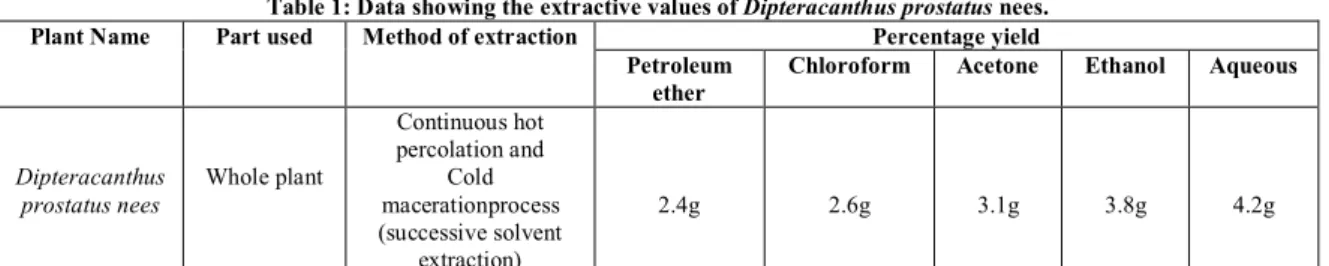
The extractive values of various extracts of Dipteracanthus prostratus Nees were presented in Table no.1
Identification of phytochemical constituents
The therapeutic potentials of plant and animal origin are being used from the ancient times by simple process without isolation of pure compounds that is in the form of crude drugs. The pharmacological action of crude drug is determined by the nature of its constituents.
Thus plant species may be considered as a biosynthetic laboratory not only for chemical compounds, e.g. Carbohydrates, proteins and fats that are utilized as a food by humans and animals, but also for a multitude of compounds including alkaloids, flavonoids, glycosides etc. which exert definite pharmacological activity.
To obtained these pharmacological activities, plant materials were used as such in their crude form or may be extracted with suitable solvents to take out the desired components and the resulting principle being employed as therapeutic agents. The phytochemistry of herbal drug embraces a thorough consideration of these chemical entities that are termed as constituents. As the herbal drugs contain so many chemical compounds, it is essential to single out those responsible for therapeutic effect to be called as active constituents.
By considering the above facts, it is necessary to evaluate the nature of extract before evaluating the biological activity of same. We have been selected such extracts for pharmacological activity which contain large number of chemical constituents. Hence for this purpose, we have to go for following preliminary tests to evaluate chemical nature of extracts qualitatively.
Preliminary phytochemical tests10-13
All the extracts of Dipteracanthus prostratus nees were subjected to qualitative tests for the identification of various active constituents.
Test For Carbohydrates And Glycosides
A small quantity of various extracts were dissolved separately in 4ml of distilled water and filtered. The filtrate was subjected to the following tests to detect the presence of carbohydrates and glycosides.
Molisch's test
The filtrate was treated with 2 - 3 drops of 1% alcoholic alpha naphthol and 2ml of concentrated sulphuric acid was added along the sides of the test tube. Appearance of brown ring at the junction of two liquids shows the presence of carbohydrates.
Fehling's test
The filtrate was treated with each 1ml of Fehling's solution A and B and heated on a water bath. A reddish precipitate was obtained shows the presence of carbohydrates.
Another portion of extracts were hydrolyzed with dilute hydrochloric acid for few hours on a water bath and the hydrolysate was subjected to the following tests to detect the presence of glycosides.
Legal's test
To the hydrolysate 1ml of pyridine and few drops of sodium nitroprusside solution were added and then it was made alkaline with sodium hydroxide solution. Appearance of pink to red colour shows the presence of glycosides.
Borntrager’s test
Hydrolysate was treated with chloroform and the chloroform layer was separated. To this equal volume of dilute ammonia solution was added. Ammonia layer acquires pink colour shows the presence of glycosides.
Detection Of Fixed Oils And Fats Filter paper test
Small quantities of various extracts were pressed separately between the filter papers. Appearance of oil stain on the paper indicated the presence of fixed oils.
Saponification test
Few drops of 0.5M alcoholic potassium hydroxide was added to small quantities of various extracts along with a drop of phenolphthalein. The mixture was heated on a water bath for 1-2 hours. Formation of soap indicates the presence of fixed oils and fats.
Detection Of Proteins And Free Amino acids
Small quantities of various extracts were dissolved in few ml of water and then they were subjected to the following tests.
Million’s test
The above-prepared extracts were treated with Million’s reagent. Red colour formed shows the presence of proteins and free amino acids.
Biuret test
To the above prepared extracts equal volume of 5% sodium hydroxide and 1% copper sulphate solution were added. Violet colour produced shows the presence of proteins and free amino acids.
Ninhydrine test
The extracts were treated with Ninhydrine reagent. Purple colour produced shows the presence of proteins and free amino acids.
Detection Of Saponins
The extracts were diluted with 20ml of distilled water and it was agitated in a measuring cylinder for 15 minutes. The formation of 1cm layer of foam shows the presence of saponins.
Detection Of Tannins And Phenolic Compounds
Small quantities of the various extracts were taken separately in water and test for the presence of phenolic compounds and tannins was carried out with the following reagents.
1) 5% Ferric chloride solution - violet colour
2) 1% solution of gelatin containing 10% sodium chloride - white precipitate
3) 10% lead acetate solution - white precipitate
Palanisamy.P
et al. IRJP 2012, 3 (1)
Page 152
Detection Of PhytosterolsSmall quantities of various extracts were dissolved in 5ml of chloroform separately. Then this chloroform solution was subjected to the following tests to detect the presence of phytosterols.
Salkowski test
To 1ml of above prepared chloroform solution, few drops of concentrated sulphuric acid was added. Brown colour produced shows the presence of phytosterols.
Libermann Burchard test
The above prepared chloroform solution was treated with a few drops of concentrated sulphuric acid followed by few drops of diluted acetic acid, 3ml of acetic anhydride. A bluish green colour appeared indicates the presence of phytosterols.
Detection Of Alkaloids
Small quantities of various extracts were separately treated with few drops of dilute hydrochloric acid and filtered. The filtrates were used for the following tests.
1) Mayer's reagent - cream precipitate 2) Dragendroffs reagent - orange brown precipitate 3) Hager's reagent - yellow precipitate 4) Wagner’s reagent - reddish brown precipitate
Detection Of Gums And Mucilages
A small quantity of various extracts were added separately to 25ml of absolute alcohol with constant stirring and filtered. The precipitate was dried in air and examined for its swelling properties. No swelling was observed indicates the absence of gums and mucilage.
Detection Of Flavonoids
1) Small quantities of various extracts were dissolved separately in aqueous sodium hydroxide. Appearance of yellow colour indicates the presence of flavonoids.
2) To the small portion of each extract, concentrated sulphuric acid was added. Yellow orange colour was obtained shows the presence of flavonoids.
3) Shinoda's test:-Small quantities of the extracts were dissolved in alcohol. To that piece of magnesium followed by concentrated hydrochloric acid was added drop wise and heated. Appearance of magenta colour shows the presence of flavonoids.
The phytochemical constituents present in various extracts were presented in Table 2.
Fluorescence Analysis
Many substances for example, quinine solution in dilute sulphuric acid when suitably illuminated emit light of a different wavelength or colour form that which falls on them. This emitted light (fluorescence) ceases when the exciting light is removed.
A very important generalization made by stokes in 1852 stated that “in fluorescence the fluorescence light is always of greater wavelength than the exciting light”. Light rich in short wavelengths is very active in producing fluorescence and for this reason strong ultraviolet light produces fluorescence in many substances which do not visibly fluorescence in day light (Evans,2001) . The results are given in table 3,4.
RESULTS AND DISCUSSION
The phytoconstitutents were extracted by using different solvents of increasing polarity like petroleum ether, chloroform acetone, ethanol and water. The extractive values were given in Table 1 .
Table 1: Data showing the extractive values of Dipteracanthus prostatus nees.
Plant Name Part used Method of extraction Percentage yield
Petroleum ether
Chloroform Acetone Ethanol Aqueous
Dipteracanthus prostatus nees
Whole plant
Continuous hot percolation and
Cold macerationprocess (successive solvent
extraction)
2.4g 2.6g 3.1g 3.8g 4.2g
The phytoconstitutents were identified by chemical tests which showed the presence of various phytoconstitutents (Table2) mainly in the following extracts.
Table 2: Data showing the preliminary phytochemical screening of the various extracts of Dipteracanthus prostates. nees Sr. no.
Constituents
Petroleum Ether Extract
Chloroform Extract
Acetone Extract
Ethanol Extract
Aqueous Extract
01 Alkaloids - - - + +
02 Sterols - - - - -
03 glycosides - - - + +
04 Fixed oil and fats + + + + +
05 Phenolic compounds + + + + +
06 Protein and amino acids + + + + +
07 Tannins - - - + +
08 Gum & mucilage + + + + +
09 Flavonoids - - + + +
10 Carbohydrates - - - + +
11 Saponins - - - - -
‘+’ Presence, ‘-‘absence
Ethanol extract
Alkaloids, Fixed oil and fats, Carbohydrate, proteins, amino acids, tannins, glycosides, phenolic compounds and flavonoids, Gum and mucilage.
Aqueous extract
Alkaloids, Fixed oil and fats, Carbohydrate, proteins, amino acids, tannins, glycosides, phenolic compounds and flavonoids, Gum and mucilage.
Palanisamy.P
et al. IRJP 2012, 3 (1)
Page 153
aqueous extracts were selected for pharmacological studies. Ethanol extract was selected for the isolation of the available active constituents, because ethanol being a bipolar solvent,
which can dissolve a wide range of phytoconstitutents, whereas the aqueous extract contains polar compounds.
Fluorescence Analysis
Table 3: Fluorescence characteristic of whole plant powder of Dipteracanthus prostratus Nees.
S.No Particulars of the treatment Under ordinary light Under UV light (366nm)
1 Powder as such Dark green Brick red 2 Powder + 1N NaOH (aqueous) Green Brick red 3 Powder +1N NaOH (alcoholic) Dark green Reddish green 4 Powder + 1N HCL Blackish green Chocolate brown 5 Powder + H2SO4 (1:1) Green Brown 6 Powder + HNO3 (1:1) Yellow Orange 7 Powder + Ammonia Greenish yellow Greenish yellow 8 Powder + Iodine Dark brown Brown 9 Powder + 5% FeCl3 Dark-yellowish brown Dark brown 10 Powder + Acetic acid Light green Orange
Table 4: Fluorescence characteristic of whole plant extract of Dipteracanthus prostratus nees.
S.No Particulars of the treatment Under ordinary light Under UV light (366nm)
1 Petroleum ether (40-60°C) Green Yellowish green 2 Chloroform Dark green Red 3 Acetone Dark green Red 4 Ethanol Dark green Brown 5 Water Brownish green Blackish brown
CONCLUSION
Based on the traditional uses and literature review of earlier studies the plant was selected. The preliminary phytochemical and physicochemical evaluation of studies on
Dipteracanthus prostratus neeswere done the Phytochemical constituents were extracted by successive solvent extraction and identified by chemical tests. These tests showed the presence of various phytochemical constituents like Alkaloids, Fixed oil and fats, Carbohydrate, proteins, amino acids, tannins, glycosides, phenolic compounds and flavonoids, Gum and mucilage.
Ethanolic and aqueous extracts shows the presence of majority of phyto constituents. Hence it was selected for the pharmacological studies.
The ethanol extracts which has the polarity in between the acetone and aqueous has been selected for isolation of the available active constituents.
The present study on preliminary phytochemical and physicochemical evaluation of Dipteracanthus prostratus
whole plant could be used as the diagnostic tool for the standardization of medicinal plant. There are controversial identities of many plants. Thus, our study is an important landmark in correct identification of Dipteracanthus prostratus.
REFERENCES
1. World Health Organization, Quality Control Methods for Medicinal Plant Materials, WHO, Geneva, 1998.
2. Nadkarni AK and Nadkarni KM, The Indian Material Medica, Popular Prakashan, Bombay, 1976, page no:1047-1048.
3. Kirtikar KR and Basu BD, Indian Medicinal Plants, Panni office, Bhuwaneswari Ashrama, Allahabad, 1991 page no: 648-652.
4. Agrawal SS and Singh VK, Immunomodulators- A review of studies on Indian medicinal plants and synthetic peptides, Part-1, Medicinal plants, Proc.Indian Natl.Sci.Acad.,65 Suppl B,1999, page no:179-204. 5. Wealth of India, A dictionary of Indian Raw material and Industrial
Products. National Institutes of Science Communication (C.S.I.R) , New Delhi, Vol.V,1959 page no:360-364.
6. Trease and Evans pharmacognosy, 15th editions ELBS publications, New Delhi, page no-138.
7. Harbourn, J.B., “Phytochemical Methods- a Guide to Modern Techniques of plant analysis”. Reprint 1976, Harsted press, New York, page no: 4-6.
8. Cooper and Gunn, In; Tutorial Pharmacy, JB Publishers, New Delhi, page no: 259.
9. Rawlins, E.A., Bentley’s Text Book of Pharmaceutics, 8th editions, ELBS publications, New Delhi, page no: 180.
10. Basset, J.; Denny, J.; Jeffery, J. H.; and Mendham, J., “Vogel’s Text Book of Quantitative Inorganic Analysis”, 4th edition, ELBS –
Longaman, Essex, UK, 1985 page no: 196.
11. Hebort, E., brain and Ellery, W, Kenneth, “Text Book of practical Pharmacognosy”, baillore, London, 1984 page no: 363.
12. Harbourne, J.B, “Phytochemical methods- A Guide to Modern Techniques of plant analysis”, 2nd Edition, Ghapman and hall, London. 1984 page no: 4-120 .
13. Kokate, C.K; Purohit, A.P.; Gokhale S.B., “Pharmacognosy”., 1st Edition, Nirali Prakashan, Pune,1990 page no:123.