Journal of Applied Fluid Mechanics, Vol. 9, No. 3, pp. 1105-1113, 2016. Available online at www.jafmonline.net, ISSN 1735-3572, EISSN 1735-3645.
Throughflow and Gravity Modulation Effects on Heat
Transport in a Porous Medium
P. Kiran
Department of Mathematics, Rayalaseema University, Kurnool, 518007, Andhra Pradesh, India. Email: [email protected]
(Received February 6, 2015; accepted July 13, 2015)
A
BSTRACTThe effect of vertical throughflow and time-periodic gravity field has been investigated on Darcy convection. The amplitude of gravity modulation is considered to be very small and the disturbances are expanded in terms of power series of amplitude of convection. A weak nonlinear stability analysis has been performed for the stationary mode of convection. As a consequence heat transport evaluated in terms of the Nusselt number, which is governed by the non-autonomous Ginzburg-Landau equation. Throughflow can stabilize or destabilize the system for stress free and isothermal boundary conditions. The amplitude and frequency of modulation, Prandtl Darcy number on heat transport have been analyzed and depicted graphically. Further, the study establishes that the heat transport can be controlled effectively by a mechanism that is external to the system. Finally flow patterns are presented in terms of streamlines and isotherms
Keywords: Throughflow; Gravity modulation; Weak nonlinear theory; Ginzburg-Landau model.
1. I
NTRODUCTIONThe natural convection in fluid saturated porous media is of fundamental interest due to its practical applications such as geothermal energy utilization, enhanced recovery of petroleum reservoirs, insulation of reactor vessels, polymer engineering, ceramic processing and nuclear waste repositories, to mention a few. The enormous volume of work devoted to this field is well documented in the literature (Ingham and Pop 1998, Nield and Bejan 2006, Vafai 2005). Because of these applications, together with the fact that porous media occur in many natural situations, several studies have been undertaken to analyze the effects of different phenomena connected with such media. An excellent review of most of these studies has been reported in Nield and Bejan (1992). A modified complex body force is important when the system is under vertical vibrations. In this case the density gradient is subjected to vibrations; the resulting buoyancy forces which are produced by the interaction of the density gradient with gravitational field have a complex spatio temporal structure. The time dependent gravity field is of interest in space laboratory experiments, in areas of crystal growth and large-scale convection of atmosphere other applications. Many theoretical and experimental studies dealing with materials processing or physics of fluids under the micro-gravity conditions aboard an orbiting spacecraft have been carried out by Nelson (1991). According to Wadih et al. (1988,
1990), the vibrations can either substantially enhance or retard heat transfer and thus drastically affect the convection. The effect of modulated gravity on a convectively stable configuration can significantly influence the stability of a system by enhancing or decreasing its susceptibility to convection. Gershuni et al. (1970) and Gresho and Sani (1970) were the first to study the gravity modulation on the stability of a heated fluid layer. Their results show that the stability of the layer being heated from below is enhanced by g-jitter and being heated from below is enhanced by g-jitter. Some of the documented works on gravity modulation are Yang (1997), Malashetty and Padmavathi (1997), Bhadauria and Kiran (2014a-d, 2015), Bhadauria et al. (2014, 2012, 2013) Kiran (2015a), Govender (2004, 2005), Malashetty and Swamy (2011) and Siddheshwar et al. (2012). The reader may also look at other studies related to time periodic excitation of the boundaries (Raji et al 2010, Shivakumara et al. 2012, Jamai 2014, Kuqali et al. 2015).
has been studied by (Wooding 1960; Jones and Persichetti 1986; Nield 1987; Shivakumara 1997). They show that a small amount of throughflow can have a destabilizing effect if the boundaries are of different types and a physical explanation for the same has been given. Khalili and Shivakumara (1998) have investigated throughflow and internal heat generation on the onset of convection in a porous medium. They found that, throughflow destabilizes the system even if the boundaries are of the same type; a result which is not true in the absence of an internal heat source. The non-Darcian effect on convective instability in a porous medium with throughflow has been investigated in order to account for inertia and boundary effects by (Shivakumara (1999), Khalili and Shivakumara (2003)). Shivakumara and Nanjundappa (2006) investigated the effect of quadratic drag and vertical throughflow on double diffusive convection in a horizontal porous medium using the Forchheimer extended Darcy model analytically. It is found that, irrespective of the nature of boundaries, a small amount of throughflow in either of its direction destabilizes the system; a result which is in contrast to the single component system. Shivakumara and Sureshkumar (2007) have studied convective instability in non-Newtonian fluid saturated porous medium in the presence of vertical throughflow and found that throughflow has stabilizing or destabilizing effect depending on the boundaries and the directions of the flow. Brevdo (2009), investigated three-dimensional absolute and convective instabilities at the onset of convection in a porous medium with inclined temperature gradient and vertical throughflow. Barletta et al. (2010) analyzed the convective roll instabilities of vertical throughflow with viscous dissipation in a horizontal porous medium. The effects of hydrodynamic and thermal heterogeneity, horizontal throughflow on the onset of convection in a horizontal layer of a saturated porous have been investigated by Nield and Kuznetsov (2011). They found that the horizontal throughflow has no effect on the stability. When the permeability increases in the direction of the throughflow a small amount of throughflow may destabilize the transverse modes and so destabilize the layer as a whole. Reza and Gupta (2012) investigated the effect of throughflow on the onset of convection in a horizontal layer of electrically conducting fluid confined between two rigid permeable boundaries heated from below in the presence of uniform vertical magnetic field, they found that magnetic field inhabits the onset of steady convection, and a positive throughflow is more stabilizing than negative throughflow. Nield and Kuznetsov (2013) considering flux and iso-temperature boundaries they investigated the effect of onset of convection in a layered porous medium with vertical throughflow and found that throughflow has a stabilizing effect whose magnitude may be increased or decreased by the heterogeneity. Throughflow and internal heating effects on anisotropic porous medium investigated by Vanishree et al. (2014). They have presented
onset of instability in the medium. They also suggest another method of controlling convection by externally controlling porous media damping and shear. This is
in addition to the throughflow mechanism of regulating convection.
From the above literature it is observed that, huge amount of analysis on throughflow has been investigated in deriving onset of convection for various flow models. Not much work found in the literature for nonlinear theories of throughflow models. Where these studies help us to analyze heat transfer in the system. As it is well known fact that nonlinearity arises due to the interaction of streamline flow with temperature or coupling nature of momentum and energy equation. At this stage one needs to account these effects to investigate heat transfer results in the system. The first nonlinear studies on throughflow under modulation is investigated recently by Kiran and Bhadauria (2015b) and Kiran (2015)b-c. They have considered different models for double diffusive convection with modulated gravity or temperature fields of the medium. The missing part of the continuation of their studies investigated in this paper where the effect of throughflow and gravity modulations are considered on fluid saturated porous medium while employing the Darcy model. A non-autonomous Ginzburg-Landau equation for the finite amplitude of convection is derived, and a method is presented here to determine the amplitude of this convection with a weakly nonlinear thermal instability for stationary mode under throughflow and gravity modulation. Heat transfer analysis discussed and presented results graphically with respect to each parameter of the system..
2. G
OVERNING EQUATIONSAn infinitely extended horizontal porous medium saturated by Newtonian fluid, confined between two free-free boundaries at z=0 and z=d, and heated from below is considered. The temperature difference across the porous medium is kept at
Δ
T
. We choose Cartesian frame of reference as, origin in the lower boundary and the z axis in vertically upward direction. The schematic diagram is shown in the Fig.1, throughflow has been considered in vertical upward and downward directions. Further Darcy law and the Oberbeck-Boussinesq approximation are taken under these assumptions; the equations which describe this system are given by (Bhadauria and Kiran 2013, Kiran and Bhadauria 2015a):0,
q
(1)
0 q p g q,
t K
(2)
2
( ) T ,
T
q T T
t
(3)
0
[1
T(
T
T
0)],
where
q
is velocity (u,v,w),
is viscosity, K is permeability,
T is the thermal diffusivity, T is temperature,
T is thermal expansion coefficient,
is density,T
0 is the temperature at which
=0
is reference density and
is the ratio of heat capacities (for simplicity
is taken to be unity in this paper). The externally imposed thermal boundary conditions and time periodic gravity field considered in this paper are:0
0
at z=0,
at z=d
T
T
T
T
T
(5)
0
(1
cos(
t)) ,
ˆ
g
g
k
(6)
where
represents the amplitude of gravity modulation and
is the modulation frequency. The basic state is assumed to be quiescent and the quantities in this state are given by:0
(0, 0, w ), = b(z), p=p (z), = ( )b b
q
T T z
(7)
Fig. 1. A Sketch of the Physical Problem.
Substituting the Eq.(7) into Eqs.(1)-(4), we get the following relations which help us to define basic state pressure and temperature:
0
,
b
b
dp
w
g
dz
K
(8)2
0 2 ,
b b
T
dT d T
w
dz
dz (9)0
[1
(
0)],
b T
T
bT
(10)The solution of the Eq.(9) subject to the thermal boundary condition given in Eq.(5), is given by:
. 1 Pez Pe
b Pe
e e
T
e
(11) The finite amplitude perturbations on the basic state are superposed in the form:
+ ', = + ', = + ', = + '.
b b b b
q q q
p p p
T T T
(12) Since our study restricted to two dimensional convection we introduce stream function as' & '
u w
z x
. Also the non-dimensional
physical variables resealed as:
* * *
( , , )x y z d x( , y , z ), p/ T p*, K
t= 2 *
T
d t
*
' T '
q q
d
* = *
T T TT
and * T2 . d
Substituting the Eq. (12) in Eqs. (1)-(4), using the above dimensionless quantities andeliminating the pressure term we obtain the following dimensionless governing system (dropping the asterisk):
2 1 2
( ) ,
Pr m
T Ra g
t x
(13)
2 ( , )
( ) .
( , ) b
T T T
Pe T
x z z t x z
(14) The dimensionless parameters in the above equations are:
2 0
T
w d Pe
is Péclet number,
2
PrD
T
d K
is Prandtl Darcy number,
T T
g TdK Ra
is thermal Rayleigh number and
(1 cos( t))
m
g k
.
The Eq. (14) show that, the basic state solution influences the stability problem through the factor Tbz
, which is given by Eq. (11).
Assuming small variation of time, and re-scaling it as
2t, the stationary mode of convection of the system will be discussed. The nonlinear system of coupled Eqs. (13, 14) may be written into the matrix form:2 2 2
D 2 2
Pr
( , )
Pr ( , )
m
b
D
Rag x
T T
T V
Pe
z x z
x z
(15) The solution of the above system (15), is evaluated by considering impermeable stress free thermal boundary conditions followed by (Kiran (2015)a,c,d Bhadauria and Kiran (2013)):
ψ
=T=0 on z=0 and z=1
(16)3. H
EAT TRANSPORT FOR STATIONARY INSTABILITY2
0 2
2 3
1 2 2
2 3
1 2 3
2 3
0 1 2 3
.. .. ..
..
Ra R R
T T T T
(17)where
R
0 is the critical value of the Rayleigh number at which the onset of convection takes place in the absence of gravity modulation. The expression of
(following the studies of Govender 2004,2005, Bhadauria and Kiran 2015) is consistent with the basic state solution provided that
0 vanishes at the lowest order. In addition, unless
1 vanishes, the equations obtained at order
and
2 present a singularity in the solution. These observations (of Bhadauria and Kiran 2015) indicate that, the effects of gravity modulation should be introduced at
2 2 thereby enabling consistency. Now the system will be evaluated for different orders of
.
3.1 At the Lowest Order
At this order the system takes the following form:
2 0 1 2 1 0 0 m b R g x T T Pe z x z (18)
The solution of the lowest order subject to the boundary conditions Eq. (16) is considered as:
1
sin(
k x
c) sin(
z
)
, (19) 21 2 2
4
-
cos(
) sin(
),
(4
)
c
c
k
A
T
k x
z
c
Pe
(20)where ck22 is square of horizontal wave number. The critical value of the Rayleigh number and the corresponding wave number for the onset of stationary convection is calculated numerically and the expressions are given by:
2 2 2
0 2 2
(4
)
,
4
cc
Pe
R
k
(21).
c
k
(22) 3.2 At the second order: At this order the system takes the following form:2
0
21 2
2 2 22
m b R g R x
T T R
Pe z x z (23)
The terms in RHS of the above system are defined as:
21
0,
R
(24)
22 ( , ) , ( , ) T R x z
(25)
The second order solutions (subject to the boundary conditions Eq. (16) and using the first order solutions) of the system is given by:
2
0
,
(26)
2 3 2
2 2 2 2
2 2 2
2 2 2
-2 sin(2 ) (4 ) -cos(2 ). (4 ) c c k
T A z
c Pe Pek A z c Pe
(27)
The horizontally averaged Nusselt number Nu, for the stationary mode of convection is evaluated by:
2 2 0 0 2 0 0 4 2 2
2 2 2
2
1
,
2
4
(
1)
1
.
(4
)
c c c k zc k b
z Pe c
k
T
x
z
Nu
k
T
x
z
k e
A
cPe
Pe
(28)The above results obtained in Eqs. (21, 22 and 28) is given by Bhadauria et al. (2012), Lapwood (1948) and Siddheshwar et al. (2012, 2013), for an isotropic porous medium in the absence of throughflow.
3.3. At the third order: At this stage the system takes the following form:
2
0
31 3
2 3 32
m b R g R x T T R Pe z x z (29)
The terms in RHS are expressed by:
2
1 1 1
31 0 2 2
1
cos( ) ,
Pr
T T
R R R
x x (30)
1 2 1
32 , T T R z x
(31)
Using and substituting the first and second order solutions into Eqs. (30, 31), obtain the expressions for R31 and R32 easily. Now by applying the
solvability condition for the existence of third order solution, the Ginzburg-Landau equation is obtained for stationary mode of convection with time-periodic coefficients in the form:
3
1 2 3
( )
( ) ( ) ( ) 0, dA
Q Q A Q A
d
(32) where the coefficients are defined by:
2 2 0
1 2 2 2
4
,
Pr (4 )
4 4 0
3 2 2 2 2
2
,
(4 )
c
R k
Q
c Pe
2 2
2 2 2 2 2 0 2
4
( ) [ cos( )] .
(4 )
c
k
Q R R
c Pe
The Eq. (32) is known as Ginzburg-Landau equation and Bernoulli equation, obtaining its analytical solution is difficult due to its non-autonomous nature. So that it has been solved numerically using the in-built function ND Solve of Mathematica 8 subjected to the suitable initial condition A0=a0 where a0 is the chosen initial amplitude of convection. In our calculations we may use R2=R0 to keep the parameters to the minimum. For un-modulated case, the analytical solution of the above Eq.(32) takes the form:
2 1
2 3
1 2
1
,
Q Q
A Q
C e Q
(33)
where
Q
1,Q
3 same as in Eq. (32),2 2 2
2 2 2 2
4
( ) .
(4 )
c
R k
Q
c Pe
and C1 which appears in
Eq. (33), is an integration constant, can be found by using suitable initial condition.
4. R
ESULTS ANDD
ISCUSSIONSIn this article, we study the combined effect of gravity modulation and vertical throughflow on densely packed porous medium. A weakly nonlinear stability analysis has been made to investigate the gravity modulation and vertical throughflow effects on heat transport. The effect of gravity modulation on the Bénard-Darcy convection has been assumed to be of third order
O
(
2)
which means only small amplitude gravity modulation is considered. Such an assumption will help us in obtaining the amplitude equation in simple and elegant manner and is much easier to obtain than in the case of the Lorenz model. The purpose of weak nonlinear theory is to study heat transfer, which linear study could not support. External regulations of Darcy convection are important to study heat transfer in porous media. The objective of this article is to consider such a candidates, gravity modulation and vertical throughflow for either enhancing or delaying the convective heat transfer as is required by a real application. Vad'asz (1998), pointed that there are some modern porous medium applications, such as mushy layer in solidification of binary alloys and fractured porous medium, where the value of PrD may be considered to beunity order, therefore the time derivative in the present study has been retained. Further, this is the reason that the values of PrD has been kept around
one in our calculations. The value of
2is consider very small around 0.1, since we are studying small amplitude modulation on heat transport. Also, sincethe effect of low frequencies, is maximum, on the onset of convection as well as on the heat transport, therefore the modulation of gravity is assumed to be of low frequency.
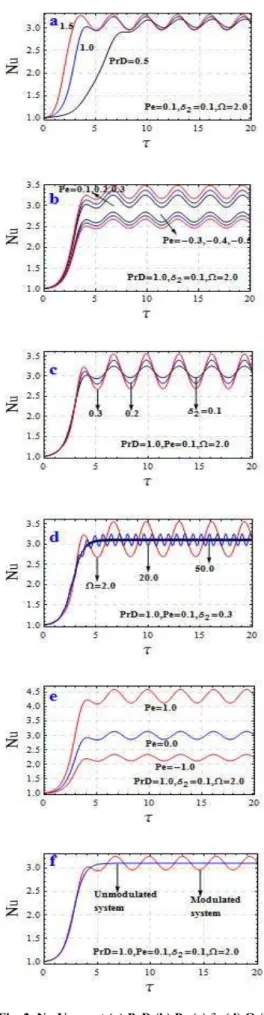
The numerical results for Nu obtained from the expression in Eq. (28) by solving the amplitude Eq. (32), and the results have been presented in the Figs. 2-4. It is clear to see the expression in Eq. (28) in conjunction with Eq. (32) in which Nu is a function of system parameters. The effect of each parameter on heat transport is shown in Figs. 2-4 where the plots of Nusselt number Nu versus τ are presented. It is found from the figures that the value of Nu starts with one and remains constant for quite some time, thus showing the conduction state initially. Then the value of Nu increases with time, thus showing the convection, on further increasing τ thus achieving the steady state.
Now seeking the results of gravity modulation, in Fig. 2a, it is observed that, Nu increases with Prandtl Darcy number, the effect is clear for small values of PrD and lower values of time, hence the
heat transfer, further increment in time the effect disappear and heat transport diminish. The reader may look at the studies of (Bhadauria et al. 2012, 2013; Bhadauria and Kiran 2013; Kiran and Bhadauria 2015a) to see the variations in PrD in the
absence of throughflow. The effect of Pe on heat transfer given in Fig. 2b is investigated for the cases of downward and upward throughflows, upward throughflow (Pe>0) has destabilizing effect where as downward throughflow (Pe<0) has stabilizing effect. The same results obtained by Nield (1987) in the case of fluid layer for small amount of throughflows. Our results are computable with the results obtained by Shivakumara and Sureshkumar (2007) and Suma et al. (2011). According to Shivakumara and Sureshkumar (2007) the destabilization effect may be due to the distortion of steady-state basic temperature distribution from linear to nonlinear by the throughflow.
A measure of this is given by the basic state temperature and this can be interpreted as a rate of energy transfer into the disturbance by interaction of the perturbation convective motion with basic temperature gradient. The maximum temperature occurs at a place where the perturbed vertical velocity is high, and this leads to an increase in energy supply for destabilization. It can be noticed that the critical Rayleigh-Darcy number given by Eq. (21) is even function of Pe and as Pe increases
R0 increases which is the case where onset of
Fig. 2. Nu Versus t (a) PrD (b) Pe (c) δ2 (d) Ω (e, f) Comparisions.
Their study was linear and found that, upward flow stabilizes more than downward flow for tow rigid plates. The reader may also look at the studies of Kiran and Bhadauria (2015b) and Kiran (2015a-d) for nonlinear thermal convection under throughflow and modulation effects. Their studies reveal that the direction of throughflow plays duel effect on heat or mass transfer in the system. Further, we found in Fig. 2c that the effect of amplitude of modulation is to increase the magnitude of Nu, thus increasing the heat transport and advancing the onset of convection. One may note that the following is in respect of effect of amplitude on heat transport:
2 0.1 2 0.2 2 0.3
Nu
Nu
Nu
.
Also, from the Fig. 2d, we observe that increasing upon the frequency of modulation decreases the magnitude of Nu, and so the effect of frequency of modulation on heat transport decreases. At high frequency the effect of gravity modulation on thermal instability disappears altogether. The above results agrees quite well with the linear theory results of temperature modulation (Venezian 1969), where the correction in the critical value of Rayleigh number due to thermal modulation becomes almost zero at high frequencies, hence it holds. The reader may also look at the studies of (Malashetty and Padmavathi 1997, Kiran 2015a, Bhadauria and Kiran 2014a, b), where gravity modulation is being discussed either for Newtonian or non Newtonian fluids of stationary or oscillatory mode of convection. One may observe the following for a particular wave number:
50 20 2
Nu
Nu
Nu
.
In Fig. 2e, the effect of throughflow in the upward direction Pe>0 (=1) is presented. In this case the system has more destabilizing effect than in the absence of vertical throughflow, similarly opposite results can be observed in the case of downward throughflow Pe<0 (Pe=-1). Though the critical Rayleigh Number is of even function in Pe, the averaged Nusselt number is of odd function of Pegiven in Eq. (28). Due to this the magnitude of Nusselt number affects the convective problem, hence the results. In Fig. 2f, we have shown comparison between the analytical solution Eq. (33) of un-modulated case and the numerical solution of the present problem. We observe that the values of magnitude of Nusselt number for un-modulated case are less than the modulated case.
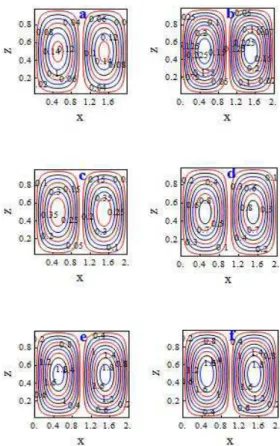
Fig. 3. Streamlineas for (a) t=0 (b) t=0.5 (c) t=1 (d) t=2 (e) t=4 (f) t=9.
Further, it is also clear from the Figs. 3e, f and 4e, f that after reaching certain instant there is no change in the magnitude of stream lines and isotherms, thus showing the steady state. The reader may also see the studies of (Badauria and Kiran 2014 a-c, Kiran 2015a, c, Bhadauria et al. 2014, 2014d) for variations in streamlines and isotherms for gravity modulation.
5. C
ONCLUSIONSThe effect of gravity modulation and vertical throughflow on Bénard-Darcy convection by performing a weakly nonlinear stability analysis resulting in the real Ginzburg-Landau amplitude equation has been investigated. The following conclusions are made:
1. Effect of PrD is to enhance the heat transport for
lower values of time and diminishes for large values of time.
2. Effect of throughflow is to increase the heat transport for upward direction (Pe>0) and opposite in downward (Pe<0) throughflow. 3. On increasing the amplitude of modulation, heat
transport in porous medium increases.
4. On increasing the value of frequency of gravity modulation, the amplitude of modulation of heat transfer decreases. Effect of g-jitter becomes negligible at higher values of Ω.
5. The magnitude of streamlines increases with time, after certain while no change in magnitude.
6. Initially isotherms are flat due to conduction state, becomes contour showing the convective regime.
Fig. 4. Isothermas for (a) t=0 (b) t=0.5 (c) t=1 (d) t=2 (e) t=4 (f) t=9.
ACKNOWLEDGEMENT
The author (Dr. Palle Kiran) would like to thank Prof. BS. Bhadauria (Institute of Science, Dept of Mathematics, BHU, Varanasi, UP, India) for his guidance towards research. He expresses his gratitude towards the Vice Chancellor Prof. Y. Narasimhulu (Rayalaseema University) for providing research specialities in the Department. The author would also like to acknowledge the support and encouragement from his father P. Thikkanna and mother P. Sugunamma. Finally, he acknowledges the financial assistance from Rayalaseema University, Kurnool, AP, India.
REFERENCES
Barletta, A. di Schio and E. R. and L. Storesletten (2010). Convective roll instabilities of vertical throughflow with viscous dissipation in a horizontal porous layer.Transp. Porous Media. 81, 461-477.
effects. MATEC Web of Conferences16, 09003. Bhadauria, B. S., I. Hashim and P. G. Siddheshwar (2013). Study of heat transport in a porous medium under G-jitter and internal heating effects. Transp. Porous Media. 96, 21-37. Bhadauria, B. S., P. G. Siddheshwar, K. Jogendra
and O. m. P. Suthar (2012). Non-linear stability analysis of temperature/gravity modulated Rayleigh-Bénard convection in a porous medium. Transp. Porous Media. 92, 633-647.
Bhadauria, S. and P. Kiran (2013). Heat transport in an anisotropic porous medium saturated with variable viscosity liquid under temperature modulation. Transp Porous Media. 100, 279-295.
Bhadauria, S. and P. Kiran (2014a). Nonlinear thermal Darcy convection in a nanofluid saturated porous medium under gravity modulation. Advanced Science Letters 20, 903-910.
Bhadauria, S. and P. Kiran (2014b). Weak nonlinear double diffusive magneto-convection in a Newtonian liquid under gravity modulation. J Applied Fluid Mech. 8(4), 735-746.
Bhadauria, S. and P. Kiran (2014c). Weak nonlinear oscillatory convection in a viscoelastic fluid layer under gravity modulation.Int. J Non-Linear Mech. 65, 133-140.
Bhadauria, S. and P. Kiran (2014d). Weak nonlinear oscillatory convection in a viscoelastic fluid saturated porous medium under gravity modulation. Transp Porous Media., 104, 451-467.
Bhadauria, S. and P. Kiran (2015). Chaotic and oscillatory magneto-convection in a binary viscoelastic fluid under g-jitter.Int. J Heat Mass Transf. 84, 610-624.
Brevdo, L. (2009). Three-dimensional absolute and convective instabilities at the onset of convection in a porous medium with inclined temperature gradient and vertical throughflow.J. Fluid Mech 641, 475-487.
Gershuni, G. Z., E. M. Zhukhovitskii and I. S. Iurkov (1970). On convcetive stability in the prescence of periodically varying parameter. J. Appl. Math. Mech. 34, 442-452.
Govender, S. (2004). Stability of convection in a gravity modulated porous layer heated from below, Transp. Porous Media 57, 113-123. Govender, S. (2005). Linear stability and
convection in a gravity modulated porous layer heated from below-transition from synchronous to subharmonic solutions. Transp. Porous Media. 59, 227-238.
Gresho, P. M. and R. L. Sani (1970). The effect of gravity modulation on the stability of a heated fluid layer.J. Fluid Mech. 40, 783-806.
Ingham, D. B. and I. Pop (1998). Transport Phenomena in Porous Media (Oxford: Pergamon).
Jamai, H., S. F. Oueslati and H. Sammouda (2014). Numerical study of sinusoidal temperature in magneto-convection. J of Applied Fluid Mech. 7(3), 493-502.
Jones, M. C. and J. M. Persichetti (1986). Convective instability in packed beds with throughflow. AIChE J. 32, 1555-1557.
Khalili, A. and I. S. Shivakumara (1998). Onset of convection in a porous layer with net throughflow and internal heat generation, Phys. Fluids.10, 315.
Khalili, A. and I. S. Shivakumara (2003). Non-Darcian effects on the onset of convection in a porous layer with throughflow. Transp. Porous Media. 53, 245-263.
Kiran, P. (2015). Nonlinear thermal convection in a viscoelactic nanofluid saturated porous medium under gravity modulation.Ain Shams Eng J.
Kiran, P. (2015). Throughflow and non-uniform heating effects on double diffusive oscillatory convection in a porous medium. Ain Shams Eng J.
Kiran, P. (2015). Throughow and g-jitter effects on binary fluid saturated porous medium. Applied Math and Mech. 36(10), 1285-1304.
Kiran, P. (2015). Weak nonlinear oscillatory convection in a nonuniform heating porous medium with throughflow. Int. J. Eng. Math. Model. 3(1), 01-17.
Kiran, P. and B. S. Bhadauria (2015) Chaotic convection in a porous medium under temperature modulation. Transp in Porous Media. 107, 745-763.
Kiran, P. and B. S. Bhadauria (2015). Nonlinear throughflow effects on thermally modulated porous medium. Ain Shams Eng J.
Kuqali, M., S. Babuin and J. Niemela (2015). Effect of periodic bottom plate heating on large scale flow in turbulent Rayleigh-B'enard convection. J of Applied Fluid Mechanics. 8(3), 483-489. Lapwood, E. R. (1948). Convection of a fluid in a
porous medium.Proc. Camb. Philos. Soc.44, 508-521.
Malashetty, M. S. and M. Swamy (2011). Effect of gravity modulation on the onset of thermal convection in rotating fluid and porous layer.Phys. Fluids.23, 064108.
Malashetty, M. S. and V. Padmavathi (1997). Effect of gravity modulation on the onset of convection in a fluid and porous layer.Int. J. Eng. Sci.35, 829-839.
103775
Nield, D. A. and A. Bejan (1992). Convection in porous media. Berlin Heidelberg New York Tokyo: Springer.
Nield, D. A. and A. Bejan (2006). Convection in Porous Media. 3rd edn (New York: Springer). Nield, D. A. and A. V. Kuznetsov (2011). The
effects of combined horizontal and vertical heterogeneity on the onset of convection in a porous medium with horizontal throughflow. Int J Heat and Mass Transf. 54, 5595-5601. Nield, D. A. and A. V. Kuznetsov (2013). The onset
of convection in a layered porous medium with vertical throughflow.Transp Porous Media. 98, 363-376.
Nield., D. A. (1987). Convective instability in porousmedia with throughflow. AIChE J.33, 1222-1224.
Raji, A., M. Hasnaoui, A. Abdelbaki and M. Naïmi (2010). Resonance of double diffusive convection in a porous medium heated with a sinusoidal exciting temperature. J Applied Fluid Mech. 2 43-252.
Reza, M. and A. S. Gupta (2012). Magneto hydrodynamics thermal instability in a conducting fluid layer with through flow. Int J Non-Linear Mech. 47, 616-625.
Shivakumara, I. S. (1997). Effects of throughflow on convection in porous media.Proc. of Seventh Asian Congress of Fluid Mech. 2, 557-560.
Shivakumara, I. S. (1999). Boundary and inertia effects on convection in a porous media with throughflow Acta Mech. 137, 151-165. Shivakumara, I. S. and C. E. Nanjundappa (2006).
Effects of quadratic drag and throughflow on double diffusive convection in a porous layer. Int Communi Heat and Mass Transf. 33, 357-363.
Shivakumara, I. S. and S. Sureshkumar (2007). Convective instabilities in a viscoelastic-fluid-saturated porous medium with throughflow.J. Geophys. Eng. 4, 104-115.
Shivakumara, I. S., S. Sureshkumar and N. Devaraju (2012). Effect of non-uniform temperature gradients on the onset of
convection in a couple stress fluid saturated porous medium. J Applied Fluid Mech. 5,49-55.
Siddheshwar, P. G., B. S. Bhadauria and A. Srivastava (2012). An analytical study of nonlinear double diffusive convection in a porous medium under temperature/gravity modulation. Transp. Porous Media. 91, 585-604.
Siddheshwar, P. G., B. S. Bhadauria and O. m. P. Suthar (2013). Synchronous and asynchronous boundary temperature modulations of Bénard-Darcy convection. Int. J. Non-linear Mech. 49, 84-89.
Suma, S. P. and R. Indira (2011). Effect of throughflow and variable gravity field on thermal convection in a porous layer.Int J. Eng Sci and Tech. 3, 7657-7668.
Vadasz, P.(1998). Coriolis effect on gravity-driven convection in a rotating porous layer heated from below. J. Fluid Mech. 376, 351-375. Vafai, K. (2005). Handbook of Porous Media.2nd
edn (Boca Raton:` Press).
Vanishree, R. K. (2014). Effects of throughflow and internal heat generation on a thermo convective instability in an anisotropic porous medium.J of Applied Fluid Mechanics.7(4), 581-590.
Venezian, G. (1969). Effect of modulation on the onset of thermal convection. J. Fluid Mech. 35. 243-254.
Wadih H, N. Zahibo and B. Roux (1990). Effect of gravity jitter on natural convection in a vertical cylinder IN: Low-gravity fluid dynamics and transport Phenomena. (A92-17051 04-29). Washington, DC, American Institute of Aeronautics and Astronautics, Inc.309-354. Wadih, M. and B. Roux (1988). Natural convection
in a long vertical cylinder under gravity modulation. J. Fluid Mech. 193, 391-415. Wooding, R. A. (1960). Rayleigh instability of a
thermal boundary layer in flow through a porous medium.J. Fluid Mech. 9, 183-192. Yang, W. M. (1997). Stability of viscoelastic fluids