Ogunsanmi, O. E. (2016). Determining the essential skill requirements for construction managers’ practice in Nigeria. International Journal of Construction Supply Chain Management Vol. 6, No. 2 (pp. 48-63). DOI: 10.14424/ijcscm602016-48-63
48
DETERMINING THE ESSENTIAL SKILL REQUIREMENTS
FOR CONSTRUCTION MANAGERS’ PRACTICE IN
NIGERIA
Ogunsanmi, Olabode Emmanuel, Department of Building, University of Lagos, Nigeria. [email protected]
ABSTRACT
The study investigates the essential skill requirements for construction managers in Nigeria. The objective is to determine the most important skill requirements for construction managers. A structured questionnaire was administered to construction professionals who worked recently with construction managers in their recently completed projects. Snowballing sampling technique was used to select seventy (70) respondents, however only forty (40) responses were used for the data analysis. The results indicate that essential skills required by the construction managers for their jobs include: procedural-industrial skills, quality assurance/management, listening skills, knowledge of codes and regulations, sustainable skills and ability to learn skills. These skills are important for the construction manager to practice effectively in Nigeria and other developing countries. These findings have seven practical implications to professional bodies, Universities and other trainers of construction managers, whose present curricula may be deficient in knowledge areas in industry (business, managerial, personal and technical). These institutions may need to re-orientate and improve the curricula for newly trained construction managers to cope with current skill requirements. On the other hand, recruiting agencies should ensure that job applicants with the right hard and soft skills are engaged as construction managers. Consequently efficient and effective management of future construction projects in Nigeria and other developing countries can be ensured.
KEYWORDS: Construction managers, Education, Essential skills, Nigeria, Training.
INTRODUCTION
Ogunsanmi, O. E. (2016). Determining the essential skill requirements for construction managers’ practice in Nigeria. International Journal of Construction Supply Chain Management Vol. 6, No. 2 (pp. 48-63). DOI: 10.14424/ijcscm602016-48-63
49 essential skill requirements also, different opinions have been expressed in Pearson (2002), Capital (2013), Study.com (2015) and Skizzik (2016).
Presently, in Nigeria various types of projects are ear marked for development by Federal, State and Local governments and some of these top projects include Eko Atlantic project in Lagos, dredging of the river Niger that is cutting across Niger, Delta, Kogi, Anambra and Imo states, Lagos light rail project consisting of proposed seven rail lines stretching from Marina to Okokomaiko. Similarly, other on –going projects such as the World Trade Centre project in Abuja, the Lekki Free Trade zone project in Lekki, Lagos, Abuja Millennium Tower project, construction of a 1400MW Gas Turbine Power Station in Delta State and Abuja Gateway Airport project (Urban Property Finder, 2016; Nairaland, 2016). In all of these construction projects, construction managers will be engaged. The basic question that probes one’s mind is whether the construction managers that will be engaged or even those already engaged and in practice have the required skill to man these projects? This is in view of the high incidence of building failure in the country. Do construction managers engaged on some of these construction projects have the essential skill requirements for these projects?
An attempt to find answer to this question necessitated the present research study in Nigeria. Some recent research studies undertaken in Nigeria pertaining to skill requirements include Bilau, Ajagbe, Kigbu and Sholanke (2015) and Okoye, Ngwu and Ugochukwu (2015) but none of these studies directly studied the essential skill requirements for construction managers. Bilau et al. (2015) reviewed the shortage of skilled craftsmen in small and medium construction firms in Nigeria. The purpose of their study was to carry out detailed review of archival documents with the intention of examining shortage of skilled craftsmen in small and medium firms. Their results indicate that craftsmen possess the ability to address the problem of rework that is due to poor level of workmanship. It appears that the investigation of this study has no significant bearing on essential skill requirements of construction managers in Nigeria. Also, Okoye et al. (2015) seems to address the evaluation of management challenges facing construction practice in Nigeria. Their study examined the management challenges facing construction managers while executing construction projects. Okoye et al. (2015) reviewed the skills required of construction managers, stating that successful construction managers require assorted skills including: interpersonal ability, technical competencies and cognitive aptitude together with hard and soft skills. Furthermore, Okoye et al. (2015) categorized these skills into six: communication, organizational, team building, leadership, coping and technological skills. Results of this study identified technical skills and management skills as essential skills required by construction managers to tackle the management challenges on projects. The study of Okoye et al. (2015) is relevant to the current study. Although this current study probes wider in scope into the essential skills a construction manager should possess. The objective of the current study is to determine the most essential skill requirements of construction managers. This study provides an insight into the essential skill requirements for constructions managers that could help in quality improvement and successful management of projects.
LITERATURE REVIEW
Professional Construction Managers’ Functions in Construction Projects
Ogunsanmi, O. E. (2016). Determining the essential skill requirements for construction managers’ practice in Nigeria. International Journal of Construction Supply Chain Management Vol. 6, No. 2 (pp. 48-63). DOI: 10.14424/ijcscm602016-48-63
50 WorkReady (2016) also stated that construction managers are responsible for planning, organizing and coordinating construction projects, whether they are building, civil engineering and heavy engineering projects. Construction managers are typically involved from the inception of projects, helping the client with initial planning, selecting the consultants (Architect, Engineers and Building contractor). They oversee the project design, work with the consultants through the tendering process and ultimately selecting a contractor to execute the project. At the construction stage, as an agent of the client, construction managers’ direct, coordinate activities on contractors’ sites. They hire, supervise the workers, select and choose contractors and sub-contractors for some work packages. In addition, construction managers’ prepare budgets and estimates, report work progress to the clients. Construction managers ensure compliances with legal requirements on the project. Construction managers as agents do not carry out physical constructions on sites.
Moreover, construction managers may be at risk in construction management procurement approach by accepting to carry out the physical construction on sites. The construction manager employs all the necessary site staff, supervises, coordinates all the sub- contractors and at the end of completion of the project, hands over the project to the client.
Roles of the construction manager are sometimes confused with that of the project manager on construction projects. According to Reeves (2016) the construction manager oversees the day-to-day operations involved in a project when constructing facilities, buildings, road systems or homes. Whereas, the project manager oversees business systems and processes of construction projects from inception to completion. Construction managers are involved in personnel management on sites, ensuring delivering of materials on time, making tools available for the work. Construction managers’ administer the construction budget, requests for change orders and make decisions as to building practices while ensuring compliance with building codes.
Construction managers are also responsible for meeting with consultants, clients, engineers and building inspectors. Project managers have broader functions, overseeing all the elements of the projects including manufacturing, construction and marketing. Project managers could oversee the administrative needs of the projects including budgeting and funding. They could work on site with a construction manager who sees to the day-to-day running of the personnel and site supervision. The project manager would be involved in overall planning, design, construction and final opening phases of the project. Construction manager’s role covers only the construction phase of the project.
Differences between the project manager and construction manager activities on a project centre on their roles and level of authority. The construction manager directly oversees the day-to-day construction activities while the project manager has a broader role in the project, more authority and responsibility. At times the project manager leads and motivates a team of managers or workers. Project managers are also involved from project inception to completion while the construction manager is involved just with the construction phase of the project.
Essential Skill Requirements for Construction Managers
Ogunsanmi, O. E. (2016). Determining the essential skill requirements for construction managers’ practice in Nigeria. International Journal of Construction Supply Chain Management Vol. 6, No. 2 (pp. 48-63). DOI: 10.14424/ijcscm602016-48-63
51 school while other skills may only be acquired in the field. Also, Enshassi et al. (2009) indicate that the graduate manager needs four top- ranked skills including: written communication, computer literacy, numerical and technical skills. Ahn et al. (2010) while investigating the key competencies of US construction graduates, identified six (6) critical skills that construction graduate in the US should possess. The skills include construction skills, awareness of ethical issues, good problem solving skills, leadership abilities, understanding of safety issues and collaborative skills. Ahn et al. (2010) further explain that construction skills could be acquired from studying courses in estimating, scheduling, project management, cost management, construction materials and equipment utilization. General skills such as leadership, cultural dynamics, communication skills, team skills, ethics, critical thinking and problem solving skills are also important for the competency of US graduates. Ahn et al. (2010) also synthesized into fourteen categories the required essential skills for US construction graduates as ethical issues, problem solving skills, interpersonal skills, leadership, adaptability, collaborative skills, safety issues, interdisciplinary application, practical awareness, technical skills, computer skills, estimating/scheduling skills, communication skills and environmental awareness. Some of these essential skills found in the US study are in agreement with the study of Enshassi et al. (2009) in the Gaza Strip, especially communication, computer literacy, numerical and technical skills.
Furthermore, Satellizer (2016) identified four (4) important skills for the construction manager: time management, negotiation, decision making and problem solving skills. Burger (2015) equally identified five (5) essential skills for the construction manager: project management, communication, document - management, technical and analytical skills. Both Satellizer (2016) and Burger (2015) buttress the essential skills identified by Ahn et al. (2010) with a few new skills identified in both studies.
Farooqui et al. (2010) investigated the desired attributes and skills of graduating construction management students in the US. They conclude that these graduates should have knowledge of health and safety regulation, interpretation of contract documents, listening ability/giving attention to details, knowledge of building codes and regulations and time management. Similarly, Baharudin (2006) specify that the construction manager should have good understanding of engineering, architectural and other constructions drawings, good oral and written communication skills.
A critical look at the different studies, would indicate similarities between the functions and duties of project managers and construction managers. For the fact that both project manager and construction manager work on construction projects at different levels of responsibilities, the essential skills for the project manager are also applicable to that of the construction manager. In the contributions of Capital (2013) to the skills of a successful construction project manager, eight (8) essential skills identified include: knowledge of construction industry, strong leadership, decision-making skills, finances and budget management skills, knowledge of construction equipment, technical skills, computer literacy and skills to use construction specific software. These skills identified are in line with Ahn et al. (2010) and are also relevant to the skills investigated in this study. On a similar note, McCormick (2012) highlights ten (10) essential skills of the project managers. These top essential skills include: inspiring a shared vision, a good communicator, integrity, enthusiasm, empathy, competence, ability to delegate
Ogunsanmi, O. E. (2016). Determining the essential skill requirements for construction managers’ practice in Nigeria. International Journal of Construction Supply Chain Management Vol. 6, No. 2 (pp. 48-63). DOI: 10.14424/ijcscm602016-48-63
52
Essential skill requirements Key content and supporting documents
Personal skills
Time management, dependability, listening ability, personal adaptability, desire to learn, assertive attitude, promptness in action, comprehension ability, and creativity.
Time management (Satellizer 2016; Farooqui et al., 2010); listening ability (Farooqui et al., 2010); personal adaptability (Ahn et al., 2010); properness in action/decision making (Satellizer, 2016; Capital, 2013) desire to learn, comprehension ability (Osita, 2015)
Managerial skills
Health and safety management, quality assurance, project management, administration, cost control, leadership, team building, site planning and management inspection/quality control, resource management and risk planning, assessment and control.
Knowledge of health and safety regulation (Farooqui et al., 2010); project management skill (Burger, 2016); leadership skill (Ahn et al., 2010; Capital, 2013); team building (McCormick, 2012); quality assurance, cost control, site planning and resource management (Osita, 2015).
Industry and business skills
Understanding cultural issues, business management knowledge of building codes and regulations, knowledge of environmental impact assessment, marketing with clients, knowledge of health and safety regulations, understanding complementary field discipline, awareness of industry trends, appreciation of construction industry supply chain,
understanding procedural issues, construction trade knowledge.
Ethical/cultural issues (Ahn et al., 2010); knowledge of health and safety regulations (Farooqui et al., 2010); knowledge of building codes and regulations (Farooqui et al., 2010) awareness of industry trends, appreciation of construction industry supply chain, procedural issues (Osita, 2015).
Professional skills
Internship, team work capabilities, work ethics, planning and goal setting, long term commitment, problem
solving/analytical skills.
Work ethics (Ahn et al., 2010); team work capabilities (McCormick, 2012); problem solving/analytical skills (Ahn et al., 2010; Safellizer, 2016; Burger, 2016; McCormick, 2012); planning and goals setting, internship (Osita, 2015)
Technical skills
Plan interpretation/blueprint reading, construction and shop drawings, knowledge of construction operations, general computer and construction IT proficiency, knowledge of green and sustainable construction, scheduling, knowledge of project close out, estimating skill.
Plan interpretation/blueprint reading (Buharudin, 2006); general computer proficiency (Enshassi et al., 2009; Ahn et al., 2010; Capital, 2013); proficiency in construction IT (Capital, 2013); knowledge of green and sustainable construction and knowledge of project close out (Osita, 2015); estimating/scheduling skill (Ahn et al., 2010).
Legal and contractual skills
Interpreting contract documents, knowledge of construction law and legal environment, contract administration skill, knowledge of bidding procedures, dispute resolutions, knowledge of project delivery, change management and understanding labour laws.
Interpreting contract documents (Farooqui et al., 2010); knowledge of bidding procedures/negotiating skills (Satellizer, 2016); contract administration/finances and budget (Capital, 2013); knowledge of project delivery, change management and understanding labour laws (Osita, 2015).
People skills
Written communication, verbal communication, diversity, trade coordination, ability to speak different languages, meetings, managing relationships/collaboration
Written and verbal communication (Study.com, 2015; Enshassi et al.,
2009; Ahn et al., 2010; Burger, 2016; McCormick, 2012); managing relationships/collaboration/interpersonal skill (Study.com, 2015; Ahn
et al., 2010); ability to speak different languages and meetings (Osita, 2015).
tasks, cool under pressure, team building and problem-solving skills. These skills are also relevant for the present study as they are included with skills investigated in this study.
According to Pearson (2002), project managers develop their skills through experience and education. Projects executed by project managers, successfully expose them to new techniques while other lessons learnt on the project can be used for the management of future projects. In Pearson’s (2002) submissions, the basic skills for project managers are five (5). These are personal skills, technical skills, management skills, coping skills and information technology (IT) skills. These skills are still within the submissions of Ahn et al. (2010). Osita (2015) also identified seven (7) major skills for the construction manager drawing on the study of Farooqui
Ogunsanmi, O. E. (2016). Determining the essential skill requirements for construction managers’ practice in Nigeria. International Journal of Construction Supply Chain Management Vol. 6, No. 2 (pp. 48-63). DOI: 10.14424/ijcscm602016-48-63
53 by Farooqui et al. (2010) while only sixty-three (63) of these skills under the seven major categories are relevant and adopted for this present study.
Strauss (2010) and Morado (2012) provide a classification of some these skills into ‘soft’ and ‘hard’ skills. In particular soft skills are described as intangibles, not measurable and include interpersonal, leadership, communication, negotiation, expectation management, influencing problem-solving, decision making, conflict resolution and motivational skills. Whereas, hard skills are technical, computer literacy, personal, management, legal and contractual skills. The later are tangible skills which are measurable.
In summary, the current study investigates sixty-three skills for the construction manager based on the study of Farouqui et al. (2010) in seven major areas of skill requirements for the construction manager that are relevant to the Nigerian situation. The seven major areas of skill requirements adopted for the study are presented in Table 1
RESEARCH METHOD
From a review of relevant literature, various functions and duties undertaken by the construction managers as well as the essential skill requirements required for effective management of construction projects were identified. From the review, sixty-three (63) skill requirements were compiled for the investigation. A questionnaire was designed for the study based on these sixty-three (63) skills. . The questionnaire comprised of four sections: the first section ‘A’ elicited information on the characteristics of respondents, Section ‘B’ collected information on construction organization characteristics; Section ‘C’ covered project characteristics and Section ‘D’ covered skill requirements of the construction manager, training needs and training delivery methods. A structured questionnaire was administered as a survey. Cross-sectional research design was used to collect the primary data for the study. The study took place in Lagos state, Nigeria. The units of analysis included Architects, Builders, Civil Engineers, Electrical and Mechanical Engineers, Project Managers and Quantity Surveyors. Snow-balling sampling technique was used to recruit respondents to the questionnaire survey. No sampling frame was available for selecting the various respondents hence, some construction sites and offices of the construction professionals were visited to find out if they recently completed some construction projects working with some construction managers. Also, if they would be willing to provide information on the questionnaire about the essential skills of their construction managers. On the basis of thier responses, questionnaires were sent out through the informants to these organizations. In all, seventy (70) questionnaires were sent through the contacts to these various organizations and hence, seventy (70) respondents were selected for this study. Only forty (40) questionnaires were later retrieved for the data analysis representing 57% response rate. Considering the difficulties in retrieving questionnaires from respondents in Nigeria, this response rate is still alright.
Ogunsanmi, O. E. (2016). Determining the essential skill requirements for construction managers’ practice in Nigeria. International Journal of Construction Supply Chain Management Vol. 6, No. 2 (pp. 48-63). DOI: 10.14424/ijcscm602016-48-63
54 used to identify latent pattern in a large set of data. Factor analysis was hence, used in this study to take decision about the most important skill requirement for the construction manager. Furthermore, other important statistical measures considered in the factor analysis were factorability of the correlation matrix, Kaiser-Meyer-Olkin (KMO) measure of sampling adequacy, factor extraction and rotation as well as interpretation and naming of the surviving variables.
RESULTS AND DISCUSSION
Characteristics of Respondents to the Study
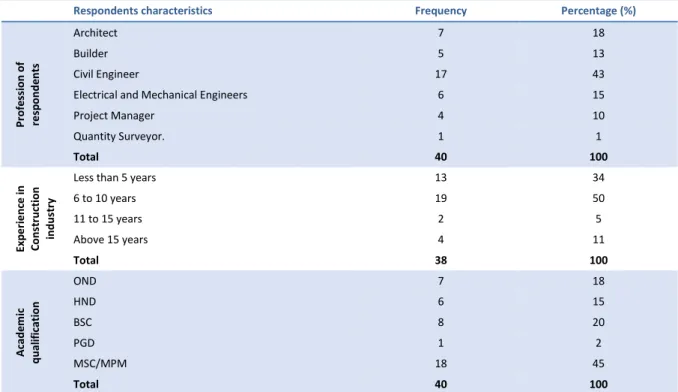
The characteristics of the various respondents that took part in this study are presented in Table 2. From the results in Table 2 it is shown for the profession of respondents, that 43% of the respondents are Civil Engineers that are main respondents that took part in the study while the next main respondents are Architects. These results suggest that Civil Engineers are actively involved in construction projects by nature of their training and had had close working relationships with Construction Managers and hence can provide reliable information about Construction Managers.
Further results from Table 2 in respect of respondents experience in the construction industry, it is shown that 50% of the respondents have between 6-10 years’ experience in the construction
Table 2: Characteristics of respondents that participated in the study
Respondents characteristics Frequency Percentage (%)
P
ro
fe
ss
io
n o
f
resp
o
n
d
en
ts
Architect 7 18
Builder 5 13
Civil Engineer 17 43
Electrical and Mechanical Engineers 6 15
Project Manager 4 10
Quantity Surveyor. 1 1
Total 40 100
Exp
er
ien
ce i
n
C
o
n
st
ru
ct
io
n
in
d
u
st
ry
Less than 5 years 13 34
6 to 10 years 19 50
11 to 15 years 2 5
Above 15 years 4 11
Total 38 100
A
ca
d
e
m
ic
q
u
a
lif
ic
a
tio
n
OND 7 18
HND 6 15
BSC 8 20
PGD 1 2
MSC/MPM 18 45
Total 40 100
Ogunsanmi, O. E. (2016). Determining the essential skill requirements for construction managers’ practice in Nigeria. International Journal of Construction Supply Chain Management Vol. 6, No. 2 (pp. 48-63). DOI: 10.14424/ijcscm602016-48-63
55 industry. This is a quite considerable experience to be able to give reliable information about the skill requirements of construction managers.
Moreover, results from Table 2 about academic qualifications of respondents that took part in this study, indicate that 45% of the respondents hold MSc/MPM degree while, 20% of the respondents have BSc degree. These results demonstrate that most respondents that took part in this study have master’s degree. They are quite qualified enough to provide reliable information about skill requirements of construction managers who have worked in their organisations.
Essential Skill Requirements for Construction Managers
For decision making on the essential skill requirements for construction managers a research hypothesis was set up. The stated null hypothesis (H0) is that personnel, managerial, industry and business, professional, technical, legal and contractual and people skills are not the most important skills a construction manager should possess. The level of significance of this test was set at 5%. Descriptive results for testing this hypothesis are presented in Table 3.
Results from Table 3 indicate that for personal skill requirements, time management (MS=4.73) and ability to learn (MS=4.70) are the two important desirable skills a construction manager will need to run a construction project. These results agree with the opinions of Satellizer (2016) and Farooqui et al. (2010). Satellizer (2016) indicates that time management is one of the four essential skills and abilities that a construction manager needs to efficiently run a construction project. Also, Farooqui et al. (2010) in investigating the desired attributes and skills of graduating construction management students in the US found that time management is one of essential skills a graduate will need. Time management ranks highest because most construction managers need time management skills to efficiently run a project as to meet the stipulated duration. Also, results of managerial skills demonstrate that site management and planning (MS=4.80), project management/ administration (MS=4.78) and health and safety management (MS=4.78) are the three most important desirable managerial skills a construction manager must have. These results agree with the findings of Osita (2015), Farooqui et al. (2010) and Burger (2016). The study of Osita (2015) on training needs of construction managers in Nigeria found site management and planning as an important skill for construction managers while the study of Farooqui et al. (2010) also found knowledge of health and safety regulation as important attribute for construction management graduating students while Burger (2016) is of the opinion that project management skills are required by construction manager. Site management and planning is required by construction managers because most construction projects are site based and hence the construction manager needs site management skills to ensure smooth running of their construction projects.
Ogunsanmi, O. E. (2016). Determining the essential skill requirements for construction managers’ practice in Nigeria. International Journal of Construction Supply Chain Management Vol. 6, No. 2 (pp. 48-63). DOI: 10.14424/ijcscm602016-48-63
56
Table 3:Descriptive result of most important skill requirements for construction managers
Skill Requirements Mean Rank Overall
Top 9 Skills P e rs o n a l s k ills
Time Management 4.73 1st 3rd
Dependability 4.43 3rd
Listening ability/ Giving attention to details 4.55 4th
Personal adaptability/ Flexibility 4.15 10th
Desire to learn 4.45 7th
Assertive attitude 4.28 9th
Promptness in actions 4.58 3rd
Comprehension ability 4.48 6th
Ability to learn 4.70 2nd 5th
Innovative mind set / Creativity 4.55 4th
M a n a g e ria l s k ills
Health and Safety management 4.78 2nd
Quality assurance/ Total Quality Management 4.63 5th
Inspection/ Quality control 4.53 6th
Document control 4.23 10th
Project management/ administration 4.78 2nd 2nd
Site planning and management 4.80 1st 1st
Personnel/ Resource management 4.35 9th
Risk planning, assessment and control 4.50 6th
In d u st ry & B u si n e ss S k il ls
Understanding cultural issues 3.80 10th
Construction organization management/ Business Management 4.10 8th Knowledge of building codes and regulations 4.30 3rd Knowledge of environment impact assessments 4.38 2nd Marketing with clients/ Developing client relations 4.20 6th Knowledge of health and safety regulations 4.53 1st Understanding complementary fields/ disciplines 4.10 5th
Awareness of industry trends 4.13 8th
Appreciation of construction industry supply chain 3.98 9th
Understanding procedural issues 4.25 4th
Knowledge of the permitting process 4.23 5th
Construction trade knowledge 4.15 7th
P ro fe ss io n a l sk ills
Hands-on project experience prior to graduation/ Internship 4.40 5th
Teamwork capabilities 4.70 1st 5th
High regards to values/ Work ethics 4.48 3rd
Planning and goal setting 4.65 2nd 7th
Long term commitment 4.33 6th
Problem solving/ Analytical skills 4.48 3rd
Plans interpretation/ Blueprint reading 4.73 1st 3rd Understanding construction & shop drawings 4.33 5th
Knowledge of construction operations 4.55 2nd
General computer proficiency 4.20 6th
Proficiency in construction information technology/ software 4.25 7th Knowledge of green and sustainable construction 4.05 9th
Scheduling 4.40 3rd
Knowledge of project closeout and handover procedures 4.33 5th
Estimating 4.35 4th
Le g al a n d Co n tr a ct u a l S k il ls
Interpreting contract documents 4.55 2nd
Knowledge of construction law and legal environment 4.43 4th
Contract administration skills 4.45 3rd
Knowledge of bidding procedures 4.38 5th
Dispute avoidance and resolution skills 4.33 6th
Knowledge of project delivery and contracting strategies 4.65 1st 7th
Change management 4.23 7th
Understanding of labour laws 4.15 8th
P e o p le S k ills
Written communication 4.55 2nd
Verbal communication 4.58 1st 9th
Diversity 4.23 4th
Trade coordination 4.10 6th
Ability to speak different languages/ Multilingual 3.80 7th
Meetings 4.33 3rd
Ogunsanmi, O. E. (2016). Determining the essential skill requirements for construction managers’ practice in Nigeria. International Journal of Construction Supply Chain Management Vol. 6, No. 2 (pp. 48-63). DOI: 10.14424/ijcscm602016-48-63
57 themselves with knowledge of construction health and safety regulations as to be able to maintain safety of workers and safe work environments. These skills will reduce accidents and hazards on construction sites. Further results in Table 3 obtained for professional skills demonstrate that teamwork capabilities (MS=4.70) and planning and goal setting (MS=4.65) are the two most important professional skills needed by a construction manager.
The results also correlates with the opinion of McCormick (2012) that stipulates team building skills as one of the top ten leadership skills while Osita (2015) also identified planning and goals setting as one of the important skills a construction manager must be equipped with. Team work capabilities are required by a construction manager to coordinate and motivate his team members for accomplishment on their Endeavors’.
Further results obtained for technical skills in Table 3 demonstrate that plans interpretation/ blueprint reading (MS=4.73) and knowledge of construction operations (MS=4.55) are the two most important technical skill requirements needed by a construction manager. These results agree with the opinion of Baharudin (2006) who indicated that construction managers should have skills of understanding engineering, architectural and other construction drawings for them to function well as construction managers as well as meeting the challenges of the profession. Plan interpretation/ blueprint reading are necessary skills for dealing with interpretation and reading of various types of drawings. These drawings are architectural, structural, mechanical and electrical engineering drawings. Proper understanding and reading of the drawings are important for the discharge of their technical skills on construction projects. For results on legal and contractual skills it is revealed that knowledge of project delivery and contracting strategies (MS=4.65) and interpreting contract documents (MS=4.55) are two important legal and contractual skills desired by a construction manager. These results corroborates with the opinion of Satellizer (2016) as well as with the findings of Farooqui et al. (2010). Satellizer (2016) indicated that knowledge of bidding procedures /negotiating skills are important for a construction manager while Farooqui et al. (2010) found that knowledge of interpreting contract documents are germane to the construction manager. Both skills are important to the construction manager because he could deal with construction of various types of projects and hence must be familiar with various strategies of project delivery and their relative advantages as well the various types of contract conditions that would go with the project delivery strategies. Procurement methodology is an important knowledge area for the construction manager.
In addition, for results on people skills it is revealed that verbal communication (MS=4.58) and written communication (MS=4.55) are the two most important people skills desired by a construction manager. These results are also in agreement with the opinions of Burger (2016) and McCormick (2012). Both sources emphasized that both verbal and written communications are necessary people skills that a construction manager must acquire. Both verbal and written communications are desirable for construction manager because every construction manager must have good listening ability and should be able to speak effectively. Effective communication is critical in any construction business.
Ogunsanmi, O. E. (2016). Determining the essential skill requirements for construction managers’ practice in Nigeria. International Journal of Construction Supply Chain Management Vol. 6, No. 2 (pp. 48-63). DOI: 10.14424/ijcscm602016-48-63
58
Table 4: Rotated factor matrix obtained from the surviving variables after factor analysis
Factor code
Variable code
Variable Description Procedural /industrial skills (D1) Quality Assurance /TQM skills. (D2) Listening skills (D3) Codes and Regulation skills (D5) Sustainable skills (D6) Learning skills (D13)
V1231 Understanding procedural issues
0.75
V1215 Team building 0.74
V1229 Awareness of industry trends
0.73
V1230 Appreciation of industry supply chain
0.73 V1205 Desire to learn 0.68 V1252 Knowledge of bidding
procedures
0.65
D1 V1249 Interpreting contract documents
0.62 V1227 Knowledge of health and
safety regulations
0.61 V1221 Risk planning, assessment
and control
0.59 V1251 Contract and
administration skills
0.59 V1255 Change management 0.58 V1226 Marketing with clients 0.58 V126 Assertive attitude 0.58 V1223 Construction organization
management
0.55
V1262 Meetings 0.55
V1247 Knowledge of project
close out 0.54
V1219 Site planning and
management 0.51 V1252 Knowledge of construction
operations 0.51 V12-12 Dispute avoidance and
resolution skills
0.50
D2 V12-03 Quality assurance/ total quality management
-0.60
D3 V12-24 Listening ability/ giving attention to details
-0.50
D5 V12-45 Knowledge of building codes and regulations
0.62
D6 V12-09 Knowledge of green and sustainable construction
0.52
D13 V12-09 Ability to learn 0.61
Eigen values
15.68 5.41 4.05 3.20 2.95 1.49
% of variance
24.89 8.58 6.43 5.09 4.68 2.36
Exploratory Factor Analysis of Skill Requirements of Construction Managers
Ogunsanmi, O. E. (2016). Determining the essential skill requirements for construction managers’ practice in Nigeria. International Journal of Construction Supply Chain Management Vol. 6, No. 2 (pp. 48-63). DOI: 10.14424/ijcscm602016-48-63
59 were subjected to Factor Analysis to determine the most important skills for the construction manager in Nigeria.
In this study, the Principal Components Analysis was employed and orthogonal varimax rotation was undertaken. For this data set the KMO measure of sampling adequacy/Bartlett’s test of sphericity was not calculated in the SPSS results possibly because 40 cases were used. Correlation Matrix was used in the Exploratory Factor Analysis to display the relationships between the individual variables. The correlation coefficient were examined and some variables showed correlation coefficients of 0.30 and greater than 0.30 (r>+/-0.30) which indicates some measure of patterned relationship among the variables and also since the correlation coefficients are not above 0.90 (r>+/-0.90) the problem of multicollinearity does not occur in the Factor Analysis. Also, a follow up check for the Determinant Score indicates a value of 0.0000 which also confirms the absence of multicollinearity. Communalities were all above 0.30 further confirming that each variable shared same variance with other variables. Given these indications the Exploratory Factor Analysis was conducted for the 63 skills requirement variables.
For the factor rotation, using an Eigen value cut-off of 1.0 there were eighteen (18) factors that explained a total cumulative variance of 86.18%. The scree plot also confirmed the findings of retaining 18 factors. Table 4 shows the rotated factor matrix using a significant factor criteria of 0.50 (Yong & Peerce, 2013) for which a total of fourteen (14) complex variables that loaded on more than one factors were removed from the final analysis as they did not contribute to the simple factor structure. After the grouping, naming and interpretation of the surviving variables, six (6) newly emerging factors were identified as procedural-industrial skills, quality assurance/management skills, listening skills, codes and regulation skills, sustainable skills and learning skills and these are the most important skill requirements that a construction manager should possess. The six factors emanating from the Exploratory Factor Analysis are described in the following subsections.
Factor 1 (D1) – Procedural-Industrial Skills
Ogunsanmi, O. E. (2016). Determining the essential skill requirements for construction managers’ practice in Nigeria. International Journal of Construction Supply Chain Management Vol. 6, No. 2 (pp. 48-63). DOI: 10.14424/ijcscm602016-48-63
60 management that loaded on Factor1 was also in agreement with the descriptive results of the study.
Factor 2 (D2) – Quality Assurance/Management Skills
Factor 2 (D2) is derived from quality assurance /total quality management variable (-0.60) that has the highest loading on the factor and is relating to quality assurance and total management skill. A construction manager must have good skills in applying quality assurance/ total quality management techniques to building production management. This factor also explains 8.58% of the total variance.
Factor 3 (D3) – Listening Skills
Factor 3 is derived from listening ability/giving attention to details (-0.54) and it has the highest loading on this factor and is relating to listening skills of the construction manager. A good construction manager is expected to have the ability to listen to complaints emanating from the jobs, consultants and from the clients. The manager must be able to give enough attention to construction details as may be required in planning and executing construction projects. This factor also explains 6.43% of the total variance. Listening ability/giving attention to details that loaded on factor 3 was also in agreement with the findings of Farooqui et al. (2010) where this variable was ranked third in their study of desirable attributes and skills for graduating construction management students in the US.
Factor 4 (D5) – Codes and Regulation Skills
Factor 4 is derived from knowledge of building codes and regulations (0.62) and this variable has the highest loading on this factor. It relates to ability of a construction manager to understand, interpret and apply building codes and construction regulations to construction projects. Several codes in terms of British standards, Nigerian National Building Codes, Town planning Acts and others are available for which construction managers must be well familiar with for effective discharge of their functions and duties on construction projects. This factor also explains 5.09% of the total variance. Knowledge of building codes and regulations that loaded on Factor 4 was also in agreement with the findings of Farooqui et al. (2010) where this variable was ranked fourth in their study of desirable attributes and skills for graduating construction management students in the US.
Factor 5 (D6) – Sustainability Skills
Ogunsanmi, O. E. (2016). Determining the essential skill requirements for construction managers’ practice in Nigeria. International Journal of Construction Supply Chain Management Vol. 6, No. 2 (pp. 48-63). DOI: 10.14424/ijcscm602016-48-63
61
Factor 6 (D13) – Learning Skills
Factor 6 is also derived from ability to learn (0.61). This variable has the highest loading on this factor. It relates to ability of a construction manager to learn either on the job or while undergoing professional trainings. Construction managers must have the skills to learn quickly on the job and also when in training. This skill can aid his performance when managing and planning for construction project executions. Also, ability to learn that loaded on Factor 6 was also in agreement with the descriptive results of the study.
Thus, it is evident from the Factor Analysis that six (6) emerging distinct factors were the essential skill requirements a construction manager must bring to his/her work. These six most essential skill requirements are procedural-industrial skills (19 variables), quality assurance/ management skills (1 variable), Listening Skill (1 varaible), codes and regulation application skill (1 variable), sustainable skill (1 variable) and learning skill (1 variable). On basis of the Factor Analysis Sixty-three (63) skill requirements variables have been reduced to twenty-four (24) essential skill requirements a construction manager must possess. These results also agree with the descriptive results where the top nine essential skills requirements for a construction manager in Nigeria were identified and ranked as site planning, interpreting contract documents, knowledge of construction operations, knowledge of Health and Safety regulations, team building and knowledge of bidding procedures which were all loaded on factor 1, as procedural- industrial skill, while Ability to learn was loaded on factor 6 as learning skills. Most other variables identified and ranked as essential skill requirements for the construction manager from the descriptive results were loaded below the cut-off point of 0.50 and some were complex in nature. That is, variables loading on more than one factor.
In summary, the essential skills a construction manager would require for their jobs are from six skill category areas of procedural-industrial skills, quality assurance/ management skills, listening skills, codes and regulation skills, sustainable skills and learning skills. These skills are: understanding of procedural issues, team building, awareness of industry trends, appreciation of construction industry supply chain, desire to learn, knowledge of bidding procedures, interpreting contract documents, knowledge of health and safety regulations. Also, are risk planning and control, contract and administration skills, change management, marketing with clients, assertive attitude, construction organization management, meetings, knowledge of project close out, site planning and management, knowledge of construction operations, dispute avoidance and resolution skills, quality assurance/total quality management, listening ability/giving attention to details, knowledge of building codes and regulations, knowledge of green and sustainable construction and ability to learn. All these twenty-four (24) essential skills are important for any construction manager to practice effectively in Nigeria.
Implications of the Study
Ogunsanmi, O. E. (2016). Determining the essential skill requirements for construction managers’ practice in Nigeria. International Journal of Construction Supply Chain Management Vol. 6, No. 2 (pp. 48-63). DOI: 10.14424/ijcscm602016-48-63
62 managerial skills, personal skills and technical skills. These may produce new construction management graduates that are well equipped with the essential knowledge and skills desired in the construction industry. In terms of practice, the implication of this study indicates that recruiting agencies at both government and private sectors should critically assess both the hard and soft skills of professional construction managers before engagement as to ensure adequate and efficient management of future construction projects in Nigeria and other developing countries).
CONCLUSION
From the findings of this study it can be concluded that construction managers need to have and be equipped with some essential skills that are necessary for their construction jobs. This study identified some of these essential skills as procedural-industrial skills, quality assurance/management skills, listening skills, knowledge of codes and regulation skills, sustainable skills and ability to learn skills. These skills emanate more from skills of business /construction industry procedures. The study recommends a total overhauling of our present educational curricula that may probably be deficient in some areas that need the reflection of the current demands and trends of the construction industry. Since, these curricula are still been used in training of construction managers by professional bodies, universities and other higher institutions there is need for their improvement. Graduates produced from these improved programmes would have the essential skills that can cope with the ever changing conditions of the industry where new technology and construction methods are daily evolving. These will equip the graduates with new skills to cope with their professional duties, roles and functions in the construction industry. Professional bodies should also be involved in organizing training programmes for their members in areas of acquisition of management, legal and contractual and business skills. Acquisition of these essential skills will enhance better management of future construction projects.
REFERENCES
Ahn, Y. H., Pearce, A. R., Kwon, H. & Shin, H. (2010). Key competency for US construction graduates: An exploratory factor analysis. Retrieved April 16, 2016, from http://ascpro.ascweb.org.crt170002010.pdf.
Adi, H. P. & Ni’am, M. F. (2012). Improving skills strategies of Indonesian construction labours to have global
competitiveness. International Journal of Civil and Structural Engineering, 3(1), 150-157.
Bahamdin, K. S. B. (2006). Construction management skills for the global market. Jurutera Bulletin (Institution of Engineers Malaysia). Retrieved April 19, 2016, from http://dspace.unimap.edu.my./Bitstream/034-035constructionmgtpdf.
Burger, R. (2015). What are employers looking for in construction managers? Retrieved April 7, 2016 from http://blog.capettera.com/employers-looking-construction-managers/.
Bilau, A. A., Ajagbe, M. A., Kigbu, H. H & Sholanke, A. B. (2015). Review of shortage of skilled craftsmen in
small and medium construction firms in Nigeria. Journal of Environment and Earth Science, 5(15),
98-110.
Capital, B. (2013). Know the skills of a successful construction project manager. Publication of Balboa Capital, California, USA, Retrieved March 14, 2016, from http://www.forconstructionpros.com/article/10884865/ skills-of-a-successful-construction-project-manager.
Enshassi, A,. Mohammed, S. & Ekarriri, A. (2009). Essential skills and training provisions for building project
stakeholders in Palestine. Journal of Construction in Developing Countries, 14(1), 31-50.
Ogunsanmi, O. E. (2016). Determining the essential skill requirements for construction managers’ practice in Nigeria. International Journal of Construction Supply Chain Management Vol. 6, No. 2 (pp. 48-63). DOI: 10.14424/ijcscm602016-48-63
63
McCormick, M. (2012). Essential project manager leadership skills. Retrieved March 17, 2016, from http://www.mccurmickspcs.com.
Morado, A. (2012). Balancing project management hard and soft skills. Retrieved April 18, 2016, from http://www.projectmgt.brandis.edu/downlocd.
Nairaland. (2016). 10 ongoing mega construction projects in Nigeria. Pictures-politics-Nigeria. Retrieved April 14, 2016, from http://www.nairaland.com/2439219/10-ongoing.mega.contruction.projects.
Okoye, P. U., Ngwu, C. & Ugochukwu, S. C. (2015). Evaluation of management challenges facing construction
practice in Nigeria. International Journal of Application or Innovation in Engineering and Management
(IJAIEM), 4(1), 19-28.
Osita, N. B. (2015). Training needs of construction managers in Nigeria. Unpublished MSc dissertation of School of Postgraduate Studies, University of Lagos, Lagos. Nigeria.
Pearson. (2002). Basic skills for project managers. Retrieved April 14, 2016 from, http://catalogue.pearsoned.co.uk/samplechapter.
Reeves, L. (2016). Difference between construction manager and project manager. Retrieved April 15, 2016, from, http://workchrun.com/difference-between-construction-manager-projectmanager-15135.html.
Sanni, A. O. (2016). Factors determining the success of public private partnership in Nigeria. Construction
Economics and Building, 16(2), 42-45. doi: http://dx.doi.org/10.5130/AJCEB.v16i2.4828
Satellizer (2016). Construction management. Retrieved August 28, 2015, from https://en.wikipeidia.org/wiki/construction-management.
Study.com (2015). Construction manager: Job description and career requirements. Retrieved August 28, 2016, from http://study.com/articles/Construction_Manager_Job_Description_and_Requirements_for_a_Career _in _Construction_Mgmt.html.
Skizzik. (2016). Skill. Retrieved March 14, 2016, from https://en.wikipedia.org/wiki/skill.
Strauss, E. (2016). Job skills US attributes. Retrieved March 15, 2016, from https://work.chron.com/jobsineducation.
Targetjobs. (2015). Essential skills for construction industry jobs and how to show employers you have them. Retrieved August 28, 2015, from https://targetjobs.co.uk/career-sectors/construction-and-building-services/316361-essential-skills-for-construction-industry-jobs-and-how-to-show-emp.
Urban Property Finder. (2016). Top 8 mind-blowing construction projects in Nigeria. Retrieved April14, 2016, from http://www.urbanprojectfinder.com/top-8-mind-blowing-construction-project-in-nigeria./
Williams, B., Brown, T., & Onsman, A. (2010). Exploratory factor analysis: A five-step guide for novices.
Australasian Journal of Paramedicine, 8(3), 1-13.
Work Ready. (2016). Construction Manager. Retrieved April 15, 2016, from
https://www/skills.sa.gov.au/careers-job/choosing-your-career/rearch-careers-and-industries/building-construction-including-funiture-construct/construction-manager.
Yong, A. G. & Pearce, S. (2013). A beginners guide to factor analysis: Focusing on exploratory factor analysis,
Tutorials in Quantitative Methods for Psychology, 9(2), 79-94.
Watermeyer, B. R. (2004). Facilitating sustainable development through public and donor regimes: Tools and