www.biogeosciences.net/10/101/2013/ doi:10.5194/bg-10-101-2013
© Author(s) 2013. CC Attribution 3.0 License.
Biogeosciences
Nitrogen isotopes in bulk marine sediment: linking seafloor
observations with subseafloor records
J.-E. Tesdal1,*, E. D. Galbraith1, and M. Kienast2
1Department of Earth and Planetary Sciences, McGill University, Montreal, Quebec, Canada 2Department of Oceanography, Dalhousie University, Halifax, Nova Scotia, Canada
*now at: School of Earth and Ocean Sciences, University of Victoria, Victoria, British Columbia, Canada
Correspondence to:E. D. Galbraith ([email protected])
Received: 15 March 2012 – Published in Biogeosciences Discuss.: 30 March 2012 Revised: 2 November 2012 – Accepted: 26 November 2012 – Published: 9 January 2013
Abstract.The stable isotopes of nitrogen offer a unique per-spective on changes in the nitrogen cycle, past and present. However, the presence of multiple forms of nitrogen in ma-rine sediments can complicate the interpretation of bulk nitrogen isotope measurements. Although the large-scale global patterns of seafloorδ15N have been shown to match process-based expectations, small-scale heterogeneity on the seafloor, or alterations of isotopic signals during transla-tion into the subseafloor record, could obscure the primary signals. Here, a public database of nitrogen isotope mea-surements is described, including both seafloor and sub-seafloor sediment samples ranging in age from modern to the Pliocene, and used to assess these uncertainties. In general, good agreement is observed between neighbouring seafloor sites within a 100 km radius, with 85 % showing differences of<1 ‰. There is also a good correlation between theδ15N of the shallowest (<5 ka) subseafloor sediments and neigh-bouring seafloor sites within a 100 km radius (R2=0.83), which suggests a reliable translation of sediments into the buried sediment record. Meanwhile, gradualδ15N decreases over multiple glacial–interglacial cycles appear to reflect post-depositional alteration in records from the deep sea (be-low 2000 m). We suggest a simple conceptual model to ex-plain these 100-kyr-timescale changes in well-oxygenated, slowly accumulating sediments, which calls on differential loss rates for pools of organic N with differentδ15N. We con-clude that bulk sedimentary nitrogen isotope records are re-liable monitors of past changes in the marine nitrogen cycle at most locations, and could be further improved with a bet-ter understanding of systematic post-depositional albet-teration. Furthermore, geochemical or environmental criteria should
be developed in order to effectively identify problematic lo-cations and to account for confounding influences where pos-sible.
1 Introduction
Nitrogen is a critical nutrient element in marine ecosystems, limiting the growth of marine life over most of the oceans (Falkowski, 1997). The supply of bioavailable nitrogen is currently being modified anthropogenically in multiple ways (Gruber and Galloway, 2008). Future changes in the nitrogen cycle have the potential to significantly impact the oceanic nutrient regime, with significant implications for the marine ecosystem, but uncertainty remains regarding how sensitive the nitrogen cycle will prove to be.
Measurements of nitrogen isotopes in marine sediments provide a unique way of understanding the past and present marine nitrogen cycle and its relationship to cli-mate change. The nitrogen isotope ratio (15N/14N) in a sam-ple is expressed relative to the nitrogen isotope composi-tion of a standard, convencomposi-tionally atmospheric nitrogen gas (δ15N=([15N/14N]sample/ [15N/14N]air−1)×1000 ‰). Over
the past two decades, the systematics of nitrogen isotopes in the ocean have become increasingly well understood, provid-ing a sound theoretical basis for their interpretation (Altabet, 2006; Galbraith et al., 2008a). Meanwhile, scores of individ-ual marine sedimentary δ15N records have been published, spanning from the late Holocene to the early Pliocene.
inorganic nitrogen. The latter is dominated by clay-bound NH+4, and can be significant in areas of high clay input rela-tive to organic matter sedimentation (Schubert and Calvert, 2001; Kienast et al., 2005). Terrestrial organic matter can also be significant in the vicinity of rivers or glacial dis-charge with high particulate loads (McKay et al., 2004), but tends to be overwhelmed by marine organic matter elsewhere (Altabet, 2006). Because we are generally interested in ma-rine organic nitrogen, the terrestrial and inorganic sources are viewed as contaminants to be avoided.
Theδ15N of marine organic matter exported from the sur-face is equal to the isotopic composition of the nitrogen sub-strate supplied to the surface. A small fraction of this nitro-gen is provided by local N2fixation or atmospheric
deposi-tion, but the majority is supplied by upward transport from the subsurface nitrate reservoir. The isotopic composition of nitrate itself is determined by fractionation during the uptake of nitrate by phytoplankton (Needoba et al., 2004) and the conversion of bioavailable N to N2gas by denitrification
(in-cluding anammox) (Brandes and Devol, 1997). Both of these reactions are more rapid for 14N than for15N, leaving the residual nitrogen pool enriched in15N. The uptake fraction-ation of phytoplankton leads only to internal gradients in the ocean, with low values in nitrate-rich regions and high val-ues in the nitrate-poor gyres (Galbraith et al., 2013), while the loss of14N through denitrification causes the global fixed
N pool to be enriched relative to its source (∼5 ‰, Bran-des and Devol, 2002). The sources of biologically available nitrogen to the ocean, from terrestrial inputs and marine N2
fixation, appear to cluster around 0 ‰ (Brandes and Devol, 2002; Knapp et al., 2010), though they remain poorly con-strained.
Alteration ofδ15N from the primary marine signal to the preserved sedimentary value, parochially known as diagene-sis, has long been recognized as a concern (Altabet and Fran-cois, 1994). Theδ15N of sinking particles has been shown to vary in the water column with no clear relationship with water depth, suggesting heterogenous processes that vary in time and space (Robinson et al., 2012; Lourey et al., 2003). Yet, the global pattern of seafloorδ15N shows broad similar-ities to that expected from both water column nitrate isotopic measurements and global isotope-biogeochemical models, showing that the material that reaches the seafloor is a bet-ter reflection of surface processes than the sinking particles would suggest (Robinson et al., 2012; Galbraith et al., 2013). Nonetheless, bulkδ15N could be compromised either (1) by significant variability in seafloorδ15N over small scales, ren-dering individual records suspect, or (2) if subseafloor sedi-ments of the geological record do not faithfully represent the isotopic composition of their modern (seafloor) counterparts due to diagenetic alteration. Neither of these concerns can be easily addressed from individual records alone.
Here, we describe the first iteration of a global database of published marine bulk sedimentδ15N measurements, includ-ing both seafloor and subseafloor downcore sediments. The
Nitrogen Cycle in the Oceans, Past and Present (NICOPP) database is intended to aid in deciphering the overlapping isotopic factors over a broad range of timescales, while an-swering a call for more thorough data management within the geoscience community at large (Parsons et al., 2010). The compilation aims to include all publishedδ15N records from marine sediments of any age retrieved from anywhere in a modern ocean basin (i.e. not including marine sediments now found on land). Some unpublished data are also included in the database. The current database includes only bulk sedi-mentaryδ15N, which represents the isotopic composition of all combustible nitrogen in the sediment. Additional types of δ15N measurements, such as species-specificδ15N measure-ments (diatom, foraminifera, etc.), could be added in future. We anticipate that, by assembling allδ15N records previously presented in the literature, the patterns of multiple nitrogen cycling processes will become clearer, local discrepancies more obvious, data gaps highlighted, and progress will be more efficiently made toward quantifying the fidelity with which sedimentaryδ15N tracks sinking and sedimented or-ganic matter.
The goals of this paper are twofold: first, to provide a brief technical description of the NICOPP database for future in-vestigators who will focus on specific aspects of the data therein; second, to use the database in order to evaluate the degree to which downcore sedimentaryδ15N records reflect theδ15N of nearby core-top data, through a spatial compari-son with neighbouring observations and a temporal compar-ison with observations throughout the Late Pleistocene. This provides a novel global view on spatial variability inδ15N and diagenesis. We do not discuss detailed interpretations of theδ15N records here as they inform past changes in the N cycle; this complex topic is left for other works to explore.
The sedimentaryδ15N database is available for use by the scientific community to assist in further research and anal-ysis. The database will be updated as new records become available, and the authors welcome additional contributions.
2 Database description
0 4 8 12 16 5
10 15 20
%
δ
15
N
[‰]
3 4 5 6 7 8 9 10 11 12
δ15N [‰]
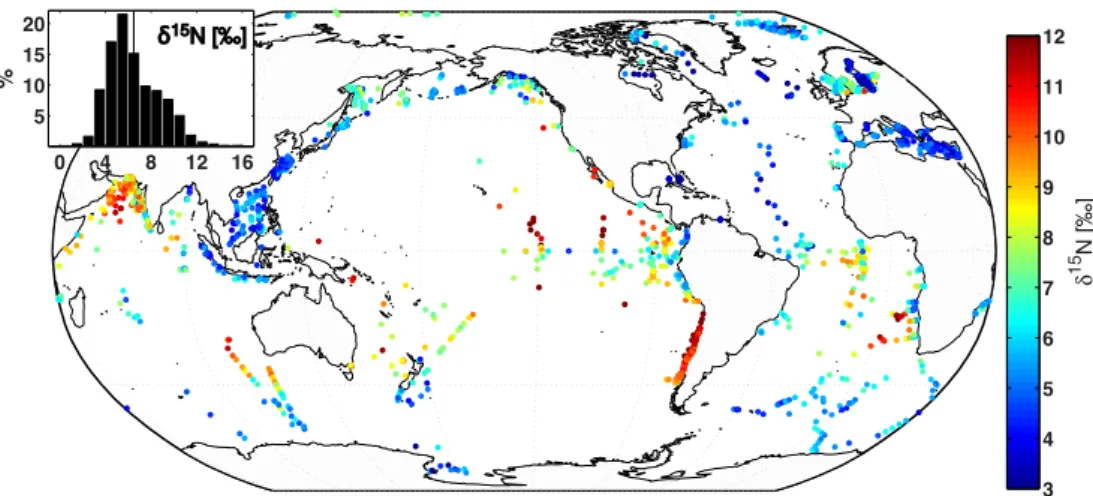
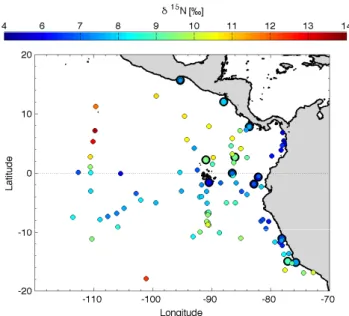
Fig. 1.Spatial distribution of surface sedimentδ15N samples. References for published data are provided on the web site. Unpublished data are from Galbraith et al. (2013) and this study. Inset: histogram of surfaceδ15N (in 1-kyr bins). The vertical line indicates the mean of 6.7 ‰, higher than the averageδ15N of nitrate in the ocean (∼5 ‰). Note the dataset is skewed towards heavier nitrogen isotopic composition.
air), and some laboratories supplement these with their own sediment standards.
The combusted material is dominated by marine organic matter at most locations, although there is significant con-tamination by clay-bound inorganic (Kienast et al., 2005) and terrigenous nitrogen (Schubert and Calvert, 2001) in some locations. Given the known problems with acidification of samples (Brodie et al., 2011), we flagged samples that had been acidified where possible, though acidification is not always reported. Reported errors for the bulk combustion method are generally better than±0.3 ‰ for replicates.
The database is publicly available and can be accessed at http://www.ncdc.noaa.gov/paleo/pubs/nicopp/nicopp.html. It may be expanded to include mineral-bound and compound-specific fractions in future.
2.1 Seafloor sediments
Thus far, the collection of seafloor sedimentδ15N contains more than 2300 sites, which include only real sediment mea-surements from any depth and region of the ocean seafloor (Fig. 1). Most of these sites (ca. 90 %) are multicores, giant-box cores, or core-tops of piston and gravity cores. There is some uncertainty about what time range the seafloor sedi-ment samples represent. Very few seafloorδ15N values have been associated with an actual age measurement, but we can assume that in low sedimentation regions samples represent a much longer timescale (order 103yr) compared with high-sedimentation sites (order 102yr).
The seafloorδ15N values range from 2.5 to 16.6 ‰ (Fig. 1, inset). The average isotopic composition is 6.7 ‰, higher than the average isotopic composition of nitrate in the ocean (∼5 ‰, Sigman et al., 1997, 1999). However, the dataset is positively skewed towards higherδ15N, such that the major-ity of sites have values centred at around 4 to 6 ‰ (Fig. 1, inset). Given the highly irregular sampling pattern (Fig. 1),
a significant spatial bias is likely, and may partially explain the elevated mean value. However, it has been shown that the δ15N of bulk nitrogen in well-oxygenated sediments of the deep sea is higher than theδ15N of organic matter exported from the surface (Altabet and Francois, 1994), with a general increase of 0.75 per km water depth (Robinson et al., 2012; Galbraith et al., 2013). This is likely the primary explanation for the generally elevated seafloorδ15N.
The global map of seafloorδ15N (Fig. 1) reveals region-ally consistent patterns, aligned with large-scale oceanic fea-tures. As expected from prior work, regions of upwelling have lowerδ15N due to incomplete consumption of nitrate, while regions near zones of water column anoxia have higher δ15N due to the preferential loss of14N nitrate during deni-trification. These patterns are discussed in detail elsewhere (Galbraith et al., 2008a and references therein).
2.2 Subseafloor sediments
The subseafloor database includes δ15N measurements and corresponding sediment depths, as well as (where available) a published age model, nitrogen content (% N), total organic carbon content (% Corg) and dry bulk density. We identified
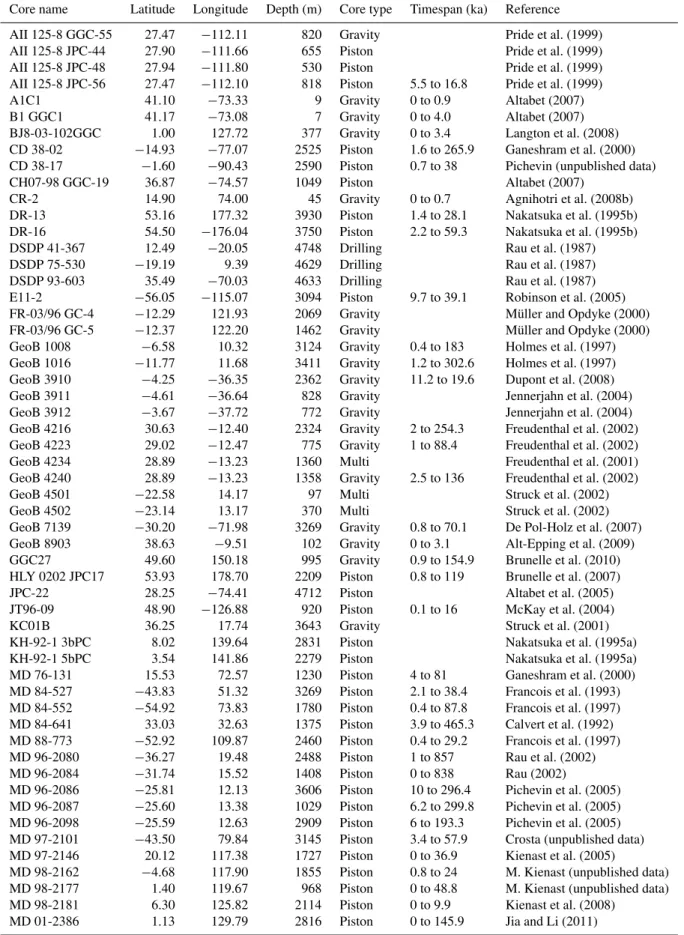
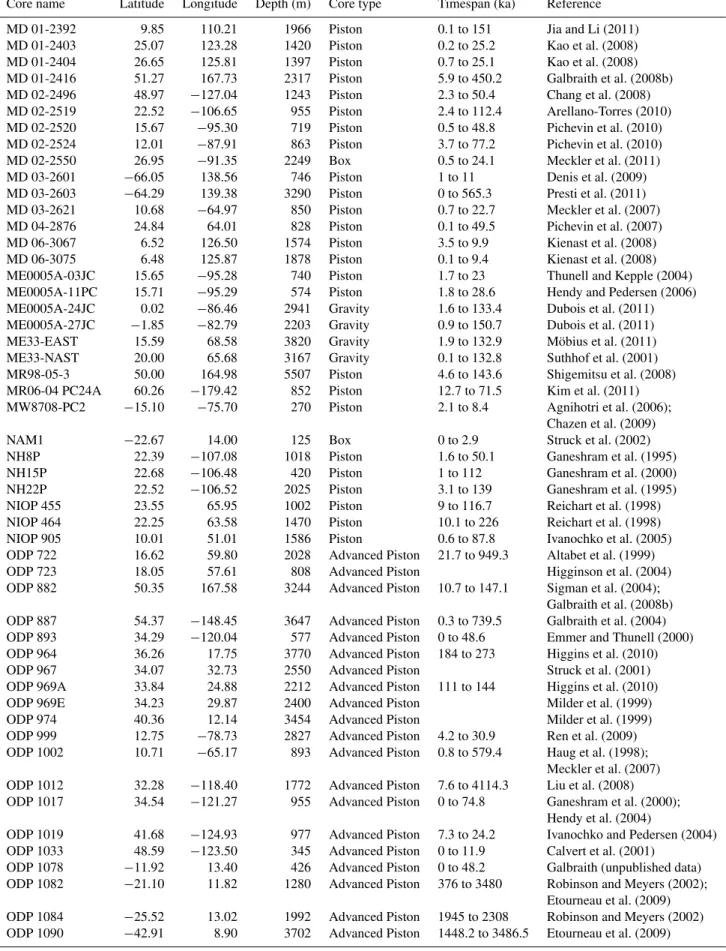
173 subseafloor records for which bulk sedimentary δ15N data exist (Table 1). We obtained δ15N data for 153 core sites, while we could only obtain a complete set of ancil-lary measurements (% N, % Corg, dry bulk density) for 14 of
those core sites, while an additional 79 core sites have at least % N or % Corg. Age models were entered as published in the
original references with no alteration (with a few exceptions where the age model was unavailable and needed to be re-generated from the original age control data).
60° E 120° E 180° W 120° W 60° W 0° 60° S
30° S 0° 30° N 60° N
Average Difference [‰]
0 0.5 1 1.5 2 2.5 3
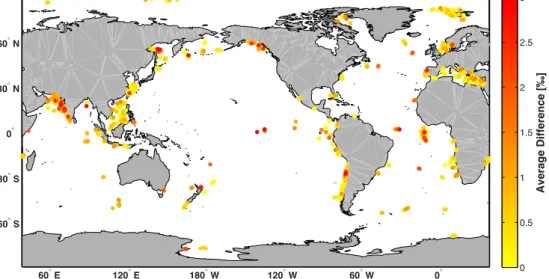
Fig. 2.Map of seafloor samples indicating the difference between theδ15N of the sample and the meanδ15N of its neighbours (within a 100 km radius). The differences are small for most of the available locations. Data points with larger differences are plotted on top of those with smaller differences, to highlight regions where high spatial variability exists.
concentrated at regions of interest, including those associated with coastal upwelling and/or suboxic conditions with water column denitrification. Thus, the database has a high degree of spatial bias. In particular, as illustrated in Figs. 2 and 3a, a considerable number of records are from the Arabian Sea (17 %), the South China Sea (13 %), the eastern equatorial Pacific (19 %), the west coasts of North (12 %) and South America (14 %), and the southwest coast of Africa (11 %). As in the case of surface sediment sampling (Fig. 1), we have vast regions of the ocean, especially in the Southern Hemi-sphere, where the spatial coverage ofδ15N records is very poor. There were no published downcore records found in the Bay of Bengal, the southwest Pacific or, surprisingly, most of the North Atlantic (Fig. 3).
The temporal coverage of the available δ15N records shows, unsurprisingly, a strong bias toward the more recent timescales of the Holocene and Late Pleistocene periods. We find the maximum number of records between 5 and 20 ka before present (BP) (Fig. 4b). As one might expect, most of the records that go beyond the last glacial–interglacial cycle (i.e. the last∼120 ka) have the disadvantage of being con-siderably coarser in resolution. In fact, the average sampling frequency for the most recent times is as high as five mea-surements per kyr, dropping to less than one measurement per kyr by about 65 ka, and to one measurement every 4 kyr by 100 ka BP. To compare these unequally spaced time series ofδ15N records quantitatively, we created a common age axis by interpolating allδ15N records.
3 Spatial and temporal consistency in sedimentaryδ15N
3.1 Consistency at the seafloor
According to Fig. 1, some regions display strong gradi-ents of surface δ15N, such as in the eastern Arabian Sea, where gradients as large as 4.5 ‰ occur within∼1◦ of lat-itude/longitude. In order to more clearly identify regions of pronounced small-scale variability, we analysed the similar-ity of neighbouring seafloor samples within 100 km of each other (Fig. 2). This variance could be due to oceanic fronts generating gradients in theδ15N of exported organic matter, sedimentary processes causing heterogeneity at the seafloor, or even to discrepancies in measurement techniques. How-ever, apart from a few regions (most notably the eastern Ara-bian Sea, central equatorial Pacific, and central equatorial At-lantic) the difference between neighbouring seafloor samples is small: less than the measurement error of 0.3 ‰ in 43 % of samples, and less than 1 ‰ in 85 % of samples.
Table 1.List ofδ15N records in the NICOPP database (as of 21 September 2012).
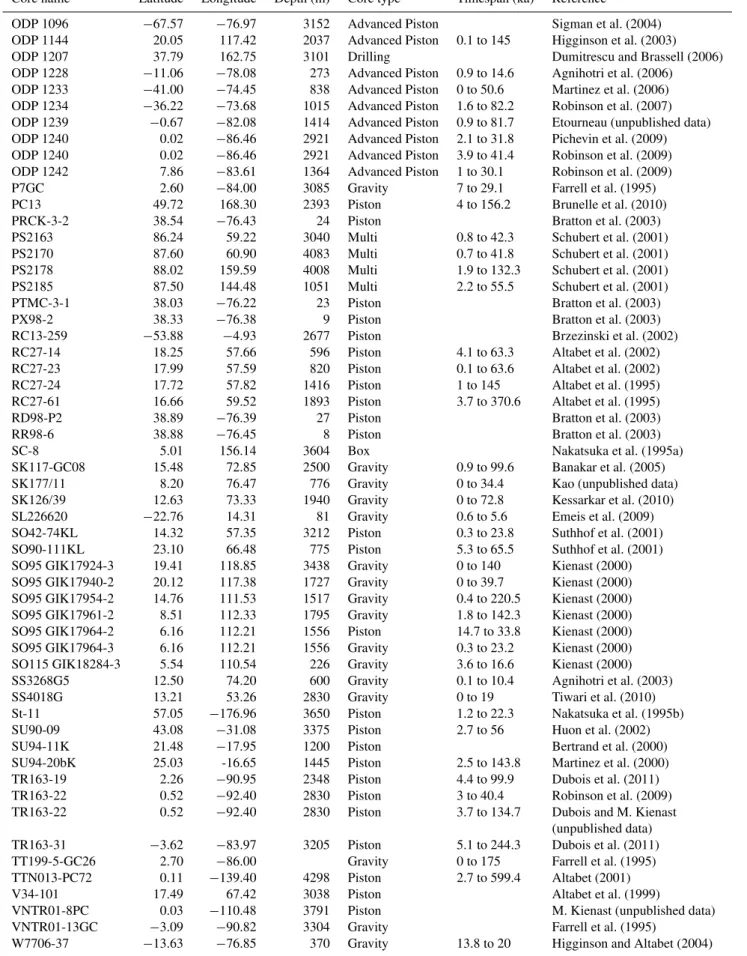
Core name Latitude Longitude Depth (m) Core type Timespan (ka) Reference
AII 125-8 GGC-55 27.47 −112.11 820 Gravity Pride et al. (1999)
AII 125-8 JPC-44 27.90 −111.66 655 Piston Pride et al. (1999)
AII 125-8 JPC-48 27.94 −111.80 530 Piston Pride et al. (1999)
AII 125-8 JPC-56 27.47 −112.10 818 Piston 5.5 to 16.8 Pride et al. (1999)
A1C1 41.10 −73.33 9 Gravity 0 to 0.9 Altabet (2007)
B1 GGC1 41.17 −73.08 7 Gravity 0 to 4.0 Altabet (2007)
BJ8-03-102GGC 1.00 127.72 377 Gravity 0 to 3.4 Langton et al. (2008) CD 38-02 −14.93 −77.07 2525 Piston 1.6 to 265.9 Ganeshram et al. (2000) CD 38-17 −1.60 −90.43 2590 Piston 0.7 to 38 Pichevin (unpublished data)
CH07-98 GGC-19 36.87 −74.57 1049 Piston Altabet (2007)
CR-2 14.90 74.00 45 Gravity 0 to 0.7 Agnihotri et al. (2008b)
DR-13 53.16 177.32 3930 Piston 1.4 to 28.1 Nakatsuka et al. (1995b)
DR-16 54.50 −176.04 3750 Piston 2.2 to 59.3 Nakatsuka et al. (1995b)
DSDP 41-367 12.49 −20.05 4748 Drilling Rau et al. (1987)
DSDP 75-530 −19.19 9.39 4629 Drilling Rau et al. (1987)
DSDP 93-603 35.49 −70.03 4633 Drilling Rau et al. (1987)
E11-2 −56.05 −115.07 3094 Piston 9.7 to 39.1 Robinson et al. (2005)
FR-03/96 GC-4 −12.29 121.93 2069 Gravity M¨uller and Opdyke (2000)
FR-03/96 GC-5 −12.37 122.20 1462 Gravity M¨uller and Opdyke (2000)
GeoB 1008 −6.58 10.32 3124 Gravity 0.4 to 183 Holmes et al. (1997) GeoB 1016 −11.77 11.68 3411 Gravity 1.2 to 302.6 Holmes et al. (1997) GeoB 3910 −4.25 −36.35 2362 Gravity 11.2 to 19.6 Dupont et al. (2008)
GeoB 3911 −4.61 −36.64 828 Gravity Jennerjahn et al. (2004)
GeoB 3912 −3.67 −37.72 772 Gravity Jennerjahn et al. (2004)
GeoB 4216 30.63 −12.40 2324 Gravity 2 to 254.3 Freudenthal et al. (2002) GeoB 4223 29.02 −12.47 775 Gravity 1 to 88.4 Freudenthal et al. (2002)
GeoB 4234 28.89 −13.23 1360 Multi Freudenthal et al. (2001)
GeoB 4240 28.89 −13.23 1358 Gravity 2.5 to 136 Freudenthal et al. (2002)
GeoB 4501 −22.58 14.17 97 Multi Struck et al. (2002)
GeoB 4502 −23.14 13.17 370 Multi Struck et al. (2002)
GeoB 7139 −30.20 −71.98 3269 Gravity 0.8 to 70.1 De Pol-Holz et al. (2007)
GeoB 8903 38.63 −9.51 102 Gravity 0 to 3.1 Alt-Epping et al. (2009)
GGC27 49.60 150.18 995 Gravity 0.9 to 154.9 Brunelle et al. (2010)
HLY 0202 JPC17 53.93 178.70 2209 Piston 0.8 to 119 Brunelle et al. (2007)
JPC-22 28.25 −74.41 4712 Piston Altabet et al. (2005)
JT96-09 48.90 −126.88 920 Piston 0.1 to 16 McKay et al. (2004)
KC01B 36.25 17.74 3643 Gravity Struck et al. (2001)
KH-92-1 3bPC 8.02 139.64 2831 Piston Nakatsuka et al. (1995a)
KH-92-1 5bPC 3.54 141.86 2279 Piston Nakatsuka et al. (1995a)
MD 76-131 15.53 72.57 1230 Piston 4 to 81 Ganeshram et al. (2000)
MD 84-527 −43.83 51.32 3269 Piston 2.1 to 38.4 Francois et al. (1993) MD 84-552 −54.92 73.83 1780 Piston 0.4 to 87.8 Francois et al. (1997) MD 84-641 33.03 32.63 1375 Piston 3.9 to 465.3 Calvert et al. (1992) MD 88-773 −52.92 109.87 2460 Piston 0.4 to 29.2 Francois et al. (1997)
MD 96-2080 −36.27 19.48 2488 Piston 1 to 857 Rau et al. (2002)
MD 96-2084 −31.74 15.52 1408 Piston 0 to 838 Rau (2002)
MD 96-2086 −25.81 12.13 3606 Piston 10 to 296.4 Pichevin et al. (2005) MD 96-2087 −25.60 13.38 1029 Piston 6.2 to 299.8 Pichevin et al. (2005) MD 96-2098 −25.59 12.63 2909 Piston 6 to 193.3 Pichevin et al. (2005) MD 97-2101 −43.50 79.84 3145 Piston 3.4 to 57.9 Crosta (unpublished data) MD 97-2146 20.12 117.38 1727 Piston 0 to 36.9 Kienast et al. (2005)
MD 98-2162 −4.68 117.90 1855 Piston 0.8 to 24 M. Kienast (unpublished data) MD 98-2177 1.40 119.67 968 Piston 0 to 48.8 M. Kienast (unpublished data)
MD 98-2181 6.30 125.82 2114 Piston 0 to 9.9 Kienast et al. (2008)
Table 1.Continued.
Core name Latitude Longitude Depth (m) Core type Timespan (ka) Reference
MD 01-2392 9.85 110.21 1966 Piston 0.1 to 151 Jia and Li (2011)
MD 01-2403 25.07 123.28 1420 Piston 0.2 to 25.2 Kao et al. (2008)
MD 01-2404 26.65 125.81 1397 Piston 0.7 to 25.1 Kao et al. (2008)
MD 01-2416 51.27 167.73 2317 Piston 5.9 to 450.2 Galbraith et al. (2008b)
MD 02-2496 48.97 −127.04 1243 Piston 2.3 to 50.4 Chang et al. (2008)
MD 02-2519 22.52 −106.65 955 Piston 2.4 to 112.4 Arellano-Torres (2010)
MD 02-2520 15.67 −95.30 719 Piston 0.5 to 48.8 Pichevin et al. (2010)
MD 02-2524 12.01 −87.91 863 Piston 3.7 to 77.2 Pichevin et al. (2010)
MD 02-2550 26.95 −91.35 2249 Box 0.5 to 24.1 Meckler et al. (2011)
MD 03-2601 −66.05 138.56 746 Piston 1 to 11 Denis et al. (2009)
MD 03-2603 −64.29 139.38 3290 Piston 0 to 565.3 Presti et al. (2011)
MD 03-2621 10.68 −64.97 850 Piston 0.7 to 22.7 Meckler et al. (2007)
MD 04-2876 24.84 64.01 828 Piston 0.1 to 49.5 Pichevin et al. (2007)
MD 06-3067 6.52 126.50 1574 Piston 3.5 to 9.9 Kienast et al. (2008)
MD 06-3075 6.48 125.87 1878 Piston 0.1 to 9.4 Kienast et al. (2008)
ME0005A-03JC 15.65 −95.28 740 Piston 1.7 to 23 Thunell and Kepple (2004)
ME0005A-11PC 15.71 −95.29 574 Piston 1.8 to 28.6 Hendy and Pedersen (2006)
ME0005A-24JC 0.02 −86.46 2941 Gravity 1.6 to 133.4 Dubois et al. (2011) ME0005A-27JC −1.85 −82.79 2203 Gravity 0.9 to 150.7 Dubois et al. (2011)
ME33-EAST 15.59 68.58 3820 Gravity 1.9 to 132.9 M¨obius et al. (2011)
ME33-NAST 20.00 65.68 3167 Gravity 0.1 to 132.8 Suthhof et al. (2001)
MR98-05-3 50.00 164.98 5507 Piston 4.6 to 143.6 Shigemitsu et al. (2008)
MR06-04 PC24A 60.26 −179.42 852 Piston 12.7 to 71.5 Kim et al. (2011) MW8708-PC2 −15.10 −75.70 270 Piston 2.1 to 8.4 Agnihotri et al. (2006);
Chazen et al. (2009)
NAM1 −22.67 14.00 125 Box 0 to 2.9 Struck et al. (2002)
NH8P 22.39 −107.08 1018 Piston 1.6 to 50.1 Ganeshram et al. (1995)
NH15P 22.68 −106.48 420 Piston 1 to 112 Ganeshram et al. (2000)
NH22P 22.52 −106.52 2025 Piston 3.1 to 139 Ganeshram et al. (1995)
NIOP 455 23.55 65.95 1002 Piston 9 to 116.7 Reichart et al. (1998)
NIOP 464 22.25 63.58 1470 Piston 10.1 to 226 Reichart et al. (1998)
NIOP 905 10.01 51.01 1586 Piston 0.6 to 87.8 Ivanochko et al. (2005)
ODP 722 16.62 59.80 2028 Advanced Piston 21.7 to 949.3 Altabet et al. (1999)
ODP 723 18.05 57.61 808 Advanced Piston Higginson et al. (2004)
ODP 882 50.35 167.58 3244 Advanced Piston 10.7 to 147.1 Sigman et al. (2004); Galbraith et al. (2008b) ODP 887 54.37 −148.45 3647 Advanced Piston 0.3 to 739.5 Galbraith et al. (2004) ODP 893 34.29 −120.04 577 Advanced Piston 0 to 48.6 Emmer and Thunell (2000) ODP 964 36.26 17.75 3770 Advanced Piston 184 to 273 Higgins et al. (2010)
ODP 967 34.07 32.73 2550 Advanced Piston Struck et al. (2001)
ODP 969A 33.84 24.88 2212 Advanced Piston 111 to 144 Higgins et al. (2010)
ODP 969E 34.23 29.87 2400 Advanced Piston Milder et al. (1999)
ODP 974 40.36 12.14 3454 Advanced Piston Milder et al. (1999)
ODP 999 12.75 −78.73 2827 Advanced Piston 4.2 to 30.9 Ren et al. (2009) ODP 1002 10.71 −65.17 893 Advanced Piston 0.8 to 579.4 Haug et al. (1998);
Meckler et al. (2007) ODP 1012 32.28 −118.40 1772 Advanced Piston 7.6 to 4114.3 Liu et al. (2008) ODP 1017 34.54 −121.27 955 Advanced Piston 0 to 74.8 Ganeshram et al. (2000);
Hendy et al. (2004)
ODP 1019 41.68 −124.93 977 Advanced Piston 7.3 to 24.2 Ivanochko and Pedersen (2004) ODP 1033 48.59 −123.50 345 Advanced Piston 0 to 11.9 Calvert et al. (2001)
ODP 1078 −11.92 13.40 426 Advanced Piston 0 to 48.2 Galbraith (unpublished data) ODP 1082 −21.10 11.82 1280 Advanced Piston 376 to 3480 Robinson and Meyers (2002);
Table 1.Continued.
Core name Latitude Longitude Depth (m) Core type Timespan (ka) Reference
ODP 1096 −67.57 −76.97 3152 Advanced Piston Sigman et al. (2004)
ODP 1144 20.05 117.42 2037 Advanced Piston 0.1 to 145 Higginson et al. (2003)
ODP 1207 37.79 162.75 3101 Drilling Dumitrescu and Brassell (2006)
ODP 1228 −11.06 −78.08 273 Advanced Piston 0.9 to 14.6 Agnihotri et al. (2006) ODP 1233 −41.00 −74.45 838 Advanced Piston 0 to 50.6 Martinez et al. (2006) ODP 1234 −36.22 −73.68 1015 Advanced Piston 1.6 to 82.2 Robinson et al. (2007) ODP 1239 −0.67 −82.08 1414 Advanced Piston 0.9 to 81.7 Etourneau (unpublished data) ODP 1240 0.02 −86.46 2921 Advanced Piston 2.1 to 31.8 Pichevin et al. (2009) ODP 1240 0.02 −86.46 2921 Advanced Piston 3.9 to 41.4 Robinson et al. (2009) ODP 1242 7.86 −83.61 1364 Advanced Piston 1 to 30.1 Robinson et al. (2009)
P7GC 2.60 −84.00 3085 Gravity 7 to 29.1 Farrell et al. (1995)
PC13 49.72 168.30 2393 Piston 4 to 156.2 Brunelle et al. (2010)
PRCK-3-2 38.54 −76.43 24 Piston Bratton et al. (2003)
PS2163 86.24 59.22 3040 Multi 0.8 to 42.3 Schubert et al. (2001)
PS2170 87.60 60.90 4083 Multi 0.7 to 41.8 Schubert et al. (2001)
PS2178 88.02 159.59 4008 Multi 1.9 to 132.3 Schubert et al. (2001)
PS2185 87.50 144.48 1051 Multi 2.2 to 55.5 Schubert et al. (2001)
PTMC-3-1 38.03 −76.22 23 Piston Bratton et al. (2003)
PX98-2 38.33 −76.38 9 Piston Bratton et al. (2003)
RC13-259 −53.88 −4.93 2677 Piston Brzezinski et al. (2002)
RC27-14 18.25 57.66 596 Piston 4.1 to 63.3 Altabet et al. (2002)
RC27-23 17.99 57.59 820 Piston 0.1 to 63.6 Altabet et al. (2002)
RC27-24 17.72 57.82 1416 Piston 1 to 145 Altabet et al. (1995)
RC27-61 16.66 59.52 1893 Piston 3.7 to 370.6 Altabet et al. (1995)
RD98-P2 38.89 −76.39 27 Piston Bratton et al. (2003)
RR98-6 38.88 −76.45 8 Piston Bratton et al. (2003)
SC-8 5.01 156.14 3604 Box Nakatsuka et al. (1995a)
SK117-GC08 15.48 72.85 2500 Gravity 0.9 to 99.6 Banakar et al. (2005)
SK177/11 8.20 76.47 776 Gravity 0 to 34.4 Kao (unpublished data)
SK126/39 12.63 73.33 1940 Gravity 0 to 72.8 Kessarkar et al. (2010)
SL226620 −22.76 14.31 81 Gravity 0.6 to 5.6 Emeis et al. (2009)
SO42-74KL 14.32 57.35 3212 Piston 0.3 to 23.8 Suthhof et al. (2001)
SO90-111KL 23.10 66.48 775 Piston 5.3 to 65.5 Suthhof et al. (2001)
SO95 GIK17924-3 19.41 118.85 3438 Gravity 0 to 140 Kienast (2000)
SO95 GIK17940-2 20.12 117.38 1727 Gravity 0 to 39.7 Kienast (2000)
SO95 GIK17954-2 14.76 111.53 1517 Gravity 0.4 to 220.5 Kienast (2000) SO95 GIK17961-2 8.51 112.33 1795 Gravity 1.8 to 142.3 Kienast (2000)
SO95 GIK17964-2 6.16 112.21 1556 Piston 14.7 to 33.8 Kienast (2000)
SO95 GIK17964-3 6.16 112.21 1556 Gravity 0.3 to 23.2 Kienast (2000)
SO115 GIK18284-3 5.54 110.54 226 Gravity 3.6 to 16.6 Kienast (2000)
SS3268G5 12.50 74.20 600 Gravity 0.1 to 10.4 Agnihotri et al. (2003)
SS4018G 13.21 53.26 2830 Gravity 0 to 19 Tiwari et al. (2010)
St-11 57.05 −176.96 3650 Piston 1.2 to 22.3 Nakatsuka et al. (1995b)
SU90-09 43.08 −31.08 3375 Piston 2.7 to 56 Huon et al. (2002)
SU94-11K 21.48 −17.95 1200 Piston Bertrand et al. (2000)
SU94-20bK 25.03 -16.65 1445 Piston 2.5 to 143.8 Martinez et al. (2000)
TR163-19 2.26 −90.95 2348 Piston 4.4 to 99.9 Dubois et al. (2011)
TR163-22 0.52 −92.40 2830 Piston 3 to 40.4 Robinson et al. (2009)
TR163-22 0.52 −92.40 2830 Piston 3.7 to 134.7 Dubois and M. Kienast
(unpublished data)
TR163-31 −3.62 −83.97 3205 Piston 5.1 to 244.3 Dubois et al. (2011)
TT199-5-GC26 2.70 −86.00 Gravity 0 to 175 Farrell et al. (1995)
TTN013-PC72 0.11 −139.40 4298 Piston 2.7 to 599.4 Altabet (2001)
V34-101 17.49 67.42 3038 Piston Altabet et al. (1999)
VNTR01-8PC 0.03 −110.48 3791 Piston M. Kienast (unpublished data)
VNTR01-13GC −3.09 −90.82 3304 Gravity Farrell et al. (1995)
Table 1.Continued.
Core name Latitude Longitude Depth (m) Core type Timespan (ka) Reference
W7706-40 −11.25 −77.97 186 Gravity 0.3 to 4.5 Higginson and Altabet (2004); Agnihotri et al. (2008a) W7706-41 −11.35 −78.12 410 Gravity 10.1 to 18.6 Higginson and Altabet (2004)
W7706-77 −5.58 −81.04 366 Gravity Altabet (2007)
W8709-1 BC 41.54 −131.96 3680 Box 0.4 to 36.9 S. Kienast and Calvert (unpublished data) W8709-2 PC 41.35 −132.00 3684 Piston 0.4 to 1190.7 S. Kienast and Calvert
(unpublished data) W8709-8 TC/PC 42.26 −127.68 3111 Trigger+Piston 0.4 to 106.5 Kienast et al. (2002) W8709-13 PC 42.12 −125.75 2712 Piston 6.3 to 67.8 Kienast et al. (2002)
Y71-6-12 −16.45 −77.57 2734 Piston S. Kienast (unpublished data)
Timespan [Cal ka BP]
1 2 5 10 20 50 100 200 500 1000 2000 4000 0−1ky
>1ky Sampling Frequency:
Fig. 3.Locations of cores with aδ15N record versus age. Each symbol represents a core site. Theδ15N records of each site differ both in their time ranges and in the resolution of their data. The shaded symbols indicate the timespan (Cal ka BP). We categorized records with high (circles) and low temporal resolution (triangles). High temporal resolution is considered to be an average sampling frequency of at least one data point every ky, whereas low resolution is everything longer than this threshold.
3.2 Consistency between seafloor and neighbouring subseafloor sediments
As shown above, the δ15N of neighbouring seafloor sedi-ment samples is consistent within a 100 km radius for most of the oceans, suggesting that local variability of sedimen-tary environments does not usually compromise the nitrogen isotopic signal on the modern seafloor. However, it is pos-sible that this seafloor material undergoes significant alter-ation during and immediately after burial, while still within the highly dynamic sediment horizon less than 20 cm beneath the sediment-water interface. In order to examine this, we follow the logic of Freudenthal et al. (2001), who argued that post-depositional alteration should be apparent as a down-core gradient in the sediments deposited during the otherwise stable Holocene. Given that the age of core-tops and the pre-cision of age control is highly variable among our database, we averaged allδ15N of late Holocene age (LH, 0–5 ka BP)
for each available record. In general, one would expect the average LHδ15N of a sediment record to be about the same as theδ15N of the surrounding surface sediments, assuming that theδ15N of sinking organic nitrogen has been constant over this time period (Thunell et al., 2004).
AS
SCS
WP
SP
NAPC
CAPC
EP
SAPC
SO
SEA
NWA
NEA MED AO
(a)
0 50 100 150 200 250 300 350 400 450 500
10 20 30 40 50 60 70 80 90 100 110
Age [Cal kyr BP]
Number of records per kyr
(b)
Fig. 4.Data point distribution through the last 500 ka. (a)Each record is plotted horizontally, and each black cross represents a data point. Records are grouped by major oceanic regions: Arabian Sea (AS), South China Sea (SCS), west Pacific (WP), subarctic Pacific (SP), North American Pacific coast (NAPC), Central American cific coast (CAPC), equatorial Pacific (EP), South American Pa-cific coast (SAPC), Southern Ocean (SO), southeast Atlantic (SEA), northwest Atlantic including Caribbean Sea and Gulf of Mexico (NWA), northeast Atlantic (NEA), Mediterranean Sea (MED) and Arctic Ocean (AO).(b)Time series of the number of records per ky through the last 500 ka.
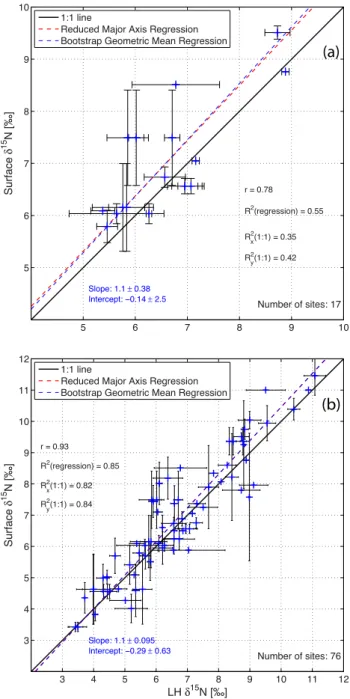
Interestingly, the line of best fit is shifted, nearly parallel to the 1:1 line, suggesting a small, uniformδ15N enrich-ment from LH to seafloor values. We used a non-parametric bootstrap resampling of the data to test the consistency of the regression coefficients; this showed that the y-intercept has much higher uncertainty than the slope. We repeated this exercise for the Arabian Sea, and found similar results of r=0.81 (not shown).
We then extended this analysis to the global dataset (Fig. 6b). The correlation for the global ocean is even
[‰]
Fig. 5.Locations of sediment core sites (large circles) and surface samples (smaller circles) in the eastern equatorial Pacific. The large circles approximately encompass the spatial range of a 100 km ra-dius. All surface samples that fall within that range are averaged and compared to the LH average of the core site.
stronger than for the eastern equatorial Pacific and Arabian Sea (r=0.93,R1:12=0.82–0.84), with little deviation from
the 1:1 line. There are a number of outliers, but these are either from regions with large variability between neighbour-ing seafloor measurements (large vertical whiskers, Fig. 6b), or with only one neighbour (no vertical whiskers). This cor-relation is highly encouraging for the use of bulk sedimentary nitrogen isotope measurements as a record of past changes in the sinking flux of organic nitrogen.
Despite the small magnitude of the discrepancies between seafloor and shallow subseafloor sediments, it is worthwhile considering their occurrence. The reasoning of Freudenthal et al. (2001) would predict that any discrepancies should represent diagenetic alterations. Surprisingly, the relation-ship between surface and LH values,δ15Nseafloor−δ15NLH,
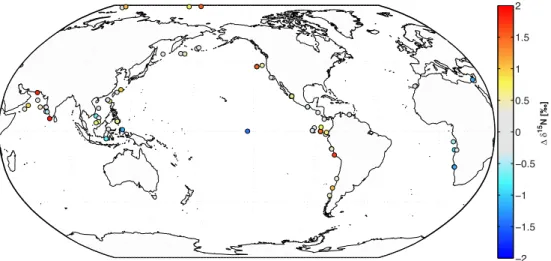
shows some spatial coherence, with clear contrasts between oceanic regions (Fig. 7). The δ15Nseafloor−δ15NLH is
con-sistently negative on the western coast of Africa, consistent with observations made by Freudenthal et al. (2001). How-ever, the picture is reversed along the western coasts of South and North America, where no sites show significant nega-tiveδ15Nseafloor−δ15NLH. Elsewhere in the Pacific and
In-dian oceans, the changes between LH and surfaceδ15N are generally small or mixed.
5 6 7 8 9 10 5
6 7 8 9 10
Surface
δ
15 N [
‰
]
Slope: 1.1 ± 0.38
Intercept: −0.14 ± 2.5
r = 0.78
R2(regression) = 0.55
R2x(1:1) = 0.35
R2y(1:1) = 0.42
Number of sites: 17 1:1 line
Reduced Major Axis Regression Bootstrap Geometric Mean Regression
3 4 5 6 7 8 9 10 11 12
3
4
5 6 7 8 9 10 11 12
LH δ15N [‰]
Surface
δ
15
N [
‰
]
Slope: 1.1 ± 0.095
Intercept: −0.29 ± 0.63
r = 0.93
R2(regression) = 0.85
R2 x(1:1) = 0.82 R2y(1:1) = 0.84
Number of sites: 76 1:1 line
Reduced Major Axis Regression Bootstrap Geometric Mean Regression
(a)
(b)
Fig. 6. LH δ15N average compared with surface δ15N within 100 km for(a)the eastern equatorial Pacific and(b)for all available records. The horizontal whiskers show the temporal variance of the LH average, and the vertical whiskers indicate the spatial variance of the surface sample average.
(for example, the Benguela and Peruvian upwellings), while different environments within the same region show similar patterns (for example, Angola and the Mediterranean), this explanation seems unlikely. The second, more likely expla-nation is that theδ15N of sinking organic matter changed sig-nificantly over the late Holocene. If this is true, it implies that the fidelity with which seafloorδ15N is transferred into the sedimentary record is somewhat better than would be
in-dicated by our seafloor–LH comparison (Fig. 6), since the assumption of temporal invariance is incorrect.
The sense of change between the LH and seafloor sedi-ments, with decreasingδ15N in the Atlantic and increasing δ15N in the Pacific, would be consistent with an increase of water column denitrification (dominantly in the Indo-Pacific) and/or an increase of N2fixation rates (the isotopic imprint
of which is stronger in the Atlantic) over this time period. We leave the resolution of this observation to future work.
3.3 Consistency between young and old sediments
The final possibility addressed here is that post-depositional alteration makes a significant imprint over longer timescales, e.g., 105yr. In order to test this, we make the assumption that the nitrogen cycle behaved similarly over each of the most recent four glacial–interglacial cycles. This assumption is supported by the similarity of oceanicδ18O (Lisiecki and Raymo, 2005) and ice core records (Petit et al., 1999) over this interval. Thus, we would expect that the averageδ15N recorded over a full glacial–interglacial cycle should be sim-ilar for all four cycles. We test this by averaging all avail-ableδ15N measurements within each cycle, defined by the terminations given in Lisiecki and Raymo (2005). Errors in the assignments of the sedimentary depths at which termi-nations occurred should lead to one cycle’sδ15N becoming erroneously high, while the adjacent cycle’s would become lower.
The data show consistent averages between cycles for some cores, while others show lowerδ15N in older sediments (Fig. 8). In no cases did the older sediments show higher δ15N. Although we were not able to find a variable that suc-cessfully predicted the magnitude of theδ15N decreases be-tween cycles, the water depth appears to divide the sites into two populations. The shallow sites (arbitrarily defined as wa-ter depth <2000 m) show no consistent trend between cy-cles, as expected from the assumption of stationarity in the global N cycle over successive glacial–interglacial cycles, and an absence of long-term downcore diagenesis. However, the deep sites show lower δ15N in older sediments. Inter-estingly, the difference of δ15N between successive glacial cycles becomes smaller in older sediments, with differences 0.5±0.20 ‰ between cycles 1 and 2, 0.4±0.17 ‰ between cycles 2 and 3, and 0.0±0.19 ‰ between cycles 3 and 4.
∆
δ
15
N [
‰
]
−2 −1.5 −1 −0.5 0 0.5 1 1.5 2
Fig. 7.Difference between surface and LHδ15N averages for available sites. The difference is calculated asδ15Nseafloor−δ15NLH, such
that positive values indicate that the averageδ15N of the seafloor sediments is higher than that of the late Holocene.
4 5 6 7 8
δ
15N [‰]
MD 84−641 MD 01−2416 MD 03−2603
ODP 887
ODP 1002 ODP 1012 TTN013−PC72 W8709−2 PC
4 5 6 7 8
δ
15N [‰]
5 10 15 20 25 30
4 5 6 7 8
Depth [mbsf]
δ
15N [‰]
50 100 150 200 250 300 350 400
Age [Cal ka BP] above 2000 m
all records
below 2000 m
Cycle 1 Cycle 2 Cycle 3 Cycle 4
Fig. 8.Plots ofδ15N versus depth and age for each of the eight records that span at least four glacial–interglacial cycles (i.e. 14 to 424 ka).
δ15N is binned according to the four glacial–interglacial cycles. The top panels show binnedδ15N for all eight records versus depth (left) and versus age (right). The middle panels show only those records from sites shallower than 2000 m water depth, while the bottom panels only those from sites deeper than 2000 m water depth.
long-term diagenesis evident in deep-sea records prompts us to seek a general mechanism that might explain it.
4 Mechanisms of diagenesis
The available global nitrogen isotopic data clearly show a di-agenetic15N enrichment of the organic nitrogen in seafloor sediments, relative both to theδ15N of sinking organic mat-ter (e.g. Gaye-Haake et al., 2005; Robinson et al., 2012), and to that expected from an ocean biogeochemical model (Gal-braith et al., 2013). Moreover, this enrichment is greater in deeper sediments, which may result from their high pore-water oxygen concentrations, slow sediment accumulation
rates, or other features, as discussed in detail by Robinson et al. (2012).
4 5 6 7 8
0 100 200 300 400 500
0 0.2 0.4 0.6 0.8 1
labile, 1‰
Fraction of deposited N
Time since deposition (ky)
0 100 200 300 400 500
Time since deposition (ky) resistant, 9‰
recalcitrant
bulk δ15N bulk δ15N
δ
15
N(
‰)
protected, 5‰
4 5 6 7 8
0.2 0.4 0.6 0.8 1
labile, 4‰
resistant, 8‰
protected, 5‰
Fig. 9.A conceptual model for long-term N diagenesis in marine sediment. The top panels show the evolution of bulkδ15N that results from the decay of two exposed organic components, mixed with a protected component, all of different isotopic composition. The left and right panels differ in the starting (deposited) fractions of the three components and their isotopic compositions, as indicated. The model is purely for illustrative purposes, and the parameters were chosen arbitrarily.
time and oxygen, the residual exposed amino acids are likely to be consumed as well, gradually eliminating this effect, un-til the exposed organic nitrogen is contained exclusively in condensed molecules that resist further degradation.
As the mass of exposed organic nitrogen dwindles, the nitrogen protected by minerals should become more signif-icant, whether sorbed to the surface of clays or protected within the matrices of biogenic opal and calcite. Thus, the bulk isotopic composition should become closer to the iso-topic composition of the mineral-protected pools as the pro-tected pools become dominant. In settings where oxygen posure times are extremely long, such as the deep sea, the ex-treme loss of exposed organic nitrogen could be expected to make the protected pool more important, which itself would depend on the composition of the sediment. For example, diatom-bound nitrogen would be expected to be important in the opal belts of the equatorial Pacific, subarctic Pacific and Southern Ocean, while calcite-bound nitrogen could be more important in carbonate-rich tropical sediments at shallower depths. Increasing burial depth may cause diagenetic changes in mineral structure, which could liberate protected N frac-tions. This liberated N would be remineralised and could be transported via porewater diffusion, or retained as absorbed NH+4, depending on the redox conditions and mineralogical environment of the sediment.
We suggest an extremely simple conceptual model that can explain aspects of the observations. If we define a labile pool of N, Nlabile, withδ15Nlabile, a resistant pool of N, Nresistant,
withδ15Nresistant, and a protected pool of N, Nprotected with
δ15Nprotected, we can write the equation δ15Nbulk=
Nlabileδ15Nlabile+Nresistantδ15Nresistant+Nprotectedδ15Nprotected
Nbulk
. (1)
If we then assume that the porewaters are open such that dissolved N is free to leave the system, we can model the loss of the N pools as first-order processes, similar to the multi-G model (Westrich and Berner, 1984), with rate constants γlabileandγresistant:
dNlabile
dt = −γlabileNlabile (2)
and dNresistant
dt = −γresistantNresistant. (3)
We assume, for this very simple illustration, that the pro-tected fraction does not change over time, although in re-ality it is likely to exchange with the porewater pool to some degree, and could be thought of as including con-densed organic phases as well. If we pick decay timescales ofγlabile=1 kyr−1andγresistant= 0.01 kyr−1, the model
pre-dicts an evolution ofδ15Nbulkand the relative fractions of the
three N components as shown in Fig. 9. Note that the initial values for all parameters were arbitrarily chosen for the two columns of Fig. 9, and are purely for illustrative purposes. Nonetheless, this very simple model reproduces the general features observed, including a rapid diagenetic enrichment (order 103yr), followed by a slow decrease ofδ15Nbulkas it
The model is clearly a gross simplification of the complex sedimentary environment, and alternative models are feasible that could explain the data equally well. For example, there is likely to be a spectrum of protectedness (e.g. heavily sili-cified diatom frustules are more durable than fragile ones), and one would expect a transfer of N from the unprotected to the protected pool as organic molecules condense. With better understanding of the dynamics of N in sediments, as informed by the study of specific molecules and theirδ15N, improved models will become possible.
5 Conclusions
Sedimentaryδ15N data from the ocean floor are now avail-able in a single database, facilitating quantitative compari-son of observations with each other and with biogeochem-ical ocean models. Although some regions of the seafloor are well sampled,δ15N data are sparse in vast regions of the oceans, such as the southern Indian Ocean, the subtropical gyres of the Pacific, and the North Atlantic. The clustered spatial distribution is even more prevalent in the collection of subseafloor sediment records, with most sites located on the continental shelves and slopes of the Pacific, Arabian Sea and southeastern Atlantic.
Robinson et al. (2012) have shown that diagenesis dur-ing the sinkdur-ing and sedimentation of organic N leads to an enrichment of seafloorδ15N relative to the export from the surface layer. Here, we examined the subsequent changes to δ15N, from the seafloor to the buried sediment record. Al-though some regions display elevated spatial variance be-tween neighbouring seafloorδ15N measurements, reflecting strong oceanographic and/or sedimentary gradients, for most of the ocean the spatial variance is close to the measurement error over spatial scales of 100 km, showing that individual sites are good reflections of their surroundings in most of the ocean. We tested the fidelity of the buried sedimentaryδ15N record by comparing the available surface data with the LH average from the uppermost part of subseafloor records. We found strong correlations between seafloor and subseafloor δ15N, which suggest reliable translation of sedimentedδ15N into the buried sediment record. We also discern relatively weak, but regionally coherent patterns of change between LH and seafloor sediments, suggestive of an acceleration of the marine nitrogen cycle over the late Holocene period (i.e. greater rates of water column denitrification and/or N2
fix-ation), rather than of significant diagenetic changes during the Holocene. However, a significant long-term diagenetic δ15N decrease does appear to be present in slowly accumu-lating sediments of the deep sea that span multiple glacial– interglacial cycles. We speculate that this decrease is due to a gradual loss of relatively resistant,15N-enriched unprotected organic matter, under oxic conditions, though more work is required in order to test this suggestion.
This global analysis agrees with that of Robinson et al. (2012) in that, in most cases, the alter-ation of the sinkingδ15N signal by diagenesis is a secondary effect. Nonetheless, it is an effect that must be taken into account when using bulk δ15N data. We suggest that the problem can be dealt with in two ways. The first way is by attempting to identify hallmarks of diagenesis where possible, in order to either exclude the data or to correct them using a mechanistic model. Identification and quantification of diagenesis could be made using bulk geochemistry (e.g. Corg vs. Norg), amino acid analyses, or mineral-bound
δ15N. Second, by basing any analysis on a collection of records, rather than on an individual location, different sedimentary environments (likely to display a range of diagenetic alterations) will be included. Where patterns of δ15N variability over time are robust among a diversity of sedimentary environments, they are more likely to represent primary signals.
Further studies with the synthesised dataset will help to improve our understanding of the marine nitrogen cycle, and thus of ocean biogeochemical dynamics in general. The database will continue to grow as new sedimentary δ15N records become available.
Acknowledgements. We thank the many investigators who
contributed data to the NICOPPδ15N database, through their pub-lications, public archives, and personal correspondence. Without their willingness to share data, this compilation would not have been possible. We also gratefully acknowledge the many colleagues and sample repositories who kindly and generously shared sample material that allowed us to fill in some of the gaps in the surface sediment δ15N coverage, in particular J. Arbuszewski, H. Bo-stock (NIWA, the National Institute of Water and Atmospheric Research), B. Conard (Deep-Sea Sample Repository at Oregon State University), A. de Vernal, T. Eglinton, L. Keigwin, K. Jarrett (Geological Survey of Canada National Marine Geoscience Col-lection), R. Lotti (Deep-Sea Sample Repository at Lamont-Doherty Earth Observatory), and DJW Piper. We thank PAGES, IMAGES, NSERC and CIFAR for funding.
Edited by: N. Ohkouchi
References
Agnihotri, R., Bhattacharya, S. K., Sarin, M. M., and So-mayajulu, B. L. K.: Changes in surface productivity and subsurface denitrification during the Holocene: a multiproxy study from the eastern Arabian Sea, Holocene, 13, 701–713, doi:10.1191/0959683603hl656rp, 2003.
Agnihotri, R., Altabet, M. A., and Herbert, T. D.: Influ-ence of marine denitrification on atmospheric N2O
variabil-ity during the Holocene, Geophys. Res. Lett., 33, L13704, doi:10.1029/2006GL025864, 2006.
the last two millennia, Geochem. Geophy. Geosy., 9, Q05013, doi:10.1029/2007GC001744, 2008a.
Agnihotri, R., Kurian, S., Fernandes, M., Reshma, K., D’Souza, W., and Naqvi, S. W. A.: Variability of subsurface denitri-fication and surface productivity in the coastal eastern Ara-bian Sea over the past seven centuries, Holocene, 18, 755–764, doi:10.1177/0959683608091795, 2008b.
Alt-Epping, U., Stuut, J. B. W., Hebbeln, D., and Schneider, R.: Variations in sediment provenance during the past 3000 years off the Tagus River, Portugal, Mar. Geol., 261, 82–91, doi:10.1016/j.margeo.2008.11.008, 2009.
Altabet, M. A.: Nitrogen isotopic evidence for micronutrient control of fractional NO−3 utilization in the equatorial Pacific, Limnol. Oceanogr., 46, 368–380, 2001.
Altabet, M. A.: Isotopic tracers of the marine nitrogen cycle: Present and past, in: Marine Organic Matter: Biomarkers, Isotopes and DNA, edited by: Volkman J. K., Springer, Berlin, Germany, 2006.
Altabet, M. A.: Constraints on oceanic N balance/imbalance from sedimentary 15N records, Biogeosciences, 4, 75–86, doi:10.5194/bg-4-75-2007, 2007.
Altabet, M. A. and Francois, R.: Sedimentary Nitrogen Isotopic Ra-tio as a Recorder for Surface Ocean Nitrate UtilizaRa-tion, Global Biogeochem. Cy., 8, 103–116, 1994.
Altabet, M. A., Francois, R., Murray, D. W., and Prell, W. L.: Climate related variations in denitrification in the Ara-bian Sea from sediment15N/14N ratios, Nature, 373, 506–509, doi:10.1038/373506a0, 1995.
Altabet, M. A., Murray, D. W., and Prell, W. L.: Climatically linked oscillations in Arabian Sea denitrification over the past 1 m.y.: Implications for the marine N cycle, Paleoceanography, 14, 732– 743, doi:10.1029/1999PA900035, 1999.
Altabet, M. A., Higginson, M. J., and Murray, D. W.: The effect of millennial-scale changes in Arabian Sea denitrification on atmo-spheric CO2, Nature, 415, 159–162, 2002.
Altabet, M. A., Agnihotri, R., Tierny, J., Higgins, S. M., and Her-bert, T. D.: A tale of two margins: A comparison of redox and productivity paleo-proxies in sediments off Oman and Peru, Geochim. Cosmochim. Ac., 69, A578–A578, 2005.
Arellano-Torres, E.: Paleoceanography of the Eastern Tropical North Pacific on millennial timescales, Ph.D. thesis, The Uni-versity of Edinburgh, Edinburgh, UK, 2010.
Banakar, V. K., Oba, T., Chodankar, A. R., Kuramoto, T., Ya-mamoto, M., and Minagawa, M.: Monsoon related changes in sea surface productivity and water column denitrification in the Eastern Arabian Sea during the last glacial cycle, Mar. Geol., 219, 99–108, doi:10.1016/j.margeo.2005.05.004, 2005. Bertrand, P., Pedersen, T. F., Martinez, P., Calvert, S., and
Shimmield, G.: Sea level impact on nutrient cycling in coastal upwelling areas during deglaciation: Evidence from nitrogen isotopes, Global Biogeochem. Cy., 14, 341–355, doi:10.1029/1999GB900099, 2000.
Brandes, J. A. and Devol, A. H.: Isotopic fractionation of oxygen and nitrogen in coastal marine sediments, Geochim. Cosmochim. Ac., 61, 1793–1801, doi:10.1016/S0016-7037(97)00041-0, 1997.
Brandes, J. A. and Devol, A. H.: A global marine-fixed nitrogen iso-topic budget: Implications for Holocene nitrogen cycling, Global Biogeochem. Cy., 16, 1120–1134, doi:10.1029/2001GB001856,
2002.
Bratton, J. F., Colman, S. M., and Seal, R. R.: Eutrophication and carbon sources in Chesapeake Bay over the last 2700 yr: Human impacts in context, Geochim. Cosmochim. Ac., 67, 3385–3402, doi:10.1016/S0016-7037(03)00131-5, 2003.
Brodie, C. R., Casford, J. S. L., Lloyd, J. M., Leng, M. J., Heaton, T. H. E., Kendrick, C. P., and Zong, Y. Q.: Evidence for bias in C/N,δ13C andδ15N values of bulk organic matter, and on environmental interpretation, from a lake sedimentary sequence by pre-analysis acid treatment methods, Quaternary Sci. Rev., 30, 3076–3087, doi:10.1016/j.quascirev.2011.07.003, 2011. Brunelle, B. G., Sigman, D. M., Cook, M. S., Keigwin, L. D.,
Haug, G. H., Plessen, B., Schettler, G., and Jaccard, S. L.: Ev-idence from diatom-bound nitrogen isotopes for subarctic Pa-cific stratification during the last ice age and a link to North Pacific denitrification changes, Paleoceanography, 22, PA1215, doi:10.1029/2005PA001205, 2007.
Brunelle, B. G., Sigman, D. M., Jaccard, S. L., Keigwin, L. D., Plessen, B., Schettler, G., Cook, M. S., and Haug, G. H.: Glacial/interglacial changes in nutrient supply and stratifica-tion in the western subarctic North Pacific since the penulti-mate glacial maximum, Quaternary Sci. Rev., 29, 2579–2590, doi:10.1016/j.quascirev.2010.03.010, 2010.
Brzezinski, M. A., Pride, C. J., Franck, V. M., Sigman, D. M., Sarmiento, J. L., Matsumoto, K., Gruber, N., Rau, G. H., and Coale, K. H.: A switch from Si(OH)4 to NO−3 depletion in the glacial Southern Ocean, Geophys. Res. Lett., 29, 1564, doi:10.1029/2001GL014349, 2002.
Calvert, S. E., Nielsen, B., and Fontugne, M. R.: Evidence from nitrogen isotope ratios for enhanced productivity during forma-tion of eastern Mediterranean sapropels, Nature, 359, 223–225, doi:10.1038/359223a0, 1992.
Calvert, S. E., Pedersen, T. F., and Karlin, R. E.: Geochemical and isotopic evidence for post-glacial palaeoceanographic changes in Saanich Inlet, British Columbia, Mar. Geol., 174, 287–305, doi:10.1016/S0025-3227(00)00156-0, 2001.
Chang, A. S., Pedersen, T. F., and Hendy, I. L.: Late Quaternary pa-leoproductivity history on the Vancouver Island margin, western Canada: a multiproxy geochemical study, Can. J. Earth Sci., 45, 1283–1297, doi:10.1139/E08-038, 2008.
Chazen, C. R., Altabet, M. A., and Herbert, T. D.: Abrupt mid-Holocene onset of centennial-scale climate variability on the Peru-Chile Margin, Geophys. Res. Lett., 36, L18704, doi:10.1029/2009GL039749, 2009.
De Pol-Holz, R., Ulloa, O., Lamy, F., Dezileau, L., Sabatier, P., and Hebbeln, D.: Late Quaternary variability of sedimentary nitrogen isotopes in the eastern South Pacific Ocean, Paleoceanography, 22, PA2207, doi:10.1029/2006PA001308, 2007.
Denis, D., Crosta, X., Schmidt, S., Carson, D. S., Ganeshram, R. S., Renssen, H., Crespin, J., Ther, O., Billy, I., and Giraudeau, J.: Holocene productivity changes off Ad´elie Land (East Antarctica), Paleoceanography, 24, PA3207, doi:10.1029/2008PA001689, 2009.
Dumitrescu, M. and Brassell, S. C.: Compositional and isotopic characteristics of organic matter for the early Aptian Oceanic Anoxic Event at Shatsky Rise, ODP Leg 198, Palaeogeogr. Palaeocl., 235, 168–191, doi:10.1016/j.palaeo.2005.09.028, 2006.
Dupont, L. M., Schlutz, F., Ewah, C. T., Jennerjahn, T. C., Paul, A., and Behling, H.: Two-step vegetation response to en-hanced precipitation in Northeast Brazil during Heinrich event 1, Global Change Biol., 16, 1647–1660, doi:10.1111/j.1365-2486.2009.02023.x, 2010.
Emeis, K. C., Struck, U., Leipe, T., and Ferdelman, T. G.: Vari-ability in upwelling intensity and nutrient regime in the coastal upwelling system offshore Namibia: results from sediment archives, Int. J. Earth Sci., 98, 309–326, doi:10.1007/s00531-007-0236-5, 2009.
Emmer, E. and Thunell, R. C.: Nitrogen isotope variations in Santa Barbara Basin sediments: Implications for denitrification in the eastern tropical North Pacific during the last 50,000 years, Pale-oceanography, 15, 377–387, doi:10.1029/1999PA000417, 2000. Etourneau, J., Martinez, P., Blanz, T., and Schneider, R.: Pliocene-Pleistocene variability of upwelling activity, productivity, and nutrient cycling in the Benguela region, Geology, 37, 871–874, doi:10.1130/G25733A.1, 2009.
Falkowski, P. G.: Evolution of the nitrogen cycle and its influence on the biological sequestration of CO2in the ocean, Nature, 387,
272–275, doi:10.1038/387272a0, 1997.
Farrell, J. W., Pedersen, T. F., Calvert, S. E., and Nielsen, B.: Glacial-interglacial changes in nutrient utilization in the equato-rial Pacific Ocean, Nature, 377, 514–517, doi:10.1038/377514a0, 1995.
Francois, R., Bacon, M. P., Altabet, M. A., and Labeyrie, L. D.: Glacial/interglacial changes in sediment rain rate in the SW Indian sector of subantarctic waters as recorded by
230Th, 231Pa, U, and δ15N, Paleoceanography, 8, 611–629,
doi:10.1029/93PA00784, 1993.
Francois, R., Altabet, M. A., Yu, E. F., Sigman, D. M., Bacon, M. P., Frank, M., Bohrmann, G., Bareille, G., and Labeyrie, L. D.: Con-tribution of Southern Ocean surface-water stratification to low atmospheric CO2concentrations during the last glacial period,
Nature, 389, 929–935, doi:10.1038/40073, 1997.
Freudenthal, T., Wagner T., Wenzh¨ofer F., Zabel, M., and Wefer, G.: Early diagenesis of organic matter from sediments of the Eastern Subtropical Atlantic: Evidence from stable nitrogen and carbon isotopes, Geochim. Cosmochim. Ac., 65, 1795–1808, doi:10.1016/S0016-7037(01)00554-3, 2001.
Freudenthal, T., Meggers, H., Henderiks, J., Kuhlmann, H., Moreno, A., and Wefer, G.: Upwelling intensity and filament activity off Morocco during the last 250,000 years, Deep-Sea Res. Part II, 49, 3655–3674, doi:10.1016/S0967-0645(02)00101-7, 2002.
Galbraith, E. D., Kienast, M., Pedersen, T. F., and Calvert, S. E.: Glacial-interglacial modulation of the marine nitrogen cycle by high-latitude O2supply to the global thermocline,
Paleoceanog-raphy, 19, PA4007, doi:10.1029/2003PA001000, 2004.
Galbraith, E. D., Sigman, D. M., Robinson, R. S., and Pedersen, T. F.: Nitrogen in Past Marine Environments, in: Nitrogen in the Marine Environment, 2, edited by: Capone, D. G., Bronk, D. A., Mulholland, M. R., and Carpenter, E. J., Academic Press, San Diego, CA, USA, 1497–1535, 2008a.
Galbraith, E. D., Kienast, M., Jaccard, S. L., Pedersen, T. F., Brunelle, B. G., Sigman, D. M., and Kiefer, T.: Consistent re-lationship between global climate and surface nitrate utilization in the western subarctic Pacific throughout the last 500 ka, Pale-oceanography, 23, PA2212, doi:10.1029/2007PA001518, 2008b. Galbraith, E., Kienast, M., Albuquerque, A. S., Altabet, M. A., Bianchi, D., Quintana, S. C., De Pol-Holz, R., Dubois, N., Fran-cois, R., Hsu, T.-C., Ivanochko, T. S., Jaccard, S. L., Kao, S.-J., Kiefer, T., Kienast, S., Lehmann, M., Martinez, P., McCarthy, M. D., M¨obius, J. H., Pedersen, T. F., Quan, T. M., Robinson, R. S., Ryabenko, E., Schmittner, A., Schneider R., Schneider-Mor, A., Shigemitsu, M., Sinclair, D., Somes, C. J., Studer, A. S., Tesdal, J.-E., Thunell R. C., and Yang, J.-Y. T.: Global nitrogen isotopic constraints on the acceleration of oceanic denitrification during deglacial warming, in review, 2013.
Ganeshram, R. S., Pedersen, T. F., Calvert, S. E., and Murray, J. W.: Large changes in oceanic nutrient inventories from glacial to in-terglacial periods, Nature, 376, 755–758, doi:10.1038/376755a0, 1995.
Ganeshram, R. S., Pedersen, T. F., Calvert, S. E., McNeill, G. W., and Fontugne, M. R.: Glacial-interglacial variability in denitrifi-cation in the world’s oceans: Causes and consequences, Paleo-ceanography, 15, 361–376, doi:10.1029/1999PA000422, 2000. Gaye-Haake, B., Lahajnar, N., Emeis, K. C., Unger, D.,
Rixen, T., Suthhof, A., Ramaswamy, V., Schulz, H., Parop-kari, A. L., Guptha, M. V. S., and Ittekkot, V.: Stable nitrogen isotopic ratios of sinking particles and sediments from the northern Indian Ocean, Mar. Chem., 96, 243–255, doi:10.1016/j.marchem.2005.02.001, 2005.
Gruber, N. and Galloway, J. N.: An Earth-system perspec-tive of the global nitrogen cycle, Nature, 451, 293–296, doi:10.1038/nature06592, 2008.
Haug, G. H., Pedersen, T. F., Sigman, D. M., Calvert, S. E., Nielsen, B., and Peterson, L. C.: Glacial/interglacial variations in produc-tion and nitrogen fixaproduc-tion in the Cariaco Basin during the last 580 kyr, Paleoceanography, 13, 427–432, doi:10.1029/98PA01976, 1998.
Hendy, I. L. and Pedersen, T. F.: Oxygen minimum zone expansion in the eastern tropical North Pacific during deglaciation, Geo-phys. Res. Lett., 33, L20602, doi:10.1029/2006GL025975, 2006. Hendy, I. L., Pedersen, T. F., Kennett, J. P., and Tada, R.: Inter-mittent existence of a southern Californian upwelling cell during submillennial climate change of the last 60 kyr, Paleoceanogra-phy, 19, PA3007, doi:10.1029/2003PA000965, 2004.
Higgins, M. B., Robinson, R. S., Carter, S. J., and Pearson, A.: Evidence from chlorin nitrogen isotopes for alternating nutrient regimes in the Eastern Mediterranean Sea, Earth Planet. Sc. Lett., 290, 102–107, doi:10.1016/j.epsl.2009.12.009, 2010.
Higginson, M. J. and Altabet, M. A.: Initial test of the silicic acid leakage hypothesis using sedimentary biomarkers, Geophys. Res. Lett., 31, L18303, doi:10.1029/2004GL020511, 2004. Higginson, M. J., Maxwell, J. R., and Altabet, M. A.:
Ni-trogen isotope and chlorin paleoproductivity records from the Northern South China Sea: remote vs. local forcing of millennial- and orbital-scale variability, Mar. Geol., 201, 223– 250, doi:10.1016/S0025-3227(03)00218-4, 2003.
sta-dial/interstadial climate transition, Geochim. Cosmochim. Ac., 68, 3807–3826, doi:10.1016/j.gca.2004.03.015, 2004.
Holmes, M. E., Schneider, R. R., M¨uller, P. J., Segl, M., and Wefer, G.: Reconstruction of past nutrient utilization in the eastern An-gola Basin based an sedimentary15N/14N ratios, Paleoceanog-raphy, 12, 604–614, doi:10.1029/97PA00819, 1997.
Huon, S., Grousset, F. E., Burdloff, D., Bardoux, G., and Mariotti, A.: Sources of fine-sized organic matter in North Atlantic Hein-rich Layers:δ13C andδ15N tracers, Geochim. Cosmochim. Ac., 66, 223–239, doi:10.1016/S0016-7037(01)00776-1, 2002. Ivanochko, T. S. and Pedersen, T. F.: Determining the
influ-ences of Late Quaternary ventilation and productivity vari-ations on Santa Barbara Basin sedimentary oxygenation: a multi-proxy approach, Quaternary Sci. Rev., 23, 467–480, doi:10.1016/j.quascirev.2003.06.006, 2004.
Ivanochko, T. S., Ganeshram, R. S., Brummer, G. J. A., Ganssen, G., Jung, S. J. A., Moreton, S. G., and Kroon, D.: Variations in tropical convection as an amplifier of global climate change at the millennial scale, Earth Planet. Sc. Lett., 235, 302–314, doi:10.1016/j.epsl.2005.04.002, 2005.
Jennerjahn, T. C., Ittekkot, V., Arz, H. W., Behling, H., P¨atzold, J., and Wefer, G.: Asynchronous terrestrial and marine signals of climate change during Heinrich events, Science, 306, 2236– 2239, doi:10.1126/science.1102490, 2004.
Jia, G. and Li, Z.: Easterly denitrification signal and nitrogen fixa-tion feedback documented in the western Pacific sediments, Geo-phys. Res. Lett., 38, L24605, doi:10.1029/2011GL050021, 2011. Kao, S. J., Liu, K. K., Hsu, S. C., Chang, Y. P., and Dai, M. H.: North Pacific-wide spreading of isotopically heavy nitrogen dur-ing the last deglaciation: Evidence from the western Pacific, Bio-geosciences, 5, 1641–1650, doi:10.5194/bg-5-1641-2008, 2008. Kessarkar, P. M., Rao, V. P., Naqvi, S. W. A., Chivas, A. R., and Saino, T.: Fluctuations in productivity and denitrification in the southeastern Arabian Sea during the Late Quaternary, Curr. Sci. India, 99, 485–491, 2010.
Kienast, M.: Unchanged nitrogen isotopic composition of or-ganic matter in the South China Sea during the last climatic cycle: Global implications, Paleoceanography, 15, 244–253, doi:10.1029/1999PA000407, 2000.
Kienast, M., Higginson, M. J., Mollenhauer, G., Eglinton, T. I., Chen, M. T., and Calvert, S. E.: On the sedimentological origin of down-core variations of bulk sedimentary nitrogen isotope ratios, Paleoceanography, 20, PA2009, doi:10.1029/2004PA001081, 2005.
Kienast, M., Lehmann, M. F., Timmermann, A., Galbraith, E., Bol-liet, T., Holboum, A., Normandeau, C., and Laj, C.: A mid-Holocene transition in the nitrogen dynamics of the western equatorial Pacific: Evidence of a deepening thermocline?, Geo-phys. Res. Lett., 35, L23610, doi:10.1029/2008GL035464, 2008. Kienast, S. S., Calvert, S. E., and Pedersen, T. F.: Nitrogen isotope and productivity variations along the northeast Pacific margin over the last 120 kyr: Surface and subsurface paleoceanography, Paleoceanography, 17, 1055, doi:10.1029/2001PA000650, 2002. Kim, S., Khim, B. K., Uchida, M., Itaki, T., and Tada, R.: Millennial-scale paleoceanographic events and implication for the intermediate-water ventilation in the northern slope area of the Bering Sea during the last 71 kyrs, Global Planet. Change, 79, 89–98, doi:10.1016/j.gloplacha.2011.08.004, 2011.
Knapp, A. N., Hastings, M. G., Sigman, D. M., Lipschultz, F., and Galloway, J. N.: The flux and isotopic composition of reduced and total nitrogen in Bermuda rain, Mar. Chem., 120, 83–89, doi:10.1016/j.marchem.2008.08.007, 2010.
Langton, S. J., Linsley, B. K., Robinson, R. S., Rosenthal, Y., Oppo, D. W., Eglinton, T. I., Howe, S. S., Djajadihardja, Y. S., and Syamsudin, F.: 3500 yr record of centennial-scale climate vari-ability from the Western Pacific Warm Pool, Geology, 36, 795– 798, doi:10.1130/G24926A.1, 2008.
Lisiecki, L. E. and Raymo, M. E.: A Pliocene-Pleistocene stack of 57 globally distributed benthicδ18O records, Paleoceanography, 20, PA1003, doi:10.1029/2004PA001071, 2005.
Liu, Z. H., Altabet, M. A., and Herbert, T. D.: Plio-Pleistocene denitrification in the eastern tropical North Pacific: Intensi-fication at 2.1 Ma, Geochem. Geophy. Geosy., 9, Q11006, doi:10.1029/2008GC002044, 2008.
Lourey, M. J., Trull, T. W., and Sigman, D. M.: Sensitivity ofδ15N of nitrate, surface suspended and deep sinking particulate nitro-gen to seasonal nitrate depletion in the Southern Ocean, Global Biogeochem. Cy., 17, 1081, doi:10.1029/2002GB001973, 2003. Martinez, P., Bertrand, P., Calvert, S. E., Pedersen, T. F., Shim-mield, G. B., Lallier-Verg`es, E., and Fontugne, M. R.: Spatial variations in nutrient utilization, production and diagenesis in the sediments of a coastal upwelling regime (NW Africa): Implica-tions for the paleoceanographic record, J. Mar. Res., 58, 809– 835, doi:10.1357/002224000321358927, 2000.
Martinez, P., Lamy, F., Robinson, R. R., Pichevin, L., and Billy, I.: Atypicalδ15N variations at the southern boundary of the East Pacific oxygen minimum zone over the last 50 ka, Quaternary Sci. Rev., 25, 3017–3028, doi:10.1016/j.quascirev.2006.04.009, 2006.
McClelland, J. W. and Montoya, J. P.: Trophic relationships and the nitrogen isotopic composition of amino acids in plankton, Ecology, 83, 2173–2180, doi:10.2307/3072049, 2002.
McKay, J. L., Pedersen, T. F., and Kienast, S. S.: Organic carbon accumulation over the last 16 kyr off Vancouver Island, Canada: evidence for increased marine productiv-ity during the deglacial, Quaternary Sci. Rev., 23, 261–281, doi:10.1016/j.quascirev.2003.07.004, 2004.
Meckler, A. N., Haug, G. H., Sigman, D. M., Plessen, B., Peter-son, L. C., and Thierstein, H. R.: Detailed sedimentary N iso-tope records from Cariaco Basin for terminations I and V: Local and global implications, Global Biogeochem. Cy., 21, GB4019, doi:10.1029/2006GB002893, 2007.
Meckler, A. N., Ren, H. J., Sigman, D. M., Gruber, N., Plessen, B., Schubert, C. J., and Haug, G. H.: Deglacial nitrogen isotope changes in the Gulf of Mexico: Evidence from bulk sedimentary and foraminifera-bound nitrogen in Orca Basin sediments, Pale-oceanography, 26, PA4216, doi:10.1029/2011PA002156, 2011. Milder, J. C., Montoya, J. P., and Altabet, M. A.: Carbon
and nitrogen stable isotope ratios at sites 969 and 974: In-terpreting spatial gradients in sapropel properties, in: Pro-ceedings of the Ocean Drilling Program, Scientific Results, Vol. 161, College Station, TX (Ocean Drilling Program), edited by: Zahn, R., Comas, M. C., and Klaus, A., 401–411, doi:10.2973/odp.proc.sr.161.271.1999, 1999.