Surface analysis of alumina ceramic exposed to shock waves
produced by plasma expander
R P Mota1, E Campos1,2, C N Santos1, E F Lucena2, M Machida3 and F C L Melo4 1
Faculdade de Engenharia - Campus de Guaratinguetá - UNESP, São Paulo, Brazil 2
Escola de Especialistas de Aeronáutica (EEAR) - Guaratinguetá, São Paulo, Brazil 3
Instituto de Física - UNICAMP - Campinas, São Paulo, Brazil 4
Instituto de Aeronáutica e Espaço -DCTA - São José dos Campos, São Paulo, Brazil E-mail: [email protected]
Abstract. Material surface treatment by plasma expander is relatively recent. Plasma expander is based on the inverse pinch effect. The shock waves produced by plasma expander may also promote modifications in ceramic materials exposed to the expander. These modifications are mainly made by ablation phenomenon. This work was intended to verify the shock wave effects on the ionic ceramic samples with high dielectric constant. The alumina ceramic samples were formed by both uniaxial and isostatic pressing methods and sintered at 1650 ºC. They were also produced with addition 0.15 wt% of MgO in order to obtain a high densification. The ceramic samples were divided in groups and exposed to 700, 1000 and 1440 pulses during 20 min. These pulses were generated by nitrogen plasma expander at 13.0 Pa and 6 kV. After plasma exposure, there was an increase in roughness parameter values of Al2O3
ceramic surface. The treatment by plasma expander did not modify the hydrophilic characteristic of the alumina ceramic samples. The results of hardness test presented no significant changes on hardness mean values.
1. Introduction
This paper aimed to analyze the changes produced by shock waves with nitrogen ions generated by a plasma expander on dense alumina ceramics. The alumina ceramic (Al2O3) is an ionic material with a hexagonal crystalline structure, which has high mechanical strength and presents high corrosion and wear resistance. One of the features of high hardness and high elastic modulus of alumina ceramics is due to the ionic bond stability. These ceramics are used in several industry fields. New applications for these materials have emerged in biomaterial industry due to ceramic surface changes such as wettability and morphology [1-5]. Such changes can occur when these materials are exposed to plasma like pinch discharge [6]. Plasma expander is an innovative method for material treatment, based on inverse pinch effect [7-11]. Plasma expander has been used to treat polymer surfaces deposited by plasma [8-10] and in silicon carbide (covalent ceramic) [11].
15th Latin American Workshop on Plasma Physics (LAWPP2014) IOP Publishing Journal of Physics: Conference Series591(2015) 012059 doi:10.1088/1742-6596/591/1/012059
Content from this work may be used under the terms of theCreative Commons Attribution 3.0 licence. Any further distribution of this work must maintain attribution to the author(s) and the title of the work, journal citation and DOI.
2. Materials and methods
2.1. Ceramic
The alumina (CT-3000 SG), 0.15 wt% of MgO and 0.12 wt% of CMC were used to produce the ceramics. They were formed by uniaxial pressing (50 MPa) in a stainless steel mold (15 x 15 x 4 mm), followed by isostatic pressing (300 MPa) and sintered at 1650 ºC, with a heating rate of 5 ºC/min. The samples were polished by using diamond paste (granulometry 6 µm, 3 µm and 1 µm).
2.2. Plasma expander
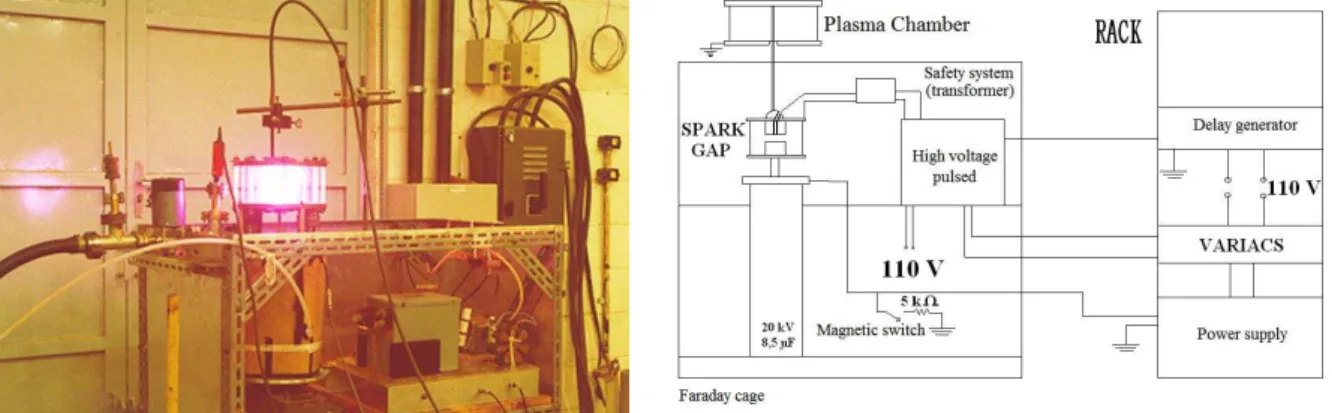
The reactor (Figure 1a and 1b) consists of a glass tube (diameter: 28 cm) covered with two circular brass plates (diameter: 30 cm). In the center, there is a central hole with a conductor bar (diameter: 0.6 cm) isolated by the glass tube, which crosses the bottom plate. The expander has a capacitor (8.5 µF, 20 kV) which is charged at 20 kV by a 20 mA dc power supply. The expansion velocity of the shock wave is measured with a collimated optical fiber coupled to a spectrometer. In the visible spectrum there is a maximum value (approximately 1.3 x 106 cm/s) which decreases to a minimum (0.9 x 106 cm/s) at the edge of the conductive plates.
Figure 1a. Plasma expander system. Figure 1b. Plasma expander diagram.
The ceramics were divided in three groups and exposed to 700, 1000 and 1440 pulses during 20 min. These pulses were generated by nitrogen plasma expander at 13.0 Pa and 6 kV. The samples were placed in the reactor (3.0 cm from the center of the conductor). According to [8-10], it was estimated an approximate value of 12 eV for the ion collision energy on the polished surfaces.
2.3. Characterization
All measurements for ceramic characterization were performed before and after the plasma exposure. The apparent porosity was determined according to ASTM C20-00 [12]. In order to determine roughness, it was used a profilometer Mitutoyo - Surftest 301, by choosing Ra (average roughness) and Rt (peak-to-valley roughness) parameters. For Vickers hardness measurements, it was used OttoWolpert-Werke, an equipment with 30 kgf load. The wettability of the sample surface was investigated by goniometer Rame-Hart 300-F1.
The light microscopy was used to monitor the change on the polished surfaces. The "ImageJ", public domain software, developed at the National Institute of Mental Health [13] was used to perform quantitative analyses of the images. The images used for porous and matrix fraction measurements were obtained from polished surfaces by using a Nikon microscope model Epiphot 200. SEM images were captured by Zeiss EVO LS-15 microscope.
15th Latin American Workshop on Plasma Physics (LAWPP2014) IOP Publishing Journal of Physics: Conference Series591(2015) 012059 doi:10.1088/1742-6596/591/1/012059
3. Results and discussion
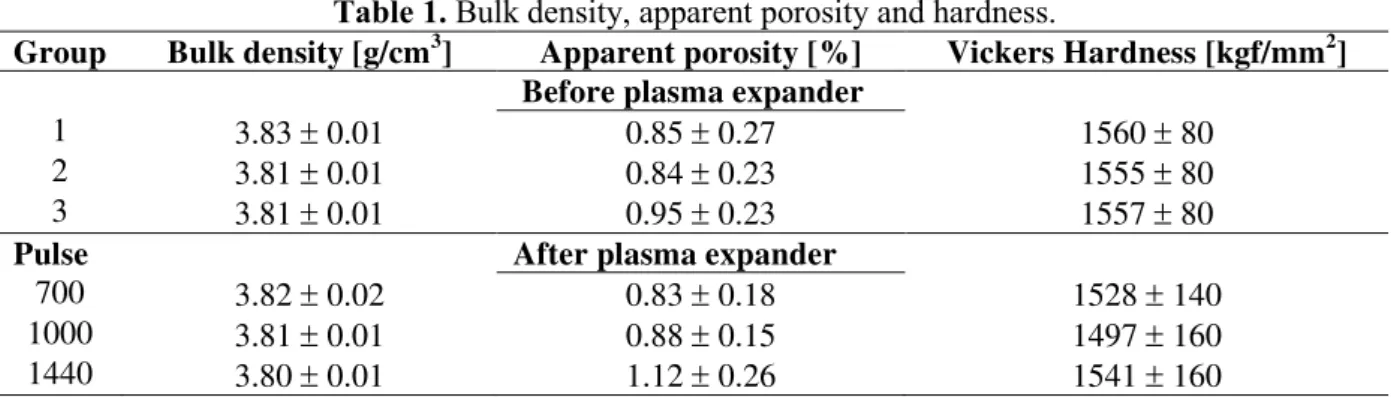
Table 1 shows the hardness and porosity results of each ceramic sample group. After the plasma exposure, there were no significant changes in bulk density and apparent porosity and the average values remained nearly the same. Probably, when nitrogen ions collided with the ceramics there
wasn’t enough energy to go into the material or to remove a large amount of material of the surface. Table 1 also shows that Vickers hardness mean values decreased very little and standard deviation (dispersion) increased for all sets. These results confirm that nitrogen ions did not cause alterations in the alumina sample bulk.
Table 1. Bulk density, apparent porosity and hardness.
Group Bulk density [g/cm3] Apparent porosity [%] Vickers Hardness [kgf/mm2] Before plasma expander
1 3.83 0.01 0.85 0.27 1560 80
2 3.81 0.01 0.84 0.23 1555 80
3 3.81 0.01 0.95 0.23 1557 80
Pulse After plasma expander
700 3.82 0.02 0.83 0.18 1528 140
1000 3.81 0.01 0.88 0.15 1497 160
1440 3.80 0.01 1.12 0.26 1541 160
Figures 2a and 2b show micrographs obtained from the sample surface (group-1), before and after the plasma exposure, respectively. It can be seen an increase of sample pore number. Furthermore, there pores present a non uniform distribution and irregular morphology after shock wave exposure.
Figure 2a. Surface samples before plasma. Figure 2b. Surface samples after plasma.
Table 2 shows roughness, wettability and porous fraction values. In this table, it can be observed that there were significant changes especially in roughness and wettability promoted by the shock waves. Despite the higher roughness values (described by Ra and Rt parameters), the average contact angle remained below 90°, i.e. the ceramic surface maintained the hydrophilic characteristic. The increase of wettability occurred due to the ablation process, which was generated by nitrogen ions of shock waves.
15th Latin American Workshop on Plasma Physics (LAWPP2014) IOP Publishing Journal of Physics: Conference Series591(2015) 012059 doi:10.1088/1742-6596/591/1/012059
Table 2. Roughness, contact angle and porous fraction measurements.
Group Ra (m) Rt (m) Contact angle (º) Porous fraction (%) Matrix fraction(%) Before plasma expander
1 0.25 0.06 2.53 0.24 70.2 ± 1.0 21.7 1.5 78.3 1.5
2 0.43 0.10 3.80 1.19 71.3 ± 1.0 25.9 3.2 74.0 3.2
3 0.22 0.06 2.63 0.80 77.4 ± 1.0 20.7 1.6 79.3 1.6
Pulse After plasma expander
700 0.94 0.14 8.53 1.90 75.5 ± 1.0 24.4 1.5 75.6 1.5
1000 0.79 0.23 5.99 2.22 81.4 ± 1.0 28.7 1.5 71.3 1.5
1440 0.92 0.12 6.34 0.94 86.1 ± 1.0 23.6 0.9 76.4 0.9
4. Conclusions
The porosity measurement, which is based on Archimedes’ Principle, and hardness results showed that the sample bulk remained practically unchanged. The plasma expander proved to be a novel surface treatment for promotes changes on Al2O3 ceramic surface.
The roughness, contact angle measurements and SEM image analysis indicate that there were changes in the sample surfaces due to momentum transfer from nitrogen ions to ceramic surface. The standard deviations determined after hardness and roughness tests, indicate that the nitrogen ions do not reach the entire ceramic surface with the same intensity.
SEM image analysis and roughness parameters indicate that the sputtering process by nitrogen ions occurs on the entire ceramic surface. However, the increase of the number of plasma pulses did not make the sputtering process more effective, probably due to the surface electric charging.
Acknowledgments
CNPq for financial support and Ms. Marisa Silva (COMAER) for technical assistance.
References
[1] Weidmann G, Lewis P, Reid N 1990 Materials in Action Series:Structural Materials (United Kingdon: The Open University)
[2] Barlak M, Piekoszenwski J, Werner Z and Stanislawski J 2009 Surface and Coatings Technology 203 2536-40
[3] Pandiyaraj K N, Selvarajan V, Deshmukh R R and Bousmina M 2008 Surface and Coatings
Technology 202 4220-22
[4] Guehennec L L, Soueidan A and Amouriq Y 2007 Dental Materials 23 844-54 [5] Webster T J 2001 Advances in Chemical Engineering 27 125-66
[6] Lee S and Saw S H 2008 Apllied Physics Letters 92 285-90
[7] Anderson O A, Furth H P, Stone J M and Wright R E 1958 The Physics of Fluids 1489-94 [8] Rangel E C, Machida M, Durrant S F and Cruz N C 2012 IEEE Transactions on Plasma
Science 40 492-96
[9] Rangel E C, Silva P A F and Mota R P 2005 Thin Solid Films 473 259-66 [10] Machida M, Aramaki E A and Moraes M B 2003 AIP Conf. Proc. 669 339-42
[11] Santos C N, Marins E M, Machida M, Campos E, Mota R P, Melo F C L and Hein L R O 2012
Materials Science Forum 727-728 1428-32
[12] ASTM. C20-00 2000 Standard test methods for apparent porosity, water absorption, apparent specific gravity, and bulk density of burned refractory brick and shapes by boiling water [13] Rasband W S 1997-2012 ImageJ-U. S. National Institutes of Health, (Bethesda, Maryland,
USA) http://imagej.nih.gov/ij/
15th Latin American Workshop on Plasma Physics (LAWPP2014) IOP Publishing Journal of Physics: Conference Series591(2015) 012059 doi:10.1088/1742-6596/591/1/012059