70
THE CARTEL IN THE EUROPEAN UNION AND ROMANIA – RETROSPECTIVE OF THE YEARS 2009-2013
Berinde Mihai 1, Fora Andreea-Florina 2
1Department of International Business, Faculty of Economic Sciences, University of Oradea, Oradea, Romania
2Department of International Business, Faculty of Economic Sciences, University of Oradea, Oradea, Romania
[email protected] [email protected]
Abstract: The cartel is considered the most harmful anti-competitive practice; therefore the competition authorities were concerned about the continuous improvement of the legislation governing this practice. In order to stimulate companies to withdraw from participating to a cartel in the European Union, the leniency policy has implemented. The present paper aims at achieving the hindsight of the years 2009-2013 regarding the evolution of cartel cases detected both at EU level and in Romania. The research methodology used is the study of literature, followed by the analysis of the legislation governing the European cartel and the analysis of all decisions issued between 2009-2013, both by the European Commission and by the Competition Council of Romania. The paper is structured in four parts. The first part presents the cartel from the theoretical and legislative point of view. The second and third parts of the paper include the analysis of cartel cases detected both at European and national level. The following aspects were taken into account when analysing the cartel cases: the date when the decision was issued by the competition authorities, the number of companies involved in the cartel, the opening date of the investigation, the method of opening the investigation, the field in which the cartel operated, the duration of the cartel as well as the amount of the fine. The final part of the paper highlights a number of conclusions. In the reviewed period 22 cartel cases were detected in the European Union and 23 cartel cases in Romania. The amount of the fines imposed at a European level is 251 times higher than the fines imposed by the Competition Council of Romania. In the European Union there were 11 long-term cartel cases, 10 medium-term cases and only one case lasted less than a year. In Romania there have been detected 4 long term cartel cases, 7 medium-term cases and 12 cases of short-term cases.
Keywords: cartel; fine; duration; competition policy; European legislation
71
1. The Cartel - theoretical and legislative approach
The cartel is an anti-competitive practice regulated at European level. Germany is to be found among the first European countries to adopt legislative measures against cartels. The literature defines the cartel as a tacit understanding between two or more enterprises which activate in the same field or similar fields of activity, in order to eliminate direct competition. Three main characteristics of cartels can be detected: market sharing and price fixing by cartel members in order to maximize profit; setting of production quotas among cartel members, so as the most effective companies to be discouraged to increase production; and preventing the entry on the market of new companies that could be attracted to the high prices imposed by the cartel (McGowan, 2010: 31).
In order to maintain fair competition in the market, and especially to protect consumers, in the EU there functions the competition policy that is constantly improving. The beginnings of the competition policy can be found in the Treaty establishing the European Coal and Steel Community and in the Treaty of Rome. As far as the cartel is concerned, it is currently regulated by Article 101 of the Treaty on the Functioning of the European Union. The main objectives of Article 101 are single market integration and competition protection. The European Commission sees competition as a vital element in achieving the goal of integration of the single market, because it is only through the existence of a single market that the objective of economic welfare of consumers can be achieved (Bennett and Padilla, 2009: 57).
According to Article 101 of the Treaty on the Functioning of the European Union, any agreement between enterprises is prohibited covering the following issues: fixing, directly or indirectly, both the purchase price and those for sale; limiting or controlling production; sharing markets and sources of supply; discriminate between trading partners and acceptance of trading partners only if they offer certain additional services not covered by the contract (Consolidated version of the Treaty on European Union and the Treaty on The Functioning of the European Union, 2010: 90).
The devastating effect cartels have on competition, and especially on consumers in conjunction with the difficulty of detection and demonstration of such anti-competitive practices have caused the European Commission to establish the leniency policy in 2006. The circumstances that allow a company which was part of a cartel to benefit from immunity from fines are clearly highlighted by the Commission notice on immunity from fines and reduction of fines in cartel cases from 8.12.2006. The procedure applied throughout the investigation of a possible cartel case is strictly regulated by Regulation no. 773/2004 of the Commission for the conduct of proceedings by the Commission pursuant to Articles 81 and 82 EC.
The cartels functioning in Romanian fall under the jurisdiction of the Romanian Competition Council of Romania. In Romania cartels are regulated by Article 5 of the Competition Law no. 21/1996, republished in 2014. Romania being a EU member country has harmonized competition law with the European Union.
2. The cartels detected in the European Union in the period 2009 - 2013
72
During the analyzed period 2009-2013 there have been detected a number of 22 cartel cases at EU level.
Table 1 examines the cartel cases that were detected by the Commission in 2009. It can be seen that the average period of investigations in 2009 was of 4 year. The largest fine was imposed to the cartel operating in the field of gas supply, worth about 1,100 million euro, the total amount of the fines imposed in 2009 reaching EUR 1.346.972.000. Of the 5 cases of cartel it was only one cartel investigation that was openedby ex officio, the rest being based on immunity request filed by one of the companies involved in the cartel.
Table 1: Cartel cases detected in the European Union in 2009. Date of
decision issuance
Number of companies involved
Method / Date of opening of the
investigation
Field Cartel duration
Fine amount euro
28.01.2009 6 immunity request/
2007
marine
pipelines long 101,960,000
08.07.2009 2 ex-officio/ 2006 gas supply long 1,106,000,000
22.07.2009 9 immunity request /
01.2007
chemicals / steel and gas
industry
medium 61,120,000
07.10.2009 7 immunity request /
2003 transformers medium 64,674,000
11.11.2009 11 immunity request /
02.2003 heat stabilizers long 13,218,000
Source: carried out by the authors on the basis of the decisions of the European Commission, available on-line: http://ec.europa.eu/competition/elojade/isef/index.cfm
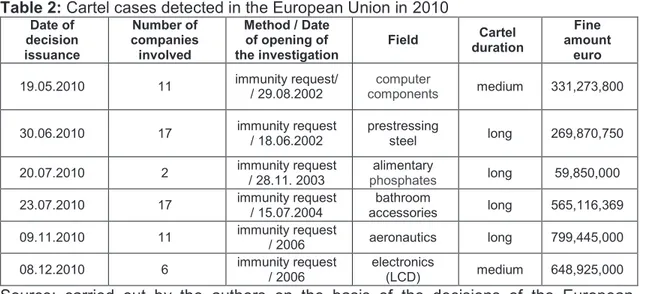
2010 was the year of the analyzed period with most cartel cases detected in the European Union, 6 in number. As it can be seen in Table 2, cartels lasted for medium and large term, the fines totaled 2,674,480,919 euro. The average duration of ongoing investigations in 2010 was of 6 years. The fields in which cartels operated were diverse, the largest cartel fine having been applied to the aeronautical domain nearly 800 million. All cases analyzed were based on the inquiry request for immunity lodged by one of the companies involved in the cartel.
Table 2: Cartel cases detected in the European Union in 2010 Date of
decision issuance
Number of companies involved
Method / Date of opening of the investigation
Field Cartel duration
Fine amount
euro
19.05.2010 11 immunity request/
/ 29.08.2002
computer
components medium 331,273,800
30.06.2010 17 immunity request
/ 18.06.2002
prestressing
steel long 269,870,750
20.07.2010 2 immunity request
/ 28.11. 2003
alimentary
phosphates long 59,850,000
23.07.2010 17 immunity request
/ 15.07.2004
bathroom
accessories long 565,116,369
09.11.2010 11 immunity request
/ 2006 aeronautics long 799,445,000
08.12.2010 6 immunity request
/ 2006
electronics
73
In Table 3 it can be seen that in 2011 the European Union have detected four small and medium term cases of cartel. In the analyzed year the Commission imposed fines amounting to 603,025,900 euro, the average time of investigation was of 3 years. All investigations were based on the immunity request, and in all cases the companies that requested for immunity were exempted from paying fines.
Table 3: Cartel cases detected in the European Union in 2011 Date of
decision issuance
Number of companies involved
Method / Date of opening of the
investigation
Field Cartel
duration
Fine amount
euro
13.04.2011 3 immunity request
/ 2008 washing powder medium 312,200,000
12.10.2011 2 immunity request
/ 08.04.2005
fruit
(bananas) short 8,919,000
19.10.2011 4 immunity request
/ 03.2009
glass for cathode
ray tubes medium 128,736,000
07.12.2011 5 immunity request
/ 2009
electronic components (refrigeration compressors)
medium 161,198,000
Source: carried out by the authors on the basis of decisions of the European Commission, available on-line: http://ec.europa.eu/competition/elojade/isef/index.cfm
Comparing 2012 with 2011 we can see that the number of cartel cases detected at EU level was maintained. By analyzing Table 4 it is obvious that the largest cartel fine was paid to the electronic components cartel that lasted for 10 years. The fines for the year 2012 totaled EUR 1,739,052,000, and the average time of investigation went on for 5 years.
Table 4: Cartel cases detected in the European Union in 2012 Date of
decision issuance
Number of companies involved
Method / Date of opening of the
investigation
Field Cartel duration
Fine amount euro
28.03.2012 9 immunity request
/ 12.06.2007
mechanical
components long 85,876,000
28.02.2012 14 immunity request
/ 2007 aeronautics medium 169,000,000
27.06.2012 3 immunity request
/ December 2008
products for water management
medium 13,661,000
05.12.2012 7 immunity request
/ 2007
electronic components (monitor tubes)
long 1,470,515,000
Source: carried out by the authors on the basis of decisions of the European Commission, available on-line: http://ec.europa.eu/competition/elojade/isef/index.cfm
74
Table 5: Cartel cases detected in the European Union in 2013 Date of decision issuance Number of companies involved
Method / Date of opening of the investigation
Field Cartel duration
Fine amount euro
10.06.2013 5 immunity request /
February. 2010
vehicles (electric
parts )
long 141,791,000
27.11.2013 4 immunity request /
2007
food
(shrimp) long 28,716,000
04.12.2013 8 immunity request /
2008
financial
services medium 1,712,468,000
Source: carried out by the authors on the basis of decisions of the European Commission, available on-line: http://ec.europa.eu/competition/elojade/isef/index.cfm
3. The cartels detected in Romania in the period 2009 - 2013
The analysis of cartels detected in Romania, in the period 2009-2013 used the same criteria as the ones used in identifying the cartels in Europe, and during the analyzed period the Competition Council detected 23 cartel cases.
Looking at 2009 we can see that 4 cartels were detected in Romania, all of a short duration, is less than one year. All investigations were opened ex officio by the Competition Council and the fines granted amounted to a total of 1.84633 million euro. The average duration of development of investigation in 2009 was about 2 years.
Table 6: Cartel cases detected in Romania in 2009 Date of decision issuance Number of companies involved
Method / Date of opening of the
investigation
Field Cartel duration
Fine amount lei/euro*
23.06.2009 32 ex officio /
20.04.2008 auto enrollment services short 1,524,555 lei 359,794 €
07.12.2009 17 ex officio /
23.05.2007
agriculture
(cereals) short
8,185 lei 1,932 €
07.12.2009 31 ex officio /
23.05.2007
bread
manufacture short
5,666,627 lei 1,337,320
€
07.12.2009 17 ex officio /
23.05.2007
bread
manufacture short
624,086 lei 147,284 € Source: carried out by the authors on the basis of the decisions issued by the Competition Council decisions available online: http://www.consiliulconcurentei.ro/ro/documente-oficiale/concurenta/decizii.html
*according to the annual rate of the National Bank of Romania in 2009 (1 € = 4.2373 lei)
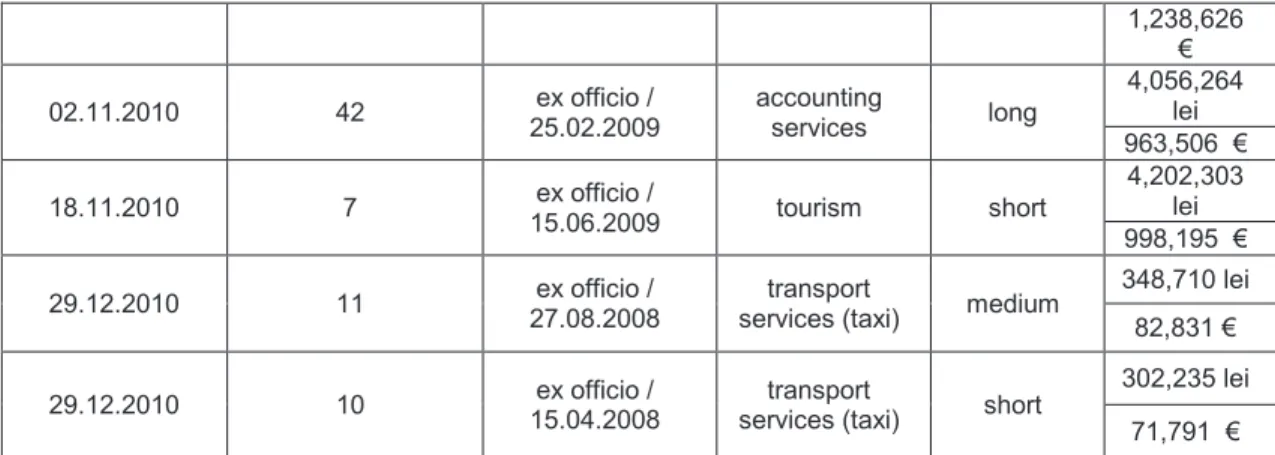
Table 7: Cartel cases detected in Romania in 2010
Date of decision issuance Number of companies involved
Method / Date of opening of
the investigation
Field Cartel duration
Fine amount lei/euro*
17.06.2010 5 ex officio /
18.02.2009 auto services short
1,094,366 lei 259,951 €
07.09.2010 14 ex officio /
03.12.2007
financial
services short
75
1,238,626 €
02.11.2010 42 ex officio /
25.02.2009
accounting
services long
4,056,264 lei 963,506 €
18.11.2010 7 ex officio /
15.06.2009 tourism short
4,202,303 lei 998,195 €
29.12.2010 11 ex officio /
27.08.2008
transport
services (taxi) medium
348,710 lei
82,831 €
29.12.2010 10 ex officio /
15.04.2008
transport
services (taxi) short
302,235 lei
71,791 €
Source: carried out by the authors on the basis of the decisions issued by the Competition Council decisions available online: http://www.consiliulconcurentei.ro/ro/documente-oficiale/concurenta/decizii.html
*according to the average annual rate of the National Bank of Romania in 2010 (1 € =
4.2099 lei)
In 2010, six cartel cases were detected. The largest fine was received by the cartel operating in the financial services 1,238,626 euro. The amount of the fines imposed by the Competition Council in 2010 was of 3.6149 million euro. All investigations were openedex officioand the average period of ongoing investigations was about 1 year and 6 months. In Table 7 it can be observed that the duration of cartels differ from case to case, i.e. small, medium and long.
Looking at Table 8 it can be noticed that in 2011 there were the most cases of cartel detected of the whole period under review, 8 in number. All cases had a medium and long term of anti-competitive infringement. In 2011 the fines imposed were worth 18,017,743 euro, the highest amount, seen in the whole analyzed period. It is to be noted that the highest fine was imposed on the cartel operating in the pharmaceutical domain, a cartel made of 11 members. The average duration of the investigation in 2011 was of 2 years.
Table 8: Cartel cases detected in Romania in 2011 Date of
decision issuance
Number of companies involved
Method / Date of opening of the
investigation
Field Cartel duration
Fine amount lei/euro*
31.05.2011 3 ex officio /
29.09.2009 fruit medium
16,698,530 lei 3,940,284 €
30.09.2011 3 ex officio /
15.10.2009 clothing long
1,273,501 lei 300,503 €
28.10.2011 4 ex officio /
07.09.2009 pharmaceutics long
4,374,834.111 lei 445,502 €
28.10.2011 2 ex officio /
07.09.2009 pharmaceutics medium
1,877,992.405 lei 443,142 €
18.11.2011 5 ex officio /
10.03.2010
transport
services (taxi) medium
21,525 lei
5,079 €
27.12.2011 11 ex officio /
07.09.2009 pharmaceutics medium
51,522,130 lei 12,157,467 €
27.12.2011 21 ex officio /
02.12.2009 cosmetics long
2,112,588 lei 498,499 €
27.12.2011 8 ex officio /
27.08.2008
transport
services (taxi) medium
76
Source: carried out by the authors on the basis of the decisions issued by the Competition Council decisions available online: http://www.consiliulconcurentei.ro/ro/documente-oficiale/concurenta/decizii.html
*according to the average annual rate of the National Bank of Romania in 2011 (1€= 4.2379 lei)
In 2012 the Competition Council detected three cartel cases. All three investigations were opened ex officio and the average time of ongoing investigation was of 1 year. Also, the cartel duration was less than one year and the fines reached a total of 6,399,365 euro.
Table 9: Cartel cases detected in Romania in 2012 Date of
decision issuance
Number of companies involved
Method / Date of opening of the
investigation
Field Cartel duration
Fine amount lei/euro*
14.11.2012 2 ex officio /
29.09.2011
natural gas
transport short
13,620,003 lei 3,056,554 €
14.11.2012 2 ex officio /
01.11.2011
natural gas
transport short
11,844,862 lei 2,667,159 €
13.12.2012 5 ex officio /
06.03.2011
road
marking short
3,010,705.61 lei 675,652 € Source: carried out by the authors on the basis of the decisions issued by the Competition Council decisions available online:
http://www.consiliulconcurentei.ro/ro/documente-oficiale/concurenta/decizii.html
*according to the annual rate of the National Bank of Romania in 2012 (1€= 4.4560 lei)
The last analyzed year reflects the fact that in Romania there were detected 2 cases of cartel a short term one and a medium term one. In Table 10 it can be seen that in one case the investigation was initiated following a complaint lodged by a company operating in the same field. The total amount of fines imposed in 2013 was of 2.929 million euro.
Table 10: Cartel cases detected in Romania in 2013 Date of
decision issuance
Number of companies involved
Method / Date of opening of the
investigation
Field Cartel duration
Fine amount lei/euro*
29.11.2013 4 ex officio /
27.10.2009 armament short
12,487,017 lei 2,825,756
€
23.12.2013 5 complaint /
23.10.2010
dental
products medium
456,237 lei 103,244 € Source: carried out by the authors on the basis of the decisions issued by the Competition Council decisions available online: http://www.consiliulconcurentei.ro/ro/documente-oficiale/concurenta/decizii.html
77 4. Conclusions
Taking into account the analysis performed in the second and third part of the paper, we can draw a series of conclusions. There were 22 cartel cases detected in the EU respectively, in Romania, there were 23 cases, during the period 2009-2013. In the cartels cases analyzed by the European Commission, of the 22 investigations opened only one was ex officio, the rest being open on the request for immunity lodged by the companies involved in these cartels.
In Romania the situation is reversed, one investigation was initiated following a complaint, the rest being automatically opened by the Competition Council. It can be seen that the leniency policy is fully used in the EU, while in Romania in the period under review no company received immunity from fines.
Regarding the average time of ongoing investigations for the years under review, in the European Union we speak about an average of 4.6 years, while in Romania the average is 1.5 years.
In the European Union there have been detected 11 cases of long term cartels, 10 medium term cases and only one case that lasted less than a year. In Romania there have been detected 4 long term cartel cases, 7 cases of medium term cartels and 12 short term cases.
The fields of activity both in cartel cases detected in Romania and in the EU are diverse, the largest fines being applied in the pharmaceutical field in Romania, respectively in financial services in the European Union. With regard to the fines imposed in the period 2009 - 2013, in the European Union there been have imposed fines in the amount of 8,246,505,819 euro, while in Romania the fines totalled 32,807,338 euro that is 251 times less than in the European Union. This proportion is logical bearing in mind that fines are calculated based on the turnover of the companies involved in the cartel, and the duration of the cartel.
The importance of competition policy and the role of the competition authorities that watch over the maintenance of fair competition, and also on the consumer welfare have to be emphasized. In this case it is to be noticed that there is concern and activities of competition authorities, both at European and national level regarding the cartel, one of the most harmful anti-competitive practices.
Acknowledgment
This paper has been financially supported within the project entitled „SOCERT. Knowledge society, dynamism through research”, contract number POSDRU/159/1.5/S/132406. This project is co-financed by European Social Fund through Sectoral Operational Programme for Human Resources Development 2007-2013. Investing in people!
References
Bennet, M and Padilla, J (2009) ‘Article 81 EC Revisited: Deciphering European Commission Antitrust Goals and Rules’ in Vives, X. (ed.) Competition Policy in the EU. Fifty Years on from the Treaty of Rome, Oxford: Oxford University Press, pp. 57.
78
Commission Decisions relating to a proceeding under Article 101 of the Traty on the Functioning of the European Union and Article 53 of the EEA Agreement (2009-2013). Available: http://ec.europa.eu/competition/elojade/isef/index.cfm [11 Apr 2014].
Competition Council Decisions having as object the alleged infringement of the provisions of article 5 (1) of the Competition Law no. 21/1996, republished (2009-2013). Available:
http://www.consiliulconcurentei.ro/ro/documente-oficiale/concurenta/decizii.html [11 Apr 2014].
Competition Law no. 21 of 10 April 1996. Republished (2014). Available:
http://www.consiliulconcurentei.ro/uploads/docs/items/id8047/lege_nr_21_republicata_a pr_2014.pdf [11 Apr 2014].
Consolidated version of the Treaty on European Union an the Treaty on The Functioning of the European Union (2010) Available: http://eur-lex.europa.eu/legal-content/EN/TXT/PDF/?uri=OJ:C:2010:083:FULL&from=EN
[06 Apr 2014].
European Commission (2011), EU Competition Law Rules Applicable to Antitrust
Enforcement, Brussels. Available: