RESEARCH ARTICLE
A Genetic Screen Identifies a Requirement
for Cysteine-Rich
–
Receptor-Like Kinases in
Rice NH1 (OsNPR1)-Mediated Immunity
Mawsheng Chern1,2, Qiufang Xu1,2,3, Rebecca S. Bart1,2¤, Wei Bai1,4, Deling Ruan1,2, Wing Hoi Sze-To1,2, Patrick E. Canlas1,2, Rashmi Jain1,2, Xuewei Chen1,2,5, Pamela C. Ronald1,2*
1Department of Plant Pathology and the Genome Center, University of California, Davis, Davis, California, United States of America,2Joint Bioenergy Institute, Emeryville, California, United States of America, 3Institute of Plant Protection, Jiangsu Academy of Agricultural Sciences, Nanjing, China,4College of Life Sciences, Inner Mongolia Agricultural University, Huhhot, China,5Rice Research Institute, Sichuan Agricultural University at Chengdu, Wenjiang, Chengdu, Sichuan, China
¤ Current address: Donald Danforth Center, St. Louis, Missouri, United States of America *[email protected]
Abstract
Systemic acquired resistance, mediated by the ArabidopsisNPR1gene and the riceNH1
gene, confers broad-spectrum immunity to diverse pathogens. NPR1 and NH1 interact with TGA transcription factors to activate downstream defense genes. Despite the importance of this defense response, the signaling components downstream of NPR1/NH1 and TGA pro-teins are poorly defined. Here we report the identification of a rice mutant,snim1, which sup-presses NH1-mediated immunity and demonstrate that two genes encoding previously uncharacterized cysteine-rich-receptor-like kinases (CRK6andCRK10), complement the
snim1mutant phenotype. Silencing ofCRK6andCRK10genes individually in the parental genetic background recreates thesnim1phenotype. We identified a rice mutant in the Kitaake genetic background with a frameshift mutation incrk10; this mutant also displays a compromised immune response highlighting the important role ofcrk10. We also show that elevated levels ofNH1expression lead to enhancedCRK10expression and that the rice TGA2.1 protein binds to theCRK10promoter. These experiments demonstrate a require-ment for CRKs in NH1-mediated immunity and establish a molecular link between NH1 and induction ofCRK10expression.
Author Summary
To survive, plants and animals must resist microbial infection. Plants employ an immune response called systemic acquired resistance that confers long-lasting resistance to a broad-spectrum of pathogens. Researchers have previously identified two key proteins (NPR1/NH1 and TGA) that control this immune response. Despite these advances, there remain many gaps in our knowledge and understanding of this important immune response. We have identified a new gene (CRK10) required for this immune response;
a11111
OPEN ACCESS
Citation:Chern M, Xu Q, Bart RS, Bai W, Ruan D, Sze-To WH, et al. (2016) A Genetic Screen Identifies a Requirement for Cysteine-Rich–Receptor-Like
Kinases in Rice NH1 (OsNPR1)-Mediated Immunity. PLoS Genet 12(5): e1006049. doi:10.1371/journal. pgen.1006049
Editor:Guo-Liang Wang, Ohio State University, UNITED STATES
Received:December 19, 2015
Accepted:April 21, 2016
Published:May 13, 2016
Copyright:© 2016 Chern et al. This is an open access article distributed under the terms of the
Creative Commons Attribution License, which permits unrestricted use, distribution, and reproduction in any medium, provided the original author and source are credited.
Data Availability Statement:All relevant data are within the paper and its Supporting Information files.
without it, plants are more susceptible to infection. These findings advance basic knowl-edge of systemic acquired resistance and open the door to a new avenue of research on this exciting and important resistance mechanism.
Introduction
Despite the lack of circulating immune cells, plants share similarities with animals in their defense responses against pathogens; they both use innate immune systems to counter attacks. For example, plants and animals utilize membrane-localized receptors that detect conserved molecular patterns derived from microbes [1], including peptidoglycan, flagellin, chitin, and sulfated peptides. Another component of the immune system consists of cytoplasmic nucleo-tide-binding-domain, leucine-rich repeat receptors (NLR) [2] that recognize cognate effector proteins secreted by the microbe into the cell. Plants have a third type of defense system, absent in animals, called systemic acquired resistance (SAR) [3,4]. Activation of this system leads to a long lasting, broad-spectrum defense response.
SAR is induced by the plant hormone salicylic acid (SA), and its analogues 2,6-dichloroiso-nicotinic acid (INA), probenazole, and benzothiadiazole (BTH) [5–10]. In Arabidopsis, NPR1 (nonexpressor of pathogenesis-related genes 1; also known asNIM1andSAI1) is the key regu-lator of SAR [11–15]; SA induces NPR1 expression and activates the NPR1 protein leading to immunity against diverse pathogens [16–19]. NPR1 interacts with TGA transcription factors, which are required for the SAR response [20–24]. NPR1 contains an ankyrin-repeat domain, a BTB/POZ domain, and a C-terminal transcription activation domain. The ankyrin-repeat domain interacts with TGA proteins [20]; the BTB/POZ domain regulates the C-terminal acti-vation domain [25,26]. SA binds NPR1 and may regulate NPR1 directly [27]; another model suggests that SA regulates NPR1 indirectly through NPR3 and NPR4, which bind SA with high affinities [28].
Arabidopsis NIMIN (NIM1 interacting) and rice NRR (negative regulator of resistance) family proteins are the second class of proteins that interact with Arabidopsis NPR1/NIM1 and rice NH1 (NPR1 homolog 1; also known as OsNPR1) [29,30], respectively. Arabidopsis NIMINs [31] and rice NRR members (NRR, RH1, RH2, and RH3) [32] negatively regulate NPR1 and NH1, respectively [31–33].
In rice, elevated expression of ArabidopsisNPR1or the rice orthologNH1or the NH1 para-logNH3[22,29,30,34] results in enhanced resistance toXanthomonas oryzaepv.oryzae(Xoo) andMagnaporthe oryzae, the causal agents of rice bacterial leaf blight and rice blast, respec-tively. Like Arabidopsis NPR1, rice NH1 also interacts with TGA transcription factors [29]. The enhanced disease resistance of NH1 overexpression (NH1ox) rice plants is accompanied by and correlated with a spontaneous cell death phenotype, commonly referred to as a lesion mimic phenotype [29,35,36]. Application of BTH enhances the formation of necrotic spots from the spontaneous cell death on the NH1ox plants [29], indicating a tight association between this lesion mimic phenotype and enhanced resistance toXoo.
Although Arabidopsis NPR1 and rice NH1 bind to TGA proteins and act as transcriptional co-activators [26,37], the downstream components required for the NPR1/NH1-mediated response remain largely uncharacterized. To identify such proteins, we screened a fast-neu-tron-induced rice mutant population of NH1ox plants treated with BTH and identified a mutant calledsuppressor of NH1-mediated immunity 1(snim1) that no longer responds to BTH. Here, we report the identification of two previously uncharacterized cysteine-rich recep-tor-like kinases (encoded byCRK6andCRK10) that complement thesnim1phenotype and are Competing Interests:The authors have declared
required for the BTH-induced immune response. We demonstrate that elevatedNH1levels induceCRK10expression and that the rice TGA2.1 protein binds to theCRK10promoter, indi-cating that both NH1 and TGA proteins regulateCRK10expression.
Results
Identification of the
snim1
mutant and an 88-kb deletion associated with
the suppressor phenotype
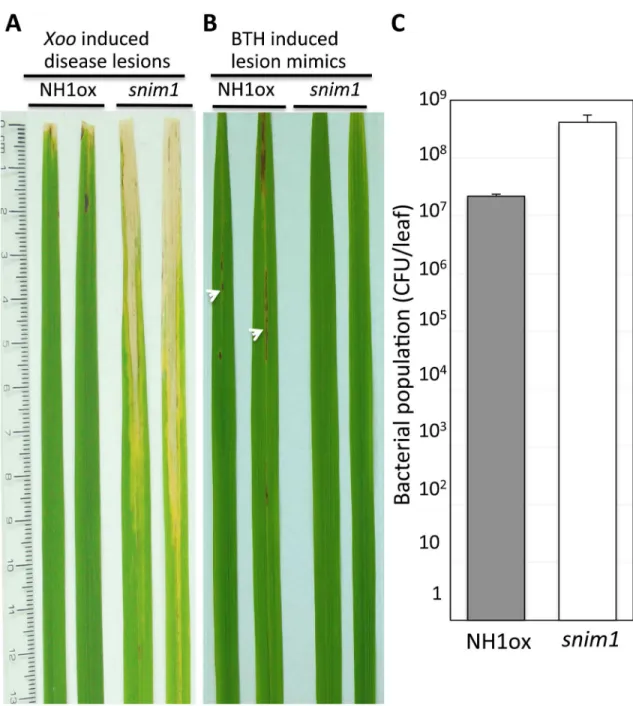
In our screen for suppressors of NH1-mediated immunity [38], we isolated thesnim1mutant. After inoculation withXanthomonas oryzaepv.oryzae(Xoo),snim1develops long water-soaked lesions, characteristic of the disease. In contrast, the parental control NH1ox plants are resistant to infection, resulting in short lesions (Fig 1A). Furthermore, the NH1ox parent dis-plays a lesion mimic spontaneous cell death phenotype after application of BTH, which is a plant defense activator [38], butsnim1lacks this phenotype (Fig 1B). Bacterial population mea-surements show thatsnim1harbors 18 times moreXoothan NH1ox plants (P = 0.0052) (Fig 1C). These results indicate that thesnim1mutation impairs NH1-mediated immunity.
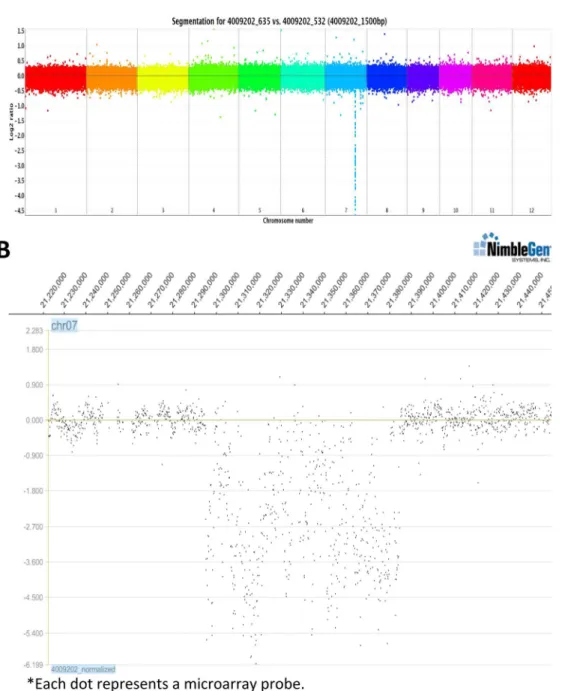
To expedite isolation of the gene(s) responsible for thesnim1phenotype, we conducted comparative genome hybridization (CGH) analysis using a NimbleGen 2.1-million-probe rice tiling array [38] comparingsnim1and NH1ox DNA (Fig 2A). These experiments identified a single large deletion (from approximately 21,297,000 to 21,385,000) on chromosome 7 of
snim1(Fig 2B). This 88kb deletion was confirmed by PCR. The deleted region contains 11 genes: sixCRKs, one encoding development and cell death-kelch motif protein, three encoding expressed proteins, and one Ty3-gypsy retrotransposon gene. Their MSU gene IDs and relative positions are shown inS1 Fig.
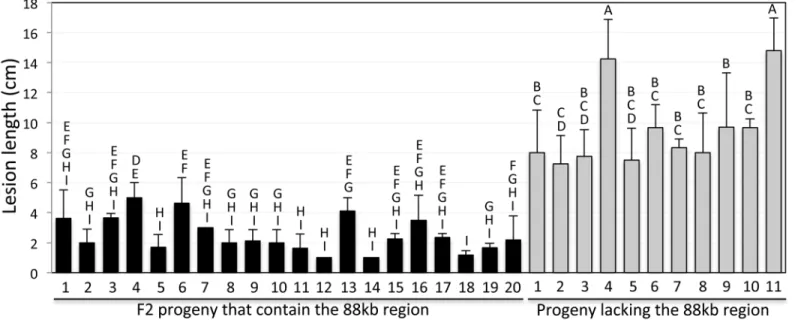
Analysis of F2 progeny derived from a cross betweensnim1and the parent reveals a com-plete association of the 88kb deletion with thesnim1phenotype (Fig 3). F2 progeny that con-tain the 88kb region exhibit levels ofXooresistance similar to that of the NH1ox parent (Fig 3). In contrast, F2 progeny lacking the 88kb region are susceptible toXoo. T-test yields P<0.0001,
indicating the difference between the two groups is highly significant.
CRK6
and
CRK10
complement the
snim1
phenotype and silencing of
CRK6
and
CRK10
individually compromises NH1-mediated immunity
To assess the involvement of the 10 non-retrotransposon genes deleted insnim1, we conducted complementation experiments. We ligated each isolated gene into the binary vector C4300, and used the resulting construct to transformsnim1. Following inoculation withXoo, we found that only theCRK6andCRK10constructs restore resistance to thesnim1mutant (Fig 4). None of the other 8 genes restore resistance toXoo(S2 Fig).
To investigate the relationship between the rice CRKs and their Arabidopsis paralogs, we constructed a phylogenetic tree for the 45 CRKs and included the Arabidopsis CRKs to display their relative positions (S3 Fig).
To further validate the requirement ofCRK6andCRK10for NH1-mediated immunity to
Xoo, we silencedCRK6andCRK10individually in the NH1ox background using RNA interfer-ence (Ri) and inoculated the resulting six transgenic lines withXoo. Real-time quantitative reverse transcription (qRT)-PCR experiments revealed that the CRK6Ri and CRK10Ri lines are effectively silenced forCRK6andCRK10expression (70%-90% reduction) (S4 Fig). Accu-mulation ofCRK6andCRK g35580RNAs are also reduced in the CRK10Ri lines. In contrast, RNA levels ofCRK g35650,g35660andg35680are not reduced in the CRK10Ri lines. These results indicate that silencing ofCRK10also affectsCRK6andCRK g35580expression levels.
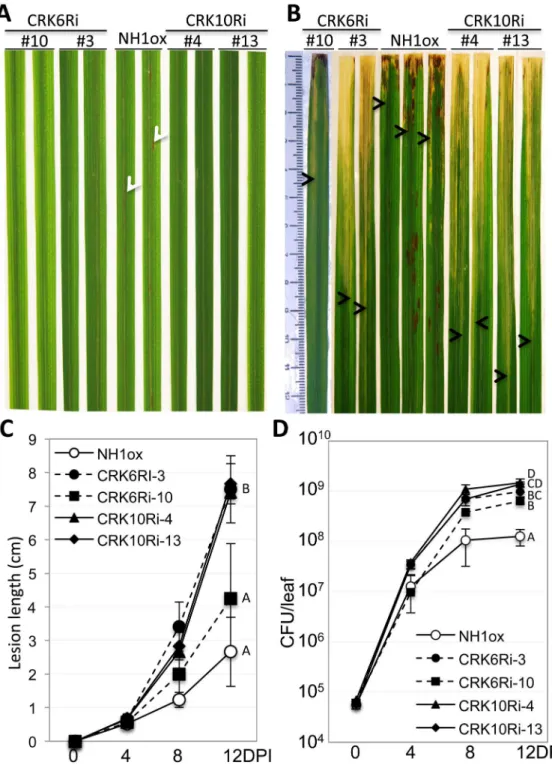
Based on the low sequence similarity of CRK6 and CRK g35580 with the region of CRK10 used for silencing, we hypothesize that the observed reduced expression is indirect and not due to co-silencing. In contrast to the resistant NH1ox parent plants, which display spontaneous cell death, lesion mimic spots following BTH treatment (Fig 5A) and are resistant toXoo(Fig 5B), the CRK6Ri and CRK10Ri lines lack the spontaneous cell death phenotype (Fig 5A) and are susceptible toXoo(Fig 5B and 5C). The presence of theCRK10RiandCRK6Ritransgenes
Fig 1. Thesnim1mutant is compromised in immunity toXooand BTH-induced necrotic lesion formation.Two representative leaves are displayed for the NH1ox parent and thesnim1mutant in (A) and (B). Inoculation withXoowas carried out with the scissor-dip method (seeMethods). (A)Xoo-induced, long water-soaked disease lesions in thesnim1 mutant. (B) Lesion mimic necrotic spots. The necrotic spots (marked with arrowheads) developed one week after application of 1 mM BTH. (C) Bacterial populations determined 14 days after inoculation. T-test yielded P = 0.0052. Each bar represents the mean and standard deviation of three leaves.
cosegregates with susceptibility toXooin T1 progeny (S5andS6Figs). Bacterial growth curve analyses reveal that CRK6Ri (lines #3&10) and CRK10Ri (#4&13) plants harbor 5–8 times and 11–12 times moreXoothan the NH1ox parent, respectively (Fig 5D). Statistical analysis of bac-terial populations at day 12 (Fig 5D) indicated significant differences between NH1ox parent, CRK6Ri, and CRK10Ri lines. These results confirm the requirement ofCRK6andCRK10for NH1-mediated immunity.
Fig 2. Comparative genome hybridization identifies a deletion insnim1.(A) A composite CGH graph. Each color represents a chromosome; the downward peak represents a deletion. The codes 4009202–635 vs 532 representsnim1vs NH1ox DNA samples. Each dot represents a segment of 1500 bp. The Y-axis is in log2 scale. (B) An enlarged view of part of chromosome 7 that contains the deleted region. Expression level is in log2 scale. Each dot represents an actual microarray probe.
doi:10.1371/journal.pgen.1006049.g002
Fig 3. The 88-kb deletion cosegregates with thesnim1phenotype.A segregating progeny population derived from a cross between thesnim1mutant and the LG parent was genotyped for the presence of theUbi-NH1gene (NH1ox) and theCRK10gene (representing the 88-kb region) and scored for resistance toXoo. Only progeny containing theUbi-NH1gene are shown.CRK10positive and negative progeny plants are separated into two groups. The letters above each bar show the statistical groupings using the student T-test on each pair based on the 5% significance level.
doi:10.1371/journal.pgen.1006049.g003
Fig 4.CRK6andCRK10complementsnim1.Thesnim1complementation lines containing eitherCRK6orCRK10were inoculated withXoo. Each bar represents the average and standard deviation of at least three leaves from an independent transgenic line. Letters show statistical groupings (P<0.05).
Fig 5. Silencing ofCRK6orCRK10re-creates thesnim1phenotypes.CRK6Ri and CRK10Ri plants were treated with 1 mM BTH beforeXooinoculation. Two lines each of CRK6Ri and CRK10Ri are shown. (A) Lesion mimic formation after BTH treatment. Lesion mimic spots on NH1ox leaves are indicated by white arrowheads. (B)Xoo-induced water-soaked lesions. The bottom boundary of the lesion on each leaf is marked with an arrowhead to indicate the lesion lengths. Leaves were taken 14 days post inoculation. (C) Lesion length development afterXooinoculation. Each time point contains 6 leaves. (D) Bacterial growth curves. Each time point represents three replicates. Statistical groupings: A = CRK10Ri-4, AB = CRK10Ri-13, BC = CRK6Ri-3, C = CRK6Ri-10, D = NH1ox.
doi:10.1371/journal.pgen.1006049.g005
The
snim1
and
CRK1
0 mutations compromise BTH-induced resistance
to
Xoo
independent of ectopic NH1 over-expression
We next tested whether thesnim1mutation affects resistance toXooin the absence of the
NH1oxtransgene. For this purpose, we crossedsnim1with the parental rice cultivar LiaoGeng (LG), which lacks theNH1oxtransgene. We identified 27 individual progeny (snim1/LG) from this cross that carry homozygoussnim188kb deletion and lack theNH1oxtransgene. We pre-treated thesnim1/LG progeny and the LG control with 1mM BTH and then inoculated with
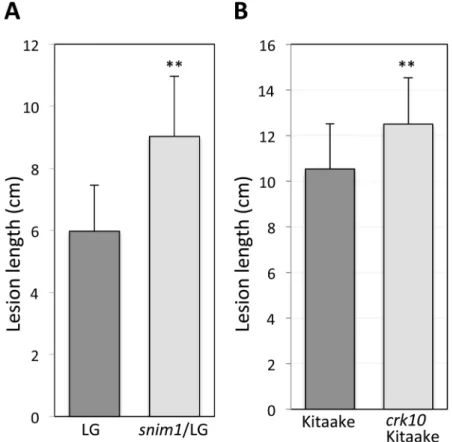
Xoo. Thesnim1/LG individuals display significantly (P<0.0001) longer lesions (9.0±1.9 cm)
than the LG control (6.0±1.5 cm) (Fig 6A). These results indicate that thesnim1mutation also affects BTH-induced resistance toXooin the absence of theNH1oxtransgene.
We further verified the role of theCRK10gene with acrk10rice mutant. We identified a homozygouscrk10mutant from a fast neutron mutagenized rice population in the Kitaake genetic background [39]. This mutant carries a two-base deletion (S7 Fig) in the third exon of
CRK10causing a frameshift, resulting in a predicted truncated CRK10 protein missing the kinase domain (seeMethods). To assess the effect of the CRK10 mutation in this second genetic background, we inoculated 27 progeny plants of thiscrk10mutant along with 25 wild type Kitaake control plants withXoofollowing 1mM BTH treatment. We observed that the
crk10/Kitaake mutant plants develop significantly (P = 0.0009) longer lesions (~12.5 cm) than the control Kitaake plants (~10.5 cm) (Fig 6B). These results further support the conclusion that theCRK10gene is required for resistance toXoo.
Elevated expression of
CRK10
enhances resistance to
Xoo
To test the hypothesis that higher levels ofCRK10enhance resistance, we generated an induc-ible construct (GVG-CRK10) using the GVG-dexamethasone (DEX) inducinduc-ible system [40,41] and obtained 10 healthy, independently transformed lines. These plants display enhanced resistance toXooafter DEX induction (Fig 7A–7C). The enhanced resistance cosegregates with theGVG-CRK10transgene in T1 segregating progeny (S8 Fig). Further analysis indicates that higher levels ofCRK10lead to higher levels of resistance toXoo(Fig 7D). Overexpression of
CRK6did not confer enhanced resistance toXoo(S9 Fig).
Expression levels of
CRK10
are dependent on NH1 levels and BTH
induction
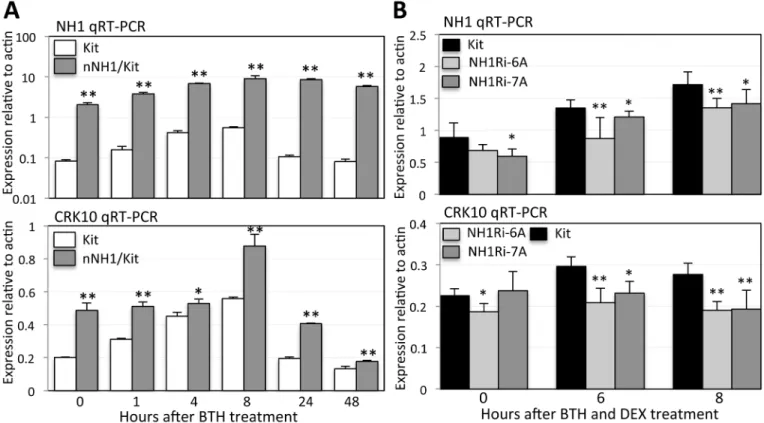
To determine if NH1 regulates expression ofCRKgenes, we assessedCRK10andCRK6 expres-sion levels in Kitaake and NH1 overexpresexpres-sion plants (nNH1 in Kitaake genetic background). We treated plants with 1 mM BTH and collected leaf samples 0, 1, 4, 8, 24, and 48 hours after treatment. BTH treatment inducesNH1expression levels in both Kitaake (labeled Kit) and nNH1 plants, reaching peaks at 8 hours (Fig 8A). BTH treatment induces 3-fold higher levels ofCRK10mRNA (at 8 hr) in Kitaake compared with the untreated control (0 hr); this induc-tion is higher (4.5-fold) in the nNH1 plants (at 8 hr;Fig 8A). In the absence of BTH pretreat-ment, theCRK10mRNA level is 2.5-fold higher in nNH1 plants compared with control plants. BTH treatment also inducesCRK6expression (by 4 fold at 8hr). We observed a slight delay in
CRK6induction in nNH1 plants. This delay does not significantly change the basal and peak levels ofCRK6expression (S10 Fig).
To further investigate the observation that NH1 regulatesCRK10expression, we assessed
compared with the Kitaake control, 6 and 8 hours after DEX and BTH treatment (Fig 8B). Importantly, we also observed thatCRK10mRNA levels are also significantly reduced in the NH1Ri plants compared with the Kitaake control (Fig 8B). These results indicate that BTH andNH1regulateCRK10expression.
The
CRK10
promoter contains a TGA binding site
To assess the mechanism by whichCRK10expression is activated, we examined theCRK10
promoter for potential transcription factor binding sites. We identified the sequences
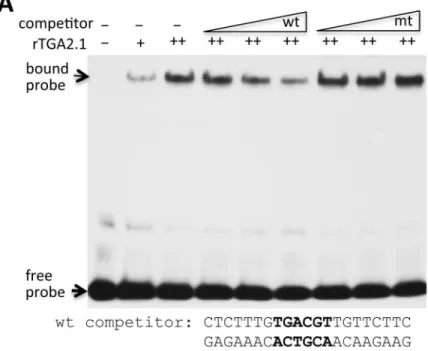
TGACGT (-793 from the TATA box) and TGACG (-164) in theCRK10andCRK6promoters, respectively, that match the consensus sequence binding sites for TGA transcription factors. We synthesized an oligonucleotide containing this putativeCRK10TGA binding site and employed an electrophoresis mobility shift assay (EMSA) to test its interaction with the rice TGA2.1 protein, which has been shown to bind to an SA-responsive element and interact with NH1 [42,43]. We found that rice TGA2.1 binds to the synthetic oligonucleotide and that the observed gel shift can be competed with higher concentrations of wild-type oligonucleotides but not by oligonucleotides carrying a mutation in the TGA binding site (Fig 9A). These results demonstrate that theCRK10promoter contains a cognate TGA binding site.
Fig 6. Thesnim1andcrk10mutations affect resistance toXooin the wild type genetic background.(A) A population of 27 plants (93 leaves) of the wild type Liaogeng (LG) control and 27 plants (110 leaves) of snim1/LG were inoculated withXoo. Lesion lengths were measured 14 days after inoculation. The average lesion lengths and standard deviations are shown. T-test between LG and snim1/LG gave a P value lower than 0.0001. (B) A population of 27 plants (147 leaves) ofcrk10/Kitaake (FN892-S) was inoculated withXoo together with 25 plants (136 leaves) of the Kitaake control and lesions measured 14 days post inoculation. T-test gave a P = 0.0009.
doi:10.1371/journal.pgen.1006049.g006
CRK6 is an active kinase
CRK6 and CRK10 carry conserved kinase motifs. To assess the kinase activity of CRK6, we fused the CRK6 kinase domain (CRK6K) to the His:Nus protein, expressed the fusion con-struct inE.coliand purified the fusion protein using Ni-NTA resins. As a negative control, we generated a kinase-dead mutant of the CRK6 kinase by mutating the conserved, required aspartate at amino acid 488 to asparagine (CRK6DN). The two fusion proteins were subject to kinase activity assay (seeMethods). The Nus:CRK6K protein shows clear autophosphorylation, whereas the Nus:CRK6DN protein did not (S11A Fig). These results indicate that CRK6 is an
Fig 7. Inducible overexpression ofCRK10enhances resistance toXoo.(A) Two leaves each of GVG-CRK10 lines (#3 and #21) and the Kitaake control were photographed 2 weeks afterXooinoculation. The lower limit of theXoo-induced water soaked lesions on each leaf is marked with a white arrowhead. (B) Lesion length development and (C) bacterial growth curves were determined over 12 days afterXooinoculation. Each time point represents the average and standard deviation of four leaves. The letter next to each time point represents the statistical grouping based on the 5% significance level. (D) RNA levels ofCRK10andPRgenes in GVG-CRK10 lines and the Kitaake control. Real time RT-PCRs forCRK10were carried out with RNA extracted from leaves collected before DEX application (0 hours) and at 4 and 24 hours after 100μM DEX application.PR1andPR10RNA levels were assessed in the samples treated with DEX for 24 hours. The letter above each bar represents the statistical grouping based on the 5% significance level.
active kinase. We were unable to express and purify the CRK10 kinase. However, the kinase domains of CRK6 and CRK10 are highly conserved sharing 76% similarity (S11B Fig), includ-ing all amino acids known to be critical for kinase activity suggestinclud-ing that CRK10 is likely also an active kinase.
In addition to the kinase domain, we have also analyzed the CRK6 and CRK10 proteins for other conserved protein domains with the SMART program, which is specialized in detecting protein domains. Both CRK6 (amino acids 1–31) and CRK10 (aa. 1–27) contain a predicted signal peptide. Both also contain a predicted transmembrane region: amino acids 295–317 for CRK6 and 284–306 for CRK10. These results strongly predict that CRK6 and CRK10 are mem-brane-localized proteins.
Discussion
In this manuscript we demonstrate that the previously uncharacterized proteins, CRK6 and CRK10, are required for BTH-inducible, NH1-mediated immunity in rice. There are 43 addi-tional CRK genes in rice (http://rice.plantbiology.msu.edu) and at least 44 CRK members in Arabidopsis [44,45]. In both rice and Arabidopsis, many of theCRKgenes are clustered together in the genome. This structure may facilitate recombination and accelerate evolution of resistance. A similar mechanism for generating diversity has been postulated for plant resis-tance genes encoding both nucleotide-binding site leucine-rich repeats proteins and leucine rich repeat receptor kinases [46,47].
Fig 8. NH1 regulatesCRK10expression.(A) BTH and NH1 induceCRK10expression. Kitaake (Kit) and nNH1 plants, which contain an extra copy ofNH1and overexpress NH1, were treated with 1mM BTH and leaf samples taken at time points 1, 4, 8, 24, and 48 hours after treatment. The nNH1 samples were compared to the Kit control at each time point for statistical analysis. (B) NH1-silencing reducesCRK10expression. Leaves were treated with 1 mM BTH and 100μM DEX. Each sample represents two biological and three technical replicates. The NH1Ri samples were compared to the Kit control at each time point for statistical analysis. One*indicates P<0.05 and two indicates P<0.01.
doi:10.1371/journal.pgen.1006049.g008
Although altered expression ofCRKgenes has been observed in several datasets in response to biotic stress [48–53], the biological functions ofCRKgenes have not previously been well elucidated for any of the Arabidopsis or riceCRKgenes for their involvement in the immune response. In particular, the requirement of these genes in NPR1- or NH1-mediated immunity
Fig 9. Binding of a rice TGA protein to theCRK10promoter and a summary model.(A) Rice TGA2.1 binds to theCRK10promoter in a gel mobility shift assay. 5X, 20X, 100X of unlabeled wild-type (wt) and mutated (mt) oligonucleotides were included as competitors (sequences as shown). The probe contains the same sequence as the wt competitor, but is coupled to a biotin at the 5’-end. (B) A model for NH1, TGA, and CRK10-mediated immunity.
has not previously been demonstrated. The observed functional redundancy ofCRKgenes in monocots and dicots has likely hindered their characterization and prevented an unambiguous assignment of their function [53]. Because of these complications, previous analyses of CRK proteins relied almost exclusively on overexpression experiments. For example, overexpression ofAtCRK4,AtCRK5,AtCRK6,AtCRK13, andAtCRK45resulted in cell death, activation of defense genes, and/or increased resistance toPseudomonas syringaepv.tomatoDC3000. Of the knockout analyses conducted, only theAtcrk45mutant displayed a slight alteration in response toPstDC3000 [50]. Here we provide direct and robust genetic evidence that the
CRK6andCRK10genes mediate BTH-induced immune response.
We have demonstrated that thesnim1mutant and thecrk10knockout mutant compromise resistance toXooin two genetic backgrounds in the absence ofNH1overexpression (Fig 6). Fur-thermore,CRK10is likely broadly involved in resistance to pathogens in a quantitative manner because higher levels ofCRK10correlate with enhanced cell death and immune response (Fig 7). This result is consistent with the observations thatCRKgenes are induced by diverse patho-gens [48–53].CRK10may play a more significant role in the immune response than other rice
CRKgenes because our results clearly show that silencing (Fig 5) and knockout (Fig 6B) of
CRK10itself both cause obvious phenotypes in the immune response;CRK6-silenced lines show a less susceptible phenotype.
Our genetic data reveal that elevated expression of NH1 results in enhancedCRK10 expres-sion. Conversely, a reduction inNH1expression leads to a reduction ofCRK10expression. These results unambiguously demonstrate thatCRK10expression is regulated by the NH1 pro-tein. The observations that TGA proteins bind to theCRK10promoter (Fig 9A) and interact with NH1 [43] suggest that NH1 and TGA proteins function together to activate expression ofCRK10.Fig 9Bpresents a model for NH1 and CRK10-mediated activation of defense responses. Based on the observation that NPR1 or NPR3/NPR4 proteins bind SA [27,28], we hypothesize that rice NH1 also senses BTH/SA and that the activated NH1 protein translocates to the nucleus where it interacts with TGA transcription factors. The TGA/NH1 protein com-plex then activates expression of downstream genes, includingCRK6/CRK10.
Methods
Plant materials, screening, and
Xoo
inoculation
The rice mutant population in the NH1ox-54 genetic background (in the rice LiaoGeng variety carrying theUbi-NH1gene) was generated by irradiation with fast neutrons at 20 Grays as pre-viously described [38].Xooinoculation was carried out in a growth chamber, set at 26°C with 80% humidity. Inoculation of rice plants withXoostrain PXO99 was carried out with the scis-sor-dip method [54] with absorbance (600 nm) at OD = 0.5. Thecrk10/Kitaake mutant was generated in theXa21background and was inoculated with theΔraxST/PXO99strain, which evadesXa21-mediated immunity [55].
Comparative genome hybridization
Comparative genome hybridization was carried out at the Roche NimbleGen facility (Madison, WI) using the Roche NimbleGen rice whole genome tiling array as described before [38].
Cloning of individual genes on chromosome 7 for test to complement the
snim1
mutant
A Qiagen Long Range PCR kit was used for amplification of each gene including the promoter, the coding region, and the 3’sequence, from chromosome 7. Amplification of g35580 used
primers G580-1 and G580-3, g35600 used primers G600-1 and G600-2, g35610 used primers G610-1 and G610-3, g35620 used primers G620-1a and G620-2a, g35630 used primers G630-1 and G630-2, g35640 used primers G640-1 and G640-2, g35650 used primers G650-1 and G650-2, g35660 used primers G660-1 and G660-2, g35680 used primers G680-1 and G680-3, g35690 used primers G690-1 and G690-3, and g35700 used primers G700-1 and G700-2. Amplification of g35600, g35610, g35640, g35650, g35660, g35690, g35700 used Liaogeng genomic DNA as the PCR template. The remaining genes used PAC clone P0458H05 as tem-plate. PCR products were cloned into the pCR8/GW/TOPO vector (Invitrogen) and confirmed by sequencing. Each gene was subcloned into the C4300 vector by Gateway recombination.
Genotyping of plants carrying the 88-kb deletion was carried out with primers targeting genesCRK6,CRK10, or Os07g35610.CRK6genotyping used primers RT1 and G690-RT2.CRK10genotyping used primers G700-RT3 and G700-RT4. Os07g35610 genotyping used primers G610-10 and G610-2.
crk10
mutant in kitaake
A two-base deletion in exon 3 of theCRK10gene (Os07g35700) is present (line # FN892-S, M2) compared to the Kitaake parent that causes a frame shift disrupting theCRK10open read-ing frame. M3 progeny plants were used forXooinoculation.
Plasmid construction for gene silencing and overexpression
To generate an RNAi construct targetingCRK6(Os07g35690), we used primers G690-SiRI and G690-SiBam to amplify a 500bp fragment from the 5’-end ofCRK6. This fragment was digested with EcoRI and BamHI and cloned into plasmid pENTR/L16, modified from pENTR/ D to contain multiple cloning sites. The clone was confirmed by sequencing. The fragment was excised with EcoRI and BamHI and subcloned into pBluescript II SK-, pre-cut with BamHI and phosphatase-treated, jointly with theXa21intron (precut with EcoRI). The resulting clone (dsG690/SK) contained two pieces of theCRK6fragment head-to-head with theXa21intron in between to serve as a spacer to stabilize the clone in bacteria. The dsG690 insert was excised with BamHI and subcloned back to the pENTR/L16 vector using the BamHI site and recom-bined with a Gateway compatible Ubi-C4300 binary vector (Ubi-C4300/GA) to yield construct Ubi-dsG690/C4300. To generate an RNAi construct targetingCRK10, we used primers G700-SiRI and G700-SiBam to amplify a 500-bp fragment from the 5’-end ofCRK10. The PCR product was processed the same way as theCRK6fragment for generating the end product Ubi-dsG700/C4300 construct. These constructs were also used to transform the NH1ox-11 line. Genotyping of CRK6Ri plants used primers G690-SiRI and Ubi-1 primers; genotyping of CRK10Ri plants used G700-SiRI and Ubi-1 primers.
A full-length, 2 kbCRK10cDNA was amplified with primers G700-3 and G700-8 from Nip-ponbare and cloned into pENTR/D. To generate an inducibleCRK10construct in the GVG-DEX system to overexpressCRK10, theCRK10cDNA was subcloned into vector TA7002/GA by Gateway recombination, creating construct GVG-G700. Genotyping of the GVG-G700 con-struct in transgenic lines used primers Hyg-3 and Hyg-4, targeting the hygromycin selection marker.
Real time quantitative RT-PCR
Total RNA was extracted using the Trizol reagent (Invitrogen) and purified with spin-column (NucleoBond). One to fiveμg of total RNA each sample was used to synthesize cDNA for real
time RT-PCR.
To assess the expression level ofCRK6, primers Q1a and Q2 or primers G690-Q1b and G690-Q2 were used. These primers were determined to be specific to theCRK6gene. ForCRK10, primers G700-RT3 and G700-RT5 were used for real time RT-PCR.
BTH and DEX applications to plants
BTH was applied to rice leaves in a greenhouse in the form of a foliar spray at a concentration of 1 mM in the form of Actigard (Syngenta). DEX was dissolved in DMSO and diluted to 100μM in 0.05% Tween 20 and applied by foliar spray.
Electrophoresis mobility shift assay (EMSA)
For the EMSA assay, a probe was generated via annealing two oligonucleotides containing the putative TGA binding site. The top oligonucleotide contains biotin at the 5’end. Detection of biotin on the probe by streptavidin was carried out using a Chemiluminescent Nucleic Acid Detection Module (Thermo Scientific, Rockford, IL).
Statistical analysis
Statistical analysis was carried out using the JMP Pro 10 statistics program.
Protein expression in
E
.
coli
and purification
Protein expression in E. coli BL21 cells and purification of the fusion protein was carried out according to Chen et al. [56].
Kinase activity assay
Kinase activity assay was conducted as described by Chen et al. [56].
Supporting Information
S1 Table. The nucleotide sequences of the primers used in this study are provided in the table.
(DOC)
S1 Fig. Genes in the 88-kb region deleted in thesnim1mutant.A schematic diagram
depict-ing the positions of the 11 annotated, expressed genes contained in the 88 kb region on chro-mosome 7 that is deleted in mutantsnim1. The sixCRK-encoding genes are highlighted as filled bars.CRK6is g35690 andCRK10is g35700.
(PPT)
S2 Fig. Complementation with genes in thesnim1deletion.Each gene, including the coding
region, promoter (approximately 1.5 kb upstream of the start codon), and 3’(500 bp) regions, was amplified, confirmed by sequencing, and cloned into binary vector C4300. T0 transgenic plants were generated by transforming mutantsnim1with each individual gene in the 88-kb region deleted insnim1. T0 plants were inoculated withXooand lesion lengths measured and recorded 14 days after inoculation. Each bar represents the average and standard deviation of 2
to 8 leaves. (PPT)
S3 Fig. A phylogenetic tree of rice and Arabidopsis CRK proteins.Forty-five rice CRK pro-tein sequences were retrieved from the MSU rice database RGAP V7. Forty four Arabidopsis CRK protein sequences are included in the tree construction. Multiple alignments with the ClustalX program were performed; bootstrapping was preformed 1000 times to generate the tree. The tree is viewed using FigTree v1.4.2.
(PPT)
S4 Fig.CRK6andCRK10are silenced in the CRK6Ri and CRK10Ri lines.RNA was
extracted from independent CRK6Ri and CRK10Ri lines as labeled under each bar.CRK6RNA levels were determined by running real time RT-PCR with primers G690-Q1a and G690-Q2, which are specific to theCRK6gene. Real time RT-PCRs were also carried out with primers G690-Q1b and G690-Q2 to confirm the above PCR results.CRK10RNA levels were assessed with primers G700-RT3 and G700-RT5, which are specific to theCRK10gene. RNA levels of g35580 (G580), g35650 (G650), g35660 (G660), and g35680 (G680) were also assessed in CRK6Ri #3 & #10 and CRK10Ri #4 & #13. Each bar represents the average and standard devia-tion of three replicates. The letters above each bar show the statistical groupings using the stu-dent T-test on each pair based on the 5% significance level.
(PPT)
S5 Fig. The CRK10Ri construct cosegregates with enhanced susceptibility in progeny. Seg-regating progeny were genotyped for the presence of the CRK10Ri transgene. Those containing the transgene colored in green and the null segregants colored in orange. Progeny plants and the NH1ox parent were inoculated withXoo. Lesion lengths were measured two weeks after inoculation. The inoculation results of three parental lines are presented. Each bar represents the average lesion length and standard deviation of all inoculated leaves from one plant. The letters above each bar show the statistical groupings using the student T-test on each pair based on the 5% significance level within the progeny of each line plus control.
(PPT)
S6 Fig. The CRK6Ri construct cosegregates with enhanced susceptibility.Segregating prog-eny were genotyped for the presence of the CRK6Ri transgene. Those containing the transgene colored in green and the null segregants colored in orange. Progeny plants were inoculated withXootogether with the NH1ox parent. Lesion lengths were measured two weeks after inoc-ulation. The inoculation results of four lines are presented. Each bar represents the average lesion length and standard deviation of all inoculated leaves from one plant. The letters above each bar show the statistical groupings using the student T-test on each pair based on the 5% significance level within the progeny of each line plus control.
(PPT)
S7 Fig. A 2-nucleotide deletion causes a frameshift in theCRK10gene of thecrk10/Kitaake
mutant.The sequences of thecrk10/Kitaake mutant and the wild type Kitaake parent are aligned in the Integrative Genome Viewer program. A 2-nucleotide deletion is revealed in the reads of thecrk10/Kitaake mutant.
(PPT)
were measured two weeks after inoculation. The results of four lines from one inoculation and another line from another inoculation are presented. Each bar represents the average lesion length and standard deviation of all inoculated leaves from one plant. Progeny of lines #3, #4, #16, and #32 are compared together with the Kitaake control. Progeny of line #21 were com-pared with its own Kitaake control separately due to the different inoculation time. The letters above each bar show the statistical groupings using the student T-test on each pair based on the 5% significance level within the progeny of each line plus control.
(PPT)
S9 Fig.Xooinoculation results of transgenic rice plants overexpressingCRK6.CRK6
over-expression transgenic lines carrying theCRK6gene driven by the maizeUbi-1promoter were generated in the Kitaake genetic background. (A) T0 plants were inoculated withXooand lesion lengths recorded 14 days after inoculation. Fourteen T0 lines are presented. Each bar represents the average and standard deviation of at least 5 leaves. (B) FourCRK6 overexpres-sion lines were tested forCRK6expression levels compared to the Kitaake control. Each bar represents three replicates.
(PPT)
S10 Fig. BTH treatment, but not elevatedNH1levels, inducesCRK6expression.Kitaake
(Kit) and nNH1 plants were treated with 1mM BTH and leaf samples taken at time points 1, 4, 8, 24, and 48 hours after treatment. The nNH1 samples were compared with the Kit control at each time point for analysis.
(PPT)
S11 Fig. CRK6 kinase activity and CRK6 and CRK10 kinase domain sequence alignment.
(A) The CRK6 kinase domain was fused to the His:Nus protein and expressed inE coliBL21 cells. The fusion protein was purified using Ni-NTA resins. A negative control containing a change from aspartate to asparagine at amino acid 488 was also expressed and purified. Kinase activity assay was performed in parallel for the two proteins. (B) The kinase domains of CRK6 and CRK10 are aligned using Geneious to display their similarity.
(PPT)
Author Contributions
Conceived and designed the experiments: MC PCR. Performed the experiments: MC QX RSB WB DR WHST PEC RJ. Analyzed the data: MC XC PCR. Contributed reagents/materials/anal-ysis tools: MC RSB XC. Wrote the paper: MC PCR.
References
1. Ronald P. C. & Beutler B. (2010). Plant and Animal Sensors of Conserved Microbial Signatures. Sci-ence 330: 1061–1064 (2010). doi:10.1126/science.1189468PMID:21097929
2. Maekawa T., Kufer T.A. and Schulze-Lefert P. (2011). NLR functions in plant and animal immune sys-tems: so far and yet so close. Nature Immunol. 12: 817–826.
3. Vlot A.C., Dempsey D.A. and Klessig D.F. (2009). Salicylic acid, a multifaceted hormone to combat dis-ease. Annu. Rev. Phytopathol. 47: 177–206. doi:10.1146/annurev.phyto.050908.135202PMID:
19400653
4. Durrant W.E. and Dong X. Systemic acquired resistance. (2004). Annu. Rev. Phytopathol. 42: 185–
209. PMID:15283665
5. Ward E.R., Uknes S.J., Williams S.C., Dincher S.S., Wiederhold D.L., Alexader D.C., Ahl-Goy P., Metraux J.P., and Ryals J.A. (1991). Coordinate gene activity in response to agents that induce sys-temic acquired resistance. Plant Cell 3: 1085–1094. PMID:12324583
6. Friedrich L., Lawton K., Ruess W., Masner P, Speckner N., Gt Rella M., Meier B., Dinher S., Staub T., Uknes S., Metraux J.-P., Kessman H., and Ryals J. A. (1996). Benzothiadiazole derivative induces sys-temic acquired resistance in tobacco. Plant J. 9: 61–70.
7. Yoshioka K., Nakashita H., Klessig D.F., and Yamaguchi I. (2001). Probenazole induces systemic acquired resistance inArabidopsiswith a novel type of action. Plant J. 25: 149–157. PMID:11169191
8. Gorlach J., Volrath S., Knauf-Beiter G., Hengy G., Beckhove U., Kogel K.-H., Oostendorp M., Staub T., Ward E., Kessmann H., and Ryals J. (1996). Benzothiadiazole, a novel class of inducers of systemic acquired resistance, activates gene expression and disease resistance in wheat. Plant Cell 8: 629–
643. PMID:8624439
9. Rohilla R., Singh U.S., and Singh R.L. (2002). Mode of action of acibenzolar-S-methyl against sheath blight of rice, caused by Rhizoctonia solani kuhn. Pest Manag. Sci., 58: 63–69. PMID:11838287
10. Shimono M., Sugano S., Nakayama A., Jiang C.J., Ono K., Toki S., and Takatsuji H. (2007). Rice WRKY45 plays a crucial role in benzothiadiazole-inducible blast resistance. Plant Cell 19: 2064–2076. PMID:17601827
11. Cao H., Bowling S.A., Gordon A.S., and Dong X. (1994). Characterization of an Arabidopsis mutant that is nonresponsive to inducers of systemic acquired resistance. Plant Cell 6: 1583–1592. PMID:
12244227
12. Delaney T.P., Friedrich L., and Ryals J.A. (1995). Arabidopsis signal transduction mutant defective in chemically and biologically induced disease resistance. Proc. Natl. Acad. Sci. 92: 6602–6606. PMID:
11607555
13. Glazebrook J., Rogers E.E., and Ausubel F.M. (1996). Isolation ofArabidopsismutants with enhanced disease susceptibility by direct screening. Genetics 143: 973–982. PMID:8725243
14. Ryals J., Weymann K., Lawton K., Friedrich L., Ellis D., Steiner H.-Y., Johnson J., Delaney T.P., Jesse T., Vos P., and Uknes S. (1997). The Arabidopsis NIM1 protein shows homology to the mammalian transcription factor inhibitor IκB. Plant Cell 9: 425–439. PMID:9090885
15. Shah J., Tsui. F., and Klessig D.F. (1997). Characterization of a salicylic acid-insensitive mutant (sai1) ofArabidopsis thaliana, identified in a selective screen utilizing the SA-inducible expression of the tms2 gene. Mol. Plant Microbe Interact. 10: 69–78. PMID:9002272
16. Cao H., Glazebrook J., Clarke J., Volko S., and Dong X. (1997). The Arabidopsis npr1 gene that con-trols systemic acquired resistance encodes a novel protein containing ankyrin repeats. Cell 88: 57–63. PMID:9019406
17. Cao H., Li X. and Dong X. (1998). Generation of broad-spectrum disease resistance by overexpression of an essential regulatory gene in systemic acquired resistance. Proc. Natl. Acad. Sci. 95: 6531–6536. PMID:9601001
18. Friedrich L., Lawton K., Dietrich R., Willits M., Cade R., and Ryals J. (2001). NIM1 overexpression in Arabidopsis potentiates plant disease resistance and results in enhanced effectiveness of fungicides. Mol Plant Microbe Interact. 14: 1114–1124. PMID:11551076
19. Mou Z., Fan W., and Dong X. (2003). Inducers of plant systemic acquired resistance regulate NPR1 function through redox changes. Cell 113: 1–10.
20. Zhang Y., Fan. W., Kinkema M., Li X., and Dong X. (1999). Interaction of NPR1 with basic leucine zip-per protein transcription factors that bind sequences required for salicylic acid induction of the PR-1 gene. Proc. Natl. Acad. Sci. USA 96: 6523–6528. PMID:10339621
21. Despres C., DeLong C., Glaze. S., Liu E., and Fobert P.R. (2000). The Arabidopsis NPR1/NIM1 protein enhances the DNA binding activity of a subgroup of the TGA family of bZIP transcription factors. Plant Cell 12: 279–290. PMID:10662863
22. Chern M., Fitzgerald H.A., Yadav R.C., Canlas P.E., Dong X., and Ronald P.C. (2001). Evidence for a disease-resistance pathway in rice similar to the NPR1-mediated signaling pathway in Arabidopsis. Plant J. 27: 101–113. PMID:11489188
23. Fan W. and Dong X. (2002).In vivointeraction between NPR1 and transcription factor TGA2 leads to salicylic acid-mediated gene activation in Arabidopsis. Plant Cell 14: 1377–1389. PMID:12084833
24. Zhang Y., Tessaro M.J., Lassner M., and Li X. (2003). Knockout analysis of Arabidopsis transcription factors TGA2, TGA5, and TGA6 reveals their redundant and essential roles in systemic acquired resis-tance. Plant Cell 15: 2647–2653. PMID:14576289
25. Rochon A., Boyle P., Wignes T., Fobert P.R., and Després C. (2006) The coactivator function of Arabi-dopsis NPR1 requires the core of its BTB/POZ domain and the oxidation of C-terminal cysteines. Plant Cell 18: 3670–3685. PMID:17172357
domain of TGA2 to negate its function. Plant Cell 21: 3700–3713. doi:10.1105/tpc.109.069971PMID:
19915088
27. Wu Y., Zhang D., Chu J.Y., Boyle P., Wang Y., Brindle I.D., Luca V.D., and Despres C. (2012). The Ara-bidopsis NPR1 protein is a receptor for the plant defense hormone salicylic acid. Cell Rep. 1: 639–647. doi:10.1016/j.celrep.2012.05.008PMID:22813739
28. Fu Z.Q., Yan S., Saleh A., Wang W., Ruble J., Oka N., Mohan R., Spoel S.H., Tada Y., Zheng N., and Dong X. (2012). NPR3 and NPR4 are receptors for the immune signal salicylic acid in plants. Nature 486: 228–232. doi:10.1038/nature11162PMID:22699612
29. Chern M., Fitzgerald H.A., Canlas P.E., Navarre D.A., and Ronald P.C. (2005). Over-expression of a rice NPR1 homolog leads to constitutive activation of defense response and hypersensitivity to light. Mol. Plant Microbe Interact. 18: 511–520. PMID:15986920
30. Yuan Y., Zhong S., Li Q., Zhu Z., Lou Y., Wang L., Wang J., Wang M., Li Q., Yang D., and He Z. (2007). Functional analysis of rice NPR1-like genes reveals that OsNPR1/NH1 is the rice orthologue conferring disease resistance with enhanced herbivore susceptibility. Plant Biotechnol. J. 5: 313–324. PMID:
17309686
31. Weigel R.R., Pfitzner U.M. and Gatz C. (2005) Interaction of NIMIN1 with NPR1 modulates PR gene expression in Arabidopsis. Plant Cell, 17, 1279–1291. PMID:15749762
32. Chern M., Canlas P.E., Fitzgerald H.A., Ronald P.C. (2005). Rice NRR, a negative regulator of disease resistance, interacts with Arabidopsis NPR1 and rice NH1. Plant J. 43, 623–635. PMID:16115061
33. Hermann M., Maier F., Nasroor A., Hirth S., Pfitzner A.J.P., and Pfitzner U.M. (2013). The Arabidopsis NIMIN proteins affect NPR1 differentially. Front Plant Sci. 4:88. doi:10.3389/fpls.2013.00088PMID:
23630533
34. Bai W., Chern M., Ruan D., Canlas P.E., Sze-To W.H., and Ronald P.C. (2011). Enhanced disease resistance and hypersensitivity to BTH by introduction of an NH1/OsNPR1 paralog. Plant Biotechnol. J. 9: 205–215. doi:10.1111/j.1467-7652.2010.00544.xPMID:20561248
35. Lorrain S., Valileau F., Balague C., and Roby D. (2003). Lesion mimic mutants: keys for deciphering cell death and defense pathways in plants. Trends Plant Sci. 8: 263–271. PMID:12818660
36. Yin Z., Chen J., Zeng L., Goh M., Leung H., Khush G., and Wang G.-L. (2000). Characterizing rice lesion mimic mutants and identifying a mutant with broad-spectrum resistance to rice blast and bacterial blight. Mol. Plant-Microbe Interact. 13: 869–876. PMID:10939258
37. Chern M., Bai W., Sze-To W.H., Canlas P.E., Bartley L.E., and Ronald P.C. (2012). A rice transient assay system identifies a novel domain in NRR required for interaction with NH1/OsNPR1 and inhibi-tion of NH1-mediated transcripinhibi-tional activainhibi-tion. Plant Methods 8: 6. doi:10.1186/1746-4811-8-6PMID:
22353606
38. Bart R., Chern M., Vega-Sanchez M., Canlas P., and Ronald P.C. (2010). Rice Snl6, a cinnamoyl-CoA reductase-like gene family member, is required for NH1-mediated immunity to Xanthomonas oryzae pv. oryzae. PLoS Genet. 6: e1001123. doi:10.1371/journal.pgen.1001123PMID:20862311
39. Li G., Chern M., Jain R., Martin J.A., Schackwitz W.S., Jiang L., Vega-Sánchez M.E., Lipzen A.M., Barry K.W., Schmutz J., and Ronald P.C. (2016). Genome-wide sequencing of 41 rice mutated lines reveals diverse mutations induced by fast-neutron irradiation. Mol. Plant, In press.
40. Aoyama T. and Chua N.H. (1997). A glucocorticoid-mediated transcriptional induction system in trans-genic plants. Plant J. 11: 605–612. PMID:9107046
41. Chern M., Bai W., Chen X., Canlas P.E., and Ronald P.C. (2013). Reduced expression of glycolate oxi-dase leads to enhanced disease resistance in rice. PeerJ. 1:e28. doi:10.7717/peerj.28PMID:
23638363
42. Fitzgerald H.A., Canlas P.E., Chern M., and Ronald P.C. (2005). Alteration of TGA factor activity in rice results in enhanced tolerance toXanthomonas oryzaepv.oryzae. Plant J. 43, 335–347. PMID:
16045470
43. Chern M., Bai W., Ruan D.. Oh T., Chen X., Ronald P.C. (2014) Interaction specificity and coexpression of rice NPR1 homologs 1 and 3 (NH1 and NH3), TGA transcription factors and Negative Regulator of Resistance (NRR) proteins. BMC Genomics 15: 461 doi:10.1186/1471-2164-15-461PMID:24919709
44. Chen Z. (2001) A superfamily of proteins with novel cysteine-rich repeats. Plant Physiol. 126: 473–
476. PMID:11402176
45. Burdiak P, Rusaczonek A, Witon D, Glow D, Karpinski S. (2015) Cysteine-rich receptor kinase CRK5 as a regulator of growth, development, and ultraviolet radiation responses in Arabidopsis thaliana. J. Exp. Bot. 66:3325–3337. doi:10.1093/jxb/erv143PMID:25969551
46. Lozano R., Hamblin M.T., Prochnik S., and Jannink J.-L. (2015). Identification and distribution of the NBS-LRR gene fanily in the Cassava genome. BMC Genomics 16:360. doi: 10.1186/s12864-015-1554-9PMID:25948536
47. Wang G.L., Ruan D.L., Song W.Y., Sideris S., Chen L., Pi L.Y., Zhang S., Zhang Z., Fauquet C., Gaut B.B., Whalen M.C., and Ronald P.C. (1998). Xa21D encodes a receptor-like molecule with a leucine-rich repeat domain that determines race-specific recognition and is subject to adaptive evolution. Plant Cell 10: 765–779. PMID:9596635
48. Chen K., Du L., and Chen Z. (2003). Sensitization of defense responses and activation of programmed cell death by a pathogen-induced receptor-like protein kinase in Arabidopsis. Plant Mol. Biol. 53: 61–
74. PMID:14756307
49. Acharya B.R., Raina S., Maqbool S.B., Jagadeeswaran G., Mosher S.L., Appel H.M., Schultz J.C., Klessig D.F. and Raina R. (2007). Overexpression of CRK13, an Arabidopsis cysteine-rich receptor-like kinase, results in enhanced resistance to Pseudomonas syringae. Plant J. 50: 488–499. PMID:
17419849
50. Zhang X., Han X., Shi R., Yang G., Qi L., Wang R., and Li G.(2013) Arabidopsis cycteine-rich receptor-like kinase 45 positively regulates disease resistance to Pseudomonas syringae. Plant Physiol. Bio-chem. 73: 383–391. doi:10.1016/j.plaphy.2013.10.024PMID:24215930
51. Wrzaczek M., Brosche M., Salojarvi J., Kangasjarvi S., Idanheimo N., Mersmann S., Robatzek S., Kar-pinski S., Karpinska B., and Kangasjarvi J. (2010). Transcriptional regulation of the CRK/DUF26 group of receptor-like protein kinases by ozone and plant hormones in Arabidopsis. BMC Plant Biol. 10: 95. doi:10.1186/1471-2229-10-95PMID:20500828
52. Ederli L., Madeo L., Calderini O., Gehring C., Moretti C., Buonaurio R., Paolocci F. and Pasqualini S. (2011). The Arabidopsis thaliana cysteine-rich receptor-like kinase CRK20 modulates host responses to Pseudomonas syringae pv. tomato DC3000 infection. J. Plant Physiol. 168: 1784–1794. doi:10. 1016/j.jplph.2011.05.018PMID:21742407
53. Yeh Y.-H., Chang Y.-H., Huang P.-Y., Huang J.-B. and Zimmerli L. (2015). Enhanced Arabidopsis pat-tern-triggered immunity by overexpression of cysteine-rich receptor-like kinases. Front. Plant Sci. 6:322. doi:10.3389/fpls.2015.00322PMID:26029224
54. Kauffman H.E., Reddy A.P.K., Hsieh S.P.V., and Marca S.D. (1973). An improved technique for evalua-tion of resistance of rice varieties to Xanthomonas oryzae. Plant Disease Reporter 57: 537–541. 55. Pruitt R.N., Schwessinger B., Joe A., Thomas N., Liu F., Albert M., Robinson M., Chan L., Luu D., Chen
H., Bahar O., Daudi A., De Vleesschauwer D., Caddell D., Zhang W., Zhao X., Li X., Heazelwood J., Ruan D., Majumder D., Chern M., Kalbacher H., Sonti R., Petzold C., Liu C., Brodbelt J., Felix G., Ron-ald P.C. (2015). The rice immune receptor XA21 recognizes a tyrosine sulfated peptide from a Gram-negative bacterium. Science Advances Vol. 1, no. 6, e1500245. doi:10.1126/sciadv.1500245