Nat. Hazards Earth Syst. Sci., 8, 813–817, 2008 www.nat-hazards-earth-syst-sci.net/8/813/2008/ © Author(s) 2008. This work is distributed under the Creative Commons Attribution 3.0 License.
Natural Hazards
and Earth
System Sciences
Disturbances in VHF/UHF telemetry links as a possible effect of the
2003 Hokkaido Tokachi-oki earthquake
H. Nagamoto1,2, T. Fukushima3, Y. Ida1,4, Y. Matsudo1,4, and M. Hayakawa1,4
1Research Station on Seismo Electromagnetics, The University of Electro-Communications, 1-5-1 Chofugaoka,
Chofu Tokyo 182-8585, Japan
2Department of Information and Communication Engineering, The University of Electro-Communications,
Chofu Tokyo, Japan
3Matsudo Municipal Matsudo High School, 2-7-5 Kamishiki, Matsudo, Chiba, Japan
4Department of Electronic Engineering, The University of Electro-Communications, Chofu Tokyo, Japan
Received: 13 June 2008 – Revised: 9 July 2008 – Accepted: 9 July 2008 – Published: 5 August 2008
Abstract. The data on radio telemetry links (for water in-formation) at VHF/UHF in Hokkaido are used to investigate the rate of disturbances on radio links (or connection fail-ure) and its association with a huge earthquake, Tokachi-oki earthquake on 26 September 2003. Especially, the telemetry links at the Tokachi region closest to the earthquake epicen-ter, showed a significant increase in disturbances on radio links two weeks to a few days before the earthquake on the basis of analysis during a long interval from 1 June 2002 to 3 November 2007 (over 5 years). We suggest that these severe disturbances in VHF/UHF telemetry links are attributed to the generation of seismogenic VHF/UHF radio noises (emis-sions). Based on this idea, we have estimated that the inten-sity of these seismogenic emissions is on the order of 10– 19 dBµV/m. Finally, the present result was compared with other physical parameters already obtained for this earth-quake.
1 Introduction
There have been recently accumulated a lot of elec-tromagnetic precursory phenomena of earthquakes (EQs) (e.g., Hayakawa, 1999; Hayakawa and Molchanov, 2002; Hayakawa and Molchanov, 2007; Molchanov and Hayakawa, 2008). Seismo-electromagnetic effects take place in the following two forms: the first one is radio emissions directly from the lithosphere in a wide-frequency range from DC/ULF, ELF/VLF up to VHF or so, and the second
cate-Correspondence to: M. Hayakawa
gory is that any seismic effect induces the perturbations ei-ther in the atmosphere or in the ionosphere, these being mon-itored in a form of propagation anomalies of the pre-existing transmitter signals (VHF and VLF) (e.g., see Hayakawa, 2007; Molchanov and Hayakawa, 2008).
This paper deals with the disturbances in the telemetry link at the frequency of VHF/UHF, which indicates that this is just the second category of radio probing mentioned above. However, the cause of these connection blackouts (or con-nection failures) in the VHF/UHF telemetry network is found to be possibly related to the radio emissions (noises) from the lithosphere which just belongs to the 1st category. Hence, this paper deals finally with both of the above two cate-gories (or a combination of phenomena of the above two cat-egories).
2 EQ treated in this paper
A huge EQ happened at 4 h 50 min L.T. on 26 September 2003, and its epicenter was located at the geographical co-ordinates (41◦46′42′′N, 144◦04′42′′E). This EQ is named 2003 Tokachi-oki EQ, whose magnitude is M=8.0 and whose depth is 45 km (Shvets et al., 2004; Hayakawa et al., 2005). The epicenter is indicated as a cross in the Pacific Ocean in Fig. 1.
3 Water flow measurements and the telemetry network of data transmission in the VHF/UHF band
Fig. 1. Map showing the EQ epicenter (cross) and monitoring
stations including three groups (Tokachigawa, Mukawa and Saru-gawa).
of rivers all over Japan. Our initial motivation of the present study dates back to a discovery of disturbances in the VHF/UHF telemetry link at many stations in the Hokkaido area at the time of a huge EQ, 2003 Tokachi-oki EQ. That is, the data on water flow measurement at many stations were not transmitted to the corresponding master station just around the EQ.
So the purpose of this paper is summarized as follows. 1. Are there any disturbances on the VHF/UHF telemetry
links (that is, connection blackout or failure)? If so, are they related to the EQ?
2. Is this disturbance in the VHF/UHF telemetry link dur-ing the EQ, associated with the VHF radio noise (as compared with the normal-time signal intensity)? Here we have to explain the system of measuring the water parameters (rain fall, water flow of rivers, etc.). Within the area of Hokkaido, there have been established 241 monitor-ing stations which have been run by Ministry of Land, Infras-tructure, Transport and Tourism for the sake of mitigation of natural hazards. Those 241 stations are grouped into several clusters, each being closely affiliated with the river. The data observed at stations in a group are collected at a master sta-tion of the group every hour, and the data are distributed to the public by internet. This data transmission from the slave stations to the master station in each group, is performed by means of radio link only in this Hokkaido area. The char-acteristics of VHF/UHF telemetry links are summarized in Table1.
Fig. 2. Temporal evolution during more than 5 years (1 June 2002
to 3 November 2007) of the probability of missing telemetry links for a particular group of Tokachigawa. EQ indicates the day of 2003 Tokachi-oki EQ. The mean is indicated by m and our threshold of m+10σ (σ: standard deviation) is also indicated.
We now define the missing transmission between the mas-ter station and its affiliated monitoring (slave) stations in a group. Every hour the master station sends a request to the 1st monitoring station, and the water data at this station are sent back to the master station. This procedure is repeated successively for all monitoring stations in the group one by one. When there might be any monitoring station which has not sent back the data, the master station does send another request to this monitoring station. Even in this situation when the monitoring station does not send back the data to the mas-ter station, we define this as the missing transmission (or con-nection failure).
4 Analysis method
H. Nagamoto et al.: Seismic effect in VHF/ULF telemetry links 815
Table 1. Characteristics of VHF/UHF telemetry transmission.
No. of monitoring stations 241
Frequency 70 MHz, 400 MHz (the ratio of use of these two frequencies being∼9:1) Transmission power 1W, 3W, 5W, 10W (the use of a connecting station for the power<
∼3W) Possible transmission range 70 MHz: 20∼30 km 400 MHz: 20 km (mainly 70 MHz in the mountain area)
Antennas (Tx and Rx) Yagi antenna (normally 3-elements Yagi, vertical polarization)
5 Analysis results
The data analysis is performed during the period from 1 June 2002 to 3 November 2007 (over 5 years). First, we illus-trate the temporal evolution of the probability of missing data transmission for the group (Tokachigawa) closest to the EQ epicenter in Fig. 2. Here we estimate the mean value (m) of the probability of missing data and also the standard devia-tion (σ) is also estimated. We impose a criterion (or thresh-old) of m+10σ, and Fig. 2 indicates that there are two obvi-ous anomalies, one in September, 2003 and another, in De-cember, 2006.
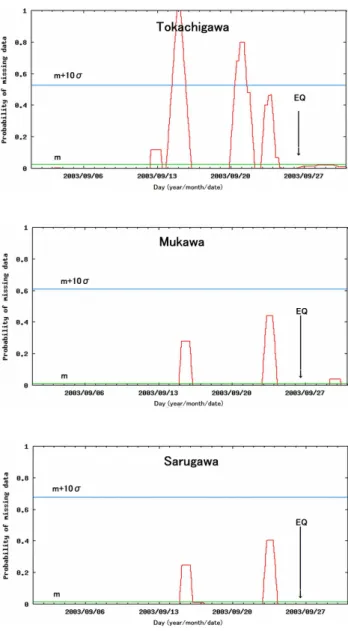
The detailed or enlanged temporal evolutions of missing link connection for the two anomalous periods of Septem-ber 2003 and DecemSeptem-ber 2006, are illustrated in Figs. 3 and 4, respectively. For both cases, all of three groups are presented in both figures; from the top, Tokachigawa, Mukawa and Sarugawa groups. Figure 3 indicates a few possible periods of high missing link connections on 12 September (20–22 h L.T.), 14–15 September (14 Septem-ber, 9 h∼15 September 17 h), 20 September (20 September 9 h∼21 September 1 h), and 23 September (9∼18 h) and 24 September (1∼2h), all just before the EQ. The duration of anomalies is found to range from a few hours to 33 h. As compared to the high rate of missing link connection for the Tokachigawa group, those of missing link connection for the other two groups of Mukawa and Sarugawa, are found to be considerably less enhanced. However, we find still suf-ficiently high missing data transmission on 15 (September 1∼17 h) and 23 September (9∼18 h). These anomalies are likely to be a precursory effect of this EQ. The different be-havior in the missing rate seems to be closely related with the distance of each group to the EQ epicenter.
While, Fig. 4 indicates that the anomalous telemetry link disturbance for the December 2006 event, is taking place only at Tokachigawa, but nothing in other two groups of Mukawa and Sarugawa . Therefore, it is high likely that this is not a natural phenomenon, even though we do not know the reason for this.
6 Discussion on the cause of disturbances in VHF/UHF telemetry links
The observation system of water flow is required to be sta-ble except at some special situations such as the maintenance etc. The VHF/UHF telemetry communication is generally designed so as to maintain the minimum S/N ratio of 30 dB. However, because of the unstable nature of natural noises (due to diurnal and seasonal changes), we normally assume an additional margin of 2∼3 times. This is the design crite-rion of these water flow system telemetry requirements. By taking into account this criterion by the Ministry of Lands, Infrastructure, Transport and Tourism, the company respon-sible for the maintenance and observation seems to provide a further margin of about 1.5∼2.0 times to ensure the stable telemetry links. By taking full consideration of these facts together, we can conclude that we expect missing data trans-mission only when there must be VHF/UHF noises whose in-tensity is, at least, 2∼6 times the background noise level. We assume that the noises (or emissions) in VHF/UHF in possi-ble association with an EQ are attributed to no data transmis-sion (connection failure). This can be easily imagined from Figs. 1, 2 and 3 that the usual percentage of missing data transmission is sufficiently small, at maximum, 1∼2%.
The usual noise level in VHF/UHF band is∼7 dBµV/m in an area with high city noises, ∼3 dBµV/m in residen-tial areas and ∼2 dBµV/m in the mountaneous areas. On the supposition that the Ministry would adopt the noise level as twice the minimum detectable electric field and then the maintenance company would adopt a margin of twice the cri-terion by the Ministry, the noise probably related to the EQ should be more intense by +12 dB than the background noise level. As the conclusion the seismogenic noise is expected to be 19 dBµV/m in the city areas, 15 dBµV/m in the resi-dential areas and 10 dBµV/m in the mountaneous areas. The noises of this order are expected to have occurred prior to the EQ.
7 Summary and discussion
Fig. 3. Temporal evolutions of probability of missing data
trans-mission for three different groups (from top, Tokachigawa, Mukawa and Sarugawa) for the anomalous event in September 2003.
Tokachigawa closest to the EQ epicenter, has shown a sig-nificant increase in transmission failure, suggesting a lot of noises on the telemetry links as radio disturbances. Only be-fore the EQ, the percentage of missing telemetry links has increased a lot; 12, 14, September September 20, 21 and 23, 24 September; two weeks to a few days before the EQ. By using the characteristics of telemetry characteristics, we have speculated the electric field intensity of seismogenic noises of the order of 10–19 dBµV/m.
This kind of radio disturbances on VHF/UHF telemetry links has already been reported by Kolvankar (2008), who has found the radio disturbances on UHF telemetry links (for the data transmission of seismic signals) in possible associ-ation with an EQ sequence in India. Principally, our paper
Fig. 4. The same as Fig. 3, but for another anomalous event in
December 2006.
deals with the same topic, but for a particularly huge EQ, Tokachi-oki EQ and by using telemetry links for the data transmission of water information. It is found that seismo-genic radio noises in UHF band are generated near Tokachi area, being close to the epicenter. They tend to be generated on 12, 14 September, 20, 21 September and 23, 24 Septem-ber before the EQ.
H. Nagamoto et al.: Seismic effect in VHF/ULF telemetry links 817 conclusion. For this EQ, our previous analysis of
subiono-spheric VLF/LF data (for example, from a Japanese JJY sta-tion (in Fukushima) to Moshiri, Hokkaido and to Kamchatka, Russia) has indicated that the ionosphere was disturbed about one week before the EQ (Shvets et al., 2004; Hayakawa et al., 2005). In good correspondence to this ionospheric perturba-tion, Cervone et al. (2006) has found the anomaly in surface latent heat flux before the EQ. The period of these anoma-lous phenomena seems to be coincident with that obtained in the present paper. So, Earth’s surface in the Tokachi area of Hokkaido is likely to be disturbed before the EQ leading to the generation of radio emissions near the Earth’s surface or of some geochemical effect in possible association with the ionospheric perturbation, though detailed mechanisms are not well understood but need to be studied in future. Acknowledgements. The authors would like to thank NiCT for its support (R&D promotion scheme funding international joint research).
Edited by: P. F. Biagi
Reviewed by: two anonymous referees
References
Cervone, G., Maekawa, S., Singh, R. P., Hayakawa, M., Kafatos, M., and Shvets, A.: Surface latent heat flux and nighttime LF anomalies prior to the Mω=8.3 Tokachi-Oki earthquake, Nat. Haz. Earth Sys. Sci., 6, 109–114, 2006.
Enomoto, Y., Hashimoto, H., Shirai, N., Murakami, Y., Mogi, T., Takada, M., and Kasahara, M.: Anomalous geoelectric signals possibly related to the 2000 Mt. Usu eruption and 2003 Tokachi-oki earthquakes, Phys. Chem. Earth, 31, 319–324, 2006. Hayakawa, M.: Atmospheric and Ionospheric Electromagnetic
Phenomena Associated with Earthquakes, Terra Sci. Pub. Co., Tokyo, p. 996, 1999.
Hayakawa, M. and Molchanov, O. A.: Seismo Electromagnetics: Lithosphere – Atmosphere – Ionosphere Coupling, TERRAPUB, Tokyo, p. 477, 2002.
Hayakawa, M., Shvets, A. V., and Maekawa, S.: Subionospheric LF monitoring of ionospheric perturbations prior to the Tokachi-oki earthquake and a possible mechanism to lithosphere – ionosphere coupling, Adv. Polar. Upper Atmos. Res., 19, 42–54, 2005. Hayakawa, M.: VLF/LF radio sounding of ionospheric
perturba-tions associated with earthquakes, Sensors, 7, 1141–1158, 2007. Hayakawa, M. and Molchanov, O. A.: Seismo-electromagnetics as a new field of radiophysics: Electromagnetic phenomena associ-ated with earthquakes, Radio Science Bull., no. 320, 8–17, 2007. Kolvankar, V. G.: Diurnal and semi-diurnal pattern of EM emis-sions related to earthquakes and volcanoes, in: Electromagnetic Phenomena Related to Earthquakes and Volcanoes, edited by: Singh, B., Narosa Pub. House, 15–29, 2008.
Molchanov, O. A. and Hayakawa, M.: Seismo Electromagnetics and Related Phenomena: History and latest results, TERRA-PUB, Tokyo, p. 189, 2008.