Toward an Applied General Equilibrium Model
with International Labor Market Linkages*
by
Jean Mercenier
THEMA, Université de Cergy Pontoise
and
Nicolas Schmitt
Université de Genève and Simon Fraser University
This version: November 15, 2002
I. Introduction
An important aspect of globalization is the growing importance of international labor mobility. Although in overall volumes, migrations remain largely traditional (i.e., non-skilled labor from non-OECD countries to OECD countries; see Gross and Schmitt, 2002), there is a growing intra-OECD country labor mobility and there is a perception that a substantially higher level of international labor mobility may be just around the corner. The existing intra-OECD country labor mobility exhibits a relatively high mean and variance with respect to skill level as compared to the worldwide international labor mobility. In this regard, Canada and the US are probably at the forefront of this evolution thanks in large part to the relatively high degree of labor mobility at the national level and to the natural pressure it creates on its cross-border counterpart given current migration policies. Europe, despite free mobility within the EU, has still very low levels of intra-European country labor mobility but labor mobility is on the rise. For instance it is rumored that well over 250,000 French citizens have recently moved to London and that a high share of these migrants are young-highly skilled and entrepreneurial individuals fleeing the French bureaucracy in favor of English laisser-faire. The number of cross-border commuters is growing steadily in border regions (for instance between Switzerland and neighboring countries). Germany, Italy, Austria and Switzerland with their rapidly aging population are adopting policies aiming at attracting and facilitating the migration of the skilled individuals they desperately need.1 However, even if mobility within the EU increases
dramatically, it is unlikely that it will ever be able to contain the demographic burden that ageing creates. Hence migration will have to come from outside the EU (see Fertig and Schmidt, 2002).
What are the economic costs and benefits of international labor mobility in a modern economy? Should it be encouraged? Should it be encouraged for some skills and not for others? Is international labor mobility of skilled workers an important factor for specialization? In order to answer these questions and, more importantly to be able to assess the magnitude of these costs and benefits, an applied general equilibrium model is arguably the most appropriate tool
available to economists. To our knowledge, applied general equilibrium models have however largely assumed a traditional form of international labor mobility (sources?). In particular, skill is
1
generally considered as being homogeneous and identical across countries. If international labor mobility with homogeneous skill is important because of its scale effect, it is unable to capture the economic impact of the international mobility in modern economy. For high value-added manufacturing and service sectors, we need differentiated skills and more importantly a
significant role given to highly skilled individuals in the production of goods and services. The main purpose of this paper is to start the modeling of these economic effects when international labor mobility is differentiated by skills. The ultimate goal is to build an applied general
equilibrium model with this feature. The present paper is a first step in this direction. Its purpose is to discuss the main issues and to propose a model aimed at addressing these issues as well as providing some simulation exercises capturing the sensitivity of the model to exogenous shocks.
The paper is organized as follows. In the next Section, we review the main mechanisms behind the economic impacts of international labor mobility. In Section 3, we concentrate on one particular mechanism based on trade and income inequality. We develop the structure of a model where individuals choose to migrate wherever their skill supports the highest wage. In Section 4 we propose the template of an applied partial equilibrium model where the quantitative
magnitude and robustness of some changes in specifications and parameter values can be evaluated. To do so we use fictive data.
II. Trade Liberalization and International Labor Mobility
between trade and factor flows implies that the economic effects of integration can be very different with or without international factor mobility and thus with or without the integration of different labor markets. We first review some of the main predictions about the relationship between trade and factor flows from the workhorse models in the field.
2.1 Main Trade Models
Today, the most commonly used trade models are without doubt the Heckscher-Ohlin model, the specific factor model, the intra-industry trade monopolistic competition model and the `core-periphery’ model of economic geography. In a world without distortion and where the same factors of production are used to produce every good, the Heckscher-Ohlin model predicts substitution between trade and factor flows. Essentially, in this world, smaller international price differences for a product lead to smaller differences in the price of the factors. Thus if there is no incentive to move factors across borders before trade liberalization, freer trade certainly does not create any international factor mobility. And if there is an incentive to mover factors across borders before trade liberalization, this incentive necessarily decreases with freer trade. In other words, the Heckscher-Ohlin approach leads to the classical substitution between trade and factor mobility.
This result no longer necessarily holds with the specific factor model. This is important because factor specificity is probably a key element of modern economies. It is indeed fair to say that, associated with globalization, there is an overall increase in factor specificity (including labor specificity) through factor specialization. To see why factor specificity could lead to
Mundell’s story because factor specificity adds a rich set of possible interactions among factors. As a result, factor flows accompanying trade liberalization may make economies more different.2
Complementarity between trade and factor flows also arises from models of imperfect competition and increasing returns to scale. Suppose for instance that one sector is characterized by monopolistic competition a la Dixt-Stiglitz while the factors of production used in this sector are modeled according to the Heckscher-Ohlin model (see Venables, 1999 for such a model). Consumers buy all the differentiated products from this sector and the elasticity of substitution between products is constant. This approach adds several important elements. First, absolute advantage matters now since a larger country implies a greater number of differentiated products and a more competitive environment. When these differentiated products are used as
intermediate inputs in other sectors then, a greater competitive environment amounts to a cost reduction to these sectors translating into higher returns to the other factors used in production. Second, firms tend to locate in the larger country because consumers spend more on the
differentiated products. This means a higher demand for factors of production in the larger country and thus higher factor prices. This combined with a lower cost of living (since there is more competition in the larger country) also contributes to increase the factor prices in terms of the numeraire. Not surprisingly, factor mobility can be destabilizing in this model. Full
agglomeration occurs only in the unlikely case of perfect factor mobility of all the factors. Even if not every factor is mobile (say one of two is immobile), trade liberalization may lead the smaller economy to become even `smaller’ producing a core-periphery type structure (see Krugman, 1991). Whether this occurs in a continuous or in a discontinuous fashion depends on the specificity of the model. In particular, for this to occur, at least one factor of production must be perfectly mobile. Hence, there is complementarity between trade and labor mobility since `free trade’ does not eliminate migration’s incentives. As can be easily imagined, the economic impacts of relaxing international migration rules could be quite significant in such an
environment,3 with possible core-periphery type outcome. 4
2
See Markusen (1988) for a model belonging to this category and specifically addressing positive and normative aspects of human capital formation, skilled labor and brain drain.
3
Other mechanisms leading to complementarity between trade and factor flows could be imagined but they would not necessarily be particularly relevant for developed economies like Canada, the US or Western European countries. It should be clear for instance that mechanisms based on country differences in technology are probably not good mechanisms simply because it is unlikely that substantial technological differences exist among Western countries. Other avenues are not very promising either. They include migration as a response to adjustment lags (such as investment lags), or complementarity due to the existence of migration networks. Migration networks imply a possible positive re-enforcement between trade and migration. Although such explanation has certainly validity for countries like the US or Canada with respect to the rest of the world5, they probably are not very significant between two developed
economies.
Factor specificity, imperfect competition and geography and trade seem the most relevant building blocks to capture important elements of modern economies and the effects of labor mobility in a freer trade environment. There are two important problems however. First, the geography and trade approach is notoriously sensitive to assumptions and quite complex to implement. It is thus not an easy task to integrate such a building block into an applied general equilibrium model. Second, although it is straightforward to call the mobile factor the skilled labor and the immobile factor the unskilled labor, there is nothing in the trade and geography approach that really associates these factors to labor. In other words, the main mechanisms at work are independent of the functioning of the labor markets or of the role of workers. For these reasons, we turn our attention to trade models with labor heterogeneity.
2.2 Models of Labor Heterogeneity and Trade
As should be clear from above, it is possible to re-interpret the monopolistic
competition/geography and trade type model as a model of international mobility of skilled labor
loss in high tech (-15%) and Montana the highest job growth (+17%) (see
www.aeanet.org/publications/IDMK_cyberstates2002_brochures.asp).
4
See Ludema and Wooton (1999) for a model of Geography and Trade with imperfect factor mobility. Their conclusion is that the de-industrialization just mentioned is not unavoidable especially if a country can control both trade liberalization, the degree of factor mobility and the sequence to implement these two policies. Tabuchi and Thisse (2001) also consider imperfect factor mobility through taste heterogeneity in the worker’s perception of the characteristics associated with regions.
5
(see Commander, Kangasniemi and Winters (2002) for more on this point). We want to depart from this model by introducing more structure to the firm production side in order to take into account labor heterogeneity. The main advantage is thus to have differentiation at the input level, specifically among workers, introducing the possibility of international movement of workers with well-defined characteristics. By doing so, one can address specific concerns such as: would a country like Canada lose firms (or industries) using intensively highly skilled labor if
international labor mobility was made easier? What would be the impacts on other sectors and on wages? Could Canada become a periphery with respect to activities for which market size and skills are important features.
Models of this type work as follows. The production technology requires skilled
individuals (call them entrepreneurs) along with labor and/or capital to produce goods. There are two key points in these models. First, skilled labor is a complement input to other factors of production. Hence there are non-convexitites in the model so that a given level of talent (or skill) can have very different impact depending if the market is small or large. This is a
pattern of trade and the pattern of migration in a Heckscher-Ohlin framework, while Schmitt and Soubeyran (2002) use this framework to investigate theoretical aspects of the international mobility of brains in a two-country environment.6
An alternative channel to model the impact of talents is through a demand effect. In this case, the entrepreneur’s ability is not associated with production ability but with how an
entrepreneur (or his product or service) is viewed by consumers. Hence there is a demand
volume effect associated with higher skilled entrepreneur (think about entertainers). Manasse and Turrini (2001) model this by assuming a correspondence between entrepreneur’s skill and
product quality. In turn, they assume a correspondence between product quality and the volume of demand for this product. This essentially means that products are differentiated at least along the quality spectrum.7 This also implies that imperfect competition is the more natural
environment in which to set this demand effect of skilled entrepreneurs.
So what are the economic impacts of international labor mobility implied by this approach? To illustrate why labor heterogeneity may imply significant economic impacts with respect to a more standard approach, consider the following case. A standard approach with homogeneous labor typically assumes that labor and capital are substitutes in production (like in the trade and geography approach; see Venables, 1999). Hence international labor mobility essentially implies some substitution away from capital for the host country and scale effects in production. When production requires skilled entrepreneurs along with labor and/or capital to produce differentiated goods, the introduction of international labor mobility of skilled
entrepreneurs has now direct effects on the number of products within an industry and thus on the number of firms since the skilled entrepreneurs are required inputs, that are complements to other factors of production (whether the entrepreneur’s effect goes through an efficiency or a
6
Grossman (2002) introduces imperfect labor contracts in a model with two-country trade and labor heterogeneity having similar characteristics as developed above. He shows that in the presence of two sectors (one with team production and the other with individual production), the most talented individuals have an incentive to flock into the sector with individual production in the presence of imperfect labor contracts, especially in the country with greater labor heterogeneity. Hence imperfect labor contract is a source of comparative advantage and freer trade can exacerbate this polarization in the allocation of labor.
7
demand effect). Hence, when a country loses skilled entrepreneurs, there are non-trivial sectoral and general equilibrium effects on that country.8
The last paragraph may suggest that out-migration of skilled individuals has mainly negative economic effects. This is not always the case. Several arguments exist suggesting that an out-migration can favor growth in the country losing skilled labor. It is the case for instance if human capital formation is boosted by the possibility of emigrating. Such an emigration offers more opportunities for skilled labor than the confine of the domestic market and thus provides a potentially higher return on human capital investment. The average level of human capital may thus be higher following out-migration of skilled labor than in the absence of such mobility (see Wildasin, 2002; Stark, Helmenstein and Prskawetz, 1998).9 In the same vein, there are arguments about increased labor market integration as a mean to enhance the flexibility and the functioning of the national labor markets (see Wildasin, 2000). These effects are dynamic in nature and will not be considered further below.
There is however another possible positive effect of out-migration that can be taken into account in the proposed approach. It is the one due to the possibility that individuals may not be able to exercise fully their talent in the country of origin whereas this possibility can be exploited in the country of immigration. Whether this is due to difference in market size or the absence of complement inputs in the country of origin does not matter. The important point is that new knowledge, products or services may emerge by migrating benefiting both the country of emigration and the country of immigration. Another way of putting it is to recognize that it is efficient for the world that these individuals migrate to a country where they can find a market size or complement inputs allowing them to create new products, services or knowledge they would not create otherwise.10
8
The fact that skilled workers are intrinsically more mobile than unskilled workers is supported by empirical evidence (see e.g. Shields and Shields, 1989). See also Finnie (2001) who is showing that Canada has been losing a significant fraction of its market elite when judged by individuals’ income tax data.
9
See Beine, Docquier and Rapoport (2001) for an empirical investigation concerning developing countries. There is no reason why this argument would apply only to developing countries. See Faini (2002) for a paper doubting about the positive impacts of brain drain on the home country, and Wildasin (2002) for a theoretical analysis of labor market integration and investment in human capital.
10
An important question is of course whether imbedding labor heterogeneity and the role of entrepreneurs into an applied general equilibrium model is relevant to the Canada-US case. First, it must be clear that such an approach makes more sense for high-value added services and manufacturing sectors (like high-tech sectors, biotechnology and the like) than for more traditional manufacturing sectors. In other words, this is relevant for knowledge-based sectors more than any other sectors. Second, the fact that highly-skilled individuals are (or could be) entrepreneurs in one country or another is clearly a static long-term effect. Hence like most applied general equilibrium this has essentially a long-term horizon. Third, the fact that they are entrepreneurs should not necessarily be taken literally. It simply means that highly-skilled entrepreneurs are essential inputs to the production. Whether they are literally the residual claimant is not crucial to the story.
III. A Model of Trade, Wage Distribution and International Labor Mobility
The comparison between Canada and the United States over the last two decades or so generally leads to three key observations (see Harris and Schmitt, 2001): (i) there is an increase in wage inequality across skill groups in both Canada and the US; (ii) there is a productivity gap between the two countries, and (iii) there is a large growth in trade and in foreign direct
investment following trade liberalization in North America. The model proposed below is able to take into account these three key points (except FDI). By `taking into account’, we do not
necessarily mean an endogenous determination of all these points but a model endogenizing the first point and that can be calibrated to take into account the two other points.
The model developed in this Section builds on Manasse and Turrini (2001). The main purpose of their paper is to link labor heterogeneity within a country and international trade (or technological changes). Their purpose is not to investigate the economic impact of the
they are likely to mean that the return to a given skill level is becoming increasingly different across countries. An easy way to see the complementarity between trade and international labor flows implied by this model is to say that trade tends to create income inequality within each country and across countries (with positive transport cost) and in which international labor mobility tends to mitigate these inequalities.
The principle here is essentially the same as in more traditional models of international labor mobility except that it works not only at the country level but also at the individual level. In a standard model of international labor mobility with homogeneous labor force, the necessary ingredient for international mobility is a difference in (uniform) country real wages. With labor heterogeneity, not only the average wage may be different across countries but individual wages as well. This means that, for a individual skill level, the wage difference between two countries can be positive, negative or nil and that if international trade creates more inequalities in the absence of such international mobility then trade liberalization and international mobility may induce certain categories of workers to emigrate to a particular country while other categories immigrate. It is the economic impacts of this particular link between trade liberalization, international mobility and the location of firms/entrepreneurs that we wish to investigate.
Consider two countries indexed i,j with two sectors indexed x,y. Sector y (called hereafter High Tech) produces differentiated goods (imperfect substitutes) while sector x (called hereafter Low Tech) produces a homogeneous good. Each of these countries have two factors of
of firms determined by the supply of entrepreneurs.11 Each firm however earns zero profit since the entrepreneur captures the entire quasi-rent generated by her talent. The production in the Low Tech sector is very standard : firms are price takers and the production function is Ricardian in raw labor. In the current version of the model, we make this homogeneous product a purely non-traded good.
International trade of goods produced in High Tech involves two specific costs (both expressed in terms of raw labor): a variable cost which can be interpreted as a transport cost (of the iceberg type) and a fixed cost interpreted as a cost to access a foreign market (for instance to establish a sales network). This fixed cost to trade is critically important because it partitions the firms into two subsets: those who are able to export and those who are confined to the domestic market only.
The demand side comes from a standard Dixit-Stiglitz sub-utility function except for the role of quality. Higher perceived product quality increases utility and thus the demand for a product. Manasse and Turrini adopt a relatively ad hoc specification since they simply assume the existence of a function T mapping technology and entrepreneur’s skill into a quality component as perceived by consumers. Hence, the representative consumer’s utility function, over the set of products Navailable to him, takes the general CES form
(1) ( 1) n( )1 n( 1) , >1 n N
U σ− σ T a σd σ− σ σ
∈
=
å
,where dn is the quantity consumed of product n and ( )T a n is the quality of the product as evaluated by the representative consumer and which depends on the entrepreneur’s skill n used to produce good n and on the technology of production represented by the parameter a.
It is important to underline here two characteristics of the model. First, if raw labor is used in proportion of the quantity produced of one differentiated good, one unit of talent is used whether the market is small or large. Second, only talent (for given technology) adds quality to a product. In other words, even if horizontal differentiation needs both the primary factors and one entrepreneur, vertical differentiation requires the skill of an entrepreneur only. It is these non-convexities in production and in consumption that give a `superstar’-Rosen-type flavor to the model.
11
Given (1), country i’s demand for a variant takes the form , , , , , , , ( ) ( ) y y i i i n i n i i
i y
y i
j i n j n j i
j j i
p
E T a c
p
p
E T a c
p
σ
σ
τ
é ù
= ê ú
ë û
é ù
= ê ú
ê ú
ë û
Hence, the demand for one variant depends on its quality Ti n, ( ),ai Tj n, (aj), on the income devoted to the consumption of differentiated products ciy, on piy the price aggregator over available differentiated products individually priced pi and pj adjusted for the (iceberg-type) barrier to trade τji. These demands depend on the entrepreneur’s skill through two channels: the quality perceived by consumers and the price of the product.
Because the utility function is CES, firms with the same technology have the same markup. Thus, a higher product quality simply translates into a higher volume of sales and not into a higher price. Since the entrepreneur is the residual claimant, her wage is equal to the operating profit. This profit is different depending on whether the firm exports or not. If it does not trade, then the wage of the non-trader-entrepreneur ,
low i n
w is simply equal to
(2) low, , ,
i n i i i i n w =éëp −v ùûE
where vi is the variable unit cost as well as the price of raw labor (Ricardian technology). Of course, the profit of the entrepreneurs depends on her skill. If the entrepreneur is trading, her wage is equal to
(3) , , , , , ,
,
i j n high
i n i i i i n i i i n i j
E
w p v E v γ φ η
τ
æ ö
é ù
=ë − û çç + ÷÷−
è ø
where the last term is the fixed cost of exporting.12 This cost is assumed to decline with the number of type-n exporters (penetration of foreign markets is easier when many are willing to sell abroad). The main difference with the non-trader-entrepreneur is that the entrepreneur’s skill allows for sales at home and abroad. In other words, talents gain from market size. In this case the trader-entrepreneur’s wage increases more than proportionally with skill. Because of the
12
difference in market size, the general relationship between entrepreneur’s wage and skill is illustrated in Figure 1.
[Insert Figure 1 about here]
Entrepreneur nichooses to be a trader or a non-trader depending on whether exporting provides a higher operating profit or not. At low levels of n, the non-trader entrepreneur’s wage increases with skill. As soon as the firm trades, her wage increases more than proportionally as a given level of entrepreneur’s talent reaches now a much larger market. The exporting firm necessarily generates a higher gross profit than a non-trading firm. However, because exporting involves a fixed cost, only the most talented entrepreneurs participate to the export market. Of course the skill level zi of the entrepreneur who is just indifferent between trading and not trading is endogenous. Therefore, at zi, we have ihighz
low z
i i w i
w, = , . Trade liberalization, whether it is through a lower transport cost or a lower fixed access cost, boosts the wage of the
trader-entrepreneur (since the foreign market can now be more easily accessed) and thus decreases the level of the critical skill necessary to participate to the export market. Trade liberalization creates wage inequality insofar as the relative earning of a trading entrepreneur rises as compared to the earnings of a non-trading entrepreneur.
It is important to note that, in the absence of migrations, the total number (and the range of product quality) of goods produced (and therefore of entrepreneurs) in each country is exogenously fixed. This is not the case for consumption since the number of goods consumed depends on the number of products that are traded.13
Let’s now introduce international labor mobility. Suppose first that only the skilled entrepreneurs can move between the two countries. A skilled entrepreneur can move across the border and be either a trading or a non-trading entrepreneur in the other country. In other words, being of one type in one country does not pre-determine the type of entrepreneur in the other
13
This exogenous feature of the number of goods produced (or of entrepreneurs) in the absence of international migration can be relaxed in one of two ways: one is to endogenize the number of products, the other is to endogenize the number of entrepreneurs. In the first case, this can be achieved by introducing a fixed cost of production. In this case, full employment of resources dictates that a product can become traded only if some other non-traded products exit the industry (see Schmitt and Yu, 2001 for such a model). Alternatively, one can
country.14 Since we have just established that, in one country, an individual with skill ni chooses to be a trader or a non-trader according to , , ,
low high i n i n con con i i w w Max p p ì ü ï ï í ý ï ï
î þ, this entrepreneur will migrate from country i to country j if and only if
(4) , , , , , , ,
low high low high
j n j n i n i n
i j con con con con
i i j j
w w
w w
Max Max
p p p p ρ
ì ü
ì ü
ï ï ï ï
< −
í ý í ý
ï ï ï ï
î þ î þ
where ρi j, is the fixed cost of moving to country j and picon,pconj are the consumer price indices in each country. Similarly, an entrepreneur migrates from country j to country i if and only if
(5) , , , , , , ,
low high low high j n j n i n i n
j i con con con con
j j i i
w w w w
Max Max
p p p p ρ
ì ü ì ü
ï ï ï ï
< −
í ý í ý
ï ï
ï ï î þ
î þ
It is of course quite possible that for some range of skills, skilled individuals will want to move from one country to another while for other ranges, they have no incentive to migrate or have an incentive to migrate in the other direction. In other words, it is quite possible in this model that the pattern of migration of skilled individuals be a two-way migration pattern. Obviously, the possibilities of migration patterns even within a single sector are much richer than in more traditional models of international labor mobility.
Consider now the possibility that unskilled labor migrates across the border. Since vi is the wage of the unskilled labor, then workers move from country i to country j if
(6) ,
i j j i i j con con v v
P < P −ρ
whereρi j, in the (static) cost of moving across the border for unskilled labor. Unskilled labor
moves in the other direction if
(7) ,
i j j i j i con con v v
P −ρ > P
Not surprisingly, only a one-way migration pattern is possible with the international mobility of unskilled labor.
14
The main difficulty with having international migrations (of skilled or unskilled labor) is that it affects the demands for the products since workers and entrepreneurs are also consumers. In the case of entrepreneurs, we need to take into account the distribution of entrepreneurs and truncate it according to who is leaving and who is staying. Similarly, these migrants affect the distribution of entrepreneurs in the host country. In addition we need to know which role (trader or non-trader) they play in each country. In the next Section, we develop a simple general equilibrium model where, using artificial data, we investigate the sensitivity of trade and labor flows to exogenous shocks.
IV Simulation Exercises
We now use a two-country version of the above model in order to investigate the sensitivity of the model to international labor mobility. The equations used in this model are found in the Appendix. We proceed in two steps. First we set the model in a free-migration environment (migration costs are set to zero) and in a quasi free-trade environment (i.e., per unit transport cost is equal to zero but the fixed export cost may be positive) and we simply ask: Given a specific asymmetry between the two countries, what are the effects of introducing free international mobility of entrepreneurs? Second, we investigate the complementarity between trade liberalization and international factor mobility. We therefore ask: Given an environment at or near free trade, what is the impact of liberalizing the international mobility of entrepreneurs. To do so, we calibrate the model for a given level of barriers to trade and for a specific
asymmetry between the two countries. We then introduce free trade without international
mobility and we compare the outcome with the equilibrium in which we have both free trade and free international labor mobility.15
Suppose the two countries are strictly identical. There is clearly no incentive to migrate (for any skill level, the wages are the same across countries). But there is still trade between the two countries (at least as long as the iceberg transport cost is not prohibitive) since products are differentiated both horizontally and vertically. Not surprisingly, the model boils down to a standard intra-industry trade model with two factors of production (skilled and raw labor)). In order to investigate the effects of international labor mobility, we must therefore introduce
15
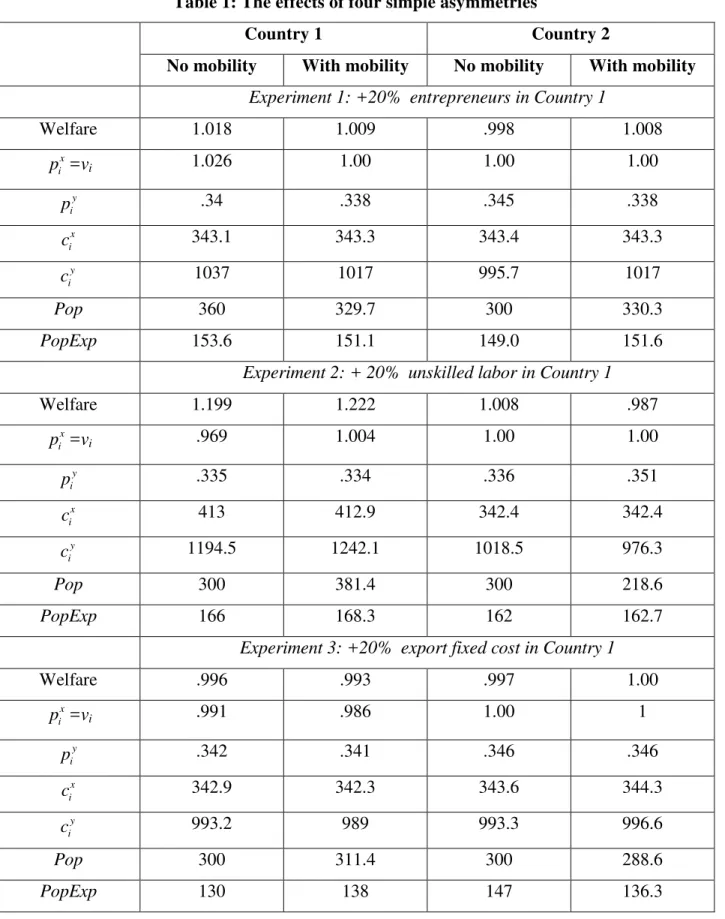
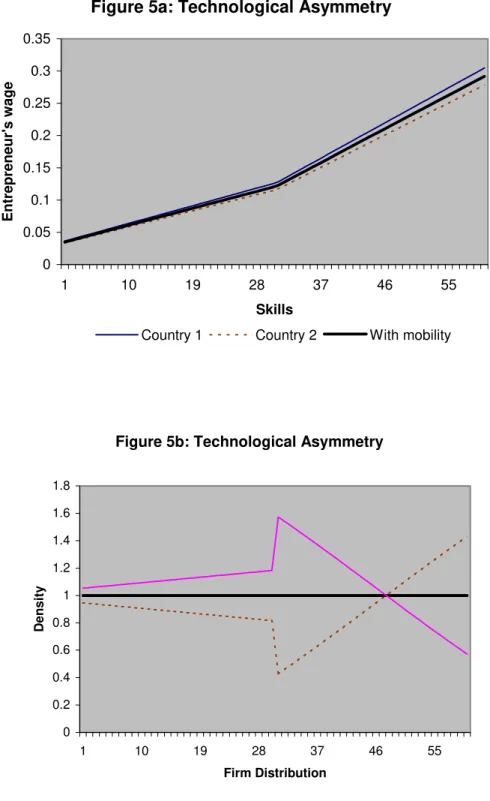
asymmetries between the two countries. We consider four different types: (i) Country 1 has a larger endowment of skilled individuals than Country 2 (but the same endowment of raw labor); (ii) Country 1 has a larger endowment of unskilled labor than Country 2; (iii) Firms exporting from Country 1 faces a higher fixed export cost than firms exporting from Country 2, and (iv) The technology in the Low Tech sector is more productive in Country 1 than in Country 2.
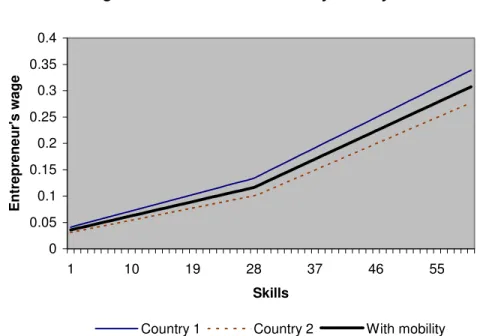
For each of these cases, we compare the equilibrium with and without the international mobility of the skilled labor (entrepreneurs). We show the results with two graphs: one showing the distribution of entrepreneur’s wage per skill (similar to Figure 1) and the other showing the distribution of firms in each country per skill (and thus quality). We set the model in such a way that in the initial distribution of firms without international mobility (and thus the initial
distribution of skills) is the same and is uniform in both countries.
Consider the first case where Country 1 has 20% more skilled labor than Country 2 but both countries have the same endowment of raw labor. As Figure 2b illustrates, this difference is uniformly distributed over the range of entrepreneur’s skills (Country 1 has a uniform density of entrepreneurs equal to 1.2, while Country 2 has a uniform density equal to 1). This implies that Country 1 produces a greater number of High Tech goods than Country 2 and that, in relative terms, a significant share of the resources is used in the High Tech sector in Country 1 (see for instance ciy in Table 1). The resource constraint however implies that, on average, the firms in the High Tech sector have a smaller size in Country 1 than in Country 2 and thus that the entrepreneur’s wage is lower in Country 1 than in Country 2 for all skills (see Figure 2a).
Introducing the international mobility of entrepreneurs (without migrating cost) leads to the international equalization of the entrepreneur’s wages in the two countries for each skill level. As expected, the outcome from international mobility of entrepreneurs is two symmetric countries (both in terms of total population and distribution per skill). Naturally, the firm size is also equalized for each skill level.
Consider the aggregate results as shown in Table 1-Experiment 1. Since some entrepreneurs migrate from Country 1 and produce in Country 2, international mobility of entrepreneurs lowers input costs in Country 1 relative to Country 2 (see vi in Table 1),
Country 2). International mobility of entrepreneurs redistributes therefore the production of differentiated goods between the two countries in such a way that, with free mobility, each country trades half its production of differentiated products with the other country. This means that, despite larger firms producing in Country 1, the total resources devoted to the High Tech sector decreases in Country 1 with international mobility as compared to the allocation of resources without such mobility.
[Insert Figure 2 about here]
With the introduction of international mobility of entrepreneurs, welfare (of the representative consumer) decreases in Country 1 and increases in Country 2 by about 1% (see Table 1). This can be attributed to the change in the number of products faced by consumers in each country. Without mobility, consumers in Country 1 benefits from a larger set of products than consumers in Country 2 since there are more entrepreneurs in Country 1 and some of the additional products are non-traded. The mobility of entrepreneurs re-equilibrates the number of products faced by consumers irrespective of their location. The welfare effect is relatively small simply because two forces go in opposite directions. Some non-traded products are no longer available to consumers in Country 1 with mobility, but Country 2 exports a larger fraction of the total number of its differentiated products than it did without international mobility (the opposite for Country 2: mobility make additional products available to consumers there some of which being non traded; however, with mobility, Country 1 exports a smaller number of its variants).
Consider now the second case where the asymmetry is with respect to the endowment of unskilled (or raw) labor. Country 1 has an endowment that is 20% larger in unskilled labor than Country 2. Since the number of entrepreneurs is the same in both countries, so is the number of firms in the High Tech sector in the absence of international entrepreneur mobility. Their size however is larger in Country 1 since unskilled labor is cheaper in Country 1 (compare for instance vi between the two countries without mobility; see Table 1-Experiment 2). Not surprisingly therefore, the entrepreneur’s (real) wage is higher in Country 1 for all skills (see Figure 3a).
the number of firms in Country 2 (see Figure 3b). There is also a strong composition effect since it is mainly the non-trading entrepreneurs who move massively from Country 2 to Country 1. In addition, if the number of trading entrepreneurs moving across the border is quite small, there is a two-way flow of entrepreneurs: some of the brightest ones move to Country 2, while some entrepreneurs with intermediate skills move in the other direction. This two-way flow among trading entrepreneurs can be explained as follows. The large inflow of entrepreneurs in Country 1 raises the cost of producing High Tech goods in Country 1. Indeed, vi increases by 3.6% in Country 1 while it does not change in Country 2 (see Table 1-Experiment 2). Since the fixed cost of exporting is expressed in terms of unskilled labor, the fixed cost of exporting from Country 1 would be (everything else being equal) higher than it was without mobility. However, the externality with respect to the fixed cost now plays its role. There are more traders in Country 1 than in Country 2 and because of this asymmetry, the fixed cost of exporting is lower in Country 1 than it is in Country 2 despite the difference in the price of labor. This has a larger impact on the marginal traders since it is for these firms that the fixed cost of export is more significant in their decision. Hence, some marginal traders move from Country 2 to Country 1. Because the balance of trade must be in equilibrium and because the Low-Tech product is non-traded, then some high quality traders must move from Country 1 to Country 2.16
Not surprisingly, free entrepreneur mobility makes the size of the firms and the cost of production more similar (see Table 1). Introducing entrepreneur mobility in this case increases welfare by about 2% in Country 1 and decreases it by 2.1% in Country 2 (see Table 1). This significant welfare effect is not surprising given the fact there is a substantial net increase in the number of products available to consumers in Country 1 since many of the entrepreneurs moving to Country 1 produce non-traded differentiated goods. Conversely, welfare decreases
significantly in Country 2 because of the net loss of the number of variants faced by consumers there.
[Insert Figure 3 about here]
16
It is apparent that the size of the relative endowment between skilled entrepreneurs and unskilled labor matters a lot in this model. Depending on where the asymmetry lies, the
introduction of international entrepreneur mobility has very different qualitative and quantitative effects. The qualitative effects are different because the flows of entrepreneurs go in opposite directions resulting in different welfare effects. Not surprisingly, when the endowment of skilled entrepreneurs in Country 1 is greater than in Country 2, entrepreneurs move to Country 2, whereas when the endowment of unskilled labor is larger in Country 1, entrepreneurs tend to move to Country 1. They also lead to different production specialization and trading patterns. In the first experiment, more High Tech products (traded and non traded) are being produced in Country 1 without mobility than with mobility. This means that less resources are being used in the High Tech sector and Country 1 exports relatively less High Tech products with mobility than without it. With the second experiment, the opposite occurs. With mobility, there is a relative specialization in production toward the High Tech sector at the expense of the Low Tech sector in Country 1 but, more interestingly, it leads to relative specialization along the quality dimension within the High Tech sector. Indeed mobility leads Country 1 to specialize mainly in low quality variants, while Country 2 specializes relatively in traded quality products with its impact on the pattern of trade.
The quantitative effects are also different. In the first case (20% more skilled workers in country 1), the flow of skilled entrepreneurs moving from Country 1 to Country 2 is roughly equal to half the difference in endowment (representing 10% of the initial number of
entrepreneurs in Country 2). In the second case (20% more raw labor in Country 1), the total number of skilled entrepreneurs migrating between the two countries represents about 34% of the initial endowment of entrepreneurs in each country (for a net change representing 27% of the initial endowment). This is quite a significant effect.
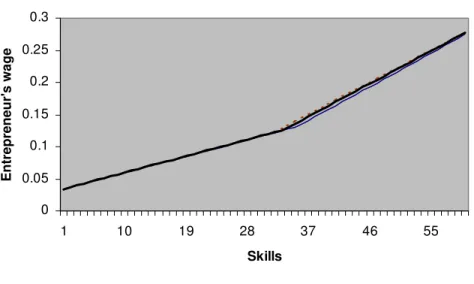
mobility of entrepreneurs cannot change the entrepreneur’s wage much. Still, the effect on the migration of entrepreneurs is significant, especially for those working in trading firms where some entrepreneurs migrate from Country 1 to Country 2, while others migrate from Country 2 to Country 1 (see Figure 4b). The higher fixed cost of exporting leads to lower raw labor cost in Country 1 with or without mobility. Indeed, mobility decreases the price of labor even further. This means that the fixed cost of exporting decreases in Country 1 relative to Country 2. In the equilibrium with mobility, Country 1 ends up with more traders than Country 2 despite the 20% higher fixed cost of exporting. Hence, in equilibrium, given the number of exporters and the price of labor in Country 1, the fixed cost is lower in Country 1 than it is in Country 2. It is apparent that, even if the two countries are similar except for this fixed cost of exporting, many `trading’ entrepreneurs migrate across the border. Mobility brings greater specialization along the quality spectrum among the High Tech products: Country 1 specializes relatively in low quality traded products and Country 2 specializes relatively in high quality traded products. Indeed, at each end of the quality range of traded products, there is almost complete
specialization in each country. At the very high end, nearly all the trading firms produce in Country 2 and, at the other extreme (but still among trading firms), nearly all the trading firms produce in Country 1.
Despite the migrations of a significant fraction of entrepreneurs, welfare changes only marginally in each country (with a slight decrease in Country 1 and a slight increase in Country 2; see Table 1).
[Introduce Figure 4 about here]
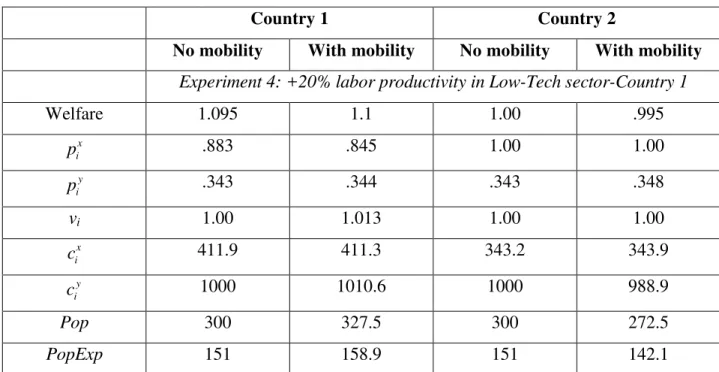
non-trading as well as on the non-trading firms. Indeed, with mobility, the number of non-trading firms increases in Country 1 with a similar externality effect and, through it, with a similar production specialization (at least for the trading firms) and trade pattern effects as in previous simulations.
[Introduce Figure 5 about here]
V Conclusions
What to make of these simulations? Of course, we have used artificial data so that none of these simulations directly apply to the Canada-US case. We have also completely disregarded how we might make the model operational with real data. This particular model raises a number of important issues whether it is about the meaning of skills, the correspondence between skills and firms without mentioning the correspondence between skills and product quality. Still we believe this type of model has great potential for a number of reasons.
First, there is a link between trade, earning inequality and labor mobility. The link between trade and inequality comes from two sources. Since trade affects the wage of the unskilled and of the skilled workers (entrepreneurs) and among entrepreneurs, trade induced increase in inequality may mean here the wage of the skilled workers increases with respect to the wage of the unskilled and it can mean that the wage of the highly skilled (in trading firms) increases with respect to the wage of the less highly skilled (in non-trading firms). Since these inequalities occur not only within a country but across countries, they create incentives to migrate across the border in order to take advantage of earning differentials. Second, skills matter in this model and returns to skills are positive giving the model a Rosen-superstar flavor.
Third because individuals (at least skilled labor) are differentiated, migration decisions are potentially different among individuals. Introducing international labor mobility leads to changes in specialization at the production level across sector and within sectors producing differentiated products. In turn this leads to changes in the patterns of trade. This is interesting because the changes in trade patterns across and within sectors are not due to trade liberalization
per se but are by-products of liberalizing international labor migration.
In order to illustrate why this last point may make this model relevant for the Canada-US case, consider the following. In a study commissioned by the EU Commission, Fontagné,
the European Union between 1980 and 1994. They have first divided trade between every pair of EU members into inter- and intra-industry trade and further divided intra-industry trade into horizontal (Helpman-Krugman type) and vertical (Shaked and Sutton-quality type) intra-industry trade. To do so, they simply compared the price of export with the price of import. If, at the level of the variants, the price of export is roughly similar to the price of import, then trade in this variant belongs to the horizontal intra-industry trade. If there is a significant difference (positive or negative) in these two prices, then trade in this variant belongs to vertical intra-industry trade. Aggregating these trade shares, they discovered that if, as expected, the share of overall intra-industry in total trade has increased over the period, it is not due to an increase in the share of horizontal intra-industry trade but to an increase in the share of vertical intra-industry trade. In other words, given their methodology, some kind of specialization has taken place within Europe at the country level despite the presence of similar countries (say France and Germany) and trade liberalization. Nobody today has a good explanation for this phenomenon.
Applying a similar methodology for the Canada-US case over the period 1989-99 period, Andresen, Harris and Schmitt (2001) find similar changes but on a much smaller scale than in Europe. Why? We do not really have a good answer either. However, our simulations now suggest this may have a very simple explanation: this difference between the results found in Europe and in North America might well simply be associated with differences in the degrees of economic integration. The 1992 Unique Market (decided well before 1992) may well have triggered firm location decisions (for instance) that were focused at serving Europe as a whole and not simply at serving a specific European country, whereas NAFTA did not have the same impact on firm location decisions (or on individual decision location) because of its more limited focus.17 This suggests that, in evaluating the effects of a deeper integration between Canada and the US and in particular measures of integration dealing with international labor mobility, an important component in this evaluation is the consequences of these measures on international trade and on the pattern of trade.
The above advantages are purely static. Useless to say that in a dynamic environment, other elements can be added to this type of model whether it is human capital formation, the
impact of an aging population, or quality-ladder/endogenous growth type components.
17
Table 1: The effects of four simple asymmetries
Country 1 Country 2
No mobility With mobility No mobility With mobility
Experiment 1: +20% entrepreneurs in Country 1
Welfare 1.018 1.009 .998 1.008
x i
p =vi 1.026 1.00 1.00 1.00
y i
p .34 .338 .345 .338
x i
c 343.1 343.3 343.4 343.3
y i
c 1037 1017 995.7 1017
Pop 360 329.7 300 330.3
PopExp 153.6 151.1 149.0 151.6
Experiment 2: + 20% unskilled labor in Country 1
Welfare 1.199 1.222 1.008 .987
x i
p =vi .969 1.004 1.00 1.00
y i
p .335 .334 .336 .351
x i
c 413 412.9 342.4 342.4
y i
c 1194.5 1242.1 1018.5 976.3
Pop 300 381.4 300 218.6
PopExp 166 168.3 162 162.7
Experiment 3: +20% export fixed cost in Country 1
Welfare .996 .993 .997 1.00
x i
p =vi .991 .986 1.00 1
y i
p .342 .341 .346 .346
x i
c 342.9 342.3 343.6 344.3
y i
c 993.2 989 993.3 996.6
Pop 300 311.4 300 288.6
Table 1: cont’d
Country 1 Country 2
No mobility With mobility No mobility With mobility
Experiment 4: +20% labor productivity in Low-Tech sector-Country 1
Welfare 1.095 1.1 1.00 .995
x i
p .883 .845 1.00 1.00
y i
p .343 .344 .343 .348
vi 1.00 1.013 1.00 1.00
x i
c 411.9 411.3 343.2 343.9
y i
c 1000 1010.6 1000 988.9
Pop 300 327.5 300 272.5
w(s)
s
s
s
z
Figure 2a: Skilled Labor Asymmetry
0 0.05 0.1 0.15 0.2 0.25 0.3
1 10 19 28 37 46 55
Skills
Entrepreneur's w
a
ge
Country 1 Country 2 With mobility
Figure 2b: Skilled Labor Asymmetry
0.9 0.95 1 1.05 1.1 1.15 1.2 1.25
1 5 9
13 17 21 25 29 33 37 41 45 49 53 57 Firm distribution
De
ns
Figure 3a: Unskilled Labor Asymmetry
0 0.05 0.1 0.15 0.2 0.25 0.3 0.35 0.4
1 10 19 28 37 46 55
Skills
Entrepreneur's wage
Country 1 Country 2 With mobility
Figure 3b: Unskilled Labor Asymmetry
0 0.2 0.4 0.6 0.8 1 1.2 1.4 1.6 1.8 2
1 10 19 28 37 46 55
Firm Distribution
De
ns
ity
Figure 4a: Export Cost Asymmetry
0 0.05 0.1 0.15 0.2 0.25 0.3
1 10 19 28 37 46 55
Skills
Entrepreneur's w
a
ge
Country 1 Country 2 With mobility
Figure 4b: Export Cost Asymmetry
0 0.2 0.4 0.6 0.8 1 1.2 1.4 1.6 1.8 2
1 10 19 28 37 46 55
Firm Distribution
De
ns
ity
Figure 5b: Technological Asymmetry
0 0.2 0.4 0.6 0.8 1 1.2 1.4 1.6 1.8
1 10 19 28 37 46 55
Firm Distribution
De
ns
it
y
Country 1 and 2 (no mobility) Country 1 Country 2
Figure 5a: Technological Asymmetry
0 0.05 0.1 0.15 0.2 0.25 0.3 0.35
1 10 19 28 37 46 55
Skills
E
n
tr
epr
e
neur
's
w
a
ge
Appendix
Parameters:
i
n = index of variety
, ( )
i n i
T a 18= quality index of variety ni
σ = differentiation elasticity between goods of type n
,
i j
τ = (iceberg) transportation cost on flows from i to j
i
γ = fixed costs on exports
η = export-cost externality parameter
Variables:
i
z = index of lowest quality type exported i
Inc = income
sup
i
L = raw labor supply i
ν = price of raw labor
,
i n
φ = number of entrepreneurs producing variety n
,
low i n
w = low-skilled type n entrepreneur’s earnings
,
high i n
w = high-skilled type n entrepreneur’s earnings x
i
p = price of competitive good x
x i
c = consumption of competitive good x
y i
p = price of (aggregate) good y
y i
c = consumption of (aggregate) good y
x i
θ = consumption share of competitive good x
i
p = price of good of variety n
, ,
i j n
E = sales of goods of variety n by a firm in i to household j.
Model
Households:
sup
, , , ,
log log (1 ) log
i i i i
low high i i i i n i n i n i n
n z n z
con x x x y
i i i i i i
Inc v L w w
p c c Inc
φ φ θ θ ≤ > = + + + + − =
å
å
18(1 ) x x x i i i i
y y x
i i i i
p c Inc
p c Inc
θ θ = = − 1 1 1 , , , , , , , , , , , ,
i j j
j y
i i n i n i j n j n
n n z j i
y y i i i n i n i
i y
y i
j i n j n i
j j i
p
p T p T
p
E T c
p
p
E T c
p σ σ σ σ σ φ φ τ τ − − − > é ù é ù = é ù + ê ú ë û ë û
ê ú ë û é ù
= ê ú
ë û é ù
= ê ú
ê ú ë û
å
å
Firms of sector x:
x i i x x i i p v L c = =
Firms of sector y:
, , , , , , , , , , , , , , , , , , , , 1
i i i i
i i low
i n i i i i n
i j n high
i n i i i i n i i i n i j
i j n y
i i n i i n i n i i n i i n
n z n z i j
p v
w p v E
E
w p v E v
E
L E E
η η σ σ γ φ τ
φ φ γ φ
τ
≤ >
é ù
= ê ú
−
ë û é ù
=ë − û
æ ö
é ù
=ë − û çç + ÷÷−
è ø
æ ö
= + çç + ÷÷+
è ø
å
å
Raw labor market:
sup
x y
i i i
L +L =L
Migration of entrepreneurs:
, ,
, , , ,
, ,
, , , .
i n j n
low high low high
j n j n i n i n
i n j n n con con con con
i i j j
w w
w w
Max Max
p p p p
φ φ φ φ φ
ì ü
ì ü
ï ï ï ï
= + =
í ý í ý
ï ï ï ï
î þ î þ
References
Andresen, Martin, Richard Harris and Nicolas Schmitt (2001), `Canada-US Intra-Industry Trade Patterns’, mimeo prepared for Jim Melvin’s Festschrift.
Beine, Michel; Docquier, Frederic and Hillel Rapoport (2001), Brain Drain and Economic Growth: Theory and Evidence, Journal of Development Economics, 64, 1, 275-89.
Commander, Simon; Mari Kangasniemi and L. Alan Winters (2002), `The Brain Drain: Curse or Boon? A Survey of the Literature’ mimeo.
Eaton, Jonathan and Samuel Kortum (2002), Technology, Geography and Trade, Econometrica, forthcoming.
Faini, Riccardo (2002), `Migration, Remittances and Growth’, mimeo, September.
Faini, Riccardo, Jaime de Melo and Klaus Zimmermann (1999), Trade and Migration: An Introduction, in Faini, de Melo and Zimmermann (eds), Migration: The Controversies and the Evidence, CEPR and Cambridge University Press, Chap 1.
Fertig, Michael and Christoph Schmidt (2002), `Mobility within Europe-What do we (still not) know?’ IZA Discussion Paper 447, Institute for the Study of Labor, Bonn.
Finnie, Ross (2001), The Brain Drain: Myth and Reality: What it is and what should be done?, Working Paper 13, School of Policy Studies, Queen’s University.
Fontagné, Lionel, Freudenberg, M and Nicolas Péridy (1998) `Intra-Industry Trade and the Single Market: Quality Matters’, CEPR Discussion Paper 1959.
Gould, David (1994), Immigration Links to the Home Country: Empirical Implications for US Bilateral Trade Flows, Review of Economics and Statistics, 76(2), 302-16.
Gross, Dominique and Nicolas Schmitt (2002), `The role of cultural clustering in attracting new immigrants’, Journal of Regional Science, forthcoming.
Grossman, Gene (2002), `The Distribution of Talent and the Pattern and Consequence of International Trade’, CESIfo Working Paper 745, June.
Harris, Richard and Nicolas Schmitt (2001), `The consequences of increased labor mobility within an integrating North America’, in R. Harris (ed.), North American Linkages, (Calgary: University of Calgary Press), forthcoming.
Head, Keith, John Ries and Don Wagner (1998), Immigrants and the Trade of Province, RIIM Working Paper 98-21, December, Vancouver.
Krugman, Paul (1991), Increasing Returns and Economic Geography, Journal of Political Economy,, 99, 483-99.
Lucas, Robert (1978), On the Size Distribution of Business Firms, Bell Journal of Economics,
IX, 508-23.
Ludema, Rodney and Ian Wooton (1999), Regional Integration, Trade and Migration: Are
Demand Linkages relevant for Europe? in Ricardo Faini, Jaime de Melo and Klaus Zimmermann (eds.), Migration: The Controversies and the Evidence, Cambridge: Cambridge University Press. Manasse, Paolo and Alessandro Turrini (2001), `Trade, wages and `superstars’’, Journal of International Economics, 54, 97-117.
Markusen, Jim (1988), `Production, Trade and Migration with Differentiated, Skilled Workers’,
Canadian Journal of Economics 21, 3, 492-506.
Mundell, Robert (1957), International Trade and Factor Mobility, American Economic Review, 47, 321-35.
Murphy, K.M., Andrew Shleifer and Robert Vishny (1991), The Allocation of Talent: Implications for Growth, Quaterly Journal of Economics, 503-30.
Rauch, James (1991), Reconciling the Pattern of Trade with the Pattern of Migration, American Economic Review, 81, 4, 775-96.
Rosen, Sherwin (1981), The Economics of Superstars, American Economic Review, 71, 845-58. Schmitt, Nicolas and Antoine Soubeyran (2002), International Labor Mobility, Brain Gain and Distribution of Firms, mimeo.
Schmitt, Nicolas and Zhihao Yu (2001), Economies of Scale and the Volume of Intra-Industry Trade, Economics Letters, 74, 127-32.
Shields, G.M. and M.P. Shields (1989), The emergence of migration theory and a suggested new direction, Journal of Economic Surveys 3, 277-304.
Stark, Oded; Helmenstein, Christian and Alexia Prskawetz (1998), Human Capital Depletion, Human Capital Formation and Migration: A Blessing or a Curse?, Economics Letters, 60(3) 363-67.
Venables, Anthony (1999), Trade Liberalization and Factor Mobility: An Overview, in Faini, de Melo and Zimmermann (eds.), Migration: The Controversies and the Evidence, Cambridge: Cambridge University Press.
Wildasin, David (2002), Labor Market Integration, Investment in Risky Human Capital, and Fiscal Competition, American Economic Review, forthcoming.