Mădălina Dumitriu
The paper herein examines the geometric filtering effect coming from the axle base of a railway vehicle upon the vertical vibrations behavior, due to the random irregularities of the track. For this purpose, the complete model of a two level suspension and flexible carbody vehicle has been taken into account. Following the modal analysis, the move ment equations have been treated in an original manner and brought to a structure that points out at the symmetrical and anti symmetrical decoupled movements of vehicle and their excitation modes. There has been shown that the geometric filtering has a selective behavior in de creasing the level of vibrations, and its contribution is affected by the axle base magnitude, rolling speed and frequency range.
: railway vehicle, vertical vibrations, geometric filtering
The evaluation of the vibrations behavior in a railway vehicle is one of the issue being looked at even since the designing stage. The lowering of vibrations to an acceptable level in terms of running behaviour, safety, passengers comfort and track fatigue is required by regulations at European level for vehicle homologation and their admission into traffic [1, 2].
The vibrations of railway vehicles mainly come from the interaction with the track. Crosing over a track with irregularities or deviations from the ideal geometry results into vibrations of vehicles, which develop both vertically and horizontally; the two types of vibrations are decoupled, though, due to the construction symmetries (inertial, elastic and geometric) [3]. As for the vertical vibrations, the bounce and pitch vibrations are causal elements for the vehicle dynamic behavior. They can be studied on simple models, one or two degrees of freedom, based on the hypothesis of excitation symmetry, by considering only one mobile base as if the wheelsets had identical moves. This is the reason why the results with these models can be overestimated.
In fact, the vertical wheelset moves are dephased during vehicle rolling on a track with configuration irregularities in dependence with the distance between wheelsets and velocity. The displacement between the wheelsets moves brings in filtering effects of the vertical vibrations [4].
The studies on the vertical vibrations in railway vehicles have proven, with the geometric filtering effect in equation, that an explanation can be found as why the variation of the vertical acceleration with the velocity is not monotonously ascending [4]. Likewise, the geometric filtering effect has been shown to influence the emergence of the vehicle resonant behavior and, thus, it can modify the percentage of influence of various resonance frequencies upon the vehicle vibration behavior [5, 6, 7]. In terms of the issues related to the evaluation of the running behavior based on vertical acceleration or concerning the optimisation of railway vehicles suspension, it has to be considered that the geometric filtering effect has a differentiated contribution along the carbody, in dependence with the rolling behavior [8].
This paper deals, for the first time, with the influence of vehicle wheel bases, along with the running behavior, upon the characteristic of geometric filtering. This influence will be further reflected in the vehicle’e response to the crossing over the rolling track random irregularities and in the magnitude of the vertical accelerations. This is the reason why the complet model of a passenger vehicle has been accounted for, including the carbody bending vibrations. The movement equations have been treated in an original manner and brought to a structure that points out at the symmetrical and anti symmetrical decoupled movements of vehi cle and their excitation modes.
!
The case of a two floor suspension railway vehicle that travels on a constant speed V on a track with random irregularities. The mechanical model of the vehicles is shown in figure 1.
Just by considering that the rolling track rigidity is much higher that the one of the suspension floor, and the frequencies of wheelsets on the track are higher than the vehicle, then the hypothesis of rigid track is adopted. Therefore, the verti cal wheelset travelling are equal to the corresponding irregularities.
The vehicle mechanical model.
specific features of a certain vehicle, only models based on the finite element method are being used.
The bogies suspended masses are considered two degree freedom rigid bod ies, namely the bounce movementzbi and pitchθbi, withi = 1, 2. The mass of a
bogie ismband its inertia moment Jb =mbib2, withib– the bogie gyration radius.
The suspension levels are modelled via Kelvin Voigt systems. The elastic constants arekzb,kzc, and the damping onesczb,czc.
The movement equations for bending the carbody, bounce of bogies and pitch of bogies are:
∑
= − δ = ∂ ∂ + ∂ ∂ ∂ µ + ∂ ∂ 2 1 2 2 4 5 4 4 ) ( ) , ( ) , ( ) , ( i ii x l
F t t x w m t x t x w I x t x w
EI , (1)
where δ(.) is Dirac’s delta function, and Fi represents the force due to the i
secondary bogie suspension
(
i bi)
zc bi i
zc
i c w lt t z k w l t z
F − −
− ∂ ∂ −
= 2 ( , ) 2 ( , ) ; (2)
that acts at the distancelifrom the carbody end;
0 )] , ( [ 2 ) , ( 2 ) 2 ( 2 ) 2 ( 2 2 , 1 2 , 1 2 , 1 2 , 1 4 , 2 3 , 1 2 , 1 4 , 2 3 , 1 2 , 1 2 , 1 = − + ∂ ∂ − + + η − η − + η − η − + t l w z k t t l w z c z k z c z m b zc b zc b zb b zb b b (3) 0 ) 2 ( 2 ) 2 (
2 1,2 1,3 2,4 1,2 1,3 2,4
2 ,
1 + θ −η +η + θ −η +η =
θb zb b b b zb b b b
b c a a k a a
I , (4)
where ab, ac are the axle bases of bogies and carbody and ηi with i = 1. 4 the
It may be noticed that the pitch movements of bogies are decoupled from the other movements of the vehicle.
The movement equations with partial derivates may be turned into equations with ordinary derivates by implementing the method of model analysis. For this, the rigid and bending modes of carbody are considered as
∑
∞ = + θ − + = 2 ) ( ) ( ) ( 2 ) ( ) , ( i i i cc t L x t X x T t
z t x
w , (5)
where zc(t) and θc(t) represent the carbody vibration rigid modes, namely the
bounce and pitch.Ti(t) is time, and Xi(x) is the own function of vibration mode i at
bending ) cosh (cos cosh cos sinh sin sinh sin )
( x x
L L L L x x x
X i i
i i i i i i
i = β + β − ββ −− ββ β − β , (6)
with βi = ω2im/(EI) and cosβiLcoshβiL−1=0, (7) whereωiis the own pulsation of the vibration modei.
Looking at two own bending modes only, symmetrical and anti symmetrical, the vehicle vibration is described by a system of 8 ordinary derivates, among which 6 are coupled (bounce and pitch of carbody, the first and second own bending mode and the bogie bounce), and other two are independent (pitch of bogies). An appropriate choice of the coordinates and a correct processing of the equations system will give the decomposition of the system with 6 movement equations, coupled in two independent system of 3 equations each. The two systems describe the carbody symmetrical and anti symmetrical movements. If we have,
c z
q1+ = ; q1−=θc ; q2+ =T2; q2−=T3 ) ( 2 1 2 1
3 zb zb
q+ = + ; ( )
2 1
2 1
3 zb zb
q− = − (8)
+ ε = = ( ) )
(1 2 2
2 l X l
X ; X3(l1)=−X3(l2)=ε−
then the equations of the symmetrical movements (carbody bounce, the symmetrical bending of two node carbody and the bogies symmetrical bounce) are obtained 0 ) ( 4 ) (
4 1 2 3 1 2 3
1++ c q++ε+q+−q+ + k q++ε+q+−q+ = q
mc zc zc ; (9)
0 ] [ 4 ] [ 4 3 2 1 3 2 1 2 2 2 2 2 2 = − ε + ε + + − ε + ε + + + + + + + + + + + + + + + + q q q k q q q c q k q c q m zc zc m m m ; (10) ; 0 ) ( 4 ) ( 4 ) ( 4 ) ( 4 2 1 3 2 1 3 3 3 3 = ε − − + ε − − + + η − + η − + + + + + + + + + + + + + + q q q k q q q c q k q c q m zc zc zb zb b (11)
along with the anti symmetrical equations (carbody pitch, anti symmetrical ben ding of the three node carbody and bogies anti symmetrical bounce)
0 ) ( 4 ) (
4 1 2 3 1 2 3
1−+ c a a q−−ε−q− +q− + k a a q−−ε−q−+q− =
q
; 0 ] [ 4 ] [
4 1 2 3 1 2 3
2 3 2 3 2 3 = − ε + − ε + − ε + − ε + + + + − − − − − − − − − − − − − q q q k q q q c q k q c q m zc zc m m m (13) ; 0 ) ( 4 ) ( 4 ) ( 4 ) ( 4 2 1 3 2 1 3 3 3 3 = ε − − + ε − − + + η − + η − + − − − − − − − − − − − − − q q a q k q q a q c q k q c q m c zc c zc zb zb b (14)
where mc and Jc =mcic2 are the carbody mass and inertia moment with ic its
gyration radius and mm2,3, cm2,3 and km2,3 are the masses, dampings and modal
rigidities
∫
= L
m m X x x
m 0 2 3 , 2 3 ,
2 ( )d ;
∫
= L m x x x X EI k 0 2 2 3 , 2 2 3 , 2 d d ) ( d ;∫
µ = L m x x x X I c 0 2 2 3 , 2 2 3 , 2 d d ) ( d . (15)The below equations include the excitation mode of the symmetrical and anti symmetrical movements 4 3 2 1 1
4η+ =η +η +η +η ; 4η− =η1+η2−η3−η4. (16) The parameters of the carbody bending vibration are the modal pulsation and the damping degree
3 , 2 3 , 2 3 , 2 m m m m k = ω , 3 , 2 3 , 2 3 , 2 3 , 2
2 m m
m m m k c =
ζ . (17)
In order to facilitate the analysis of vibrations, the damping degrees of the suspension floors considered uncoupled, as below
c b c b c b c b m k c , , , , 4 2 4 =
ζ . (18)
The following section will see the movement equations being used to evaluate the geometric filtering effect due to the vehicle axle base upon the behavior of ver tical vibrations.
Thus, the carbody magnification factor is calculated, taking into account the vibration harmonic behavior where the track irregularities have a sinusoidal shape with the wavelengthl and the amplitudeη0.
The size of irregularities against each axle depends on its position. Thus, bearing reference to the track irregularity against the vehicle centre, the defects against the axles are dephased with 2π(ac ± ab)/lΛ opposite the first bogie and
with 2π(–ac ±ab)/Λopposite the second bogie, whereΛis the defect wavelength,
2ac is the vehicle wheelbase and 2abrepresents the bogie wheelbase. The defects
Against each wheelset, the irregularity is dephased corresponding to the vehicle axle base and to the velocityV of traveling over the irregularities of rolling track – all these will trigger an imposed movement for the vehicle that becomes a pulsation time functionω=2πV/Λ
) (
cos 0 2 ,
1 =η VωVt ±ab +ac
η , 3,4 0cos (Vt ab ac)
V ± −
ω η =
η . (19)
The vibrations of carbody are excited by the track irregularities against the wheelsets, and the plan of bogie axles has both a bounce and pitch movement. Since the bogies pitch movement is decoupled from the carbody’s, the symmetrical and anti symmetrical modes of carbody vibration will be determined by the symmetrical and anti symmetrical axles bounce movements, presented in figure 2.
Excitation modes of wheel sets: (a) symmetric bounce; (b) skew symmetric bounce
The frequency features of the two excitation modes depend by the axle base in bogie and carbody, as well as by velocity. Their forms for the symmetrical and anti symmetrical modes are as follows
V a V a
H+(ω)=cos bωcos cω; (20)
V a V a
H−(ω)=icos bωsin cω, (21)
whereωis the angle frequency and i2= 1.
The magnification factor in a pointx of carbody is as below
∑
=
θ ω + ω
− + ω = ω
3
2
) ( ) ( )
( 2
) ( ) , (
i
T i Z
c c x H c X x H i
L H
x
H , (22)
where Hzc(ω), Hθc(ω), HTi(ω)are the magnification factors corresponding to the vibration modeszc,θcsiT2,3.
To calculate the carbody vertical acceleration, the power spectrum density of the track random irregularities is as follows [9]
) )(
( )
( 2 2 2 2
2
c r
c A S
Ω + Ω Ω + Ω
Ω =
Ω , (23)
The track irregularities become an excitation factor for a vehicle that travels at speedV and this is the reason why the spectral density of the track irregularities need to be expressed as a function of the angle frequency ω = VΩ, and G(ω) = [S(ω/V)]/V respectively. As a result, the rel. (23) will trigger
] ) ( ][ ) ( [ )
( 2 2 2 2
3 2
r c
c V V
V A G
Ω + ω Ω + ω
Ω =
ω . (24)
Starting from the carbody frequency response Hc(x,ω) and from the spectral density of track irregularities, the acceleration spectral density may be calculated at a point locaated at distancex from the carbody referential
2
4 ( ) ( , )
) ,
(x ω =ωG ω H x ω
Gc c . (25)
This helps calculate the mean square deviation of acceleration in one point of carbody while the vehicle is crossing over the random irregularities in a track
∫
∞
ω ω π
= σ
0
)d , ( 1 )
(x Gc x
c . (26)
It is worthwhile mentioning that the mean square deviation is the magnitude of evaluating the rolling quality [1].
Carbody mass mc= 34320 kg
Bending module EI = 3.2⋅109Nm2
Carbody length L = 26.4 m
Carbody axle base 2ac= 19 m
Carbody gyration radius ic= 7.6 m
Carbody modal damping ratio ζm2,3= 0.015
Vertical rigidity of secondary suspension 4kzc= 2.4 MN/m
Vertical damping of secondary suspension 4czc= 68.88 kNs/m
Bogie mass mb= 3200 kg
Bogie gyration radius ib= 0.8 m
Bogie axle base 2ab= 2.56 m
Vertical rigidity of primary suspension 4kzb= 4.4 MN/m
Vertical damping of primary suspension 4czb= 52.21 kNs/m
"
evaluated by the mean square acceleration of the vehicle carbody vertical vibra tions. The model parameters are shown in table 1.
The excitation modes will bring a series of maximum and minimum values that are conditional upon the velocity and may smoothen or not the resonance peaks of the carbody frequency response. For instance, for the frequencies f = (2n+1)V/4ab with n = 0, 1, ..., the wheelsets’ bounce (symmetrical and anti
symmetrical) is null and, thus, the carbody bounce and pitch are not excited at these frequencies – the geometric filtering effect given by the axle base. The distance between bogies will derive an effect of geometric effect for the symmetrical bounce of wheelsets at frequenciesf = (2n+1)V/4acand for the anti
symmetrical bounce mode at frequenciesf = nV/2ac.
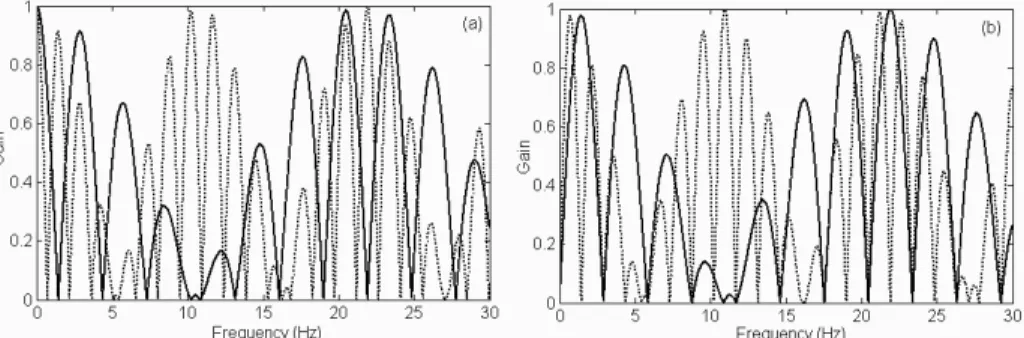
" Influence of velocity upon the frequency characteristics of the vehicle excitation modes: (a) symmetrical mode; (b) skew symmetrical mode:
H H H,V = 100 km/h;##,V = 200 km/h.
Figure 3 shows the frequency feature of the two excitation modes at velocities of 100 and 200 km/h, for 2ac = 19 m and 2ab = 2.56 m. Since the distance be
tween bogies is much longer than the one between the wheelsets in a bogie, the frequency features will display itself in the shape of a carrying wavelength, corre sponding to the geometric filtering effect of the distance between bogies and modulated in amplitude by the effect of geometric filtering of the distance between wheelsets. The frequency of the geometric filtering effect increases along with the velocity of vehicle. For instance, the first frequency of geometric filtering due to the bogie axle base is of 5.43 Hz at 100 km/h, and the next one at 16.28 Hz. For V = 200 km/h, the interval between two consecutive minimum values is 21.7 Hz, and the first minimum occurs at 10.85 Hz. The filtering due to the carbody axle base introduces the first frequency minimum at 0.73 Hz for the symmetrical bounce mode of axle bases at 100 km/h and at 1.46 for 200 km/h. For the skew symmetrical bounce condition, the first minimum occurs at 1.46 Hz if speed is 100 km/h and at 2.92 Hz for 200 km/h.
behavior lowers. Still, at high velocities, the filtering frequency of the axles bounce exceeds the range of the own vehicle frequencies and this filtering effect exerts a much smaller impact. Indeed, the frequency of geometric filtering effect of wheel set bounce is 10.85 Hz, a value superior to the frequencies of the main natural vibration conditions of the vehicle under discussion. For this reason, it is expected to have a vibration behavior more intensified at velocities higher than 200 km/h, as seen further herein.
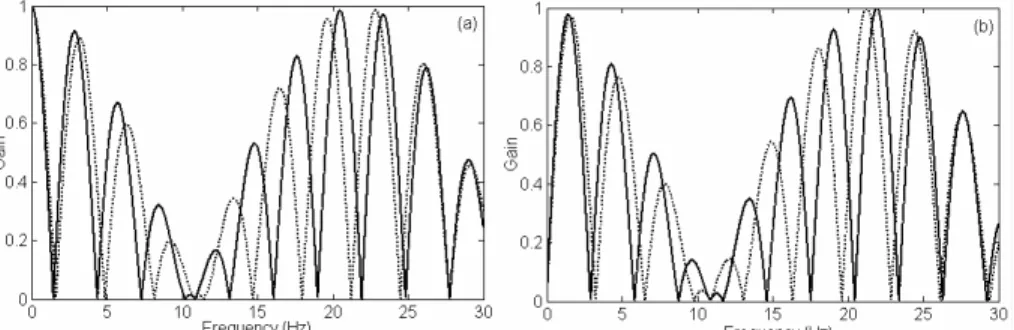
$ Influence of bogie axle upon the frequency characteristics of vehicle excitation modes: (a) symmetrical; (b) skew symmetrical:
H H H H, 2ab= 2.56 m;##, 2ab= 3 m.
The frequency of filtering effect decreases along the increase of bogie axle base – see figure 4, which features the filtering characteristics of the two excitation modes for the axle base reference value (2ab = 2.56 m) and for 2ab= 3 m. The
velocity isV = 200 km/h, and the reference value for the carbody axle base is pre sented in the table 1. The first frequency of the geometric filtering given by the 3 meter axle base lowers to 9.26 Hz, compared to the previous situation – the 2.56 meter axle base (see figure 2), where the frequency was shown to be 10.85 Hz. Another mention to be made is related to the change in the filtering lobes height for the two situations above. The closer their height is to 1, the lower the geomet ric filtering effect. It is evident that an increase in the bogie axle base results into a higher or a lower geometric filtering effect, depending on the frequency range. At 200 km/h, within the frequency interval of up to circa 10 Hz, which includes the frequencies of main natural vibration conditions of vehicle – the higher the bogie axle base, the higher the geometric filtering effect. For frequencies between 10 and 19 Hz, the effect derived from the increase of axle base upon the filtering ef fect is opposite.
above, a smaller carbody axle base may trigger a lower geometric filtering effect, than for a 19 meter axle base and viceversa.
% Influence of carbody axle base upon the frequency characteristics of the vehicle excitation modes: (a) symmetrical; (b) skew symmetrical:
H H H H, 2ac= 17 m;##, 2ac= 19 m.
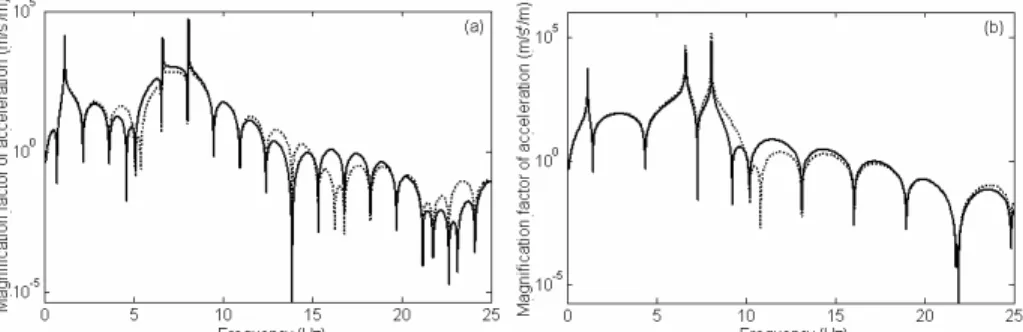
& The magnification factors of the vertical acceleration: (a) non filtered; (b) filtered, H H H H,V = 100 km/h;##,V = 200 km/h.
Figure 6 shows the frequency response of the acceleration in the center of carbody, both without the filtering effect due to the vehicle axle bases (a) and with it in the equation (b). The reference velocities: 100 and 200 km/h. In the center of carbody, the frequency response is only due to the vibration symmetrical modes, namely the symmetrical bounce and pitch. In order to point out at the system resonance frequencies, the non damped case has been admitted, when the rest of the parameters are in Table 1. The peaks of resonance frequencies of low bounce at 1.17 Hz and of high bounce at 6.65 Hz, as well as of the symmetrical bending’s (two node) at 8.1 Hz.
situation where the geometric filtering effect is minimum, which is similar in the position on the filtering characteristic against the center of a lobe.
For the frequencies of filtering effect, the vehicle response frequency has a minimum value, an anti resonance. Should the filtering effect frequency coincides with the dominant frequency of the vehicle response, then the response to the random irregularities in the rolling track is weaker. As already shown, the filtering effect makes that the system frequency response be dependent on the velocity, which is quite natural for vehicles. It can also be noted that a visible change of the magnification factor in dependence with velocity occurs, and that the filtering ef fect is mainly visible at a 100 km/h speed within the range of low frequencies (as thus anticipated)
The magnitude of the vehicle axle bases, whose influence upon the frequency characteristics of the vehicle excitation modes was shown above and will therefore determine changes in the vehicle frequency response.
' Influence of bogie axle base upon magnification factor of the vertical acceleration: (a)V = 100 km/h; (b) V = 200 km/h:
H H H H, 2ab= 2.56 m;##, 2ab= 3 m.
Figure 7 shows the vehicle frequency response at 100 and 200 km/h, for the values of the bogie axle base included in the legend. The analysis of the results needs to be done in correlation with the observations made for figure 4. As already presented, an increase in the bogie axle base means a higher or a lower geometric filtering effect, dependent on the frequency range under study.
The observation made forV = 200 km/h and frequencies lower than 11 Hz, the higher the bogie axle, the more intense the geometric filtering effect, an evident fact in the vehicle response. Moreover, for low speeds, the frequency intervals between anti resonants become smaller. Consequently, a change in the bogie axle base will make the filtering effect of vertical vibration be selective in nature, depending on the frequency range and velocity.
( Influence of carbody axle base upon the magnification factor of vertical acceleration: (a)V = 100 km/h; (b) V = 200 km/h:
H H H H, 2ac= 17 m;##, 2ac= 19 m.
On the contrary, the vibration behavior will intensify at high frequencies (see figure 8). At 100 km/h, the decrease of the carbody axle base at 17 meters, compared to the value adopted as reference, will trigger the decrease of the magnification factor of the vertical acceleration at high bounce resonance frequencies and symmetrical bending – whereas at 200 km/h, the same result is only obtained at the high bounce resonance frequency. Such observations are supported, on the one hand, by making the correlation with the mentions of figure 5, where it was evident that the geometric filtering effect can be higher or lower for one or the other end between the carbody axle bases, depending on the frequency and height of the filtering lobes.
) The r.m.s. acceleration in the center of carbody: (a) influence of bogie axle base; (b) influence of vehicle axle base.
way vehicle is evaluated. It needs to be mentioned that the acceleration shows a succession of maximum and minimum values for a speed of circa 160 km/h, due to the geometric filtering effect. At higher speeds, the filtering frequency of the wheelset bounce exceeds the range of natural vehicle frequencies and the filtering effect has a smaller influence. Starting with this speed up to the superior limit (250 km/h), acceleration rises along with velocity, the maximum and minimum values derived from the filtering effect have a lower frequency and the acceleration variations are also smaller.
In terms of the influence of the bogie axle base upon the vertical acceleration, it can be noticed that its increase will result into different effects upon the acceleration magnitude, velocity dependent. Generally speaking, the level of the vertical vibration tends to lower – except for the speed interval of 80 – 150 km/h, where the acceleration is higher if the axle base does the same. Should the carbody axle base increases, the vertical vibration behavior intensifies, which is visible by a higher acceleration. There are exceptions, though, for small intervals of speeds, 50 – 80 km/h and 230 – 250 km/h, where acceleration shows a series of maximum and minimum values, triggered by the geometric filtering effect.
$ *
The vertical vibrations behavior during the railway vehicle rolling on a track with nivelment irregularities is atenuated by the geometric filtering effect from the vehicle axle bases. While neglecting this phenomenon in the study of the vertical vibrations, the results can be overestimated and the vehicle resonant condition incorrectly evaluated.
To make the analysis simpler, the model of a two level suspension passenger railway vehicle has been considered – where the carbody, modelled via an Euler Bernoulli beam, is linked by Kelvin Voigt systems to the two (considered) rigid bogies. Following the modal analysis, the symmetrical and anti symmetrical de coupled movements of vehicle and their excitation modes have been highlighted.
The geometric filtering effects in the vehicle response to the random irregu larities in the rolling track are analyzed in correlation with the filtering characteris tics and the influence of vehicle axle base. The geometric filtering is shown being able to lower the level of vertical vibrations and the vehicle axle bases play an important role here. Nevertheless, the filtering effect has a selective nature, a function of the frequency range and velocity. At higher speeds, the filtering has a smaller influence, easily explained by the fact that the filtering frequency of wheelset bounce exceeds the interval of the vehicle natural frequencies.
[1] UIC Leaflet 518, Testing and approval of railway vehicles from the point of view of their dynamic behaviour – Safety – Track fatigue – Run ning behaviour, 4th edition, September 2009.
[2] UIC Leaflet 513R,Guidelines for evaluating passenger comfort in rela tion to vibration in railway vehicle, International Union of Railways, 1994. [3] SebeLan I.,Dinamica vehiculelor de cale ferată (Dynamic of the railway
vehicles), Ed. MatrixRom, BucureLti, 2011.
[4] SebeLan I., Mazilu T., VibraŃiile vehiculelor feroviare (Vibrations of the railway vehicles), MatrixRom, BucureLti, 2010.
[5] Zhou J., Goodall R., Ren L., Zhang H., Influences of car body vertical flexibility on ride quality of passenger railway vehicles, Proceedings of the Institution of Mechanical Engineers, Part F: Journal of Rail and Rapid Transit, 223, 2009, 461 471.
[6] Gong D., Sun W., Zhou J, Xie X.,Analysis on the vertical coupled vibra tion between bogies and metro car body, Procedia Engineering, 16, 2011, 825 – 831.
[7] Zhou J., Sun W., Gong D.,Analysis on geometric filtering phenomenon and flexible car body resonant vibration of railway vehicles, Journal of Tongji University, 12, 2009.
[8] Dumitriu M.,On the assessment of the vertical vibration behaviour of a railway vehicle, Romanian Journal of Acoustics and Vibration, vol. VIII, is sue 2, 2011, 131 138.
[9] C 116 Interaction between vehicles and track, RP 1, Power spectral density of track irrgularities, Part 1: Definitions, conventions and available data, Utrecht, 1971.
Address:
• Assistant Prof. PhD. Stud. Eng. Mădălina Dumitriu, Politehnica University of Bucharest, Splaiul IndependenŃei 313, 060042, Bucharest,