FORMULATION AND EVALUATION OF
A MATRIX-TYPE TRANSDERMAL
PATCH CONTAINING RIVASTIGMINE
TARTRATE
SWETHA VENNAPOOSA*, DEVAREDDY SANDEEP
Dept. of PHARMACEUTICS, J.K.K MUNIRAJAH MEDICAL RESEARCH FOUNDATION COLLEGE OF PHARMACY, KOMARAPALAYAM, TAMILNADU, INDIA.
E-MAIL: [email protected]
ABSTRACT
Rivastigmine tartrate is an effective reverse cholinesterase inhibitor which binds to both the esteratic and ionic sites of AchE, preventing the enzyme from metabolizing Ach, resulting in higher levels of Ach in the brain. (In Alzheimer’s disease lower levels of Ach leads to impaired memory (dementia) and learning). Thus Rivastigmine tartrate is used in the treatment of mild to moderate dementia of Alzheimer’s disease. Though the drug is rapidly and completely absorbed following oral administration, it shows significant first-pass effect. Its half life is about 1.5 hrs. Gastro intestinal side effects like vomiting, diarrhea, increased acid secretion in stomach and reduced heart rates are reported. The drug Rivastigmine tartrate posses suitable characteristics such as low daily doses (1.5 to 6 mg twice daily), short half-life (1.5 hrs), low molecular weight (400.43 gms) and low melting point (123ºC - 127ºC) which is suitable for incorporation of drug in transdermal drug delivery system. These properties make Rivastigmine tartrate as a model drug for exploring its application as transdermal drug delivery system. To develope a matrix-type transdermal patch containing Rivastigmine tartrate using blend of polymers PVPandEC in the ratios 1:1, 1:3 and 1:5 with 30% Dibutyl phthalate as a plasticizer.
KEY WORDS: Rivastigmine tartarate, Trandermal, Alzheimer’s.
INTRODUCTION
The treatment of an acute disease or a chronic illness has been mostly accomplished by delivery of drugs to patients using various conventional dosage forms; like tablets, capsules, ointments, liquids, aerosols and injectables as drug carriers. This type of drug delivery system is known to provide a prompt release of drug. Therefore, to achieve as well as to maintain the drug concentration within the therapeutically effective range needed for treatment, it is often necessary to take this type of drug delivery systems several times a day. This results in a significant fluctuation of drug levels.
Further the conventional dosage forms used for the control of infection, pain and fertility may cause side effects like nausea, vomiting, gastric irritation and toxicity if they are consumed for long duration.
Continuous I.V. infusion has been recognized as a superior mode of systemic drug delivery that can be tailored to maintain a constant and sustained drug level within a therapeutic concentration range for as long as required for effective treatment. It also provides a means of direct entry into the systemic circulation of drugs that are subjected to hepatic first-pass metabolism and/or suspected of producing gastro-intestinal incompatibility. Unfortunately, such a mode of drug administration entails certain health hazards and therefore necessitates continuous hospitalization during treatment and requires close medical supervision.
To duplicate the benefits of intravenous drug infusion without its potential hazards several technical advancements have been developed.They have resulted in the development of new techniques for drug delivery. These techniques are capable of controlling the rate of drug delivery, sustaining the duration of therapeutic activity and/or targeting the delivery of drug to a particular tissue.
With the concept of delivering drug into the skin for both local effects in dermatology and through the integument for the systemic treatment of disease states, this latter process has been brought into sharp focus in recent years by the efforts of pharmaceutical field to develop transdermal delivery devices to treat motion sickness, angina, hormone deficiency and hypertension.
system (TDDS) have recently been developed aiming to achieve the objective of systemic medication through application to the intact skin.
The intensity of interest in the pontential bio-medical application of transdermal controlled drug administration is demonstrated in the increasing research activities in a number of health care institutions in the development of various types of transdermal therapeutic systems(TTS) for long term continuous infusion of therapeutic agents including antihypertensives, antianginal, anti-histamine, anti-inflammatory , analgesic drugs etc.
“Transdermal drug delivery systems are adhesive, drug containing devices of defined surface area that deliver a pre-determined amount of drug to the surface of intact skin at a pre-programmed rate. These systems provide drug systemically at a predictable rate and maintain the rate for extended periods of time.
The skin acts as a formidable barrier to the penetration of drugs and other chemicals, it does have certain advantages which make it an alternative route for systemic delivery of drugs. Transdermal drug delivery system involves the passage of substances from the skin surface through the skin layers, into the systemic circulation. The skin has been commonly used as a site for topical administration of drugs, when the skin serves as a port for administration of systemically active drugs. The drug applied topically is distributed following absorption, first into the systemic circulation and then transported to the target tissue, which can be relatively remote from the site of drug application to achieve its therapeutic action.(Chien Yie W. Transdermal drug delivery and delivery systems,19921,2,3.
Methods to enhance permeation
1. Chemical methods 2. Physical methods
1. Chemical means of transdermal penetration enhancement:
In this method various chemicals are used to enhance the permeation across the skin which acts as a tough barrier. Ex: DMSO, menthol, limonene, etc.
Mechanism:
The enhancement in absorption of oil soluble drugs is apparently due to the partial leaching of the epidermal lipids by the chemical enhancers, resulting in the improvement of the skin conditions for wetting and for transepidermal and transfollicular penetration. The miscibility and solution properties of the enhancers used could be responsible for the enhanced transdermal permeation of water-soluble drugs. Some of them alter the composition of the cell content while others effect the cohesiveness between cells and composition of intercellular material or have a direct effect on cell membrane. The composition of intercellular lipids undergo a solid-lipid phase transition at 40°c. it is possible that some penetration enhancers act to disrupt the structure of intercellular lipids and lower the phase transition temperature, thereby increasing the permeability of skin to more polar compounds. To increase the rate of transfer of lipophilic compounds, it is necessary to modify the partitioning characteristics at the stratum corneum viable tissue interface. This may be possible by combining a penetration enhancer with a co-solvent. Some agents can establish a reservoir in stratum corneum, which may facilitate diffusion of drug, when penetrating the epidermis, may carry drug through, by acting as a solvent (Swarna lata soni and Vinod KD,1992). Many of these agents may act by a combination of various effects on the skin while others may be involved in a direct chemical insult on the skin, When the specified lipid film, made up of sebaceous secretion, desquamated cells, sweats and other components, the percutaneous absorption is enhanced slightly. When lipids are removed from the skin as by means of prolonged exposure to polar solvents, however, considerably enhanced absorption of applied materials. it is quite likely that lipid solvents must damage the lipid portion of the membrane before much change in passage through the skin can take place. The existence of a depot or reservoir for topically applied drugs within the stratum corneum was postulated by Malkinson and Furgoson.4,5.
Classification of penetration enhancers:
1. Terpenes(essential oils) : Nerodilol, menthol, 1 8 cineol,limonene, carvone etc. 2. Pyrrolidones : N-methyl-2-pyrrolidone(NMP), azone etc.
3. Fatty acids and esters : Oleic acid, linoleic acid, lauric acid, capric acid etc. 4. Sulfoxides and similar compounds : Dimethyl sulfoxide(DMSO), N,Ndimethyl formamide 5. Alcohols, Glycols, and Glycerides : Ethanol, Propylene glycol, Octyl alcohol etc.
2. Physical means of penetration enhancement:
The permeation of drugs across the skin is enhanced by physical means like pulsed DC iontophorosis or effect of ultrasounds may have synergistic effect depending upon the current density of pulse current applied and ultrasound intensity time e.g. Ragel’s studied the penetration of tetracycline into the tissues subject to electro and phonphoresis. It was found that tissue levels of tetracycline administered by the use of both electro and phonphoresis were higher than those obtained by the use of either electro of phonphoresis alone6,7,8.
Technologies in the development of TDDS. A. Membrane moderated systems:
In this, the drug reservoir is totally encapsulated in a shallow compartment molded from a drug impermeable metallic plastic laminate and a rate controlling polymeric membrane. In the drug reservoir compartment, the drug solids are either dispersed in a solid polymer matrix or suspended in an unleachable, viscous liquid medium e.g. silicon fluid. The rate controlling membrane can be micro porous or nonporous polymeric membrane e.g. ethylene vinyl acetate co-polymer on the external surface of the polymeric membrane, a skin layer of drug, compatible hypo allergic adhesive polymer may be applied to achieve an intimate contact of TDDS with skin surface9,10.
Marketed systems
• Transderm-Nitro system for once a day. • Transderm-Scop system- 3 days medication. • Catapres- TTS – for weekly treatment.
B. Adhesive diffusion controlled system
It is the simplest version of the membrane moderated drug delivery systems. In this system the drug reservoir is formulated by directly dispersing the drug in an adhesive polymer and then spreading the medicated adhesive by solvent casting onto a flat sheet of drug impermeable metallic plastic backing to form thin drug reservoir layer. On the top of the reservoir layer, layers of non-medicated rate controlling adhesive polymer of constant thickness are applied.
Marketed devices.
Deponit system and Frandol tape
C. Matrix dispersion:
Here the drug reservoir is formed by homogeneously dispersing the drug solids in a hydrophilic or lipophilic polymer matrix and medicated polymer is then molded into disc with defined area and thickness. This is glued onto an occlusive base plate on the surface of the disc, the adhesive polymer is spread along the circumference to form a stripe of adhesive rim around the disc.
D. Micro-reservoir system:
These are considered as combination of reservoir and matrix dispersion type. In this the drug reservoir is formed by first suspending the drug solids in an aqueous solution of water soluble polymer and then dispersing the drug suspension homogenously in lipophilic polymer, by high shear mechanical force to form unleachable microscopic spheres of drug reservoir. This dispersion is stabilized immediately by cross-linking the polymer chains which produces a medicated disc with constant surface area and thickness11,12,13.
AIM AND OBJECTIVE OF THE STUDY
The present work is planned with the following objectives:
To develope a matrix-type transdermal patch containing Rivastigmine tartrate using blend of polymers PVPandEC in the ratios 1:1, 1:3 and 1:5 with 30% Dibutyl phthalate as a plasticizer.
To evaluate, the transdermal systems for their physical appearance, moisture content, moisture uptake, thickness, area etc.
To produce the economical patches for the poor people, by using simple and economical polymers.
To study In-vitro drug release to ensure drug release was controlled and prolonged over a period of time.
To lessen the side-effects by using Rivastigmine tartrate containing transdermal patches in comparison to newer analogues in treating Alzheimer’s disease.
warm glass-distilled water and was constantly stirred on a magnetic stirrer at 60°C for few min without formation of bubbles to attain a homogeneous solution. 3 ml of homogeneous solution was then poured into glass cylindrical mold (3.3cm length, 2.3cm internal diameter) to one of the open end which was wrapped by aluminum foil. Smooth uniform, transparent backing membrane was obtained after keeping the mold at 60°C for 6 hours14,15.
Formation of drug matrix over the backing membrane
Blend of polymers PVP and EC were measured in the requisite ratios of 1:1, 1:3 and 1:5 and were dissolved in chloroform in each case [Mukherjee et al.,2006]. A homogeneous solution was made using a magnetic stirrer and a magnetic bead. Rivastigmine tartrate was added to each mixture and stirred for 20 min until a homogeneous suspension was obtained. 3 ml of the homogeneous suspension was then casted on the prepared backing membrane and dried at room temperature for 24 h, which yielded a uniform, flat medicated matrix patch of Rivastigmine tartrate 16,17.
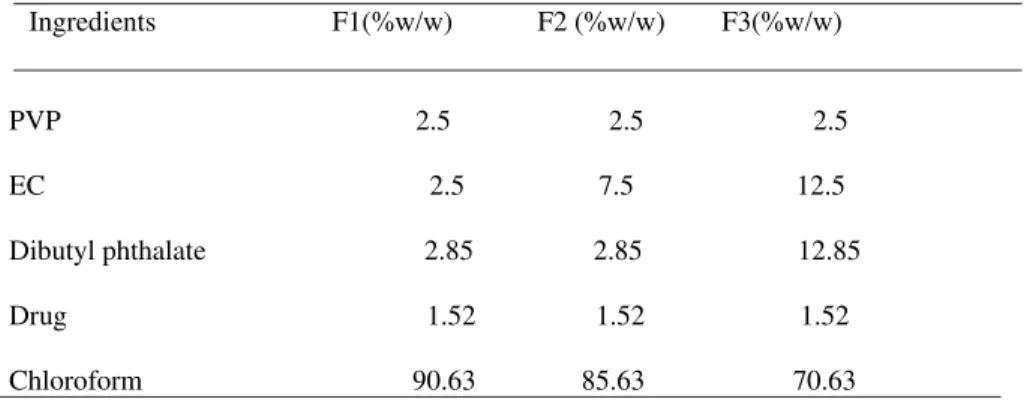
Formula:
Ingredients F1(%w/w) F2 (%w/w) F3(%w/w)
PVP 2.5 2.5 2.5 EC 2.5 7.5 12.5 Dibutyl phthalate 2.85 2.85 12.85 Drug 1.52 1.52 1.52 Chloroform 90.63 85.63 70.63
In Vitro studies of Rivastigmine tartrate Patches In vitro drug release studies:
The release studies were performed using a modified Franz diffusion cell assembly. The backing membrane side of the patches was stuck on a parafilm membrane which was bigger than the actual size of the patch with the help of a water impermeable adhesive. The release liner was removed and the patch was mounted on the diffusion cell with the patch facing the receptor compartment. The receptor compartment was filled with propylene glycol and phosphate buffer (pH 7.4) in ratio of 1:1 and maintained at 37 ◦C. The receptor medium was continuously stirred at 600rpm and 0.5 ml of receptor solution was taken for each sample time point which was immediately replaced with fresh receptor solution. The samples were analyzed using the respective HPLC methods18,19,20.
RESULTS
S.No. Concentration (μg/ml) Absorbance(nm)
1 0 0.000 2 2 0.032 3 4 0.064 4 6 0.095 5 8 0.125
Concentration (µg/ml) Fig 1. standard graph of Rivastigmine tartrate
Sl.No. Drug
name
Melting point
(ºC)
Solubility (mg/ml)
Partition coefficient
Log P Water Buffer
pH 7.4
1 Rivastigmine tartrate 124ºC 642.28 743.38 2.611
Table -2 Preformulation studies of Rivastigmine tartrate
S.No. Formulation codes
Physical appearance
* Weight (mg)
* Moisture content
*% Moisture uptake capacity
(%)
1 F1 ++ 351.45 ± 0.84 4.8±0.20 5.4±0.23
2 F2 ++ 351.1 ± 0.73 2.47±0.39 2.95±0.42
3 F3 ++ 351.42 ± 0.54 1.56±0.13 1.72±0.17
* → Average of five observations ++ → Satisfactory
Table-3 Evaluation parameters of the transdermal systems
Mean diameter of patch (cm) ± SD (n = 10)
Mean area of patch (cm2) ± SD (n = 10)
2.34 ± 0.032 4.19 ± 0.06
0 0.02 0.04 0.06 0.08 0.1 0.12 0.14
0 2 4 6 8 10
Formulation Code
Mean thickness of whole patch (in mm) ± SD (n = 5)
Mean thickness of backing membrane(in mm) ± SD (n = 5)
Mean thickness of polymer matrix (in mm) ± SD (n = 5)
F1 0.552±0.03 0.259±0.0063 0.293±0.017 F2
F3
0.573±0.03 0.597±0.02
0.261±0.0087 0.276±0.041
0.312±0.014 0.321±0.012
Table -5 Thickness of Rivastigmine tartrate transdermal patches
Table -6 Invitro drug release studies (Rivastigmine tartrate transdermal patches)
Conclusion
Rivastigmine tartrate is a reversible cholinesterase inhibitor used for the treatment of mild to moderate dementia of alzheImer’s disease ,which is having a short half-life about 1.5 hours which causes increased frequency of dosing.The matrix film fomers PVP and EC in the ratio of 1:1,1:3 and 1:5 were used here to develop transermal matrix pattern of Rivastigmine tartrate as these ratios were found to be acceptable in terms of tackiness and consistency by our earlier study (Mukeerjee Et al 2006). Further no predominant interaction was detected between the mixture of pure drug and combination of polymers using FT-IR spectroscopy. Various data of the pharmaco technical parameters generated from this study such as thickness, moisture content, moisture uptake, patch area and weight uniformity were found to be favourable to the development of transdermal,matrix patches in case of all the three formulations F1,F2,and F3 but F3 was found to be more suitable with slow drug release for the development of transdermal patches.
Invitro drug release studies revealed that the formulation F3 provided sustained release for drug molecules due to increase in amount of EC in the formulation. A more or less similar trend was studied in case of F2 formulation and F1 formulation. When the average rate constant of these 3 formulations were compared it was found that F3(PVP:EC -1:5)had the slowest release rate of all the formulations studied. Therefore based on the above observations it can be reasonably concluded that EC (1:5)polymers are better suited over
PVP-% Cumulative drug release (Time in Hours)
Time (Hr) PVP:EC (1:1) (F1)
PVP:EC (1:3) (F2)
PVP:EC (1:5) (F3)
0 0 0 0
EC (1:1 &1:3) for the development of TDDS of Rivastigmine Tartrate. Hence the formulation F3 (PVP:EC, 1:5) may be used for further pharmokinetic and pharmacodynamic studies in suitable animal models.
REFERENCES
[1] Ainlay wade, Paul J wells ,1994.Handbook of pharmaceutical excipients. 2nd ed. [2] Alfred Martin, James Swarbrick, Arthur Cammarata,1991. Polymer Science. 3rd ed. [3] Bombay: K. M. Varghese company.
[4] Atherden LM, 2002. Analytical methods. 8th ed. Oxford medical publication.
[5] Ballard C, Margallo-Lana M, Juszczak E, Douglas S, Swann A, Thomas A, O’ Brien J, Everralt A, Sadler S, Maddisen C, Lu L, Bannistic C, Elvish R, Jacoby R Quetiapine and Rivastigmine and Cognitive decline in ALzhimer’s Disease: Randomised double blind placebo controlled trial – Institute of Psyciatry, Kings College, London.
[6] Barry BW, 1987. Mode of action of penetration enhancers in human skin. J Controlled Rel; 6: 85-97.
[7] Bhaskar P, Krishnaiah YSR and Vijaya ratna J, 2004. Transdermal drug delivery: Role of chemical penetration enhancers. J Pharma Excip: 6-15.
[8] Bradley R. Williams Pharm D, Arlette Nazarians, Pharm D and Mark a Gill Pharm D. A Reversible Cholinesterase Inhibitor ; Department of Pharmacy and Gerentology, University of South Carolina School of Pharmacy, Los Angeles, California., pg 1634-1653 [9] Burns .A, Spiegel R. and Quarg P, 2004.Efficacy of Rivastigmine in Subjects with Moderately Severe Alzhimer’s Disease ,
Interntional Journal of Geriatric Psychiatry; 19; 243-249
[10] Carpel MC, Erasmo AME, Rawena SW, Elizebath PH, Rondoll Z. 1987.Drug Intelligence Clinical Pharmacy.
[11] Chien Yie W. 1992.Concepts and system design for rate controlled drug delivery. 2nd ed. New York : Marcel Dekker Inc. [12] Chien Yie W. 1992.Parenteral drug delivery and delivery systems. 2nd ed. New York : Marcel Dekker Inc.
[13] Chien Yie W. 1992.Transdermal drug delivery and delivery systems. 2nd ed. New York : Marcel Dekkar Inc. [14] Chien YW,1991.Systemic drug delivery of pharmacologically active molecule across the skin. Vol 100. New york.
[15] Choudhary KPR, and Naidu RAS, 1991. Studies on permeability of ethyl cellulose filmsfor transdermal use. The eastern pharmacist; 34(405): 119-21.
[16] Davidson’s Principles and Practice of Medicine 20th
Edition, edited by Nicholas.A.Boon, Nicki.R.Colledge, Brian.R.Walker, International Editor John A.A. Hunter pg 1217, 1188, 1189
[17] Devy K, Paranjothy KLK. 1999. Pharmacokinetic profile of a new matrix type transdermal delivery system: Diclofenac diethylammonium patch. Drug.Dev.Ind.Pharm 25: 695-700.
[18] Fang JY, Wamg RJ, Wu PC, Jsai YH, 2000.Passive and iontophoretic delivery of three diclofenac salts across various skin types. Bio Pharm Bul; 23: 1357-1362.
[19] Flynn GL, Durrheim H, Huguchi WI, 1981. Permeation through hairless mouse skin II: membrane sectioning techniques and influence on alkanol permeabilities. J Pharm Sci; 70 (1): 52-56.