*Correspondence: I. F. Andreazza. Departmento de Farmácia, Universidade Federal do Paraná. Av. Pref. LothárioMeissner, 632 - Jardim Botânico, 80210-170 – Curitiba - PR, Brasil. E-mail: [email protected]
A
vol. 50, n. 3, jul./sep., 2014 http://dx.doi.org/10.1590/S1984-82502014000300008
Development of a multiparticulate system containing
enteric-release mini-tablets of omeprazole
Volnei Jose Tondo Filho, Itamar Francisco Andreazza
*, Mayumi Elisa Otsuka Sato,
Fábio Seigi Murakami
Department of Pharmacy,Federal University of Paraná, Curitiba, PR, Brazil
The main aim of this study was to develop a multiparticulate system containing mini-tablets of omeprazole formulated with an enteric polymer with pH-dependent solubility. Pre-formulation studies showed good low and compaction capacity, leading to the production ofhigh quality mini-tablets. The mini-tablets were coated in a luidized bed with hydroxypropylmethylcellulose /Eudragit® L30D55 and packed into hard gelatin capsules. The dissolution proile showed gastro-resistance and zero-order kinetics. The dissolution proile for the formulation containing lactose as the diluent and coated with 12% (tablet weight gain) of polymer was similar to that ofthe reference drug.
Uniterms: Multiparticulate system/modiied release. Enteric release mini-tablets/development. Enteric
release mini-tablets/evaluation. Omeprazole/dissolution.
O presente trabalho teve como objetivo desenvolver e avaliar um sistema multiparticulado de liberação modiicada, composto por mini-comprimidos revestidos com polímero de liberação pH-dependente, utilizando como fármaco modelo o omeprazol. Os mini-comprimidos (diâmetro de 2,5 mm) foram obtidos em máquina de compresssão excêntrica, revestidos em leito luidizado com hidroxipropilmetilcelulose/ Eudragit®L30D55 e, em seguida, acondicionados em cápsulas gelatinosas duras. A partir dos resultados
obtidos no peril de dissolução foi possível demonstrar a liberação gastro-resistente e comportamento cinético de ordem zero. A formulação contendo lactose como diluente, com revestimento de 12% de polímero, demonstrou semelhança com o medicamento referência.
Unitermos: Sistema multiparticulado/liberação modiicada. Mini-comprimidos de liberação entérica/
desenvolvimento. Mini-comprimidos de liberação entérica/avaliação. Omeprazol/dissolução.
INTRODUCTION
The solid dosage forms of drugs for oral use are marketed all over the world and are classiied according to their drug release behavior as conventional or modiied release (Ashford, 2005; Allen, Popovich, Ansel, 2013)
The modiied-release dosage forms are designed as monolithic or multiparticulate systems, and their function is to modify the bioavailability of the drug and extend the release or control the beginning of the drug dissolution in the gastrointestinal tract(Costa, Lobo, 1999; Lee, Robinson, 2000; ANVISA, 2010).
In a monolithic system the total administered drug is concentrated in a single release unit (tablet, coated tablet
or hard gelatin capsule). In contrast, in multiparticulate forms the drug is divided into several functional subunits, such as granules, pellets or mini-tablets (coated or not), contained within a inal dosage form (tablet or softgel) that disintegrates rapidly after administration releasing the subunits into the gastrointestinal tract. This reduces the risk of a high local drug concentration and the potential effect of localized irritation of the gastric mucosa (Ghebre-Sellassie, Knoch, 2002; Pezzini, Silva, Ferraz, 2007).
In order to optimize the multiparticulate system, the subunits that comprise it can be coated to protect the drug, to mask the taste and/or odor, to protect against digestive fluids (enteric coating) or to control the drug release (Aulton, 2005; Pezzini, Silva, Ferraz, 2007).
especially in the case of drugs with sensitivity to humidity and/or temperature, when the formulation demonstrates appropriate flow and compression properties. Other compression techniques can also be used but due to the larger numbe rof operations required these methods are not as attractive (Rouge et al., 1997; Lennartz,Mielck, 2000)
Omeprazole (OMP) is a lipophilic drug, which behaves as a weak base and it is moderately soluble in alcohol and slightly soluble in water (pKa1=4.2 and
pKa2=9.0). In aqueous solution at 25 °C there is the complete formation of a precipitate at pH = 2.2 to 4.0 and at pH = 11 the drug degrades in less than 4 hours (Mathew, Gupta, Bailey, 1995; Riedel, Leopold, 2005).
In the preparation of medicinal products for oral use it is therefore important to consider using a protective layer comprised of a gastro-resistant polymer to maintain the integrity of omeprazole, thereby preserving its therapeutic activity (Bruntonet al., 2008;Nair et al., 2010).
In this context, the main objective of this study was to develop and evaluate a multiparticulate modiied-release system, containing mini-tablets of omeprazole coated with a polymer with pH-dependent solubility.
MATERIAL AND METHODS
The pharmaceutical materials were kindly supplied by the pharmaceutical laboratory Prati Donaduzzi and used as received.
Preparation of mini-tablets
Two formulations were prepared (Table I). The size of the raw materials was standardized using a 40 mesh sieve and the materials were then mixed for 15 minutes in the BIN mixer at 15 rpm. The compacted bulk density of the mixtures obtained was evaluated in triplicate (SVM121 Erweka). The values obtained were used to determine the Hausner factor (HF) according to the procedure described in USP, 2010.
Evaluation of mini-tablets
Hardness
The hardness of the mini-tablets produced was determined in a TBH ERWEKA® hardness tester using 10
mini-tablets of each formulation (Farmacopéia brasileira, 2010).
Friability
A dust-free sample (3g) of mini-tablets was accurately weighed and analyzed in a tablet friability
apparatus (Erweka® GmbH, Bizen, Germany) with 200
glass beads. The percentage of friability was calculated considering the initial weight (Thoma, Ziegler, 1998).
Weight Variation
Twenty mini-tablets were weighed individually in an AG200 analytical balance (Gehaka, São Paulo, Brazil) and the mean and coeficient of variation were determined.
Coating of mini-tablets
Batches of formulations A and B (mini-tablets 100g) were coated in a fluidized bed (LM-FBD 5.0/Wuster, Labmac, Sao Paulo, Brazil) with an air inlet temperature of 40 °C and an initial low of 2.5 mL.min-1 followed by
10 min at 4 mL.min-1. The insulating layer of 4% (w/v)
aqueous hydroxypropyl methylcellulose (HPMC) was applied until a weight gain of 3% was achieved. After this treatment, the mini-tablet batches were covered with an enteric coating, employing the same equipment and conditions, using an aqueous dispersion of Eudragit®
L30D55, talc, triethyl citrate and titanium dioxide, to give weight gains of 8, 10 and 12%. These batches were evaluated employing the dissolution test (acid phase) to determine the minimum effective coating, considering the amount of polymer that provides an OMP release of < 10%.
Preparation of multiparticulate dosage form
Multiparticulate systems were prepared in hard gelatin capsules (size 3), encapsulating in each one around 200 mg of mini-tablets (equivalent to 20 mg of OMP). The samples containing uncoated mini-tablets were
TABLE I - Formulation of mini-tablets containing omeprazole
Raw material Formulation A (%) Formulation B (%)
Omeprazole 11.98 11.98
Microcrystalline cellulose
73.65
-Spray-dried lactose - 73.65
Magnesium carbonate
1.20 1.20
Colloidal silicon
dioxide 0.6 0.6
TABLE II – Characterization of mini-tablets produced
Analysis Formulation A Formulation B Limits
Friability (%) 0.34 0.45 <1.5
Hardness (kgf) 6.2 ± 0.4 6.3 ± 0.3 ≥ 3
Mean Weight (mg) 12.35 ± 0.34 12.40 ± 0.36
-Concentration (% w/w) 11.89 ± 0.19 11.95 ± 0.17 11.37 ≤ R ≤ 12.57
denominated as systems A and B (Table I). Also, they were referred to as 1 or 2 according to the amount of coating required to meet the minimum effective coating (10 or 12% of tablet weight, respectively).
The samples were thus named as follows: formulation A1 (with 10% of weight gain); A2 (with 12 % of weight gain); formulation B1 (with 10% of weight gain) and B2 (with 12% of weight gain).
Determination of omeprazole in uncoated and coated mini-tablets
The content of OMP in the mini-tablets was determined by high performance liquid chromatography (HPLC) according to the United States Pharmacopoeia(United States, 2010).
Dissolution profile of the multiparticulate dosage forms
The reference sample (REF)and the systems A, B, A1, A2 , B1 and B2 were evaluated in a Varian dissolution apparatus (paddle), at a speed of 100 rpm and temperature of 37 ºC±0.5 °C. The dissolution test was conducted at 150 min, divided into two steps. The first step was performed in 120 min using 0.1 M hydrochloric acid (500 mL) with a 10 mL sample removed at the end of the step. In the second step (30 min) 400 mL of 0.235 M dibasic potassium phosphate buffer was added to the dissolution medium and the pH was adjusted to 6.8. Samples (10 mL) were removed at 125, 130, 135, 140 and 150 min after the start of the test. The dissolved drug content was evaluated by HPLC (United States Pharmacopoeia, 2010).
For the uncoated mini-tablets (A and B) the dissolution was evaluated without passing through the first step to prevent the acid decomposition of OMP. The comparison between the dissolution profiles was performed by analysis of the difference (f1)/similarity (f2) factors and the dissolution efficiency (DE). The comparison between the DE values was performed by analysis of variance (ANOVA - single factor) with a signiicance level of 5% (Khan, 1975; Marcolongo, 2003).
Study on OMP release kinetics
To identify the most suitable kinetic model to
describe the drug release from the multiparticulate system developed zero-order, irst-order and Higuchi (or pseudo-zero-order)equations were used (Jug, Becirevic-Lacan, 2004).
RESULTS AND DISCUSSION
Evaluation of mixtures and mini-tablets obtained
The Hausner factor (HF) was used to predict the low properties of the powder mixtures, since this measurement is closely related to the friction between the particles of the mixture. Both formulations showed good low properties represented by their HF values of 1.20 (for A) and 1.17 (for B), and thus the mini-tablets (A and B) could be obtained by direct compression (Aulton, 2005).
Characterization of uncoated mini-tablets
Table II shows the results obtained for the uncoated mini-tablets (cores). The parameters were adapted to the speciications of the monograph for tablets given in the Brazilian Pharmacopoeia 2010. The hardness values of >3.5Kgf, the good results obtained in the friability test and the non-occurrence of capping, cracks or lamination demonstrated the mechanical strength of the cores (Wu
et al., 2008). The omeprazole contents were determined by HPLC and were in agreement with the compositions detailed in Table I.
Minimum effective amount of enteric coating
Batches of mini-tablets coated with appropriate amounts of polymer to give 10% and 12% weight gain were dissolved by less than 10% after a 120-min test in acid medium, conirming the gastric resistance within the speciied pH range.
The composition of each formulation corresponds to around 200 mg of mini-tablets(equivalent to 20 mg of OMP)in accordance with the content of omeprazole determined by high performance liquid chromatography (HPLC) and described in Table III.
A l l s a m p l e s e v a l u a t e d p r e s e n t e d d i ff e r e n t omeprazole contents according to their formula and this value serves as a reference for determining the level of coating required. For the coated batches, the omeprazole content decreased as the level of coating applied increased. Thus, a higher drug content indicated a lower level of coating (Amighi, Moes, 1996).
Dissolution profile of the reference product
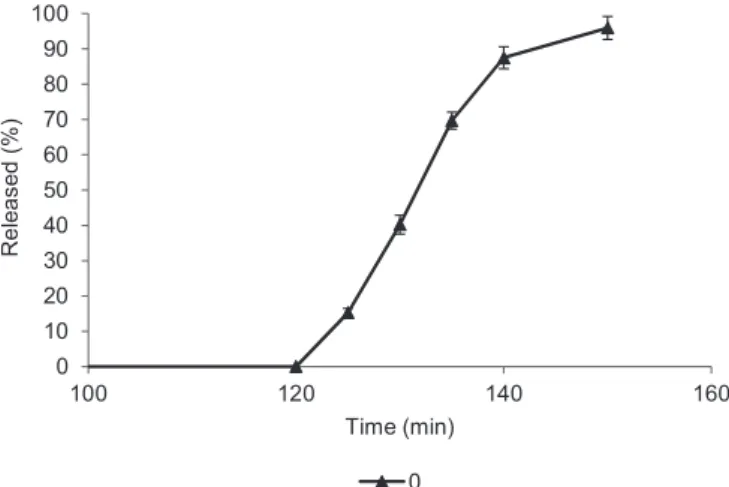
The dissolution proile of the reference drug showed pH-dependence, consistent with retarded drug release (Figure 1).
The release of OMP from capsules containing mini-tablets is regulated by the system reservoir. After dissolution of the coating, the pharmaceutical formulation was rapidly dissolved. The typical sigmoid shape of the curve indicates that the disintegration and dissolution are comparable. The behavior under different pH conditions was consistent with that expected, that is, no release at pH 1.0 and rapid release in pH 6.8 (Maganti, Elik, 1994).
Dissolution profile of the formulations prepared
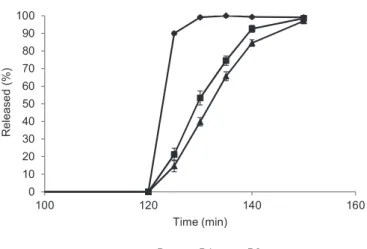
The encapsulated mini-tablets (A and B)showed more than 90% of drug release after 10 min of testing in phosphate buffer pH 6.8 (Figures 2 and 3), behaving as an immediate-release dosage form. This behavior was expected, since the compositions do not include components that modify the release process.
The multiparticulate systems A1, A2, B1 and B2 (Figures 2 and 3) showed pH-dependent dissolution proiles with the dissolution of the drug beginning after changing the dissolution medium to pH 6.8 (120 min) with the release reaching over 90% after 150 min of testing. This behavior was also expected, since the gastro-resistant polymer coating was derived from methacrylic acid (Eudragit® L30D55), which dissolves at pH >5.5 (Chuong,
Christensen, Ayres, 2008).
The dissolution of < 1% at acidic pH showed that the polymer coating provided good control of the drug release at the two levels of coating evaluated (10% and12%, by weight), but the mini-tablets with a higher amount of polymer used in the coating (12%) showed more effective control.
Comparison of dissolution profiles
A comparative evaluation of the dissolution proiles (Figure 1, 2 and 3) is useful in the selection of formulations
TABLE III - Result for contents and average weight of coated mini-tablets of omeprazole
Analysis A1 A2 B1 B2
Mean Weight (mg) 14.18 ± 0.42 14.52 ± 0.29 14.17 ± 0.54 14.58 ± 0.44
Concentration (% w/w) 10.24 ± 0.15 10.05 ± 0.20 10.29 ±0.14 10.07 ±0.18
FIGURE 1 – Reference omeprazole released (%) in the
dissolution test (n=18).
FIGURE 2 - Drug release proiles of formulations A, A1 and
TABLE IV - Results for f1, f2 and DE% of capsules containing
coated mini-tablets
Samples f1 f2 DE (%)
Reference 56.73 ± 3.44
A1 3.63 76.20 59.66 ± 0.74
A2 10.25 57.21 52.83 ± 0.67
B1 10.22 56.29 64.41 ± 1.15
B2 2.96 79.83 57.3 ± 1.00
TABLE V - Dissolution efficiency (%) in comparison with
reference using ANOVA
Fcalculated F Results
A1 5.5421 4.6001 Different
A2 9.8165 Different
B1 35.81 Different
B2 0.2229 Similar
TABLE VI - Study on release kinetics
Formulation Zero-order First-order Higuchi
A1 0.9218 0.9584 0.9154
A2 0.9465 0.9391 0.8711
B1 0.9005 0.9611 0.9409
B2 0.9465 0.9458 0.9170
Reference 0.9246 0.9657 0.9109
FIGURE 3 - Drug release proiles of formulations B, B1 and
B2 (n=18).
during the processes related to pharmaceutics and also to establish the similarity between a new general formula and its reference (Moore, Flanner, 1996; Adams et al., 2001).
A comparison of the dissolution profiles using the factors f1 and f2 (Table IV) demonstrated that all formulations had dissolution proiles similar to that of the reference drug (ANVISA, 2010).
The dissolution eficiency (DE%; Table IV) is an important parameter of the release kinetics and it allows the comparison of two formulations (Costa, Lobo, 1999). For a more detailed assessment, the dissolution study was accompanied by statistical analysis to infer the similarity between the dissolution proiles obtained. The analysis of variance (ANOVA) results showed that only the capsule containing B2 mini-tablets (Table V) showed a DE% similar to the reference drug. However, assessment of the formulation by determining the DE% is not addressed by pharmaceutical regulatory agencies.
The results revealed that the different methods used to compare dissolution proiles can lead to antagonistic results. However, the application of these methods can provide more accurate information on the dissolution
behavior of products, facilitating the development or optimization of formulations.
The quantitative interpretation of the values obtained for the dissolution profiles, based on the percentage dissolved versus time, is facilitated by the use of mathematical models (Marcolongo, 2003; Kumar, Tewari, 2006).
In this study, three mathematical models were applied for the interpretation of the dissolution kinetics: zero-order, first-order and the Higuchi model. The kinetics models were evaluated through the linearization of the proile data according to the dissolution time and percent drug released. To select the most suitable model the coeficient of correlation (r) is calculated, to identify which model most closely approaches perfect linearity. The results for the linearization of the data are shown in Table VI.
The correlation coefficients for the formulations showed different release kinetics. The A2 and B2 mini-tablets presented zero-order release kinetics profiles, indicating that the release occurs independently of the amount of drug remaining, due to excess coating being employed, which delayed the early release.
CONCLUSIONS
The mini-tablets containing omeprazole prepared by direct compression presented smooth edges and uniform color and were able to support the coating processes. Coating of the mini-tablets with 10% (in terms of weight gain) of methacrylic polymer was suficient to obtain the desired gastro-resistance.
The proposed formulations showed good flow properties (Hausner factor) for formulations A and B, respectively. The produced uncoated mini-tablets meet the requirement for speciications of the monograph for tablets given in the Brazilian Pharmacopoeia (2010).
The dissolution profiles of the tablets produced indicated good control of the release of the drug by the polymer coating at the two levels evaluated, indicating that the methacrylic derivative used is suitable for obtaining delayed-release systems. For the comparative analysis of the dissolution proiles based onf1 and f2, all capsules produced showed similarity to the reference product. Only capsules containing the mini-tablets B2 showed dissolution proiles similar to the reference drug, according to single factor ANOVA.
The irst-order kinetics model was found to be most suitable to represent the release proiles of omeprazole multiparticulate systems A1 and B1 and the reference drug whereas the zero-order model was best suited for systems A2 and B2.
REFERENCES
AMIGHI, K.; MÖES, A. Inluence of plasticizer concentration and storage conditions on the drug release rate from eudragit® RS30D ilm-coated sustained-release teophylline
pellets. Eur. J. Pharm. Biopharm., v.42, p.29-35, 1996.
ADAMS, E.; COOMANS, D.; SMEYERS-VERBEKE, J.; MASSART, D.L. Application olinear mixed effects models
to the evaluation of dissolution profiles. Int. J.Pharm.,
v.226, p.107-125, 2001.
ALLEN JR, L.V.; POPOVICH, N.G.; ANSEL, H.C. Formas
farmacêuticas e sistema de liberação de fármacos. 9. ed.
Artmed, 2013.p.187-206.
ASHFORD, M. Biodisponibilidade - fatores físico-químicos e relacionados à formafarmacêutica. In: AULTON, M.E.,
(Ed.). Delineamento de formas farmacêuticas. 2. ed. Porto
Alegre: Artmed, 2005. chap.17, p.245-263.
AULTON, M.E. Pharmaceutics. The science of dosage
form.2ed. Edinburgh:Churchill - Livingstone, 2005.679 p.
AGÊNCIA NACIONAL DE VIGILÂNCIA SANITÁRIA. ANVISA. Resolução da diretoria colegiada nº 31, de 11 de agosto de 2010. Determina a publicação do “Guia para realização dos Estudos de Equivalência Farmacêutica e de Peril de Dissolução Comparativo”. Diário Oicial da União, 2010. Available at: http://www.brasilsus.com.br/ legislacoes/rdc/105005-31.html. Accessed on May 2014.
BRUNTON, L.; PARKER, K.; BLUMENTHAL, D.; BUXTON, I. Goodman and Gilman’s manual of pharmacology and
therapeutics.1ed. New York: McGraw Hill, 2008.623 p.
CID, E.C. Cinética de dissolución de medicamentos. Washington:
Organización de los Estados Americanos, 1981. p.102.
CHUONG, M.C.; CHRISTENSEN, J.M.; AYRES, J.W. New dissolution method for mesalamine tablets and capsules.
Dissolut. Technol., v.15, p.7-14, 2008.
COSTA, P., LOBO, J.M.S. Formas farmacêuticas de liberação
modiicada. Rev. Port. Farm., v.59, p.181-190, 1999.
GHEBRE-SELLASIE, I.; KNOCH, A. Encyclopedia of
pharmaceutical technology. 2. ed. Marcel Dekker, v.3, 2002. p.1-13.
FARMACOPÉIA BRASILEIRA. 5. ed. Rio de Janeiro:
Fiocruz, 2010. p.62.
JUG, M.; BECIREVIC-LACAN, M. Inluence of hydroxypropyl-beta-cyclodextrin complexation on piroxicam release from
buccoadhesive tablets. Eur. J. Pharm. Sci., v.21, p.251-260,
2004.
KHAN, K.A. The concept of dissolution eficiency. J. Pharm.
Pharmacol., v.28, p.48-49, 1975.
LENNARTZ, P.; MIELCK, J.B. Minitabletting: improving
the compactibility of paracetamol powder mixtures. Int. J.
Pharm., v.173, p.75-85, 2000.
LEE, T.W.; ROBINSON, J.R. Controlled-release drug delivery
systems. In: GENARO, A.R. (Ed.). Remington: the science
and practice of pharmacy. 20ed. Baltimore: Lippincott Williams & Wilkins, 2000. chap.47, p.903-929.
MAGANTI, L.; ELIK, M.C. Compaction studies on pellets: II.
MARCOLONGO, R. D i s s o l u ç ã o d e m e d i c a m e n t o s: fundamentos, aplicações, aspectos regulatórios e perspectivas na área farmacêutica. São Paulo, 2003.114 p. [Dissertion of master degree, Faculty of Pharmaceutical Sciences, University ofSão Paulo].
MATHEW, M.; GUPTA, V.D.; BAILEY, R.E. Stability of omeprazole solutions at various pH values as determined
by high-performance liquid chromatography. Drug Dev.Ind.
Pharm., v.21, p.965-971,1995.
MOORE, J.W.; FLANNER, H.H. Mathematical comparison of
dissolution proiles. Pharm. Technol., v.20, p.64-74, 1996.
NAIR, B.A; GUPTA, R.; KUMRIA, R.; JACOB, S.; ATTIMARAD, M. Formulation and evaluation of enteric
coated tablets of proton pump inhibitor. J. Basic Clin.
Pharm., v.1, p.215-221, 2010.
PEZZINI, B.R.; SILVA, M.A.S.; FERRAZ, H.G. Formas farmacêuticas sólidas orais de liberação prolongada:
sistemas monolíticos e multiparticulados. Braz. J. Pharm.
Sci., v.43,p.491-502, 2007.
RIEDEL, A.; LEOPOLD, C.S. Degradation of omeprazole induced by enteric polymer solutions and aqueous
dispersions: HPLC investigations. Drug Dev.Ind.
Pharm.,v.31, p.149-158, 2005.
ROUGE, N.; COLE, E.T.; DOELKER, E.; BURI, P. Screening
of potentially floating excipients for minitablets. . STP
Pharma. v. 7:p.386-92, 1997
THOMA, K.; ZIEGLER, I. Investigations on the influence of the type of extruder for pelletization by
extrusion-spheronization. II. Sphere characteristics. Drug Dev. Ind.
Pharm., v.24, p.413-422, 1998.
TROY, D. B.; BERINGER, P. Dissolution. In: KUMAR, V.; TEWARI, D. Remington: The Science and Practice of Pharmacy. 21. ed. Baltimore: Lippincott Williams & Wilkins, 2006. p.672-688.
UNITED STATES PHARMACOPOEIA. 33. ed. Rockville:
United States Pharmacopoeial Convention, 2010. p.2479-84.
WU, C.Y.; HANCOCK, B.C.; MILLS, A.; BENTHAM, A.C.; BEST, S.M.; ELLIOTT, J.A. Numerical and experimental investigation of capping mechanisms during pharmaceutical
tablet compaction. Powder Technol., v.181, p.121-129,
2008.
Received for publication on 05th April 2013