Introduction: Motivation in Malaysia is to a large extent influenced by the value system amongst all Malaysians. Being able to motivate employees is one of the important keys to the success of the organization. In this paper, an attempt was made to look into the needs of employees in organizations and in particular, the needs based on Maslow’s theory on motivation.
Subjects and Methods: Employees which consisted of both academic and administrative employees of the International Medical University (IMU) were surveyed using a standard questionnaire. The aim of this study was to compare which levels of Maslow’s hierarchy of needs theory had been fulfilled and which needs were yet to be fulfilled in the different ethnic groups at IMU.
Results: Amongst the males, the Chinese and Indian ethnic groups placed most emphasis on the esteemneeds and on self-actualization needs. The Malay males gave importance to Safetyneeds. Amongst the female ethnic groups, all three groups placed most importance on the esteem needs and self-actualization needs. The Chinese females scored the lowest for the Basic needs compared to the Malay and Indian females. The Indian females scored the lowest for Socialneeds.
Conclusion: Organisations should play an important role in the motivation of employees. Human resource development is an integral part in the development of its employees.
IeJSME 2007: 1 (1): 46-51 Key words: Maslow, motivation, ethnic, medical, university
Motivation in Malaysia is to a large extent influenced by the value system amongst all Malaysians who are from different ethnic backgrounds.1Organisations need
to know what motivates their employees and what does not. Motivated employees are needed in our rapidly changing workplaces and help organizations survive. Motivated employees are more productive. To be effective, managers need to understand what motivates employees within the context of the roles they perform. Of all the functions a manager performs, motivating
employees is arguably the most complex. Of the many theories that relate to motivation, they have been broadly classified into two categories: the ‘Content’ and the ‘Process’ theories. The Content theory focus on why certain goals are more important to some people as compared to others. They emphasize on ‘what’ motivates a person and define motivation in terms of need satisfaction. The ‘Process’ theory explains ‘why’ individuals behave in a particular manner.2 It defines
motivation as a rational cognitive process occurring within the individual.
In the late 1960’s Abraham Maslow developed a hierarchical theory of human needs.3Maslow focused on
In Malaysia, basic amenities such as food, water and shelter are available to most of the population. Safety needs such as feeling secure and free from threats in their basic existence is seen through racial harmony amongst the different ethnic groups; in keeping with the policies laid down by the government. Employees in Malaysia need not worry excessively about natural disasters such as earthquakes, terrorism and hurricanes and, hence, both organisations in Malaysia and investors from abroad are able to plan strategically and have long term visions and goals for their corporations and staff are able to plan their careers and ‘where they want to be’ in their strategic plans. Socialneeds, in fact, form a ‘core’ for the existence of the majority of the Malaysians. Social units, families, feelings of worthiness, belonging to a particular community and identifying with culture groups are more or less a norm in the life of an individual. These needs are mostly fulfilled. This leaves us with the last two needs, namely esteem needs and self-actualization needs. Esteem needs are important for all workers in an organisation. People need to feel recognised and appreciated and given due respect, for example, to a task completed well. They need to feel confident, capable and adequate. Self-actualization needs, according to Maslow’s theory, are the ultimate human goal. Most employees and employers, working in corporations, seek personal achievement; that is the capability of achieving everything one is capable of achieving. Hankins and Clark investigation revealed that a career choice in teaching had a great deal to do with the level of achievement an individual wanted in motivation.4
In Malaysia, a lot depends on the value-system and culture for individuals to be motivated.
Over the last several years, the Malaysian management circles have been exposed to a number of Western management theories and practices including those related to employee motivation. Not all of these theories and practices, however, are necessarily directly applicable to the Malaysian workforce.5It is important
to note that as we move from one culture to another, we observe systematic differences which may be viewed
as important for effective motivation. The purpose of this study was to see which levels of Maslow’s hierarchy of needs theory had been fulfilled and which needs were yet to be fulfilled and to compare the needs of the different ethnic groups at IMU, mainly the Malays, Chinese and Indians.
Subjects & Methodology
The research design for this study employed a descriptive survey method. The target population of this study included employees which are a mix of both academic and administrative employees at the International Medical University (IMU). Employees in this survey are of different categories, i.e. academic staff from Professors to Lecturers and administrative staff from executives to senior Managers. All have different types of work loads and responsibilities.
The structured questionnaire consisted of ten (10) questions in total. Each question had five (5) parts to it i.e. A, B, C, D & E [Table 1]. The scoring for each set of the five ‘needs’ motives range from 1 to 5 points. Subjects are to rank their responses for each of the questions. The most important or relevant response for the staff scored 5 marks, whilst the least important or least relevant response scored 1 mark. With reference to motivation, different questions assessed basic comfort needs, safety needs, social or affiliation needs, self- esteem needs and self - actualization needs.
Data was collected through use of a questionnaire hand-delivered to participants. The questionnaires were distributed at random to both the academic and non academic (i.e. administrative) staff. An e-mail was also sent out to staff who could get in touch with the author in case the need of any clarification arose. Employees were required to fill up the demographic details and their identities remain anonymous. Employees were assured that all information obtained was “Private & Confidential”. Any doubts were clarified. The questionnaires were collected after a week.
Results
distributed, only 68 questionnaires were returned (45.3 %). Out of these 68, 20 questionnaires were filled up by males (29.4%) and 48 were filled up by females (70.5%). Further 22 were filled up by Malays (32.3%), 24 were filled up by Chinese (35.2%) and 22 were filled up by Indians (32.3 %). Of the Malay population in study, 8 were males (36.3 %) and 14 were females (63.6%). Amongst the Chinese population, 6 were males (25%) and 18 were females (75 %) and amongst the Indian population, 6 were males (27.2%) and 16 were females (72.7%).
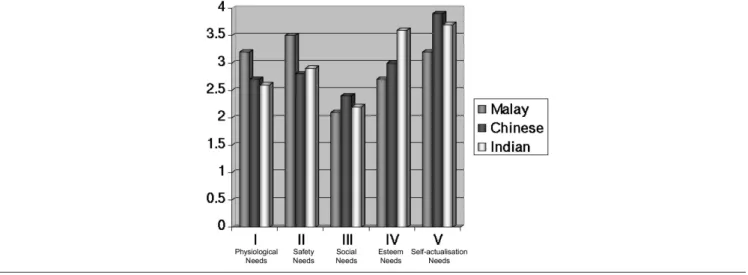
The distribution of responses amongst the males in the different ethnic groups are fairly even. The distribution of responses amongst the different female ethnic groups are fairly constant too. Amongst the males, the Chinese and Indian ethnic groups placed most emphasis on the esteem needs and the maximum on self - actualization needs. Even though the Malay males paid emphasis on the Self-actualization needs, they however felt that Physiological or Basic needs were equally important (both scored a mean of 3.2). The Malay males in this survey gave the highest score and importance (mean 3.5) to Safety needs. The Malay males placed less emphasis on Esteem. All three male ethnic groups scored low means for Social needs (Figure 1). Amongst the female ethnic groups, all three groups placed most importance on the esteem needs and self-actualization needs (all scored more than a mean of 3). The Chinese females scored the lowest mean (2.1) for the Basic needs compared to the Malay and Indian females. The Indian females scored the lowest for Social needs (mean 2.1) (Figure 2).
Discussions
It is important to note that the levels that received the highest scores are the most important needs identified by the employees at the International Medical University. The lowest scores show that those needs have been relatively well satisfied. It could however also mean that the needs with the lower scores are those needs that are de-emphasized by the employees during the time of the survey.
Esteem needs are important for all workers in an organisation. People need to feel recognised and appreciated and given due respect, for example, to a task completed well. They need to feel confident, capable and adequate. Self-actualization needs which according to Maslow’s theory, are the ultimate human goal. Most employees, working in corporations, seek personal achievement; that is the capability of achieving everything one is capable of achieving. Even though the Malay males paid emphasis on the Self-actualization needs, they however felt that Physiological or Basic needs were equally important which comes as surprise as in Malaysia, basic amenities such as food, water and shelter are available to most of the population. The Malay males in this survey gave the highest score and importance to Safety needs. This could perhaps mean that they felt less secure and less free from threats as an individual in an organization or with the policies laid down by the government. The Malay males placed less emphasis on Esteem. Perhaps they felt recognized and appreciated and given due respect. They perhaps also feel more confident, capable and adequate compared to the others. What is interesting is that all three male ethnic groups scored low means for Social needs. It is assumed that majority felt that they are happy with their families, had feelings of worthiness, felt they belonged to a particular community and were able to identify with culture groups.
One of the ways in which one can aim for individuals, especially for staff in corporations to acquire better management is perhaps to pay more emphasis on the motivation of employees and the development of human resource. Staff should be sent for training programmes and needs should be catered according to individual requirements and those in keeping with the attainment of both and individual goals.
A study by Asma Abdullah and Surjit Singh discussed how different ethnic groups demonstrate motivational behaviors. In their respective studies, motivation has been linked to the sharing of common values so that employees are inspired, empowered and committed to a vision and mission.7Their studies compared and came to
a finding that Americans valued esteem and self-actualization very highly. Malaysians in general were usually motivated when they were able to develop and cultivate good relationship among their bosses and subordinates and work in an atmosphere that is friendly and supportive. The true Malaysian motivational factors embodied an appreciation of cultural diversity and the ability to have a global mindset which required sensitivity to the values, needs and aspirations of the workforce, flexibility in meeting the needs of people from diverse cultures, and ability to relate cross culturally.8 Their
studies indicated that while money was generally the underlying factor that drove Malaysians to work, other factors such as opportunities for self – development, contributing to the community and having good harmonious relationships were also important.
The key to motivating employees is to know what motivates them and designing a motivation program based on those needs. In 1991, the past Malaysian Prime Minister outlined a brave and bold plan for achieving ‘developed nation status’ by the year 2020.9He stressed
that successful achievements of Vision 2020, as it is called, will require the best efforts of all Malaysians. In fact, the key element for the success of a futuristic vision is the country’s most important resource – its people.
To meet the strategic challenges of the Vision 2020, many areas and values of importance have been
identified. Briefly, among the more frequently stated are as follows: quality, productivity, innovativeness, integrity, accountability, professionalism, training of personnel, discipline, management responsibility and adequate quality system.10 Therefore human resource
development plays a very important role in training and it indirectly motivates employees and improves the organisation’s and country’s future to achieve its missions and goals.
As Malaysians become more exposed to globalisation and international business events and trends, they would have to re-examine their current organisational structures and work practices so as to be able to respond to the values and standards expected of the global workforce. It is widely believed that the behaviour of senior managers and leaders in an organization determines the corporate culture and value system of that organisation. They are responsible for the motivation, commitment and the attainment of goals by their employees. The managers have to be role models that are visible to the organisation. Local values play an important role in determining the corporate culture. Organisational structures of the past which tend to undermine the values of knowledge-sharing, speed and accuracy in information flow and multicultural team effectiveness, may have to make way for new structures and processes which are less bureaucratic and hierarchical in nature. Similarly, work practices, policies and planning by higher management which provide low value added work, which cause wastage and serving as roadblocks to workplace efficiency and effectiveness will have to be replaced. New ways of getting things done must be explored if Malaysian-based organizations want to remain responsive to the needs of the workplace. However, one needs to bear in mind that some of these new structures and work practices may run counter to the prevailing cultural values and beliefs of the society or of the organisation.
REFERENCES
1. Abdullah A. Local values in Malaysian managerial practices. Intan Management Journal 1992; 1: 27-63.
3. Maslow A. Motivation & Personality. Harper & Row, 1954. 4. 4 Banyard P, Hayes N. Psychology: Theory and Application. 2ndedn.
Chapman and Hall, 1994.
5. Gallagher E, Abdullah A. Managing with cultural differences. The Journal of Malaysian Management Review 1995; 30: 1-17. 6. Robbins S, Coulter M. Management. 5thedn. Prentice Hall, 1996.
7. Singh S, Abdullah A. Influence of ethnic values at the Malaysian workplace.
8. Malaysian Management Review 1992; 27.
9. Sivalingam G, Yong P. Models of corporate culture and its implications for Malaysia. Intan Management Journal 1992; 1: 20-23. 10. Mahathir M. Vision 2020: The way forward. Malaysian
ManagementReview 1997; 32: 1-6.
11. Fisher R, Dawkins L, Akin R. The human resource development needs of Malaysia : achieving vision 2020. Intan Management Journal 1993; 1: 97 – 115.
Table 1
Questions Scores calculated based on responses of
A,B,C,D,E & the weightage of 1-5 for each
1. Overall, the most important thing to me about a job is whether or not…..
2. If I were to quit a job, it would probably be because….
3. For me, the most important rewards in working are those that… 4. My morale would suffer most in a job in which..
5. In deciding whether or not to accept a promotion, I would be most concerned with whether…
6. The kind of job that brings out my best is one in which… 7. I would consider changing jobs if my present position… 8. The job situation that would cause the most stress for me is … 9. I would accept a new position if..
10. I would work overtime if…
I II III IV V
MOTIVATION LEVELS