Zhao, Z., et al.: Effects of Pressure and Temperature on Thermal Contact …
THERMAL SCIENCE, Year 2015, Vol. 19, No. 4, pp. 1369-1372 1369
EFFECTS OF PRESSURE AND TEMPERATURE ON THERMAL
CONTACT RESISTANCE BETWEEN DIFFERENT MATERIALS
by
Zhe ZHAO a, Hai-Ming HUANG a*, Qing WANG b, and Song JI a
a Institute of Engineering Mechanics, Beijing Jiaotong University, Beijing, China b School of Engineering and Computing Sciences, Durham University, Durham, United Kingdom
Original scientific paper DOI: 10.2298/TSCI1504369Z
To explore whether pressure and temperature can affect thermal contact re-sistance, we have proposed a new experimental approach for measurement of the thermal contact resistance. Taking the thermal contact resistance between phe-nolic resin and carbon-carbon composites, cuprum, and aluminum as the exam-ples, the influence of the thermal contact resistance between specimens under pressure is tested by experiment. Two groups of experiments are performed and then an analysis on influencing factors of the thermal contact resistance is psented in this paper. The experimental results reveal that the thermal contact re-sistance depends not only on the thermal conductivity coefficient of materials, but on the interfacial temperature and pressure. Furthermore, the thermal contact resistance between cuprum and aluminum is more sensitive to pressure and tem-perature than that between phenolic resin and carbon-carbon composites.
Key words: thermal contact resistance, interfacial temperature, pressure, experiment
Introduction
Thermal protection systems are essential for the safety of vehicles subjected to severe aerodynamic heating [1]. A lot of researches have been performed on this subject [2-4]. Thermal contact resistance (TCR) is the most common quantity characterizing interfacial heat transfer and is also an open issue in the thermal protection system of multi-layer structures. The process of heat transfer across an interface is a complex thermal problem which depends on not only the thermal physical properties of the contact materials, but also the interfacial conditions. Owing to the rough nature of mechanical surfaces, the actual contact area is a small fraction of the nominal contact area. Gas or another fluid fills the interstitial area where the surfaces may not contact di-rectly and completely. Sometimes interstices may be in a vacuum, and when heat flux conducts through two adjacent contact surfaces, an additional thermal resistance appears in the contact re-gions. Huang et al. [5] presented a procedure to determine the TCR between a smooth surface of a film and a rough surface of a metal specimen. Akinyemi et al. [6] investigated the effects of heat sink compounds with high or low-conductivity on thermal conductivity. However, few rec-ords have considered the effect of interfacial pressure and temperature on the thermal contact re-sistance between different materials at middle and high temperatures [7]. In this study, it will be explored whether pressure and temperature can affect thermal contact resistance between phenol-ic resin and carbon-carbon composites, cuprum, and aluminum.
––––––––––––––
Zhao, Z., et al.: Effects of Pressure and Temperature on Thermal Contact … 1370 THERMAL SCIENCE, Year 2015, Vol. 19, No. 4, pp. 1369-1372
Experimental approach
The apparatus for the TCR measurements consists of a heating block, upper and lower specimens, an electronic tension-compression testing machine, and a heating chamber in which the highest temperature is up to 650 °C, fig. 1. The me-chanical load is applied by an electronic tension-compression testing machine, in which the contact pressure is measured with a pressure sensor and record-ed by computer. Thermocouples of 8·0.75 mm in diam-eter are installed into the holes of the specimens with grease so as to enhance the contact between sensors and specimen. In order to stabilize the heat flux of the con-tact surfaces, the voltage of the heating block must be kept constant. In fig. 1, 1 to 8, respectively, represents water trough, integrated digital collection tester, com-puter, thermocouples, cuprum, steel, asbestos, electron-ic tension-compression testing machine, 9I and 9II are two specimens, 10 is insulating layer, 11 is resistance wire, and I and II are heating device and dashpot damper device, respectively.
The TCR is measured using the static heat flow method. Two cylindrical cross-sec-tion specimens under a certain pressure are maintained in the axial contact, and then the upper one is heated. By utilizing the insulation in contact with the lateral side of both specimens, these surfaces are kept in approximate adiabatic conditions, so the heat conducts mainly along the axial direction. Actually, the heat flow in the vicinity of the contact interface is 3-D, but the lateral heat flow is much less than the axial one, so it can be regarded as a 1-D heat con-duction problem. By measuring the temperature at different positions of the specimen along the axial direction, the axial heat flux and the interface temperature difference can be ob-tained, and then the values of TCR can be computed.
One group of specimens are made from phenolic resin or carbon-carbon composite, while the other specimens consist of cuprum or aluminum. There are five pairs of specimens in each group. Each specimen is manufactured to a cylinder of 90 mm in length and 30 mm in diameter. The roughness of specimen surface must be very small. Each specimen has three internal cylindrical screw holes, which are 8·0.75 mm and 20 mm in depth for the place-ment of thermocouples, and the distance be-tween every two holes is 37 mm.
Each specimen contains three temperature sensing points and their locations are illus-trated in fig. 2. Temperatures Ti (i = 1, 2, 3, 4, 5, and 6) are measured by utilizing the
thermo-couples.
The location of the interface is marked 0 in fig. 2. The temperatures at the interface of the right and left specimen are defined respectively as T0- and T0+. Based on the Fourier heat equation, the axial heat fluxqijbetween any two adjacent points can be calculated, in the case of 1-D heat flux, from:
i j
ij ij
j i
T T q k
y y − =
− (1)
Figure 1. Apparatus for the TCR measurements
Zhao, Z., et al.: Effects of Pressure and Temperature on Thermal Contact …
THERMAL SCIENCE, Year 2015, Vol. 19, No. 4, pp. 1369-1372 1371 where kij(i,j = 1, 2, 3, 4, 5, and 6) is the thermal conductivity between point i and j, yi – the
position co-ordinates of the sensing temperature points, which are 0.008, 0.045, 0.082, 0.09, 0.098, 0.135, and 0.172 m, respectively.
As the interfacial temperatures cannot be measured directly, an inverse method is used to deduce the temperatures T0– and T0+. Approximately, if the axial heat flux is constant along the specimen, i. e., q23≈q30, from eq. (1) we can obtain:
23 0 3
0 3 2 3
30 3 2
( )
k y y
T T T T
k y y
+ ≈ − − −
− (2)
45 4 0
0 4 4 5
40 5 4
( )
k y y
T T T T
k y y
− ≈ − − −
− (3)
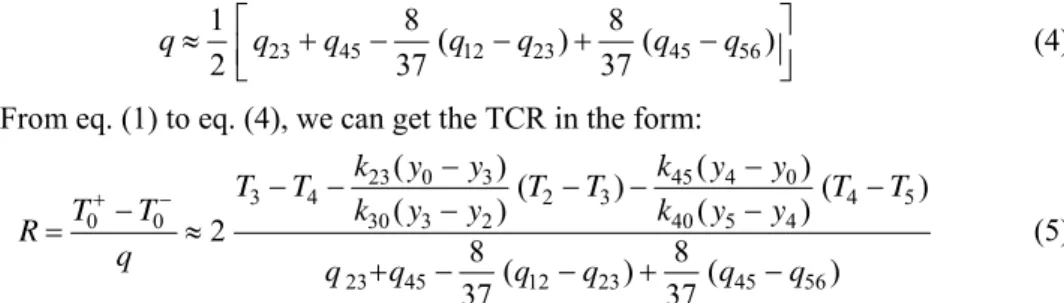
As the heat loss inevitably exists around the specimen, the calculated heat flow is not the same according to two adjacent temperatures. In order to correct for lateral heat losses, the arithmetic mean of the heat flow through the interface on both sides is considered as the axial heat flux of the interface, namely:
23 45 12 23 45 56
1 8 8
( ) ( )
2 37 37
q≈ ⎢⎡q +q − q −q + q −q ⎤⎥
⎣ ⎦ (4)
From eq. (1) to eq. (4), we can get the TCR in the form:
23 0 3 45 4 0
3 4 2 3 4 5
0 0 30 3 2 40 5 4
23 45 12 23 45 56
( ) ( )
( ) ( )
( ) ( )
2
8 8
( ) ( )
37 37
k y y k y y
T T T T T T
T T k y y k y y
R
q q q q q q q
+ −
− −
− − − − −
− − −
= ≈
+ − − + −
(5)
where the thermal conductivity of carbon-carbon composites in the axial direction is approx-imately taken as 70 W/m°C, of phenolic resin as 0.55 W/m°C, of aluminum as 239 W/m°C, and of cuprum as 395 W/m°C on the basis of the thermal conductivity tested previously.
Results
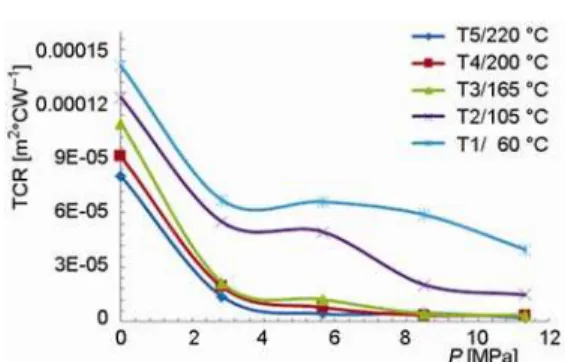
Carbon/carbon composite and phenolic resin are placed at 9I and 9II in fig. 1, re-spectively. The heat flux conducts from the carbon-carbon composite, through the contact in-terface, to the phenolic resin. The TCR can be calculated using eq. (5) after the measurement. Figure 3 shows that the TCR does not fluctuate much when interfacial temperatures range be-tween 50 °C and 250 °C, no matter what pressure is applied. In other words, the interfacial temperature does not influence the TCR significantly. However, the TCR decreases slowly as contact pressure increases.
However, as shown in fig. 4, the experiment on cuprum and aluminum with high thermal conductivities shows us different results. It can be found from fig. 4 that the TCR de-creases when temperature rises. The TCR tends to decline gradually with pressure inde-creases.
Zhao, Z., et al.: Effects of Pressure and Temperature on Thermal Contact … 1372 THERMAL SCIENCE, Year 2015, Vol. 19, No. 4, pp. 1369-1372
Figure 3. Variation of the TCR between phenolic resin and carbon-carbon with pressure
Figure 4. Variation of the TCR between cuprum and aluminum with pressure
Conclusions
This paper proposes a new experimental approach for measurements of the TCR on the basis of the Fourier thermal conductivity theory, and two groups of experiments of the TCR were performed. The results show that the TCR depends on not only the thermal con-ductivity coefficient of materials, but also interfacial temperature and pressure. However, its sensitivity is not the same; the TCR between cuprum and aluminum is more sensitive to pres-sure and temperature than that between phenolic resin and carbon-carbon composite.
Acknowledgment
This work is supported by the National Natural Sciences Foundation of China (Nos. 11472037 and 11272042).
Nomenclature
k – thermal conductivity, [Wm–1°C–1]
P – pressure, [MPa]
q – axial heat flux, [Wm–2]
R – thermal contact resistance, [m2°CW–1]
T – temperature, [°C]
y – co-ordinate, [m]
Subscripts
0– – interface of right specimen
0+ – interface of left specimen
References
[1] Li, W. J., et al., Nonlinear Analysis on Thermal Behavior of Charring Materials with Surface Ablation,
International Journal of Heat and Mass Transfer, 84 (2015), May, pp. 245-252
[2] Li, W. J., et al., Thermochemical Ablation of Carbon/Carbon Composites with Nonlinear Thermal
Con-ductivity, Thermal Science, 18 (2014), 5, pp. 1625-1629
[3] Huang, H. M., et al., Simulation of Co-Rotating Vortices Based on Compressible Vortex Method,
Inter-national Journal of Numerical Methods for Heat and Fluid Flow, 24 (2014), 6, pp. 1290-1300
[4] Chen, Z., et al., Thermal Contact Resistance between Grapheme and Silicon Dioxide, Applied Physics
Letters, 95 (2009), 16, pp. 161910.1-191910.3
[5] Huang, H. M., et al., Effect of Surface Morphology on Thermal Contact Resistance, Thermal Science, 15
(2011), Suppl. 1, pp. 33-38
[6] Akinyemi, O. D., et al., Effects of Heat Sink Compounds on Contact Resistance of Porous Media,
Ther-mal Science, 11 (2007), 4, pp. 113-124
[7] Heichal, Y., et al., Predicting Thermal Contact Resistance between Molten Metal Droplets and a Solid
Surface, Journal of Heat Transfer, 127 (2005), 11, pp. 1269-1276