FUNDAÇÃO GETÚLIO VARGAS
ESCOLA DE ADMINISTRAÇÃO DE EMPRESAS DE SÃO PAULO
AMAL NAIT HAMMOU
Performance of Incentive Contracts in Highway PPP Projects in Brazil
FUNDAÇÃO GETÚLIO VARGAS
ESCOLA DE ADMINISTRAÇÃO DE EMPRESAS DE SÃO PAULO
AMAL NAIT HAMMOU
Performance of Incentive Contracts in Highway PPP Projects in Brazil
SÃO PAULO 2014
Thesis presented to Escola de Administração de Empresas de São Paulo of Fundação Getúlio Vargas, as a requirement to obtain the title of Master in International Management
Knowledge field:
Public-Private Partnerships
Nait Hammou, Amal.
Performance of incentive contracts in highway PPP projects in Brazil / Amal Nait Hammou. - 2014.
112f.
Orientador: Julia Alice Sophia von Maltzan Pacheco
Dissertação (MPGI) - Escola de Administração de Empresas de São Paulo.
1. Parceria público-privada. 2. Setor privado - Brasil - Relações com o governo. 3. Contratos. 4. Rodovias - Brasil. I. Pacheco, Julia Alice Sophia Von Maltzan. II. Dissertação (MPGI) - Escola de Administração de Empresas de São Paulo. III. Título.
AMAL NAIT HAMMOU
Performance of Incentive Contracts in Highway PPP Projects in Brazil
Thesis presented to Escola de Administração de Empresas de São Paulo of Fundação Getúlio Vargas, as a requirement to obtain the title of Master in International Management
Knowledge Field:
Public-Private Partnerships
Aproval Date 15/07/2014.
Banca Examinadora:
_________________________________
Prof. Dr. JULIA ALICE SOPHIA VON MALTZAN PACHECO (ORIENTADOR)
_________________________________ Prof. Dr. SERGIO GOLDBAUM
ABSTRACT
Private-Public Partnerships (P.P.P.) is a new contractual model institutionalized in 2004 that could be used to remedy to the infrastructure deficit in Brazil. In a context of a principal and agent relation, the public partner goal is to give incentives to the private partner in the contract so that their interests are aligned. This qualitative research presents the findings of an empirical study examining the performance of incentive PPP contracts in Brazil in the highway sector. The goal is to explain how the contracting parties can align their interests in an environment of asymmetric information. Literature identified the factors that can influence PPP design and efficient incentive contracts. The study assesses the contribution of these factors in the design of PPP contracts by focusing on the case of the first and only PPP signed in the highway sector in Brazil which is the MG-050. The first step is to describe the condition of the highway network and the level of compliance of the private partner with the contract PPP MG-050. The second step is to explain the performance of the private partner and conclude if the interests of both partners were aligned in contractual aspects. On the basis of these findings and the analysis of the contract, the study formulates suggestions to improve the draft of PPP contracts from the perspective of the incentive theory of contracts.
RESUMO
A parceria público-privada é um novo modelo contratual institucionalizado em 2004 que pode ser usado para remediar o déficit em infra-estrutura no Brasil. No contexto de uma relação principal-agente, o objetivo do parceiro público é dar incentivos contratuais ao parceiro privado para que os interesses de ambossejam alinhados. Essa pesquisa qualitativa apresenta os resultados de um estudo empírico que examina o desempenho dos contratos de PPPS com incentivos no Brasil no setor das rodovias. O objetivo é explicar como os contratados podem alinhar seus interesses num ambiente de informação assimétrica. Literatura identificou os fatores que podem influenciar o desenho das PPPs e dos contratos com incentivos eficientes. Esse estudo avalia a contribuição desses fatores no desenho dos contratos de PPPs focando no caso do primeiro e único contrato PPP assinado no setor de rodovias no Brasil, o PPP MG-050. O primeiro passo é descrever a condição da rede de rodovias no Brasil e o nível de cumprimento do parceiro privado com o contrato PPP MG-050. O segundo passo é explicar o desempenho do parceiro privado e concluir se os interesses dos dois parceiros foram alinhados em aspectos contratuais.Com base nesses resultados e na análise do contrato, o estudo formula sugestões para melhorar o desenho dos contratos de PPPs apoiando-se na teoria dos incentivos em contratos.
Table of Content
Chapter 1. Introduction ... 13
1.1. Benefits of Investments in Transport Infrastructure ... 13
1.2. Definition of PPPs ... 14
1.3. History of PPPs ... 16
1.4. Definition of PPP Framework in Brazil ... 18
1.5 History of Brazilian PPPs in Highways ... 20
1.6. Objectives of the Study ... 25
Chapter 2. Literature Review: Key Success Factors for PPP Planning ... 28
2.1. Definition of Interests for the Contractual Parties... 29
2.2. Risk Management ... 33
2.2.1 Moral Hazard Risk ... 33
2.2.2. Credit Risk ... 39
2.2.3 Relationship Risk ... 40
2.2.4. Contract Risk ... 42
Conclusion of the Literature Review ... 43
Chap 3. Methodology ... 44
3.1. Participants ... 44
3.2. Research Design: Procedures ... 45
3.3. Data Analysis ... 48
Chapter 4. Empirical Data: Factors Impacting Highway Management in Brazil ... 50
4.1. Operational Conditions of the Highway Network in Brazil ... 50
4.2. Causes of the Operational Conditions of the Highway Network in Brazil ... 54
Chapter 5. Case Study Presentation: the PPP MG-050 ... 61
5. PPP Environment ... 61
5.1. Governance of PPPs in the State of Minas Gerais ... 61
5.2. MG-050 Basic Data ... 64
Chapter 6. Case Study Analysis: The Incentive Level of the Contract PPP MG-050 ... 72
6.1. Overview of the Incentive Structure ... 72
6.2. Application of the Theoretical Framework to the Main Contractual Responsibilities of the SPV ... 82
6.3. Reasons for Misaligned Incentives ... 88
6.4. Recommendations ... 92
Conclusion ... 97
References ... 99
Acknowledgements
Glossary
P.P.P: Public-Private Partnerships
MG-050: the name of the PPP project based on the name of the highway that is located in the state of Minas Gerais (MG)
C.P: Contrasprestação Pecuniária in Portuguese stands for the subsidy paid by the public partner to the private partner)
Q.I.D: Quadro de Indicadores de Desempenho in Portuguese stands for the table of Performance Indicators that the private partner needs to comply with to receive the subsidy
S.P.V: Special Purpose Vehicle stands for the legal structure of the private partner
List of Figures and Tables
Figure 1.1: PPPs Classification Based on Risk Level………...15
Figure 1.2: Maturity Curve of Some Countries in PPP Development………..18
Figure 1.3: Share of the Highway Network in the Transportation Matrix in Brazil….21 Figure 1.4: Share of Paved and Non-Paved Road Network in the Brazilian Network.22 Figure 1.5: The Three Phases of the Federal Highway Concession Program in Brazil (1995-2012)………...24
Figure 1.6: Main Phases of a PPP Project……….26
Table 2.1: The Multidisciplinary Aspects of PPPs………...28
Figure 2.2: Investment in Infrastructure Based on the Percentage of GDP in 2008….30 Table 2.3: Evolution of Infrastructure Investment in Brazil from 1970 to 2012 (% GDP)………...31
Table 2.4: The Evolution of Highway Length Extension (1960-2010)………31
Figure 2.5: Two Types of Tendering Models………...36
Figure 2.6: The Typical Approval Process and Stakeholders for a PPP at the State Level……….41
Table 3.1: PPP Highway Projects Announced by the Ministry of Transportation...45
Table 3.2: Data Description………..47
Figure 4.1: Map of the Highway System in Brazil...51
Figure 4.2: Comparison of Highway Densities in the State of Sao Paulo in Brazil, California, France, Spain and Germany in 2011...52
Figure 4.3: Comparison of Fatal Accidents on the Highway in Brazil, the Union European and the U.S.A...53
Figure 4.4: Comparison of Investment on Highways Based on Percentage of GDP in Brazil, China and the US...54
Figure 4.5: Ongoing Highway Investment in Brazil in 2012...55
Figure 4.6: Map Illustrating the Potential Regions for PPPs and Private Concession Use ...57
Figure 4.7: Highway Quality Assessment Over Time...58
Table 4.8: Current Situation of the Brazilian Highway Network and Impact on Contractual Parties of PPPs ...59
Figure 5.1: Overview of the Approval Process for the PPP MG-050...63
Figure 5.2: The Three Main Groups of Stakeholders of the PPP...64
Figure 5.3: Map of the Drawing of the Highway MG-050...66
Table 5.4: Main Components of the Revenue of the SPV...68
Table 5.5: Total Number and Value of Delayed Works and Works with Defaults...68
Figure 5.6: Average QID Grade for the SPV from Year 3 to Year 7...69
Figure 5.7: Total Number of Accidents in the MG-050 from 2003 to 2013...70
Figure 5.8: Annual Revenue of the SPV (in million of R$)...71
Figure 6.1: Description of the Payment Mechanism of the CP...74
Figure 6.2: Composition of the Final QID Grade...75
Figure 6.3: Operational Indicators of the QID...76
Figure 6.4: Environmental Indicators of the QID...77
Figure 6.5: Financial Indicators of the QID...79
13
Chapter 1. Introduction
"Public-Private Partnerships are not supposed to cure the weaknesses of the Brazilian public sector. If efficiently designed and implemented, they are rather the opportunity to significantly contribute in reducing the infrastructure gap of the country." (Bacha, 2013; p.9)
1.1. Benefits of Investments in Transport Infrastructure
All nations share the same need to construct, repair and, modernize their infrastructure. Infrastructure investment initiatives are more urgent in developing countries that lack basic services (Levy, 1996). Improving infrastructure facilities yields economic gains by increasing economic growth, human welfare and competitiveness of the country. Inequality does not only decline with a larger stock of infrastructure, but also with improved quality (World Bank Toolkit, 2009).
Investment in transportation holds economic, environmental and social benefits for a series of stakeholders. Theory shows that countries with a high level of transportation investment reduce travel time and cost for users on top of increasing reliability and connectivity. This increased productivity and efficiency in market access are benefits for the business community. The consequent economic growth is then captured by users, taxpayers, business and public authorities (Zhang, 2006).
Infrastructure investment spending in the world in the 2000’s accounted for 3,26 % of the GDP at Purchasing Power Parity while researchers estimate that this proportion should be of 4,5% of the world GDP. In terms of sectors, telecommunications is the sector that receives the most investment. While transportation and energy are increasing their shares worldwide investment in water is decreasing. Within the transportation sector, the highways segment is leading with a 0,38 % share of the world GDP (PPI, 2013).
Due to the difficulty to exclude non-payers to use the infrastructure service1, the public sector has historically been in charge of providing and financing infrastructure investment because it is associated with positive externalities2. The democratic ideal also
1
It is referred to the so-called free rider problem.
14 urges governments to provide citizens with infrastructure even for the population that cannot afford it (World Bank Toolkit, 2009).
Until the nineties, public investment and privatization were the instruments most used to finance infrastructure investment. However, since 1995, the emergence of hybrid institutional arrangements called the Public-Private Partnerships (PPP) 3 has occurred impacting cooperation frameworks between public and private players (World Bank Toolkit, 2009).
1.2. Definition of PPPs
Three major options for infrastructure provision exist: direct public provision, contracting-out and public-private partnerships. PPPs are becoming tools increasingly used by governments with budget constraints to faster meet the needs of infrastructure development (Hodge, 2004). The PPP emergence reflected the private economic interest to provide services that were traditionally fulfilled by the public sector.4 From 1990 to 2012, the worldwide number of infrastructure projects with private participation in water and sewage, transportation, telecom and energy sectors5 increased yearly by 5% to reach an accumulated of more than 2.400 projects (Private Participation in Infrastructure Data Base, 2013).
Despite their continuous popularity around the world, PPPs remain a vague notion because they cover a diversity of contracts, governance arrangements and operations (Asian Development Bank, 2000; AusCID, 2003; European Commission, 2003). Internationally, the term PPP refers to a broad concept including several types of structures. Besides, according to the World Bank Toolkit (2009), other terms are internationally used to describe the partnership between the public and the private sectors such as PFI (Private Finance Initiative), PPI (Private Participation in Infrastructure) or PSP (Private Sector Participation).
Considering the lack of consensus on the concept definition, PPPs can be defined based on two trends: PPPs can be considered new governance tools or rhetoric tools (Teisman and Klijn, 2002).
On the one hand, when considered as governance tools, PPPs are institutional arrangements with three basic characteristics: “long-term orientation”6, “significant
risk-sharing” and “cooperation resulting in a joint-production”. The definition of PPP coined by Van Han Ham and Koppenjan (2001) reflects these three criteria: “cooperation of some sort of durability between public and private actors in which they jointly develop products and
3
For future references to the term Public-Private Partnership, the abbreviation PPP will be used.
4
The reasons of this increasing interest are detailed in section 1.3.
5
Sectors where public sector investment is relatively dominant compared to the private participation.
6
15 services and share risks, costs and resources which are connected with these products” (p. 598). This first definition captures the collaborative nature of PPPs and differentiates them from contractual arrangements such as contracting-out.7
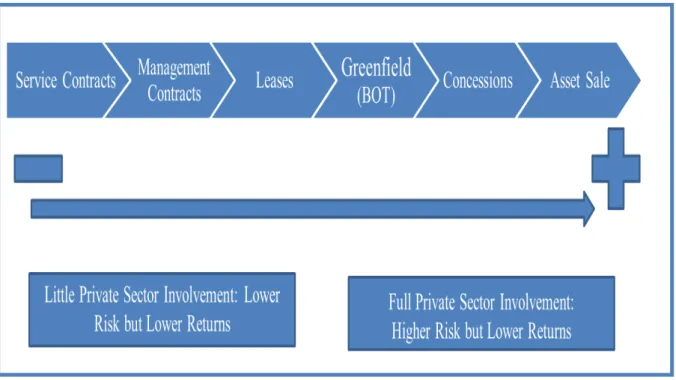
According to Akitoby et al. (2007), PPPs classification is based on the level of risk sharing between the public and private partners. Before a public partner chooses a specific contract of partnership for a given project, it is expected to perform a pre-analysis of the desirable and feasible level of risk transfer. As Figure 1.1 illustrates, a PPP can take the format of service contracts, management contracts, leases, Build-Operate-Transfer (BOT) contracts and concessions. The selection of a specific type of contract is based on the level of risk transfer between the two partners. Moreover, the sector of the project plays a role in the selection of a specific contract.
Figure 1.1: PPPs Classification Based on Risk Level
Source: Akitoby et al. (2007)
On the other hand, others scholars view PPPs as a language game emphasizing that PPP can be a misleading term. Under the rhetorical approach, PPP multiple meanings hide implicit strategies and purposes of the partnership members (Linder, 1999). In this line of reasoning, Hodge (2004) states that: “It seems fair to say that a number of governments have tried to avoid using the terms privatization and contracting out to speak instead of partnerships. That may be part of a general trend within public management of needing to renew the buzzwords from time to time (…)”(p. 547).
7
16 For the purpose of this research, considering PPPs as governance tools, the PPP will be defined based on the De Clerck et al.8 (2012) definition: “A PPP is a settlement between a public party and a private sector company to engage in a long-term contractual arrangement for designing, building and operating capital-intensive projects while trying to attain value for money by the appropriate allocation of risks”(p.247).Value for money is an essential concept coined and used by PPP literature to justify the existence and use of this specific contractual method. In brief, value for money refers to the state when value is created for all stakeholders of the PPP meaning public and private partners, users and citizens (Colman, 2000; Akintoye et al., 2003; Morallos et al., 2008; Yuan et al., 2009).
1.3. History of PPPs
History indicates that there always has been some degree of cooperation between the public and the private sector. Civilizations have adopted early cooperative forms of partnerships between public and private players in the world (Wettenhall, 2003). However, the sudden rise and institutionalization of these partnerships took place in the nineties. In fact, in a context of surveillance of public expenditures, a conjunction of three factors triggered the development of PPPs: (i) the public deficit, (ii) the value-added created by PPPs and (iii) the rise of collaborative frameworks worldwide (Koppenjan, 2005).
(i) The PPP arrangement first started in 1992 in the UK, this being the most experienced PPP market. The early nineties is considered the period where the PPP term got a buzzword status. The main argument that pushed OECD governments to choose the PPP route in infrastructure development was the conversion of up-front fixed costs into a stream of future obligations (Bovaird, 2004). It is called the off-balance sheet treatment. The expression was coined because the capital invested by the government does not entirely appear on its account as one liability. Instead, the amount of the debt is split in different streams. With the off-balance sheet treatment, PPP can be seen as a mega credit card for governments (Hodge, 2004).
(ii) With the risk of accentuating possible fiscal crises, this accounting benefit was reduced and PPPs were treated more and more as a case of optimal risk allocation in public infrastructure projects. Indeed, PPPs were seen as a way to guarantee a risk allocation to the party that is more able to manage it. With the right mix of risk sharing between public and private partners, the product and service should be delivered with quality, securing then the “value for money” for the public sector (Colman, 2000; Akintoye et al., 2003; Morallos et al., 2008; Yuan et al., 2009).
8
17 PPPs have been used to reach the goal of obtaining greater value for money, which is materialized by the lowest life-cycle cost9 (Akintoye et Al, 2003; Zhang, 2006). In brief, instead of a public investment, PPPs were presented as a great deal for the taxpayer thanks to four factors: a) construction and operation are centralized in one contract, b) temporary transfer of the assets to the private partner, c) risk-sharing with the private partner during all contract life and d) private financing. These factors make the private partner accountable and may result in a lower life-cycle cost (Brinkerhoff and Brinkerhoff, 2004; Sedjari, 2004).
(iii) In the nineties, with the advent of “network” societies10, interdependencies between public and private sectors were increased and deepened. During globalization, people and institutions collaborated to create networks of knowledge. In this context, partnerships were increasingly used to share knowledge (Castells, 1993).
After their start in the OECD countries, PPPs then proliferated in emerging countries. In emerging economies, after the privatization period of the nineties, governments were striving to attract foreign investment and the building of quality infrastructure emerged as a top requirement. With limited budget capacity, governments considered the use of PPPs to reduce the infrastructure gap. Budgetary conditions were the first factor that dynamized the PPP use in these countries (World Bank Toolkit, 2009).
Despite their popularity, the participation of PPPs11 in the total global infrastructure investment is low. It is only of 5,26% in 2011, against 7,36% in 2010. This decrease is continuous since the global economic crisis of 1997 where PPP infrastructure investment peaked (USD 180 bn). The low participation of PPPs at the global scale is due to the fact that the public sector remains the major investor in a lot of countries (PFI, 2013).
Yet, PPPs may have a more significant role than it appears in the global figures. These statistics are aggregated and it therefore underestimates the higher growth rate of PPPs in developing countries some of which face an explosive construction of infrastructure. Thanks to the increase of the revenue per capita and the improvement in education and access to information, society will demand better infrastructure. Moreover, PPP potential may also be soon materialized in a case in which public investment will be more limited due to fiscal restrictions and difficulty in terms of management capability of complex infrastructure projects (World Bank Toolkit, 2009).
Concerning Latin American concessions, the region has shown dynamism thanks to the leadership of Chile and Brazil. According to the Private Participation in Infrastructure
9
Lowest life cycle cost implies that infrastructure costs need to be calculated over their entire life spans and not limited to up-front costs.
10
In “network” societies, these interdependencies reduced hierarchical relationships in favor of more horizontal ones (Castells, 1993).
11
18 database (2013), from 1990 to 2012, infrastructure projects with private participation12 amounted close to USD 770 bn about 38% of worldwide value.13 Within the Latin America region, Brazil is the leader both in project value and number. Worldwide, Brazil is ranked in the top three of countries with the highest project numbers with private participation, only after China and India. Moreover, Brazil is the leader in terms of project value in the world in 2011.
1.4. Definition of PPP Framework in Brazil
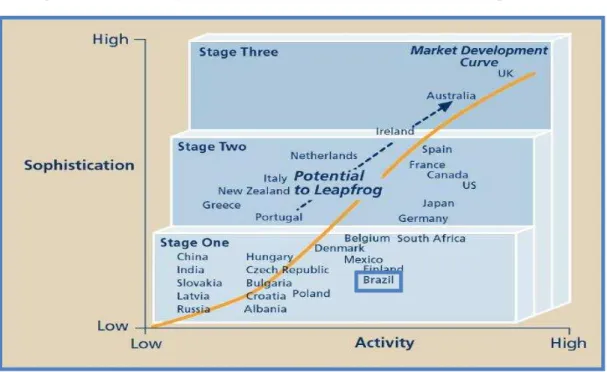
Compared to the other OECD countries with a mature experience in PPP development, the sophistication degree of PPPs in Brazil is low (UNECE, 2008). As Figure 1.2 below illustrates, although the country has developed a significant number of projects, the sophistication level of PPP framework is low related to the number of projects undertaken. Low sophistication means that in Brazil, market foundations are under construction and that regulation frameworks need to be further developed.
Figure 1.2: Maturity Curve of Some Countries in PPP Development
Source: UNECE (2008)
12
These figures do not refer to PPP but all types of investment with private participation such as PPPs, concessions or private works.
13
19 In 2004, PPPs in Brazil have become part of the legal agenda with the improvement of PPP enabling laws. The Federal Law No 11.079/04 innovated to permit the creation of not commercially-feasible PPPs that have significant social returns.14 Based on this Federal Law, a PPP minimum contract value is R$ 20 million, and the length of contract needs to be framed between 5 to 35 years and the subsidy paid to the private partner is limited to R$ 35 million per year (Ministry of Transportation, 2012).
The Law No 11.079/04 was later amended in 2012 by Law No 12.766/12. This amendment brought three new modifications. Firstly, the mechanism of fund allocation was created that enables the private partner to receive the subsidy from the public partner during the phase of construction of the physical asset. Secondly, the scope of the Federal General Fund of Guarantees that gives financial guarantees to the private partner for the payment of the subsidy was extended to the state and municipal level. Thirdly, engineering studies must be carried out before the tendering procedure to define the value of the PPP investment expected from the private partners (Ministry of Planning, 2013).
According to Federal Law No 11.079/0415, in Brazil, PPPs are defined as a type of concession (Ministry of Planning, 2013). The country allows four types of concessions:
- Administrative concessions: public partner makes periodic payments to the private partner for the services provided because it is not possible to charge users16. The project is wholly subsidized by the public partner;
- Sponsored concessions: private partner charges users and receives periodic payments from the government for the services provided17. Public partner only subsidizes the part of the project that is not covered by user fees;
- Traditional concessions based on the Law No 8.987/9518: these are concessions where public services are delegated to the private partner whose revenues come from the user fees. There is no payment from the public partner to the private partner in the form of a subsidy.
PPPs are defined either as administrative or sponsored concessions.
14
Meaning positive externalities
15
Chapter 1 of the Law is detailed in Appendix 1.
16 Common in waste management and prison 17
Common for low-traffic highways for example
20 In this text, PPPs in Brazil will be defined as governance instrument mechanisms19 and stricto sensu based on the terms of the Federal Law No 11.079/0420. The term PPP will only be applied to describe sponsored or administrative concessions. Since the use of the PPP concept is restricted to these legal terms, political manipulation of the term described by Hodge (2004) can be if not entirely avoided, clearly circumscribed.
1.5 History of Brazilian PPPs in Highways
The dynamics of low investment capital and flows in Brazil resulted in an inefficient and poor transport infrastructure system (Guash, 2004). In 2013, it was estimated that 3.4 % of the GDP or R$ 125 bn should be invested to maintain and extend the current transport network. It is equivalent to more than half of the service of the national public debt in 2012 (IPEA, 2013). The context of preparation of the 2014 World Cup21 and the 2016 Olympic Games increased the need of transportation investment.22
The issue of the infrastructure deficit in Brazil has been on the top of the political agenda with the improvement of the regulatory framework23 and a series of communications about investment initiatives. In 2007, the Growth Acceleration Program24 was announced to improve the infrastructure level of the country. The PAC initiative was launched by President Lula and followed by President Dilma Rousseff under the name of PAC 2 (Ribeiro and Prado, 2007).
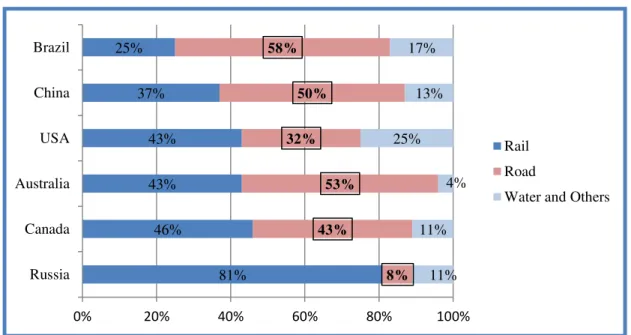
Compared to countries with similar size, Brazil is a country where the road is the most dominant mode of transportation. Figure 1.3 depicts the transportation matrix in Brazil and
19
Based on De Clerck et al. (2012) definition: “A PPP is a settlement between a public party and a private sector company to engage in a long-term contractual arrangement for designing, building and operating capital-intensive projects while trying to attain value for money by the appropriate allocation of risks” (p.247) as previously presented in 1.1.
20 A PPP contract value is of R$ 20 million minimum and the length is limited between 5 to 35 years as
previously observed.
21
World Cup will take place in July 2014.
22
One of the central topics of the series of demonstrations that faced the Brazilian government in June 2013 was the low quality of the state infrastructure provision.
23 The 2004 PPP Federal Law 11.079/04 was amended in 2012 as previously detailed in 1.4. 24
21 five others countries with similar territory size. In Brazil, roads amount to about two thirds of total transportation infrastructure modes. With the PAC program, the goal of the government is to rebalance the transportation matrix by further developing the railway network and waterborne transportation systems25 (Ministry of Transportation, 2012).
Figure 1.3: Share of the Highway Network in the Transportation Matrix in Brazil
Source: Ministry of Transportation (2012)
In this text, highways will be differentiated from roads. Based on the definition of the Brazilian Código de Trânsito (1997), a highway is a paved road.
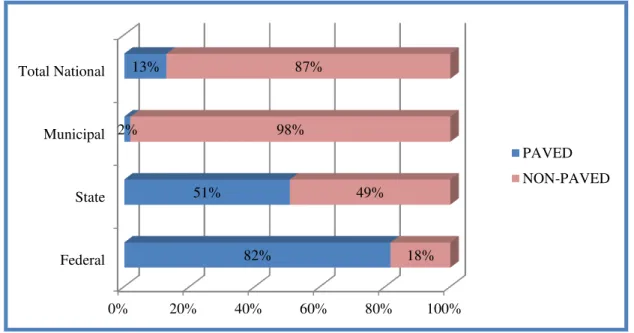
Investment in highways within the PAC firstly targets the rehabilitation of the existing network and then its extension. The focus on network rehabilitation is due to the state of deterioration of the highway network in Brazil. As Figure 1.4 thereafter shows, most of the road network is non-paved26 (Ministry of Transportation, 2012).
Brazil already has one of the widest highway networks under concession among developing countries with a total length of 12,000 km27. PAC plans to target 58.500 km of highways: 53,585 km are existing highways and will be maintained, 2,989 km of new
25 The expected results to this progressive shift from road to railway and water modes are gains in
economic and energy efficiency.
26
The largest share of the unpaved network is the responsibility of the municipal level.
27
Brazil is just second to China. 81% 46% 43% 43% 37% 25% 8% 43% 53% 32% 50% 58% 11% 11% 4% 25% 13% 17%
0% 20% 40% 60% 80% 100%
Russia Canada Australia USA China Brazil Rail Road
22 highways will be constructed and 1,926 km of existing highways will be expanded (Ministry of Transportation, 2012).
Figure 1.4: Share of Paved and Non-Paved Road Network in the Brazilian Network
Source: Ministry of Transportation (2012)
After decades of low investment, better economic conditions28 in Brazil favored partnerships between the public and private sector to rehabilitate the highway network (Ribeiro and Prado, 2007). Before 1995, private parties, mostly engineering firms, built highways but operation and maintenance operations were managed by the public sector. In 1995, the first phase of the Federal Highway Concession Program started with the award of six highway concessions29. In 2007 and 2012, the second30 and third31phases of the Federal Highway Program were launched. The program of concessions for Federal Highways has steadily increased the network under private management from 1,428 km to 6,240 km (i.e. a multiplication by 4). The three phases span a process where private participation in
28 From 2000 to 2013, the GDP per capita in Brazil increased from USD 3,694 in 2000 to USD 11,340
in 2012 in nominal terms.
29 Phase 1:program was launched in the states of Rio Grande do Sul, São Paulo and Rio de Janeiro 30
Phase 2: program was deployed in the states of Bahia, Minas Gerais, Rio de Janeiro, São Paulo, Parana and Santa Catarina
31
Phase 3: program was deployed in the states of Minas Gerais, Espirito Santo, Goais, Distrito Federal and Santa Catarina
0% 20% 40% 60% 80% 100%
Federal State Municipal Total National
82% 51%
2% 13%
18% 49%
98% 87%
24 Figure 1.5: The Three Phases of the Federal Highway Concession Program in Brazi (1995-2012)
Source: Ministry of Transportation (2013)
Although the government is increasingly transferring responsibility to run highways to the private sector, less than a quarter of the total road network (16%32) is financially feasible for private concession due to a low traffic volume and/or low GDP per capita of the potential users to afford toll payment. Therefore, the major part of the Brazilian road and highway network requires the payment of subsidies to enable private parties’ participation (Bain, 2013), and therefore are, under Brazilian law potential PPPs.
32
25
1.6. Objectives of the Study
Brazil needs infrastructure in transportation especially in the highway sector that is the main mode of transportation for goods and passengers (Ministry of Transportation) The problem is that for highways, the main part of the network is not financially feasible for exclusive private players, thus investment needs public funding (Bain, 2013).
There is thus an increasing need and potential for partnerships between the public and the private partner. PPPs, which law (No 11.079/04) passed in 2004, established one of the contractual forms possible. Yet, in reality, after a decade of law enactment, only few PPPs have been used. Since 2004, only 35 PPP contracts have been registered to be under project with all at the state level except 1 at the federal level. Concerning the highway sector, only one PPP project became reality with its contract signed in Brazil: the PPP contract for the exploitation of the highway Minas Gerais 050 (MG-050) (Ministry of Transportation, 2012).
By signing a PPP contract, public and private partners may intend to align their interests. However, there are conditions where interests might not be aligned between the two contracting parties. In fact, the context is one of a relationship between one principal (the public partner) and an agent (the private partner). PPP arrangement can be subject to the typical agency problem. The principal relies on an agent to work or provide services for the interests of the principal. In case where it is difficult to watch the results of the private partner, the private partner can be tempted to work for their own interests rather than for the public partner. Therefore, the research question is how the contracting parties in a PPP can align their interests (Milgrom and Roberts, 1992).
The first approach to the research question is descriptive. The condition of the highway network in Brazil will be described because it has an impact on the design of PPP incentive contracts. The PPP MG-050 is currently the only one signed in the highway sector in Brazil. Data about this first PPP will be presented to describe the level of compliance to the contract of the private partner.
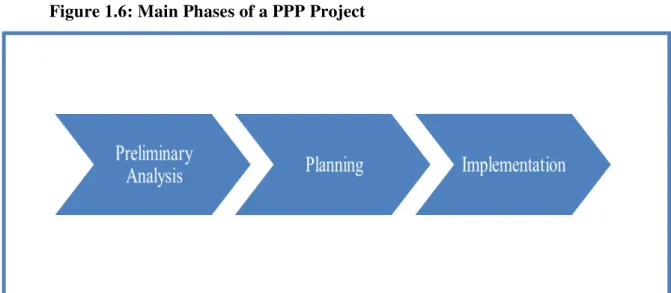
The second approach to the research question is analytical. Literature review about PPP efficient design will identify the principles that design efficient contracts. On the basis of these theoretical foundations, the contract PPP MG-050 will be analyzed to make explicit the embedded incentives. Eventually, the study formulates suggestions to improve the design of the contract from the perspective of the theory of incentive contracts.
26 Figure 1.6: Main Phases of a PPP Project
Source: The author based on Koppenjan (2005)
Firstly, this study aims at addressing the current lack of relevant study in PPP incentive contracts in Brazil. There is still little understanding about how partners should deal with the problems of implementation and risk management in PPPs (Koppenjan, 2005).
Secondly, since the PPP Federal law (No 11.079/04) has been applied in few cases33, institutions that need to accompany this new contractual type has not gained enough experience. This study will contribute to describe the level of maturity of institutions that should support PPP development (Yuan et al., 2009).
Thirdly, the PPP topic is very political because governments may be under pressure of users and taxpayers to renegotiate contracts (Hirschman, 1970). This study will adopt a fact-based view and attempt to stay away from the political interferences of such topic but remain aware of moral hazard implications in the contract.
Regarding limitations, the scope of the study will only include the agent-principal relationship between the public and private partner. The relation between the public partner and the user/taxpayer will be ignored. The perspective adopted is that the public partner has the ultimate responsibility for providing the service and act benevolently34. Given the fact that the state of public finances does not allow such role, a possible alternative to the public partner is to attract private player investment. This allows the focus on the agency problem between the public partner and the private partner.
33
Since 2004, only 34 PPP projects are under project at the state level and 1 at the federal level (Ministry of Planning, 2013).
34
27 Moreover, the study is limited to the examination of contractual incentives in terms of the economic theory of incentives adopting a qualitative perspective and not a quantitative approach.
28
Chapter 2. Literature Review: Key Success Factors for PPP
Planning
“Infrastructure projects in emerging countries require significant financing from the private partner resulting in partnerships more complex and with more risks. These particular characteristics of emerging markets such as Brazil imply significant challenges for the PPP design” (Oliveira et al., 2013).
There is a significant scarcity of data, information and academic papers about the Brazilian experience of PPP contracts. Oliveira et al., (2013) explain that this lack of research is due to the fact that there are not significant number35 of PPP contracts in Brazil either at the state or the federal level. Given the lack of knowledge of this new contractual model and the potential use of private resources in infrastructure projects, Ribeiro and Prado (2007) state that PPPs in Brazil will raise the interests of researchers.
The fact that PPPs are a complex topic explains that the little available literature is scattered covering specific fields of PPPs. As Table 2.1 below shows, the literature on PPPs is mainly divided into six different research fields. Each research field has various impacts on risks and incentives of each contractual party. Hodge (2004) points that this multidisciplinary character of PPPs may be one of the major challenges to improve their contract application. Indeed, both public and private partners need to evaluate the impact of this multitude of fields on contract elaboration.
Table 2.1: The Multidisciplinary Aspects of PPPs
FIELD EXAMPLE OF IMPACT
LAW Contractual theory defines the obligations of each party.
ACCOUNTING A project must meet certain conditions in order to allow the government to remove it from its balance sheet.
ECONOMY The impact of PPPs on the welfare of the society and its social marginal cost can be taken into consideration.
ENGINEERING Feasibility studies are essential to estimate project cost.
PROJECT
MANAGEMENT
The definition of adequate planning of the project is essential to design risk-coping strategies.
FINANCE Raising equity capital and debt finance can be mandatory to make the investment viable for both partners.
35
29 Source: The author based on Hodge (2004)
As seen, the research question is how the contracting parties in a PPP can align their interests. As previously seen, the elaboration of a PPP contract happens during the planning phase of a project but incentives should be aligned during the whole life cycle of the project36 (Koppenjan, 2005; World Bank Toolkit, 2009; Veron and Cellier, 2010).
Authors have shown that the interests of the contractual parties should be clearly defined for both parties so that the goal of the contract is clearly identified and can be associated to measurable tasks and strong incentives (Koppenjan, 2005; World Bank Toolkit, 2009; Veron and Cellier, 2010).The first part of this literature review reviews the interests of the principal and agent in elaborating a PPP contract.
The majority of scholars show that PPP contracts should be designed to include an optimal risk-sharing scheme meaning that risks should be allocated to the best party capable of handling them (Guash, 2004; De Clerck et al., 2012; Frishtak, 2013; Mattos, 2013). For any project, risk management is a tremendous task but it is all the more complex with PPPs due to the addition of the complexity of the arrangement itself. The second part of this literature review will expose the main risks weighing in the contractual parties that are largely described in literature since they should be managed in any PPP contract. The economic theory of incentive contracts will also be described to show how the principal can give incentives to the agent in a context of high risk.
2.1. Definition of Interests for the Contractual Parties
As seen in Chapter 1, poor infrastructure is one of the factors reducing the competitiveness of Brazil in international trade and investment attractiveness (World Bank Toolkit, 2009). In the Global Competitiveness Report (GCR) of 2012, out of the 144 countries analyzed, Brazil was ranked 107nd in the quality of its infrastructure. The low performance was reported especially in terms of transport logistics where Brazil ranked 100th on railroads, 123rd on highways, 134th on airports and 125th on ports. In contrast, the country is placed 48th for the total index competitiveness and 52nd in revenue per capita. These results show that Brazil does not have a sufficient development level of infrastructure compared to its level of development and reflects the lack of priority for this type of investment (World Economic Forum, 2012).
The lack of infrastructure investment and the bad quality of the infrastructure are the top problem for private companies in Brazil. It was the first time that the issue of infrastructure surpassed the problem of high taxation (World Economic Forum, 2012).
36
30 According to Oliveira et al., (2013), Brazilian governments have abandoned the country’s infrastructure showing very low levels of investment flows. For example, compared to the group of emerging countries shown in Figure 2.2 below, Brazil had the lowest share of infrastructure investment in 200837 (2,03%), which represents about one third of the proportion of other countries such as Chile or Colombia (Frischtak, 2008).
Figure 2.2: Investment in Infrastructure Based on the Percentage of GDP in 2008
Source: Frischtak (2008)
This situation of low investment is explained by the decline of the investment in infrastructure in Brazil stemming from the low investment levels since the eighties (Oliveira et al., 2013). As Table 2.3 below shows, the percentage of GDP investment has steadily decreased each decade starting from 5,42% for the period 1970 to 1980 and ending at 2,32% for the decade from 2000 to 2010.
37
This investment level was registered in 2008, i.e, before the announcement of the PAC.
Thailand Vietnam China Chile Colombia India Philippines Brazil
15,40% 9,90%
7,30% 6,20% 5,80% 5,63% 3,60%
31 Table 2.3: Evolution of Infrastructure Investment in Brazil from 1970 to 2012 (% GDP)
1970-1980 1981-1989 1990-2000 2000-2010 2011-2012
Electricity 2,13% 1,47% 0,76% 0,67% 0,59%
Telecoms 0,80% 0,43% 0,73% 0,65% 0,50%
Transportation 2,03% 1,48% 0,63% 0,71% 0,75%
Water 0,46% 0,24% 0,15% 0,29% 0,17%
Total 5,42% 3,62% 2,27% 2,32% 2,01%
Source: The author based on World Economic Forum (2013)
As Table 2.3 shows, the decrease of investment levels has affected all sectors (World Economic Forum, 2013). The federal highway network is a typical sector that suffered from a lack of investment (Mattos, 2013). The precarious situation of the highway infrastructure is reflected when compared to the average of some Latin American countries. Only 13% of the Brazilian roads are highways against an average of 29% in Latin America (Mattos, 2013) (Pinheiro, 2013; Almeida, 2013).
The precarious state of the Brazilian infrastructure is due to the increase of the demand for these services. The high demand was not compensated by a corresponding supply and created thus a higher congestion and deterioration of the quality of services (Pinheiro, 2013). For example, the traffic in highways increased by 14,6% between 2006 and 2011 and this increases causes the saturation of highways, facing slow investments (Mattos, 2013).
As shown in Table 2.4, the proportion GDP/km of highways highly increased from 1960 to 1980 but was drastically reduced from 1980 to 2000. These figures about the extension of the network underestimate the saturation of highways during this period. Indeed, due to the fact that highways were built two or three decades ago, technology age is increasing which decreases the average speed and traffic capacity (Mattos, 2013).
Table 2.4: The Evolution of Highway Length Extension (1960-2010)
Time Frame Proportion GDP/km of Highways (km/year)
1960-1980 8,7 to 47,5 km (1900 km/year)
1980-2000 47,5 to 56,1 km (430km/year)
2000-2010 56,1 to 62,0 km (587 km/year)
32 To explain the situation of infrastructure supply in Brazil, Oliveira & al., (2013) show that every government has limited fiscal resources and need to make trade-offs. They show that in Brazil, infrastructure has just not emerged as a priority relatively to other types of spending. From 1970 to 1980, the investment rate in infrastructure was around 5% of GDP (cf Table 2.4), but it was then reduced because of the pressure on fiscal spending. Faced with the threat of huge deficits, governments preferred to cut infrastructure investment and increase current spending (World Bank Toolkit, 2009). In fact, the public consumption started to increase from 1985: from 1947 to 1985, it was on average of 10,8 % of the GDP and it increased to 21 % from 1985 to 1995. Since 1995, it is around 20,2 % of the GDP. In addition, there was an increase of transfers (especially pensions) expanding from 3,4 % of the GDP in 1991 to 7,0 % in 2012 (Afonso and Biasoto, 2013).
This fiscal expansion was enormous and was accompanied by the increase of taxes. Until 1990, aggregate taxes were 25% of GDP for an infrastructure investment rate of 5% of the GDP. Starting 2005, this shifted to a gross tax rate of 35% for an investment in infrastructure of 2%. Therefore, investment infrastructure did not benefit from the increase(World Bank, 2013).
Some other authors also show that the lack of funds is not the only reason to explain the poor state of Brazilian infrastructure. Almeida (2013) does not deny that this situation is due to fiscal constraints. Yet, he emphasizes that the state of infrastructure depends on the public institutions management capabilities that were shown to be poor when it comes to execute infrastructure projects. Therefore, according to Almeida (2013), a lack of priority for infrastructure investment and management skills are the cause of low investment in Brazil. It is what he calls the “paradox of the public investment” in Brazil where there is an apparent excess of funds but few infrastructure projects become a reality. For example, he states that in 2011, the authorized budget for investment was of R$ 107.4 bn. However, the executed investment by the Federal Government was R$ 50 bn, less than 50% of the amount authorized by the Annual Budget Law of 2011 (Ministry of Transportation, 2012).
Literature has extensively studied the question of the lack of infrastructure in Brazil (World Bank, 2009; De Clerck et al., 2012). Authors in majority agree on the fact that infrastructure levels are not sufficient for Brazil economic development. Therefore, the interest of the public partners in a PPP contract is to increase investment to face demand and implement investment via the increasing use of private resources to prevent the pressure on the fiscal resources38. Private partner needs to consider that this is the principal goal because public partner will set sanctions and incentives to make investment happen (Oliveira et al, 2013).
For private parties, as agents, their interests in elaborating a PPP contract are to open up new markets and investment opportunities that would not be accessible without the
38
33 partnership with the public partner. Given the long-term frame of these contracts, risk involved in PPPs are high and in many cases, the public sector’s financial contribution to the project is indispensable to make the project viable for the private angle (Koppenjan, 2005; Bain, 2012). As the principal, public partner needs to plan that without financial guarantees, the private partner will not have incentives or will bear too many risks to make investment.
2.2. Risk Management
Al Bahar and Crandall (1990) demonstrate that as for any project, both partners in a PPP contract should identify and quantify risk as well as design a strategy to respond to each risk occurrence. Fisher (2010) points out to the peculiarity of risk management in PPP projects because risk is higher in a PPP due to the hybrid nature of the partnership (Fisher, 2010).
Zwikael and Saleh (2007) specify that the definition of specific risk management strategies should happen during the negotiation phase of the contract and carefully be implemented all along the project life: “Risks are not only to be considered upon negotiation of the contract, but risks should be monitored during the life-cycle of the project (…)” (p. 758). By monitoring the balance of risks between partners, risk transfer from one party to another is more likely to be prevented.
According to De Clerck et al. (2012): “the risk of contracting with the adagio allocate the risk to the party that is most capable to deal with it is not always a bed of roses” (p. 253). Literature underlines the challenge to design incentive schemes that would align private and public interests due to the occurrence of a multitude of risks. Four types of risks largely discussed by literature will be described: moral hazard risk (2.2.1), credit risk (2.2.2.), political risk (2.2.3) and contract risk (2.2.4).
2.2.1 Moral Hazard Risk
The goal of the public partner is to provide a service at the least life-cycle cost. The most efficient firm should be chosen and this firm will do its best to minimize this cost. This is the case when the decision is based on perfect information (Milgrom and Roberts, 1992).
34 efficiency and commitment to costs reductions. These two elements are difficult to observe and therefore subject to asymmetry of information (Starkie, 1990).
Because their costs are not revealed, the private partner can obtain rents, i.e. profit in excess in comparison to the situation where costs could perfectly be observed. In this environment of asymmetric information, agent and principal can adopt opportunistic behavior (Milgrom and Roberts, 1992).
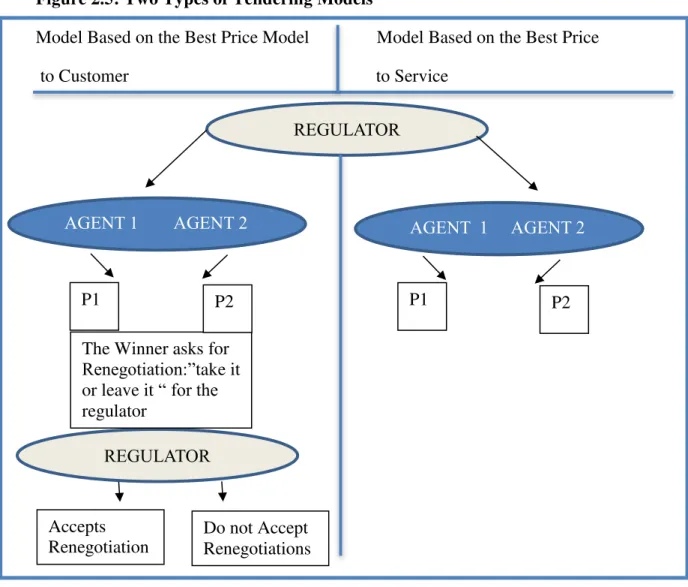
The occurrence of opportunistic behaviors during the enforcement of the contract may depend on the type of tendering procedure chosen. This is an old debate in the economic theory between Demsetz (1968) that advocates for concessions based on the lowest toll price to the customer while Williamson (1976) proposes a model based on the best value paid to the concession.
According to Demsetz (1968), the concessions of services should use the tender based on the best price of the service. Based on this criteria, the winner of the tender is the one with the lowest average cost since she is willing to offer a price that is between its own average cost and the average cost of the second best candidate, something that the other participants and the second positioned would not be ready to do. This tendering model would solve two problems for governments in the context of asymmetry of information about the cost of companies: firstly, they will know the best price of the service and secondly, they will know which candidate is the most efficient to operate the service.
Williamson (1976) criticizes this model saying it can create a lack of commitment of the tendering participants and incentivize opportunistic behavior from the private partners. According to Williamson (1976), projects based on the tendering model of the best price of service are more likely to generate contract renegotiations. He explains that because of two reasons: firstly, the private partners are incentivized to bid with very low to win the tender; secondly, they can rely on their ability to successfully renegotiate.
Williamson (1976) warns that the government can lack the capacity ex post to not give way to price renegotiation due to the transaction costs of replacement of the supplier. In this context, it is difficult for the public partner to mitigate the risk of opportunistic behavior such as the renegotiation of the price (Carrasco et al., 2013). Therefore, although the tendering model based on the best price to customer appears to be benefitting the customer, if renegotiated, the effect of the revenue transfer to the customer is less reached. To lower the likeliness of contract renegotiations, Williamson (1976) proposes a model based on the best value paid to the concession that ensures the best productivity to the customer because it selects the most productive company.
35 short-time frame shows the existence of private opportunism because renegotiation occurred early. In fact, since renegotiations took place during the phase of the constitution of the physical asset and close to the signature of the contract, there is a low probability of occurrence of external factors that could significantly alter the contractual equilibrium (Bajari and Tadelis, 2001).
The high frequency of contracts renegotiations is due to the existence of high sunk costs. Such as warned by Williamson (1976) since replacement costs of suppliers are high, this allows opportunistic behavior from both partners. For example, governments can avoid the change of suppliers because they prefer to not waste time to organize a new tender. This delay could deceive voters and put in risk the reelection of governments. Governments can also be reluctant to switch suppliers because they have preferences over a specific company that gives contributions to the political party that fits their interests. In brief, the negotiation capacity of government can be highly reduced because of a series of variables.
Renegotiations from one partner will depend on capacity of negotiation skills and the strength of the threat of termination of the contract. If the private partners participating in the tender believe that the government will not stick to the commitment of the price originally negotiated and will tend to accept renegotiation, there is a risk from tendering companies to offer prices that are less based on their variables of costs and demand but rather on their capacity to successfully lobby the regulator. In this sense, the company that will have the best political connections or the most optimistic view on the difficulties of the regulator to avoid renegotiations will be more likely to win the tender (Williamson; 1976).
According to Mills (1991), the better capacity the government has to renegotiate, the more welfare for the people. In case of opportunistic renegotiations, the goal of reaching efficiency maximization from the public partner is less likely to be reached (Bajari and Tadelis, 2001). Guasch (2004) also alerts at opportunistic renegotiations: “If tendering companies believe it is possible or probable to negotiate, their incentives and tendering prices will be affected and the tender will choose not the best companies but the one more apt at renegotiations (…)” (p. 24). All in all, the process tends to be plagued by moral hazard and, quite frequently, adverse selection.
36 Figure 2.5: Two Types of Tendering Models
Model Based on the Best Price Model Model Based on the Best Price
to Customer to Service
Source: Williamson (1976)
The fundamental difference between the first and second model is that the concessionaire is less able to ask for renegotiations when the tender is based on the best price paid to the concession. This derives from the fact that in the case of the tendering model based on the best values paid to the concession, there is a stronger institutional resistance from institutional organizations that will make the renegotiation highly difficult. The presence of this institutional control represents a high probability that the government will not renegotiate after contracting (Mattos, 2007; Carrasco et al., 2013).
On top of the type of tendering procedure, the object of the contract impacts the likeliness of renegotiations. According to Hirschman (1970), there are some services that users are less likely to stop using even if they are not happy with them such as water or transportation. Since customer cannot avoid the use of these services, there is no “exit” in Hirschman’s terms and users thus have less powerful tools to express their opinions. If there are mechanisms for customer to express their voices such as organizations or public audiences,
REGULATOR
AGENT 1 AGENT 2 AG
REGULATOR
AGENT 1 AGENT 2 AGENT 2 AG
Accepts Renegotiation s
Do not Accept Renegotiations The Winner asks for
Renegotiation:”take it or leave it “ for the regulator
37 the customer is more likely to prevent opportunistic behavior from the contract suppliers. In brief, the enforcement of the PPP contract will be more efficient in case of a service highly used.
On top of the type of tendering procedure, the object of the contract impacts the likeliness of renegotiations. Laffont and Tirole (1993) show that if the government fixes high penalties for the company in charge of the investment and that there is a strong enforcement capacity, private partners will be less likely to ask for price renegotiation. Milgrom and Roberts (1992) are more specific and show that this incentive works more for contractable’ investment than for non ‘contractable’ investment. Contractablity of investment means that investment performance can be verified and enforced ex post.
In the case of ‘contractable’ investment, renegotiations of higher price increase the incentive of the company to invest more and that decreases the cost of monitoring and enforcement of the government. This is an incentive for the private company because it creates additional rents and it can appropriate the results of the investment. On the contrary, the “non-contractibility” generates problems because it can imply opportunistic behaviors from the partners since progress on the investment cannot be monitored (Milgrom and Roberts, 1992).
This requirement of contractable investment is the basis of one of the four principles proposed in the framework of Milgrom and Roberts (1992). The two authors established a set of four principles that should be respected in order to design incentive contracts between a principal and an agent and minimize the occurrence of opportunistic behavior. Their fundamental idea is that even if the evolution of the remuneration cannot solely depend on elements that can be observed by the public partner, the performance of the private partner is the best element to base the payment of the private partner. They demonstrate that incentive contracts should be based on four principles:
(i) The Principle of Incentive Intensity
The principle of incentive intensity requires that the more the private partner increases its effort level per unit, the more the remunerations should increase. Therefore, the level of effort that the public partner is asking needs to be compatible with the level of incentives that it offers to the private partner. The private partner private partner will select its effort level so that the marginal gain of efforts will be equal to the marginal cost of the effort.
(ii) The Principle of Informativeness
38 (iii) The Principle of Monitoring Intensity
Although a part of the effort of the private partner cannot be measured, the public partner can improve its knowledge of the performance level of the private partner by allocating recourses for that goal. For example, the public partner can hire auditors to conduct quality tests. These measures are costly but since the goal is to pay the private partner based on performance, they help to improve the information that the public partner has about the performance level of the private partner. Therefore, the principles of incentive intensity and intensity of control are complementary.
(iv) The Principle of Equal Compensation
The public partner does not have the means to control how the private partner spends its effort and time on different tasks. Therefore, the marginal yield of the private partner in all activities needs to be equal. If the public partner offers more incentives for a specific activity than others, the private partner will rationally focus on the activities with more incentives and spend less time on the others.
Since real contracts are incomplete and never mention the totality of contingent factors, the moral hazard risk will never completely disappear. Yet, contract renegotiations are not always triggered by opportunism from contractual parties (Milgrom and Roberts, 1992). There is a difference between “good” and “bad” renegotiations, terms coined by Carrosco et al. (2013).
39
2.2.2. Credit Risk
In administrative and sponsored PPPs, the private sector remuneration depends on the public partner subsidy partially (sponsored PPPs) or entirely (administrative PPPs). In this sense, there is a high risk for the private partner to go bankrupt. Most authors established that the lack of financial guarantees from the public sector is one of the obstacles for the execution of PPPs (Ribeiro and Prado, 2007; World Bank, 2009; Amorelli, 2009; Veron and Cellier, 2010; PPP Brasil, 2013).
In PPPs, the private partner is responsible for the construction and funding of the project and received its remuneration all along the operation of the infrastructure. If the public partner does not pay the remuneration at the start of the operation period, the private partner would already have funded the necessary investments and would have to pay back all its funders (Guash, 2004; Vittor and Samples, 2011).
In order to decrease the credit risk, state companies and funds that guarantee PPPs were created whose role it is to guarantee the financial obligations of the public partners bound by the contract. For example, the Guarantee Fund, enacted by the Federal Law of 2004, is a type of guarantee for the private partner regarding financial obligations that were contracted by the public sector in the celebration of a PPP contract (Ministry of Transportation, 2012). These guarantees exist because many states and cities do not have liquid assets to serve as capital for a public fund or company that could guarantee PPPs (Santos, 2009).
On top of the Guarantee Fund, according to the Ministry of Planning (2013), the guarantee of states and cities can also come from the stream of future tax revenues of the project and from the Federal or State Participation Funds. However, there are two obstacles to make viable these two financial guarantees. First, the Brazilian Constitution does not allow the link of future tax revenues for the purpose of financial guarantee. Furthermore, the link with the Federal or State Participation Funds is also not very practiced because banks have not accepted these resources as a credit guarantees (Oliveira et al., 2013).
40
2.2.3 Relationship Risk
Building good relationships is far more important in PPPs than in traditional procurement methods due to the high risk and complex profile of the project (Kumarawamy and Anvuur, 2008). Yet, the fact that political, institutional and cultural characteristics of the contractual parties differ has an impact on the negotiation approach of each partner.
According to Jacobs (1992), risk management can be difficult due to the different political orientations of both partners that they may not know and/or understand. On one hand, private partners can bear the risk of administrative uncertainty that can occur when the government is not able to complete the administrative procedures on time. In fact, private partners could be faced to uncertain transaction costs in the case the public partner who has a multiple role of principal in the contract and regulator would be able to shift legal procedures that have an impact on the contract enforcement (Koppenjan, 2005). On the other hand, public parties can also risk the private discontinuity subsequent to a change in company strategy, bankruptcy or take-over for example. Another threat for both partners is the use of corruption (Guash, 2004; World Bank, 2009; Veron and Cellier, 2010).
For Hirschman (1970), private parties are not always equipped to manage the public tumult and publicity that can surround major PPP projects. In fact, the nature of PPPs implies high visibility and therefore attracts social pressure groups. The PPP project proponents should implement a communication plan so that the general public can understand the long-term implications and benefits of the project. This support is essential for viability of the project (Salman et al., 2007).
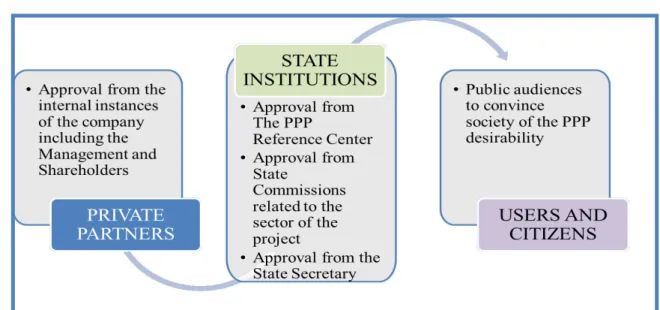
41 Figure 2.6: The Typical Approval Process and Stakeholders for a PPP at the State Level
Source: Ministry of Planning (2013)
Spatial differences may not facilitate the coordination and the decision-making process of a PPP. On one hand, private parties may be faced with the complexity of public administration. For example, according to Koppenjan (2005), “private partners often see government as a hierarchical organization that can command local government” (p. 138). Yet, the centralization power of the public sector is more limited in reality and can be fragmented across a set of players, even at the central level. On the other hand, public partner often assumes that private partners are regionally or nationally based in a partnership. Yet, although it is not the case in Brazil, in some countries, the organizational trend for private partners is moving more towards international companies and consortiums (Weihe, 2005).
The different time orientations between the public and private partners can also make it more difficult to manage adequately and spread the risks involved in PPPs (Koppenjan, 2005). For instance, regarding project success, there might be a time horizon gap between both partners. For example, the public partner could base the project follow-up based on electoral cycles while the private partner could have a different time frame (Li et al., 2005 b).