Farm Hosp. 2015;39(2):80-91
ORIGINALES
Indirect comparison for Anti-TNF drugs in moderate to
severe ulcerative colitis
M. Galván-Banqueri
1, M. D. Vega-Coca
1, M. A. Castillo-Muñoz
1, C. Beltrán Calvo
1and
T. Molina López
11Andalusian Agency for Health Technology Assessment. Seville. Spain.
* Autor para correspondencia.
Correo electrónico: [email protected] (Mercedes Galván Banqueri).
Recibido el 10 de octubre de 2014; aceptado el 31 de diciembre de 2014. DOI: 10.7399/fh.2015.39.2.8218
Abstract
Objective: To compare the relative efficacy of infliximab, ada-limumab and goada-limumab through adjusted indirect treatment comparisons (ITCs).
Methods: An exhaustive search was performed until October 2013. Databases consulted were MEDLINE, EMBASE, the Co-chrane Library, the Centre for Reviews and Dissemination and the Web of Science. Randomized control trials (RCTs) compa-ring the efficacy of infliximab, adalimumab or golimumab ver-sus placebo, in terms of clinical remission, clinical response and mucosal healing, were included. In the case that more than one RCT fulfilled the inclusion criteria for the same drug, a metanalysis was undertaken using a fixed effects model. ITCs were carried out using the method proposed by Bucher et al. Results: 6 RCTs published in 5 papers were included: 2 for in-fliximab (ACT 1 and ACT 2), 2 for adalimumab (ULTRA 1 y ULTRA 2) and 2 for golimumab (PURSUIT-SC y PURSUIT-M).In these RTCs, each biological agent was superior in efficacy to placebo. The results of the adjusted ITC are the following. In relation to the clinical remission, in the induction and mainte-nance period, there are no statistically significant differences between the three anti-TNF drugs. In relation to the clinical response and mucosal healing, in the induction period, there are statistically significant differences between infliximab and adalimumab.
Conclusion: In view of the results obtained, infliximab, adali-mumab and goliadali-mumab appear to be similarly effective
the-Fármacos anti-TNF en colitis ulcerosa moderada-grave: comparación indirecta
Resumen
Objetivo: Comparar la eficacia relativa de infliximab, adali-mumab y goliadali-mumab mediante comparaciones indirectas (CI) ajustadas.
Métodos: Se realizó una búsqueda bibliográfica que abarcó hasta Octubre 2013. Las bases de datos consultadas fueron: MEDLINE, EMBASE, the Cochrane Library, the Centre for Re-views and Dissemination y the Web of Science. Se incluyeron ensayos clínicos aleatorizados (ECA) que compararan la efica-cia de infliximab, adalimumab o golimumab frente a placebo en términos de remisión clínica, respuesta clínica y curación de la mucosa. En el caso de que se incluyera más de un ECA para un mismo fármaco se llevó a cabo un metanálisis utilizado el modelo de efectos fijos. Las CI se realizaron utilizando el mé-todo de Butcher et al.
Indirect comparison for Anti-TNF drugs in moderate to severe ulcerative colitis Farm Hosp. 2015;39(2):80-91 - 81
Introduction
Ulcerative colitis (UC) is a chronic inflammatory bowel disease of multifactorial aetiology that mainly affects the colon. It has a relapsing-remitting pattern. It could be classified in function of its extension in ulcerative proc-titis, left sided colitis or extensive colitis; and in function of its severity in colitis in remission, mild, moderate or severe colitis1.
Symptoms of active disease or relapse include bloody diarrhoea, an urgent need to defecate and abdominal pain2.
The incidence in Europe is estimated at 1.5 to 20.3 ca-ses per 100,000 person-years3. Disease onset can occur
at any age, with a peak incidence between 15 and 25 years and a second smaller between 55 and 65 years2.
Current medical approaches focus on treating ac-tive disease to address symptoms, to improve quali-ty of life, and thereafter to maintain remission. The treatment chosen for active disease is likely to depend on clinical severity, extent of disease and the patient’s preference, and may include the use of aminosalicyla-tes, corticosteroids or biological drugs. Surgery may be considered as emergency treatment for severe ul-cerative colitis that does not respond to drug treat-ment2,4.
Currently, three anti-TNF (tumour necrosis factor) drugs have been authorized by the European Medici-nes Agency (EMA) with the following indication: treat-ment of moderately to severely active ulcerative colitis in adult patients who have had an inadequate response to conventional therapy including corticosteroids and 6-mercaptopurine or azathioprine, or who are intole-rant to or have medical contraindications for such the-rapies5,6,7.
To ensure the rational use of these drugs in clini-cal practice, aspects such as the efficacy, safety and cost-effectiveness of each drug must be evaluated. No direct head-to-head clinical trials have evaluated the su-periority or non-inferiority of these drugs. Given the lack of head-to-head trials comparing biologic agents, indi-rect treatment comparisons (ITCs) were carried out to explore the relative efficacy of these drugs.
ITCs are relatively new approaches to evaluate the re-la ti ve treatment effect when two or more interventions have not been compared directly.
An adjusted indirect comparison is an indirect com-parison of different treatments adjusted according to the results of their direct comparison with a common control, so that the strength of the randomised trials is preserved. Empirical evidence indicates that results of adjusted indirect comparison are usually, but not always, consistent with the results of direct comparison. Basic assumptions underlying indirect comparisons include a homogeneity assumption for standard meta-analysis, and similarity assumption for adjusted indirect compari-son8.
These approaches are being increasingly used by heal-th technology assessmentl (HTA) agencies9 as new and
existing drugs must be placed within the context of all available evidence for technology appraisals.
The main objective of this study was to compare the relative efficacy of infliximab, adalimumab and golimu-mab through adjusted indirect comparisons.
Material and methods
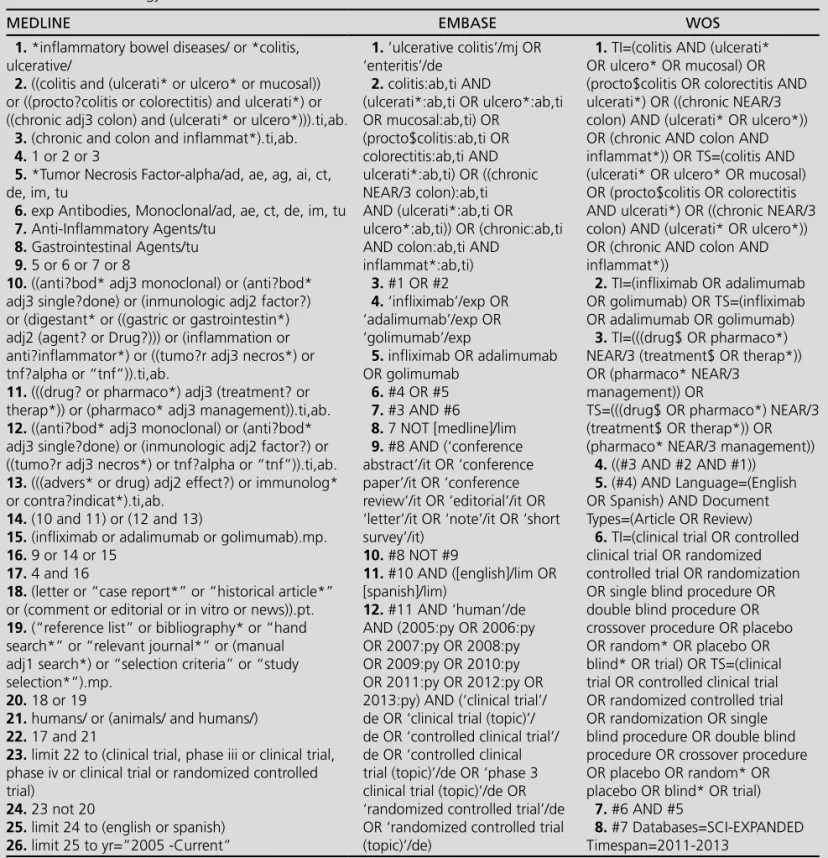
A systematic review was carried out to identify re-levant studies published between 2005 (when the first trial about the first anti-TNF drug, infliximab, was pu-blished) and October 2013. The electronic search was performed by an information specialist in referential sources. Databases consulted were MEDLINE (through OVID), EMBASE, the Cochrane Library, the databases of the Center for Reviews and Dissemination (CRD) and the Web of Science (WOS). Also, Pubmed was revised in order to detect papers not included in MEDLINE (OVID) yet. The search strategies used in the main databases are shown in table 1.
Grey literature was obtained by searching the web sites of the EMA and HTA agencies. Unpublished data were not included in this review.
Studies were chosen for inclusion in the review based on the criteria outlined below:
• Population: adult patients naïve to biological drugs with moderate to severe ulcerative colitis.
rapeutic alternatives. Therefore, other considerations such as safety, tolerance and cost-effectiveness should be taken into account in order to select the most appropriate treatment.
KEYWORDS
Anti-TNF; Ulcerative colitis; Infliximab; Adalimumab; Golimumab; Indirect treatment comparisons
Farm Hosp. 2015;39(2):80-91
inducción hay diferencias estadísticamente significativas entre infliximab y adalimumab.
Conclusiones: En base a los resultados obtenidos (eficacia simi-lar), infliximab, adalimumab y golimumab parecen ser alterna-tivas terapéuticas. Así, otras consideraciones como la seguri-dad, la tolerancia y el coste-efectividad deben considerarse a la hora de seleccionar el tratamiento más adecuado.
PALABRAS CLAVE
Anti-TNF; Colitis ulcerosa; Infliximab; Adalimumab; Golimumab; Comparaciones indirectas
82 - Farm Hosp. 2015;39(2):80-91 Mercedes Galván-Banqueri et al.
• Intervention: infliximab, adalimumab or golimumab. • Comparator: other anti-TNF-drug (direct comparison
between the aforementioned interventions), or pla-cebo.
• Outcomes: clinical remission, clinical response and mucosal healing.
• Study design: randomized controlled trials (RCTs).
Selection, critical appraisal, data extraction, qualita-tive and quantitaqualita-tive synthesis of the evaluated studies
were independently undertaken by two researchers. Any discrepancies between the reviewers were resolved by a third independent reviewer.
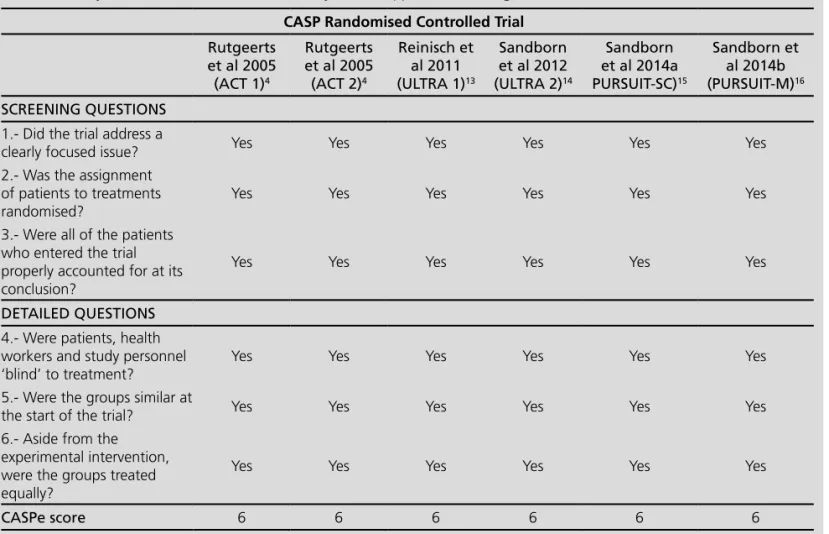
The quality of the evidence of the included studies was assessed by the section A of the Critical Appraisal Skills Programme (CASP)10.
Heterogeneity of included studies was assessed with respect to the trial design and patient populations. For drugs with more than one study, a traditional me-ta-analysis of the efficacy data was performed, using a
Table 1. Search strategy.
MEDLINE EMBASE WOS
1. *inflammatory bowel diseases/ or *colitis, ulcerative/
2. ((colitis and (ulcerati* or ulcero* or mucosal)) or ((procto?colitis or colorectitis) and ulcerati*) or ((chronic adj3 colon) and (ulcerati* or ulcero*))).ti,ab. 3. (chronic and colon and inflammat*).ti,ab. 4. 1 or 2 or 3
5. *Tumor Necrosis Factor-alpha/ad, ae, ag, ai, ct, de, im, tu
6. exp Antibodies, Monoclonal/ad, ae, ct, de, im, tu 7. Anti-Inflammatory Agents/tu
8. Gastrointestinal Agents/tu 9. 5 or 6 or 7 or 8
10. ((anti?bod* adj3 monoclonal) or (anti?bod* adj3 single?done) or (inmunologic adj2 factor?) or (digestant* or ((gastric or gastrointestin*) adj2 (agent? or Drug?))) or (inflammation or anti?inflammator*) or ((tumo?r adj3 necros*) or tnf?alpha or “tnf”)).ti,ab.
11. (((drug? or pharmaco*) adj3 (treatment? or therap*)) or (pharmaco* adj3 management)).ti,ab. 12. ((anti?bod* adj3 monoclonal) or (anti?bod* adj3 single?done) or (inmunologic adj2 factor?) or ((tumo?r adj3 necros*) or tnf?alpha or “tnf”)).ti,ab. 13. (((advers* or drug) adj2 effect?) or immunolog* or contra?indicat*).ti,ab.
14. (10 and 11) or (12 and 13)
15. (infliximab or adalimumab or golimumab).mp. 16. 9 or 14 or 15
17. 4 and 16
18. (letter or “case report*” or “historical article*” or (comment or editorial or in vitro or news)).pt. 19. (“reference list” or bibliography* or “hand search*” or “relevant journal*” or (manual adj1 search*) or “selection criteria” or “study selection*”).mp.
20. 18 or 19
21. humans/ or (animals/ and humans/) 22. 17 and 21
23. limit 22 to (clinical trial, phase iii or clinical trial, phase iv or clinical trial or randomized controlled trial)
24. 23 not 20
25. limit 24 to (english or spanish) 26. limit 25 to yr=”2005 -Current”
1. ’ulcerative colitis’/mj OR ‘enteritis’/de
2. colitis:ab,ti AND
(ulcerati*:ab,ti OR ulcero*:ab,ti OR mucosal:ab,ti) OR
(procto$colitis:ab,ti OR colorectitis:ab,ti AND ulcerati*:ab,ti) OR ((chronic NEAR/3 colon):ab,ti AND (ulcerati*:ab,ti OR ulcero*:ab,ti)) OR (chronic:ab,ti AND colon:ab,ti AND
inflammat*:ab,ti) 3. #1 OR #2
4. ‘infliximab’/exp OR ‘adalimumab’/exp OR ‘golimumab’/exp
5. infliximab OR adalimumab OR golimumab
6. #4 OR #5 7. #3 AND #6
8. 7 NOT [medline]/lim 9. #8 AND (‘conference abstract’/it OR ‘conference paper’/it OR ‘conference review’/it OR ‘editorial’/it OR ‘letter’/it OR ‘note’/it OR ‘short survey’/it)
10. #8 NOT #9
11. #10 AND ([english]/lim OR [spanish]/lim)
12. #11 AND ‘human’/de AND (2005:py OR 2006:py OR 2007:py OR 2008:py OR 2009:py OR 2010:py OR 2011:py OR 2012:py OR 2013:py) AND (‘clinical trial’/ de OR ‘clinical trial (topic)’/ de OR ‘controlled clinical trial’/ de OR ‘controlled clinical trial (topic)’/de OR ‘phase 3 clinical trial (topic)’/de OR ‘randomized controlled trial’/de OR ‘randomized controlled trial (topic)’/de)
1. TI=(colitis AND (ulcerati* OR ulcero* OR mucosal) OR (procto$colitis OR colorectitis AND ulcerati*) OR ((chronic NEAR/3 colon) AND (ulcerati* OR ulcero*)) OR (chronic AND colon AND inflammat*)) OR TS=(colitis AND (ulcerati* OR ulcero* OR mucosal) OR (procto$colitis OR colorectitis AND ulcerati*) OR ((chronic NEAR/3 colon) AND (ulcerati* OR ulcero*)) OR (chronic AND colon AND inflammat*))
2. TI=(infliximab OR adalimumab OR golimumab) OR TS=(infliximab OR adalimumab OR golimumab) 3. TI=(((drug$ OR pharmaco*) NEAR/3 (treatment$ OR therap*)) OR (pharmaco* NEAR/3
management)) OR
TS=(((drug$ OR pharmaco*) NEAR/3 (treatment$ OR therap*)) OR (pharmaco* NEAR/3 management)) 4. ((#3 AND #2 AND #1))
5. (#4) AND Language=(English OR Spanish) AND Document Types=(Article OR Review) 6. TI=(clinical trial OR controlled clinical trial OR randomized controlled trial OR randomization OR single blind procedure OR double blind procedure OR crossover procedure OR placebo OR random* OR placebo OR blind* OR trial) OR TS=(clinical trial OR controlled clinical trial OR randomized controlled trial OR randomization OR single blind procedure OR double blind procedure OR crossover procedure OR placebo OR random* OR placebo OR blind* OR trial) 7. #6 AND #5
Indirect comparison for Anti-TNF drugs in moderate to severe ulcerative colitis Farm Hosp. 2015;39(2):80-91 - 83
fixed-effect model, in the absence of heterogeneity, and the inverse variance method. Analyses were conducted using Epidat version 4.011.
Both clinical similarity and methodological similari-ty should be considered in adjusted indirect compa-rison. If the trial similarity assumption is not fulfilled, estimates from adjusted indirect comparisons will be invalid and misleading or should be interpreted cau-tiously.
Finally, adjusted ITCs were conducted based on the relative effects of each biological drug against a com-mon comparator (placebo), following the method pro-posed by Butcher et al12. For the calculation of the risk
ratio (RR) (95% CI), the software CIT, developed by the Canadian Agency for Drugs and Technologies in Health (CADTH), was used13.
Results
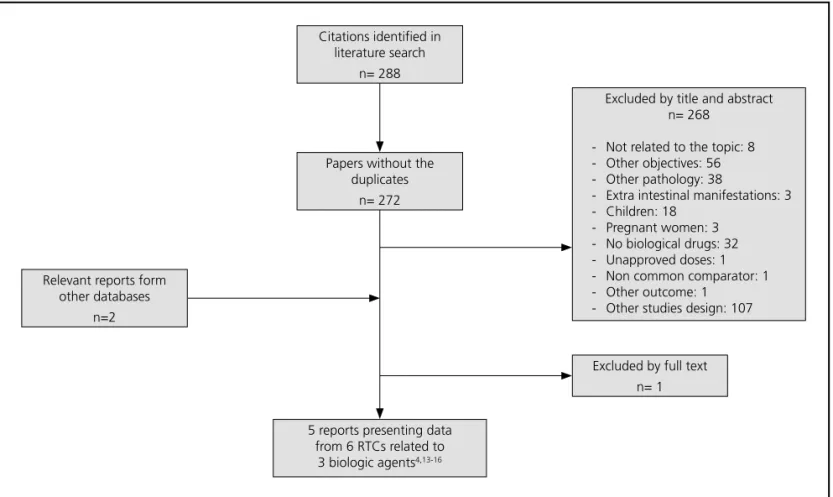
A total of 288 citations were found. 6 RCTs published in 5 papers were included: 2 for infliximab (ACT 1 and ACT 2)4, 2 for adalimumab (ULTRA 1 y ULTRA 2)14,15 and
2 for golimumab (PURSUIT-SC y PURSUIT-M)16,17. The
flow diagram illustrates the way in which the trials were selected (Fig. 1).
The quality of the included studies, based on CASP checklist, is detailed in table 2. All of them were of high quality (score 6 out of 6).
Rutgeerts et al reported the results of 2 randomi-zed, double-blind, placebo-controlled trials (ACT 1 and ACT 2) which evaluated the efficacy of infliximab for induction and maintenance therapy in adults with ulcerative colitis5. 364 patients were included in each
trial. Patients were followed for 54 weeks and 30 weeks in ACT 1 and ACT 2 studies, respectively. The primary endpoint was clinical response at week 8 in both cases.
For adalimumab, 2 randomized, double-blind and placebo controlled trials were included, ULTRA 1 and ULTRA 214,15. The ULTRA 1 study evaluated the efficacy
of two dosing regimens of adalimumab in the induc-tion period. A total of 390 patients were included and the primary endpoint was clinical remission at week 8. Moreover, in the ULTRA 2 study, the efficacy of adalimu-mab in the maintenance period was evaluated. A total of 494 patients were included. However, the subset of patients naïve to biological drugs (the study population in this review) was 295, as patients previously treated with biological agents could be included in the study. The primary end point was clinical remission at weeks 8 and 52.
PURSUIT-SC and PURSUIT-M trials assessed the effica-cy of golimumab in the induction and maintenance pe-riod, respectively16,17. PURSUIT-SC integrated data from
phase II and III trials. For phase III, a total of 771 patients, followed for 6 weeks, were included. The primary
en-Figure 1. Literature flowchart for inclusion and exclusion of studies. Citations identified in
literature search n= 288
5 reports presenting data from 6 RTCs related to
3 biologic agents4,13-16
Excluded by full text n= 1 Papers without the
duplicates n= 272
Excluded by title and abstract n= 268
- Not related to the topic: 8 - Other objectives: 56 - Other pathology: 38
- Extra intestinal manifestations: 3 - Children: 18
- Pregnant women: 3 - No biological drugs: 32 - Unapproved doses: 1 - Non common comparator: 1 - Other outcome: 1
- Other studies design: 107 Relevant reports form
84 - Farm Hosp. 2015;39(2):80-91 Mercedes Galván-Banqueri et al.
dpoint was clinical response at week 6. PURSUIT-M inclu-ded 464 patients and the primary endpoint was clinical sustained response through week 54.
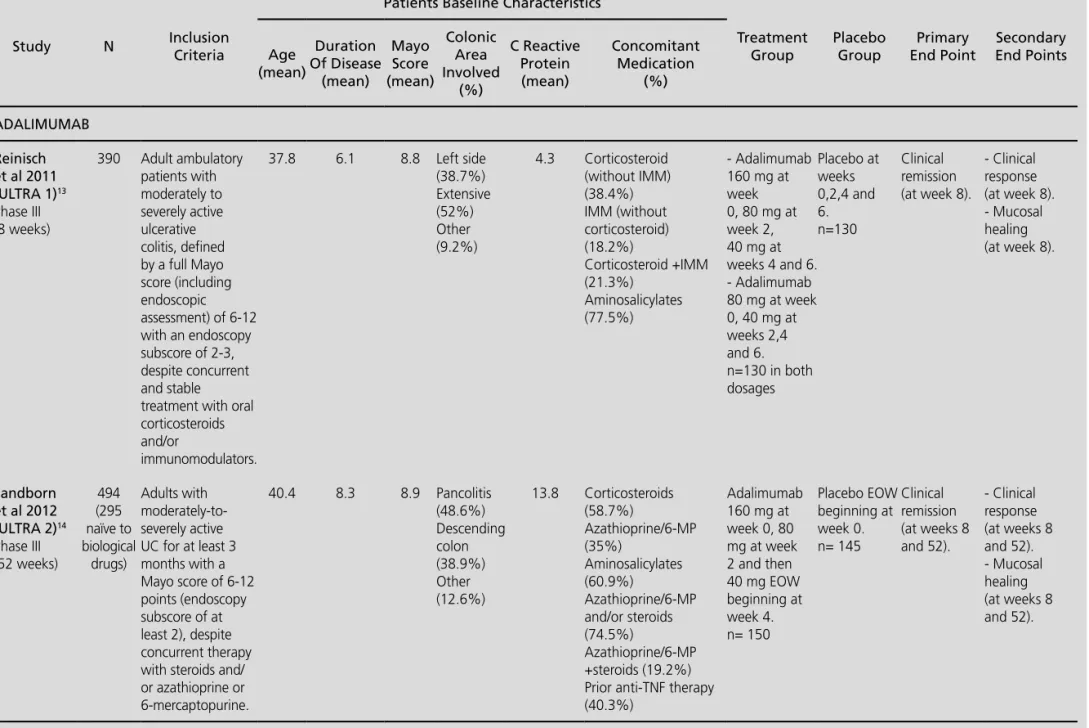
Patients baseline characteristics are showed in table 3. In order to asses the relative efficacy of the biologic drugs in the induction and maintenance periods, rele-vant and common clinical endpoint in the studies for the three drugs were selected: clinical remission, clinical response and mucosal healing, measured in the 6-8 (in-duction) and 52-54 (maintenance) weeks.
The efficacy results for the endpoints clinical remis-sion, clinical response and mucosal healing of each cli-nical trial included are listed in tables 4 and 5, for the induction and maintenance periods, respectively.
The results of the adjusted ITCs (table 6) for the se-lected outcomes (clinical remission, clinical response and mucosal healing) revealed that:
In the induction period, there were no statistically significant differences between the 3 drugs in terms of clinical remission. In relation to the efficacy endpoints clinical response and mucosal healing, statistically signi-ficant differences were observed between infliximab and adalimumab.
In the maintenance period, there were no statistically significant differences between the 3 drugs in terms of clinical remission, clinical response and mucosal healing.
Discussion
In the six RCTs included, patients had similar baseline characteristics and the efficacy outcomes used were the same, although the primary endpoint was not the same in all trials. In addition, the six trials evaluated the results at weeks 6-8 and 52-54 for induction and maintenan-ce periods, respectively. Based on the homogeneity and similarity of the trials, it was possible to realize indirect comparisons between the three biological agents.
The internal validity of the analyses is contingent on three factors: 1) the appropriate identification of the stu-dies that make up the evidence network, 2) the quality of the individual RCTs, and 3) the extent of confounding bias due to similarity violations. Appropriate search and selection methods of all relevant RCTs was conducted. The internal validity of the single RCTs included was high. Studies did not differ with respect to the charac-teristics of the patients, the way in which the outcomes were measured or defined, the protocol requirements in-cluding the concomitant interventions allowed, the len-gth of follow-up as well as differential loss to follow-up. There are several limitations to consider in these analyses. The study ULTRA 2 included patients who could have been previously treated with anti-TNF drugs. However, the patients were stratified according to prior
Table 2. Quality of the included studies assessed by Critical Appraisal Skills Programme (CASP)
CASP Randomised Controlled Trial
Rutgeerts et al 2005
(ACT 1)4
Rutgeerts et al 2005 (ACT 2)4
Reinisch et al 2011 (ULTRA 1)13
Sandborn et al 2012 (ULTRA 2)14
Sandborn et al 2014a PURSUIT-SC)15
Sandborn et al 2014b (PURSUIT-M)16
SCREENING QUESTIONS
1.- Did the trial address a
clearly focused issue? Yes Yes Yes Yes Yes Yes
2.- Was the assignment of patients to treatments randomised?
Yes Yes Yes Yes Yes Yes
3.- Were all of the patients who entered the trial properly accounted for at its conclusion?
Yes Yes Yes Yes Yes Yes
DETAILED QUESTIONS
4.- Were patients, health workers and study personnel ‘blind’ to treatment?
Yes Yes Yes Yes Yes Yes
5.- Were the groups similar at
the start of the trial? Yes Yes Yes Yes Yes Yes
6.- Aside from the experimental intervention, were the groups treated equally?
Yes Yes Yes Yes Yes Yes
Indirect comparison for Anti-TNF drugs in moderate to severe ulcerative colitis
Farm Hosp. 2015;
39(2)
:80-91
- 85
Table 3. Summary of key features of clinical trials of biological agents selected for indirect comparisons
Study N Inclusion
Criteria
Patients Baseline Characteristics
Treatment Group
Placebo Group
Primary End Point
Secondary End Points Age
(mean)
Duration Of Disease (mean)
Mayo Score (mean)
Colonic Area Involved
(%)
C Reactive Protein (mean)
Concomitant Medication
(%)
INFLIXIMAB
Rutgeerts et al 2005 (ACT 1)4 Phase III (54 weeks)
364 Active ulcerative colitis with a Mayo score of 6 to 12 points and moderate-to-severe active disease on sigmoidoscopy (Mayo endoscopic subscore of at least 2) despite concurrent treatment with corticosteroids alone or in combination with azathioprine or mercaptopurine in ACT 1 or despite concurrent treatment with corticosteroids alone or in combination with azathioprine or mercaptopurine and medications containing 5-aminosalicylates in ACT 2.
41.8 6.8 8.4 Left side
(54%) Extensive (45,6%)
1.6 Corticosteroids (61%) 5-Aminosalicylates (69.5%)
Immunosuppressants (48.9%)
Infliximab at a dose of 5 mg or 10 mg per kilogram of body weight at weeks 0, 2, and 6 and then every eight weeks through week 22 in ACT 2 or week 46 in ACT 1.
ACT 1, n infliximab 5 mg/kg=121; n infliximab 10 mg/ kg=122
ACT 2, n infliximab 5 mg/kg=121; n infliximab 10 mg/ kg=120
Placebo at weeks 0, 2, and 6 and then every eight weeks through week 22 in ACT 2 or week 46 in ACT 1.
ACT 1, n=121
ACT 2, n=123
Clinical response (at week 8).
- Clinical response (at week 8 at 30 in both and at 54 in ACT 1). - Clinical remission (at week 8 at 30 in both and at 54 in ACT 1). - Mucosal healing (at week 8 at 30 in both and at 54 in ACT 1). Rutgeerts et
al 2005 (ACT 2) 4 Phase III (30 weeks)
364 40 6.6 8.4 Left side
(60%) Extensive (40%)
1.4 Corticosteroids (51.1%) 5-Aminosalicylates (74.7%)
86 -
Farm Hosp. 2015;
39(2)
:80-91
Mercedes Galván-Banqueri et al.
Table 3. Summary of key features of clinical trials of biological agents selected for indirect comparisons (cont.)
Study N Inclusion
Criteria
Patients Baseline Characteristics
Treatment Group Placebo Group Primary End Point Secondary End Points Age (mean) Duration Of Disease (mean) Mayo Score (mean) Colonic Area Involved (%) C Reactive Protein (mean) Concomitant Medication (%) ADALIMUMAB Reinisch et al 2011 (ULTRA 1)13 Phase III (8 weeks)
390 Adult ambulatory patients with moderately to severely active ulcerative colitis, defined by a full Mayo score (including endoscopic assessment) of 6-12 with an endoscopy subscore of 2-3, despite concurrent and stable treatment with oral corticosteroids and/or
immunomodulators.
37.8 6.1 8.8 Left side
(38.7%) Extensive (52%) Other (9.2%) 4.3 Corticosteroid (without IMM) (38.4%) IMM (without corticosteroid) (18.2%) Corticosteroid +IMM (21.3%) Aminosalicylates (77.5%) - Adalimumab 160 mg at week 0, 80 mg at week 2, 40 mg at weeks 4 and 6. - Adalimumab 80 mg at week 0, 40 mg at weeks 2,4 and 6. n=130 in both dosages Placebo at weeks 0,2,4 and 6. n=130 Clinical remission (at week 8).
- Clinical response (at week 8). - Mucosal healing (at week 8).
Sandborn et al 2012 (ULTRA 2)14 Phase III (52 weeks) 494 (295 naïve to biological drugs) Adults with moderately-to-severely active UC for at least 3 months with a Mayo score of 6-12 points (endoscopy subscore of at least 2), despite concurrent therapy with steroids and/ or azathioprine or 6-mercaptopurine.
40.4 8.3 8.9 Pancolitis
(48.6%) Descending colon (38.9%) Other (12.6%) 13.8 Corticosteroids (58.7%) Azathioprine/6-MP (35%) Aminosalicylates (60.9%) Azathioprine/6-MP and/or steroids (74.5%) Azathioprine/6-MP +steroids (19.2%) Prior anti-TNF therapy (40.3%)
Adalimumab 160 mg at week 0, 80 mg at week 2 and then 40 mg EOW beginning at week 4. n= 150 Placebo EOW beginning at week 0. n= 145 Clinical remission (at weeks 8 and 52).
Indirect comparison for Anti-TNF drugs in moderate to severe ulcerative colitis
Farm Hosp. 2015;
39(2)
:80-91
- 87
Table 3. Summary of key features of clinical trials of biological agents selected for indirect comparisons (cont.)
Study N Inclusion
Criteria
Patients Baseline Characteristics
Treatment Group
Placebo Group
Primary End Point
Secondary End Points Age
(mean)
Duration Of Disease (mean)
Mayo Score (mean)
Colonic Area Involved
(%)
C Reactive Protein (mean)
Concomitant Medication
(%)
GOLIMUMAB
Sandborn et al 2014a (PURSUIT-SC)15 Phase II-III (6 weeks)
168 (Phase II) 771 (Phase III)
Patients had an inadequate response to, or had failed to tolerate, 1 or more of the following conventional therapies: oral mesalamine, oral corticosteroids, azathioprine, and/or
6-mercaptopurine; or were
corticosteroid dependent.
40 6.3 8.5 Left side
(57,8%) Extensive (42,2%)
11.5 Corticosteroids (excluding budesonide) (42.8%)
Budesonide (2.3%) Immunomodulatory drugs (32.4%) 6-MP/azathioprine (31.2%)
Methotrexate (1.2%) Mesalamine (81.9%)
Phase III: Golimumab: - 200 mg at week 0 and 100 mg at week 2. - 400 mg at week 0 and 200 mg at week 2. n= 257 and 258 respectively.
Placebo at weeks 0 and 2. n= 256
Clinical response (at week 6).
- Clinical remission (at week 6). - Mucosal healing (at week 6).
Sandborn et al 2014b (PURSUIT- M)16 Phase III (52 weeks)
464 Participants in
PURSUIT-M had completed one of two golimumab induction studies, PURSUITIV or PURSUIT-SC.
40.2 7 8.3 --- 9 Corticosteroid (5.,5%)
Budesonide (3.2%) Immunomodulatory drugs (31.7%) Aminosalicylates (80.2%)
Golimumab: - 50 mg every 4 weeks through week 52.
- 100 mg every 4 weeks through week 52.
n= 154 for both dosages.
Placebo every 4 weeks through week 52. n=156
Maintenance of clinical response through week 54.
- Clinical remission (at weeks 30 and 54). - Mucosal healing (at weeks 30 and 54).
Clinical response was defined as a decrease from baseline in the total Mayo score of at least 3 points and at least 30 percent, with an accompanying decrease in the subscore for rectal bleeding of at least 1 point or an absolute subscore for rectal bleeding of 0 or 1.
88 -
Farm Hosp. 2015;
39(2)
:80-91
Mercedes Galván-Banqueri et al.
Table 4. Efficacy results in the induction period (week 8 for infliximab y adalimumab; week 6 for golimumab).
Clinical remission Clinical response Mucosal healing
Treatment Placebo RR
(95% CI)
Treatment Placebo RR (95% CI) Treatment Placebo RR
(95% CI)
INFLIXIMAB (5 mg/kg weeks 0, 2 y 6)
Rutgeerts et al
2005 (ACT 1)4 47/121 18/121
2.61
(1.61-4.23) 84/121 45/121
1.87
(1.44-2.42) 75/121 41/121
1.83 (1.38-2.43)
Rutgeerts et al
2005 (ACT 2)4 41/121 7/123
5.95
(2.78-12.75) 78/121 36/123
2.2
(1.62-2.99) 73/121 38/123
1.95 (1.44-2.64)
Metanalysis --- --- 3.3
(2.19-4.96) ---
---2
(1.64-2.44) ---
---1.88 (1.53-2.32)
ADALIMUMAB (160 mg at week 1,80 mg at week 2 and 40 mg at week 4 y 6)
Reinisch et al 2011
(ULTRA 1)13 24/130 12/130
2
(1.05-3.83) 71/130 58/130
1.22
(0.96-1,57) 61/130 54/130
1.13 (0.86-1.49)
Sandborn et al
2012 (ULTRA 2)14 32/150 16/145
1.93
(1,11-3,37) 89/150 56/145
1.54
(1.20-1.96) 74/150 51/145
1.4 (1.07-1.84)
Metanalysis --- --- 1.96
(1.29-2.99) ---
---1.37
(1.15-1,63) ---
---1.26 (1.04-1,53)
GOLIMUMAB (200 mg at week 0 and 100 mg at week 2)
Sandborn et al 2013 (PURSUIT-SC)15
48/257 16/256 2.99
(1.74-5.12) 133/257 76/256
1.74
(1.40-2.18) 111/257 73/256
Indirect comparison for Anti-TNF drugs in moderate to severe ulcerative colitis Farm Hosp. 2015;39(2):80-91 - 89
Table 6. Results of the adjusted indirect comparisons
Induction period Maintenance period
Clinical remission RR (95% CI)
Infliximab vs adalimumab: 1.68 (0.94-3.03)
Infliximab vs golimumab: 1.10 (0.56-2.17)
Adalimumab vs golimumab: 0.66 (0.33-1.30)
Infliximab vs adalimumab: 1.19 (0.59-2.40)
Infliximab vs golimumab 50 mg: 1.40 (0.77-2.56)
Infliximab vs golimumab 100 mg: 1.37 (0.75-2.50)
Adalimumab vs golimumab 50 mg: 1.18 (0.62-2.25)
Adalimumab vs golimumab 100 mg: 1.16 (0.61-2.20)
Clinical response RR (95% CI)
Infliximab vs adalimumab: 1.46 (1.12-1.90)
Infliximab vs golimumab: 1.15 (0.85-1.55)
Adalimumab vs golimumab: 0.79 (0.59-1.04)
Infliximab vs adalimumab: 1.51 (0.87-2.60)
Mucosal healing RR (95% CI)
Infliximab vs adalimumab: 1.49 (1.12-1.98)
Infliximab vs golimumab: 1.25 (0.91-1.71)
Adalimumab vs golimumab: 0.83 (0.61-1.14)
Infliximab vs adalimumab: 1.54 (0.86-2.79)
Table 5. Efficacy results in the maintenance period (week 54 for infliximab and golimumab; week 52 for adalimumab).
Clinical remission Clinical response Mucosal healing
Treatment Placebo RR
(95% CI) Treatment Placebo
RR
(95% CI) Treatment Placebo
RR (95% CI)
INFLIXIMAB (5 mg/kg every 8 weeks)
Rutgeerts et al 2005 (ACT 1)4
42/121 20/121 2.1
(1.31-3.36) 55/121 24/121
2.29
(1.52-3.45) 55/121 22/121
2.5 (1.63-3.83)
ADALIMUMAB (40 mg every 2 weeks)
Sandborn et al 2012 (ULTRA 2)14
33/150 18/145 1.77
(1.05-3) 55/150 35/145
1.52
(1.06-2.17) 47/150 28/145
1.62 (1.08-2.44)
GOLIMUMAB (50 mg every 4 weeks)
Sandborn et al 2013 (PURSUIT-M)16
50/151 34/154 1,50
(1.03-2.18) --- --- --- --- ---
---GOLIMUMAB (100 mg every 4 weeks)
Sandborn et al 2013 (PURSUIT-M)16
51/151 34/154 1,53
---90 - Farm Hosp. 2015;39(2):80-91 Mercedes Galván-Banqueri et al.
exposure to the same or not, and the results were re-ported independently for each subgroup of patients. Moreover, in this study, patients not responding to adali-mumab treatment could continue with it, but they ente-red to an open trial, assuming these losses as treatment failure (this does not happen with trials of infliximab and golimumab). Finally, the Mayo score was calculated in ULTRA 2 as the worst score of the last three days for stool frequency and rectal bleeding, while in RCTs of in-fliximab and golimumab was calculated as the average score of the last three days for these items.
The statistical approach that we employed is widely accepted by agencies such as the National Institute for Health and Care Excellence (NICE), and the CAD-TH. However, many clinicians may be unfamiliar with this approach and few guides are available to critica-lly appraise such studies. The ITCs rely on many of the same assumptions as a standard pair-wise meta-analysis. There is a necessary consideration that the trials of each agent are sufficiently similar to pool together in terms of populations, interventions and outcomes. A further ne-cessary consideration is that these similarities exist across the different agents.
For both infliximab and golimumab, the results of ACT 1 and ACT 2 and PURSUIT-SC and PURSUIT- M, were consistent with each other respectively. However, in the case of adalimumab, in ULTRA 1 and ULTRA 2, the results for the primary endpoint (clinical remission at week 8) were similar, but these studies differed in the results of the secondary endpoints. In ULTRA 1, there were no statistically significant differences between ada-limumab and placebo for clinical response and mucosal healing at week 8, while in ULTRA 2 there were. This discrepancy may be due to higher response rates in the placebo group in ULTRA 1.
The three biological agents showed statistically supe-rior efficacy to placebo. The available evidence is limited, as there are no comparative head to head trials.
The results of the adjusted ITCs for the outcomes eva-luated were heterogeneous and insufficient to suggest differences between the three drugs. Therefore, they can be considered therapeutic alternatives with similar efficacy.
The results of the RCTs can be extrapolated to the population of interest, because the baseline characteris-tics of the patients do not have substantially differences with the patients treated in the routine clinical practice. Moreover, the end points used in the studies are the re-commended for this condition.
Given the lack of ITCs related to biological agents in Spain, this work could be an important contribution for the evidence available so far. Nevertheless, a network meta-analysis18, which includes vedolizumab (a
biologi-cal agent recently approved by EMA), had been publi-shed after we finipubli-shed our systematic review. This new meta-analysis concludes that biological agents are
effec-tive treatments for UC. However head-to-head trials are necessary to select the best treatment option.
There is no evidence to suggest the superiority of one drug over the other. In view of the results obtained, inflixi-mab, adalimumab and golimumab appear to be similarly effective therapeutic alternatives. Therefore, other consi-derations such as safety, tolerance and cost-effectiveness should be taken into account in order to select the most appropriate treatment for individuals with ulcerative colitis.
Bibliography
1. Gomollón F, García López S, Sicilia B, Gisbert JP, Hinojosa J, Spa-nish Group for Working on Crohn’sDisease and Ulcerative Colitis (GETECCU). Therapeutic guidelines on ulcerative colitis: a GRADE methodology based effort of GETECCU. Gastroenterol Hepatol. 2013; 36: 483.e1-e46.
2. National Clinical Guideline Centre (NICE). Ulcerative colitis: ma-nagement in adults, children and young people [Internet]. Lon-dres: NICE, jun 2013 [cited 2013 4 October]. 37 p. NICE clinical guideline 166. Available from: http://www.nice.org.uk/nicemedia/ live/14189/64216/64216.pdf
3. European Medicine Agency (EMA). Scientific discussion. Humira® (adalimimab) [Internet]. Londres: EMA; nov 2007 [cited 2013 4 October]. 19 p. Procedure number: EMEA/H/C/481/II/38. Availa-ble from: http://www.ema.europa.eu/docs/en_GB/document_li-brary/EPAR_-_Scientific_Discussion_-_Variation/human/000481/ WC500050876.pdf
4. Rutgeerts P, Sandborn WJ, Feagan MD, Reinisch W, Olson A, Jo-hanns J et al. Infliximab for Induction and Maintenance Therapy for Ulcerative Colitis. N Engl J Med. 2005;353:2462-76.
5. European Medicine Agency (EMA). Summary of product charac-teristics: Remicade® (infliximab) [Internet]. Londres: EMA; ago 2013 [cited 2013 4 October]. 59 p. EMEA/H/C/000240 -WS/0400. Available from: http://www.ema.europa.eu/docs/es_ES/docu-ment_library/EPAR_-_Product_Information/human/000240/ WC500050888.pdf
6. European Medicine Agency (EMA). Summary of product cha-racteristics: Humira® (adalimumab) [Internet]. Londres: EMA; oct 2013 [cited 2013 4 October]. 250 p. EMEA/H/C/000481 -II/0120. Available from: http://www.ema.europa.eu/docs/es_ES/ document_library/EPAR_-_Product_Information/human/000481/ WC500050870.pdf
7. European Medicine Agency (EMA). Summary of product characte-ristics: Simponi® (golimumab) [Internet]. Londres: EMA; 2013 [cited 2013 4 October]. 207 p. EMEA/H/C/000992 -IAIN/0051. Available from: http://www.ema.europa.eu/docs/es_ES/document_library/ EPAR_-_Product_Information/human/000992/WC500052368.pdf 8. Jansen JP, Fleurence R, Devine B, Itzler R, Barret A, Hawkins N et
al. Interpreting Indirect Treatment Comparisons and Network Me-ta-Analysis for Health-Care Decision Making: Report of the ISPOR Task Force on Indirect Treatment Comparisons Good Research Practices: Part 1. Value Health. 2011; 14:417-28.
9. European Network for Health Technology Assessment (EUnetHTA). Comparators & Comparisons. Direct and indirect comparisons. Final version [Internet]. Copenhagen: EUnetHTA. February 2013. [cited 2014 15 April]. URL: European network for Health Tech-nology Assessment. Febrero 2013. [Internet]. Available from: ht-tps://5026.fedimbo. belgium.be/ sites/5026.fedimbo.belgium.be/ files/Direct and indirect comparisons.pdf
10. CASP Randomised Controlled Trial . [Internet] 2013. [cited 2013 20 December]; Available from: http://www.casp-uk.net/wp-con- tent/uploads/2011/11/CASP-Randomised-Controlled-Trial-Chec-klist-31.05.131.pdf
Xun-Indirect comparison for Anti-TNF drugs in moderate to severe ulcerative colitis Farm Hosp. 2015;39(2):80-91 - 91
ta de Galicia; Organización Panamericana de la Salud. Epidat 4.0 [Internet]. A Coruña: Sergas 1991- [cited 2013 18 November]. Available from: http://www.sergas.es/MostrarContidos_N3_T01. aspx?IdPaxina=62714.
12. Bucher HC, Guyatt GH, Griffith LE, Walter SD. The results of direct and indirect treatment comparisons in meta-analysis of randomi-zed controlled trials. J Clin Epidemiol 1997;50 :683-91.
13. Wells GA, Sultan SA, Chen L, Khan M, Coyle D. Indirect Treat-ment Comparisons (ITC) [software on internet]. Ottawa: Canadian Agency for Drugs and Technologies in Health; c2012 [cited 2013 4 October]. Available from: http://www.cadth.ca/en/resources/ about-this-guide/download-software.
14. Reinisch W, Sandborn WJ, Hommes DW, D´Haens G, Hanauer S, Schreiber S et al. Adalimumab for induction of clinical remission in moderately to severely active ulcerative colitis: results of a rando-mised controlled trial. Gut. 2011;60:780-787.
15. Sandborn WJ, Assche GV, Reinisch W, Colombel JF, D´Haens G,
Wolf DC, et al. Adalimumab Induces and Maintains Clinical Remis-sion in Patients With Moderate-to-Severe Ulcerative Colitis. Gas-troenterology. 2012; 142:257–265.
16. Sandborn WJ, Feagan BG, Marano C, Zhang H, Strauss R, Johanns J et al. Subcutaneous Golimumab Induces Clinical Response and Remission in Patients With Moderate to Severe Ulcerative Colitis. Gastroenterology. 2014; 146: 85-95.
17. Sandborn WJ, Feagan BG, Marano C, Zhang H, Strauss R, Johanns J et al. Subcutaneous Golimumab Maintains Clinical Response in Patients with Moderate-To-Severe Ulcerative Colitis. Gastroentero-logy. 2014; 146: 96-109.