Albanian j. agric. sci. ISSN: 2218-2020, (2012), Nr. 2/Vol. 11 © Agricultural University of Tirana
APPLICATION OF NATURAL POLLINATOR BOMBUS TERRESTRIS IN
CULTIVATION OF THE ‘BIO’ VEGETABLES
ARTAN TREBICKA1, LEOMIRA OSMANI (LATAJ)2 ERJOLA KEÇI3 1
Department of Biology, Faculty of Natural Sciences, Tirana University 2
Department of Vegetable Production, Faculty of Agriculture and Environment, Agriculture University of Tirana 3
Department of Biology, Kristal University, Tirana * Author of correspondence; Email: [email protected]
Abstract
In this study is presented the pollination activity of the Bombus terrestris L. Type: Arthropoda, Class: Insecta, Order: Hymenoptera, Family: Apidae, Genus: Bombus Latr. The aim is presentation of the evidences in the impact on the efficiency and qualitative improvement of the plant cucumber Cucurum sativum and the red pepper plant Capsicum annuum in greenhouses. The experiments conducted during the period 2009-2010 in the Germenji (Lushnje) related to the cucumber plant and the red pepper plant to the Hamallaj (Durrës). Application of the pollination material in comparison with the control greenhouse, give evidences regarding to the enhancement of the fructifying proportion, with 80.3% to the cucumber plant and 84.1% to the red pepper plant with a confidence level of 97%.
Keywords: greenhouse, pollinator, Bombus terrestris L, cucumber, red pepper
1. Introduction
Enhancement of the productivity in the agriculture sector nowadays is related not cultivation only during the heat seasons, but in parallel it is extended in cold periods. Referred to these conditions employment of the greenhouse plantations have enhanced the efficiency and the profitability of the agriculture sector. During last decade production of the agriculture products nominated bio has taken great bonus. Hence, shifting from the conventional products to the ‘bio’ products has been an interesting opportunity to the farmers. Albania has a long experience in the greenhouse agriculture. Even during the socialism it was applied massively. To support the ‘Bio’ production the study was conducted in a number of experimental greenhouses of the Lushnja and
Durrësi by application of the wild bee, Bombus
terrestris L. This insect accomplish quite very
successfully the natural pollination of the cucumber and red pepper flower, by avoiding the application of the stimulating chemicals [1, 2] consequently assuring increase of the production and the consumer health protection as well as environmental protection [3]. Natural pollination method not only increases the product quality but also it increases the efficiency.
2. Material and Methods
In the first phase of the study were selected the greenhouse stations where the vegetable have to be cultivated and followed by the selection of the appropriate environment sites to install the imported nests as well as the artificial nests.
The experiment was conducted in two sites for the cucumber vegetable with a area of 3000 and 4000
m2 respectively, in Gërmenji (Lushnja), and two other
sites for the red pepper vegetable with area of 4000
m2 respectively, in Hamallaj (Durrësi).
One greenhouse was used to follow the experiment while the other was selected as control. For each site were recorded the hydro-meteorological conditions during the time of the experiment running. In experimental greenhouses in a time of 3-4 days before staring of the pollination stage where installed three nest of BIOPLANET type of Italian origin which number approximately 80-100 wild bees
(Bombus terrestris L.). Each colony used in the study was calculated to have an expectancy of life 8-14
weeks. In general, Bombus terrestris L. is more active
during the first part of the days in the morning hours and in the late hours of the afternoon. Their activity is depended in the flowering model of the studied plant.
66
10-30o C, but the best temperature range is 15-25oC.
As consequence the condition of our study were selected in that interval of temperatures. The humidity applied in both greenhouses reached values of 65-70 %, and was controlled automatically [4]. Their installation need to be applied some conditions such as 50-100 cm above the soil, protected from sun rays. Initially they were kept for a period of more than 30 minutes prior to open their door. During its life the plant is grown and consequently the nest is elevated by ensuring the pollination of the flower.
In the experimental greenhouses was avoided use of chemicals because those have direct or indirect impact on the bee’s health [5, 6, 7, 8, 9].
The nest were applied in two different periods: May – July 2009 and September – November 2010 in the cucumber vegetable, while in the red pepper vegetable the period of application were: June- September 2009 and August-November 2010.
Observation of the fructification process were realized in ten lines of plants positioned vertically toward three bees nests, approximately 15 m from each other, by selecting randomly 10 plants for each line. In the observation process were examined the number of the flowers that formed fruits compared to
the overall numbers related to the observed floors. For the cucumber vegetable the observed floors were II, III, V and VII, while for the pepper vegetable the observed floors were II, IV.VI and VIII. Numbering was conducted once in month during the morning,
because in that time the Bombus terrestris L. is highly
active [10, 11, 12]. Related to the floors under observation were noted the number of the flowers that have realized fructification to each floor related to the overall number of the flowers.
3. Results and Discussions
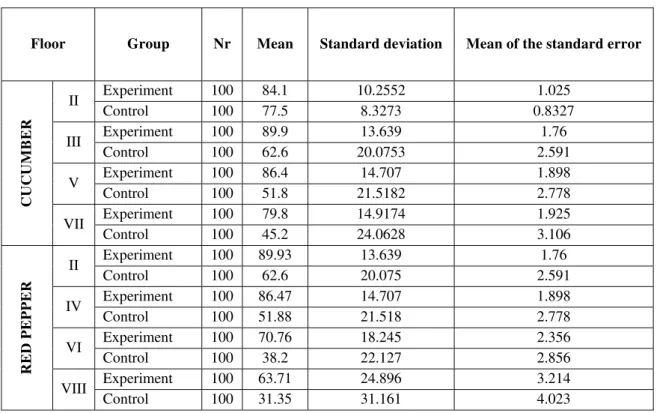
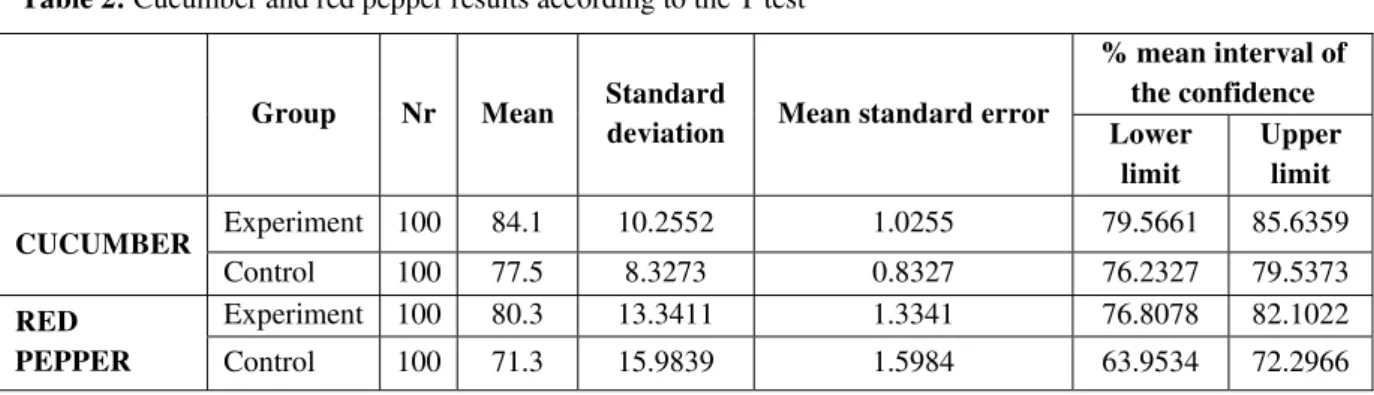
All the data collected during the experiments are presented in the table 1, analyzed by SPSS 19.0. The data were analyzed by the test T, responsible for the statistical significance among the data of the two, referred to the variance equivalency.
The table 1 presents the data on the cucumber and pepper for the greenhouse where is experimented
the Bombus and in the control greenhouse according
to the SPSS. In the table 2 are presented the data on two vegetables in observation according to the T Test (SPSS 19.0).
Table 1: Results according to the floors for the cucumber and red pepper vegetables
Floor Group Nr Mean Standard deviation Mean of the standard error
C
UCU
M
B
ER
II Experiment 100 84.1 10.2552 1.025
Control 100 77.5 8.3273 0.8327
III Experiment 100 89.9 13.639 1.76
Control 100 62.6 20.0753 2.591
V Experiment 100 86.4 14.707 1.898
Control 100 51.8 21.5182 2.778
VII Experiment 100 79.8 14.9174 1.925
Control 100 45.2 24.0628 3.106
RED PEPPE
R
II Experiment 100 89.93 13.639 1.76
Control 100 62.6 20.075 2.591
IV Experiment 100 86.47 14.707 1.898
Control 100 51.88 21.518 2.778
VI Experiment 100 70.76 18.245 2.356
Control 100 38.2 22.127 2.856
VIII Experiment 100 63.71 24.896 3.214
Application of natural pollinator in cultivation of the ‘bio’ vegetables
67
Table 2: Cucumber and red pepper results according to the T test
Group Nr Mean Standard
deviation Mean standard error
% mean interval of the confidence Lower
limit
Upper limit
CUCUMBER Experiment 100 84.1 10.2552 1.0255 79.5661 85.6359
Control 100 77.5 8.3273 0.8327 76.2327 79.5373
RED PEPPER
Experiment 100 80.3 13.3411 1.3341 76.8078 82.1022 Control 100 71.3 15.9839 1.5984 63.9534 72.2966
3.1 Anova analysis
In the table 3 is assembled the interpretation of the data that present the significance levels. The significance levels show that the on each group in the experiment and the control greenhouses is lower than < 0.05.
That data give evidence that the variability is not the same for two groups. So the significance difference in the variable linked to each individual of both groups. The T Test presented in the Table 4 gives evidence that among the data of two groups in the experimental and that of control greenhouses has difference in the variance of significance due to the influence of the pollination insects in the enhancement of the fructification percentage.
Table 3: Significance level for each group in the experimental and control greenhouse
Group Square
sum Df
Mean
square F Sig.
Cucumber Among
groups 690.43 1.00 690.43 7.91 0.01 In group 17,276.76 198.00 87.26
Total 17,967.19 199.00 Red
pepper
Among
groups 7,601.45 1.00 7,601.45 35.07 0.00 In group 42,913.58 198.00 216.74
Total 50,515.02 199.00
Table 4: Significance variance difference because of the fructification percentage enhancement
Levene Test related to the
symmetry of variables T-test related to the mean of symmetry
F Sig. t df
Si. (2-tailed)
Mean
alteration
Standard error
95% interval of confidence
Lower upper
Cucumber 7.913 0.005 2.813 198 0.005 3.716 1.321 1.1109 6.3211
Red
68
Figure 1: Histogram of the percentage mean values of the fructification in both greenhouses (experiment/control), for cucumber vegetable (Cucurum sativum)
The charts are extracted from the data on the T test presented in the tables. In the figure 1 the data presented give evidence that in the experimental greenhouse the fructification percentage is higher compared to that of the red pepper. Until the VII floor is observed a higher fructification in both greenhouses. In the upper floors is observed a dropping trend of the flowering percentage, as consequence of that of fructification.
For these floors the probability for the natural fructification is low, due to the plant height. The insect by frequenting the flowers in the upper floors of the plant gives possibility to the enhancement of the fructification levels in the experimental greenhouse compared to the control greenhouse.
In the experiment greenhouse the pollination insect has influenced in the enhancement of the fructification level by 26.2% compared to that of the control greenhouse, where this insect is not present.
Figure 2: Fructification percentages in both greenhouses for the red pepper (Capsicum annuum).
On these floors the probability of the natural fructification is very low, due to the plant height. The insect by frequenting the flowers in the upper floors gives possibility to the enhancement of the fructification level in the experiment greenhouse compared to the control greenhouse.
On the experimental greenhouse the pollination insect has influenced in the fructification percentage enhancement by 31.3% compared to that of the control greenhouse. The comparison of the study
results with other scientific publications (Shipp et al.
1994) give evidences on the advantage of this induced pollination method compared with self-pollination methods.
4. Conclusions
The results on every culture under experiment
with application of the natural pollinator Bombus
terrestris L. concluded that cucumber vegetable
(Cucurum sativum) results with a net increase of 26.2 % of fructification level on the experimental greenhouse compared with control.
The red pepper vegetable (Capsicum annuum)
cultivated in the experimental greenhouse, with
application of the Bombus insects resulted with a total
increase of 31.3% fructification level compared to the
control greenhouse. Application of the Bombus
insects together with other beneficial insects, may replace completely the chemical protection with the integrated protection, part of that is also the biological protection. The smaller the application of the insecticides in the greenhouse agriculture, the greater will result the impact on the consumer health protection from the exposure of pesticides and other chemicals.
In conclusion we can underline that Bombus
terrestris L. is the most suitable pollinator in the greenhouses where is applied the central warming, and it may be considered in some circumstances as irreplaceable both in the case of the cucumber and red pepper vegetables. The results presented are analyzed by statistical analysis. So the flowering and fructification level were accompanied by the weighting of the vegetables. By comparing the mean values of the weight of the vegetables per floor in the experimental greenhouse with that of the control greenhouse it results that the first values are higher.
This results give evidence that Bombus terrestris L
influence considerably in the enhancement of the
84.1 77.5 89.9 62.6 86.4 51.8 0 10 20 30 40 50 60 70 80 90 Bima 79.8 45.2
II III V VII
Kati 89.93 62.6 86.47 51.88 70.76 38.2 63.71 31.35 0 10 20 30 40 50 60 70 80 90 BIM ET
1 2 3 4
Application of natural pollinator in cultivation of the ‘bio’ vegetables
69
mean number of the fruit and consequently in the increase of the mean values of the weigh.5. References
1. Andoni V: Study of the Apides of Albania. PhD
Dissertation. Agricultural University of Tirana, Kamëz, Tirana, Albania. 1981.
2. Dogterom M. H., Matteoni,1 J. A., Plowright R.
C: Apiculture and Social insects. Entomology
1998, 91(1): 71 - 75
3. Balliu A, Çota E: Ecological Alternatives on the
Greenhouse cultivation. Tirana. 2005: 7-15. (In
Albanian)
4. Bio-Bee Biological Systems- B. terrestris (Int).
5. Misja K: Entomology, SHBLU; 2003. (In
Albanian)
6. Sabatini AG, Bolchi Serini G, Frilli F, Porrini C:
Il ruolo della ricerca in apicoltura, Bologna;
2002.
7. Sabatini AG: Apicoltura e frutticoltura. In: La
frutta si conosce mangiandola, Regione
Emilia-Romagna; 2005.
8. Maus V: Bestimmungsschlussel fur hummeln.
Hamburg; 1986.
9. Lodesani M, Costa C: La biodiversita dell’ape
in un progeto di ricerca europeo, Apitalia 9.
2001(a): 15-20.
10. Lodesani M: Apicoltura biologica:
problematiche relative alla lavorazione della cera, Rivista di apicoltura Lapis, 2001(b), 7: 11-15
11. Lodesani M: La colonia d'api: gli insetti sociali
più amati dall'uomo. Proceedings of the 3°
Symposiu , Po, cultura di fiume e di terra,
Guastalla (RE), 2004: 239-253
12. Misja K: What is known and what is yet not
known. Tirana; 199: 12-25 (In Albanian)
13. Shipp JL, Whitfield GH & Papadopoulos AP:
Effectiveness of the bumble bee, bombus
impatiens cr. (hymenoptera: apidae), as a