FUNDAÇAo
GETUUO VARGAS
EPGE
Escol. de P6s-Graduação
em Economia
Ensaios Econômicos
AI"
541
Escola de
セ セMMMMMMMM MMMMMM M
Pós Graduação
em Economia
da
fオョ
セ 、 R 。 セ セ ̄ セッ@
__________ ___
Getulio Vargas
ISSN 0104-8910
Robustness of stationary tests under long-memory alternatives
Robustness of Stationarity Tests under
Long -Memory Al ternati ves
Luiz Renato Lima
Getulio Vargas Foundation
Zhijie Xiao
University of Illinois
J anuary 16, 2004
Abstract
This paper investigates the presence of long memory in financiaI time series using four test statistics: V / 8, KPSS, KS and modified R/S. There has been a large amount of study Oli the long memory behavior in eco-nomic and financiaI time series. However, there is still no consensus. We argue in this paper that spurious short-term memory may be found due to the incorrect use of data-dependent bandwidth to estimating the long-run variance. We propose a partially adaptive lag tlong-runcation procedure that is robust against the presence of long memory under the alternative hypothesis and revisit several economic and financiaI time series using the
proposed bandwidth choice. Our results indicate the existence of spurious short memory in real exchange rates when Andrews' formula is employed, but long memory is detected when the proposed lag truncation procedure is used . Using stock market data, we also found short memory in returns and long memory in volatility.
1
Introduction
In the time domain, a time series exhibits long-range dependence if the absolute
values of the autocorrelations are not summable. In practice, the presence of
long-memory components in asset returns has important implications for many
of the paradigms used in modern financiaI economics. For example, pricing of
deriva tive securities with martingale methods will no longer be valid, since most
of the stochastic calculus employed in that field is inconsistent with long memory.
Long memory is also inconsistent with usual statistical inference methods which
are largely employed to estimating and conducting hypothesis testing in the
capital pricing asset model (CAPM). There has been intense debate on the
presence of long memory in financiaI time series. For instance, Greene and
individual stocks on the New York Stock Exchange exhibit long memory. Lo
(1991) crilicized lheir resulls and proposed lhe modified R/S slalislic, in which
one accounts for short memory in the null model, and obtained no evidence in
favor of long memory of the monthly and daily returns on Center for Research
in Securily Prices (CRSP) . Teverovsky el . a!. (1999) show lhal lhe modified
R/S statistic has a strong preference for accepting the null hypothesis of short
memory, even when long memory is present in the data. Based on this finding,
Willinger et. aI. (1999) conducted further analysis and found some evidence
of long memory in the CRSP stock return data. Thus, there seems to be no
consensus about the presence of long memory in stock returns.
The same lack of consensus is present in the discussion on the existence of
long memory in real exchange rates. By examining the statistical properties of
the real exchange rate, past studies have tried to draw some implications on
lhe PPP hypolhesis. The PPP hypolhesis suggesls lhal nalional price leveIs of
two countries are equalized when expressed in the common currency unit. Even
though this relation is not likely to hold in the short run due to price stickiness,
it may hold in the long run. The real exchange rate, by definition, is the relative
national price leveI of two countries expressed in common currency units. If the real exchange rate exhibits short-range dependence, deviations from the PPP
are transitory and a mean reversion occurs. In such a case, the relative national
price leveI is equalized in the long run and the PPP hypothesis holds in the
long run. On the other hand, if the real exchange rate has long memory, then
deviations from the PPP will be highly persistent and mean reversion will take
longer to occur. The use of fractional models for exchange rate dynamics is quite
common. Cheung and Lai (1993), Diebold el. a!. (1991) and Cheung and Lai
(2001) find mean-reverting long-memory dynamics in series of real exchange
rates. On the other hand, using the KPSS test, Culver and Pappel do not
reject the null hypothesis of short-range dependence in real exchange rate at
the 5% criticaI value. Although both long memory and short memory models
imply PPP reversion in the long run, they yield different reversion speed toward
equilibrium. Taylor (2002), emphasizes that the more important and interesting
question is to explain and measure amplitude and persistence of deviations
from PPP . For this reason, it is important that statistical tests be able to
we re-exam many test statistics used in applications and show that the use of
bandwidth procedures that are not robust against long-range dependence may
lead to spurious short-range dependence in financiaI time series.
There is a large literature in both theory and applications on testing for
long range dependence (Mandelbrol and Wallis (1968, 1969a, b, c), Mandelbrol
and Taqqu (1979), Beran(1994), Lo (1991), Lee and Schmidl (1992), Girailis el
a!. (2003), Robinson, Taqqu, Teverovsky and Willinger (1995), Xiao (1999)) .
Among various testing procedures, the rescaled variance V /8 statistic recently
proposed by Girailis el a!. (2003), lhe modified R/S lesl suggesled by Lo
(1991), lhe KPSS slalislic derived by Kwialkowski el a!. (1992), and lhe KS
statistic proposed by Xiao (2001) are widely used in economics and finance. In
alI these test statistics, the scaling factor includes the estimate of the long-run
variance. Compared to the conventional variance estimator in classical tests,
the long-run variance estimator is robust to weak dependence under the null.
In practice, the long-run variance of a time series Xt is usualIy estimated
by the nonparametric kernel method which entail a choice of bandwidth (lag
truncation) parameter q satisfying the property that q ---t CXJ and q/n ---t O as the sample size n ---t CXJ. Just like many other statistical procedures that use nonparametric estimates, the finite sample performance of these tests depends
largely on the choice of bandwidth, although tests using different bandwidth
values are asymptoticalIy equivalent as long as the bandwidth q satisfies a certain expansion rate . One of the most popular choices is probably the data-dependent
automatic bandwidth
(1)
where f.Lk is a constant associated with the kernel function,
15(1, k)
is a function of the unknown spectral density and is estimated using a plug-in method, andp is the characteristic exponent of k. This bandwidth choice has been stud-ied by Andrews (1991) in the estimation of a covariance matrix for stationary
time series and is now widely used in econometrics applications. 8uch a
band-width has the advantage that it partialIy adapts the serial correlation in the
(2)
where
p
is a estimate of the first order autoregression coefficient.Lo (1991) reporls Ihal lhe modified
RIS
lesl has good empirical size andpower if one employs the automatic truncation lag procedure 2. Giraitis et aI
(2003) affirm Ihal Ihey did nol check how lhe Andrews' formula works for lhe
KPSS and V /8 tests, but "it can expected that it will yield fairly good results".
In a recent paper, Xiao (2002) shows that, the Monte Carlo finding of
unusu-ally low power and some empirical findings of short-memory in time series are
relaled lo lhe use of lhe dala-dependenl bandwidlh choice (1) and (2). In Ihis
paper, we conduct extensive monte carlo simulations and show that the power of
lhe modified
RIS,
VIS and KPSS and KS slalislics reduces dramalically whenthe Andrews' formula is employed. lndeed, either fixed values or fixed functions
of n, have been considered in the existing literature. Fixed bandwidth values are not robust to short-term memory and are generally not recommended. For many
fixed functions of n, they generally have better performance than fixed band-width values when the short-term memory is strong, but have poor performance
if the short-range dependence is weak For this reason, we propose partially
data-dependent bandwidth choices. Monte Carlo simulations are conducted and they
indicate that, among the existing choices of the bandwidth parameter, the V /8,
KPSS, KS and modified
RIS
lesls have lhe besl sample performance when lhepartial data-dependent truncation lag procedure is adopted.
We re-visit several economic and financiaI time series using the proposed
approach. In particular, we used the same stock return data as in Lo (1991)
and concluded that the null hypothesis of short memory cannot be rejected even
when the bandwidth choice takes into account the presence of long memory
under the alternative. However, we find that evidence against short memory in
absolute and squared values of stock returns is much more strong, indicating
the presence of long memory in volatility. Long memory in volatility has been
extensively reported in the literature (see, e.g., Huang and Yang, 1995; Lobato
and 8avin, 1998; Lobato and Robinson, 1998; Ohanissian et aI. 2003, among
olhers.).
We also investigated the presence of short memory in real exchange rates.
bandwidth usmg the Andrews' formula. However, the use of the Andrews'
formula may induce the arising of spurious short memory. This problem is
resolved when we replace the Andrews' formula by the partially data dependent
one and evidence against short memory is found. This result implies that the
PPP holds in the long run and that deviations from PPP are highly persistent .
The paper is organized as follows: section 2 presents the V /S, KPSS, KS
and the modified R/S statistics. In section 3, we discuss bandwidth selection
in testing 1(0) versus
I(d).
Section 4 motivates and introduces the partiallydata-dependent bandwidth choice. The Monte Carlo experiment is designed
and results are presented in section 5. An empirical application using data on
exchange rate and stock returns is carried out in section 6. Section 7 concludes.
2
Test Statistics
This section presents three test statistics largely used to test the null
hypoth-esis of short memory against long memory: the rescaled variance V /S
statis-tic recently proposed by Giraitis et aI (2003); the KPSS statisstatis-tic derived by
Kwiatkowski et a!. (1992); The KS statistic introduced by Xiao (2001); and the
modified R/S statistic proposed by Lo (1991).
We show in the sequeI that, unlike what was suggested by Giraitis et aI.
(2003), these tests may deliver low power when the bandwidth choice is based
on Andrews' formula. We will propose an alternative bandwidth choice that
will work well with the above mentioned tests. In particular, when this new
bandwidth choice is used, the power of the tests will not only increase as d
moves away from zero, but it will also be very high for distant alternatives
besides yielding a reasonable empirical size under the null modeI.
2.1
V /8 statistic
Giraitis et aI (2003) proposed the following statistic to test the null hypothesis
where
ci
is an nonparametric estimator of the long run variance and Xn is the nsample mean n-1
L:
Xj. The V/8 statistic can be re-written as j=lvOsセ@
n-IV;;(S"S2,,,,,Sn)
セR@
W
k _ _
(3)
where 8k = L:(Xj - X n ) are the partial sums ofthe observations and Var(81, 82 , ... , 8 n )
1
is the sample variance of the partial sums.
Under regularity conditions, Giraitis et aI (2003) derived the asymptotic
distribution of the V /8 statistic under the null hypothesis of short memory and
the alternative hypothesis of long-memory. Under Ho, the V /8 statistic has the
following behavior
V/S=?1)(t)
where
1)(t)
セ@
[(WO(t)2dt- ([(WO(t)dt)
2 andWO(t)
islhe slandard Brownianbridge. The dislribulion funclion of
1)(t)
was derived by Walson (1961) and hasthe following formula
=
, ,
Fn セ@ 1
+
2L.:
(_1)ke- 2k セ@ x.k=l
Girailis el aI (2003) observed lhal Fn セ@ FK(,,/X) where FK is lhe
asymp-totic distribution function of the standard Kolmogorov statistic sUPo:::; t:::; 1
fo
(Fn
(t)
-
t) .
Under the assumption of stationarity with long memory,V/
8 ---t CXJ which yieldsa consistent testo
2.2
KPSS Statistic
Kwialkowski, Phillips, Schmidl, and Shim (1992) proposed a lesl of lhe null
hy-pothesis of stationarity against unit root. Later, Lee and 8chmidt (1996) showed
that the KP88 test is consistent against stationary long memory alternatives.
The KPPS slalislic is defined as follows
1 n k _
( )
2
KPSS
セ@
(wn)2
f,
jL;,
(X
j
-
X n)
(4)
Notice that the KP88 may be seen a rescaled sample uncentered second
laller correcls for lhe mean. This imply lhal lhe VIS slalislic will probably be
more sensitive to shifts in variance and will have higher power than the KPSS
statistic against long memory in squares (Giraitis et aI., 2003).
Under lhe null of shorl memory, Kwialkowski el. a!. (1992) show lhal lhe
KPSS statistic has the following asymptotic behavior
KP88 =?
",(t)
1
where
",(t)
セ@J(WO(t))2dt,
which KPSS labulale. Under lhe assumplion°
of slalionarily wilh long memory, Lee and Schmidl (1996) show lhal K P 88
diverge in probability to infinity , yielding a consistent test against stationary
long-memory alternatives.
2.3 Modified
RIS
Statistic
Lo (1991) developed a test for long memory that is robust to short memory
dependence. This test is a modification of the rescaled range, or
RIS
statisticinlroduced by Hursl (1951). The modified
RIS
slalislic has lhe following formQn
セ@セ@ {L[Zセョ@
jt,
(Xj
-
Xn)
-
G[セセョ@
jt,
(Xj
-
Xn)]
Under lhe null hypolhesis of slalionarily, Lo (1991) showed lhal
RI
8セ@ セ@
=?U R/S
セ@ G[Zセョ@
WO(t)
-
ャセュセセョ@
WO(t)
The distribution function of the random variable U RIs was derived by Feller
(1951) and has lhe following funclional form
=
2 2 2k2x2FUR/S(x) セ@ 1
+
2L.:
(1-4k x)e-k=l
This distribution function is used to calculate the criticaI values of the
modified R/S testo CriticaI values at various significance leveI are available
in Table 2 in Lo(1991). Under lhe allernalive hypolhesis of slalionary long
2.4 The KS Statistic
Notice that the KPSS statistic uses the Cramér-von Misses measure of the
fluc-tuation in time series Xt . Xiao (2001) proposes testing for stationarity based on
the Kolmogoroff-Smirnoff measure of fluctuation, that is:
KS
セ@Max
セGB@QQ
Q ォセ@
' \ '
X
t - -ォョセQ@
' \ 'X
tャセォセョカョキ@
セ@
ョセ@
where Xt is the detrended time series Xt . Under the null hypothesis of short
memory and assuming that
X
t is the demeaned time series, Xiao (2001) showedlhal
As any other testing procedures in the short memory context, the assymptotic
distribution of S depends on the limiting function of the deterministic trend.
Under the presence of linear deterministic trend
where W '
(t)
corresponds lo second-level Brownian bridge (MacNeill, 1978).The above test was originally proposed in testing stationarity against the
alternative of a unit root. However, the test also has power against alternatives
of long memory processes. The behavior of the KS test under the alternative of
long memory hypothesis is similar to that of the
R/S
statistic.3
Bandwidth Selection
In all tests discussed in Section 2, an estimate of the long-run variance w is needed to standardize the testo The nonparametric kernel estimator of the
long- run variance of a time series Xt has the following form
( 5)
where
9xx(h)
is theh-th
order sample autocovariance of Xt,k(-)
is a kernelthat q ---t CXJ and q/n ---t
o
as the sample size n ---t CXJ. For example, when we use the Bartlett kernel, we obtain(6)
which is widely used in econometric applications. The finite sample performance
of these tests is affected by the choice of bandwidth. In practice, many
appli-calions use lhe dala-dependenl aulomalic bandwidlh (1) coupled wilh AR(l)
plug-in given by (2).
Simply using the data-dependent bandwidth choice (1) is inappropriate.
No-lice lhal lhe bandwidlh choice (1) of Andrews (1991) was derived under a
dif-ferent situation for 1(0) time series. In the models that we are considering, the
integration order of the time series changes between
Ho
andH
1 . The bandwidthselection influences both the size and the power of these tests in finite samples.
In choosing the bandwidth, it is necessary that the serial correlation can be
captured under the null hypothesis. It is also important that the statistical test be able to discriminate between the null and the alternative hypothesis.
To lesl lhe 1(0) hypolhesis againsl an
I(d)
alternalive, lhe bandwidlh q should be large enough to capture the short-range dependence under the null. On theother hand, it should not be too large that it also captures long-range
depen-dence under the alternatives. Unfortunately, as shown in Xiao (2002), the
data-dependent bandwidth (1) not only captures the short-range dependence under
the null, but can also (at least partially) capture the long-range dependence
under the alternatives. This is reflected on the value of the plug-in component
b(J,
k)
in (1). As lhe lemporal dependence in Xt increases, lhe value of lhedata-dependent
6(j, k)
becomes larger and larger. However, there is nothing toprevent
6(j, k)
being too large under the alternative!Under the alternative hypothesis, the divergence rate ofthe tests discussed in
Section 2 and the power of these tests depend on the ratio
n/
q. If the bandwidth value q is too big, the tests will have very low power. Unfortunately, the data-dependent coefficient6(j, k)
adapts to the serial correlation in Xt and oftendelivers very large bandwidth values under the alternative hypothesis. The
tests using such a bandwidth choice generally have very low power even for
alternatives that are distant from the null hypothesis. For example, in the case
A number of other bandwidth choices, including fixed values or fixed
func-tions of n, have been considered in the existing literature. Fixed bandwidth val-ues are not robust to short-term memory and are generally not recommended.
For many fixed functions of n, they generally have better performance than fixed bandwidth values when the short-term memory is strong, but have poor
performance if the short-range dependence is weak.
Comparing the existing bandwidth choices, the data-dependent bandwidth
(1) generally gives better size properties than other choices, but suffers from low
power. Thus, it would be ideal if we could use the data-dependent bandwidth
under the null hypothesis (to obtain good size) and a bandwidth that is not too
large under the alternative to preserve reasonable power.
Given the above facts, we may consider a partially data-dependent
band-widlh choice: The dala-dependenl plug-in bandband-widlh I'kbU,k)n'/(2Q+')
cou-pled with an upper bound. We have two choices: we may either impose the
upper bound on the data-dependent coefficient f.Lkb(f, k); or impose the upper
bound to the bandwidth itself. Qur first choice impose the upper bound on the
dala-dependenl coefficienl I'kb(J, k)
where
A
is an upper bound. We may chooseA
to be a fixed number, sayA
= 5;or, corresponding to the kernel function, we may simply choose A = b*(j, k)
where b*(j,
k)
is calculated based on a pre-determined large value of p.In our second choice we impose the upper bound to the bandwidth f.Lk 15 (!,k )n1/(2q+l)
itself. The upper bound is a fixed increasing function of the sample size n and the suggested bandwidth has the following form:
where B(n) is an upper bound funclion, say [4(n/lOO)'/3] or [8(n/100)'/4] .
When the serial correlation is weak, f.Lkb(!,k)n1/(2Q+l) generally has a smaller
value lhan B (n) and M
2
is delermined by lhe dala-dependenl formula I'kbU,k)n'/(2Q+')and gives better size than fixed bandwidth or fixed functions of n . Under the alternative hypothesis, b(j,
k)
is generally very large. In this case the upperbound function
B(n)
preventsM';
from being too big and thus retainsNotice that the above suggested bandwidth choices are not fully data-dependent
and still involves choosing an upper bound
A
orB(n).
Again, choosing the up-per bound function involves the trade-off between size and power and dependson a specific criterion, and there is no widely accepted criterion for this
as-pect . However, compared with the existing bandwidth choices, the proposed
partially data-dependent bandwidth provides a better trade-off between
robust-ness and efficiency. Monte Carlo evidence indicates that existing formulae like
[4(n/100)'/3], [8(n/100)'/4]
are reasonable candidates for the upper bound. Thepartially data-dependent bandwidth gives better size than simple fixed functions
of n and retains respectable power, improving upon the data-dependent
band-width choice (1).
Rernark 1 We may consider lower bound as well, but the lower bound is not
as important as the upper bound. The following is a form of the lower bound:
we may choose, say, A = 5 and B = 0.5.
4
Monte Carlo Experiments
We conducted Monte Carlo experiments to investigate finite sample performance
of the modified R/S test, the V /S test, KPSS and the KS test under different
bandwidth choices. The data were generated by using functions of the Arfima
package (Doornik and Ooms, 2001) for Ox programming language. In particular,
we generate sequences of ARFIMA(l,d,O) process, (1 -
L)d
Xt セ@ I't, where(1 -
q,L)l't
セ@ ft, in which ft セ@iid N(O,
1),1q,1
<
1, and O S;d
<
1/2. Theexperiment has SOOO replications and considered two sample sizes: n = 1000 and n = 4000. In order to investigate the power of 5% tests, we considered
q,
セ@ 0.5, andd
セ@ 0.1, 0.4, 0.49, and 0.495 ' .As for the value of the truncation parameter
(q),
we considered two choices:(i) the Andrews' (1991) formula
----:--- _ _ _ q1
セMMMMLMM{c[@
)'/3
C
セーR@
t
3
]
where
fi
セ@(Lt
X;_1
)-1
(Lt
X
t_
1X
t ),
and [xl is lhe largesl inleger less lhanx.
(ii)
the partially data-dependent bandwidth choice, in which we impose anupper bound on lhe bandwidlh I'kb(J,k)n'/(2Q+') ilself. The upper bound is a
fixed increasing function of the sample size n. In other words, we considered
the following choice
q2 セ@ min{M"B(n)},
and B(n) セ@ [4(n/lOO)'/31. Nolice lhal q2 is numerically equivalenl lo :
where p* = min(p, A) and A = O.3.Therefore, the above formula imposes an upper bound on the first order autoregressive coefficient estimator
p.
We onlyreport the results for Q2.
4.1
Results
We present in this section the results of a simulation study examining the finite
sample performance of lhe V /S, KPSS, KS and modified R/S slalislics. The
tables below show the percentage of replications in which the rejection of a
short memory null hypothesis was observed. We first present the results on the
empirical power and then we turn to the empirical size of 5% tests.
4.1.1 Power of Test
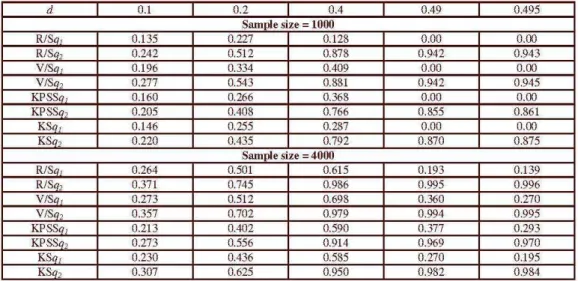
Table 1 presenls lhe 5% power of lhe modified R/ S, V /S, KPSS and KS lesls.
We notice that: (i) the power of each test decreases as d ---t 1/2 and ql is used. This happens because ql captures the long-range dependence under the alterna-tives; (ii) power of each test increases as d ---t 1/2 and q2 is used . In other words, our partially data-dependent formula q2 always generates reasonable power be-cause it captures the good performance of ql when the alternative is near the null model and the good performance of
B(n)
whenH
1 is distant fromHo;
(iii)V /S and modified R/S lesls have more power lhan KPSS and KS tesls when
Table 1: Power of Tesls
d 0.1 I 0.2 I 0.4 0.49 0.495
Sample size 1000
RISq, 0.135 0.227 0.128 0.00 0.00
RISq, 0.242 0.512 0.878 0.942 0.943
VISa, 0.196 0.334 0.409 0.00 0.00
V/Sq, 0.277 0.543 0.881 0.942 0.945
KPSSq, 0.160 0.266 0.368 0.00 0.00
KPSSq, 0.205 0.408 0.766 0.855 0.861
KSq , 0.146 0.255 0.287 0.00 0.00
KSq , 0.220 0.435 0.792 0.870 0.875
Sample size _ 4000
RISq, 0.264 0.501 0.615 0.193 0.139
RISq, 0.371 0.745 0.986 0.995 0.996
V/Sq, 0.273 0.512 0.698 0.360 0.270
V/Sq, 0.357 0.702 0.979 0.994 0.995
KPSSq, 0.213 0.402 0.590 0.377 0.293
KPSSq, 0.273 0.556 0.914 0.%9 0.970
KSq, 0.230 0.436 0.585 0.270 0.195
KSq, 0.307 0.625 0.950 0.982 0.984
Giraitis et aI. (2003) conducted Monte Carlo simulations to compare the
empirical power of modified R/S, V /S and KPSS lesls under differenl fixed
values of q. They concluded Ihal lhe V /S has always bel ler power Ihan lhe KPSS slalislic, for ali fixed values of q considered. Tables 1 shows Ihal lhe V /S lesl has more power Ihan lhe KPSS and KS lesls when boi h q セ@ q, and q セ@ fJ2
are employed. Anolher result reporled by Girails el a!. (2003) is Ihal lhe V /S
statistic has more power than the modified R/S statistic for large values of q.
Since ql ---t CXJ as d ---t 1/2 or rjJ ---t 1, the finding of Giraitis et aI. is a180 valid
if one employs the not recommended Andrews' formula, q = Ql. On the other
hand, if one uses Q2, the V /8 statistic is as powerful as the modified R/S. In
sum, Qur results indicate that, among the four test statistics considered, if q2
is chosen to be the lag truncation procedure, then, in terms of power, the V /8
and modified R/S slalislic will dominale lhe KPSS and KS slalislics. These
result exlend lhe findings of Girailis el ai (2003) for a bandwidlh choice Ihal is
4.1. 2 Size af Tes!
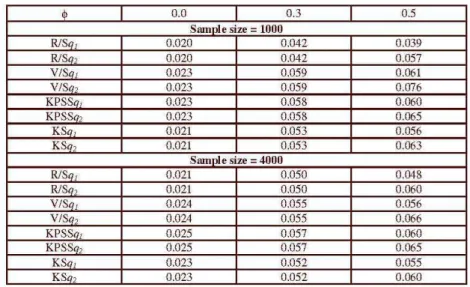
Table 2 shows the empirical size of 5% tests. We first notice that for all sample
sizes and truncation lags considered, the modified
RIS
statistic is moreconser-valive lhan lhe V/S. KPSS and KS slalislics for ali values of
q,.
When lhe shorlmemory dependence gets strong, that is, when rjJ gets distant from zero and q2
is used, the empirical size of all three statistics becomes larger than the nominal
size, but the difference between empirical and nominal size seems to diminish
when the sample size increases. For example, if rjJ = 0.5 and q = Q2, when the
sample size increases from 1000 to 4000, the empirical size of the V /8 statistic
goes from 0.076 to 0.066. In general, the empirical sizes of all four test statistics
are not very different from one another when q = q2 .
Table 2: Size of Tesls
"
I
0.0I
0.3I
0.5Sample size _ 1000
RlSq1 0.020 0.042 0.039
RlSa, 0.020 0.042 0.057
VISa, 0.023 0.059 0.061
V/Sq, 0.023 0.059 0.076
KPSSq1 0.023 0.058 0.060
KPSSa, 0.023 0.058 0.065
KSq, 0.021 0.053 0.056
KSq, 0.021 0.053 0.063
Sam le size _ 4000
RlSq1 0.021 0.050 0.048
RlSq, 0.021 0.050 0.060
V/Sq, 0.024 0.055 0.056
V/Sq, 0.024 0.055 0.066
KPSSq1 0.025 0.057 0.060
KPSSq, 0.025 0.057 0.065
KSq , 0.023 0.052 0.055
KSq, 0.023 0.052 0.060
5
Empirica! Results
In this sectioll, we investigate the presence of long-memory in financial time
series. We considered data on stock returns from the Center for Research in
Se-curily Prices (CRSP) daily files. We included lhe same period considered by Lo
indexes labelled as VWRETD and EWRETD, respectively. Daily observations
range from 3 July 1962 lo 31 December 1987, lolalizing 6,409 observalions. We
also considered real exchange rate data. We used monthly data of six
bilat-eral real exchange rates: Japan-USA, United Kingdom-USA, Germany-USA,
Germany-United Kingdom, Germany-Japan and Japan-United Kingdom. To
construct the real exchange rate, the data on the nominal exchange rate and
the price leveI (Consumer Price Index) are collected from the International
Fi-nanciaI Statistics CD-ROM, which is made by the International Monetary Fund
(IMF). The sample covers lhe Posl-Brellon Woods period lhal runs from April
1973 lo March 2001.
For each set of tests, we considered three lag truncation procedures: a lag
truncation equals to zero; the Andrews' formula ql; and our partially data de-pendent choice, q2.
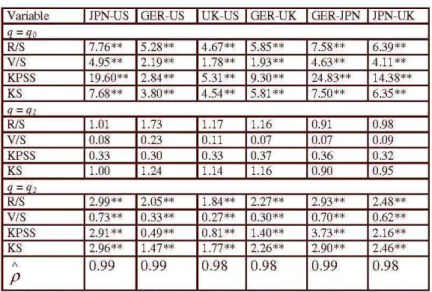
Table 3 displays the results for real exchange rates. We notice that the
null hypothesis of short memory is easily rejected when q =
o.
As mentioned in Lo (1991), the dassical tests, in which the long-run variance is replaced by the conventional variance estimator are not robust to the presence of shortmemory under the null and, consequently, we rejects
Ho
too often when q = O.Hence, we proceed by adopting the Andrews' formula, qll which turns out to
be robust against short memory in the null model. As you can see in table 3,
the null hypothesis of short memory cannot be rejected at all, excluding the
possibility that real exchange rate exhibit long range dependence . Remember
that, although robust against short memory, the Andrews' procedure is not
robust under the alternative model. Notice that the first order autoregressive
coefficient estimator,
p,
is too dose to unity, suggesting the absence of short memory. Consequently, ql will be too big causing a dramatic reduction in the power of the tests. The presence of short memory in exchange rate detectedwhen ql is used may be, in fact, a case of spurious short memory. Thus, the practitioner is led to believe that deviations from PPP are not persistent when
ql is used. If our partially data dependent choice q2 is employed, then the V /S, KPSS, KS and modified R/S statistics become robust against departures from
short memory. As a consequence, the null hypothesis is easily rejected when
process, lhen ils impulse response funclion IRk
セ@
88Yk "" l/(k' -d ) for O<
d<
UI1. SO, the impact of the innovations vanishes in the long run, but vanishes very
slow.
Table 3: Analysis of Real Exchange Rales
Variable IPN US I GER US IUK US GER UK I GER IPN I IPN UK I q ' アセ@
RIS 7.76** 5.28** 4.67** 5.85** 7.58** 6.39**
VIS 4.95** 2.19** 1.78** 1.93** 4.63** 4.11
**
KPSS 19.60** 2.84** 5.31
**
9.30** 24.83** 14.38**KS 7.68** 3.80** 4.54** 5.81
**
7.50** 6.35** I q ' q,RIS LOl 1,73 U7 U6 0,91 0,98
VIS 0,08 0,23 0,11 0,07 0,07 0,09
KPSS 033 030 033 037 036 032
KS LOO 1,24 U4 U6 0,90 0,95
I q" q
RIS 2.99** 2.05** 1.84** 2.27** 2.93** 2.48**
VIS 0.73** 0.33** 0.27** 0.30** 0.70** 0.62**
KPSS 2.91
**
0.49** 0.81**
1.40** 3.73** 2.16**KS 2.96** 1.47** 1.77** 2.26** 2.90** 2.46**
Á 0.99 0.99 0.98 0.98 0.99 0.98
P
The Symbol (**) mdicates reJoction of the DUO hypOtheslS at 5 % of slgnificance levei
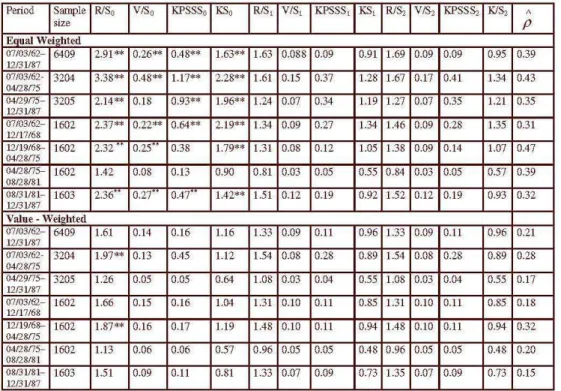
Tables 4, 5 and 6 report results for the equal and value weighted returns
indexes and its squared and absolute values for the sample periods considered
in Lo (1991): lhe enlire sample period ( lhe third row), lwo equally-parlilioned
sub-samples (the next two rows), and four equally-partitioned sub-samples (the
next four rows) . The last column of the tables include estimates of the first
order autoregressive coefficient,
p.
One can see that the estimates of the firstorder autoregressive coefficient of the return and its squared and absolute values
are small in all sample periods considered. Consequently, we do not expect
expressive differences between the value of q2 and the value of the bandwidth parameter obtained by the Andrews' formula. In other words, the tests will
Table 4: Analysis of Stock Returns
Period Sample RISo VISo KPSSSo KSe RiS, V/S1 KPSSS1 KS, R/S2 V/S2 KPSSS2 KlS, À
size p
Equal Weighted
07103/62 6409 2.91
**'
0.26** 0.48** 1.63** 1.63 0.088 0.09 0.91 1.69 0.09 0.09 0.95 0.3912/31/87
07103/62- 3204 3.38** 0.48** 1.17** 2.28** 1.61 0.15 0.37 1.28 1.67 0.17 0.41 1.34 0.43
04!28n5
04/29n5 3205 2.14** 0.18 0.93** 1.96** 1.24 0.07 0.34 1.19 1.27 0.07 0.35 1.21 0.35
12/31/87
07103/62 1602 2.37** 0.22** 0.64** 2.19** 1.34 0.09 0.27 1.34 1.46 0.09 0.28 1.35 0.31
12/17/68
12119168- 1602 2.32 0.25 0.38 1.79** 1.31 0.08 0.12 1.05 1.38 0.09 0.14 1.07 0.47
04!28n5
04!28n5 1602 1.42 0.08 0.13 0.90 0.81 0.03 0.05 0.55 0.84 0.03 0.05 0.57 0.39
08/28/81
08/31/81 1603 2.36 0.27 0.47 1.42** 1.51 0.12 0.19 0.92 152 0.12 0.19 0.93 0.32
12/31/87
Value - Weie:hted
07103/62 6409 1.61 0.14 0.16 1.16 1.33 0.09 0.11 0.96 1.33 0.09 0.11 0.96 0.21
12/31/87
07103/62- 3204 1.97** 0.13 0.45 1.12 1.54 0.08 0.28 0.89 1.54 0.08 0.28 0.89 0.28
04!28n5
04/29n5 3205 1.26 0.05 0.05 0.64 1.08 0.03 0.04 0.55 1.08 0.03 0.04 0.55 0.17
12/31/87
07103/62 1602 1.66 0.15 0.16 1.04 1.31 0.10 0.11 0.85 1.31 0.10 0.11 0.85 0.18
12117/68
12119168- 1602 1.87** 0.16 0.17 1.19 1.48 0.10 0.11 0.94 1.48 0.10 0.11 0.94 0.32
04/28n5
04/28n5 1602 1.13 0.06 0.06 0.57 0.96 0.05 0.05 0.48 0.96 0.05 0.05 0.48 0.20
08/28/81
08/31/81 1603 1.51 0.09 0.11 0.81 1.33 0.07 0.09 0.73 1.35 0.07 0.09 0.73 0.15
12/31/87
"
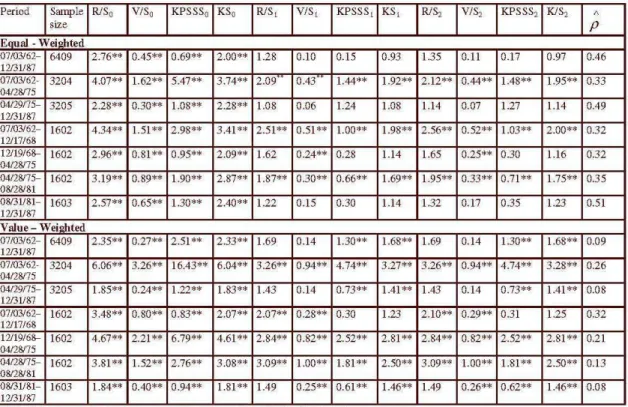
Table 5: Analysis of Squared Returns
Period Sample RIS, VISo KPSSS o KSo RIS, V/S1 KPSSS1 KS1 RiS, VIS, KPSSS2 KlS2
;;
size
I Euum
セ@
iセセZ[Zイ@
2.76" 1°045• 10M.' 2.00 ' 1.2' 1°.10 0.15 O." IUS 0.11 1°.17 10m 0046I
セセセセセ[@
3204 4.07 " 11.62" 15047 •• 3.74· ' 2.09 10043 1.44· ' 1.92·· 12.12'. 0.44·· 11048'. 11.95·· 0.33iセセゥ[ゥ[M
3205 2.28 · ' 0.30** 1.08** 2.28 · ' 1.08 0.06 1.24 1.08 1.14 0.07 1.27 1.14 0.49107/03/62- 1602 4.34· · 1.51 ** 2.98 ** 3041 " 2.51 ** 0.51 ** 1.00 ** 1.98 ** 2.56** 0.52** 1.03** 2.00 ** 0.32
1602 2.96· ' 10.81 " 10.95 •• 2.09" 1.62 10.24'. 0.28 1.14 11.65 0.25·· 10.30 11.16 0.32
104/28/75
I
セセ[セゥ[M
1602 3.19 " 10.89" 11.90·' 2.87 " 1.87' · 10.30. ' 0.66" 1.69" 11.95· ' 0.33 " 10.71 " 11.75·' 0.35I
セセZ[ZゥM
1603 2.57" 10.65" 1.30** 2.40" 1.22 10.15 0.30 1.14 1.32 0.17 10.35 1.23 0.51I
i03i/87
6409 2.35" 10.27" 12.51 " 2.33 " 1.69 10.14 1.30 " 1.68 " 11.69 0.14 11.30" 11.68 " 0.09I
セセセセセゥ@
3204 6.06** 3.26** 16.43 ** 6.04** 3.26** 0.94** 4.74** 3.27** 3.26** 0.94** 4.74** 3.28** 0.26iセセセ[セM
3205 US " 1°·24· 11.22·' U3 ' 1.43 1°.14 0.73 ·· 1.41 ·· 11.43 0.14 10.no 11.41 ·' 0.0'I
セセセゥ[ZゥM
1602 3.48 · ' 10.80" 10.83 •• 2.07· ' 2.07'· 10.28'. 0.30 1.23 12.10 •• 0.29 ·· 10.31 11.25 0.32iセセ[セセセ@
1602 4.67 ' · 12.21 . ' 16.79. ' 4.61 ·· 2.84" 10.82.' 2.52" 2.81 · ' 12.84. ' 0.82" 12.52" 12.81 " 0.21I
セセ[セゥ[M
1602 3.81 ,. 1.52** 2.76** 3.08 " 3.09** 1.00 ** 1.81 ** 2.50 ** 3.09 ** 1.00 ** 1.81** 2.50 ** 0.13iセセZ[Zイ@
1603 U4' 1°040 • 1°.94.' UI' 1.49 1°·25" 0.61"' 1.46' · 11.49 0.26" 1°·62' 11.46·' 0.0'Table 6: Analysis of Absolute Value of Returns
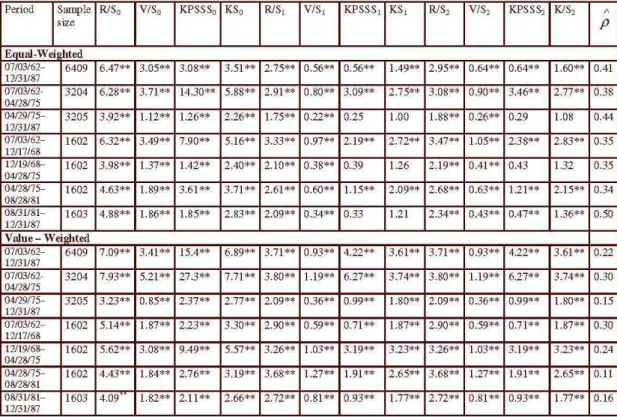
I P,riod QセZ[ャ・@ RIS, VIS, KPSSSo KS, RIS, V/S1 KPSSS1 KS, RIS, V/S2 KPSSS2
iセセゥ[ァM
6409 6.47** 3.05" 3.08** 3.51**
2.75** 0.56** 0.56** 1.49** 2.95** 0.64** 0.64**I
セセセセセセN@
13204 16.2" 3.71" 14.30' 15.," ' 12.n ' 0.'0 " 13.°'.' 12.75.' 3.0'·· 1°.'°.' 3.46"iセセゥ[[[M
13205 13.92. ' 1.12" 1.26" 12.26" 11.75" 0.22'· 10.25 11.00 1.88·· 10.26" 0.29I
セセセゥ[ZゥM
1602 632** 3.49" 7.90 ** 15.16" 3.33** 0.97** 2.19** 2.72** 3.47** 11.05" 238**iセセ[セセセ@
1602 3.98 ** 1.37 ** 1.42** 2.40** 2.10 ** 0.38 ** 0.39 1.26 2.19 ** OA1 "'* 0.43I
セzセセ[セM
11602 14.63 •• 1.89 ' · 3.61 · ' 13.71 " 12.61 •• 0.60 " 11.15" 12.09' . 2.68 " 10.63 ' . 1.21 "iセセセZゥM
11603 14.88" 1.86·' 1.85" 12.83 " 12.09 " 0.34" 10.33 11.21 2.34" 10.43 " 0.47"112131/87 16409 17.09 . ' 3.41 " 15.4" 16.89 • • 13.71 " 0.93'· 14.22 •• 13.61" 3.71 ·· 10.93'. 4.22"
I
セセセセセゥ@
13204 17.93" 5.21 ·' 27.3" 17.71 " 13.80" 1.19'· 16.27" 13.74" 3.80" 11.19·' 6.27"iセセゥ[ゥゥM
13205 3.23 ** 0.85" 237** 2.77 ** 2.09 ** 0.36** 0.99** 1.80** 2.09 ** 0.36** 0.99* *I セZ←セZ←セZM 11602 15.W U7 2.23' 1330 ' 12.'° ' 0.5' ·· 1°.71 .' IU7·' 2.'0·· 1°.5'.' 0.71"
11602 15.62. ' 3.08·· 9.49 · ' 15.57. ' 13.26 •• 1.03" 13.19 ' . 13.23' . 3.26·' 11.03'· 3.19" 104/28/75
I
セz[セゥ[M
11602 14.43" 1.84" 2.76" 13.19 " 13.68 " 1.27 " 11.91 " 12.65. ' 3.68 " 11.27 " 1.91"I
セセZ[ZゥM
1603 14.09 ' 1.82** 2.11**
2.66** 2.72** 0.81**
0.93** 1.77** 2.72** 0.81**
0.93* *No'" W ' )
ind',,""*'
tion, ofth" '5%kvel"Table 4 shows that when one employs the correct bandwidth parameter (q2
or
Ql),
the null hypothesis of short memory cannot be rejected in all sampleperiods. This result validate the findings of Lo (1991) by considering trunca-tion lag procedures that are robust under the alterna tive hypothesis of long
memory. Using other samples and other statistical tests, the presence of short
memory in stock returns indexes has also been reported by Hauser, Kunst, and
Reschenhofer, 1994; Huang and Yang, 1995, Lobato and Savin (1998), among
others.
KlS/ A
P
1.60 ** 0.41 2.77 ·· 1°.3'
1.08 10.44
2.83 ** 10.35
1.32 0.35
2.15" 10.34 1.36" 10.50
3.61 ·· 10.22 3.74'· 10.30 1.80 ** 10.15
u r· 1°.30
Tables 5 and 6 show the resutls for the squared and absolute values of
the stock return indexes. The results below suggest the rejection of the null of
weak dependence in squared returns for most of the considered sample periods.
The rejection is even stronger for absolute returns. These results suggest the
presence of long memory in series ofvolatility, implying that standard techniques
of inference can yield misleading results in volatilities models. For instance, the
standard errors for the estimates of the coefficients of conventional ARCH or
stochastic volatility models will be imprecise and, therefore, wrong confidence
intervals for forecasting will be obtained. Using other samples and statistical
tests, long memory in volatility has already been reported in the literature by
Lobalo and Savin (1998), Lobalo and Robinson (1998), Ohanissian el a!.
(2003), among others. In sum, using a truncation lag procedure that is robust
under the alterna tive hypothesis of long memory, we validate standard results
already reported in the literature: returns exhibit short memory whereas more
evidence of long memory is observed in squared and absolute values of returns,
suggesting the existence of long-memory volatility.
6
Conclusion
This paper attempts to contribute to the advance in the literature of
long-range dependence by showing that stationarity tests may have low or no power
when an inappropriate bandwidth parameter is used to calculate the long-run
variance. In particular, we showed that the use of the Andrews ' formula may
produce what we called spurious short memory. A new bandwidth procedure is
proposed and Monte Carlo experiments indicate that it is robust against
long-memory alternatives. Among the four test statistics studied, we found that
lhe V /S slalislic proposed by Girailis el . a!. (2003) and lhe modified R/S
statistic proposed by Lo (1991) have the best trade-off between size and power. We recognize that the problem of choosing the optimal q is not solved yet, but providing a bandwidth procedure that is robust against both the null and
alternative models may help practitioners in their investigation on the presence
of long range dependence in financiaI time series. We re-visited several economic
and financiaI time series using the proposed approach and found evidence of
spurious short memory in real exchange rates, implying that, if the Andrews'
are not persistent. Short memory in stock returns and long memory in volatility
are also found.
7
References
Andrews, D.W.K., 1991, "Heteroskedasticity and autocorrelation consistent
covariance matrix estimation," Econometrica, 59, 817---S58.
Beran, J., 1994, Statistics for Long-Memory Processes. Chapman & HaU, New
York.
Caner, M., and L. Kilian., 2001, Size Distortions of the NuU Hypothesis of
Stationarity: evidence and implications for the PPP debate .
Culver, S.E., and D.H. Papell., 1999, Long-run Purchasing Power Parity with
Short-run Data: evidence with a nuU hypothesis of stationarity. Journal
of International Money and Finance 18, 751-768.
Doornick, J. A., and M. Ooms (2001). A package for estimating, forecasting
and simulating Arfima models: Arfima package 1.01 for Ox. Nuffield
College, Oxford OX1 INF, UK.
Fan, Y., and Linton, O.B., 2000, Some Higher Order Theory for a Consistent
Nonparametric Model Specification Test, Manuscript, Yale University.
Giraitis, L., and M.S. Taqqu, 1999, Convergence of Normalized Quadratic
Forms, Journal of Statistical Planning and lnference, 80, 15-36.
Giraitis, L., P. Kokoszka, R. Leious, and G. Teyssiere, 2003, Rescaled Variance
and Related Tests for Long Memory in Volatility and LeveIs, Journal of
Econometrics, 112, 265-294.
HaU, P., J.L. Horowitz, and B. Jing, 1995, On Blocking Rules for the Bootstrap
with Dependent Data, Biometrika, 82, 561-574.
Hauser, M., R. Kunst and E. Reschenhofer, 1994, Modelling Exchange Rates:
Long Run Dependence versus Conditional Heteroskedasticity, Applied
Huang, B., and C. Yang, 1995, The Fractional Structure in Multinational Stock
Returns, Applied Economic Letters, 2, 67-71.
Lee, D., and P. Schmidl, 1996, On lhe Power of lhe KPSS Tesl of Slalionarily
Against Fractionally-integrated Alternatives, Journal of Econometrics, 73,
285-302.
Koenker, R. and Z. Xiao, 2000, Testing Stationarity Using M-Estimation,
Man-uscript, University of Illinois.
Linton, O.B., 1998, Edgeworth Approximations for Semiparametric
Instru-mental Variable Estimators and Test Statistics. Journal of Econometrics
(forlhcoming).
Lo, A., 1991, Long-Term Memory in Stock Market Prices, Econometrica, 59,
1279-1313.
Lobato, L N., and N.E. Savin, 1998, Real and Spurious Long-Memory
Prop-erties of Stock-Market Data. Journal of Business
êJ
Economic Statistics,16, 261-268.
Lobalo, I. N., and P. M. Robinson, 1998,
A
Nonparamelric Tesl for 1(0),Review of Economic Studies, 65, 475-495.
Mandelbrol,
B.
and M.S. Taqqu, 1979, Robusl R/S analysis of long-run serialcorrelation, Proc. of the 42nd Session of the Int. Statistical Institute,
Manila.
Mandelbrot, B. and J. Wallis, 1969a, Computer experiments with Fractional
Gaussian Noises, Part 1, 2, 3, Water Resources Research, 5, 228-267.
Mandelbrol,
B.
and J. Wallis, 1969b, Robuslness of lhe rescaled range R/Sin the measurement of noncyclic long-run statistical dependence, Water
Resources Research, 5, 967-988.
Mandelbrot, B. and J. Wallis, 1969c, Some long-run properties of geophysical
records, Water Resources Research, 5, 321-340.
Ohanissian, A ., J. Russell, and R . Tsay, 2003, Using Temporal Aggregation
to Distinguish between True and Spurious Long Memory, Working Paper,
Phillips, P.C.B., 1991, "Spectral regression for Cointegrated time series," Non-parametric and semiNon-parametric methods in economics and statistics, eds. W. Barnett etc., Cambridge University Press.
Taqqu, M.S., V. Teverosky, and W. Wilinger, 1995, Estimators for long-range
dependence: an empirical study. FractaIs 3(4),785-798.
Taylor, A .M. (2002). A century of purchasing-power parity. Review of
Eco-nomics and Statistics 84, 139-150.
V . Teverovsky, M.S. Taqqu, and W . Willinger, 1999, A CriticaI Look at Lo's
Modified R/S statistic, Journal of Statistical Planning and lnference, 80,
211-228.
Willinger, Walter, Murad S. Taqqu, and Vadim Teverovsky, 1999, Stock Market
Prices and Long-Range Dependence. Finance and Stochastic, 3(1), 1-13.
Xiao, Z., 2001, Testing the Null Hypothesis of Stationarity Against an
Autore-gressive Unit Root Alternative. Journal of Time Series Analysis, 22(1),
87-103.
Xiao, Z., 2002, Note on Bandwidth Selection in Testing for Long-Range