The Multiple Impacts of Tropical Forest
Fragmentation on Arthropod Biodiversity
and on their Patterns of Interactions with
Host Plants
Julieta Benítez-Malvido1
*, Wesley Dáttilo2, Ana Paola Martínez-Falcón1,3,
César Durán-Barrón4, Jorge Valenzuela5, Sara López4, Rafael Lombera6
1Laboratorio de Ecología del Hábitat Alterado, Instituto de Investigaciones en Ecosistemas y Sustentabilidad, Universidad Nacional Autónoma de México (UNAM), Morelia, Michoacán, Mexico, 2Instituto de Ecología AC, Red de Ecoetología, Xalapa, Veracruz, Mexico,3Centro de Investigaciones Biológicas, Universidad Autónoma del Estado de Hidalgo, Apartado postal 69–1, 42001 Pachuca, Hidalgo, Mexico,4Departamento de Zoología, Instituto de Biología, Universidad Nacional Autónoma de México, A.P. 70–153, México, Distrito Federal C. P., 04510,5Instituto de Ecología AC, Red de Ecología Funcional, Xalapa, Veracruz, Mexico,6Universidad Intercultural de Chiapas, Unidad Académica Multidisciplinaria Las Margaritas, Chiapas, Mexico
Abstract
Tropical rain forest fragmentation affects biotic interactions in distinct ways. Little is known, however, about how fragmentation affects animal trophic guilds and their patterns of inter-actions with host plants. In this study, we analyzed changes in biotic interinter-actions in forest fragments by using a multitrophic approach. For this, we classified arthropods associated withHeliconia aurantiacaherbs into broad trophic guilds (omnivores, herbivores and preda-tors) and assessed the topological structure of intrapopulation plant-arthropod networks in fragments and continuous forests. Habitat type influenced arthropod species abundance, diversity and composition with greater abundance in fragments but greater diversity in con-tinuous forest. According to trophic guilds, coleopteran herbivores were more abundant in continuous forest and overall omnivores in fragments. Continuous forest showed a greater diversity of interactions than fragments. Only in fragments, however, did the arthropod com-munity associated withH aurantiacashow a nested structure, suggesting novel and/or opportunistic host-arthropod associations. Plants, omnivores and predators contributed more to nestedness than herbivores. Therefore,Heliconia-arthropod network properties do not appear to be maintained in fragments mainly caused by the decrease of herbivores. Our study contributes to the understanding of the impact of fragmentation on the structure and dynamics of multitrophic arthropod communities associated with a particular plant species of the highly biodiverse tropical forests. Nevertheless, further replication of study sites is needed to strengthen the conclusion that forest fragmentation negatively affects arthropod assemblages.
a11111
OPEN ACCESS
Citation:Benítez-Malvido J, Dáttilo W, Martínez-Falcón AP, Durán-Barrón C, Valenzuela J, López S, et al. (2016) The Multiple Impacts of Tropical Forest Fragmentation on Arthropod Biodiversity and on their Patterns of Interactions with Host Plants. PLoS ONE 11(1): e0146461. doi:10.1371/journal.pone.0146461
Editor:Tadashi Fukami, Stanford University, UNITED STATES
Received:July 29, 2015
Accepted:December 17, 2015
Published:January 5, 2016
Copyright:© 2016 Benítez-Malvido et al. This is an open access article distributed under the terms of the
Creative Commons Attribution License, which permits unrestricted use, distribution, and reproduction in any medium, provided the original author and source are credited.
Data Availability Statement:All relevant data are within the paper.
Introduction
Habitat loss and fragmentation have been recognized as the most immediate threats to global biodiversity [1,2]. Biotic interactions (e.g. pollination, seed dispersal, predation, etc.) are important forces in structuring biological communities [3,4], and understanding how tropical rain forest fragmentation affects the ways in which organisms interact within and across tro-phic levels is relevant for conservation studies [4]. The new environments that develop after fragmentation generally fall outside the range of conditions that occurred in the natural forest in which different organisms interact [5,6]. Some novel environments, however, facilitate the colonization of native and/or exotic disturbance-loving species affecting the organization of ecological communities [7–10]. Because ecosystems are conformed by a web of trophic levels, the loss or decrease in the population of one species or functional group could in turn affect species of other trophic levels, thus modifying community structure and dynamics [7,11].
Plants are subject to colonization and/or attack by many different organisms (e.g. viruses, bacteria, fungi, nematodes, insects, among others) that may modify or interrupt their vital functions which affect plant fitness. In spite of this, some other organisms simply use plants as temporal or permanent habitats without damaging them and are even considered beneficial once they can predate on plant pests [12]. In Neotropical forests, antagonistic and mutualistic interactions of someHeliconiaspecies (Heliconiaceae: Zingiberales) have been fully described under natural and cultivated conditions [13–15]. Some such organisms are incidental visitors that use heliconias only as a substrate or to search for prey; they are also herbivorous inverte-brates feeding on the rhizomes, stems, floral bracts and leaves of heliconias. In contrast, other animal species expend part or their whole lives in the different structures of heliconias. These specialized herbivores include hispine beetles (Chrysomelidae) and caterpillars (Nymphalidae) [13]. Moreover, almost all species of Hispinae beetles are obligate pests of the Zingiberales, including heliconias [16,17].
Therefore, the large number of invertebrates within different trophic guilds (e.g. parasites, saprophytes, herbivores, omnivores and predators) associated withHeliconiaspecies provides an excellent model system for understanding the impact of tropical rain forest fragmentation on multitrophic interactions and also arthropod species diversity, abundance, composition, and species turnover. Several types of biotic interactions are increasingly at risk from local and global extinction as a consequence of fragmentation and other anthropogenic disturbances; however, most studies have focused only on species loss and overlook the loss of biotic interac-tions within different trophic guilds [7,18,19]. Thus, in this study we aimed to understand the patterns and processes underlying the structure of plant and animal communities in a frag-mented landscape of southern Mexico. We used as a model system the understory perennial tropical herbHeliconia aurantiacaGhiesbreght ex Lamaire and its associated arthropod fauna. We consideredH aurantiacaherbs as microhabitats, in which different trophic guilds of arthropods interact (i.e. herbivores, omnivores and predators).
Based on graph theory, several studies have found nonrandom patterns of interactions in plant-animal networks, including for example nestedness and modularity [20–22]. A network is considered nested if species with fewer interactions (peripheral species) are connected with species with the most interactions (central core species) in cohesive subgroups [23,24]. Alter-natively, a modular network indicates that there are subgroups of species that interact more fre-quently among themselves than with species from other subgroups in the network [22,25]. In fact, network analysis is a valuable tool for studying the diversity of species and interactions within and across trophic levels [19–21].
In tropical forests, studies have shown that although a drastic turnover of animal species from conserved to disturbed habitats the nested structure of ecological networks is maintained
The funders had no role in study design, data collection and analysis, decision to publish, or preparation of the manuscript.
[8–10]. Therefore, by usingH.aurantiacaas a model system we evaluated whether or not the structure of ecological networks depends on habitat type and on the trophic guild of the associ-ated arthropod faunas. Specifically we addressed the following questions: (1) Do arthropod abundance and diversity change between continuous forest and fragments? (2) Do trophic guilds change between habitat types? (3) Does individual-based network structure change in
H.aurantiacaplants between continuous forest and forest fragments? (4) What is the
contribu-tion of distinct trophic guilds to nestedness in the resulting ecological networks? Because the abundance and composition of invertebrate communities have been shown to differ in human-disturbed landscapes and specialized herbivores decrease therein (e.g. chrysomelid beetles and caterpillars), we expected that fragments and continuous forest do not share similar ecological network structures.
Methods
Study area
The Comisión Nacional de Áreas Naturales Protegidas (CONANP), granted permits to work in Montes Azules Biosphere Reserve (MABR) (permission number SGPA/DGVS/07830). The study was conducted within the MABR, Chiapas, in southeastern Mexico (16°06’N, 90°56’W, 120 m elev.). The MABR is within the Selva Lacandona region that comprises part of Guate-mala and Mexico [26]. Human activities have dramatically reduced the original forested area (500,000 ha) by one-third in 40 years. The MABR contains the majority of the remaining forest of the region (3, 310 km2) and constitutes the main component of the Mesoamerican biodiver-sity hotspot [27,28]. Currently the landscape is composed of a mosaic of land uses including forest fragments, secondary vegetation of various ages, human settlements, cropland, pastures, and paved and unpaved roads. Maximum and minimum annual temperatures are 31.8°C (April-May), and 18°C (January-February), respectively. Annual precipitation is ca. 3, 000 mm [29].
The main vegetation type is lowland tropical rain forest, with trees reaching up to 40 m in height in alluvial terraces along main rivers [30]. There are ca. 4,000 species of vascular plants [26]. Two replicates of contrasting habitat types were considered for this study: old-growth continuous forests and small forest fragments (<10 ha with 20–30 years of isolation). Tree
species richness and density are similar between fragments and continuous forest; however, continuous forest sites hold a greater number of large trees (>60 cm diameter at breast height)
and lower canopy openness than forest fragments [31]. In order to have different populations
ofH.aurantiaca, the four study sites were at least 4 km apart from each other and in alluvial
terraces [30].
Study species
Eight species of the genusHeliconiahave been recorded in the study area, but only three can be found under the shaded conditions of the forest understory:H.aurantiaca,H.librata, and
H.vaginalis[32]. The most common of these shade-tolerant herbs within forest fragments is
H.aurantiaca. Herbs ofH.aurantiacaare native to America, and are 0.5–2.0 m tall, with a
zin-giberoid growth form and a spiral bract arrangement with erect inflorescences [32]. The foliage ofH.aurantiacais attacked by three major groups of insects [33]: (i) hispine beetles—mostly small chrysomelids, some specialized in the genusHeliconia[16,17,34]; (ii) caterpillars represented by a broad gradient of body size, including those large and specialized
CaligoandOpsiphanes(owl butterflies) [33,35]; and (iii) leaf-cutter ants of the generaAttaand
Preliminary observations in the study area suggest that the density of specialist hispines declines in forest fragments, whereas that of leaf-cutter ants increases. No change has been observed in the abundance of caterpillars [37]. Three species of hispine beetles (i.e.Cephaloleia
spp) have been recorded feeding on the foliage ofH.aurantiaca; one species belongs to the belti-complex, and the other two species belong to the instabilis-stenosoma complex. In addi-tion, six species of caterpillars have been observed feeding onH.aurantiacafoliage; three of which are considered specialized in Zingiberales (i.e.Caligo uranus,C.memnonand
Opsi-phanes tamarindi tamarindi), and the rest are considered as generalist herbivores (i.e.Tarchon
felderi,Antichlorissp.,Achariacf.stimulea[37]). Furthermore, the numbers of leaf-cutter ant
nests (Atta cephalotes) are higher in fragments than in continuous forest [37]. Other inverte-brates found to inhabit different structures ofH.aurantiacafoliage include spiders, harvest-men, other ants, other beetles, bees, cockroaches, ticks, flies, mosquitoes, grasshoppers, phasmids, bugs and snails (Benítez-Malvido, unpublished data). The density of and the physi-cal and chemiphysi-cal foliage traits ofH.aurantiaca(i.e. leaf area, leaf toughness, leaf condensed tannins, number of shoots per plant, etc.) have been shown not to differ significantly between continuous forest and forest fragments (Table 1).
Invertebrate sampling
To assess whether or not forest fragmentation affects local arthropod diversity and abundance within different trophic guilds, in each habitat at each study site we randomly selected seven individuals ofH.aurantiaca. Individuals ofH.aurantiacawere at least 5 m apart from each other on all study sites and habitat types. Arthropods were collected in three surveys during May, August and November of 2013. In each survey, we randomly selected new individuals, and therefore no plant ofH.aurantiacawas sampled more than once. In total, we sampled 84 different plants: 42 in continuous forest and 42 in forest fragments. The samples of one plant per habitat were lost however.
We collected all arthropods (mainly adults and a few larvae) found onH.aurantiaca
clumps. Firstly, we made a visual inspection of the plant to catch jumping insects and spiders. Secondly, we collected arthropods by tapping the plant with a stick while holding a collecting tray underneath. Finally, we carefully reviewed all plant structures including leaf blade, petiole, and bracts to collect all the arthropods in the individual clumps. Arthropods were placed into plastic pots containing alcohol 70% and subsequently identified to the lowest possible taxo-nomic level. Voucher adult specimens were deposited at the Instituto de Biología and at the Instituto de Investigaciones en Ecosistemas y Sustentabilidad collections, UNAM, Mexico. Some of the collected specimens might be undescribed or new records for Mexico. Although
Table 1. Characteristics (mean±SE) ofHeliconia aurantiacaplants in continuous forest and forest fragments in southeastern Mexico (modified after [37]; Santos & Benítez-Malvido, unpublished data).
Continuous Forest Forest Fragments
Host density (clumps/314 m2) 98±13 137±22
No. of leaves 134±18 154±14
Leaf area (cm2)a 1532±19 1396±39
No. of shoots per yeara 38±04 43±09
No. offlowers per yeara 143±20 172±21
Absorbance of condensed tannins 26±02 25±032
Leaf toughness (g/cm2) 2626±242 2738±145
aMean leaf area, shoot number and
flower number were calculated from 18 plants per habitat
caterpillars (Lepidoptera) have been reported as pests ofHeliconiaelsewhere [15], we did not collect their larvae in our surveys [33]. All collected arthropods were subsequently classified into four broad trophic levels as follows: herbivores, omnivores, scavengers and predators [12,15]. The designation of the trophic guilds was based on the literature, morphological exam-ination of the mouth structures and on expert knowledge. Scavengers were poorly represented (three species of Coleoptera, Ptinidae and eight individuals) and therefore were excluded from further analysis (S1 Table). Insect herbivores can feed either externally or internally within plants (e.g., chewing insects, leaf miners, fluid and/or phloem feeders, and gall-making insects) [15]. However, because of the limited knowledge on the arthropod community in the study region, it was only possible to classify insects and other arthropods into the above trophic guilds regardless of their feeding mode.
The arthropod community
To detect differences in arthropod density within trophic guilds between habitats we used gen-eralized linear models (GLM) for count data with a Poisson error distribution and a logit link function; we also checked for overdispersion [38]. Preliminary analysis showed that arthropod density did not differ between sampling times (χ2= 4.05, df = 2,P= 0.1) and therefore, data
from the three surveys were pooled for all analyses as indicated for repeated measurements [39, 40]. Sample coverage and true diversity metrics were calculated in SPADE [41]. Generalized linear models and bootstrap plot curves were carried out using R. 3.0.1 [38,42]. Completeness of arthropod species inventory per habitat type was evaluated as the percentage of observed species in relation to the number of species predicted by the sample coverage estimator, which is the least biased estimator of sample completeness [43]:
Cn¼1 f1
n
ðn 1Þf1
ðn 1Þf1þ2f2
wheref1andf2are the number of singletons and doubletons in the sample, respectively, andn is the number of individuals. Furthermore, in order to make direct statistical comparisons of species richness between habitat conditions, we generated individual-based rarefaction curves by using the on-line resource ¡NEXT [44] that is based on R-statistical language.
We calculated the number of effective species by using the measure of true diversity of Order 1 [45], which weights each species exactly by its frequency in each habitat type (i.e. favoring neither rare nor common species). Given the presence of rare species (singletons) in both habitats, we calculated the estimated diversity by employing the Chao and Shen method [46], which is a non-parametric approach that allows for an accurate estimation when there are unseen species in a community. In addition we calculated the diversity Order 2 (inverse of the Simpson index) [45], by using the MVUE estimator (minimum variance unbiased estimator). Finally, to assess the turnover of species composition between habitats we used similarity Bray-Curtis index between the two habitats [47], and differences were analyzed with a permutational multivariate analysis of variance after 999 permutations [48].
Patterns of species interactions by using an interaction network
approach
Firstly, we included the presence of different animal species visiting the 82 different individuals
ofH.aurantiacain each habitat (continuous forest and forest fragments) as independent
metric is derived from the Shannon’s diversity index and ranges from 0 (no diversity) to infin-ity [49]. We used theNODFmetric (based on overlap and decreasing fill) [50] in the ANIN-HADO program [51] to calculate if selective species would visit only a subset of plant
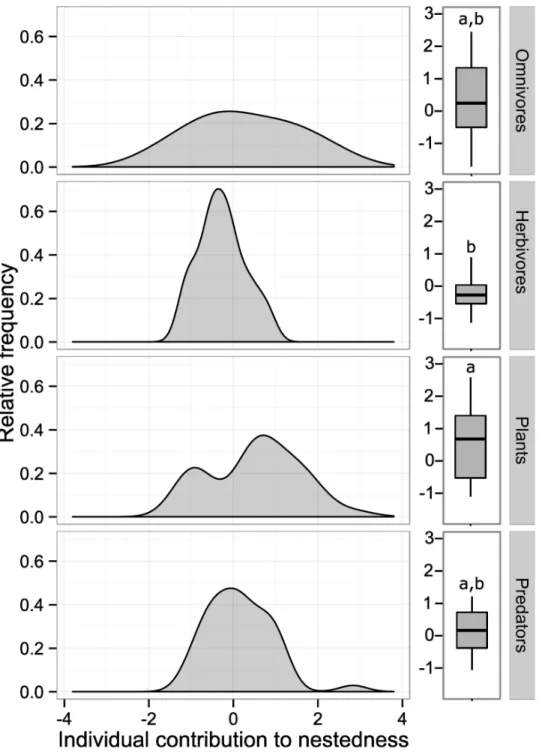
individuals visited by the central core species. We choose this metric because it is less prone to Type-I statistical error: in other words, the incorrect rejection of a true null hypothesis (a“false positive”). TheNODFmetric reduces the chance of overestimating the degrees of nestedness in ecological networks [50]. To assess if the nestedness value observed was higher than expected by random interaction patterns, we tested the nestedness of each network with 1000 networks generated by Null Model II. In this null model, the probability of occurrence of a new interac-tion is proporinterac-tional to the number of interacinterac-tions of a given species [20]. Once our interacinterac-tion network in the forest fragments was significantly nested (see theResultssection), we explored whether the three trophic guilds (herbivores, omnivores and predators) contributed equally to the structuring of the nested pattern. We estimated the degree to which the interactions of plants or trophic guilds increase or decrease the network’s overall nestedness (contribution to nestedness,cn) [52]. This estimate is derived from theNODFmetric, and positive values ofcn
indicate a higher contribution to the nested structure. Thereafter, we used a one-way ANOVA followed by a Tukey post hoc test to test for differences in mean values ofcniamong the three trophic guilds and plants.
Results
Fragmentation and arthropod abundance
Overall, we collected a total of 727 individuals, 285 (71 morphospecies) in continuous forest and 442 (55 morphospecies) in forest fragments. Arthropods collected fromH.aurantiaca
herbs included five orders and 27 families: Araneae, Coleoptera, Hemiptera, Hymenoptera and Orthoptera. Hymenoptera showed the greatest abundance: 470 individuals, all of which were ant species (Formicidae,S1 Table). All of the 82 sampledH.aurantiacaplants were occupied by arthropods; however, not all arthropod taxa were present in all plants. The number of arthropods per plant ranged from 1 to 25 individuals in continuous forest and from 1 to 55 individuals in forest fragments.
Arthropod abundance differed significantly between habitats (χ2= 34.14, df = 1,P<0001),
with forest fragments having the greatest abundance. Furthermore, there were significant dif-ferences in the density of arthropods within taxonomic orders between habitats (χ2= 392.42,
df = 4,P<0001). Forest fragments hold a significantly greater abundance of Hymenoptera
(ants) than continuous forest, whereas continuous forest holds a greater abundance of Coleop-tera (beetles) than forest fragments (Fig 1).
Forest fragmentation and trophic guilds
The arthropod community associated withH.aurantiacain continuous forest and fragments was grouped into three distinct trophic guilds: omnivores, herbivores and predators, with ant, beetle and spider species being the most representative taxa of each guild, respectively (S1 Table). The most common herbivore species were tortoise beetles (Chrysomelidae: Cassidinae) and bugs (Hemiptera); the most common predators were jumping spiders (Salticidae), whereas the most common omnivores were ants of the genusPheidoleandPseudomyrmex (Formici-dae). The abundance of trophic guilds differed significantly between habitats (χ2= 161.29,
df = 2,P<0.001), with omnivore species being significantly more abundant in forest
Fig 1. Total number of individuals within the five most abundant arthropod taxa and trophic-guilds inhabitingHeliconia aurantiacaherbs in continuous forest and forest fragments in southeastern Mexico.The number of arthropods was obtained from 41 clumps of heliconias per habitat type.
Fragmentation and arthropod diversity
Although estimations of sample coverage were high for both habitat types, 87% for continuous forest and 91% for forest fragments, none of the rarefaction curves in either habitat reached an asymptote (Fig 2). Comparing rarefaction curves at the lowest abundance value of 285 individ-uals, species richness showed no significant differences between habitats; and comparing spe-cies frequenspe-cies according to diversity Order 1, there were almost the same effective spespe-cies in continuous forest (25.83) as in forest fragments (22.54). In contrast, with diversity Order 2, diversity was two times greater in continuous forest (12.48 effective species) than in forest frag-ments (6.96 effective species). Finally, the permutational multivariate analysis of variance showed significantly different species composition (Bray-Curtis similarity index) between hab-itat types (pseudo-F1, 2= 1.73,P= 0.05). Some species were exclusively found in continuous forests (e.g.Dolichoderus lutosus) whereas others in fragments (e.g.Camponotus planatus) and some others were common in either habitat (e.g.Dolichoderus bispinosus, seeS1 Table).
Fragmentation and the structure of ecological networks
By evaluating the patterns of interactions, we found a higher diversity of interactions (DI= 451) in the continuous forest compared to forest fragments (DI= 422). Interestingly,
Fig 2. Rarefaction curves of species richness (bootstrap method) based on the number of arthropods inhabitingHeliconia aurantiacaherbs in continuous forest and forest fragments in southeastern Mexico.The shaded area represents the confidence intervals of 95% based on 1000 randomizations.
only in forest fragments the interaction network involving plants and their associated fauna was significantly nested (NODF= 8.99,P= 0.02) (Fig 3). The interaction network in the con-tinuous forest did not exhibit a nested pattern (NODF= 8.79,P= 0.19). Contributions to nest-edness differed greatly among plant and animal species for the interaction network in
fragments (ANOVA:F3, 109= 32.73, df = 3,P= 0.02), and only a few species within each tro-phic guild contributed strongly to the nested pattern. In general, plants (meanci± SE: 0.28 ± 1.03), omnivores (0.27 ± 1.28) and predators (0.15 ± 0.76) contributed more to nested-ness than herbivores (-0.27 ± 0.55) (Fig 4).
Discussion
Our results indicate that forest fragmentation influences the relative density and diversity of arthropods associated withH.aurantiacaherbs. Species richness remained fairly constant, but there was a marked species turnover in trophic guilds from continuous forest to fragments. Contrary to other findings on arthropod assemblages in conserved and disturbed habitats, we found that the structure ofHeliconia-invertebrate networks is not maintained in forest frag-ments [8–10]. The changes in the local abundance, diversity and composition of invertebrates across trophic guilds may seem to be caused by the combined effects of abiotic and biotic factors.
Habitat fragmentation and the arthropod community
Physical and biological factors in fragments may affect the rates of colonization and extinction of different arthropod taxa and trophic guilds in contrasting ways. In tropical rain forest frag-ments greater canopy openness tends to favor disturbance-loving insect herbivores (e.g. leaf-cutter ants; [7,36]). In fact we found a greater abundance and richness of ant species associated
withH.aurantiacain forest fragments, many of which were omnivorous species. The density
of ants inhabitingH.aurantiacawas six times greater in forest fragments than in continuous forest; fragments hold more than twice the number of ant species (17 ant species) than continu-ous forest (seven ant species). Nevertheless, none of the common leaf-cutter antsAttaand
Acromyrmex(common pests in the Neotropics) were recorded in our surveys (but see
[33,37,53]). Apart from ants, our results revealed that fragments have a higher proportion of omnivorous species that together with predatory spiders probably represent novel and oppor-tunisticHeliconia-arthropod interactions (Fig 2).
Fig 3. Interaction networks between individuals ofHeliconia aurantiacaand their arthropod
inhabitants divided into three trophic guilds inserted in (A) continuous and (B) forest fragments.Each node represents one animal species or plant individual, and lines represent plant-animal interactions.
Host traits and the arthropod community
Host quality and density may affect invertebrate growth and reproduction and therefore plant–
invertebrate interactions (Table 1) [11,56,57]. Leaf toughness is likely the best defensive strat-egy in heliconias as several species in the genus have few secondary compounds [56,58,59]. In
Fig 4. Relative frequency of individual nestedness contribution for all species within each of three trophic guilds.The data on absolute values of individual nestedness is presented as box plots illustrating the median (center line), quartile (box edges), and extreme values (bars) of each trophic guild. Boxplots sharing the same case letters are not significantly different among themselves according to Tukeypost hoc
tests.
the study area, however, the local density and chemical and physical leaf traits ofH.aurantiaca
did not differ significantly between habitats (seeTable 1), indicating that bottom-up (i.e. defense and nutrient content of plants) herbivory controls are not evident in our study system. On the other hand, top-down controls (i.e. predators and parasitoids) may be regulating the population dynamics of arthropods and therefore theHeliconia–arthropod interactions at some level [7].
This study highlights that the persistence of specialized plant-herbivore interactions ( Helico-nia-chrysomelids) could be limited in forest fragments, in which the understory physical envi-ronment, local extinction of some taxa, limited dispersal, reduced reproduction due to an increased predation and parasitism, will likely have deleterious consequences for the coloniza-tion ofH.aurantiacaplants by specialized beetles and other insects. The local extinction of spe-cies within different trophic guilds may affect the population dynamics of arthropods and therefore herbivory levels. In addition, as herbivores insects act as vectors of disease our results suggest that other biotic interactions may be affected by forest fragmentation as well [15].
Ecological network patterns in fragments
Nestedness describes the organization of niche breadth within an interactive community in which more nested interactions tend to have the highest niche overlap [9,60,61]. In this study, we found that only in fragments the arthropod community associated withH.aurantiacawas nested mainly because the increase of specialized herbivorous insects in continuous forest (e.g.
Spaethiellasp.). Moreover, we observed that more generalized trophic guilds (i.e. plants,
omni-vores and predators) had a greater contribution to network nestedness than did a trophic guild with specialized species inHeliconia(i.e. herbivores). These findings indicate that aHeliconia -arthropod network could be more functionally redundant in fragments compared to a Helico-nia-arthropod network within continuous forest. In other words, habitat fragmentation could be simplifying the community of arthropods interacting withH.aurantiacaand suggesting novel and/or opportunistic host-arthropod associations as some other interactions may disap-pear. Additionally, high herbivore diversity can also be promoted if plant–herbivore interac-tions are specialized, because finely partitioned plant resources will facilitate species
coexistence [11]. In fact, fragments exhibited lower diversity of interactions than continuous forest. Therefore,Heliconia-arthropod network properties do not appear to be maintained in fragments mainly because of the decrease in specialized herbivorous insects.
Conclusion
Further studies are still needed to analyze the importance of forest fragmentation in the distri-bution and phenology of specialized herbivores (e.g. Chrysomelidae) and other arthropods liv-ing inHeliconiaspecies. Studies including the impact of predators and parasitoids on
arthropod assemblages. The results obtained provide with valuable empiric information on the effects of forest fragmentation on biotic interactions of a particular system (Heliconia -arthropod interactions) within the Lacandon rain forest.
Supporting Information
S1 Table. Arthropod species associated to the tropical herbHeliconia aurantiaca.Labels according to trophic guilds are: Predators (Pr), Herbivores (Hb), Omnivores (O) and Saproph-agous (Sa). Trophic guilds and species are according to Arnett, et al. (2002), Ubick, et al. (2005), Foelix (2011), Groc, et al. (2014). Numbers indicate the abundance of each species within each habitat type, at Lacandon rain forest, Mexico.
(DOC)
Acknowledgments
We are grateful to JM Lobato-García for technical assistance in the field and in the laboratory and to Dr. W Maddison for identifying Salticidae species. We appreciate the financial and logistic support from Universidad Nacional Autónoma de México (UNAM) Project PAPIIT IN214014 to JBM and for a sabbatical grant to JBM at the Instituto Mediterráneo de Estudios Avanzados (IMEDEA), WD was supported by CNPq grant 237339/2012-9, and APMF by a postdoctoral scholarship from UNAM. The Comisión Nacional de Áreas Naturales Protegidas (CONANP), permission number SGPA/DGVS/07830)) granted permits to work in the MABR.
Author Contributions
Conceived and designed the experiments: JBM. Performed the experiments: APMF RL. Ana-lyzed the data: WD APMF. Contributed reagents/materials/analysis tools: JBM WD CD SL JV RL. Wrote the paper: JBM WD. Conceived of the study, designed the study, coordinated the study and drafted the manuscript: JBM. Carried out the ecological network analyses and helped draft the manuscript: WD. Collected field data, helped draft the manuscript and carried out statistical tests: APMF. Identified the arthropod species: CDB JV SL. Collected the specimens RL. Gave final approval for publication: JBM WD APMF CD SL JV RL.
References
1. Wilson EO. The Diversity of Life. Cambridge (MA): Belknap Press 1992.
2. Fazey I, Fischer J, Lindenmayer DB. What do conservation biologists publish. Biol Cons 2005; 124:63–73.
3. Webb CO, Ackerly DB, McPeek MA, Donoghue MJ. Phylogenies and community ecology. Ann Rev Ecol Syst 2002; 33:475–505.
4. Burslem DFRP, Pinard MA, Hartley SE. Biotic interactions in the tropics: their role in the maintenance of species diversity. Cambridge University Press, Cambridge. 2005.
5. Ewers RM, Didham RK. Confounding factors in the detection of species responses to habitat fragmen-tation. Biol Rev 2006; 81:117–142. PMID:16318651
6. Laurance WF, Useche DC. Environmental synergisms and extinctions of tropical species. Cons Biol 2009; 23:1427–1437.
7. Terborgh J, Lopez L, Nuñez VP, Rao M, Shahabuddin G, Orihuela G, Riveros M, Ascanio R, Adler GH, Lambert TD, Balbas L. Ecological meltdown in predator-free forest fragments. Science 2001;
294:1923–1926. PMID:11729317
8. Villa-Galaviz E, Boege K, del-Val E. Resilience in plant-herbivore networks during secondary succes-sion. PLoS ONE 2012; 7(12): e53009 PMID:23300846
10. Dáttilo W, Aguirre A, Quesada M, Dirzo R. Tropical forest fragmentation affects floral visitors but not the structure of individual-based palm-pollinator networks. PLoS ONE 2015; 10(3): e0121275 PMID:
25826702
11. Lewinsohn TM, Roslin. Four ways towards tropical herbivore megadiversity Ecol Let 2008; 11:398–416. 12. Aristizábal LF, Ospina KA, Vallejo UA, Henao ER, Salgado M, Arthurs SP. Entomofauna associated
withHeliconiaspp (Zingiberales: Heliconiaceae) grown in the central area of Colombia. Flo Ento 2013; 96:112–119.
13. Seifert RP. NeotropicalHeliconiainsect communities. Quart Rev Biol 1982; 57:1–28. 14. Sewake KT, Uchida JY. Diseases ofHeliconiain Hawaii. Res Ext Ser 1995; 159.
15. Benítez-Malvido J, Dáttilo W. Interaction intimacy of pathogens and herbivores with their plant hosts determines the topological structure of ecological networks in different ways. Am J Bot 2015; 102:1–8. 16. Strong DR. Rolled-leaf hispine beetles (Chrysomelidae) and their Zingiberales host plants in Middle
America. Biotropica 1977; 9:156–169.
17. Strong DR. Insect species richness: hispine beetles ofHeliconia latispatha. Ecology 1977; 58:573–582. 18. Memmott J, Waser NM, Price MV. Tolerance of pollination networks to species extinctions. Proc Roy
Soc Lon B 2004; 271:2605–2611.
19. Tylianakis JM, Laliberté E, Nielsen A, Bascompte J. Conservation of species interaction networks. Biol Cons 2010; 143:2270–2279.
20. Bascompte J, Jordano P, Melian CJ, Olesen J. The nested assembly of plant-animal mutualistic net-works. PNAS 2003; 100:9383–9387. PMID:12881488
21. Bascompte J, Jordano P. Plant-animal mutualistic networks: the architecture of biodiversity. Ann Rev Ecol Syst 2007; 38:567–593.
22. Olesen JM, Bascompte J, Dupont YL, Jordano P. The modularity of pollination networks. PNAS 2007; 104:19891–19896 PMID:18056808
23. Guimarães PR, Rico-Gray V, dos Reis SF, Thompson JN. Asymmetries in specialization in ant-plant
mutualistic networks. Pro Roy Soc Biol Sci 2006; 273:2041–2047.
24. Bascompte J, Stouffer BD. The assembly and disassembly of ecological networks. Phil Trans Roy Soc B 2009; 364:1781–1787.
25. Dáttilo W, Izzo TJ, Vasconcelos HL, Rico-Gray V. Strength of the modular pattern in Amazonian symbi-otic ant-plant networks. Arthro Plant Int 2013; 7:455–461.
26. Medellín R. Mammal diversity and conservation in the Selva Lacandona, Chiapas, Mexico. Cons Biol 1994; 8:780–799.
27. Myers N, Mittermeier RA, Mittermeier CG, Fonseca GAB, Kent J. Biodiversity hotspots for conservation priorities. Nature 2000; 403:853–858. PMID:10706275
28. Figueroa F, Sánchez-Cordero V, Meave JA, Trejo I. Socioeconomic context of land use and land cover change in Mexican biosphere reserves. Environ Cons 2009, 36:180–191.
29. Meave del Castillo J. Estructura y composición de la selva alta perennifolia de los alrededores de Bonampak. Colección Científica Serie Arqueológica Instituto Nacional de Antropología e Historia. 1990; México, DF.
30. Siebe C, Martínez-Ramos M, Segura-Warnholtz G, Rodríguez-Velázquez J, Sánchez-Beltrán S. Soils and vegetation patterns in the tropical rainforest at Chajul, Southeast Mexico. In: Simorangkir D, editor, Proceedings of the International Congress on Soils of Tropical Forest Ecosystems 3rd Conference on Forest Soils (ISSS-AISS-IBG) Mulwarman University Press, Samarinda, Indonesia,1995; pp 40–58. 31. González-Di Pierro AM, Benítez-Malvido J, Méndez-Toribio M, Zermeño I, Arroyo-Rodríguez V, Stoner
KE, et al. Effects of the physical environment and primate gut passage on the early establishment of an old-growth forest tree species (Ampelocera hottleiStandley) in tropical rainforest fragments.Biotropica
2011; 43:459–466.
32. Santos BA, Lombera R, Benitez-Malvido J. New records ofHeliconia(Heliconiaceae) for the region of Chajul, Southern Mexico, and their potential use in biodiversity-friendly cropping. Rev Mex Biod 2009; 80:857–860.
33. Santos AB, Benítez-Malvido J. Insect herbivory and leaf disease in natural and human disturbed habi-tats: lessons from early-successional Heliconia herbs Biotropica 2012; 44:53–64.
34. Wilf P, Labandeira CC, Kress WJ, Staines CL, Windsor DM, Allen AL, et al. 2000 Timing the radiations of leaf beetles: hispines on gingers from latest cretaceous to recent.Science2000; 289:291−294. PMID:10894775
36. Rico-Gray V, Oliveira PS. The ecology and evolution of ant-plant interactions. University of Chicago Press, Chicago 2007.
37. Santos BA. Efecto de la fragmentación de la selva y de la formación de bosques secundarios sobre la interacción planta-patógeno en especies de Heliconia (Heliconiaceae) en la Selva Lacandona. PhD. Thesis, Posgrado en Ciencias Biológicas, Universidad Nacional Autónoma de México; 2011. 38. Crawley M. The R Book. John Wiley and Sons Inc. West Sussex; 2007.
39. Mead R. The design of experiments: statistical principles for practical application. Cambridge Univer-sity Press, Cambridge, UK. 1990.
40. Crawley MJ. Statistical Computing: An Introduction to Data Analysis Using S-Plus. John Wiley and Sons, Ltd, West Sussex, UK. 2002.
41. Chao A, Shen T-J. Program SPADE (Species prediction and diversity estimation) Program and User’s Guide 2010. Available:http://chaostatnthuedutw.
42. R Development Core Team. R: a Language and Environment for Statistical Computing. R Foundation for Statistical Computing Vienna, Austria. 2013.
43. Chao A, Jost L. Coverage-based rarefaction and extrapolation: standardizing samples by complete-ness rather than size. Ecology 2012; 93:2533–2547. PMID:23431585
44. Hsieh TC, Ma KH, Chao A. iNEXT online: interpolation and extrapolation (Version 130) (Software) 2013. Available:http://chaostatnthuedutw/blog/software-download/Accessed 30 April 2015. 45. Jost L. Entropy and diversity. Oikos 2006; 113:337–363.
46. Chao A, Shen T-J. Non-parametric estimation of Shannon’s index of diversity when there are unseen species in sample. Environ Ecol Stat 2003; 10:429–443.
47. Magurran AE. Measuring biological diversity. Oxford: Blackwell Publishing; 2004. ISBN 0-632-05633-9. 48. Clarke KR, Gorley RN. PRIMER v61: user manual/tutorial. Plymouth Marine Laboratory Primer-E Ltd,
Plymouth; 2009.
49. Bersier LF, Banasek-Richte C, Cattin MF. Quantitative descriptors of food–web matrices. Ecology 2002; 83:2394–2407.
50. Almeida–Neto M, Guimaraes P, Guimaraes PR, Loyola RD, Urlich W. A consistent metric for nestedness analysis in ecological systems: reconciling concept and measurement. Oikos 2008; 117:1227–1239. 51. Guimarães PR Jr, Guimarães PR. Improving the analyses of nestedness for large sets of matrices.
Environ Mod Soft 2006; 21:1512–1513.
52. Saavedra S, Stouffer DB, Uzzi, Bascompte J. Strong contributors to network persistence are the most vulnerable to extinction. Nature 2011; 478:233–235. doi:10.1038/nature10433PMID:21918515
53. Wirth R, Meyer ST, Almeida WR, Araújo MV Jr, Barbosa VS, Leal IR. Increasing densities of leaf-cutter ants (Attaspp.) with proximity to the edge in a Brazilian Atlantic forest. J Trop Ecol 2007; 23:501–505. 54. López-Pérez S, Martínez-Falcón AP, Benítez-Malvido AP. First Record of the Tribe Hemisphaerotini
Monros and Viena (Chrysomelidae:Cassidinae) in Mexico. South Entomo 2015; 40:241–243. 55. Staines CL, Staines SL.The leaf beetles (Insecta:Coleoptera:Chrysomelidae):potential indicator
spe-cies assemblages for natural area monitoring. In: Therres GD (Ed). Proceedings of Conservation of Bio-logical Diversity: a key to restoration of the Chesapeake Bay ecosystem and beyond Maryland Department of Natural Resources, 2001; pp 233–244.
56. Fáveri SB, Vasconcelos HL, Dirzo R. Effects of Amazonian forest fragmentation on the interaction between plants, insect herbivores, and their natural enemies.J Trop Ecol2008; 24:57–64.
57. Kessler A, Baldwin IT. Plant responses to insect herbivory: the emerging molecular analysis. Ann Rev Plant Biol 2002; 53:299–328.
58. Gage DA, Strong DR. The chemistry ofHeliconia imbricataandH.latispathaand the slow growth of a hispine beetle herbivore. Bio Syst Ecol 1981; 9:79–82.
59. Dominy NJ, Grubb PJ, Jackson RV, Lucas PW, Metcalfe DJ, Svenning JC, Turner IM. In tropical low-land rain forests monocots have tougher leaves than dicots, and include a new kind of tough leaf. Ann Bot 2008; 101:1363–1377. doi:10.1093/aob/mcn046PMID:18387969
60. Bastolla U, Fortuna MA, Pascual-García A, Ferrera A, Luque B, Bascompte J. The architecture of mutu-alistic networks minimizes competition and increases biodiversity. Nature 2009; 458:1018–1021. doi:
10.1038/nature07950PMID:19396144
![Table 1. Characteristics (mean ± SE) of Heliconia aurantiaca plants in continuous forest and forest fragments in southeastern Mexico (modified after [37]; Santos & Benítez-Malvido, unpublished data).](https://thumb-eu.123doks.com/thumbv2/123dok_br/17167715.241086/4.918.299.864.151.307/characteristics-heliconia-aurantiaca-continuous-fragments-southeastern-benítez-unpublished.webp)