Case-Control Study of Platelet Glycoprotein
Receptor Ib and IIb/IIIa Expression in
Patients with Acute and Chronic
Cerebrovascular Disease
Peter Kraft1,4*, Christiane Drechsler2, Ignaz Gunreben1, Peter Ulrich Heuschmann3,4, Christoph Kleinschnitz1*
1Department of Neurology, University Hospital Würzburg, Würzburg, Germany,2Department of Internal Medicine, University Hospital Würzburg, Würzburg, Germany,3Clinical Trial Center, University Hospital Würzburg, Würzburg, Germany,4Institute of Clinical Epidemiology and Biometry, Comprehensive Heart Failure Center, University of Würzburg, Würzburg, Germany
*[email protected](PK);[email protected](CK)
Abstract
Background
Animal models have been instrumental in defining thrombus formation, including the role of platelet surface glycoprotein (GP) receptors, in acute ischemic stroke (AIS). However, the involvement of GP receptors in human ischemic stroke pathophysiology and their utility as biomarkers for ischemic stroke risk and severity requires elucidation.
Aims
To determine whether platelet GPIb and GPIIb/IIIa receptors are differentially expressed in patients with AIS and chronic cerebrovascular disease (CCD) compared with healthy volun-teers (HV) and to identify predictors of GPIb and GPIIb/IIIa expression.
Methods
This was a case—control study of 116 patients with AIS or transient ischemic attack (TIA), 117 patients with CCD, and 104 HV who were enrolled at our University hospital from 2010 to 2013. Blood sampling was performed once in the CCD and HV groups, and at several time points in patients with AIS or TIA. Linear regression and analysis of variance were used to analyze correlations between platelet GPIb and GPIIb/IIIa receptor numbers and demographic and clinical parameters.
Results
GPIb and GPIIb/IIIa receptor numbers did not significantly differ between the AIS, CCD, and HV groups. GPIb receptor expression level correlated significantly with the magnitude of GPIIb/IIIa receptor expression and the neutrophil count. In contrast, GPIIb/IIIa receptor OPEN ACCESS
Citation:Kraft P, Drechsler C, Gunreben I, Heuschmann PU, Kleinschnitz C (2015) Case-Control Study of Platelet Glycoprotein Receptor Ib and IIb/IIIa Expression in Patients with Acute and Chronic Cerebrovascular Disease. PLoS ONE 10(3): e0119810. doi:10.1371/journal.pone.0119810
Academic Editor:Sven G. Meuth, University of Muenster, GERMANY
Received:November 25, 2014
Accepted:February 1, 2015
Published:March 6, 2015
Copyright:© 2015 Kraft et al. This is an open access article distributed under the terms of the Creative Commons Attribution License, which permits unrestricted use, distribution, and reproduction in any medium, provided the original author and source are credited.
Data Availability Statement:Patient privacy concerns make data ethically unsuitable for public deposition. A de-identified dataset can be obtained from the corresponding author.
numbers were not associated with peripheral immune-cell sub-population counts. C-reactive protein was an independent predictor of GPIIb/IIIa (not GPIb) receptor numbers.
Conclusions
Platelet GPIb and GPIIb/IIIa receptor numbers did not distinguish between patient or control groups in this study, negating their potential use as a biomarker for predicting stroke risk.
Introduction
The crucial contribution of platelets to lesion development after ischemic stroke (IS) has gained widespread acceptance [1,2], although their specific pathophysiologic role and interactions with endothelial or immune cells have not been wholly delineated. With the aid of transgenic mouse models and specific antibodies, extensive studies in the area of experimental stroke re-search have proved successful in distinguishing the pathways involved in pathologic thrombus formation [2,3].
In conventional terms, arterial thrombus formation can be considered to be a dynamic and multistep process, whereby platelets initially flow over vascular lesions, decelerate and subse-quently‘tether’to the damaged vascular endothelium as a result of interactions with endotheli-um-derived von Willebrand factor (VWF) and the platelet-specific glycoprotein (GP) Ib-V–IX receptor complex [2,3]. In consequent steps, platelet GPVI receptors bind to sub-endothelial collagen while simultaneously activating platelets that, in turn, produce a conformational change in the GPIIb/IIIa receptors. Finally, activated GPIIb/IIIa receptors promote platelet ag-gregation by binding fibrinogen, which acts as a substrate for recruitment of additional plate-lets to the lesion site [2,3].
Evidence shows that inhibition of GPIb and GPVI receptors by antibodies or antibody frag-ments protects against IS formation in mice models of transient middle cerebral artery occlu-sion, without elevating the risk of bleeding complications [4,5]. Conversely, blockade of the final step of thrombus formation with monoclonal GPIIb/IIIa antibodies has not been shown to protect animals from IS and leads instead to increased rates of cerebral hemorrhage [4]. The observation that GPIb receptors not only stimulate thrombus formation, but also mediate in-flammatory processes [6,7] may provide a rational explanation for the high efficacy seen in ex-perimental stroke models of GPIb blockade.
In contrast to non-clinical models, there is limited knowledge surrounding the role and pathophysiologic relevance of GPIb and GPIIb/IIIa receptors in human stroke development. At best, a series of publications has focused on distinct platelet GP polymorphisms and their role as risk factors for vascular diseases, but the results remain controversial. It has been shown that the Kozak dimorphism of GPIb, but not the human platelet antigen (HPA)-Ib polymor-phism, was associated with an increased risk of IS [8,9]. Another study reported that GPIb re-ceptor numbers were elevated in patients with post-stroke depression [10]. Nevertheless, to date, the fundamental importance of GPIb and GPIIb/IIIa receptors in the clinical setting has been rarely investigated beyond genetic polymorphisms, and the factors that influence the ex-pression of these GP receptor sub-types warrant identification. As the main ligand of the GPIb receptor, VWF is differentially regulated in patients with acute ischemic stroke (AIS)/transient ischemic attack (TIA) and chronic cerebrovascular diseases (CCD), as well as in healthy volun-teers (HV) [11], whereas the regulation of GPIb and GPIIb/IIIa receptors has not yet been as-sessed in detail.
study design, data collection and analysis, decision to publish, or preparation of the manuscript.
Competing Interests:CK is a PLOS ONE Editorial
Board member. This does not alter the authors’
Additionally, despite experimental evidence that platelets have an important role in athero-sclerotic plaque pathophysiology [12,13] very few studies have specifically examined the regu-lation of the GPIb and GPIIb/IIIa receptors in patients with CCD [14–16].
Aims
This case—control study was conducted to evaluate whether GPIb and GPIIb/IIIa receptor numbers per single platelet differ between patients with acute cerebrovascular events (AIS/ TIA) and those with CCD, and to identify demographic and clinical factors associated with GPIb and GPIIb/IIIa receptor counts.
Methods
Data collection
Patients with acute cerebrovascular events (AIS/TIA) and CCD were included, as were HV from the local population who were used as controls in the study. All patients and subjects par-ticipating in the study met the following inclusion criteria: blood withdrawal within 24 hours after symptom onset in patients with AIS (defined as acute ischemic lesion on brain imaging) and TIA (no acute lesion); presentation with extracranial and/or intracranial stenosis of the large cerebral arteries with (n= 66) or without (n= 51) a history of AIS or TIA for the CCD group; and age50 years, no history of stroke, myocardial infarction, or peripheral arterial disease for the HV group. Patients with intracerebral hemorrhage, age<18 years, known plas-matic coagulation disorder or platelet dysfunction based on a detailed medical history were ex-cluded from the study.
Study participants were consecutively recruited from the Stroke Unit (inpatients diagnosed with TIA or AIS), the outpatient department for CCD, or from a convenient sample of the local population (HV) after responding to poster requests at the Neurology Department, Uni-versity Hospital of Würzburg, Germany, between September 2010 and January 2013. Informed written consent was obtained from all participants. The study protocol was approved by the ethics committee of the medical faculty of the University of Würzburg, Germany (reference number 65/2010). Overall, 116 patients with AIS or TIA, 117 patients with CCD, and 104 HV were eligible to participate in the study. Study participation did not affect treatment and patient care.
TOAST (Trial of Org 10172 in Acute Stroke Treatment) criteria [17] were applied to pa-tients with AIS or TIA in an adapted format: (1) cardioembolism; (2) large-artery atherosclero-sis; (3) small-vessel occlusion; or (4) other determined or undetermined etiology. Moreover, the National Institutes of Health Stroke Scale (NIHSS) [18] and Barthel Index score [19] were documented on patient admission, in addition to data on the interval between symptom onset and blood withdrawal, platelet inhibitor pretreatment, and acute stroke therapy modality (thrombolysis vs. no thrombolysis).
Cerebral lesion volume was measured using MIPAV software (medical image processing, analysis and visualization, Bethesda, US) on the basis of routine diffusion-weighted images (DWI) in a blinded fashion.
Blood collection and measurements
The number of GPIb and GPIIb/IIIa receptors per single platelet was measured using a com-mercially available fluorescent-activated cell sorting (FACS) kit (Biocytex, ID 7004, Marseille, France) according to manufacturer’s instructions. After the staining procedure, platelet recep-tors were quantified by FACS analysis (FACSCalibur, Becton Dickinson, Heidelberg, Ger-many) using beads that enabled quantification of the distinct number of receptors per single platelet based on mean fluorescence intensity. Differential hematology parameters and C-reactive protein (CRP, measured in the AIS/TIA group) were analyzed at the Division of Labo-ratory Medicine of the University Hospital Würzburg.
Statistical analysis
Continuous variables are expressed as mean with standard deviation or median with interquar-tile range (as appropriate), whereas categorical variables are presented as percentages. The as-sociation between the number of GPIb or GPIIb/IIIa receptors and demographic and clinical characteristics (age, sex, neurologic scales, disease modality [TIA or AIS], TOAST criteria, du-ration between symptom onset and blood withdrawal, NIHSS, Barthel Index, treatment modal-ity [intravenous thrombolysis or not], and intake of platelet inhibitors in the days before blood withdrawal) was explored using analysis of variance (ANOVA) and the chi-square test.P val-ues for comparisons across groups of clinical and demographic characteristics were derived from the aforementioned analyses, as appropriate. In order to identify potential predictors of GPIb and GPIIb/IIIa receptor numbers, a linear regression model was applied that included all variables without collinearity in a multivariate model with adjustment for age and sex. Coeffi-cients and corresponding 95% confidence intervals were estimated using the model. GPIb and GPIIb/IIIa receptor numbers were compared between the different patient groups (AIS/TIA inpatients, CCD outpatients, or HV), and distributions analyzed using the Kolmogorov—
Smirnov test. Numbers of GPIb and GPIIb/IIIa receptors were assumed to form a normal dis-tribution, which were compared using ANOVA with a Bonferronipost-hoctest and additional-ly adjusted for age and sex. All reportedPvalues are two-sided, with aPvalue<0.05
considered to be statistically significant. Analyses were performed using SPSS Version 21 and SAS software version 9.1 (SAS Institute Inc., Cary, NC).
Results
Descriptive analysis of the patients with an acute cerebrovascular event
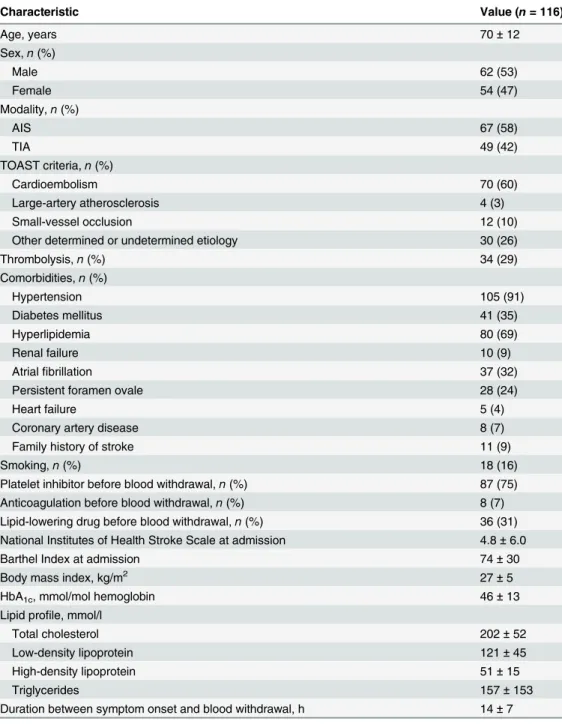
Overall, 116 patients with AIS/TIA were included in the study, with a mean age of 70 ± 12 years and a predominance of males (53%). In patients with AIS or TIA, the baseline clinical se-verity measured with NIHSS and Barthel Index was 4.8 ± 6.0 and 74 ± 30, respectively. More than half of the patients had an AIS (58%). The demographic and clinical characteristics of pa-tients with acute cerebrovascular events are summarized inTable 1.Comparison of GPIb and GPIIb/IIIa receptor numbers in patients with
AIS/TIA, CCD, and HV
Relationship between GPIb and GPIIb/IIIa receptor numbers and key
demographic and clinical parameters in patients with an acute
cerebrovascular event
In correlation analyses, the number of GPIb receptors was significantly associated with GPIIb/ IIIa receptor numbers (r= 0.44,P<0.001) and neutrophil counts (r= 0.23,P= 0.01). GPIIb/IIIa Table 1. Baseline characteristics of patients with acute ischemic stroke/transient ischemic attack.
Characteristic Value (n= 116)
Age, years 70±12
Sex,n(%)
Male 62 (53)
Female 54 (47)
Modality,n(%)
AIS 67 (58)
TIA 49 (42)
TOAST criteria,n(%)
Cardioembolism 70 (60)
Large-artery atherosclerosis 4 (3)
Small-vessel occlusion 12 (10)
Other determined or undetermined etiology 30 (26)
Thrombolysis,n(%) 34 (29)
Comorbidities,n(%)
Hypertension 105 (91)
Diabetes mellitus 41 (35)
Hyperlipidemia 80 (69)
Renal failure 10 (9)
Atrialfibrillation 37 (32)
Persistent foramen ovale 28 (24)
Heart failure 5 (4)
Coronary artery disease 8 (7)
Family history of stroke 11 (9)
Smoking,n(%) 18 (16)
Platelet inhibitor before blood withdrawal,n(%) 87 (75)
Anticoagulation before blood withdrawal,n(%) 8 (7)
Lipid-lowering drug before blood withdrawal,n(%) 36 (31) National Institutes of Health Stroke Scale at admission 4.8±6.0
Barthel Index at admission 74±30
Body mass index, kg/m2 27±5
HbA1c, mmol/mol hemoglobin 46±13
Lipid profile, mmol/l
Total cholesterol 202±52
Low-density lipoprotein 121±45
High-density lipoprotein 51±15
Triglycerides 157±153
Duration between symptom onset and blood withdrawal, h 14±7
AIS, acute ischemic stroke; HbA1c, glycated hemoglobin; TIA, transient ischemic stroke; TOAST, Trial of Org 10172 in Acute Stroke Treatment.
receptor expression was not associated with peripheral immune-cell sub-populations. In univari-ate analysis, neither GPIb nor GPIIb/IIIa receptor numbers correlunivari-ated with CRP levels (P>0.15). There was no correlation between cerebral lesion volume and GPIb (r= -0.15,P= 0.26) or GPIIb/ IIIa receptor numbers (r = -0.06, P = 0.67) on day 0, respectively (data not shown).
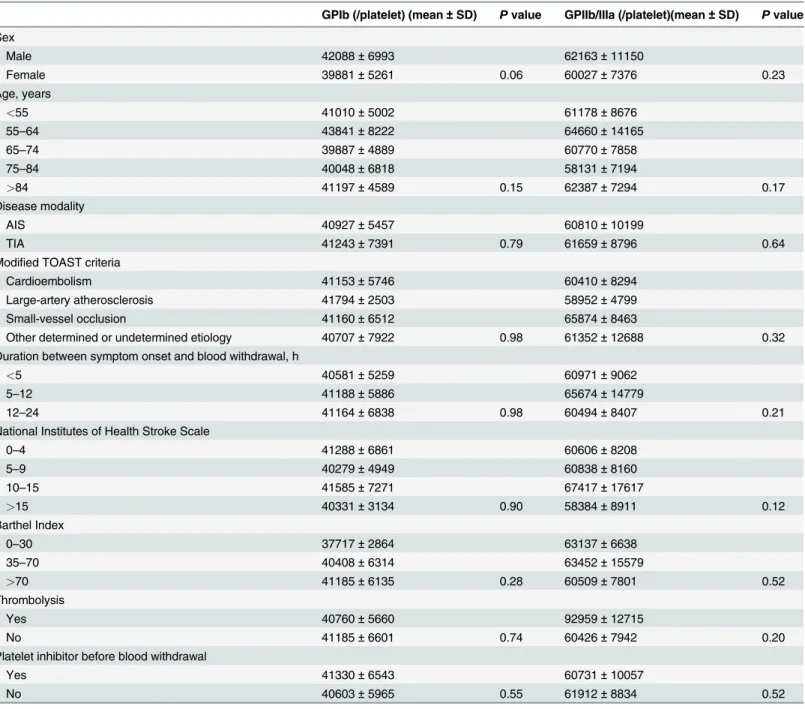
Results from univariate analysis of the association between GPIb and GPIIb/IIIa receptor numbers and key demographic and clinical characteristics are summarized inTable 3. Only fe-male sex displayed a trend towards association with GPIb receptor numbers (P= 0.06). GPIb and GPIIb/IIIa receptor counts per single platelet were not associated with patient age, disease (AIS vs. TIA), treatment modality (thrombolysis vs. no thrombolysis), etiology, severity of stroke (NIHSS, Barthel index), or antithrombotic treatment before stroke onset.
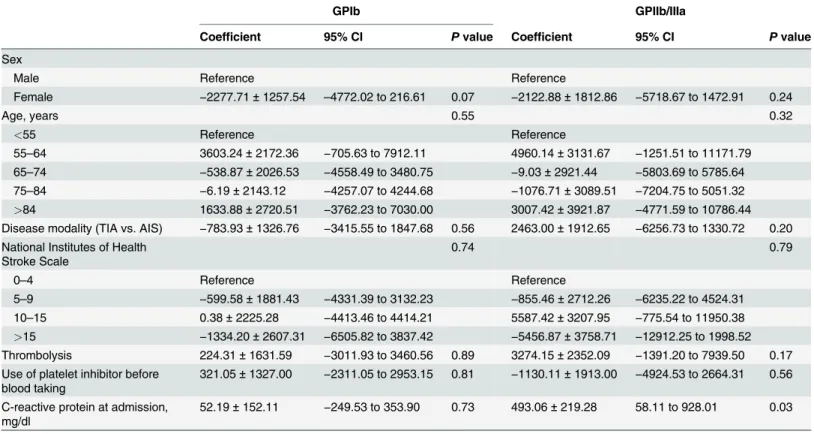
In the multivariate analysis (adjusted for age and sex), CRP was identified as an independent predictor of GPIIb/IIIa (P= 0.03) but not of GPIb (P= 0.73) receptor numbers. The trend to-wards an association between sex and GPIb receptor count was maintained in the multivariate analysis (P= 0.07). As observed for univariate analysis, other demographic and clinical param-eters were not associated with GPIb or GPIIb/IIIa receptor numbers after multivariate adjust-ment (Table 4). Additionally, the time point of blood withdrawal (days 0, 1, and 3) did not influence GPIb (P= 0.77) and GPIIb/IIIa (P= 0.26) receptor numbers (data not shown).
Discussion
To the best of our knowledge, no published study has systematically assessed GPIb and GPIIb/ IIIa receptor numbers in patients with AIS/TIA and CCD. The findings from this case—
control study showed that GPIb and GPIIb/IIIa platelet receptors are not differentially regulat-ed in patients with AIS/TIA or in patients with CCD or in HV. Nevertheless, within the AIS/ TIA group, inflammatory markers were positively correlated with GP receptor numbers (GPIb with neutrophils; GPIIb/IIIa with CRP), thus being indicative of an association between throm-bus formation and inflammatory processes.
As observed with GPIb inhibition [4], blockade of VWF also leads to profound protection from IS in mice [20,21]. To evaluate the regulation of VWF in humans, we previously assessed serum levels in the population reported in this study and observed differential regulation of Table 2. Number of GPIb and GPIIb/IIIa receptors in patients with acute ischemic stroke/transient ischemic attack, as well as patients with chronic cerebrovascular disease and healthy volunteers by univariate and multivariate analysis.
GPIb receptor numbers (mean±SD)
GPIIb/IIIa receptor numbers (mean±SD)
HV 40965±5890 60807±8125
CCD 44078±9492 62368±11233
AIS/TIA (day 0) 41060±6318 61168±9600
P(ANOVA, univariate analysis)
<0.01 0.46
P(multivariate analysis, adjusted for age and sex)
0.87 0.87
AIS, acute ischemic stroke; ANOVA, analysis of variance; CCD, chronic cerebrovascular disease; GP, glycoprotein; HV, healthy volunteers; SD, standard deviation; TIA, transient ischemic stroke.
VWF, with higher levels in patients with CCD compared with HV, and patients with AIS/TIA having even higher levels than the CCD group [11]. Therefore, in this study, the finding that GPIb receptor numbers are unchanged between these patient groups is unexpected at first glance. However, a potential explanation for the lack of differentiation between GPIb receptor numbers is the postulated downregulation of GPIb receptors as a result of ectodomain shed-ding that is induced by platelet agonists during modulation of platelet function [22]. Indeed, a recent study of Chinese patients with atherosclerotic IS demonstrated lower expression levels Table 3. Predictors of GPIb and GPIIb/IIIa receptor numbers in patients with acute ischemic stroke/transient ischemic attack by univariate analysis.
GPIb (/platelet) (mean±SD) Pvalue GPIIb/IIIa (/platelet)(mean±SD) Pvalue
Sex
Male 42088±6993 62163±11150
Female 39881±5261 0.06 60027±7376 0.23
Age, years
<55 41010±5002 61178±8676
55–64 43841±8222 64660±14165
65–74 39887±4889 60770±7858
75–84 40048±6818 58131±7194
>84 41197±4589 0.15 62387±7294 0.17
Disease modality
AIS 40927±5457 60810±10199
TIA 41243±7391 0.79 61659±8796 0.64
Modified TOAST criteria
Cardioembolism 41153±5746 60410±8294
Large-artery atherosclerosis 41794±2503 58952±4799
Small-vessel occlusion 41160±6512 65874±8463
Other determined or undetermined etiology 40707±7922 0.98 61352±12688 0.32
Duration between symptom onset and blood withdrawal, h
<5 40581±5259 60971±9062
5–12 41188±5886 65674±14779
12–24 41164±6838 0.98 60494±8407 0.21
National Institutes of Health Stroke Scale
0–4 41288±6861 60606±8208
5–9 40279±4949 60838±8160
10–15 41585±7271 67417±17617
>15 40331±3134 0.90 58384±8911 0.12
Barthel Index
0–30 37717±2864 63137±6638
35–70 40408±6314 63452±15579
>70 41185±6135 0.28 60509±7801 0.52
Thrombolysis
Yes 40760±5660 92959±12715
No 41185±6601 0.74 60426±7942 0.20
Platelet inhibitor before blood withdrawal
Yes 41330±6543 60731±10057
No 40603±5965 0.55 61912±8834 0.52
AIS, acute ischemic stroke; GP, glycoprotein; TIA, transient ischemic stroke; TOAST = Trial of Org 10172 in Acute Stroke Treatment.
of GPIb but higher levels of a disintegrin and metalloproteinase 17 (ADAM17), an enzyme that has been reported to play a major role in GPIb shedding [23].
In our study, GPIb and GPIIb/IIIa receptor numbers correlated with inflammatory process-es such as neutrophil count and CRP levels. This relationship between platelet markers and in-flammation is in accordance with our novel theory, which defines stroke as a thrombo-inflammatory disease rather than solely a thrombotic disease. Thrombo-inflammation is recog-nized as being an important mediator of IS pathophysiology in rodents [24–26], which, in broad terms, can be defined as the interaction of thrombotic (e.g. coagulation factors, platelets) and inflammatory (e.g. immune cells) processes at the ischemic neurovascular unit [6,7]. In IS, similar associations between thrombotic and inflammatory markers have also been described for plasma coagulation factors such as VWF [11] and factor XII [27].
To date, there have been few or no standardized assessments of GPIb and GPIIb/IIIa recep-tors in patients with CCD. Our findings of minimal variation in GPIb and GPIIb/IIIa receptor numbers in the CCD group versus the AIS/TIA group and HV (in multivariate analysis) does not preclude a pathophysiologic role for these platelet receptors. Nevertheless, recent publica-tions suggest that the GPIb-V–IX receptor complex and GPIIb/IIIa receptors are not essential for the development of atherosclerotic lesions [14,15,28,29], although platelets are implicated in the early stages of atherosclerosis [29,30].
The limitations of this study require some consideration. It should be borne in mind that the potential for reverse causation induced by blood withdrawal post-cerebrovascular events Table 4. Predictors of GPIb and GPIIb/IIIa receptor numbers in patients with acute ischemic stroke/transient ischemic attack by multivariate analysis.
GPIb GPIIb/IIIa
Coefficient 95% CI Pvalue Coefficient 95% CI Pvalue
Sex
Male Reference Reference
Female −2277.71±1257.54 –4772.02 to 216.61 0.07 −2122.88±1812.86 −5718.67 to 1472.91 0.24
Age, years 0.55 0.32
<55 Reference Reference
55–64 3603.24±2172.36
−705.63 to 7912.11 4960.14±3131.67 −1251.51 to 11171.79
65–74 −538.87±2026.53 −4558.49 to 3480.75 −9.03±2921.44 −5803.69 to 5785.64
75–84 −6.19±2143.12 −4257.07 to 4244.68 −1076.71±3089.51 −7204.75 to 5051.32
>84 1633.88±2720.51 −3762.23 to 7030.00 3007.42±3921.87 −4771.59 to 10786.44
Disease modality (TIA vs. AIS) −783.93±1326.76 −3415.55 to 1847.68 0.56 2463.00±1912.65 −6256.73 to 1330.72 0.20
National Institutes of Health Stroke Scale
0.74 0.79
0–4 Reference Reference
5–9 −599.58±1881.43 −4331.39 to 3132.23 −855.46±2712.26 −6235.22 to 4524.31
10–15 0.38±2225.28 −4413.46 to 4414.21 5587.42±3207.95 −775.54 to 11950.38
>15 −1334.20±2607.31 −6505.82 to 3837.42 −5456.87±3758.71 −12912.25 to 1998.52 Thrombolysis 224.31±1631.59 −3011.93 to 3460.56 0.89 3274.15±2352.09 −1391.20 to 7939.50 0.17 Use of platelet inhibitor before
blood taking
321.05±1327.00 −2311.05 to 2953.15 0.81 −1130.11±1913.00 −4924.53 to 2664.31 0.56
C-reactive protein at admission, mg/dl
52.19±152.11 −249.53 to 353.90 0.73 493.06±219.28 58.11 to 928.01 0.03
AIS, acute ischemic stroke; CI, confidence interval; GP, glycoprotein; TIA, transient ischemic stroke.
cannot be disregarded. Thus, our study describes the degree and significance of associations be-tween GPIb and GPIIb/IIIa receptor numbers and demographic/clinical parameters without assigning causality. Instead, prospective studies are warranted to address this limitation. Due to ethical constraints, which precluded the recruitment of individuals who were unable to pro-vide informed consent, it may not have been possible to ensure that patients with very large strokes and/or aphasia were fully represented in our study. Moreover, a non-vascular origin for symptoms could not be completely discounted in 42% of the TIA patient population, and 7% of patients with AIS/TIA were administered anticoagulant treatment. Thus, there remains a possibility that the aforementioned factors may have influenced the regulation of GPIb and GPIIb/IIIa receptors.
Conclusions
Results from this study did not show differential regulation of platelet GPIb and GPIIb/IIIa ceptors in patients with AIS or CCD. Hence, our findings suggest that GPIb and GPIIb/IIIa re-ceptor quantification is unlikely to represent a clinically valid method for delineating patients at risk of a cerebrovascular event.
Acknowledgments
We thank Melanie Glaser and Andrea Sauer for excellent technical assistance.
Author Contributions
Conceived and designed the experiments: PK CK. Performed the experiments: PK IG. Ana-lyzed the data: PK CD PUH. Wrote the paper: PK PUH CK.
References
1. Stegner D, Nieswandt B. Platelet receptor signaling in thrombus formation. J Mol Med (Berl). 2011; 89: 109–121. doi:10.1007/s00109-010-0691-5PMID:21058007
2. Kraft P, De Meyer SF, Kleinschnitz C. Next-generation antithrombotics in ischemic stroke: preclinical perspective on‘bleeding-free antithrombosis’. J Cereb Blood Flow Metab. 2012; 32: 1831–1840. doi:
10.1038/jcbfm.2012.108PMID:22805877
3. Stoll G, Kleinschnitz C, Nieswandt B. Molecular mechanisms of thrombus formation in ischemic stroke: novel insights and targets for treatment. Blood. 2008; 112: 3555–3562. doi: 10.1182/blood-2008-04-144758PMID:18676880
4. Kleinschnitz C, Pozgajova M, Pham M, Bendszus M, Nieswandt B, Stoll G. Targeting platelets in acute experimental stroke: impact of glycoprotein Ib, VI, and IIb/IIIa blockade on infarct size, functional out-come, and intracranial bleeding. Circulation. 2007; 115: 2323–2330. PMID:17438148
5. Goebel S, Li Z, Vogelmann J, Holthoff HP, Degen H, Hermann DM, et al. The GPVI-Fc fusion protein Revacept improves cerebral infarct volume and functional outcome in stroke. PLoS One. 2013; 8: e66960. doi:10.1371/journal.pone.0066960PMID:23935828
6. Nieswandt B, Kleinschnitz C, Stoll G. Ischaemic stroke: a thrombo-inflammatory disease? J Physiol. 2011; 589: 4115–4123. doi:10.1113/jphysiol.2011.212886PMID:21768262
7. Stoll G, Kleinschnitz C, Nieswandt B. Combating innate inflammation: a new paradigm for acute treat-ment of stroke? Ann N Y Acad Sci. 2010; 1207: 149–154. doi:10.1111/j.1749-6632.2010.05730.x
PMID:20955438
8. Baker RI, Eikelboom J, Lofthouse E, Staples N, Afshar-Kharghan V, López JA, et al. Platelet glycopro-tein Ibalpha Kozak polymorphism is associated with an increased risk of ischemic stroke. Blood. 2001; 98: 36–40. PMID:11418460
10. Cassidy EM, Walsh MT, O’Connor R, Condren RM, Ryan M, O’Keane V, et al. Platelet surface glyco-protein expression in post-stroke depression: a preliminary study. Psychiatry Res. 2003; 118: 175–181. PMID:12798982
11. Kraft P, Drechsler C, Gunreben I, Nieswandt B, Stoll G, Heuschmann PU, et al. Von Willebrand factor regulation in patients with acute and chronic cerebrovascular disease: a pilot, case—control study. PLoS One. 2014; 9: e99851. doi:10.1371/journal.pone.0099851PMID:24937073
12. van Lammeren GW, Pasterkamp G, de Vries JP, Bosch L, de Haan JJ, de Kleijn DP, et al. Platelets enter atherosclerotic plaque via intraplaque microvascular leakage and intraplaque hemorrhage: a his-topathological study in carotid plaques. Atherosclerosis. 2012; 222: 355–359. doi:10.1016/j.
atherosclerosis.2012.03.008PMID:22498256
13. Theilmeier G, Michiels C, Spaepen E, Vreys I, Collen D, Vermylen J, et al. Endothelial von Willebrand factor recruits platelets to atherosclerosis-prone sites in response to hypercholesterolemia. Blood. 2002; 99: 4486–4493. PMID:12036879
14. Shpilberg O, Rabi I, Schiller K, Walden R, Harats D, Tyrrell KS, et al. Patients with Glanzmann throm-basthenia lacking platelet glycoprotein alpha(IIb)beta(3) (GPIIb/IIIa) and alpha(v)beta(3) receptors are not protected from atherosclerosis. Circulation. 2002; 105: 1044–1048. PMID:11877352
15. Girolami A, Sambado L, Lombardi AM. The impact of blood coagulability on atherosclerosis and cardiovas-cular disease: a rebuttal. J Thromb Haemost. 2013; 11: 213–214. doi:10.1111/jth.12030PMID:23106773
16. Loeffen R, Spronk HM, ten Cate H. The impact of blood coagulability on atherosclerosis and cardiovas-cular disease. J Thromb Haemost. 2012; 10: 1207–1216. doi:10.1111/j.1538-7836.2012.04782.x
PMID:22578148
17. Adams HP Jr, Bendixen BH, Kappelle LJ, Biller J, Love BB, Gordon DL, et al. Classification of subtype of acute ischemic stroke. Definitions for use in a multicenter clinical trial. TOAST. Trial of Org 10172 in Acute Stroke Treatment. Stroke. 1993; 24: 35–41. PMID:7678184
18. Muir KW, Weir CJ, Murray GD, Povey C, Lees KR. Comparison of neurological scales and scoring sys-tems for acute stroke prognosis. Stroke. 1996; 27: 1817–1820. PMID:8841337
19. Granger CV, Dewis LS, Peters NC, Sherwood CC, Barrett JE. Stroke rehabilitation: analysis of repeat-ed Barthel index measures. Arch Phys Mrepeat-ed Rehabil. 1979; 60: 14–17. PMID:420565
20. Kleinschnitz C, De Meyer SF, Schwarz T, Austinat M, Vanhoorelbeke K, Nieswandt B, et al. Deficiency of von Willebrand factor protects mice from ischemic stroke. Blood. 2009; 113: 3600–3603. doi:10. 1182/blood-2008-09-180695PMID:19182208
21. De Meyer SF, Stoll G, Wagner DD, Kleinschnitz C. Von Willebrand factor: an emerging target in stroke therapy. Stroke. 2012; 43: 599–606. doi:10.1161/STROKEAHA.111.628867PMID:22180250
22. Qiao JL, Shen Y, Gardiner EE, Andrews RK. Proteolysis of platelet receptors in humans and other spe-cies. Biol Chem. 2010; 391: 893–900. doi:10.1515/BC.2010.081PMID:20482312
23. Ling JY, Shen L, Liu Q, Xue S, Ma W, Wu H, et al. Changes in platelet GPIbαand ADAM17 during the acute stage of atherosclerotic ischemic stroke among Chinese. J Huazhong Univ Sci Technolog Med Sci. 2013; 33: 438–442. doi:10.1007/s11596-013-1138-3PMID:23771674
24. Schuhmann MK, Kraft P, Stoll G, Lorenz K, Meuth SG, Wiendl H, et al. CD28 superagonist-mediated boost of regulatory T cells increases thrombo-inflammation and ischemic neurodegeneration during the acute phase of experimental stroke. J Cereb Blood Flow Metab. 2014; 35: 6–10. doi:10.1038/jcbfm. 2014.175PMID:25315859
25. Kraft P, Göb E, Schuhmann MK, Göbel K, Deppermann C, Thielmann I, et al. FTY720 ameliorates acute ischemic stroke in mice by reducing thrombo-inflammation but not by direct neuroprotection. Stroke. 2013; 44: 3202–3210. doi:10.1161/STROKEAHA.113.002880PMID:24029635
26. Kleinschnitz C, Kraft P, Dreykluft A, Hagedorn I, Göbel K, Schuhmann MK, et al. Regulatory T cells are strong promoters of acute ischemic stroke in mice by inducing dysfunction of the cerebral microvascula-ture. Blood. 2013; 121: 679–691. doi:10.1182/blood-2012-04-426734PMID:23160472
27. Kraft P, Drechsler C, Gunreben I, Heuschmann PU, Kleinschnitz C. Regulation of Blood Coagulation Factors XI and XII in Patients with Acute and Chronic Cerebrovascular Disease: a Case—Control Study. Cerebrovasc Dis. 2014; 38: 337–343. doi:10.1159/000368434PMID:25427539
28. Lugli AK, Brown MM, Steffel J, Büchi L, Förnzler D, Dupont A, et al. Platelet receptor gain-of-function single nucleotide polymorphisms in carotid and vertebral stenosis patients. J Thromb Thrombolysis. 2011; 32: 215–222. doi:10.1007/s11239-011-0586-5PMID:21505785
29. Strassel C, Hechler B, Bull A, Gachet C, Lanza F. Studies of mice lacking the GPIb-V-IX complex ques-tion the role of this receptor in atherosclerosis. J Thromb Haemost. 2009; 7: 1935–1938. doi:10.1111/j. 1538-7836.2009.03608.xPMID:19740100