GID
2, 765–780, 2012Muon radiography of the Puy de D ˆome
C. C ˆarloganu et al.
Title Page
Abstract Introduction
Conclusions References
Tables Figures
◭ ◮
◭ ◮
Back Close
Full Screen / Esc
Printer-friendly Version
Interactive Discussion
Discussion
P
a
per
|
Dis
cussion
P
a
per
|
Discussion
P
a
per
|
Discussio
n
P
a
per
|
Geosci. Instrum. Method. Data Syst. Discuss., 2, 765–780, 2012 www.geosci-instrum-method-data-syst-discuss.net/2/765/2012/ doi:10.5194/gid-2-765-2012
© Author(s) 2012. CC Attribution 3.0 License.
Geoscientiic
Instrumentation Methods and Data Systems
Discussions
This discussion paper is/has been under review for the journal Geoscientific Instrumentation, Methods and Data Systems (GI). Please refer to the corresponding final paper in GI if available.
Towards a muon radiography
of the Puy de D ˆome
C. C ˆarloganu1, V. Niess1, S. B ´en ´e1, E. Busato1, P. Dupieux1, F. Fehr1, P. Gay1, D. Miallier1, B. Vulpescu1, P. Boivin2,3,4, C. Combaret5, P. Labazuy2,3,4,
I. Laktineh5, J.-F. L ´enat2,3,4, L. Mirabito5, and A. Portal2,3,4
1
Clermont Universit ´e, Universit ´e Blaise Pascal, CNRS/IN2P3, Laboratoire de Physique Corpusculaire, BP 10448, 63000 Clermont-Ferrand, France
2
Clermont Universit ´e, Universit ´e Blaise Pascal, Observatoire de Physique du Globe de Clermont-Ferrand, Laboratoire Magmas et Volcans, BP 10118,
63000 Clermont-Ferrand, France 3
CNRS – UMR6524, LMV, 63038 Clermont-Ferrand, France 4
IRD, R 163, LMV, 63038 Clermont-Ferrand, France 5
Universit ´e de Lyon, Universit ´e Lyon 1, CNRS/IN2P3, IPNL, 1 Rue E. Fermi, 69622 Villeurbanne Cedex, France
Received: 18 July 2012 – Accepted: 30 August 2012 – Published: 13 September 2012 Correspondence to: V. Niess ([email protected])
GID
2, 765–780, 2012Muon radiography of the Puy de D ˆome
C. C ˆarloganu et al.
Title Page
Abstract Introduction
Conclusions References
Tables Figures
◭ ◮
◭ ◮
Back Close
Full Screen / Esc
Printer-friendly Version
Interactive Discussion
Discussion
P
a
per
|
Dis
cussion
P
a
per
|
Discussion
P
a
per
|
Discussio
n
P
a
per
|
Abstract
High energy (above 100 GeV) atmospheric muons are a natural probe for geophysical studies. They can travel through kilometres of rock allowing for a radiography of the density distribution within large structures, like mountains or volcanoes. A collaboration between volcanologists, astroparticle and particle physicists, TOMUVOL, was formed in 5
2009 to study tomographic muon imaging of volcanoes with high resolution, large scale tracking detectors. We report on two campaigns of measurements at the flank of the Puy de D ˆome using Glass Resistive Plate Chambers (GRPCs) developed for Particle Physics, within the CALICE collaboration.
1 Introduction
10
Muons are leptonic elementary particles analogous to their well known cousins, the electrons, about 200 times heavier with a mass of 105.7 MeV. Atmospheric muons are naturally produced, over a wide range of energies and directions, as secondaries of cosmic rays interacting in the earth’s atmosphere. While muons are unstable, they decay solely weakly, ∼100 % to electrons, with a rather large proper lifetime in their
15
rest frame,τ, ascτ=658.650 m, wherecis the vacuum speed of light. Consequently, ultra relativistic high energy (HE, above 100 GeV) muons are highly penetrating in matter. They can travel through kilometres of rock before losing all of their energy to the medium or decaying in flight. Indeed, ultra relativistic muons suffer only moder-ate radiative losses in matter due to their high mass while being close to stable in the 20
terrestrial rest frame. Therefore, atmospheric muons are a relevant probe to perform an absorption measurement through large and dense structures. Early uses included probing Chephren’s pyramid (Alvarez et al., 1970) and estimating the snow overbur-den on mountains (George, 1955). The counting of the number of atmospheric muons surviving through the structure provides a radiographic measurement of the matter 25
GID
2, 765–780, 2012Muon radiography of the Puy de D ˆome
C. C ˆarloganu et al.
Title Page
Abstract Introduction
Conclusions References
Tables Figures
◭ ◮
◭ ◮
Back Close
Full Screen / Esc
Printer-friendly Version
Interactive Discussion
Discussion
P
a
per
|
Dis
cussion
P
a
per
|
Discussion
P
a
per
|
Discussio
n
P
a
per
|
is further known, by repeating the measurement from different locations, tomographic three-dimensional models of the matter’s density distribution can then be computed (Tanaka et al., 2010). A few percent density contrast over tens of metres spatial resolu-tion is achievable from remote locaresolu-tions, at several kilometres from the target. Hence, muon imaging could locate and characterise in terms of size, depth and shape, magma 5
reservoirs, volcanic conduits and hydrothermal systems, particularly when combined with other techniques used in volcanology, as seismic, electrical and electromagnetic tomography and satellite interferometry. However, HE atmospheric muons are scarce, with fluxes of ∼100 m−2deg−1day−1 close to the horizontal (Matsuno et al., 1984).
Therefore, accurate measurements require timescales of∼1 month/(L/1 m)2, whereL2
10
is the area of the muon collection plane. In addition, the muons propagation through matter has to be well understood and it is prone to result in model dependent system-atics.
TOMUVOL (TOmographie MUonique des VOLcans) is an interdisciplinary
collabora-tion initiated in 2009, joining particle physicists and volcanologists from three French 15
laboratories: Magmas and Volcanoes Laboratory (LMV) and Laboratory of Corpuscu-lar Physics (LPC), located in Clermont-Ferrand (Auvergne) and the Lyon Institute of Nuclear Physics (IPNL, Rh ˆone Alpes). It aims to develop muon tomography of volca-noes. The project benefits from a reference site located near Clermont-Ferrand: the Puy de D ˆome (alt. 1464 m a.s.l.). The Puy de D ˆome is an extinct 11 000 yr old vol-20
canic dome in the Massif Central, south-central France (Miallier et al., 2010; Boivin, 2009). It has a remarkable structure with two domes originating from two subsequent eruptions, which occurred within a short time interval. Its density structure is therefore expected to be complex with large variations. The first phase of the TOMUVOLproject started in 2011 and is dedicated to extensive radiographic studies of the Puy de D ˆome 25
GID
2, 765–780, 2012Muon radiography of the Puy de D ˆome
C. C ˆarloganu et al.
Title Page
Abstract Introduction
Conclusions References
Tables Figures
◭ ◮
◭ ◮
Back Close
Full Screen / Esc
Printer-friendly Version
Interactive Discussion
Discussion
P
a
per
|
Dis
cussion
P
a
per
|
Discussion
P
a
per
|
Discussio
n
P
a
per
|
Puy de D ˆome from multiple observation directions. The second phase, to start begin-ning 2014, is the design, construction and validation of an autonomous and portable radiographic device for volcano tomography (Labazuy, 2012), which can be used for monitoring active volcanoes and for studying their internal structure.
We report here on two preliminary campaigns of measurements of the Puy de D ˆome 5
from close to orthogonal directions: Grotte Taillerie and Col de Ceyssat. In Sect. 2 we briefly review the hardware and software tools used for these measurements. Section 3 is dedicated to a more in depth discussion of the detection sites and of the experimental setups. Our preliminary results are presented in Sect. 4 and in the concluding section we discuss our prospects.
10
2 Tools for muon tomography
Before discussing in more detail the various hardware and software tools used for the muon tomography let us first point out that in order to convert any measured integrated density to an average density, or for a complete tomographic reconstruction, accurate topographical data are needed. Therefore, a dedicated LiDAR survey of the Puy de 15
D ˆome and its surroundings was realised in March 2011, thanks to regional funding. An overall precision of better than 10 cm on a 0.5 m grid was achieved for the digital elevation model of the area.
2.1 The GRPC detector used as a muon tracker
The TOMUVOL muon telescope is made of parallel planes of GRPCs, operated in 20
avalanche mode. This technology allows a high segmentation, in 1 cm2 cells, while being easily scalable up to large areas,∼1 m2. For a typical spacing of 1 m between
the detection planes it results in 0.5◦ angular resolution (evaluated conservatively). In addition, GRPCs are rather cheap, robust, highly efficient (∼0.95 %), with a detection
GID
2, 765–780, 2012Muon radiography of the Puy de D ˆome
C. C ˆarloganu et al.
Title Page
Abstract Introduction
Conclusions References
Tables Figures
◭ ◮
◭ ◮
Back Close
Full Screen / Esc
Printer-friendly Version
Interactive Discussion
Discussion
P
a
per
|
Dis
cussion
P
a
per
|
Discussion
P
a
per
|
Discussio
n
P
a
per
|
discussion can be found in ILaktineh (2012). A single detection plane consists of two parallel thin glass plates kept at a distance of about 1 mm using tiny ceramic balls as spacers so that a gas mixture (93 % forane, 5 % isobutane, 2 % SF6) can circulate be-tween the plates, with a throughput of∼1 l h−1. The outer sides of the glass plates are
coated with a thin layer of highly resistive material on which the high voltage (typically 5
7 kV) is applied. The high voltage needs to be adapted to the environmental pressure and temperature conditions in order to maintain a constant operating gain. A thin Mylar layer is used as insulation between the anode and the readout: a layer of 1 cm2copper pads. An ionising charged particle traversing the chamber initiates a fast and highly contained electron avalanche in the gas volume that results in an induced charge in 10
the close by copper pad(s). The discharge avalanche is limited to a tiny area due to the high resistivity of the glass electrodes and the quenching characteristics of the gas. The chambers are embedded in steel cassettes and are vertically mounted onto a movable aluminium support framework.
The collecting copper pads are assembled on one face of a Printed Circuit Board 15
(PCB) of 50×33.3 cm2. By using 6 PCBs a total detection area of 1 m2 can be read
out. The HARDROC2 readout ASICs (Dulucq et al., 2010) each handle 8×8 pads. In
total 48 ASICs are connected on a 1 m2 PCB set, leading to a total of 9142 readout channels per m2. For each pad, ASIC-implemented comparators provide a two bit digi-tised amplitude information, with a low and high threshold. In data-taking mode, each 20
ASIC buffers up to 512 successive signals above the low threshold. They are read out through a Field Programmable Gate Array (FPGA) upon receival of an external, peri-odical trigger signal. The FPGAs manage also the communication with a PC through an USB interface. The data acquisition and monitoring software is based on a cross-platform, distributed framework software (XDAQ, 2012), customised for TOMUVOL. 25
2.2 The software tools
An intensive simulation effort is ongoing within TOMUVOLin order to provide a full
GID
2, 765–780, 2012Muon radiography of the Puy de D ˆome
C. C ˆarloganu et al.
Title Page
Abstract Introduction
Conclusions References
Tables Figures
◭ ◮
◭ ◮
Back Close
Full Screen / Esc
Printer-friendly Version
Interactive Discussion
Discussion
P
a
per
|
Dis
cussion
P
a
per
|
Discussion
P
a
per
|
Discussio
n
P
a
per
|
detector designs. Furthermore, it is believed that only a detailed simulation can con-vincingly address the various systematic errors that flaw a quantitative density state-ment. The simulation studies deal with several topics. Detailed air shower simulations are carried out with both the established code within the astroparticle community: COR
-SIKA (Heck it et al., 1998), and a more general and flexible one: GEANT4 (Agostinelli
5
et al., 2003), which is a reference for the particle physics accelerator-community. The latter GEANT4 code can incorporate a detailed topography and composition of the relief which is of prime importance for close to horizontal muon tracks, and consequently for muon radiography. In addition, these simulations are used to study the background con-tamination from vertical air showers that are reconstructed as horizontal tracks (Bene, 10
2012).
In order to estimate the detection efficiency when accounting for dead cells, detector simulations have been carried out with a fast but simplified code. A GEANT4 geometric description of the detector is currently being implemented. It will allow for more de-tailed efficiency studies by simulating the full detection chain, from the charge signal 15
collection to its digitisation and processing.
Finally, a preliminary simulation scheme has been developed based on a mixed lan-guage approach interfacing C++and Java using Python (Fehr, 2011). The simulation of the atmospheric muon flux relies both on measurements (Matsuno et al., 1984) and theoretical assumptions (Parente et al., 1995). The propagation of muons through rock 20
is handled with the dedicated propagation code MMC (Chirkin and Rhode, 2004), de-veloped for large scale neutrino detectors. The muon detector and the target geometry are fully customisable. For the geometrical modelling of the Puy de D ˆome the precision topographical data from the LiDAR survey were used.
3 The radiography measurements
25
GID
2, 765–780, 2012Muon radiography of the Puy de D ˆome
C. C ˆarloganu et al.
Title Page
Abstract Introduction
Conclusions References
Tables Figures
◭ ◮
◭ ◮
Back Close
Full Screen / Esc
Printer-friendly Version
Interactive Discussion
Discussion
P
a
per
|
Dis
cussion
P
a
per
|
Discussion
P
a
per
|
Discussio
n
P
a
per
|
(867 m a.s.l.) from January to July 2011. It was a long term survey from a location 2 km East of Puy de D ˆome with a 1/6 m2detector. For the second campaign, from February to March 2012, the detector was at Col de Ceyssat (1074 m a.s.l.) 1.2 km South of Puy de D ˆome. It was a short term survey from a closer location but with a detector twice as large (1/3 m2).
5
Full simulations have been carried out for the two geometries, assuming a uni-form target density of 1.66g cm−3, and a 1 m2 detector. It appears that the Puy de D ˆome inner structure should be accessible within a month timescale using a 1 m2 detector, provided that the noise level from fake tracks is controlled at the level of 1 month−1deg−1m−2. A radiography of the very base below the Puy de 10
D ˆome would however require to contain the background contamination at the level of 1 yr−1deg−1m−2.
3.1 The Grotte Taillerie campaign
For the first campaign the detector was deployed in Grotte Taillerie, an underground artificial cave in which it was shielded from vertical atmospheric showers by 60 cm of 15
concrete. In order to protect the electronics against moisture, due to a high ambient humidity, the detector was placed under a tent of polyethylene foil. Additionally, a de-humidifier ventilated dry air under the tent. The whole setup was controlled remotely from LPC through the long-range WIFI network of the Puy de D ˆome summit observa-tory. This link was also used to transfer the recorded data to a central server. A video 20
camera continuously monitored the installation. Environmental data (i.e. temperature, pressure and humidity) were recorded every 15 min and are archived in a data base.
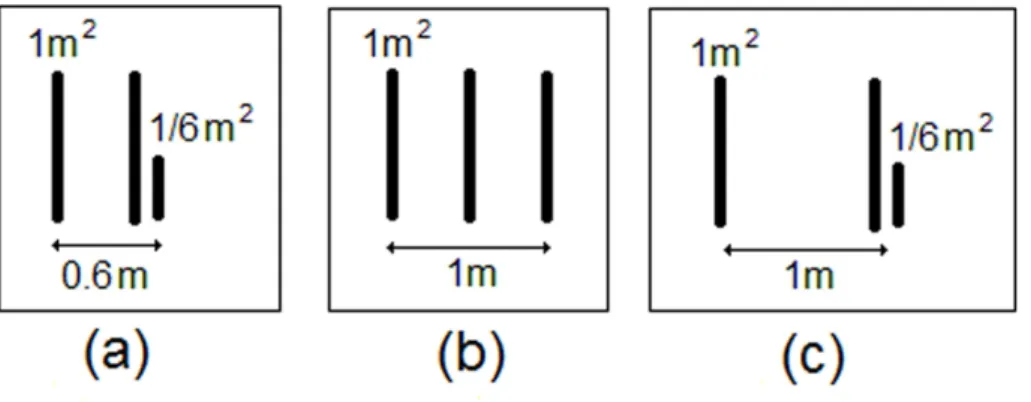
From January to July 2011 a total of 17 million muon tracks candidates from the entire sky have been recorded with a 91 % duty cycle. Three different detector config-urations were actually used, as sketched in Fig. 1, with only a few short interruptions 25
GID
2, 765–780, 2012Muon radiography of the Puy de D ˆome
C. C ˆarloganu et al.
Title Page
Abstract Introduction
Conclusions References
Tables Figures
◭ ◮
◭ ◮
Back Close
Full Screen / Esc
Printer-friendly Version
Interactive Discussion
Discussion
P
a
per
|
Dis
cussion
P
a
per
|
Discussion
P
a
per
|
Discussio
n
P
a
per
|
chamber replaced the small outer chamber and the total spacing increased to 1 m. On 12 May, we put back the small 1/6 m2 chamber. A 1 m distance between the three chambers was however maintained.
The muon detector has been carefully aligned with respect to the Puy de D ˆome using GNSS and tachymetric measurements of the surroundings and of the basement thanks 5
to a collaboration with the Ecole Sup ´erieure des G ´eom `etres et Topographes from Le Mans (ESGT). Absolute surface positions are provided by GPS measurements. Ref-erence points in the Taillerie basement have then been fixed by tachymetric measure-ments through the skylights of the basement. Finally the muon detection planes were positioned with respect to these points. The final achieved accuracy on the detector 10
position is better than 5 mm.
3.2 The Col de Ceyssat campaign
In order to get a better view of the Puy de D ˆome summit, for the second campaign the detector was installed closer to the volcano at the Gros Manaux Inn. The shielding was only partial from the close nearby main building of the inn. In addition, in order to re-15
duce the background rate from fake tracks, a fourth chamber was used. Hence, in total 3×1 m2 vertical chambers and one smaller outer chamber of 1/3 m2 were operated.
The total spacing was 1 m. We recorded a total of 11 million muon track candidates. As previously the detector was monitored and operated remotely. The positioning, in col-laboration with ESGT, was more difficult than in Grotte de la Taillerie due to the detector 20
location within a room with small openings. The estimated accuracy is of 1 cm.
4 Data processing and preliminary results
GID
2, 765–780, 2012Muon radiography of the Puy de D ˆome
C. C ˆarloganu et al.
Title Page
Abstract Introduction
Conclusions References
Tables Figures
◭ ◮
◭ ◮
Back Close
Full Screen / Esc
Printer-friendly Version
Interactive Discussion
Discussion
P
a
per
|
Dis
cussion
P
a
per
|
Discussion
P
a
per
|
Discussio
n
P
a
per
|
bundles of high multiplicity. The overall χ2-distribution of the track residuals agrees well with the theoretical expectation, assuming Gaussian distributed errors. Overall, a position resolution of 0.4 cm and an angular resolution better than 0.5◦are achieved for the muon tracks during the first data taking period. The angular resolution is improved by about a factor of 2 for the 1 m wide setups. Additionally, the procedure also allows a 5
relative inter alignment of the detection planes by letting free the chambers orientation angles in the track fit. For the Grotte Taillerie setup, this allowed to crosscheck the 5 mm accuracy achieved through GPS and tachometers measurements with the muon tracks themselves.
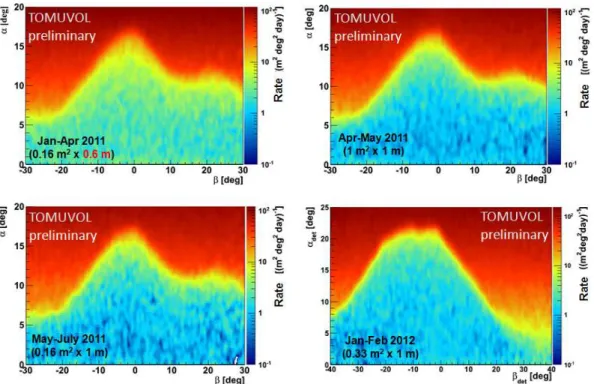
The shadow cast in the flux of atmospheric muons by the Puy de D ˆome, as measured 10
with the various setup configurations, is shown in Fig. 2. For these measurements, the event rates were corrected both for the detector geometrical acceptance, dead cells and dead time. Note that there is no correction from individual chamber detection effi -ciencies yet, which is an additional factor ofǫ∼[0.90; 0.95]N=3,4. In addition, a
smooth-ing algorithm has been applied to the recorded map in order to reduce artificial bands 15
(Moir ´e-patterns) typical of digital images. The observed shape is in good agreement with the actual outline of the volcano. However, it has been found that for the lower part of the Puy de D ˆome the recorded track rate decreases by a factor of ∼2 when
increasing the chamber spacing from 0.6 m to 1 m. This is attributed to background contamination from down going showers and back scattered close to horizontal tracks. 20
Therefore, with the current data analysis, interpretations are limited to the upper part of the Puy de D ˆome, where the muon flux through the rock is above the background.
For illustrative purpose, the full processed data set collected from Grotte de la Tail-lerie was used in order to compute a tentative scaled transmission coefficient map through the Puy de D ˆome. The transmission through the rocks was normalised by the 25
GID
2, 765–780, 2012Muon radiography of the Puy de D ˆome
C. C ˆarloganu et al.
Title Page
Abstract Introduction
Conclusions References
Tables Figures
◭ ◮
◭ ◮
Back Close
Full Screen / Esc
Printer-friendly Version
Interactive Discussion
Discussion
P
a
per
|
Dis
cussion
P
a
per
|
Discussion
P
a
per
|
Discussio
n
P
a
per
|
with lower transmission just beneath the summit. At the base of the Puy de D ˆome, unfortunately, background tracks mimic a higher transmission.
5 Conclusion and outlook
We reported on the first extensive muon flux measurements through the Puy de D ˆome performed by the TOMUVOLcollaboration. The results are very encouraging with
5
17+11 million track candidates recorded from two close to orthogonal directions. The detector has proven to be working well in an out-of-the-lab environment. The analysis work is ongoing in order to get quantitative results with detailed systematics estimates. In particular, the pollution from background tracks needs to be controlled in order to extend the density image to the lower part of the Puy de D ˆome. Yet, it is time for a 10
tentative 3-D tomographic reconstruction of the dome’s summit region.
A new detector with a grand total of 1 m2detection area and a total spacing of 1 m is to be deployed beginning in 2013. It will integrate four GRPCs with a modular design. It should allow the ultimate radiographic and tomographic imaging of the Puy de D ˆome. The design, construction and validation of an autonomous and portable radiographic 15
device for volcanoes tomography would be the next step.
Acknowledgements. The TOMUVOL collaboration acknowledges support from the University Blaise Pascal of Clermont-Ferrand, CNRS, R ´egion Auvergne, Conseil G ´en ´eral du Puy-de-D ˆome. We also thank Jacques Puy-de-Dreher, owner of the Grotte Taillerie du Puy-de-Puy-de-D ˆome, who kindly hosted the TOMUVOLdetector in Grotte Taillerie during seven months.
GID
2, 765–780, 2012Muon radiography of the Puy de D ˆome
C. C ˆarloganu et al.
Title Page
Abstract Introduction
Conclusions References
Tables Figures
◭ ◮
◭ ◮
Back Close
Full Screen / Esc
Printer-friendly Version
Interactive Discussion
Discussion
P
a
per
|
Dis
cussion
P
a
per
|
Discussion
P
a
per
|
Discussio
n
P
a
per
|
References
Agostinelli, S., Allison, J., Amako, K., Apostolakis, J., Araujo, H., Arce, P., Asai, M., Axen, D., Banerjee, S., Barrand, G., Behner, F., Bellagamba, L., Boudreau, J., Broglia, L., Brunengo, A., Burkhardt, H., Chauvie, S., Chuma, J., Chytracek, R., Cooperman, G., Cosmo, G., Degt-yarenko, P., Dell’Acqua, A., Depaola, G., Dietrich, D., Enami, R., Feliciello, A., Ferguson, 5
C., Fesefeldt, H., Folger, G., Foppiano, F., Forti, A., Garelli, S., Giani, S., Giannitrapani, R., Gibin, D., G ´omez, J., Cadenas, J., Gonz ´alez, I., Gracia Abril, G., Greeniaus, G., Greiner, W., Grichine, V., Grossheim, A., Guatelli, S., Gumplinger, P., Hamatsu, R., Hashimoto, K., Hasui, H., Heikkinen, A., Howard, A., Ivanchenko, V., Johnson, A., Jones, F. W., Kallenbach, J., Kanaya, N., Kawabata, M., Kawabata, Y., Kawaguti, M., Kelner, S., Kent, P., Kimura, A., 10
Kodama, T., Kokoulin, R., Kossov, M., Kurashige, H., Lamanna, E., Lamp ´en, T., Lara, V., Lefebure, V., Lei, F., Liendl, M., Lockman, W., Longo, F., Magni, S., Maire, M., Medernach, E., Minamimoto, K., Mora de Freitas, P., Morita, Y., Murakami, K., Nagamatu, M., Nartallo, R., Nieminen, P., Nishimura, T., Ohtsubo, K., Okamura, M., O’Neale, S., Oohata, Y., Paech, K., Perl, J., Pfeiffer, A., Pia, M. G., Ranjard, F., Rybin, A.,Sadilov, S., Di Salvo, E., Santin, G., 15
Sasaki, T., Savvas, N., Sawada, Y., Scherer, S., Sei, S., Sirotenko, V., Smith, D., Starkov, N., Stoecker, H., Sulkimo, J., Takahata, M., Tanaka, S., Tcherniaev, E., Safai Tehrani, E., Tro-peano, M., Truscott, P., Uno, H., Urban, L., Urban, P., Verderi, M., Walkden, A., Wander, W., Weber, H., Wellisch, J. P., Wenaus, T., Williams, D. C., Wright, D., Yamada, T., Yoshida, H., and Zschiesche, D.: Geant4?a simulation toolkit, Nucl. Inst. Meth. A, 506, 250–303, 2003. 20
770
Alvarez, L. W., Anderson, J. A., El Bedwei, F., Burkhard, J., Fakhry, A., Girgis, A., Goneid, A., Hassan, F., Iverson, D., Lynch, G., Miligy, Z., Moussa, A. H., Sharkawi, M., and Yazolino, L.: Search for Hidden Chambers in the Pyramids, Science, 167, 832–839, 1970. 766
Bedjidian, M., Belkadhi, K., Boudry, V., Combaret, C., Decotigny, D., Cortina Gil, E., de la Taille, 25
C., Dellanegra, R., Gapienko, V. A., Grenier, G., Jauffret, C., Kieffer, R., Fouz, M.-C., Han, R., Laktineh, I., Lumb, N., Manai, K., Mannai, S., Mathez, H., Mirabito, L., Puerta Pelayo, J., Ruan, M., Schirra, F., Seguin-Moreau, N., Tromeur, W., Tytgat, M., Vander Donckt, M., and Zaganidis, N.: Performance of Glass Resistive Plate Chambers for a high-granularity semi-digital calorimeter, J. Instrument., 6, P02001, doi:10.1088/1748-0221/6/02/P02001, 2011. 30
GID
2, 765–780, 2012Muon radiography of the Puy de D ˆome
C. C ˆarloganu et al.
Title Page
Abstract Introduction
Conclusions References
Tables Figures
◭ ◮
◭ ◮
Back Close
Full Screen / Esc
Printer-friendly Version
Interactive Discussion
Discussion
P
a
per
|
Dis
cussion
P
a
per
|
Discussion
P
a
per
|
Discussio
n
P
a
per
|
Bene, S.: Atmospheric showers simulation for background estimation for muons tomography, Geosci. Instrum. Method. Data Syst. Discuss., 2012. 770
Boivin, P.: Volcanologie de la Chaˆıne des Puys, 5th Edn., Parc Naturel R ´egional des Volcans d’Auvergne, Puy-de-D ˆome, France, 196 pp., 2009. 767
CALICE: https://twiki.cern.ch/twiki/bin/view/CALICE/WebHome, last access: 13 Septem-5
ber 2012. 767
Chirkin, D. and Rhode, W.: Muon Monte Carlo: A High-precision tool for muon propagation through matter, arXiv:hep-ph/0407075, e-Print: hep-ph/0407075 [hep-ph], 37 pp., 2004. 770 Dulucq, F., de La Taille, C., Martin-Chassard, G., and Seguin-Moreau, N.: Nuclear Science Symposium Conference Record (NSS/MIC), Institute of Electrical and Electronics Engineers 10
Publication (IEEE), 1678–1683, doi:10.1109/NSSMIC.2010.5874060, 2010. 769
Fehr, F.: Density Imaging of Volcanoes with Atmospheric Muons, Proceedings of the 32nd In-ternational Cosmic Ray Conference, ICRC 2011, 0671, Beijing, China, 2011. 770
George, E. P.: Cosmic rays measure overburden of tunnel, Commonwealth Eng., 455, 455–457, 1955. 766
15
Heck, D., Knapp, J., Capdevielle, J. N., Schatz, G., and Thouw, T.: CORSIKA: A Monte Carlo Code to Simulate Extensive Air Showers, Report FZKA 6019, Forschungszentrum Karlsruhe, Karlsruhe, 90 pp., 1998. 770
Labazuy, P.: Requirements for a survey system of active volcanoes based on muon radiography, Geosci. Instrum. Method. Data Syst. Discuss., in preparation, 2012. 768
20
Laktineh, I.: Development of large GRPC with a very fine segmentation readout electronics, Geosci. Instrum. Method. Data Syst. Discuss., in preparation, 2012. 769
Matsuno, S., Kajino, F., Kawashima, Y., Kitamura, T., Mitsui, K., Muraki, Y., Ohashi, Y., Okada, A., Suda, T., Minorikawa, Y., Kobayakawa, K., Kamiya, Y., Nakamura, I., and Takahashi, T.: Cosmic-ray muon spectrum up to 20 TeV at 89 deg zenith angle, Phys. Rev. D, 29, 1–23, 25
1984. 767, 770
Miallier, D., Boivin, P., Deniel, C., Gourgaud, A., Lanos, P., Sforna, M., and Pilleyre, T.: The ultimate summit eruption of Puy de D ˆome volcano (Chaˆıne des Puys, French Massif Central) about 10,700 years ago, C. R. Geosci., 342, 847–854, doi:10.1016/j.crte.2010.09.004, 2010. 767
30
GID
2, 765–780, 2012Muon radiography of the Puy de D ˆome
C. C ˆarloganu et al.
Title Page
Abstract Introduction
Conclusions References
Tables Figures
◭ ◮
◭ ◮
Back Close
Full Screen / Esc
Printer-friendly Version
Interactive Discussion
Discussion
P
a
per
|
Dis
cussion
P
a
per
|
Discussion
P
a
per
|
Discussio
n
P
a
per
|
Parente, G., Shoup, A., and Yodh, G. B.: Horizontal air showers, atmospheric muons and the cosmic-ray spectrum, Astro. Part. Phys., 3, 17–28, 1995. 770
Portal, A.: Inner structure of the Puy de D ˆome: cross-comparison of geophysical models (ERT, Gravimetry, Muonic Imagery), Geosci. Instrum. Method. Data Syst. Discuss., in press, 2012. 767
5
Tanaka, H. K. M., Taira, H., Uchida, T., Tanaka, M., Takeo, M., Ohminato, T., Aoki, Y., Nishi-tama, R., Shoji, D., and Tsuiji, H.: Three-dimensional computational axial tomography scan of a volcano with cosmic ray muon radiography, J. Geophys. Res., 115, B12332, doi:10.1029/2010JB007677, 2010. 767
GID
2, 765–780, 2012Muon radiography of the Puy de D ˆome
C. C ˆarloganu et al.
Title Page
Abstract Introduction
Conclusions References
Tables Figures
◭ ◮
◭ ◮
Back Close
Full Screen / Esc
Printer-friendly Version
Interactive Discussion
Discussion
P
a
per
|
Dis
cussion
P
a
per
|
Discussion
P
a
per
|
Discussio
n
P
a
per
|
GID
2, 765–780, 2012Muon radiography of the Puy de D ˆome
C. C ˆarloganu et al.
Title Page
Abstract Introduction
Conclusions References
Tables Figures
◭ ◮
◭ ◮
Back Close
Full Screen / Esc
Printer-friendly Version
Interactive Discussion
Discussion
P
a
per
|
Dis
cussion
P
a
per
|
Discussion
P
a
per
|
Discussio
n
P
a
per
|
GID
2, 765–780, 2012Muon radiography of the Puy de D ˆome
C. C ˆarloganu et al.
Title Page
Abstract Introduction
Conclusions References
Tables Figures
◭ ◮
◭ ◮
Back Close
Full Screen / Esc
Printer-friendly Version
Interactive Discussion
Discussion
P
a
per
|
Dis
cussion
P
a
per
|
Discussion
P
a
per
|
Discussio
n
P
a
per
|