142
özgün araştırma/Original ınvestigation
Turk Neph Dial Transpl 2011; 20 (2): 142-145
Development of Encapsulating Peritoneal Sclerosis in Kidney Allograft
Recipients: Risk Factors and Clinical Implications
Renal Transplant Alıcılarında Enkapsüle Peritoneal Skleroz Gelişimi:
Risk Faktörleri ve Klinik Sonuçları
Kenan KEvEn1 Ebru uz1 şule şEnGÜl1 İlhan KuRulTaK1 acar TÜzÜnER2
Selçuk HazİnEdaROğlu2 Kenan aTEş1
1 Ankara University Faculty of Medicine, Department of Nephrology,
Ankara, Turkey
2 Ankara University Faculty of Medicine, Department of General Surgery, Ankara, Turkey
aBSTRaCT
OBJECTıvES: Although bowel obstruction due to encapsulating peritoneal sclerosis (EPS) is a rare complication following kidney transplantation, all our patients were previous peritoneal dialysis (PD) patients. The aim of this study was to investigate the incidence and risk factors for development of bowel obstruction due to EPS in kidney allograft recipients previously treated with PD.
mETaRıal and mETHOdS: We retrospectively recruited 31 PD patients who had kidney transplantation between 1999 and 2009. Development of postoperative bowel obstruction due to EPS was further analysed for the risk factors.
RESulTS: Four patients (12.9%) developed bowel obstruction due to EPS in post-transplant period (minimum 7 days to maximum 24 months). Three patients underwent surgical adhesiolysis and intestinal resection due to ischemia and one patient in this group lost the graft due to renal graft artery thrombosis during the bowel obstruction period. The fourth was resolved with conservative treatment. PD duration and the number of peritonitis attacks were the statistically signiicant risk factors for development of bowel obstruction due to EPS (p=0.0018 and p=0.004, respectively).
COnCluSıOn: Bowel obstruction due to EPS can be seen after kidney transplantation in PD patients and it needs surgical treatment in most cases. PD duration and number of previous peritonitis attacks are the risk factors for post-transplant EPS development
KEY wORdS: Continuous ambulatory, Peritoneal dialysis, Encapsulating peritoneal sclerosis, Kidney transplantation
öz
amaÇ: Renal transplantasyon sonrasında enkapsüle peritoneal skleroz (EPS) gelişimi nadir görülmesine rağmen, tüm olgularımız daha once periton diyalizi (PD) uygulanan hastalardan oluşmaktadır. Bu çalışmanın amacı, daha once PD ile tedavi edilen renal transplant alıcılarında EPS nedeni ile gelişen ileus sıklığını, risk faktörlerini ve klinik sonuçlarını ortaya koymaktır.
GEREÇ ve YönTEmlER: 1999-2009 yılları arasında PD tedavisi uygulanmakta olan 31 hastaya renal transplant yapılmış olup bu olgular çalışmaya alındı. Transplantasyon sonrası EPS nedeni ile ileus gelişen hastalar risk faktörleri yönünden ayrıntılı incelendi.
BulGulaR: Toplam 4 hastada (%12,9) EPS gelişimine bağlı ileus yaşandı (en az 7 gün-en uzun 24 ay). Bunlardan 3 hasta cerrahi olarak tedavi edilirken (adhesiolysis ve iskemi nedeni ile intestinal rezeksiyon) cerrahi tedavi uygulanan hastalardan birisi ileus sırasında renal arter trombozu gelişerek greftini kaybetti. Son hasta ise cerrahi uygulanmadan koruyucu tedavi ile düzeldi. PD süresi ve peritonit atak sayısı EPS ve ileus gelişimi için anlamlı risk faktörleri olarak saptandı (p=0,0018 ve p=0,004, sırası ile).
SOnuÇ: EPS ve ileus renal transplant sonrasında özellikle daha once PD ile tedavi edilen olgularda gözlenebilmektedir ve çoğu olguda cerrahi tedavi gerektirmektedir. PD süresi ve peritonit atak sayısı anlamlı risk faktörleri olarak dikkati çekmektedir.
anaHTaR SözCÜKlER: Enkapsüle peritoneal skleroz, Periton diyalizi, Renal transplant doi: 10.5262/tndt.2011.1002.04
Received : 27.10.2010 Accepted : 26.01.2011
Correspondence Address:
Kenan KEvEn
Ankara Üniversitesi Tıp Fakültesi, İç Hastalıkları Anabilim Dalı,
Nefroloji Bilim Dalı, Ankara, Turkey Phone : +90 312 310 33 33 Gsm : +90 533 420 75 00
143
Keven K et al :Development of Encapsulating Peritoneal Sclerosis in Kidney Allograft Recipients: Risk Factors and Clinical Implications
Türk nefroloji diyaliz ve Transplantasyon dergisi
Turkish Nephrology, Dialysis and Transplantation Journal
Turk Neph Dial Transpl 2011; 20 (2): 142-145 ınTROduCTıOn
Kidney transplantation is the best treatment modality for end-stage-renal-disease patients and it is a life-extending procedure compared to dialysis (1). Despite these advantages, kidney allograft recipients may be exposed to several complications including acute rejection, calcineurin inhibitor toxicity, infections, and gastrointestinal (GI) complications which can lead to morbidity and / or mortality (2). GI complications are common after kidney transplantation and they consist of gastritis, peptic ulcer of the stomach or duodenum, diarrhea, ileus, and intestinal perforations (3,4). Encapsulating peritoneal sclerosis (EPS) is an intestinal obstruction syndrome and is reported to effect 2.5% of peritoneal dialysis (PD) patients. Although it occurs frequently after withdrawal of PD, bowel obstruction due to EPS is rarely reported after kidney transplantation (5).
The aim of this study was to evaluate the incidence of post-transplant bowel obstruction due to EPS and to evaluate the risk factors and outcomes of EPS in kidney allograft recipients who were treated previously by PD.
paTıEnTS and mETHOdS
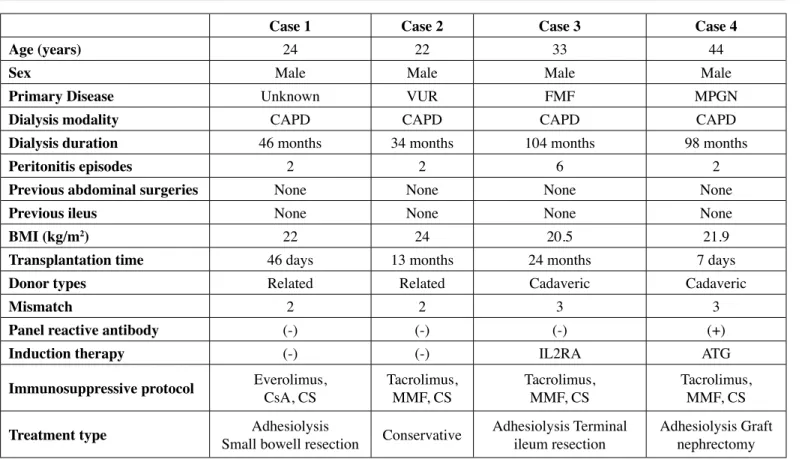
In this retrospective analysis, kidney allograft recipients who had had PD at least 6 months before transplantation between January 1999 and October 2009 were enrolled to the study. Thirty-four patients (8 deceased and 26 living donor recipients) were evaluated and 2 patients with deceased donor (irst patient lost the graft due to thrombotic thrombocytopenic purpura in 2 weeks and the patient returned to PD while the second one was lost to follow-up) and 1 patient with living related donor transplantation were excluded as they were lost to follow-up. Six deceased donor and 25 living related kidney allograft recipients were included in the analysis. Charts were reviewed for age, gender, primary renal disease, duration of PD, number of peritonitis attacks during the PD period, donor type, immunosuppression, previous abdominal surgeries, previous history of bowel obstruction, and development of post-transplant bowel obstruction. Potential precipitating factors, management and outcomes are presented in Table I. We further analyzed the charts and hospital admissions of our all kidney allograft recipients for 10 years and it was recorded that there were 265 patients undergoing kidney transplantation from hemodialysis. Their iles were evaluated for hospitalization due to bowel obstruction.
Table ı: Characteristics and clinical course of four patients with EPS.
Case 1 Case 2 Case 3 Case 4
age (years) 24 22 33 44
Sex Male Male Male Male
primary disease Unknown VUR FMF MPGN
dialysis modality CAPD CAPD CAPD CAPD
dialysis duration 46 months 34 months 104 months 98 months
peritonitis episodes 2 2 6 2
previous abdominal surgeries None None None None
previous ileus None None None None
Bmı (kg/m2) 22 24 20.5 21.9
Transplantation time 46 days 13 months 24 months 7 days
donor types Related Related Cadaveric Cadaveric
mismatch 2 2 3 3
panel reactive antibody (-) (-) (-) (+)
ınduction therapy (-) (-) IL2RA ATG
ımmunosuppressive protocol Everolimus,CsA, CS Tacrolimus,MMF, CS Tacrolimus,MMF, CS Tacrolimus,MMF, CS
Treatment type Small bowell resectionAdhesiolysis Conservative Adhesiolysis Terminal ileum resection
Adhesiolysis Graft nephrectomy
vuR: Vesicoureteral relux; FmF: Familial Mediterranean Fever; mpGn: Membranoproliferative Glomerulonephritis; Capd: continuous ambulatory peritoneal dialysis; mmF: mycophenalate mofetil; CS: Corticosteroid; Csa: Cyclosporine; ıl-2Ra:
Keven K et al :Development of Encapsulating Peritoneal Sclerosis in Kidney Allograft Recipients: Risk Factors and Clinical Implications
Turk Neph Dial Transpl 2011; 20 (2): 142-145 144
Türk nefroloji diyaliz ve Transplantasyon dergisi
Turkish Nephrology, Dialysis and Transplantation Journal
Statistics
All statistical analyses were performed using SPSS for Windows, version 15.0 (Chicago, IL, USA). Results were expressed as medians (minimum-maximum). Fisher’s exact test was used for categorical variables and the Mann-Whitney U test was used for numerical variables as appropriate. P<0.05 was considered statistically signiicant.
RESulTS
After exclusion, 31 PD patients (25 male/6 female), who had undergone kidney transplantation were evaluated and 4 patients were found to have developed post-transplant bowel obstruction due to EPS (12.9%). The condition occurred minimum 7 days to maximum 24 months after transplantation. We observed only one case of postoperative bowel obstruction in 265 kidney allograft recipients previously treated with hemodialysis, and this patient was found to have colon cancer.
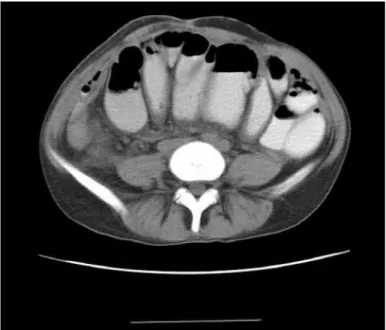
All patients were given tacrolimus or cyclosporine A, mycophenolate mofetil or azathioprine or sirolimus/everolimus, and steroids. Steroids were initiated as 500 mg per day intravenous methylprednisolone for 3 days and were then tapered gradually to 4 mg oral prednisone. Induction therapy with interleukin-2 receptor antibodies or antithymocyte globulin was given to all deceased transplant recipients. The demographic features and treatment of post-transplant bowel obstruction are given in Table I. No patient had a history of bowel obstruction or abdominal surgery in pre-transplantation period. Dialysis duration was 6-104 months. The patients with EPS were admitted to the hospital due to development symptoms of bowel obstruction and they were treated conservatively (cessation of oral intake, nasogastric decompression, and total parenteral nutrition). Surgery was performed if there was no response to the treatment. All patients underwent abdominal CT scan with barium enema to rule out other possible causes, and the results were consistent with EPS showing dilatation of the bowel and adherent intestinal loops in these four patients (Figure 1, CT of case 1). Three patients needed surgery due to lack of response to the initial treatment while one patient resolved with a conservative approach.
The earliest occurrence was 7 days after transplantation and this patient had immediate allograft function. The patient was treated with nasogastric decompression, cessation of oral intake, and total parenteral nutrition. On the 8th day, abdominal CT scan
showed dilatation of intestinal loops and adherent intestinal
loops. The patient then suddenly developed complete anuria on post-transplant day 9. Doppler ultrasound showed no low in the graft artery. The patient underwent surgery that revealed graft necrosis and nephrectomy was performed. Adhesiolysis was also performed (Case 4).
As seen in Table II, the duration of PD and number of peritonitis attacks were the signiicant risk factors for bowel obstruction due to EPS in post-transplant period.
dıSCuSSıOn
The incidence of GI complications is relatively high in kidney transplantation recipients and these complications may be severe in about 10% of patients (3). The most frequent gastrointestinal complications in kidney allograft recipients include oral lesions, esophagitis, peptic ulcer, diarrhea, intestinal tuberculosis, colon hemorrhage or perforation and colon cancer. These disorders may be related to medications, infections or exacerbation of pre-existing gastrointestinal pathology (3,4). Although EPS is not an infrequent complication in patients with PD, there is limited Table ıı: Risk Factors for bowel obstruction due to EPS in kidney allograft recipients.
patients with EpS non-EpS p-value
patient number (n) 4 27
age 29.5 (22-44) 33 (18-51) NS
Sex F/m 0/4 7/20 NS
Capd duration (months) 73 (34-104) 19 (6-84) 0.018
peritonitis episodes 2 (2-6) 0 (0-3) 0.004
F: Female; m: Male; nS: None signiicant
145
Keven K et al :Development of Encapsulating Peritoneal Sclerosis in Kidney Allograft Recipients: Risk Factors and Clinical Implications
Türk nefroloji diyaliz ve Transplantasyon dergisi
Turkish Nephrology, Dialysis and Transplantation Journal
Turk Neph Dial Transpl 2011; 20 (2): 142-145
data about this disorder in kidney allograft recipients previously treated with PD (5). In our study, we showed that EPS developed after kidney transplantation in 4 of 31 asymptomatic PD patients. It needed surgical adhesiolysis to resolve in three cases and we had one graft loss because of this complication.
Renal transplant recipients may develop bowel obstruction because of several reasons including ischemic colitis, post-transplant intestinal malignancies, and post-post-transplant toxic megacolon due to pseudomembranous enterocolitis (6-9). In their study, Sarkio et al. investigated GI complications in kidney allograft recipients and found that age was the only signiicant risk factors for GI complications in 1445 patients during 1990-1999 (3). In their report, mechanical bowel obstruction was reported in 5 patients a median of 0.3 years (4 days to 1.8 years) after kidney transplantation. However, there was no detailed data on these patients. It is likely that some of these 5 patients might have had EPS.
EPS is an intestinal obstruction syndrome caused by peritoneal inlammation and injury resulting in ibrin capsule formation and bowel obstruction symptoms. It occurs in 2.5% of peritoneal dialysis patients (5,10). A longer duration of PD, recurrent infections, and cessation of PD treatment are the well known risk factors for EPS. Its pathogenesis involves loss of mesothelial cells due to ongoing injury of peritoneal dialysis solutions resulting in progressive peritoneal ibrosis, angiogenesis and increased peritoneal endothelial permeability. These lead to ibrin accumulation and a ibrin membrane in the peritoneal cavity. While it can be asymptomatic during peritoneal dialysis due to some elimination via peritoneal lavage, it can develop after withdrawal of PD. Diagnosis is based on symptoms and indings of bowel obstruction. Abdominal CT scan shows dilated intestinal loops, adherent bowel loops and peritoneal thickening (10,11). Although, tamoxifen, steroids and continuing peritoneal lavage with a catheter left in place are the treatment options for EPS, they seem not to be very effective in the long term. The best treatment modality is surgical adhesiolysis which can lead to a complete cure in most cases (10). In our study, 3 of 4 patients needed surgical treatment and adhesiolysis was done in these patients. They are still asymptomatic and there is no recurrence in these patients during the follow-up. Kawanishi et al. reported that median PD duration in patients with EPS was 124 months (28-224). They noticed the EPS development after PD withdrawal in 95% of their patients, and median time to EPS onset after PD withdrawal was 12 months (0-64). Multiple operations were required in 25% their patients and the postsurgical mortality rate was 6.9% (4). Our cases did not need a second surgery and this can be explained by steroids which prevent recurrence. However, the effect of cyslosporin A, tacrolimus, mycophenolate mofetil, and everolimus on EPS has not been evaluated. They might be proibrotic and increase the rate of EPS in the post-transplant period.
There is a limited number of studies evaluating the occurrence of post-transplant EPS in kidney allograft recipients. Fieren et al. reported 10 EPS patients after kidney transplantation in their 13-case EPS series (1 patient was a heart transplant recipient, 1 had EPS before kidney transplantation, 1 did not have kidney transplantation). Four of these 10 patients died and 2 in this group
underwent adhesiolysis while 2 did not have surgery. Among the surviving patients, 3 out of 6 underwent adhesiolysis, while 3 did not have surgery. The PD duration was 24 to 120 months and the onset of EPS was between 0.6 to 50 months after kidney transplantation. Most of the cases were on mycophenolate mofetil and tacrolimus (12).
In conclusion, EPS can develop after kidney transplantation in patients treated previously by PD and it needs surgical adhesiolysis in most cases. EPS development should be considered in PD patients in the post-transplant period, even days after kidney transplantation.
REFEREnCES
1. Nolan CR: Strategies for improving long-term survival in patients with ESRD. J Am Soc Nephrol 2005 Nov; 16: 120-127
2. Wolfe RA, Ashby VB, Milford EL, Ojo AO, Ettenger RE, Agodoa LY, Held PJ, Port FK: Comparison of mortality in all patients on
dialysis, patients on dialysis awaiting transplantation and recipients
of a irst cadaveric transplant. N Engl J Med 1999; 341(23): 1725-1730
3. Sarkio S, Halme L, Kyllonen L, Salmela K: Severe gastrointestinal complications after 1515 adult kidney transplantations. Transpl Int 2004; 17(9): 505-510
4. Ponticelli C, Passerini P: Gastrointestinal complications in renal transplant recipients. Transplant Int 2005; 18: 643-650
5. Kawanishi H, Moriishi M: Encapsulating peritoneal sclerosis: Prevention and treatment. Perit Dial Int 2007; 27: 289-292
6. Billard JL, Guérin C, Farcot M, Barral X, Berthoux F: Colonic perforation after renal transplantation. Nephrologie 1990; 2: 95-96 7. Church JM, Fazio VW, Braun WE, Novick AC, Steinmuller DR:
Perforation of the colon in renal homograft recipients. A report of 11 cases and review of the literature. Ann Surg 1986; 203: 69-76 8. Lao A, Bach D: Colonic complications in renal transplant recipients.
Dis Colon Rectum 1988; 31: 130-133
9. Keven K, Basu A, Re L, Tan H, Marcos A, Fung JJ, Starzl TE, Simmons RL, Shapiro R: Clostridium dificile colitis in patients after kidney and pancreas-kidney transplantation. Transpl Infect Dis 2004; 6: 10-14
10. Kawanishi H, Moriishi M, Ide K, Dohi K: Recommendation of the surgical option for treatment of encapsulating peritoneal sclerosis. Perit Dial Int 2008; 28: 205-210
11. Vlijm A, Stoker J, Bipat S, Spijkerboer AM, Phoa SS, Maes R, Struijk DG, Krediet RT: Computed tomographic indings characteristic for encapsulating peritoneal sclerosis: A case-control study. Perit Dial Int 2009; 5: 517-522