Strain and vacancy cluster behavior of vanadium and tungsten-doped
Ba[Zr0.10Ti0.90]O3 ceramics
F. Moura, A. Z. Simões, L. S. Cavalcante, M. Zampieri, J. A. Varela et al.
Citation: Appl. Phys. Lett. 92, 032905 (2008); doi: 10.1063/1.2837196
View online: http://dx.doi.org/10.1063/1.2837196
View Table of Contents: http://apl.aip.org/resource/1/APPLAB/v92/i3
Published by the AIP Publishing LLC.
Additional information on Appl. Phys. Lett.
Journal Homepage: http://apl.aip.org/
Journal Information: http://apl.aip.org/about/about_the_journal
Top downloads: http://apl.aip.org/features/most_downloaded
Information for Authors: http://apl.aip.org/authors
Strain and vacancy cluster behavior of vanadium and tungsten-doped
Ba
†
Zr
0.10Ti
0.90‡
O
3ceramics
F. Moura, A. Z. Simões, L. S. Cavalcante,a兲 M. Zampieri, J. A. Varela, E. Longo, and M. A. Zaghete
Instituto de Química, UNESP, P.O. Box 355, 14801-907 Araraquara, São Paulo, Brazil
and Departamento de Química, UFSCar, P.O. Box 676, São Carlos, 13565-905 São Paulo, Brazil
M. L. Simões
EMBRAPA Agricultural Instrumentation, P.O. Box 741, São Carlos, 13560-970 São Paulo, Brazil
共Received 8 October 2007; accepted 1 January 2008; published online 25 January 2008兲
Strain and vacancy clusters behavior of polycrystalline vanadium 共V兲 and tungsten 共W兲-doped
Ba关Zr0.10Ti0.90兴O3,共BZT:2%V兲and共BZT:2%W兲ceramics obtained by the mixed oxide method was
evaluated. Substitution of V and W reduces the distortion of octahedral clusters, decreasing the Raman modes. Electron paramagnetic resonance data indicate that the addition of dopants leads to defects and symmetry changes in the BZT lattice. Remnant polarization and coercive field are affected by V and W substitution due the electron-relaxation mode. The unipolar strainEcurves as
a function of electric field reach its maximum value for BZT:2%V and BZT:2%W ceramics. ©2008
American Institute of Physics.关DOI:10.1063/1.2837196兴
Very high piezoelectric and electrostrictive properties have been achieved in a series of lead based perovskite-type relaxor ferroelectric single crystals1,2 for a certain orienta-tion. It is believed that in these systems, the high strain is engendered by phase switching from low to high spontane-ously deformed states and that the usual hysteresis in such a process is moderated by an induced monoclinicity, which permits almost continuous rotation of the polarization vector. Unfortunately, lead compounds are toxic so there is an in-creasing desire to develop lead-free materials with high strain capability.3Among several groups of lead-free
candi-dates, BaTiO3 共BTO兲 is known to have a large
electrome-chanical coupling factor. Substitution of Ti4+by Zr4+exhibits
several interesting features in the dielectric behavior of BTO ceramics. The effect of doping on various physical and chemical properties of this material is known and this effect has been extensively exploited in piezoelectrics and ferro-electrics to improve their performance. Many aliovalent compositional alterations to Ba关ZrxTi1−x兴O3have been
stud-ied either with higher valence substitutions共donors兲or with lower valence ions共acceptors兲. Donor dopants, such as V5+ and W6+, induce cationic defects while occupying theBsite
of the perovskite lattice.4,5Such behavior may cause several effects on the dielectric behavior through interaction with domain walls.6,7 Recently, it was found that in sintering of Y2O3-doped BTO with Y2O3 higher than 0.80 mol %,
pre-sumably exceeded the solid solubility of Y2O3 in BTO, is
improved by both enhanced densification共by solid-solution
defect兲 and suppressed coarsening 共by second-phase
pinning兲.8These results demonstrate the performance of our capacitors for future piezoelectric resonators consuming low
energy levels at low phase transition temperature.
Ba关Zr0.10Ti0.90兴O3 共BZT兲 ceramics were prepared by
solid-state reaction. BaCO3, TiO2, and ZrO2 starting materials
with high purity were weighed and wet mixed in alcohol. After drying, the powders were calcined at 600 ° C for 4 h. An aqueous solution of tungsten and vanadium was added to
BZT powders. BZT, BZT:2%V, and BZT:2%W were sintered at 1550, 1350, and 1200 ° C, respectively, with pellets in a size of about 10⫻1 mm2. The density of the sintered
com-pacts was measured by Archimedes method. After sintering, the disks were polished to 1 mm in thickness and character-ized by means of electrical measurements. Gold electrodes were applied by evaporation through a sputtering system in a polished surface of sintered discs. Fourier transform Raman
共FT-Raman兲 spectroscopy was performed on Bruker-RFS
100, Germany. A 1064 nm Nd:YAG共yttrium aluminum
gar-net兲laser was used to obtain the Raman spectra as excitation source with its power kept at 85 mW. Ferroelectric proper-ties were measured on a Radiant Technology RT6600A tester equipped with a micrometer probe station in a virtual ground mode. The strain as a function of electric field was measured at 0.2 Hz by a modified Sawyer–Tower circuit and a linear variable displacement. Electron paramagnetic resonance
共EPR兲 spectra were recorded on a Bruker EMX-300
Spec-trometer, operating atXband 共9 GHz兲and operating at mi-crowave power of 2 mW, amplitude modulation of 1 G, time constant of 2.56 ms, conversion time of 10.24 ms, and
modulation frequency of 100 kHz. The g factor was
refer-enced with respect to MgO : Cr3+共g= 1.9797兲as the external standard. All EPR measurements were performed under
room temperature 共25 ° C兲 and the spectra were evaluated
using theSIMFONIAprogram.
Evolution of Raman spectra in the vanadium and tung-sten doped ceramics shows the order-disorder degree of the atomic structure at short range共Fig.1兲.
The modes further split into longitudinal共LO兲and trans-verse共TO兲components due the long electrostatic forces
as-sociated with lattice ionicity caused by Ba2+ ions in BTO
such as reported in the BZT lattice.9,10The spectrum shows the stretching mode ofA1共TO1兲 andA1共TO3兲 at around 193
and 517 cm−1, according to the Refs. 11 and 12. The
E1共TO1兲andE1共TO2兲 modes that have been associated with
the tetragonal-cubic phase transition13 were observed at 116
and 301 cm−1, whereas the A
1共LO3兲 mode was found at
720 cm−1, with zirconium共Zr兲 substituting on titanium共Ti兲
a兲
Electronic mail: [email protected].
APPLIED PHYSICS LETTERS92, 032905共2008兲
0003-6951/2008/92共3兲/032905/3/$23.00 92, 032905-1 © 2008 American Institute of Physics
sites. However, the coupling between the sharpA1共TO1兲and
broad A1共TO2兲 modes reduces as the intensity of A1共TO2兲
mode decreases.14,15As vanadium and tungsten are incorpo-rated in the BZT lattice, a Raman mode at 915 cm−1appears, which reduces the distortion of octahedral clusters, decreas-ing the relative intensity of bands.
Room-temperature EPR spectrum is shown in Fig.2.
The reported parameters of the EPR Hamiltonian were used to perfectly reproduce the observed sequence of the symmetrical peak pattern of the fine structure. V and W sub-stitution in the Ti site cause distortion in the lattice being responsible for changes in the spectra. Charges were quanta-tively measured共spins/g兲and are showed in Fig.2. The ob-served signal is typical of oxygen vacancies, as cited in the
Ref. 16. BZT:2%W also shows hyperfine bands which are
typical of materials with paramagnetic ion . That can be at-tributed to the paramagneticW5+共5d1兲ions, according to the
Ref.17, supporting the high symmetry as inferred from
Ra-man studies. Moreover, it suggests the almost isotropic neighborhood of the isolated Zr and Ti ions in the pattern.
There is an increase in the defects and symmetry changes in the BZT lattice as vanadium and tungsten are added in the system. The main difference in the spectra corresponds to the expected line broadening attributed to dipolar interactions of vanadium and tungsten in the host, according to Eqs. 共1兲–共13兲:
WO3→
BZT
WTi·· +VBa
⬙
+ 3OOx
, 共1兲
关MO6兴c x
+关MO5·VO
x兴 c x
→关MO6兴c
⬘
+关MO5·VO•兴
c, 共2兲
whereM= Zr or Ti andc= complex;
关VBa
⬙
O12兴c+关WO6兴c⬙
→关VBax
O12兴c+关WO6兴c x
, 共3兲
关MO5·VO
x
兴c+关WO6兴c
⬙
→关MO5·VO •兴c+关WO6兴c
⬘
, 共4兲关MO5·VO
x兴
c+关WO6兴c
⬘
→关MO5·VO •兴c+关WO6兴c x
, 共5兲
2关MO6兴c
⬘
+关WO6兴c⬙
→2关MO6兴c x+关WO6兴c x
, 共6兲
V2O5→
BZT
2VTi ·
+VBa
⬙
+ 5OOx
, 共7兲
关MO6兴c x
+关MO5·VO
x兴
c→关MO6兴c
⬘
+关MO5·VO •兴c, 共8兲
关VBa
⬙
O12兴c+ 2关VO6兴c⬘
→关VBax
O12兴c+ 2关VO6兴c x
, 共9兲
关MO5·VO
x
兴c+关VO6兴c
⬘
→关MO5·VO •兴c+关VO6兴c x
, 共10兲
关MO6兴c
⬘
+关VO6兴c⬘
→关MO6兴c⬘
+关VO6兴c x, 共11兲
despolarization of关MO5·VO ·
兴ccluster,
关MO5·VO •兴
c+ O2→关MO5·VO •兴
. O2共ads兲, 共12兲
关MO5·VO •
兴· O2共ads兲→关MO5·VO ••
兴· O2
⬘
. 共13兲High 关VO˙兴 concentration adsorbs O2 leading to
关MO5·VO ··兴
O2
⬘
. This species favors the creation of oxygenvacancies in关TiO6兴 or 关ZrO6兴 sites being most of that
con-sidered as complex vacancies in BZT lattice. As a conse-quence, the oxygen vacancy-acceptor ion dipole may interact with polarization within a domain making it movement more difficult to switch.
The inset of Fig. 2 illustrates the hysteresis loops of
BZT, BZT:2%V, and BZT:2%W ceramics. All loops are
characteristic for materials employed in ferroelectric
memories.18 For BZT:2%V, the remnant polarization
in-creased from 6 to 8.6C/cm2 compared to BZT and
de-creases after to 2.2C/cm2 for BZT:2%W. The values of
dielectric constant at 10 kHz were of 11.660, 6.420, and 15.111 for BZT, BZT:2%W, and BZT:2%V, respectively. Ad-dition of vanadium leads to oxygen vacancies which de-crease the stress within the domains,19 resulting in an in-crease of coercive field 共Ec兲 from 1.2 to 1.7 kV/cm. The
remnant polarization is reduced for BZT:2%W due the electron-relaxation-mode coupling mechanism in which car-riers共or polarons, protons, and so on兲 are coupled with the existing dielectric modes. Besides that, tungsten acts by re-pulsion with their next nearest neighbors and as a conse-quence, increases the defects of oxygen octahedral at short range. In this case, the coercitive field is unchanged com-pared to BZT.
FIG. 1.共Color online兲Room temperature depolarized Raman spectra for共a兲
BZT pure,共b兲BZT:2%W, and共c兲BZT:2%V ceramics. The vertical dashed lines indicate the position and relative intensity of Raman modes.
FIG. 2.共Color online兲Electron paramagnetic resonance measurements for BZT pure, BZT:2%W, and BZT:2%V ceramics. The inset shows theP-E
hysteresis loops for BZT pure, BZT:2%W, and BZT:2%V ceramics and quantitative analysis of EPR.
032905-2 Mouraet al. Appl. Phys. Lett.92, 032905共2008兲
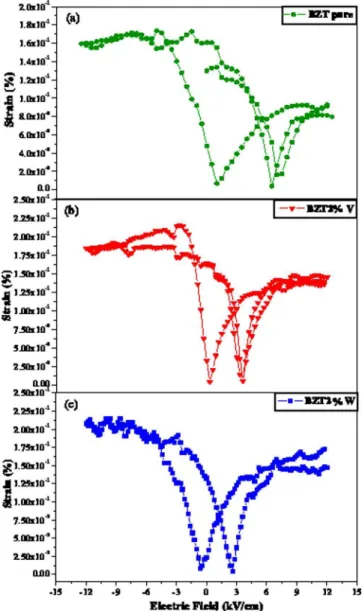
The unipolar strain behavior at room temperature is shown in Fig.3.
The unipolar strain became a maximum at 5 kV/cm, but
saturates at 10 kV/cm. The modifiers increase the strain
be-havior, in part, due to domain reorientation. Beyond that point, it is possible that a modest bias field results in the transition from asymmetric to symmetric phase. This field-induced phase transition may be ascribed to the pinching effect, that is, the consequent decrease in free energy differ-ence among polymorphic phases. A careful inspection of the S-Eplots reveals that there are two apparent linear regions at low fields 共E⬍5 kV/cm兲 and high fields 共E⬎10 kV/cm兲 and one transition region. That corresponds to domain reori-entation induced by external electric fields. The hysteretic strain could be associated with domain reorientation. At elec-tric fields higher than 10 kV/cm, the strain is hysteresis free,
indicating a stable single domain/poling state induced by the
high external electric fields. In addition, from theS versusE profiles, no noticeable induced phase transition is observed at such high electric fields. It is shown that BZT:2%V and BZT:2%W ceramics exhibit a slightly higher unipolar strain than that for nominally pure BTO ceramics, as shown in Fig. 3. Compared to BZT 共S= 0.11%兲, the strain was 共S= 0.16
and 0.19%, respectively兲 for BZT:2%V and BZT:2%W
ce-ramics, respectively. This is a generally observed phenom-enon in doped electronic ceramics, which might be attributed to the improved ceramic quality due to a small amount of impurity doping.
As conclusion, we have shown that the main effect of 关MO5·VO
··兴
O2
⬘
vacancies in BZT:2%V and BZT:2%Wceram-ics prepared by the mixture oxide method is the introduction of complex vacancies defects, oxygen vacancies and despo-larization of关MO5·VO
˙
兴cclusters. As consequence, occurs an increases in the disorder of关MO6兴 octahedral at short range
共M= Zr or Ti兲. The unipolar strain behavior was
approxi-mately at 5 kV/cm, but decreases and, subsequently,
satu-rates at 10 kV/cm. Raman modes are affected by V and W
substitution due the distortion reduction of octahedral clus-ters. EPR data evidenced disorder and symmetry changes in the BZT lattice while hysteresis data confirm that the substi-tution is due to the electron relaxation mode in which carri-ers共polarons, protons, and so on兲are coupled with existing dielectric modes.
The authors acknowledge CAPES, FAPESP, and CNPq.
1
S. E. Park and T. R. Shrout, Mater. Res. Innovations 1, 20共1997兲.
2
S. E. Park and T. R. Shrout, J. Appl. Phys. 82, 1804共1997兲. 3
A. Simon, J. Ravez, and M. Maglione, J. Phys.: Condens. Matter16, 963 共2004兲.
4
Y. Zhi, A. Chen, J. Zhi, P. M. Vilarinho, and J. L. Baptista, J. Appl. Phys.
88, 410共2000兲. 5
A. Carg and T. C. Goel, Mater. Sci. Eng., B 60, 128共1999兲. 6
R. Shannigrahi, R. N. P. Choudhary, and N. Acharya, Mater. Sci. Eng., B
56, 31共1999兲.
7
D. Bolten, U. Bouger, T. Schneller, M. Grossnam, O. Lose, and R. Waser, Appl. Phys. Lett. 77, 3830共2000兲.
8
H. Y. Lu and M. H. Lin, Ceram. Int. 31, 989共2005兲.
9
A. Dixit, S. B. Majumder, P. S. Dobal, R. S. Katiyar, and A. S. Bhalla, Thin Solid Films 447, 284共2004兲.
10
P. S. Dobal and R. S. Katiyar, J. Raman Spectrosc. 33, 405共2002兲. 11
P. S. Dobal, A. Dixit, R. S. Katiyar, Z. Yu, R. Guo, and A. S. Bhalla, J. Appl. Phys. 89, 8085共2001兲.
12
J. Kreisel, P. Bouvier, M. Maglione, B. Dkhil, and A. Simon, Phys. Rev. B
69, 092104共2004兲. 13
B. D. Begg, K. S. Finnie, and E. R. Vance, J. Am. Ceram. Soc. 79, 2666 共1996兲.
14
P. S. Dobal, A. Dixit, R. S. Katiyar, Z. Yu, R. Guo, and A. S. Bhalla, J. Raman Spectrosc. 32, 69共2001兲.
15
A. Dixit, S. B. Majumder, P. S. Dobal, R. S. Katiyar, and A. S. Bhalla, Thin Solid Films 447, 284共2004兲.
16
M. Zhang, Z. Jin, J. Zhang, X. Gou, J. Yang, W. Li, X. Wang, and Z. Zhang, J. Mol. Catal. A: Chem. 217, 203共2004兲.
17
V. V. Laguta, M. Martini, A. Vedda, E. Rosetta, M. Nikl, E. Mihókóva, J. Rosa, Y. Usuki, Phys. Rev. B 67, 205102共2003兲.
18
G. D. Hu, X. Cheng, W. B. Wu, and C. H. Yang, Appl. Phys. Lett. 91,
232909共2007兲. 19
J. Zhu, X. B. Chen, J. H. He, and J. C. Shen, Phys. Lett. A 362, 471 共2007兲.
FIG. 3.共Color online兲Strain hysteresis as a function of electric field for共a兲
BZT,共b兲BZT:2%W, and共c兲BZT:2%V ceramics.
032905-3 Mouraet al. Appl. Phys. Lett.92, 032905共2008兲