When Does an Immigrant with HIV
Represent an Excessive Demand on
Canadian Health or Social Services?
peter coyte &
kednapa thavorn
Introduction
In 2005, the Canada Communicable Disease Report esti-mated that 58,000 people in Canada were living with HIV. [1] During that year it was estimated that between 2,300 and 4,600 new cases of HIV emerged, with the incidence rate relatively uniform since 2002.[2] The number of people worldwide living with HIV is approximately 33 million and increasing.[3] As the world HIV population expands, there is expected to be an increase in the number of HIV-positive immigrants applying for entry to Canada,[4] and
accord-ingly, it is important to critically review federal immigration policies that affect such applicants.
The Canadian Immigration and Refugee Protection Act (IRPA) states in Section 38(1) that:
A foreign national is inadmissible on health grounds if their health condition:
(a) is likely to be a danger to public health; (b) is likely to be a danger to public safety; or (c) might reasonably be expected to cause excessive demand on health or social services.
While IRPA does not speciically mention HIV or related ill -nesses, Canada generally excludes people infected with HIV if they can be expected to place an “excessive demand” on publicly funded health or social services. It is important to note that entry restrictions to Canada based on HIV status do not apply to short-term visitors staying for less than six months.[5] This is indicative of the underlying assumption that HIV is not highly contagious and therefore is not rea-son in itself for a perrea-son to be denied entry to Canada. The extent to which an immigrant is likely to place an excessive
1
Abstract
burden on the health care system is indicated as the primary concern and is evaluated based on whether an applicant’s projected annual health care costs would exceed the annual health care costs of an average Canadian,[4] which in 2007
was $4,867.40.[6] It is not speciied what constitutes an
‘average’ Canadian, given the large within-group variation that exists among the general population, but it is likely that an HIV-positive person receiving antiretroviral treatment will incur expenses that exceed that threshold. While the law has resulted in denial of admission due to “excessive burden” to only 3.4% of all HIV-positive applicants between 2006 and 2007 (i.e. 36 of 1,050), the overwhelming majority of the HIV-positive applicants (94.7% or 994 of 1,050) were exempt from this condition as they were admitted as spouses or legal dependents under family-class sponsorship or as
oficially recognized refugees. Consequently, 64.3% of those
HIV-positive applicants (i.e. 36 of 56) who were at potential risk of denial of admission due to the potential “excessive burden” attributable to their HIV status were denied admis-sion between 2006 and 2007.
The purpose of this paper is twofold: irst, to review the appli -cation of Canadian immigration law and jurisprudence as it pertains to persons with HIV and to place this review within a broader international context of restrictions on
interna-tional mobility; and second, to derive a statistical deinition
of excessive demand and to apply that threshold to persons with HIV who are seeking admission to Canada. In Section 2.0, we review the application of Canadian immigration law as it pertains to persons with HIV. In Section 3.0, we review and assess the current threshold used to determine excessive demand on Canadian health or social services. Section 4.0 yields a synthesis of the clinical, epidemiological and economics literatures concerning the expected burden placed on health or social services by persons with HIV. In Section 5.0, we derive estimates of the economic burden of a new immigrant with HIV after stratifying for their underlying health state, age and sex at the time of admission. Section 6.0 affords a comparison between the thresholds derived to measure excessive demand with the expected economic burden that immigrants with HIV may place on Canadian health or social services in order to yield evidence-informed criteria for the determination of medical inadmissibility. We
conclude with a brief summary of our indings.
Canadian and international experience with
medical inadmissibility
While international standards do not prohibit the practice of screening prospective immigrants for communicable
dis-eases prior to entry, the scope of restrictions on people with HIV is strictly constrained. According to the International Guidelines on HIV and Human Rights:
The right to liberty of movement encompasses the rights of everyone lawfully within a territory of a State to liberty of movement within that State and the free-dom to choose his/her residence, as well as the rights of nationals to enter and leave their own country…. Where States prohibit people living with HIV from longer-term residency due to concerns about eco-nomic costs, States should not single out HIV, as opposed to comparable conditions, for such treatment and should establish that such costs would indeed be incurred in the case of the individual alien seeking residency.[7]
In the United Kingdom, Australia and the United States, it is common to deny admission to prospective immigrants with HIV. In the United Kingdom, denial of admission to HIV-positive immigration applicants has occurred on the
basis that required treatments may be too expensive for the
applicant to afford.[8] While a publicly funded National Health Service (NHS) allows citizens of the United Kingdom to seek health care treatment at minimal individual cost, the UK’s immigration practice has been to stringently enforce its policy of medical inadmissibility to deter persons with HIV from engaging in ‘treatment tourism’.[9]
In Australia, travelers wishing to stay temporarily in the
country for short visits may do so but are required to sign
a declaration of good health, or otherwise state the health problems with which they are currently living.[8] Based on the information provided, a person may be deemed inadmis-sible for even a temporary visit, although such cases are typi-cally reserved for severe circumstances. In order to immigrate to Australia, each applicant must undergo HIV testing and if it is suspected that the cost of health care treatment will
be excessive, or will subsequently deny Australian citizens
access to limited health care resources, an applicant may be denied admission.[8]
In the United States, no person with HIV, in principle, may be admitted to the country as an immigrant.[8] Under excep-tional circumstances a person may be admitted temporarily (30 days or less) to visit family, seek medical treatment or to conduct business.[8] While admission to the United States
does not require one to undergo a medical examination, it is
important to note that if a foreign national knowingly declares that he or she is HIV-negative and is found to have HIV in the United States after arrival, that person will be deported to his or her country of origin.[8]
standard, however, as in both Denmark and Sweden there are few entry restrictions for HIV-positive persons.[8] Many Western countries have denied medical treatment to persons with HIV who are often from countries in which access to antiretroviral (ARV) treatment is not readily available.[10] Further, the incidences of deportation which have been noted in both the United States and the United Kingdom,[11] on the grounds that HIV-positive persons tend to place excessive
demands on health care services, has been questioned on
the basis of health as a human right, while the act of
deporta-tion itself has been deplored as ‘immoral’[9] and ‘unjustii -able’.[11]
The inancial burden of HIV on the general population is
evaluated at the level of the individual and is typically based on a metric involving the calculation of hospitalization costs, ARV and drug treatment expenses as well as the use of other health care services.[11] In a 2001 study conducted by Chen et al.,[12] concerning the per capita costs of HIV based on medication and hospitalization expenditures in the United States, it was found that disbursements for highly active ARV therapy were relatively constant at $10,500 USD across all CD4 cell count strata. However, patients with CD4 cell counts less than 50 cells/mm3 incurred costs that were 2.6 times greater than the total annual expenditures of patients with CD4 cell counts less than 350 cells/mm3.[12] The study concluded that an increase in disease severity was positively correlated with increased health care costs.[12] The
impli-cations of this inding suggest that the use of health care
services by persons with HIV increases over time and needs to be considered in the evaluation of applicants seeking to migrate to countries such as Canada. At present, Citizenship and Immigration Canada (CIC) uses an Operational Process-ing Instruction manual to assess the eligibility of HIV-positive applicants that may enter Canada. The manual indicates that certain applicants may be Excessive Demand Exempt (EDE), according to Section 38(2) of the IRPA, in cases where one,
(a) has been determined to be a member of the family class and to be the spouse, common-law partner or child of a sponsor within the meaning of the regula-tions;
(b) has applied for a permanent resident visa as a Con-vention refugee or a person in similar circumstances; (c) is a protected person; or
(d) is, where prescribed by the regulations, the spouse, common-law partner, child or other family member of a foreign national […]
Such applicants, as deined above, are assessed for entry
based on whether or not they present a threat to public health or safety. Problematically, it is not clear from the IRPA
guidelines what may constitute a public health or safety threat. Moreover, non-EDE applicants must undergo testing to determine their CD4 cell count. If the test indicates that an applicant has a CD4 cell count below 350 cells/mm3, ARVs
are required based on Canadian guidelines.[13] In such
cases, an applicant is said to represent an excessive demand
irrespective of the source of inance for such mediations.[13]
The interpretation of excessive demand also includes those
who may in the future require ARVs to mitigate the progres -sion of the disease, substantially decreasing the possibility that any HIV-positive person would be found admissible without a separate claim to entry under family-class sponsor-ship or as a refugee.[4]
While the cost of ARVs may be a long-term inancial burden
on the Canadian public health care system, the results of
sus-tained ARV treatment have led to a decrease in the frequency
and duration of hospitalizations by HIV-positive persons.[14] In addition, the methods used by CIC to determine whether an applicant represents an excessive burden fail to account for the productivity that any given person might generate
within Canada after immigrating.[10] As CIC has afirmed,
immigration plays “an increasingly important role in support-ing Canada’s economic prosperity and competitiveness” and immigration is “a key source of labour force growth in the future.”[15] Indeed, immigrants arriving in Canada between 1991 and 2001 represented 70 percent of the decade’s total net labour force growth, and notably accounted for 24 per-cent of the labour force growth of the health and social ser-vices sector during that period.[16] Moreover, immigration makes an enormous contribution to the pool of people in
Canada with post-secondary qualiications. In 2006, among
new immigrants 15 years of age and over, almost 42 % of economic immigrants to Canada held a university degree and a further 15.5% held some other form of post-secondary
credentials such as a non-university diploma or trade certii -cate.[17] Therefore, the relative contribution of HIV-positive individuals to Canadian society needs to be evaluated in addition to the health care costs he or she may accrue in managing the progression of HIV in order to yield a
com-prehensive assessment of net cost (or net beneit) associated
with each immigration applicant.
immigration applications on an individualized basis, so as to incorporate into admissibility decision-making schemes the ability of each applicant to invest personal resources of time, money, and social support to sustain the livelihood of them-selves or family members with disabilities.[18] The Supreme Court decision validated the concern that an objective metric for evaluating the eligibility of a prospective immigrant fails to account for important individualized circumstances, and it acknowledged the legitimate claim that an applicant’s indi-vidual resources may offset the costs that would otherwise mean he or she would place an excessive burden on public costs in Canada. The Hilewitz decision concerned excessive
demand in relation to social services; to date, no oficial
court ruling has been made to extend the reasoning behind the Hilewitz decision to the context of health care services in Canada.
In sum, the literature suggests that fair treatment of people with
HIV requires evidence-based policies at home and abroad.
Immigration policies for persons with HIV will become increasingly important as legal, political and humanitarian concepts of access to health care services evolve. Presently,
Canadian federal immigration policies relect somewhat arbi -trary and rigid standards for determining excessive demand for persons with HIV. These assessments are conducted with-out individualized assessments of those who are not exempt from IRPA’s medical inadmissibility clause. Whether or not such standards serve to protect the Canadian health care
sys-tem and the citizens of Canada has yet to be afirmed, given:
the positive contributions HIV-positive persons may make to
Canada; and the possibility that applicants’ private inancial
and social resources may reduce their relative demand on
publicly inanced health care services.
Threshold for excessive demand on Canadian
health or social services
The current threshold used to determine excessive demand on Canadian health or social services is assessed in this sec-tion in light of Canadian health expenditure characteristics.
Although the provision of health care is a provincial concern
in Canada, the federal government has inluenced the devel -opment of policy. Since January 1, 1971, all ten provinces and the territories have had public health insurance plans covering all necessary medical and hospital services. Since the federal government covers a substantial portion of all health expenditures, it has been able to establish certain cri-teria that the provinces and territories must meet if they were
to qualify for their full share of federal transfers. Reasonable
access by all residents to the full range of insured services
without inancial impediments to utilization captures the
essence of the federal funding criteria.[19]
In 2007, average per capita Canadian health care expen-ditures were $4,867.40.[6] These expenexpen-ditures included various categories of health service expenditures whether
inanced publicly or privately. While the public share
accounts (in 2007) for 70.6% of total expenditures, most services are delivered privately. For example, physicians are generally self-employed, but reimbursed by provincial health insurance plans on a fee-for-service basis; while hospitals,
which are owned and operated on a not-for-proit basis by
various organizations, receive prospective global budgets
from provincial governments to inance ambulatory and
inpatient services.
To assess whether a potential immigrant represents an “excessive” demand on Canadian health or social services, a
threshold is required as stipulated in the legislation. Current
practice by CIC has been to set the annual cost threshold at approximately the same value as that for average per capita Canadian health care expenditures. However, that threshold is arbitrary and may be shown to be neither a reasonable nor statistically appropriate interpretation of the term “excessive” demand used in IRPA.
We propose that “excessive” demand on Canadian health or
social services be deined as a cost proile for a prospective
immigrant that is statistically greater than that for Canadians. To establish this “excessive” demand threshold, a statistical test is used to determine how large costs need to be before a prospective immigrant “might reasonably be expected to cause “excessive” demand on health or social services” in accordance with Section 38(1) of the Canadian Immigration and Refugee Protection Act (IRPA) of 2001.
To operationalize this statistical test, the distribution of
Canadian health care costs, the cost proile of a prospective immigrant, and the level of statistical signiicance all need to be established. Once acquired, tests may then be performed
to assess whether the expected health care cost experience of an immigration applicant is the same as or is greater than that
for Canadians. Speciically, a statistical test is constructed to
determine how large costs might need to be before a
prospec-tive immigrant’s cost proile is deemed to be “excessive”, i.e.
statistically different from that for a representative Canadian.
suggests that health care costs are non-negative and posi-tively skewed, i.e. skewed towards the high end. A distribu-tion that is consistent with such costs (i.e. non-negative and positively skewed) is a Gamma distribution. This distribution has been used previously in modeling health care
costs,[20-23] and it is relatively simple to describe because it is deined
in terms of scale and shape factors. These factors are the ratio of the variance of costs to average costs (s2/μ) and the ratio of
squared average cost to the variance of costs (μ2/s2),
respec-tively. Consequently, the Gamma distribution is essentially
based on two parameters: average costs; and the relative
vari-ance in costs (i.e. the coeficient of variation which is deined
as the ratio of the standard deviation of costs to its mean, s/μ).
A low relative variance yields cost observations concentrated around average costs, while observations are more dispersed when the relative variance is high.
Once the cost distribution for Canadians and for a prospec-tive immigrant have been established, the level of statistical
signiicance used to test the null hypothesis that a prospective immigrant exhibits a cost proile that is the same as that for Canadians against the alternative that such costs are greater than those for Canadians needs to be established. While it
is conventional in the research literature to use a 5% signii
-cance level (i.e. Fisher, 1925),[24] this level of signii-cance is discretionary and depends on the conidence warranted in the test. Use of a 5% signiicance level implies that the
statistical test correctly rejects the null hypothesis that a prospective immigrant has the same cost distribution as a
Canadian 95% of the time. A less stringent requirement to be correct (i.e. only 90%) yields a signiicance level of 10%, while a more stringent requirement to be correct (i.e. 98%) yields a signiicance level of 2%. A less stringent require
-ment increases the chance that the null hypothesis is rejected when a prospective immigrant has the same cost distribution as a Canadian. Based on the distribution of costs for
Cana-dians and for a prospective immigrant, the signiicance level invoked yields a unique “excessive” demand threshold as
shown in Figures 1(i) and 1(ii).
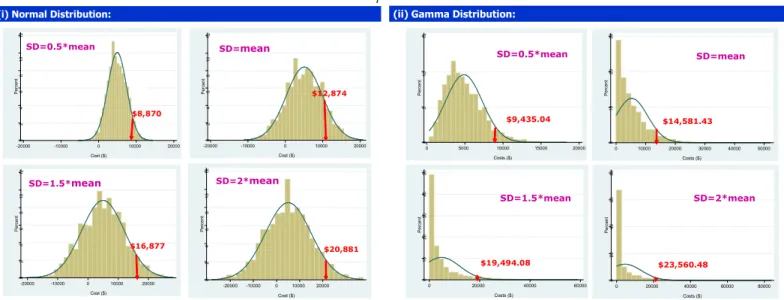
Figures 1(i) and 1(ii) represent two sets of simulated distri-butions of Canadian health care expenditures when we know average per capita health care expenditures, but where assumptions are made about both their relative vari-ance and proposed distribution. Figure 1(i) represents four possible normal (or bell-shaped) distributions for Canadian
health care costs, while Figure 1(ii) offers equivalent Gamma
distributions. The solid curves represent continuous prob-ability density functions, while the bar charts represent the proportion of observations that fall within various intervals. The simulated distributions of health care costs become more dispersed when the relative variance increases from 0.5 to 2.0. The solid vertical lines represent the threshold of health care costs experienced by 5% or fewer Canadians.
These upper values of health care costs are equivalent to the threshold used in hypothesis testing when a 5% signiicance
level is considered. Moreover, these thresholds increase as the relative variance of costs increase.
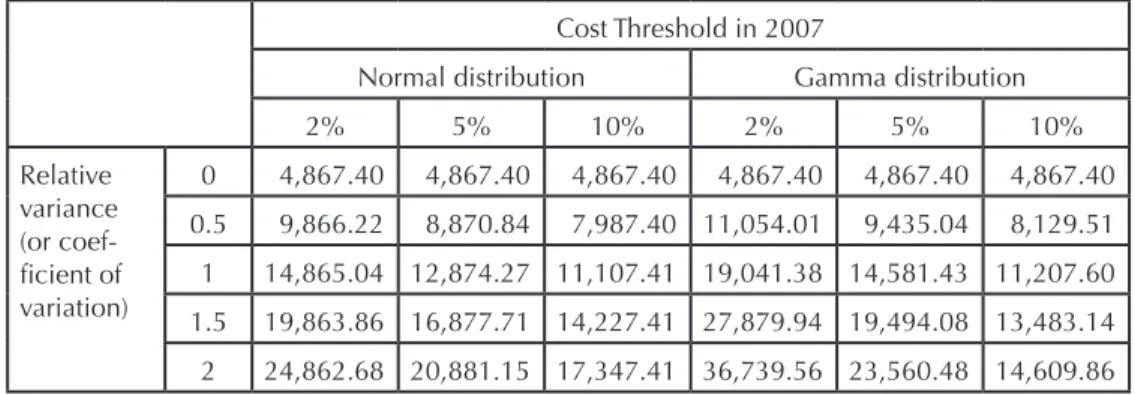
Annual cost thresholds for excessive demand are reported in Table 1. These thresholds are dependent on the assumed cost distribution (normal or gamma), the relative variance of
such costs (0, 0.5, 1, 1.5, or 2), and the signiicance level
used to test the null hypothesis that an immigration applicant
exhibits a cost proile that is the same as that for a Cana
-dian or a cost proile that is higher. Three indings may be
summarized. First, the Gamma distribution generally results
0 2 4 6 8 10 12 Percent
-20000 -10000 0 10000 20000
Cost ($) 0 2 4 6 8 10 12 Percent
-20000 -10000 0 10000 20000 Cost ($) 0 2 4 6 8 10 12 Percent
-20000 -10000 0 10000 20000
Cost ($) 0 2 4 6 8 10 12 Percent
-20000 -10000 0 10000 20000 Cost ($)
(i) Normal Distribution:
SD=0.5*mean SD=mean
SD=1.5*mean SD=2*mean
$8,870
$12,874
$16,877 $20,881
(ii) Gamma Distribution:
0
5
10
15
Percent
0 5000 10000 15000 20000 Costs ($) 0 10 20 30 Percent
0 10000 20000 30000 40000 50000
Costs ($) 0 10 20 30 40 50 Percent
0 20000 40000 60000
Costs ($) 0 20 40 60 80 Percent
0 20000 40000 60000 80000
Costs ($)
SD=0.5*mean SD=mean
SD=1.5*mean SD=2*mean
$9,435.04 $14,581.43
$19,494.08 $23,560.48
in a larger cost threshold than that obtained when using a normal distribution. This occurs because the Gamma distri-bution yields only positive values for health expenditures and incorporates a positive skew to such costs. In contrast, non-positive costs are possible under a normal distribution, with the distribution of costs symmetric around the mean of such costs. Second, for both the normal and the gamma
distribu-tion, and for each invoked level of statistical signiicance,
the annual cost threshold for excessive demand consistently increases with the relative variance in costs. Only when the relative variance in costs is zero, i.e. all Canadians incur the same annual costs for health care, would the threshold be the same as that currently used by CIC. In all other instances, the cost threshold is higher. Finally, the annual cost thresh-old for “excessive” demand increases with a more stringent
requirement for hypothesis testing, i.e. where the invoked signiicance level is lower. (If the statistical test is designed to
be more likely to be correct in rejecting the null hypothesis
that a prospective immigrant has the same cost proile as a
Canadian, then the threshold needs to be higher.)
Table 1 yields wide variations in the cost threshold that may be used to determine “excessive” demand. Thresholds vary from a low of $4,867.40 (the current threshold used by CIC) when the relative variance of costs is zero to a threshold of $36,739.56, which is almost eight-fold greater. While there are circumstances in which each threshold is appropriate, there is compelling evidence to support a Gamma distribu-tion in contrast to a Normal distribudistribu-tion. Moreover, for those who have studied the distribution of health care costs they have tended to invoke a Gamma distribution and have used unity as the relative variance of costs.[20-23] Moreover,
use of a conventional level of statistical signiicance of 5%,
yields a health care cost threshold for “excessive” demand as $14,581.43, as reported in Table 1. If a potential immigrant
were to exhibit a cost proile yielding higher costs, then the hypothesis that that potential immigrant had a cost proile
that is the same as that for a representative Canadian would
be rejected. Consequently, this is how we interpret, in a
statistical sense, the meaning of “excessive” demand within Section 38(1) of IRPA, i.e. statistically different from that for a representative Canadian.
Potential economic burden on health or social
services by persons with HIV
This Section reports on a synthesis of the clinical, epidemio-logical and economics literatures concerning the economic burden placed on health or social services by persons with HIV. In reviewing data for inclusion in our assessment of the relationship between disease progression and health care costs, studies reviewed in a publication by Levy et al.[25] were used. Only nine studies met three inclusion criteria: (i) peer-reviewed publication in English; (ii) original, patient-level data yielding mean monthly or annual direct estimates of medical costs of treating people with HIV, where anti-ret-roviral medication was included as routine clinical practice even when CD4 cell counts were over 500 cells/mm3; and
(iii) medical cost estimates stratiied by CD4 cell counts. A
recent Canadian study, which was not included in the review by Levy et al, yields slightly lower cost estimates than those reported below.[26] Data from the studies reported by Levy et al were extracted from either the original article or directly from the author(s). Monthly health care costs in 2007 US
dollars were presented after stratiication by CD4 cell count
categories as shown in Figure 2. A wide range of cost compo-nents were captured, including inpatient, outpatient, labora-tory, and medication costs.
There is a general tendency for health care costs to increase
with disease progression, but our conidence in some of the
point estimates are limited by the underlying sample size.
Speciically, while there are only 71 and 385 patients cap -tured for the CD4 cell count categories 51-100 cells/mm3 and 201-350 cells/mm3, respectively, all other cost estimates were based on samples of more than 23,000 patients.
Cost Threshold in 2007
Normal distribution Gamma distribution
2% 5% 10% 2% 5% 10%
Relative variance (or
coef-icient of
variation)
0 4,867.40 4,867.40 4,867.40 4,867.40 4,867.40 4,867.40
0.5 9,866.22 8,870.84 7,987.40 11,054.01 9,435.04 8,129.51
1 14,865.04 12,874.27 11,107.41 19,041.38 14,581.43 11,207.60
1.5 19,863.86 16,877.71 14,227.41 27,879.94 19,494.08 13,483.14
2 24,862.68 20,881.15 17,347.41 36,739.56 23,560.48 14,609.86
The economic burden of persons with HIV over
various time horizons
Estimates of the economic burden of new immigrants with HIV are derived over three different time horizons (5-years, 10-years, and their remaining lifetime) after stratifying for underlying health state, age and sex at the time of admission to Canada.
In order to derive estimates of the economic burden a Markov model was developed, as shown in Figure 3 that describes the
transition of a cohort of immigrants with HIV through various
health states, here deined as CD4 cell count categories.
In Figure 3, a cohort of immigrants is classiied into initial
health states according to their CD4 count measured at the time of application for admission to Canada. Transitions between health states are assessed on an annual basis. Potential health state transitions are: death; progression to a lower CD4 cell count health state; disease improvement to a
higher CD4 cell count health state; or the status quo in which
individuals remain in their current health state. The
Figure 2: Disease progression and average monthly health care costs in 2007 (US$)
CD4 level $3,000
$2,000
$1,000
$0
Health care costs per month (s)
<50 51-100 101-200 201-350 351-500 >500
Figure 3: Health-state transition for the Markov Model
CD4 >500
CD4 350-400
CD4 100-200
CD4 <100
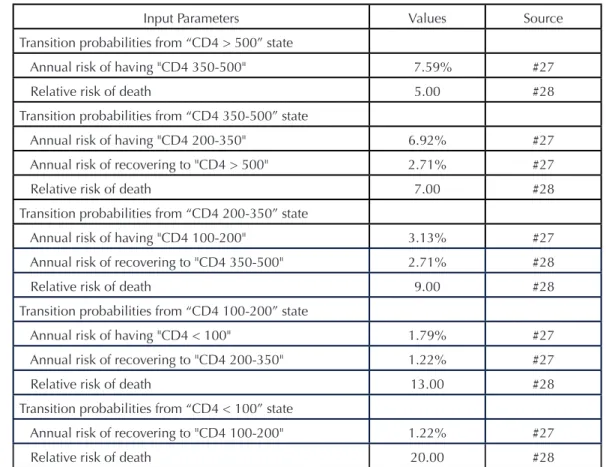
model tracks the proportion of individuals in each health state after each cycle. Transitions are based on conditional prob-abilities that depend on age, sex, and CD4 cell count. Table 2 reports transition probabilities for each CD4 cell count category were drawn from the literature as referenced.
Economic burden estimates for immigrant applicants with HIV depend crucially on the projected trajectory of disease, the anticipated incidence of mortality, health care cost
estimates stratiied by CD4 cell count categories, the rate at
which future care costs are discounted to present values, and the time horizon over which cost are assessed. To derive eco-nomic burden estimates for each immigration applicant with HIV, costing weights (as discussed above) and reported in 2007 Canadian dollars in Table 3, are applied to each health state as represented by CD4 cell count categories.
Because standard practice in the economic evaluation
requires adjustment for the timing of costs, the analysis fol -lows current practice and invokes a discount rate of 3 per-cent to convert the annual stream of expected health care costs to present valve terms.[29] Moreover, in order to assess the economic burden of immigrants with HIV, three separate time horizons are considered, 5-years, 10-years, and lifetime for both men and women using mortality rates derived from Canadian life tables.[30]
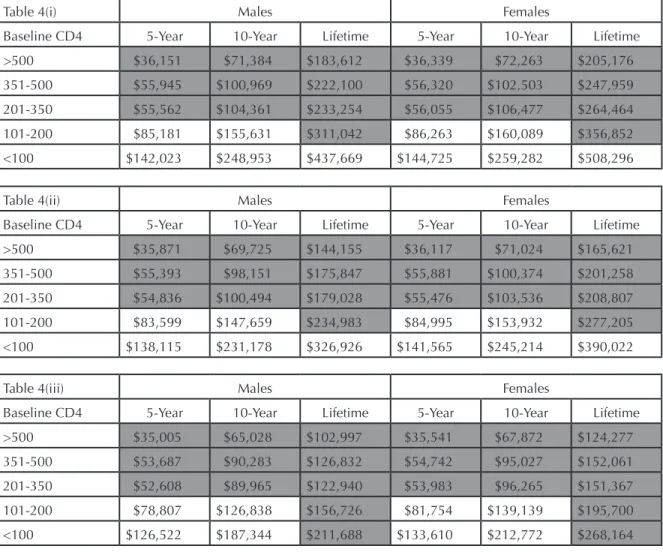
Application of the Markov model yields estimates of the economic burden of new immigrants with HIV that depend on: the time horizon used to assess the impact on health care costs (5-years, 10-years, and the remaining lifetime); baseline CD4 cell count; and the age and sex of individuals at the time of admission to Canada. These estimates are reported in Tables 4(i)-4(iii).
There are four notable indings regarding the economic bur -den of new immigrants. First, the economic bur-den of immi-gration applicants increases with disease progression, i.e. the burden is larger if immigration applicants have smaller CD4 cell counts, indicating more serious symptoms. This
occurs because such immigrants present a higher cost proile
than other immigrants. Second, the burden increases when the time horizon over which health care costs are assessed increases. This occurs because more years are included in the assessment of the burden on health or social services. Third, the burden is greater for women than for men, and particularly so if the time horizon for assessment is longer. This occurs because women face a lower mortality rate, and
consequently a longer life expectancy. Forth, the burden falls
with the age of the immigration applicant, because older immigrants face a higher mortality rate than younger immi-grants.
Input Parameters Values Source
Transition probabilities from “CD4 > 500” state
Annual risk of having "CD4 350-500" 7.59% #27
Relative risk of death 5.00 #28
Transition probabilities from “CD4 350-500” state
Annual risk of having "CD4 200-350" 6.92% #27
Annual risk of recovering to "CD4 > 500" 2.71% #27
Relative risk of death 7.00 #28
Transition probabilities from “CD4 200-350” state
Annual risk of having "CD4 100-200" 3.13% #27
Annual risk of recovering to "CD4 350-500" 2.71% #28
Relative risk of death 9.00 #28
Transition probabilities from “CD4 100-200” state
Annual risk of having "CD4 < 100" 1.79% #27
Annual risk of recovering to "CD4 200-350" 1.22% #27
Relative risk of death 13.00 #28
Transition probabilities from “CD4 < 100” state
Annual risk of recovering to "CD4 100-200" 1.22% #27
Relative risk of death 20.00 #28
Table 4(i) Males Females
Baseline CD4 5-Year 10-Year Lifetime 5-Year 10-Year Lifetime
>500 $36,151 $71,384 $183,612 $36,339 $72,263 $205,176
351-500 $55,945 $100,969 $222,100 $56,320 $102,503 $247,959
201-350 $55,562 $104,361 $233,254 $56,055 $106,477 $264,464
101-200 $85,181 $155,631 $311,042 $86,263 $160,089 $356,852
<100 $142,023 $248,953 $437,669 $144,725 $259,282 $508,296
Table 4(ii) Males Females
Baseline CD4 5-Year 10-Year Lifetime 5-Year 10-Year Lifetime
>500 $35,871 $69,725 $144,155 $36,117 $71,024 $165,621
351-500 $55,393 $98,151 $175,847 $55,881 $100,374 $201,258
201-350 $54,836 $100,494 $179,028 $55,476 $103,536 $208,807
101-200 $83,599 $147,659 $234,983 $84,995 $153,932 $277,205
<100 $138,115 $231,178 $326,926 $141,565 $245,214 $390,022
Table 4(iii) Males Females
Baseline CD4 5-Year 10-Year Lifetime 5-Year 10-Year Lifetime
>500 $35,005 $65,028 $102,997 $35,541 $67,872 $124,277
351-500 $53,687 $90,283 $126,832 $54,742 $95,027 $152,061
201-350 $52,608 $89,965 $122,940 $53,983 $96,265 $151,367
101-200 $78,807 $126,838 $156,726 $81,754 $139,139 $195,700
<100 $126,522 $187,344 $211,688 $133,610 $212,772 $268,164
Males Females
Age 5-Year 10-Year Lifetime 5-Year 10-Year Lifetime
30 years $67,085 $124,283 $361,909 $67,149 $124,544 $378,274
40 years $66,990 $123,794 $323,314 $67,074 $124,182 $343,459
50 years $66,692 $122,325 $274,821 $66,877 $123,229 $299,380
Table 4: Present value of health care expenditures in 2007 for
(i) Immigration Applicants aged 30 years with HIV;
(ii) Immigration Applicants aged 40 years with HIV;
(iii) Immigration Applicants aged 50 years with HIV.
Inadmissibility depends on an applicant’s
charac-teristics and time horizon
Thresholds used to deine excessive demand are reported in
this Section and applied to estimates of the economic burden of persons with HIV in order to identify which immigration applicants may be deemed to be inadmissible on medical grounds. In Section 3.0, we demonstrated that the current annual cost threshold used by CIC to determine whether an applicant is likely to pose “excessive” demand ($4,867.40)
is too low, and that there might be justiication under some
circumstances for a threshold that is almost eight-fold greater at $36,739.56. Under these extreme positions either all indi-viduals with HIV would be denied admission or all would be accepted. In Section 3.0, we proposed a middle posi-tion that we felt was a statistically more appropriate annual cost threshold at $14,581.43 (or three-fold greater than the current CIC threshold). Application to various assessment periods and to Canadian mortality rates yields Table 5. This Table reports the present value of cost thresholds (in 2007 Canadian dollars) for representative Canadians based on their age, sex, and the time horizon for assessment.
Con-sequently, in order to assess whether immigrant applicants present a cost proile that is higher than that for a matched
representative Canadian warrants a comparison between the
igure in each cell in Table 5 and an appropriate igure from
Tables 4(i)-4(iii).
Comparison between the igures in Tables 4(i)-4(iii) and Table
5 yields the shaded regions in Tables 4(i)-4(iii). These shaded regions identify individuals who do not represent an exces-sive burden on Canadian health or social services.
Clas-siication as medically inadmissible depends on the unique
characteristics of each potential immigrant including their age, sex and baseline CD4 cell count as well as on the time horizon over which an applicant is assessed to impact health or social services.
The baseline CD4 cell count category, at which immigration applicants with HIV are deemed to represent an excessive burden on Canadian health or social care, falls as the time
horizon for assessment increases. Speciically, a ive-year
or ten-year time horizon generally warrants individuals with CD4 cell counts <200 cells/mm3 to be deemed inadmis-sible, while a lifetime horizon provides for admission to all except for women and men aged 30 and 40 years with CD4
cell counts <100 cells/mm3. These inding occurs because
persons with HIV are at a greater risk of death than the general population which lowers the present value of their potential economic burden when the time horizon increases. Similarly, as women have greater life expectancies than men,
their potential economic burden on Canadian health or social care is accordingly greater. While this does not make a difference in Table 4 when comparisons are made every ten years, it would make a difference if the age intervals were
iner. Moreover, as the age of the applicant increases, their
remaining life expectancy falls. This decline lowers their potential economic burden on health or social services, and accordingly, lowers the CD4 cell count threshold at which
potential immigrants may be classiied as being medically
inadmissible. This effect is only noticeable when a lifetime time horizon is used whereby the threshold for being deemed medically inadmissible drops for women and men aged 40 to 50 from CD4 cell counts <100 cells/mm3 to include all women and men irrespective of their CD4 cell count when aged 50 years. These are interesting age and sex related differences and suggest that women or younger applicants face a slightly greater likelihood of being deemed medically inadmissible than men or older applicants.
Conclusions and limitations
There is a paucity of studies assessing thresholds used by
immigration oficials in the determination of medical inadmis -sibility. Despite the need for evidence informed immigration
policy, and the indings contained in this paper, a number of limitations warrant discussion. First, the deinition of “exces -sive” demand is inherently subjective. While this paper has
offered a statistical deinition of “excessive” demand, the
paper has demonstrated that the precise threshold is
dis-cretionary; it depends on the conidence warranted in the test that a prospective immigrant has a cost proile that is the same as that for Canadians. A more stringent conidence requirement (i.e. that we are correct in rejecting this hypoth
-esis) than the customarily 5% signiicance level, warrants a
higher threshold. Second, while we have shown how the statistical threshold used to determine “excessive” demand depends on the underlying distribution of health care costs,
unless precise estimates of that distribution are acquired the
resulting threshold will always be an approximation. Third, present value estimates of the economic burden of illness are limited by the available literature and the sophistication in the modeling of the underlying health conditions. This is also true in the context of HIV and is crucially dependent not
just on the unit cost of speciic CD4 cell count health states,
inadmissible, consideration of the trajectory of costs for both HIV-positive individuals and those for Canadians were converted to present value terms for particular assessment horizons. Variation in underlying assumptions concerning discounting practices, disease progression and relative rates
of mortality inluence the indings and should be considered
in a comprehensive assessment of current policy. Finally, in order to have a balanced assessment of the costs and contributions of a prospective immigrant, there should also be an assessment of the potential contributions of a new immigrant.
Notwithstanding the limitations, three substantive indings
are offered in this paper. First, the current cost threshold used by CIC in assessing whether an applicant is likely to pose “excessive” demand on Canadian health or social services is too low. A statistically more appropriate threshold is three-fold greater at $14,581.43. Second, there is a close relationship between disease progression (measured by CD4 cell counts) and health care costs, with annual costs increasing from under C$8,000 for CD4 >500 cells/mm3 to over C$35,000 for CD4 <100 cells/mm3. Third, application of these cost estimates to a revised cost threshold for inadmissibility indicates that
clas-siication depends on individual characteristics, including
age, sex and baseline CD4 cell count as well as on the time horizon over which each applicant’s projected demand for health or social services is assessed. “Excessive” demand is more likely to occur for applicants with low CD4 cell counts and a shorter time horizon for assessment (i.e., 5-years versus their lifetime). Women and younger applicants are slightly more likely to be deemed inadmissible than men and older immigration applicants.
Our indings suggest that the adjudication guidelines and
policies used by CIC warrant urgent review so that they are informed by the existing clinical, epidemiological and economics evidence, and that they conform to an appropri-ate statistical interpretation of “excessive” demand. In the absence of this review, current policy results in immigration denial on medical inadmissibility grounds and the
conse-quent loss to Canadian society of some gifted individuals.
References
1. Boulos D, Yan P, Schanzer D, Remis RS, Archibald CP. Canada Communicable Disease Report 2006. Public Health Agency of Canada. Ottawa: Government of Canada, 2006. p.165-176.
2. Public Health Agency of Canada, Government of Canada. Estimates of the number of people living with HIV in Canada.
2005. Available from URL:http://www.phac-aspc.gc.ca/ media/nr-rp/2006/20060731-hiv-vih-eng.php. Accessed 14 April 2008.
3. World Health Organization. Worldwide HIV Statistics. 2007. Available from URL: http://www.avert.org/worldstats. htm. Accessed 14 April 2008.
4. The Henry Kaiser Family Foundation. Number of HIV Posi-tive Immigrants to Canada Triples in One Year, Immigration Department Says. 2004. Available from URL: http://www.kai-serhealthnews.org/Daily-Reports/2004/May/14/dr00023718. aspx?p=1. Accessed 14 April 2008.
5. Canadian HIV/AIDS Legal Network. Recent changes to visitor visa process affecting entry into Canada for people living with HIV. XVI International AIDS Conference. Toronto: Canadian HIV Legal Network, 2005.
6. Canadian Institute for Health Information: National Health Expenditure Trends, 1975-2007. Ottawa: Canadian Institute for Health Information, 2007.
7. Ofice of the United Nations High Commissioner for
Human Rights, UNAID. International Guidelines on HIV and Human Rights. 2006 Consolidated Version. Available from URL: http://data.unaids.org/Publications/IRC-pub07/jc1252-internguidelines_en.pdf. Accessed 14 April 2008.
8. NAMLIFE. Countries and their entry restrictions. 2008. Available from URL: http://www.namlife.org/cms1255072. aspx. Accessed 14 April 2008.
9. Averting HIV and AIDS. AIDS in the UK. 2008. Available from URL: http://www.avert.org/uk-statistics.htm. Accessed 15 April 2008.
10. Sadoway, Geraldine. Personal interview. 29 February 2008.
11. Gibson K. UK: House of Lords Upholds Deporta¬tion Order.HIV AIDS Policy Law Rev 2005 ;10(2):48-9.
12. Chen RY, Accortt NA, Westfall AO, Mugavero MJ, Raper JL, Cloud GA, et al. Distribution of health care expenditures for HIV-infected patients. Clin Infect Dis 2006;42(7):1003-10.
13. Citi¬zenship and Immigration Canada. Operational Processing Instruction 2002-2004. Ottawa: Government of Canada, 2002; 1-7.
15. Citi¬zenship and Immigration Canada. Annual report to parliament on immigration. 2007. Available from URL: http:// www.cic.gc.ca/ENGLISH/resources/publications/annual-report2007/section1.asp. Accessed 29 February 2008.
16. Statistics Canada. The Canadian Immigrant Labour Mar-ket in 2007, the Immigrant Labour Force Analysis Series. 2007. Available from URL: http://www.statcan.ca/english/ freepub/71-606-XIE/71-606-XIE2008003.htm. Accessed 13 May 2008.
17. Citizenship and Immigration Canada. Facts and Figures 2006, Immigration Overview: Per¬manent and Temporary Residents. 2007. Available from URL: http://www.cic.gc.ca/ english/resources/statistics/facts2006/perma¬nent/25.asp. Accessed 13 May 2008.
18. Hilewitz V. Minister of Citizenship and Immigration. Supreme Court of Canada. (21 October 2005).
19. Vayda E, Deber RB. The Canadian health care system: an overview. Soc Sci Med 1984;18(3):191-7.
20. Diehr P, Yanez D, Ash A, Hornbrook M, Lin DY. Methods for analyzing health care utilization and costs. Annu Rev Public Health 1999; 20:125–44.
21. Fryback DG, Chinnis JO Jr, Ulvila JW. Bayesian cost-effectiveness analysis: an example using the GUSTO trial. Int J Technol Assess Health Care 2001; 17(1):83-97.
22. Nixon RM, Thompson SG. Parametric modeling of cost data in medical studies. Stat Med 2004; 23(8):1311-31.
23. Briggs A, Gray A. The distribution of health care costs and their statistical analysis for economic evaluation. J Health Services Res Pol 1998; 3(4):233–245.
24. Fisher RA. Statistical Methods for Research Workers. 1st ed. Edinburgh: Oliver & Boyd; 1925.
25. Levy AR, Annemans L, Tramarin A, Montaner JS: The impact of disease progression on direct medical costs of treat-ing persons with HIV: a review of the international literature. Pharmacoeconomics, forthcoming, 2009
26. Krentz HB, Gill MJ. Cost of medical care for HIV-infected patients within a regional population from 1997 to 2006. HIV Med. 2008;9(9):721-30.
27. Sypsa V, Touloumi G, Karafoulidou A, Hatzakis A.
Com¬parison of smoothing techniques for CD4 data in a Markov model with states deined by CD4: an example on
the esti¬mation of the HIV incubation time distribution. Stat-ist Med 2001; 20:3667–3676.
28. Sighem A, Sven D, Azra C, Luuk G, Roy A, Frank de W. Mortality in patients with successful initial response to highly active antiretroviral therapy is still higher than in non-HIV-infected individuals. Journal of AIDS 2005; 40(2):212-8.
29. Drummond ME, O’Brien BJ, Stoddart GL, Torrance GW. Methods for the Economic Evaluation of Health Care Pro¬grammes. 2nd Ed. Oxford: Oxford University Press, 1997.
30. Statistics Canada. Canadian life tables. 2007. Available from URL: http://www.statcan.ca/english/freepub/84-537-XIE/tables.htm. Accessed 8 February 2007.
Acknowledgements:
The opinions expressed are those of the authors and do not
nec-essarily relect the opinion of any funding agency or institution.
The research reported herein was supported by a grant from the Ontario HIV Treatment Network for a project entitled “Guidelines for the Determination of Medical Inadmissibility for Canadian
Immi-gration Applicants with HIV”.
Contact Information for Author:
Peter C. Coyte, Ph.D.
Professor
University of Toronto Faculty of Medicine
Department of Health Policy, Management, and Evaluation 155 College Street, 4th Floor,
Toronto, ON M5T 3M6
Canada
Email: [email protected] Kednapa Thavorn, M.Pharm.
Doctoral Student University of Toronto Faculty of Medicine