0103 - 5053 $6.00+0.00
Article
*e-mail: [email protected]
A Structural Conformation Study of Aquatic Humic Acid
Luiz F. Zara,*,a André H. Rosa,b Ilda A. S. Toscanoc and Julio C. Rochad
a
Universidade Católica de Brasília, Q.S. 07, Lote 01, EPCT, 72030-170 Brasília-DF, Brazil
b
Departamento de Engenharia Ambiental, Universidade Estadual Paulista, Av. 3 de Março, 511, 18087-180 Sorocaba-SP, Brazil
c
Departamento de Química, Universidade Federal da Paraíba 58059-900 João Pessoa-PB, Brazil
d
Instituto de Química, Universidade Estadual Paulista, 14800-900 Araraquara-SP, Brazil
No presente trabalho foram extraídas substâncias húmicas aquáticas através do uso da resina adsorvente XAD 8, e a fração ácida separada por acidificação. Depois da purificação com resina Hyphan e diálise, os ácidos húmicos aquáticos foram caracterizados por espectroscopia no infravermelho com transformada de Fourier e análise elementar. A influência das concentrações dos ácidos húmicos e eletrólitos, pH e tempo de complexação ácido húmico-metal sobre a conformação estrutural foi investigada através de estudos de espectroscopia UV-Vis, empregando a equação sugerida por Doty e Steiner. Os resultados indicam que a macromolécula flexível do ácido húmico assume uma forma condensada em valores de pH ácidos e alcalinos. Outros fatores favorecendo formas condensadas são tempos de complexação mais longos, e altas concentrações de ácidos húmicos e eletrólitos. Assim, considerando a forte influência dos parâmetros investigados na conformação estrutural da macromolécula húmica, podemos concluir que estudos usando espectroscopia UV/Vis para determinar a concentração, aromaticidade e grau de humificação dos ácidos húmicos aquáticos, requerem condições rigorosamente controladas para garantir uma correta interpretação dos resultados analíticos.
In the present work, aquatic humic substances (HS) were extracted by use of adsorbent XAD 8 and the acid humic fraction (AH) was separated throught acidification. After being purified by Hyphan resin and dialyze, the aquatic AH was characterized using Fourier-transform infrared spectroscopy and elemental analysis. The influence of the aquatic HA and electrolyte concentrations, pH and aquatic AH-metal complexation time on the conformation was investigated using UV/Vis spectroscopic studies, employing the equation suggested by Doty and Steiner. The results indicated that the acid humic flexible macromolecule assumes a condensed form at acid and alkaline pH. Other factors favoring condensed conformations are longer metal complexation time (“ageing”) and higher aquatic AH and electrolyte concentrations. Thus considering the strong influence of the investigated parameters in the structural conformation of the humic macromolecule, we conclude that studies using UV/Vis spectroscopy to estimate the concentration, aromaticity, humification degree of the aquatic AH and so on, require rigorous control over the experimental conditions employed to provide a correct interpretation of the analytical results.
Keywords: aquatic humic acid, degree of condensation, UV/Vis spectroscopy
Introduction
Humic substances (HS) are products of the trans-formation of organic matter by the action of mycrobes and enzymes presents both in soil and water. They may be defined as a mixture of high molecular weight
macromolecules (0.500-100 kDalton) of natural origin.1
The definition of aquatic HS is based on chromatographic
extraction methods. Thurman and Malcolm,2 gave the
reactions that may occur during its degradation, it is not easy to suggest precise structural formulae for the HS. Nevertheless, it is thought that most HS consist of hydrophobic acids with highly oxygenated functional groups able to interact with heavy metal ions in aquatic
systems.3
The fraction of aquatic HS insoluble at pH < 2 is defined as aquatic humic acids (HA), whose molecular weights are in the range 0.003 to 0.100 kDalton. The elemental composition of aquatic HA in this range is of 54-59% C, 3-6% H, 33-38% O, 0.8-4% N and 0.1-1% S.3,4
The structural conformation of the macromolecules depends on the extendedness of this “belt”, pH, charge density, degree of ionization of the acid groups, ionic strength and concentration of humic substances, as well as on hydrogen bond formation and intramolecular
rearrangements.5-7
The scattering of monochromatic light in a dilute solution of macromolecules or colloidal particles is closely related to its weight, size and interactions of the particles
in solution. However, according to Doty and Steiner,8
similar information can be derived from difference spectroscopy (comparison of the absorbances at distinct wavelengths), using their formula:
- d log A = 4 - β
d log λ (1)
where A is the absorbance of the solution, λ the wavelength
of transmitted light, β is directly proportional to b/λ0, b is
the largest dimension of the particle and λ0, the wavelength
of incident light.
Chen et al.,9 using absorbance of a fulvic acid solution
with different average molecular weights in 465 and 665
nm shows that the Doty and Steiner’s,8 theory can be
applicant to humic substances in dilute solution. Therefore
the quantity β can be directly related to the level of
macromolecular aggregation, with higher values indicating a more aggregated humic macromolecule.
Investigations of the humic substances structural aggregation are important because its structure influences on the properties of the humic material. For example, on its capacity to react with metals and the stability of the
aquatic HS-metal ion species formed.10
The aim of this work is to investigate the influence of the pH, aquatic HA and electrolyte concentrations, and aquatic HA-metal complexation time on the conformation of the aquatic humic acid using UV/Vis spectroscopy
studies, based on the Doty and Steiner’s theory.8
Experimental
Reagents and materials
(All chemicals used were of high purity). Solutions of hydrochloric acid (30% v/v), nitric acid (65% v/v) and sodium hydroxide were prepared with high-purity water (Millipore Milli-Q). The resin XAD 8 p.a. (Serva Feinbiochimica), necessary for isolation of aquatic humic substances, was prepurified by successive soaking with 0.5
mol L-1 HCl, 0.5 mol L-1 NaOH and methanol p.a.
(24 h each).11 Cellulose Hyphan used for the removal of
heavy metals from aquatic HS concentrate was applied
according to recommendations given in Danielsson.12 The
cellulose sorbent cellulose phosphate (CellPhos) used in this study for the separation of labile metal fractions in the
aquatic HA was functionalized according to Ford and Hall.13
This collector has a surface area of 1.94+0.06 m2 g-1 and
1.3+0.09 mol g-1 of immobilized phosphate groups.
Aquatic HA isolation, separation and purification
The aquatic HS under study was isolated from a humic-rich water sample collected from the Itapanhaú river, which flows through the Ecological Reserve of the “Parque Estadual da Serra do Mar” located in São Paulo State, Brazil. For this purpose, 20 liters of surface water (about 25 cm below the water surface) were on-site filtered
through 0.45 µm cellulose-based membranes and acidified
with concentrated HCl to pH 2.0 with 10 mol L-1 HCl
(suprapur, Merck). Afterwards, the aquatic HS were conventionally isolated on the XAD 8 collector following
the recommendations of Malcolm12. After elution with
0.1 mol L-1 NaOH (100 mL), the concentrate obtained
was neutralized to pH 7.0 with 2.0 mol L-1 HCl solution.
In order to remove the metals naturally present in the aquatic HS, 50 mL of this concentrate was mechanically
stirred for 24 h with 1 g of cellulose Hyphan at pH 8.0.14
Next, the aquatic HA fraction was precipitation at pH 1.5,
with 6 mol L-1 HCl solution, and separated by
centrifu-gation (4000 rpm) after 24 hour, purified by dialyze,15
and lyophilized.
Characterizations
The determination of DOC contained in the aquatic humic substance was carried out by catalytic combustion in an oxygen stream on an Schimadzu TOC 2000
Analyser.16 The elemental composition (CHN) of the
spectrum of aquatic HA was recorded using a Nicolet 730 SX-FT spectrometer. The pellets was prepared with 8 mg
of aquatic HA per 100 mg of KBr.17
Structural aggregation study
UV/Vis spectroscopy. The influence of the pH (3-11),
aquatic HA (0.04-1.02 mg L-1) and electrolyte (0-0.32 mg
L-1) concentrations, and aquatic HA-metal complexation
time (0.25-130 hour) on the conformation of the aquatic humic acid macromolecule were obtained by UV/Vis spectrometry at 465 and 665 nm, using a twin-beam Hitachi UV-2000 spectrometer.
Complexation time. The aquatic HA sample used in the
investigation of the complexation time was spiked with
copper as follows: 5.0 µg Cu(II) ions were added to 20
mL of 0.5 mg L-1 aquatic HA solution in 0.01 mg L-1
NaCl (buffered at pH 5.0), and, after adjust of volume to
25 mL with 0.01 mg L-1 NaCl solution, mechanically
stirred for 130 h. After pre-set complexation time (2-120 h), 80 mg of CellPhos was added in 10.0 mL of aquatic AH solution contend metal spiking and stirred for 24 h. The ion-exchange was filtered though filter paper (2 cm
diameter) previously cleaned with 1 mol L-1 HCl. Paper
and resin were transferred to small flasks and extracted
for 1 h with 3.0 mL of 2.0 mol L-1 HCl suprapur.18 After
centrifugation (4000 rpm) of the eluate, the metal contained was determined by ICP-AES, using a Thermo Jarrel Ash-CID-DUO spectrometer, according to the experimental condition give in Table 1.
Results and Discussion
Aquatic HA characterization
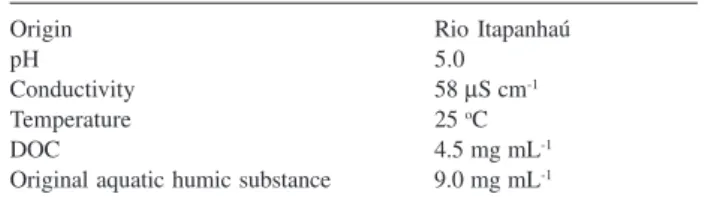
The Table 2 shows the complementary information about the studied aquatic humic substance.
The aquatic HA in the sample was found to contain average 51.76% C, 4.32% H and 2.13% N, in agreement
with previously published data.19 In the infrared absorption
spectrum of the humic acid, a wide band was observed in
the region of 3430 cm-1, attributed to stretching of alcoholic,
phenolic and/or carboxylic OH bonds, while absorption due
to carboxylic CO stretching was seen in the 1160 cm-1
region. An absorption band at 2940 cm-1 is caused by
aliphatic CH stretching, while another at 1718 cm-1 is
assigned to C=O stretching in ketones and/or carboxylic
acids. A medium-width band around 1620 cm-1 is associated
with C=C stretching in alkenes and/or aromatics. This infrared absorption spectrum is consistent with those found
in the literature.20-22
Structural aggregation study
In the literature we found three different viewpoints about sizes and shapes of humic substances in solution. One suggest that macromolecule humic assume random coil conformation, a second proposed that HS are molecular association of relatively small molecules held together by weak interaction force; a third considered that HS appears in solution as micelle or “pseudomicellar”
structures.23-25 The ratio of the optical densities of a dilute
solution at two different wavelengths, 465 and 665 nm
(E4/E6) is used to characterize humic acids. The E4/E6 ratio
indicates the average level of structural condensation of
the molecules in solution.13 Applying the ratio E
4/E6 in
Doty and Steiner formula,8 we have:
-log E4 – log E6= 4 - β
log 465 – log 665
Rearranging, 4 – 6.435 (E4/E6) = β
The quantity β can be directly related to the level of
condensation of the macromolecular structure, higher values indicating a more condensed conformation of the humic macromolecule.
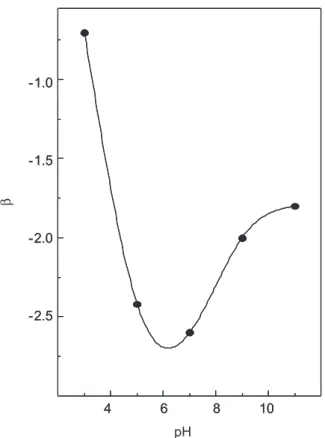
In Figure 1, β is the highest, at acid pH indicating
more condensed macromolecules. A second maximum is observed at alkaline pH. At low pH, interactions due to
hydrogen bonds, van der Waal’s forces and π-orbitals in
conjugated aromatic rings within the humic
macro-molecule,7 favor a more aggregated conformation of the
aquatic HA macromolecules and intermolecular association. Moreover, intermolecular interactions may
Table 2. Complementary information about the studied aquatic humic
substances
Origin Rio Itapanhaú
pH 5.0
Conductivity 58 µS cm-1
Temperature 25 oC
DOC 4.5 mg mL-1
Original aquatic humic substance 9.0 mg mL-1
Table 1. Operating parameter for the ICP-AES determinations
Incident power 1.5 KW
Plasma air flow-rate 15 L min-1 Nebulizer air flow-rate 1.2 L min-1 Auxiliary air flow-rate 0.5 L min-1
Sample flow-rate 2.4 mL min-1
induce the formation of dipoles through the delocalization
of aromatic-ring π-electrons, thus favoring the aggregation
of the macromolecule humic.24 At high pH, the charge
density on the macromolecule rises, owing to increased ionization of the acid groups. However, the counter-ions
in solution (Na+) minimize the charge potential on the
humic polyelectrolyte, causing na expansion of the eletric duble layer, resulting in repulsion and dispersion of the particle. In this condition the humic macro molecule assumes an “micelle-like” structure. The humic substance have amphiphilic properties in which the molecules have hydrophobic (nonpolar) and hydrophilic (polar) parts, which can induce the “micelle-like” structure formation
in solution.25 The Figure 1 shows the variation value β of
the 1.9 units in the acid region (pH 3-7), while in the alkaline region (pH 7-11) this variation is only 0.8 unites. This indicates the strong influence of alkaline region in the charge repulsion, favouring the extended conformation.
Lower values of β are found at neutral pH, leading to
the conclusion that, in this case, the flexible humic macromolecule apparently adopts an extended form, because of intramolecular charge repulsions associated with increased charge density on the macromolecule.
In Figure 2 the b values are plotted as a function of aquatic HA concentration, and the latter is seen to exert a
strong influence in dilute solution. This effect may be due to a reduction, in dilute solution, of the intramolecular repulsion between negative charges arising from ionization of the acid groups, leading to a more condensed structure.
However, the effect on β caused by concentration of aquatic
AH rises from 0.2 to 1.02 mg L-1 is approximately 9 times
smaller that observed in the rise in concentration from 0.08
to 0.2 mol L-1. This fact is probably due to the micelle
formation. These results evidence that aggregation greed of humic macromolecule is more strongly influenced by intra-/intermolecular interaction that by micelle formation, according to data observed from these pH study.
In the environment, the aquatic HA-metals interactions occur over a relatively long time (ageing process) affecting the lability of metal fractions complexed by aquatic AH. Figure 3 shows that after a complexation time of 48 h the Cu(II) ion recovery is reduced from 73% to 54%. In general, metals complexed with the most external groups of the humic macromolecule react preferentially with the functional groups of the resin. Consequently, the metal remains complexed for a long time, probably due to transformation process and inner rearrangement. As time increase, less accessible binding sites of substances humic may be occupied, and a change of metal ions from weaker
to stronger binding sites may take place.10, 14
Figure 2. Influence of the aquatic humic acid concentration on the
pa-rameter β. Condition: pH: 5.0 and NaCl concentration: 0.01 mg L-1.
Figure 1. Influence of the pH on the parameter β in aquatic humic acid
The increase invalue of β with the complexation time, seen in Figure 3, indicates that aggregation greed of macromolecule is influenced by rearrangements of the metal in the humic macromolecule during “ageing”. It is reasonable to assume that these rearrangements diminish intramolecular repulsive forces, favoring the condensed conformation by allowing more intramolecular interactions. As this takes place, the complexation sites become less accessible to ion exchange processes. This may explain the large effect that complexation time has
on the relative decrease in the lability of metal ions.26,27
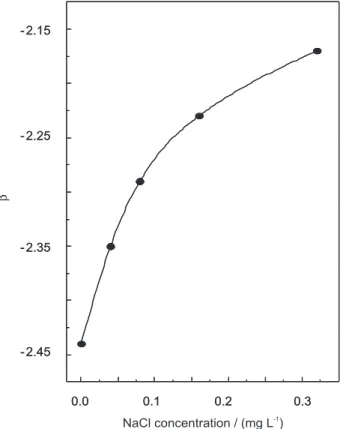
Variation of the sodium chloride concentration has an exponential effect on the value of b, as shown in Figure 4. In dilute solution at appropriate pH, fulvic and humic acids and their alkali metal salts are considered to be real colloidal solutions, showing the properties of both polyelectrolyte and
surfactant solution. Tombácz and Regdon,25 using humic acid
extracted from brown coal reported that Na-humate solutions had a very weak emulsifying effect. Therefore, it is reasonable to assume that the micelle formation increase with the sodium chloride concentration. This effect is similarity to the observed on alkaline region in the Figure 1.
Conclusions
The aquatic humic acid macromolecule can be classified as a flexible polyelectrolyte whose structural conformation depends on conditions in the medium, such
as pH, concentration of AHA and electrolyte concen-tration. Thus, studies using visible light absorption to estimate the concentration, aromaticity, extent of humification of the AHA and so on, require rigorous control over the experimental conditions employed, to enable a correct interpretation of the analytical results.
Moreover, it has been shown that longer complexation times “ageing” favor the condensed conformation of the macromolecule, possibly lowering the relative lability of the metal ions complexed by the aquatic humic acid.
Acknowledgments
The financial support for this work by CAPES, CNPq and FAPESP is gratefully acknowledged.
References
1. Aiken, G. R. In Humic Substances in Soil, Sediment and Water. Geochemistry, Isolation and Characterization; Aiken, G. R.;
MacKnight, M. D.; Wershaw, R. L.; MacCarthy, P., eds.; John Wiley & Sons: New York, 1985.
2. Thurman, E. M.; Malcolm, R. L.; Environ. Sci. Technol.1981,
15, 463.
3. Huffman Jr., E. W. D.; Stuber, H. A. In Humic Substances in Soil, Sediment and Water. Geochemistry, Isolation and
Figure 4. Influence of sodium chloride concentration on the parameter
β. Condition: aquatic HA: 0.4 mg L-1 and pH 5.0.
Figure 3. Influence of aquatic HA-metal complexation time (“ageing”)
Characterization; Aiken, G. R.; MacKnight, M. D.; Wershaw,
R. L.; Mac Carthy, P., eds.; John Wiley & Sons: New York, 1985.
4. Schulten, H. R.; Fresenius J. Anal. Chem.1995, 351, 62.
5. Swift, R. S. In Humic Substances II; Hayes, M. H. B.;
MacCarthy, P.; Malcolm, R. L.; Swift, R. S., eds.; John Wiley & Sons: New York, 1989.
6. Hayes, M. H. B. In Humic Substances in Soil, Sediment and Water. Geochemistry, Isolation and Characterization; Aiken,
G. R.; MacKnight, M. D.; Wershaw, R. L.; MacCarthy, P., eds.; John Wiley & Sons: New York, 1985.
7. Ghosh, K.; Schnitzer, M.; Soil Sci.1980, 129, 266.
8. Doty, P.; Steiner, R. F.; J. Chem. Phys. 1950, 18, 1211.
9. Chen, Y.; Senesi, N.; Schnitzer, M.; Soil Sci. Soc. Am. J.1977,
41, 352.
10. Burba, P.; Fresenius’ J. Anal. Chem.1994, 348, 301.
11. Malcolm, R. L. In Humic Substances In The Aquatic And Terrestrial Environment; Allard, B.; Boren, H.; Grimvall, A.,
eds.; Springer: Berlin, 1991.
12. Danielsson, L. G.; Water Res.1992, 16, 179.
13. Ford, F. M.; Hall, W. P.; US pat. 2,482,755 1949.
14. Rocha, J. C.; Toscano, I. A. S.; Cardoso, A. A.; J. Braz. Chem. Soc. 1997, 8, 239.
15. Town, R. M.; Powell, H. K. J.; Anal. Chim. Acta1992, 256, 81.
16. Wangersky, P. J.; Mar. Chem.1993, 41, 61.
17. Pang, L. S. K.; Vassallo, A. M.; Wilson, M. A.; Org. Geochem.
1990, 16, 853.
18. Rocha, J. C.; Toscano, I. A. S.; Burba, P.; Talanta1997, 44, 69.
19. Senesi, N.; In Organic Substances in Soil and Water. Natural Constituents and Their Influences on Contaminant Behaviour;
Beck, A. J.; Jones, K. C.; Hayes, M. H. B.; Mingelfrin, U., eds.; Royal Society of Chemistry: Cambridge, 1993. 20. Rocha, J. C.; Rosa, A. H.; Furlan, M.; J. Braz. Chem. Soc. 1998,
9, 51.
21. Rocha, J. C.; Sene, J. J.; Santos, A.; Toscano, I. A. S.; Zara, L. F.; J. Environ. Monit.2000, 2, 39.
22. Celi, L.; Schnitzer, M.; Nègre, M.; Soil Sci.1997, 162, 189.
23. Clapp, C. E.; Hayes, M. H. B.; Soil Sci.1999, 164, 777.
24. Bartschat, B. M.; Cabaniss, S. E.; Morel, F. M. M.; Environ. Sci. Technol.1992, 26, 284.
25. Tombácz, E.; Regdon, I. In Humic Substances in the Global Environment and Implications on Human Health; Senesi, N.;
Miano, T. M., eds.; Elsevier: Amsterdam, 1994.
26. Burba, P.; Rocha, J. C.; Klockow, D.; Fresenius’ J. Anal. Chem.
1994, 349, 800.
27. Sargentini Jr., É; Rocha, J. C.; Rosa, A. H.; Zara, L. F.; Santos, A.; Quim. Nova 2001, 24, 339.
Received: November 19, 2004
Published on the web: July 13, 2006