O
RIGINALA
RTICLE Revista Brasileira de FisioterapiaEffectiveness of aquatic and non-aquatic lower
limb muscles endurance training in the static
and dynamic balance of elderly people
Efetividade do treinamento de resistência à fadiga dos músculos dos membros
inferiores dentro e fora d’água no equilíbrio estático e dinâmico de idosos
Núbia C. P. Avelar, Alessandra C. Bastone, Marcus A. Alcântara, Wellington F. Gomes
Abstract
Background: Aging compromises the ability of the central nervous system to maintain body balance and reduces the capacity for adaptive reactions. To prevent falls, the reception conditions for sensory information need to be improved. Objectives: To evaluate the impact of a structured aquatic and a non-aquatic exercise program for lower-limb muscle endurance on the static and dynamic balance of elderly people. Methods: This was a prospective randomized clinical study in which the variables were assessed before and after the training program. Thirty-six elderly people were evaluated using four tests: the Berg Balance Scale, Dynamic Gait Index, gait speed and tandem gait. The participants were randomized into three groups: aquatic exercise group, non-aquatic exercise group and control group. The exercise groups underwent a program for lower-limb muscle endurance that consisted of 40-minute sessions twice a week for six weeks. The participants were reevaluated after six weeks. The data were analyzed statistically using the univariate ANOVA test for comparisons between the groups before and after the intervention. Results: The program for lower-limb muscle endurance significantly increased balance (p<0.05) in the evaluation tests after the training program. Conclusion: The muscle endurance program provided a significant improvement in static and dynamic balance among community-dwelling elderly people. It was also possible to infer that this improvement occurred regardless of the environment, i.e. aquatic or non-aquatic.
Article registered in the Australian New Zealand Clinical Trials Registry (ANZCTR) under the number ACTRN 12609000780257.
Key words: hydrotherapy; physical therapy; elderly people.
Resumo
Contextualização: O envelhecimento compromete a habilidade do sistema nervoso central (SNC) de realizar a manutenção do equilíbrio corporal bem como diminui a capacidade das reações adaptativas. Para prevenir as quedas, é necessário aprimorar as condições de recepção de informações sensoriais. Objetivos: Comparar o impacto de um programa estruturado de exercícios de resistência muscular dos membros inferiores dentro e fora d’água no equilíbrio estático e dinâmico em idosos. Métodos: Trata-se de um estudo clínico, prospectivo, aleatório, em que as variáveis utilizadas foram avaliadas antes e após o programa de treinamento. Foram avaliados 36 idosos por meio de quatro testes: Escala de Equilíbrio de Berg, Dynamic Gait Index, velocidade da marcha, Marcha Tandem. Posteriormente, houve a alocação dos voluntários em três grupos: grupo de exercício na piscina terapêutica, grupo de exercício no solo e grupo controle. Os grupos de exercícios foram submetidos a um programa de resistência muscular dos membros inferiores aplicado durante seis semanas, duas sessões semanais com 40 minutos de duração. Os voluntários foram reavaliados após seis semanas. Os dados foram analisados estatisticamente pelo teste ANOVA univariada para comparação entre os três grupos antes e após a intervenção. Resultados: O programa de resistência muscular dos membros inferiores promoveu aumento significativo do equilíbrio dos idosos (p<0,05) nos testes avaliados após o programa de treinamento. Conclusão: O programa de resistência muscular proporcionou uma melhora significativa no equilíbrio estático e dinâmico de idosos comunitários. Foi possível inferir também que essa melhora ocorreu independentemente do meio em que o programa foi realizado, ou seja, se dentro ou fora d’água.
Artigo registrado no Australian New Zealand Clinical Trials Registry (ANZCTR) sob o número ACTRN 12609000780257.
Palavras-chave: hidroterapia; fisioterapia; idosos.
Received: 08/12/2008 – Revised: 14/06/2009 – Accepted: 18/08/2009
Physical Therapy Department, Universidade Federal dos Vales dos Jequitinhonha e Mucuri (UFVJM), Diamantina (MG), Brazil
Correspondence to: Wellington Fabiano Gomes, Rua da Glória, 187, Centro, CEP 39100-000, Diamantina (MG), Brazil, e-mail: [email protected]
Introduction
Improvement of health conditions, increasing life expec-tancy worldwide and birth rate reductions have brought about a proportional increase in the older population1-3. Ageing
com-promises the ability of the central nervous system to carry out processing on the vestibular, visual and proprioceptive signals that are responsible for the maintenance of body balance, as well as reducing individuals’ capacity to come up with adaptive reactions1. Postural instability is one of the main factors that
limit older individuals’ daily activities, and falling is the most harmful consequence of this process, thereby limiting func-tional mobility and rendering older adults more dependent4.
In order to prevent falls, the conditions under which sen-sory information is received from the vestibular, visual and so-matosensory systems need to be improved in such a way that the muscles of the efector system are activated and balance is stimulated5,6, one of the means adopted to promote such stimuli
is physical exercise7. his reduces the risk of falls among older
adults through enhancing coordination and balance8, increasing
the recruitment of motor neurons and boosting the resistance to muscle fatigue and hypertrophy, particularly of type II ibers9.
Most studies in the literature have shown improvements in older patients’ balance through multifactorial interventions, including balance10,11, muscle endurance9,11 or muscle
strength-ening11-13 exercises, or an association between these8-10 . Studies
that assess the efect of muscle endurance training alone on balance are rare9,11.
Muscle endurance exercises may be carried out in an aquatic environment, as well as on the loor9-11. Aquatic
exer-cises make it possible to create situations of instability by using efects such as turbulence, providing a great amount of sensory information, which in turn promotes improvement in body balance reactions14,15,17-20.On the other hand, exercises
per-formed in a non-aquatic environment are closer to activities of daily living activities, since they do not cancel out the force of gravity9-13. However, there are no studies in the literature
comparing the efectiveness of muscle endurance training in aquatic and non-aquatic environments. Hence, this study had the objective of comparing the impact of structured exercise programs to test lower-limb muscle endurance in aquatic and non-aquatic environments, in situations of static and dynamic balance, involving older adults.
Methods
his was a prospective, randomized clinical study in which the variables used were evaluated before and after the train-ing program. his study was conducted in accordance with
the ethical principles for research involving human beings, as prescribed by Resolution 196/96 from the National Health Board (Conselho Nacional de Saúde). It received approval from the Research Ethics Committee of the Universidade Federal dos Vales do Jequitinhonha e Mucuri (UFVJM), Diamantina (MG), Brazil (protocol no. 020/08). he participants received information about the study and signed a free and informed consent statement.
A pilot study was carried out to check the feasibility of the investigation and to monitor the entire data collection process. he volunteers in this speciic group (n=10) were not included in the treatment together with the other subjects, and there were no problems during the process.
Sample
he sample for this study was made up of elderly volun-teers from the community, who lived in the city of Diamantina, Minas Gerais, Brazil. hey were recruited through the Family Health Program (Programa de Saúde da Família – PSF).
All the selected participants met the following inclusion requirements: 60 years of age or older, and able to perform the
Get Up and Go Test19. he exclusion criteria were: individuals
undergoing physical therapy treatments; those who had re-spiratory diseases or heart or metabolic diseases; those with a cognitive deicit according to the Mini-Mental State Examina-tion (MMSE)20; those who had contagious skin abnormalities;
those who were using lower limb prostheses; those who made use of drugs or medicines that might interfere with balance (nicotine, cafeine, alcohol, sedatives and tranquilizers); and those who had no anal or vesical sphincter control.
he volunteers who fulilled the inclusion criteria made up the inal sample (n=46), and these individuals were distrib-uted randomly among the groups that were assigned to the therapeutic pool intervention (n=14), non-aquatic interven-tion (n=15) and control group (n=17). he interveninterven-tion groups performed the protocol twice a week for six weeks, while the control group did not have any speciic kind of treatment, with only a weekly follow-up by telephone.
Assessment instruments
• Dynamic gait index (DGI) (Brazilian version): his is a functional assessment test on mobility among elderly pa-tients with balance impairments, which was validated by Shumway-Cook and transculturally adapted for application in Brazil2. he test is made up of 14 tasks, and each of them
is categorized on a ive-point ordinal scale. It has the aim of assessing and documenting patients’ capacity to modify their gait according to changes in the demands of certain
tasks. he maximum score is 24 points, and a score of 19 or lower suggests a risk of falls2.
• Berg Balance Scale: his is an instrument for functional as-sessment of balance that has been validated and adapted transculturally for application in Brazil21-23. he test is made
up of 14 tasks and each them is categorized on a ive-point ordinal scale ranging from 0 (unable to perform the task) to 4 (able to carry out the task independently), based on the quality of the performance, need for assistance and time taken to complete the task. he scores from the 14 tasks are summed to form a total score going from 0 to 56 points, such that the highest scores correlate with the best performance.
• Tandem gait test: his test assesses patients’ dynamic bal-ance. hey are required to walk in a straight line, such that the heel of the non-dominant foot is placed in front of the toes of the other foot. he performance in this test is inter-preted as good when the subject is able to walk more than ten steps in a straight line; the subject is considered to have feelings of fear and uneasiness when he/she takes between two and ten steps; and the performance is poor when less than two steps are taken in a straight line24.
• Gait speed test: the normal gait speed was measured by using a digital stopwatch. The volunteers were told to walk along a 10-meter path and the time taken was recorded, although the first two and the last two me-ters were left out of the calculation, in order to exclude speed variation during the acceleration and deceleration phases, respectively. The gait speed was calculated by dividing these 6-meters by the time taken to cover this distance along the path25.
Procedures
he volunteers received a detailed explanation about the objectives and procedures of the study and signed a free and in-formed consent statement. Clinical and demographic data were collected by means of an evaluative questionnaire. he MMSE and some physical tests, namely the DGI, Berg Balance Scale, Tandem gait and Gait speed tests, were applied to the participants.
he next step consisted of randomly distributing the vol-unteers into three groups: an intervention group that received aquatic physical therapy treatment (AG), a non-aquatic inter-vention group (NAG) and a control group (CG). he appraisers had no access to the allocation of the volunteers to the groups. he AG underwent muscle endurance training in the physical therapy pool, twice a week, for six weeks. he NAG underwent muscle endurance training in the physical therapy gym twice a week, for six weeks. he CG did not receive any kind of physi-cal therapy intervention during the six weeks of the study. In
order to further ensure that the latter group’s condition was maintained, weekly phone calls (six calls) were made to each participant, in order to follow up their daily activities.
Intervention
he structured muscle endurance program for the lower limbs consisted of a series of muscle endurance exercises for the lower limbs, carried out twice a week, every other day, for six weeks in a row. hese exercises were similar for both the non-aquatic and therapy pool groups, difering only in relation to the environment in which they were being performed. he program, with the positions and activities that were carried out, is described below:
Phase I – warming up
Walking: gait with progressive speed, up to 3 minutes. Stretching (the stretching positions were sustained for 30 seconds):
Stretching of the hamstring muscles
Position in the pool and on the loor: orthostatic position with the back resting against the wall.
Activity in the pool: to lift one of the lower limbs, while maintaining knee extension and ankle dorsilexion.
Activity on the loor: to perform spinal lexion, while keep-ing the lower limbs stretched out.
Stretching of the rectus femoris and iliopsoas muscles
Position in the pool and on the loor: orthostatic position with both hands resting on the edge of the pool or against the wall, respectively.
Activity in the pool and on the loor: to perform knee lex-ion, sustaining it with the aid of the ipsilateral upper limb, in association with hip extension.
Phase II – muscle endurance exercises
Exercise 1: endurance exercise for the anterior muscles of the thigh
Position in the pool and on the loor: orthostatic position with the backrestingagainst the wall.
Activity in the pool and on land: to perform hip lexion with knee extension (4x20).
Exercise 2: endurance exercise for the posterior muscles of the thigh
Position in the pool and on the loor: orthostatic position with the hands resting on the edge of the pool, or against the wall, respectively.
Activity in the pool and on the loor: to perform hip lexion with knee extension, while keeping the spine straight (4x20).
Exercise 3: endurance exercise for the lateral muscles of the thigh
Position in the pool and on the loor: orthostatic position, perpendicular to the supporting edge, with the hands resting on the edge of the pool or wall, respectively.
Activity in the pool and on the loor: to perform hip abduc-tion, while avoiding any spinal movement (4x20).
Exercise 4: endurance exercise for the medial muscles of the thigh
Position in the pool and on the loor: orthostatic position, perpendicular to the supporting edge, with the hands resting on the edge of the pool or wall, respectively.
Activity in the pool: to perform adduction (return from the ab-duction) of the hip, while avoiding any spinal movement (4x20).
Activity on the loor: to perform adduction beyond the me-dian line, while preventing the spine from moving (4x20).
Exercise 5: endurance exercise for triple lexion of the lower limbs
Position in the pool and on the loor: orthostatic position with the back resting against the wall.
Activity in the pool and on the loor: to perform triple lex-ion of the hips, knees and ankles (4x20).
Exercise 6: endurance exercise for the plantar lexors
Position in the pool and on the loor: orthostatic position facing the edge of the pool or wall, respectively, with support only in the event of lack of balance.
Activity in the pool and on the loor: plantar lexion in as-sociation with knee extension (4x20).
Exercise 7: endurance exercise for dorsilexors
Activity in the pool and on the loor: to perform gait while standing on heels (three series lasting one minute each with a 30-second interval between them).
Phase III – cooling down
Walking
Activity in the pool and on the loor: gait with regressive speed, for up to three minutes.
Statistical analysis
he SPSS 11.0 software was used to analyze the data. For the quantitative variables, central tendency and variability
measurements (mean, median, SD, minimum and maximum) were used. For the nominal variables, a frequency distribu-tion table was produced. he Shapiro-Wilk test was applied to investigate whether the data was normally distributed. For multiple comparisons between the groups before and after the intervention, we used the univariate ANOVA test with Tukey’s post-hoc test to identify the diferences between the groups. It was decided to analyze the data by means of parametric analy-sis, because the data had normal distribution. Furthermore, the Kruskal-Wallis test was used to compare the category vari-ables of sex and incidence of falls between the groups. In all the analyses, the signiicance level was set at 5%.
Results
Among the 46 older adults initially selected, 36 completed the study and were reevaluated after six weeks. Two partici-pants in the AG group had to discontinue their treatment due to health problems; one in the NAG moved to another town, and seven individuals in the CG abandoned the study.
he participants’ mean age was 69 years (SD=5.6; range 60–80) in the NAG, 68 years (SD=5.7; range 62–78) in the AG and 71 years (SD=3.9; range 65–78) in the CG. here was no signii-cant age diference among the groups (p=0.402). he proportion of male subjects was signiicantly larger in the AG, comprising 64% (p<0.05), whereas the NAG and CG consisted mainly of female individuals (respectively, 83% and 70%). he AG and CG reported greater incidence of falls; however, there was no statis-tically signiicant diference among the groups (p>0.05).
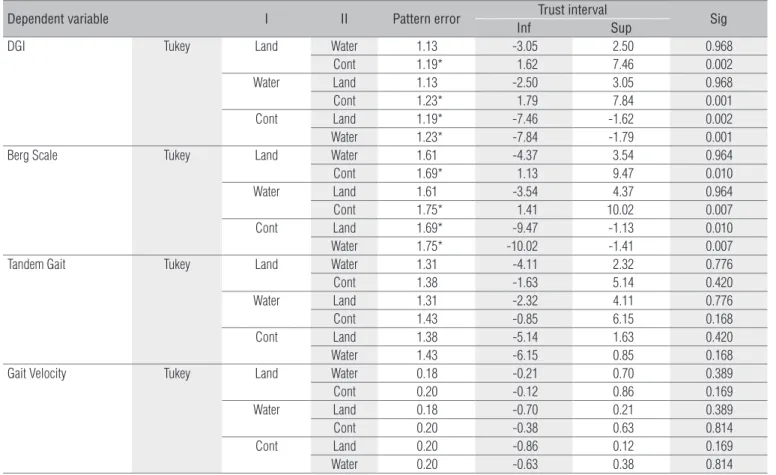
Figure 1 represents the test measurements: a) Berg Balance Scale; b) DGI; c) Tandem gait; and d) Gait speed before and after the intervention. No variables showed diferences between the groups before the intervention, thus indicating that the sample was homogeneous (Table 1). After the intervention, only the DGI and Berg variables showed signiicant diferences between the intervention groups and the CG (Table 2). here was no signiicant diference between the therapies carried out in the non-aquatic and aquatic environments (Figure 1).
Discussion
he objective of this study was to investigate whether a lower-limb muscle strengthening program, conducted either in an aquatic or in a non-aquatic environment, would be ca-pable of improving older adults’ static and dynamic balance. In order to test our hypothesis, we used exercises that were easy to reproduce and to apply, with speciications relating to the frequency and duration of each exercise. his makes it possible
to replicate this experiment in order to conirm the eicacy of the muscle training program for the static and dynamic bal-ance of older people.
he sample was made up mainly of older women with a history of falls. his sample composition may be seen in several other studies10,12,15,17,18,26,27, thereby corroborating the literature,
since functional limitations occur more frequently among women, and they report sufering from a greater number of chronic conditions28.
he results from the present investigation show that the training proposed was capable of improving the static and dynamic balance of older people. Likewise, other studies had shown that muscle training has a positive impact on balance among older adults8,9,11,13,18. Our training protocol had a
fre-quency of twice a week, for a period of six straight weeks. here is evidence that two or three times a week is a frequency that results in signiicant improvements in muscle endurance, bal-ance and functional performbal-ance, and it also reduces the num-ber of falls8,25. In addition to this, the minimum duration of a
training program is thought to be between six and eight weeks, i.e. the time needed to surmount the motor learning and neu-ral adaptation phases, which are the phases mainly responsible for the production of strength and endurance during the irst weeks of a training program25.
Several studies have used physical exercise to improve older adults’ static and dynamic balance26-31. Ballard et al.32
looked into the effect of a program of exercises and measures to reduce falling among 40 community-living older women. The experimental group performed exercises in sessions that lasted one hour, three times a week, for 15 weeks. Among the activities, they underwent aerobic exercises and exer-cises to strengthen the lower limbs with elastic resistance. The volunteers were evaluated on the Berg Balance Scale, to measure their balance, and by means of a test referred to as Wall-sit, to measure their muscle endurance. The results from their study showed that their muscle endurance had increased significantly and that the participants’ body bal-ance had improved.
he Berg Balance Scale is an instrument that is very fre-quently used both in clinical practice and in research work to assess dynamic and static balance. In the present study, we observed that the groups that underwent the muscle en-durance test improved their mean score on this scale. Simi-lar data, in which it was observed that training and balance programs improve the scores on this scale, are found in the literature11,14,30-32. In the experiment conducted by Hess and
Woollacott33, a muscle endurance program lasting only ten
weeks provided an improvement in older adults’ balance that was made evident by signiicantly higher scores on the Berg Balance Scale.
In the present study, there were no improvements in the older people’s static or dynamic balance according to the Tandemgait test. As reported by Pereira34, the Tandem
gait test is one in which the elderly population has a weak performance. Therefore, we believe that it was not sensitive
Figure 1. Medium values of the static and dynamic balance appraised for the instruments: A) Berg Scale; B) DGI; C) Tandem Gait; D) Gait Velocity in elderly in Water Group (GW), Land Group (GL) and Control Group (GC).
44 46 48 50 52 54 56
GC
Berg Scale (Score)
Before intervention After intervention **
** **
GW GL
Before intervention After intervention
0 5 10 15 20 25
DGI (Score)
* *****
GC
GW GL
Before intervention After intervention
0 2 4 6 8 10
Tandem Gait (nº pace)
GC
GW GL
Before intervention After intervention
0 0,5 1 1,5 2 2,5
Gait Velocity (m/s
2)
GC
GW GL
A
B
C
D
Dependent variable I II Pattern error Trust interval Sig
Inf Sup
DGI Tukey Land Water 1.59 -3.97 3.85 0.999
Cont 1.68 -1.76 6.47 0.350
Water Land 1.59 -3.85 3.97 0.999
Cont 1.73 -1.84 6.67 0.356
Cont Land 1.68 -6.47 1.76 0.350
Water 1.73 -6.67 1.84 0.356
Berg Sacle Tukey Land Water 1.88 -5.35 3.89 0.922
Cont 1.98 -2.91 6.82 0.590
Water Land 1.88 -3.89 5.35 0.922
Cont 2.05 -2.35 7.71 0.400
Cont Land 1.98 -6.82 2.91 0.590
Water 2.05 -7.71 2.35 0.400
Tandem Gait Tukey Land Water 1.53 -4.15 3.34 0.962
Cont 1.61 -3.02 4.87 0.833
Water Land 1.53 -3.34 4.15 0.962
Cont 1.66 -2.75 5.41 0.704
Cont Land 1.61 -4.87 3.02 0.833
Water 1.66 -5.41 2.75 0.704
Gait Velocity Tukey Land Water 0.16 -0.29 0.49 0.810
Cont 0.17 -0.31 0.53 0.792
Water Land 0.16 -0.49 0.29 0.810
Cont 0.17 -0.41 0.44 0.997
Cont Land 0.17 -0.53 0.31 0.792
Water 0.17 -0.44 0.41 0.997
Table 1. Tests Post Hoc among the groups in the moment before the intervention (n=36).
Dependent variable I II Pattern error Trust interval Sig
Inf Sup
DGI Tukey Land Water 1.13 -3.05 2.50 0.968
Cont 1.19* 1.62 7.46 0.002
Water Land 1.13 -2.50 3.05 0.968
Cont 1.23* 1.79 7.84 0.001
Cont Land 1.19* -7.46 -1.62 0.002
Water 1.23* -7.84 -1.79 0.001
Berg Scale Tukey Land Water 1.61 -4.37 3.54 0.964
Cont 1.69* 1.13 9.47 0.010
Water Land 1.61 -3.54 4.37 0.964
Cont 1.75* 1.41 10.02 0.007
Cont Land 1.69* -9.47 -1.13 0.010
Water 1.75* -10.02 -1.41 0.007
Tandem Gait Tukey Land Water 1.31 -4.11 2.32 0.776
Cont 1.38 -1.63 5.14 0.420
Water Land 1.31 -2.32 4.11 0.776
Cont 1.43 -0.85 6.15 0.168
Cont Land 1.38 -5.14 1.63 0.420
Water 1.43 -6.15 0.85 0.168
Gait Velocity Tukey Land Water 0.18 -0.21 0.70 0.389
Cont 0.20 -0.12 0.86 0.169
Water Land 0.18 -0.70 0.21 0.389
Cont 0.20 -0.38 0.63 0.814
Cont Land 0.20 -0.86 0.12 0.169
Water 0.20 -0.63 0.38 0.814
Table 2. Tests Post Hoc among the groups in the moment after the intervention (n=36).
enough to detect any improvements in the body balance of these older adults.
he results from this study showed that the training pro-tocol was not capable of improving the volunteers’ gait speed. Our inding contrasts with studies in the recent literature25,35.
Britto et al.35 observed a signiicant improvement in
individu-als’ gait speed and balance after eight weeks of aerobic train-ing and muscle endurance exercises. However, our endurance training program prioritized training at slow motion speed, whereas static balance calls for quick muscle contractions.
We also observed a signiicant increase in the static and dynamic balance of the older adults who underwent the train-ing protocols in the therapy pool. here is a growtrain-ing trend within the clinical environment to indicate aquatic exercises for individuals who are afraid of, or who are at risk of falling13-17.
Resende, Rassi and Viana14 implemented a program of aquatic
physical therapy for older women, lasting for 12 weeks, twice a week. he program, which was intended to improve balance, included activities for adaptation to the aquatic environment, hydrokinesiotherapy and aquatic exercises that deied balance. he results from their study suggested that the program of
aquatic physical therapy exercises provided an increase in bal-ance and a reduction in the risk of falls among older women.
We did not observe any signiicant diferences in balance improvement between the intervention groups in the aquatic and non-aquatic environments. his result difers from what was found by Lund et al.13, who compared the eicacy of
aquatic and non-aquatic exercise programs on the body bal-ance of elderly patients and observed that the aquatic exercises were signiicantly better for their balance than were the non-aquatic exercises. Nevertheless, it is important to highlight that the subjects of that study sufered from osteoarthritis in their knees, thus difering from our sample.
Although our sample was small, it showed that a program of exercises to develop endurance of the lower limb muscles, both in aquatic and in non-aquatic environments, provided a signiicant improvement in the static and dynamic movement of these community-living elderly people. herefore, this endur-ance protocol may be used to improve the static and dynamic balance of older adults. Moreover, it can be concluded that aquatic muscle endurance training may be used as an alterna-tive to conventional physical therapy treatment.
235
References
1. Connolly BH. Tópicos sobre o envelhecimento em indivíduos com incapacidades prévias. Rev Bras Fisioter. 2006;10(3):249-62.
2. De Castro SM, Perracini MR, Gananca FF. Versão brasileira do Dynamic Gait Index. Rev Bras Otorrinolaringol. 2006;72(6):817-25.
3. Gazzola JM, Perracini MR, Ganança MM, Ganança FF. Fatores associados ao equilíbrio funcional em idosos com disfunção vestibular crônica. Rev Bras Otorrinolaringol. 2006;72(5):683-90.
4. Gananca FF, Gazzola JM, Aratani MC, Perracini MR, Ganança MM. Circunstances and consequences of falls in elderly people with vestibular disorder. Rev Bras Otorrinolaringol. 2006;72(3):388-93.
5. Ruwer SL, Rossi AG, Simon LF. Equilíbrio no idoso. Rev Bras Otorrinolaringol. 2005;71(3):289-303.
6. Booth CE. Water exercise and its effects on balance and gait to reduce the risk of falling in older adults. Activies, Adaptation & Aging. 2004;28(4): 45-57.
7. American Geriatrics Society, Bristish Geriatrics Society and American Academy of Orthopaedic Surgeons Panel of Falls Prevention. Guideline for the prevention of falls in older persons. J Am Geriatr Soc. 2001;49(5):664-72.
8. Aveiro MC, Granito RN, Navega MT, Driusso P, Oishi J. Influence of a physical training programo n muscles strengh, balance and gait velocity among women with osteoporosis. Rev Bras Fisioter. 2006;10(4):441-8.
9. Faria JC, Machala CC, Dias RC, Dias JMD. Importância do treinamento de força na reabilitação da função muscular, equilíbrio e mobilidade de idosos. Acta Fisiátrica. 2003;10(3):133-7.
10. Scalzo PL, Diniz GCLM, Zambaldi PA, Costa TAPN. Efeito do treinamento de equilíbrio em um grupo de mulheres idosas da comunidade: estudo piloto de uma abordagem específica, não sistematizada e breve. Acta Fisiátrica. 2007;14(1):17-24.
11. Bean JF, Kiely DK, LaRose S, Alian J, Frontera WR. Is star climbing power a clinically relevant measure of leg power impairments in at-risk older adults? Arch Phys Med Rehabil. 2007;88(5):604-9.
12. Barnett A, Smith B, Lord SR, Willians M, Baumand A. Community-based group exercise improves balance and reduces falls in at-risk older people: a randomized controlled trial. Age Aging. 2003;32(4):407-14.
236
14. Resende SM, Rassi CM, Viana FP. Efeitos da hidroterapia na recuperação do equilíbrio e prevenção de quedas em idosas. Rev Bras Fisioter. 2008;12(1):57-63.
15. Gomes WF. Impacto de um programa estruturado de exercícios terapêuticos subaquáticos em mulheres idosas com osteoartrite de joelho [dissertação]. Belo Horizonte (MG): Universidade Federal de Minas Gerais; 2007.
16. Candeloro JM, Caromano FA. Efeito de um programa de hidroterapia na flexibilidade e na força muscular de idosas. Rev Bras Fisioter. 2007;11(4):303-9.
17. Lord SR, Matters B, George RS, Thomas M, Bindon J, Chan DK, et al. The effects of water exercise on physical functioning on older people. Aust J Ageing. 2006;25(1):36-41.
18. Devereux K, Roberston D, Briffa NK. Effects of a water-based program on women 65 years and over: a randomized controlled trial. Aust J Physiother. 2005;51(2):102-8.
19. Mathias S, Nayak US, Isaacs B. Balance in elderly patients: the “get up and go” test. Arch Phys Med Rehabil. 1986;67(6):387-9.
20. Brucki SMD, Nitrini R, Caramelli P, Bertolluci PHF, Okamoto IH. Sugestões para o uso do mini-exame do estado mental no Brasil. Arq Neuropsiquiatr. 2003;61(3B):777-81.
21. Berg KO, Maki BE, Williams JI, Holliday PJ, Wood-Dauphinee SL. Clinical and laboratory measures of postural balance in an elderly population. Arch Phys Med Rehabil. 1992;73(11):1073-80.
22. Miyamoto ST. Escala de equilíbrio funcional: versão brasileira e estudo da reprodutibilidade da Berg Balance Scale [dissertação]. São Paulo (SP): Universidade Federal de São Paulo; 2003.
23. Miyamoto ST, Lombardi Júnior I, Berg KO, Ramos LR, Natour J. Brazilian version of the Berg balance scale. Braz J Med Biol Res. 2004;37(9):1411-21.
24. Hu MH, Woollacott MH. Balance evaluation, training and rehabilitation of frail fallers. Rev Clin Gerontol. 1996;6:85-99.
25. Lopopolo RB, Greco M, Sullivan D, Craik RL, Mangione KK. Effect of therapeutic exercise on gait speed in community-dwelling elderly people: a meta-analysis. Phys Ther. 2006;86(4):520-40.
26. Silva A, Almeida GJM, Cassilhas RC, Cohen M, Pecin MS, Tufik S, et al. Equilíbrio, coordenação e agilidade de idosos submetidos à prática de exercícios físicos resistidos. Rev Bras Med Esporte. 2008;14(2): 88-93.
27. Rebelatto JR, Calvo JI, Orejuela JR, Portilho JC. Influência de um programa de atividade física de longa duração sobre a força muscular manual e a flexibilidade corporal de mulheres idosas. Rev Bras Fisioter. 2006;10(1):383-9.
28. Barbosa AR, Souza JMP, Lebrão ML, Laurenti R, Marucci MFN. Functional limitations of Brazilian elderly by age and gender differences: data from SABE survey. Cad Saúde Pública. 2005;21(4):1177-85.
29. Lord SR, Tiedemann A, Chapman K, Munro B, Murray SM, Gerontology M, et al. The effect of an individualized fall prevention program on fall risk and falls in older people: a randomized, controlled trial. J Am Geriatric Soc. 2005;53(8):1296-304.
30. Lin SI, Wollacott M. Association between sensoriomotor function and functional and reative balance control in the elderly. Age Ageing. 2005;34(4):358-63.
31. Ikezoe T, Tsutou A, Asakawa Y, Tsuboyama T. Low intensity training for frail elderly women: long term effects on motor function and mobility. J Phys Ther Sci. 2005;17(1):43-9.
32. Ballard JE, McFarland C, Wallace LS, Holiday DB, Roberson G. The effect of 15 weeks of exercise on balance, leg strength, and reduction in falls in 40 women aged 65 to 89 years. J Am Med Womens Assoc. 2004;59(4): 255-61.
33. Hess JA, Woollacott M. Effect of high-intensity strength-training on functional balance ability in balance-impaired older adults. J Manipulative Physiol Ther. 2005;28(8):582-90.
34. Pereira LSM. Avaliação pelo fisioterapeuta. In: Maciel A, editor. Avaliação multidisciplinar do paciente geriátrico. Rio de Janeiro: Revinter; 2002. p. 43-86.