Fundação
Getulio
Vargas
- Escola
de
Pós-Graduação
em
Economia
Marcelo
Yuji
Nomoto
Improvements
and
Alternatives
to
Intellectual
Property:
A
survey
Dissertação
de
mestrado
Fundação
Getulio
Vargas
- Escola
de
Pós-Graduação
em
Economia
Improvements
and
Alternatives
to
Intellectual
Property:
A
survey
Dissertação de mestrado submetida à Escola de Pós-Graduação em Economia da Fundação Getulio
Vargas como requisito parcial para obtenção do título de Mestre em Economia
Aluno: Marcelo Yuji Nomoto
Orientador: Luis Henrique B. Braido
Fundação
Getulio
Vargas
- Escola
de
Pós-Graduação
em
Economia
Improvements
and
Alternatives
to
Intellectual
Property:
A
survey
Dissertação de mestrado submetida à Escola de Pós-Graduação em Economia da Fundação Getulio
Vargas como requisito parcial para obtenção do título de Mestre em Economia
Aluno: Marcelo Yuji Nomoto
Orientador: Luis Henrique B. Braido
Banca Examinadora:
Luis Henrique Bertolino Braido (EPGE - FGV)
Marcelo Fernandes (Queen Mary, University of London)
Carlos Eugênio Ellery Lustosa da Costa (EPGE/FGV)
Título: Melhorias e Alternativas para Propriedade Intelectual: Uma Revisão da
Literatura
Resumo
Uma parcela importante do crescimento econômico é devida a inovações. Esta
dissertação revisa a literatura recente em propriedade intelectual. Esta revisão discute os
seguintes artigos: Kremer (1998), Boldrin e Levine (2001), Kremer (2001), Shavell e
Ypersele (2001), Lerner (2002) e DiMasi, Hansen e Grabowski (2003). Estes contém
tanto artigos empíricos quanto teóricos. Na primeira categoria está um artigo sobre
efeitos na inovação de mudanças na força das patentes e outro sobre custo de
desenvolver novos medicamentos. Os estudos teóricos propõem melhorias e alternativas
ao sistema de patentes, por exemplo, recompensas opcionais, compras de patentes,
eliminação de patentes em alguns setores e compromisso de compra prévio.
Palavras-chave: propriedade intelectual, patente, recompensa, compromisso de compra
Abstract
An important share of the economic growth is due to innovations. This thesis reviews the recent
literature in intellectual property. This survey discusses the following papers: Kremer (1998),
Boldrin and Levine (2001), Kremer (2001), Shavell and Ypersele (2001), Lerner (2002) and
DiMasi, Hansen, and Grabowski (2003). These include both empirical and theoretical articles.
In the fírst category, there is one study about the responses in innovation caused by a change in
patenfs strength and another about the cost of developing new drugs. The theoretical studies
propose enhancements and alternatives to the patent system, e.g. optional rewards, patent
buyouts, elimination of patents in some sectors and advanced purchase commitments.
Improvements
and
Alternatives
to
Intellectual
Property:
A
survey
Candidate:
Marcelo
Yuji
Nomoto*
Thesis
Adviser:
Luis
H.
B.
Braido
Getulio
Vargas
Foundation^
Rio
de
Janeiro,
Brazil
February
2007
Abstract
An important share of the economic growth is due to innovations. This the
sis reviews the recent literature in intellectual property. This survey discusses
the following papers: Kremer (1998), Boldrin and Levine (2001), Kremer
(2001), Shavell and Ypersele (2001), Lerner (2002) and DiMasi, Hansen, and
Grabowski (2003). These include both empirical and theoretical articles. In
the first category, there is one study about the responses in innovation caused
by a change in patenfs strength and another about the cost of developing new
drugs. The theoretical studies propose enhancements and alternatives to the
patent system, e.g. optional rewards, patent buyouts, elimination of patents
in some sectors and advanced purchase commitments.
JEL Classification codes: 031, 034.
Keywords: intellectual property, patent, reward, advanced purchase commitment
*I am indebted to Luis H. B. Braido, for guiding and encouraging me to pursue this work. Fm
also thankful to several colleagues that always helped me in a number of discussions.
Contents
1 Introduction 5
2 How to reduce the deadweight loss problem? 6
3 What to do when patents are not enough incentive? 15
4 What would happen if patents cease to exist? 19
5 Do patents spur innovation? What is the empirical evidence? 27
6 What is the cost of a new drug? 39
7 Conclusion 42
Appendix 42
Kremer (1998) 42
Boldrin and Levine (2001) 51
Kremer (2001) 59
Shavell and Ypersele (2001) 65
Lerner (2002) 73
DiMasi, Hansen, and Grabowski (2003) 85
List
of
Tables
1 Impact of a change in patent policy on patenting activity 31
2 Weighted least squares regression analyses of patenting in Great Britam 35
3 Weighted least squares regression analyses of domestic patenting by
residents of nations undergoing patent policy changes 36
4 Instrumental variable regression analyses of patenting in Great Britain 38
5 Average out-of-pocket clinicai period costs for investigational
com-pounds 41
6 Average phase times and clinicai period costs for investigational
com-pounds 41
7 Impact of a change in patent policy on patenting activity 78
8 Weighted least squares regression analyses of patenting in Great Britain 82
9 Weighted least squares regression analyses of domestic patenting by
residents of nations undergoing patent policy changes 83
10 Instrumental variable regression analyses of patenting in Great Britain 84
11 Average out-of-pocket clinicai period costs for investigational
com-pounds 87
12 Average phase times and clinicai period costs for investigational
List
of
Figures
1 Optional Reward System: Investment and Incentives 13
2 Number of changes in patent policy over time 30
3 Patenting changes around the time of patent protection-enhancing
policy changes 33
4 Patenting changes around the time of patent protection-reducing or
ambiguous policy changes 34
5 Patent and Reward: Investment and Incentives 69
6 Optional Reward System: Investment and Incentives 70
7 Number of changes in patent policy over time 76
8 Patenting changes around the time of patent protection-enhancing
policy changes 79
9 Patenting changes around the time of patent protection-reducing or
1
Introduction
Innovation is responsible for a great share of the economic growth. A recent
example is the development of the computer industry that spillover to practically
every field causing great impacts on economic growth. Pharmaceuticals are another
área in which innovations brought great social benefits. These innovations caused
people to live longer with more quality.
There are several ways to encourage innovation. Tournaments, fellowships, awards,
patents and copyrights are some examples. By far, the most used system of innova
tion incentives is Intellectual Property which includes mainly patents and copyrights.
However, this system has efficiency problems. First, innovators are awarded with
monopoly rights over their invention for a period, which causes deadweight losses.
This means that part of the welfare gain from the innovation is neither received by
the innovator nor by the consumer which causes underinvestment in innovations.
Another problem is that firms have incentive to invent around existing patents to
steal profits, which is not optimal. On the other hand, one important advantage of
this system is that the innovator's reward is proportional to the innovation's value.
The deadweight loss problem should be enough to motivate research in more
appropriate mechanism to generate innovations. But economic researchers do not
seen to have given the adequate importance to the theme, despite its role in economic
growth. Section 2 discusses rewards and buyouts as alternatives to reduce this
problem.
Another important problem is the absence of cooperation among researchers.
The first to fill a patent application receives ali benefits. Therefore, innovators try
to keep their research secret until the filling. One consequence is a slower develop
ment process. Another source of inefficiency is research races. In this races, several
firms try to develop the same innovation independently. While this may speed up
inventions, it is clearly a waste of resources that could be used to research other in
novations. None of the papers in this survey addresses successfully these problems.
What to do when patents are not enough incentive to develop a very impor
solution.
What would happen if patents cease to exist? Boldrin and Levine (2001) have a
theory in which innovations occur without the need of intellectual property. Section
4 discusses this theory.
Theoretically, patents should spur innovation. What is the empirical evidence?
Lerner's (2002) empirical study finds evidence that stronger patents may cause less
innovation. Section 5 analyses this paper.
Another problem with patents is that some countries, mainly developing ones,
break patents of some pharmaceutical products to provide treatment for its
popula-tion. That causes pharmaceutical firms not to spent on R&D for tropical diseases.
Section 6 presents DiMasi, Hansen, and Grabowski (2003) in which the authors
estimated the cost of development of a new drug.
Finally, the conclusions are in last section.
The appendix contains summaries of the papers discussed in this survey.
2
How
to
reduce
the
deadweight
loss
problem?
There are several ways to reduce or eliminate deadweight losses. One way is
to allow price discrimination. If patent holders were allowed to discriminate prices,
they would sell more units and have more profits. This simple solution would reduce
deadweight losses and increase incentives to innovate. On another hand, it is not
easy to discriminate prices and this solution has not much political support.
To place innovations in public domain may be an alternative. This solution
eliminates deadweight losses but it reduces incentives to innovate, unless innovators
are compensated in some way.
Kremer (1998) and Shavell and Ypersele (2001) present alternatives that
com-pensate innovators for their inventions and place innovations in public domain. The
former presents a mechanism in which the government buys patents from innovators
willing to sell while the later proposes a reward system to replace patents, which
may be optional.
In Kremer's solution, the government buys patents to place them in public do
main. This solves the deadweight loss problem, raises the private incentives closer to
the social value of the innovation and avoids the incentives to invent around existing
patents to steal profits. But this solution depends on the participation of innovators,
since the government does not force them to sell their inventions.
The mechanism is a second-price, sealed bid auction to determine the invention's
value. The process begin with a inventor who wants to sell his or her patent to the
government, and in order to do so he or she needs to pay the administr ative cost of the
auction. The government asks for bids, which under a second-price auction should
be the expected value of the patent to bidders given their information. To incentive
the bidders to reveal their true patenfs valuation, the government randomizes after
buying the patent if it will go to public domain or if it will be sold to the auction's
winner, with probabilities (1 p) and p respectively.
The government then offers to buy the patent at a markup times the private
value extracted from the auction. The inventor decide if he or she wants to sell.
If he or she do not sell the invention, he or she retains the patent, only incurring
administrative costs of the auction. In case he or she decides to sell, the government
randomizes as described before.
To estimate the patenfs private value, the government should use ali bids
re-ceived, rather than only the highest one, because there is no reason to ignore infor
mation from lower bids.
The markup serves to adjust the value of benefits to innovators since social return
to innovation under patents is two and half times the private rate of return.
The main problems in this approach are collusion, informational advantages of
inventors, innovators that are low cost producers and dealing with complementary
and substitute innovations. Collusion is a great problem because the innovator
always receives the bid plus markup while the bidder only pays with probability p.
The author proposes several mechanisms to prevent collusion:
1. When the government uses the third bid to calculate buyout price, it is very
hard to the inventor cheat on the auction because it is necessary that three
buyers take part on collusion.
higher than the invention's value. Suppose the government with information
extracted from other bidders conclude that the invention's value is
approxi-mately n, but the highest bid is n + x. The government could, in this situation,
pay tf + $1 to the inventor and charge ir + x to the auction's winner for the
invention. Then the government would make a profit of x 1 from the attempt
of fraud.
3. The government should have list of suspects of fraud and prohibit them to
par-ticipate. Should not be hard to elaborate such list, because these participants
will have great losses when they buy the patent.
4. The government should investigate inventor financial ties with bidders and
punish inventors who fail to disclose their ties. This should avoid the use of
front companies.
5. If there is a fee or if companies had to make a deposit to participate in auctions
then it would become unprofitable to inventors create dummy companies to
bid in their products. Alternatively, government could focus on drugs, because
firms in the industry are already known, making frauds more difncult.
6. The government should prohibit inventors to buy back their inventions and to
make side payments to bidders. The later is, in the author's opinion, the most
difficult aspect to control to avoid collusion.
7. A waiting period. The government would let inventions under patents over
several years before buyout. This would give more information about patents'
value and ceiling price would be a multiple of annual revenues before buyout.
A problem is the incentive to inventors try to raise sales artificially. Another
ceiling price could be prebuyout price times postbuyout consumption.
8. Another option could be capping the buyout price by total sales times the
estimated social value per dose of drug. The government should do this
9. One last suggestion is a mechanism where the price is capped by profits
from product. This mechanism is the same as before until randomization.
But what happens after randomization is different. Now, inventor receives
{M/p) min(bid, ir) for invention only if the invention is sold to the highest
bid-der. If the invention is placed in public domain, the inventor receives nothing.
The expected value of buyout price in this case is Mmin(bid, n). The inven
tor could insure the risk of receiving nothing in this situation without great
difficulties.
When the innovator has informational advantage, the problem is the winner's
curse. In this situation, bidders will bid low values. The markup reduces this prob
lem since it gives the inventor incentive to reveal as much information as possible.
Asymmetric information makes it difficult for small biotech firms to sell patents to
large ones, and it even prevents some transactions. But even without any markup
trade takes place frequently. So it is possible to affirm that a 100 percent markup
will convince many patent proprietaries to sell their patents.
Sometimes the inventor has advantages in producing the good. In this situa
tion, inefficiency may arise if another firm receives monopoly rights. Furthermore,
releasing the invention in public domain may not affect the deadweight loss.
Suppose that an inventor can produce the good at cost Cq while the íth lowest
cost producer can produce it at cost q. Demand for the good is Q = Pa, a < 1.
If a producer was the patent holder and had cost q, the optimal price would be
c^a/{a + 1) and he or she would profit
a
In a second-price auction this producer would bid ttj. The government receives bids
and offers MZitj for the patent, where Z is a multiplier, e.g. the historical ratio
of the jth highest to the highest bid, M > 1 is the markup. The patent will only
be sold if 7r0 < MZiTj + (1 p)7tCOmp> where tto is the value of a monopoly on the
good for the inventor, p is the probability that the government sells the patent to
the auction's winner, 7rCOMp is the value to the inventor of producing the good in
If the patent is placed in public domain and c\/cq < a/(a + l), the inventor does
not have a great cost advantage and will face Bertrand competition. He or she will
profit
ttcomp
= c?
+ (ei
- co).
However if C\/c$ > a/(a + 1) then the inventor has a great cost advantage. So
great that he or she will be able to sell at monopoly price even with the good in
public domain. He or she will profit tt0 in this case.
Note
that
inventors
will
almost
aways
sell
their
patents.
If Cj/cq
< (MZ)~1^1+a\
the cost advantage is not too great relative to markup. Then MZ-Kj > tt0 and they
will sell. When C\/cq > a/(a + 1), they will sell if p is small enough, because their
profit in competition will be the same as under monopoly, 7rCOMp =
^o-The author points out that his method is more efficient when the industry has
no great cost differences across firms and when the difference between competitive
price and monopoly price is large. In this scenario, the cost advantage problem has
little or no importance.
The markup does not make innovators always accept the government offer. There
will be some cases in which the cost to acquire information about the patent will be to
high, or the industry has too few competitors willing to buy the patent and this will
cause bids to be too low, making the government offer to be refused. But, because
the administrative cost of the auction is paid by the patent seller, the government
will not incur a loss. The original patent holder will keep the patent in this situation.
While markup raises incentive to research, expectation that substitutes to patented
products will be developed more quickly reduces this incentive.
To keep a socially optimal research levei, the markup has to be larger than current
ratio from social value of inventions to their private value. To show this, Kremer
(1998) uses a model of creative destruction. In this model, research at time t can
be written as xt <f>(Mt, xt+\), where Mt is the subsidy to research at t, 4>\ > 0 and
4>2 < 0. Define xs as the research levei that would be chosen by a social planner and
xs > xp. The optimal markup solves xs (f)(Ms, xs). Ms is greater than the markup
needed to induce xs given expectations that future patents will not be bought, Mp,
because Mp solves xs = (j){Mp,xp).
The author recommends joint randomization to solve problems with
tary and substitute inventions. The later problem arises when a seller is offering
the government a patent that is a substitute to another one. If the offered patent
is placed in public domain, it would become a formidable competitor for the one
patented before. This would discourage investments in research.
Joint randomization works in the following way: Every time a new patent, that
is substitute to another patent not in public domain, is offered to the government,
the owner of the original patent may ask to sell his or her own. The government
then asks for bids for each invention separately, but makes just one randomization.
With probability p both inventions go to the respective auction winners and with
probability (1 p) both are placed in public domain. With the joint randomiza
tion the inventions are valued on the contingency that both inventions and future
substitutes will stay in private domain.
Notice that no bureaucracy is necessary to implement the system. Every claim
that an invention is substitute to another one would be accepted, because it causes
no harm and has the benefit that another invention may be placed in public domain.
Another use for joint randomization is when complementary patents are sold to
the government. The patent value is higher when a complement to a patent is or
will be in public domain. Under these circumstances, separate auctions may cause
the government to pay more than the social value of inventions. This may incentive
inventors to break their inventions in various complementary patents before selling
them to the government.
To prevent this, the government should not buy complementary inventions sep
arately. If they belong to a single owner, the government should offer to buy ali
complements. If the owner refuses the government should offer to buy a single in
vention randomly chosen, but the inventor cannot offer to sell the other inventions
to the government later. And this inventor will have a waiting period before he or
she can sell future developed compliments of his or her invention to the government.
If inventions belong to different owners the government should ask for bids to each
owner patents separately and for the whole set of complimentary patents. If owners
fail to joint sell, the government should buy the patent of only one randomly chosen
both situations, sellers will be better off than under the current patent system.
Two last comments end this paper analysis. First, firms do not need a licence
to improve products in public domain. As long as the improvement is patentable,
there will be incentive to invent it. And there is much more incentive to invent
complementary products, because the quantity sold of the original product will be
larger when the product is in public domain, favoring complements.
On another hand, one important problem in this approach is that selectively
putting inventions in public domain may cause the adoption of an inferior technology,
since these inventions are sold at competitive prices. This makes them formidable
competitors, even to superior innovations.
Shavell and Ypersele (2001) proposes an optional reward system to avoid
dead-weight losses. In this system innovators may choose to receive a reward instead of
a patent for their inventions. If this happens, the innovation is placed in public
domain. Otherwise, the innovator receives a patent for his or her invention.
They build a model to show that this system is superior to patents. In the model
a risk neutral potential innovator chooses investment in research k. The probability
of an innovation is p(k), and it increases on k; p (k) > 0;p (k) < 0. If an innovation
is discovered, it generates a product that can be produced at cost c. The inverse
demand curve for the product is d(q; t) where q is the quantity of product and t
is a parameter in [to,tj,]. The probability density of t is g(t) > 0 on [ío,íb]. As
usual dq(q; t) < 0. The authors assume that at ta there is positive monopoly profits,
deadweight losses and social surplus, and they are increasing in t. Social welfare
is the expected value of utility obtained from the product by individuais, minus
production costs, and minus research investment. With the exception of t, every
function and variable described above is common knowledge. Only the innovator
knows the value of t.
Under patent regime, when an innovation occurs, the innovator holds exclusive
rights over the product. Assuming profit maximization, he or she sells the monopoly
quantity qm(t) and earn monopoly profits n(t). The innovator will choose k to
maximize
p{k)n(t) - k. (2.2)
As 7r(í) is the payoff from an innovation, he or she will choose k(n(t)).
Under the optional reward regime the innovator chooses if he or she wants to
patent his or her invention or if he or she prefers to receive a reward for it. He will
pick the one with highest expected value. Thus he or she will choose patent if and
only if r < n(t). This is illustrated in figure 1.
Figure 1: Optional Reward System: Investment and Incentives
optnml implus
optknft] rewvd uivculiiiciit
itwvd caMcn pneot
Source: Shavell and Ypersele (2001)
If r < ?r(ío), then the optional reward system is equivalent to the patent system
because the innovator will always choose patents. Hence to determine the optimal
reward the authors made a restriction: r > n(ta). Let l(r) = 7r~J(r) for r in
n(ta), n(tb), and let t(r) = tb for r > 7r(íf,). Social welfare becomes:
fí(r) rtb
Wo(r)=
í T \p(k(r))s*(t)-k(r)]g(t)dt+
[ \(k(*(t)))(s*(t)-l{t))k(n{t))]g(t)dt.
Jta Jt(r)
(2-3)
The derivative of (2.3) is
W'o{r)
= k'(r)\p'(k(r))E(s*\t
< t(r))
-
+t (r)p(k(r))l(t(r))g(t(r)), (2.4)where G is the cumulative distribution function of g and E(s*\t < t(r)) is the ex
pected value of s*(t) conditional on t < t(r). First term in (2.4) is the inframarginal
reward. Second term is the marginal effect, i.e. the effect from innovators deciding
to accept reward instead of to patent their products. This effect does not change
in-vestment because the reward is equal to monopoly profits when this change happens,
it only eliminates deadweight loss.
First term of (2.4) is nonnegative and second term is positive when r < E(s*\t <
t{r))
is positive
(thus
\p'(k{r))E(s*\t
< t(r))-l]
is positive).
Since
s*(ta)
< E(s*\t
<
t(r)) the optimal reward r** is always greater than s*(ta). If the optimal reward is
greater than n(tb) the system is equivalent to a mandatory reward r**.
Suppose an optional reward system with r = 7r(ía). In this case the innovator
would choose to patent his or her invention (except on a set of measure zero, when
t = ta).
But
in this
point
W'o(r)
> 0, hence
to
increase
the
reward
raises
welfare.
This result shows that an optional reward system is superior to a patent system.
If government can observe quantity sold q and use this information to choose
reward, the results are better. In this case, reward is now r(q) and the innovator
chooses k(r(q(t))). Assuming that he or she can not influence q(t), welfare in this
scenario is
= [tb\p(k(r(q(t)))s*(t)
- k(r(q(t)))}g(t)dt
Jta
(2.5)
'\q)-k(r{q))]f{q)dq,
Qa
where E(s*\q) is the mean of s*(t) given that q(t) = q, f(q) is the density of q derived
from g(t) and ç, = ç(íj). From (2.5) it is easy to see that optimal r(q) is E(s*\q).
Conditional optimal is usually different from unconditional optimal and therefore,
it is superior. This means that an optional conditional reward is more superior to a
patent system than an unconditional one.
One great problem is how to determine the reward. The authors defend that
the government should use sales data and, when possible, frequency of use of music,
computer software and television production to define the reward. Using this system
the government does not need to fear the existence of incentives to ask for rewards
if the invention is not relevant. But as Kremer (1998) points: "General Motors
could stick a useless piece of metal onto a Chevrolet, and as long as the automobile
sold due to other attractive features, GM could argue it deserved the reward." The
authors claim that the government could supplement rewards on an annual basis.
Another point is the difference between government and innovators information.
They claim that ex-ante innovators' information is substantially imperfect and gov
ernment^ information will be reasonably good ex-post. So, as long as rewards are
based on ex-post information, and the governmenfs ex-post information is as good as
the innovator's ex-ante information, not only optional rewards, but also mandatory
rewards are superior to intellectual property rights.
Shavell and Ypersele (2001) argue that optional reward has many advantages
over the patent system, including practical ones. The industry should not object it
because it could only raise proflts. And since the system is optional, the government
would not try to pay too little as rewards. They suggest that this system would have
more advantages in áreas where social losses caused by intellectual property rights
are high, e.g. pharmaceuticals, computer software, and recorded music and visual
products.
Both alternatives discussed in this section reduce the problem of deadweight
losses. Kremer (1998) has a better mechanism to solve this problem, since the
markup increases incentives to invest and to sell patents to the government
simul-taneously. A great problem that both papers fail to mention is which country pays
to place patents in public domain. When one country places the invention in public
domain, firms will sell this good at competitive price. These firms have incentive
to export the good, and since they are selling at competitive price, other countries
have incentive to import the invention without place the innovation in public do
main. Innovators will expect this situation and will only sell for a higher price. The
creation of a international fund to buy patents may solve this problem.
3
What
to
do
when
patents
are
not
enough
incentive?
Sometimes patents are not enough to incentive socially optimal innovations.
Deadweight losses may be sufnciently large to discourage some research. Solutions
to this problem are discussed in section 2.
Some countries do not have laws of patent. In these countries firms may copy
countries break patents in some áreas like pharmaceuticals. The result is cheaper
medications.
On another hand, there are less incentive to innovate in these places. This is a
large problem when some disease affects only countries without patent protection.
Since there is no incentive, firms will not research medications or vaccines to these
diseases.
There are other options to incentive research. One of them is direct government
support, in which government pays for research in some fields. But it is hard to
choice the research to fund and the results are not predictable.
Another alternative is research tournaments. The problem in this approach is
that even if no researcher finds a vaccine or medication, the sponsor has to pay the
prize.
Kremer (2001) presents a mechanism to incentive development of vaccines. He
argues that an advance commitment to buy a large quantity of these vaccines could
incentive their development.
Benefits from a 80 percent effective malária vaccine could be cost-effective even
at a price of $41 per immunized person on a total of 42.1 million people immunized
every year. The revenues to the producer would be more than $1.7 billion annually.
This value shows that the research towards a malária vaccine could recover the
costs of development and generate a large profit, increasing social welfare. But a
private company is not able to recover its costs because even vaccines that cost a
dollar or two per dose do not reach most children. Private benefits are much lower
than social ones and this causes under investment on malária vaccine research.
If pharmaceutical companies could charge the amount each nation is willing to
pay and intellectual property rights were respected globally, then the market could
achieve efficient size to incentive the production of these vaccines.
The author suggests that the advanced purchase commitment is a good incentive
in the end of development process. In the other steps, different mechanisms may be
more efficient.
On initial stages of a new vaccine development, programs that funds research
through public investment, tax credits for R&D, grants, etc. may be a better option.
The main advantage of these programs is that researchers share their knowledge by
publishing their work. This accelerates the development of products.
Another advantage is that the risk of failure is transferred from researching firms
to society at large, which is beneficiai when the shareholders of these firms cannot
diversify this risk in stock markets.
On later stages of development, advanced purchase commitments are better in
centives for vaccine development. The rise of biotech industry and existence of
venture capital favor these programs. The main advantage of such program is that
the government pays only for a vaccine that is actually developed.
In these stages, there may be several projects of new vaccines. It is hard to select
the best research projects. Researchers are over optimistic about their own line of
research and it is difncult to answer if the investment would improve social welfare.
Advance purchase commitments avoid investment that is not welfare improving.
Since the payment is made only when a vaccine is ready, it avoids waste of public
resources. The program rewards only successful projects. In this case, the amount
of payments measures how much a country values the vaccine.
Furthermore, biotech and venture capital companies are encouraged to select
promising projects and target a marketable vaccine.
Other types of incentives have problems in the final stages of development.
Public-sector equity investments have a selection problem because only firms less
confident in their research would seek public investments. Firms highly confident
will refuse public investment since this would reduce their share on profits.
Public directed research has problems in selection of research projects and in the
process of shutting down disappointing projects. It is easier for private companies
to shut down projects that are shown not to be worth pursuing anymore.
Subsidizing private research through tax credits has problems too because even
firms that research subjects with little relation to the diseases that can be used to
ask for credits will claim eligibility. On the other hand, credits linked to vaccine
sales are a better mechanism to obtain a private developed vaccine because it avoids
this type of problem.
(1991) that relates the history of the push program of the U.S. Agency for
Interna-tional Development (USAID) on 1980s that tried to develop a malária vaccine.
Three teams of researchers were funded by that program and only one of them
developed a candidate vaccine. This candidate vaccine was tested in 9 volunteers
and only 2 were protected against malária while the test pointed side effects. These
results caused a claim by USAID in 1984 that a vaccine against malária should be
ready in five years. Despite this claim, until today there is no such vaccine. The
other teams had worse results on preliminary work but they continued to receive
funding. The principal investigators of both teams transferred grant funds to their
personal accounts and were later indicted for theft.
USAID spent over $60 million funding malária research with little results. The
project director of USAID's malária vaccine, James Erickson, pleaded guilty on some
charges after the discovery of a contract to acquire monkeys from an associate who
paid Erickson a kickback.
Erickson was oversight by the American Institute of Biological science, but he
and the project manager responsible for the oversight were lovers.
This is an extreme case of failure in funding projects. But it illustrates how
a researcher may deviate resources away from what they were given for. Another
point is that the three groups of researchers were over optimistic about the possible
results of their research.
The combination of direct support and advanced purchase commitments may
be more effective because the work on less intellectual rewarding leveis of research
would have monetary reward. This would incentive a faster development of vaccines.
The author concludes that the social value of new vaccines may be much higher
than private incentives. This causes potential vaccine developers to pass up socially
desirable research on vaccines.
Even if these vaccines were developed, they would not be widely available because
they would be sold at monopoly prices.
Commitments to purchase future developed vaccines to distribution on
develop-ing countries provides incentives to vaccine research and guarantees that they will
reach people who needs them. And taxpayers only would pay when a vaccine is
developed.
One problem with Kremer's approach is that pharmaceutical firms do not trust
the countries that need do to an advanced purchase commitment. These countries
do not have patent laws, break specific pharmaceutical patents or use their power
to purchase vaccines at lower prices. Once a vaccine is ready for use, it would be
no surprise if a country withdraws the purchase commitment and breaks the patent
of this vaccine. Therefore, some international organization need to guarantee this
advanced purchase commitment or it probably will not work.
4
What
would
happen
if
patents
cease
to
exist?
Innovations have been occurring even before the existence of patents. Therefore,
while patents may incentive innovation, they are not necessary for innovation to
exist.
One current example is development of open source software. Thousands of
people build better programs everyday, and the source code is available to anyone.
If patents cease to exist, it would be easier to develop open source software, since
programmers will be allowed to use patented code.
On another hand, there would be less innovation in several industries. The
development cost of a new product may be very expensive. If anyone could copy
others inventions, nobody would spend money in R&D.
Boldrin and Levine (2001) elaborated a model in which innovation occurs under
perfect competition. Their motivation is that historically there was no intellectual
property, but yet innovation took place.
One fundamental hypothesis of their model is that ideas do not spillover. Ideas
only have value embodied in goods or people. This implies that for someone to
learn the idea, he or she needs access to people or goods that embody the idea.
The authors argument that ideas are rival because people or goods embodying it are
rival.
Boldrin and Levine (2001) define innovation as the flrst time a good is actually
produced or an activity is employed. Then they suppose that one innovation was
copy of it is a perfect substitute of the original. The copying process of the product
demands only time. Then 0 < c < k units are consumed and k c are used to
make copies. These k c units result in 0(k c) units in next period, where /3 > 1.
Since the good may be durable, there are another £c units on next period. £ < 1
because of depreciation and ( < j3 because it is not easier to copy the product
while using it. u(c) is the representative consumer's utility function, u is strictly
increasing, concave, and bounded below. The representative consumer lives forever
and discounts the future at rate 0 < S < 1. The authors assume that technology
and preferences are such that feasible utility is bounded above.
The solution of this problem is a concave value function v(k), the unique solution
of
v(k) = max (it(c) + ôv(0k - (/? - ()c)}.
In equilibrium pt = u (q). From the resource constraint
If ( is large enough relative to f3 it may be optimal not to invest.
The price qt of the durable good kt is
Since pt > 0, qt > 0 for ali t. The zero profit condition implies that qt decreases at
a rate 1/(5 per period of time.
When an innovator creates something he or she has k0 = 1 units of the new
product. In a competitive market this unit sells for q0. Assuming a cost C > 0 to
create the first unit of the good, innovation will occur if c < q0.
The difference between this model and those in which innovations are non rival
is that (3 < oo, meaning that the number of copies made in a period is limited. But
there is no limit on the number of units that can be produced and there is no cost to
produce these units. The authors believe that non rivalry is only an approximation
to the fact that reproduction costs are very small.
When the reproduction costs diminish and there is no intellectual property, inno
vations cease to exist in traditional models. That happens because the inventor will
20 FUNDAÇÃO
GETÚLIO
VARGAS
not be able to receive for his or her invention more than the production cost. But
under Boldrin and Levine's model this is not necessarily true. In the first period the
inventor has the only copy of his or her invention and its price is Ço > u (co), which
is bounded
below
by
u'(l).
Therefore
the
first
copy
price
will
never
fali
to
zero
if
consumers are impatient. And under this framework a reduction in reproduction
costs may even raise the price of the first unit.
Notice that dqo/dpo > 0 and
- = u (Co) -u
(coj-dp dp {/j
t,;-When /? is sufficiently large relative to £ the first term dominates. In this case
the result depends on whether consumption is substitute or complement across time
periods. If it is substitute, then a raise in (3 diminishes consumption and consequently
raises the first unit price. If it is complementary, then the opposite happens and
rents fali.
The authors provide an example where the utility function has the CES form
u(c) = (l/9)(c)~e, 9 > 1. If demand is inelastic then 9 > 0 and there is little
substitutability across periods. As f3 > oo the initial consumption Cq > c < 1. Thus
in this case the rents fali, but not toward zero and innovation will happen under a
competitive framework if p = u (c) > C.
If demand is elastic, 9 G (1,0] then there is a high intertemporal substitution
in
consumption.
In
this
situation
utility
becomes
unbounded
as
/3
d1/6.
As
(3
approaches this limit, cq 0 and the invention price becomes infinite. Hence if (3 is
large enough in this case, every social desirable invention will occur.
One case not discussed yet is Ç = j3. In this situation, capital grows at rate (3
and the initial rent is
i=0 i=0
Again, price is bounded below by marginal utility of the first unit and the initial
rent becomes infinite as (3 increases.
The authors question if the reproduction rate is becoming larger. They do not
to understand and reproduce these ideas is increasing, since ideas are becoming more
complex. But for copyrightable creations, they believe that electronic reproduction
over the Internet makes (3 to increase. Computers also reduce indivisibility C. One
example is that a music studio is much cheaper today than a decade ago.
Boldrin and Levine (2001) also models innovations that occur in sequence. Now
there are many qualities of capital beginning with quantity zero. Capital of type i is
ki and each unit of ki allocated to production of consumption results in (7)* units of
output, where 7 > 1. That means that higher quality capital is more efficient. Every
capital used to produce consumption is depreciated at rate (1 Ç). If c, is produced
using type i capital then there is ki Ci/Y units available to produce capital. As
before each unit of type i capital may be used to produce f3 > 1 units of the same
type of capital. But now there is an option to produce type i +1 capital and hi is the
investment on it. Each unit invested results in p/?,, units oíi+1 capital. It is assumed
that p < (3 and there is a minimum of h > 0 that needs to be invested on the p
technology before getting any output. This represents indivisibility in innovation,
which was the role of C in the previous model. Therefore there will be investment
in higher quality capital only if the rents of introducing fcj+i are large enough to
compensate the investment of at least h/p units of ki. To make sure that sustained
growth is possible it is assumed 5(/3 () > 1.
One case analysed is h = 0. When p7 > (3, one never uses (3 technology because
p technology is dominant. The optimal consumption under competition is obtained
when
u'(ct)
= S(p1-Ou(ct+l).
(4.1)
Since the utility function is strictly concave, u is strictly decreasing. Thus q+i > q
and
if cu"(c)/u'(c)
is bounded
above
as
c » 00
then
applying
Taylor's
theorem,
one can show that not only Ct+\ > Q, but also (q+i Ct)/ct > A > 0 and, in this
case, q grows without bound. So in this model the occurrence of innovations is
possible under a competitive scenario.
Another case analysed is if (h) > 0. When h is large enough there will be
no investment in innovation and no equilibrium. But if h is small enough, it may
not be binding at social optimum. In this case, the competitive equilibrium with
innovations exists, and the welfare theorems apply.
Based on that fact, one important question is, What happens to investment in
the newest technology asymptotically? If it is either constant or increasing, a small
enough indivisibility will not be binding, but if it is diminishing any indivisibility
will
be
binding.
Assuming
that
utility
has
a CES
form,
u(c)
= (l/9)(c)~e,
9 >
1
the first-order condition (4.1) may be used to find the growth rate of consumption g
There is no difference in which capital type is used to produce consumption and
which is used to innovate in the case without indivisibility. This is no longer
neces-sarily true. The optimal plan now may involve using p technology in some periods
and /3 in others because of the threshold h. These complications make the full
characterization of the equilibrium beyond the scope of the paper. But Boldrin and
Levine (2001) provide a sufficient condition for the class of production plans in which
old capital is used only to produce consumption.
The necessary and sufficient condition for physical investment to be
nondecreas-ing asymptotically is
Note that (p7 g)/{pr) () + (g C)/(P7 ~ C) = 1- Thus the restriction is satisfied
if 9 C/4 > 7- If this condition is satisfied, it is probably satisfied strictly, which is
a sufficient condition for asymptotic growth of investment in this class of production
plans. Therefore even if in early periods the indivisibility is binding, as time goes by
investment grows and the indivisibility will become irrelevant. The authors associate
this characteristic to simultaneous discovery in advanced economies. Their view is
that even if part of innovations occurs because of patents, another part cannot be
explained in the same way, e.g. basic science, where patent law does not apply, open
source software, where innovators do not restrict downstream licensing agreements,
and fashion industry, where labels are protected but the designs can be reproduced
without large costs.
According to this model innovations can thrive in a competitive environment.
non-rivalrous good, this theory argues there exists sunk costs to produce a rivalrous
good. In the former situation, since there are increasing returns to scale, competi
tion cannot thrive. In the later one, sunk costs pose no threat to competition, but
indivisibility is the great problem.
One competition problem is that rents may not cover the costs to innovate even if
the invention is socially desirable. Another one is that the indivisibility may bind and
there is no adequate theory of competitive equilibrium with binding indivisibilities.
The authors defend the view that competition is a powerful force and it may find
its way through indivisibilities.
But even in the case where some socially desirable innovations are not produced
under competition, Boldrin and Levine (2001) do not believe that monopoly will have
a better output because while a monopolist has incentive to produce one innovation,
once that happens he or she has incentive to hold up other innovations.
To show this possibility they elaborate the following example. Commodities and
activities are as before and now there is a transferable commodity m. Consumer
utility
is iti + Ym^Lo
^Mq))
where
m is a transferable
commodity,
and
the
monopolist
utility is m. The consumer has an endowment of m unities of transferable commodity
and the monopolist has an endowment of zero unities of transferable commodity
and ali initial capital (k®). The monopolist also has full patent protection over the
f3, p and 7 activities. At the beginning of each period, the monopolist chooses a
production plan and then price is determined by the consumer's willingness to pay.
Suppose that the period utility function is
-*1
c < 1
cr"2
Oi
where 6\ < 0 and #2 > 0. Thus this is an elastic CES below c = 1 and an inelastic
CES above this levei of consumption. Suppose for now that there is no indivisibility,
no depreciation and the initial capital stock is k% = 1. The asymptotic competitive
growth rate in this case is
and the capital stock will grow over time if
Assuming, for example, 02 = 0.10, p = 2.20, 7 = 1.05 and ò = 0.98 this condition
holds and the parameters will satisfy the condition for asymptotically non-decreasing
investment in innovation. Therefore there will be sustained innovation on
competi-tive equilibrium, even with positive depreciation and a small indivisibility.
A monopolist in this scenario will have maximum revenue (u (c)c) when he or
she produces one unit. As he or she starts with one unit of capital that does not
depreciate, he or she can produce one unit of consumption in each period, and this
is the best he or she can do in this situation, because if he or she decides to innovate
it is necessary to produce a suboptimal quantity in one period to make innovation
possible. But this innovation will not result in higher profits on future periods, and
then the monopolist will choose not to invest, and as he or she has patent protection,
the monopolist will prohibit everyone else to innovate.
So under monopoly the result is a constant output and no innovation at ali, while
under competition there are successive innovations and the output grows without
bound. This result is significantly dependent on the durability of capital, because
without indivisibility the optimal method to replace depreciated capital is innova
tion, even for the monopolist. Although this would not result in output growth
under monopoly, at least it would result in successive innovations.
Therefore, when a small amount of depreciation is introduced into the model,
the first best is still the competitive equilibrium because the monopoly results in
deadweight loss. But now monopoly is as innovative as competition, introducing a
new quality of capital every period because of depreciation.
When a small indivisibility is introduced, competition is still the first best while
monopoly may cease to innovate. This happens if investment to cover depreciation
is less than the amount necessary to create a new quality of capital.
Boldrin and Levine (2001) point that this is an important result because it shows
the incentives to innovate in both regimes. Under competition, the industry has in
centive to produce innovations beyond the rate of depreciation. As the marginal
valuation of the good is sufficient to cover costs of production under competition,
the industry will raise output and total stock of capital. This will make it
monopoly, they will be just enough to cover depreciation. The authors suggest that
this was the situation before and after the breakup of national monopolies of the
telecommunication industry.
If a monopolist receives a patent with fc-periods duration, he or she has incentive
to suppress invention during this time. In the case where patents are awarded by a
patent race, outcome is even worse. The monopolists, except the íirst, will not invest
to cover depreciation of capital stock or will even destroy it, because this raises their
revenues. If the monopolist controls f3 but not p technology, consumers would have
incentive to become a monopolist buying sufficient k\ to use p technology. Thus the
monopolist would keep the amount of kl available to consumers below k, avoiding
the introduction of an innovation by consumers. The higher the indivisibility, the
easier to prevent consumer innovation.
Boldrin and Levine (2001) argue that competition is a socially beneficiai
mech-anism even in markets for innovations. This casts doubt on the necessity of patents
and copyrights to incentive innovation. The analysis of the case with innovation
chains is even harsher on patents, because it shows that a monopolist has incentive
to hold innovation when he or she detains a patent.
But would it work? The technology to share digital content is already very
efficient. One person may watch a movie or hear a song and, at the same time,
share this file with thousands of people in peer-to-peer networks. Actually, in these
networks even people without the innovation are already producing it. They do not
have the entire file, but they are sharing the downloaded pieces as they come. In this
scenario, will someone pay a large sum of money for something that will be really
cheap in few hours? Is there somebody this impatient?
On the other side of the problem, will a firm invest millions in R&D knowing
that in few months a exact copy of its innovation will hit the market? Even if nrms
discriminate price, in few hours another firm will get a sample of the innovation
and start to reverse engineering it. One possible solution is the firm that has an
innovation sell first to its competitors. But why would these competitors buy the
first copies of an innovation if they can get them much cheaper a little later?
On other hand, there are some examples of innovations developed without
tellectual rights protection. One example cited before is the open source software
development. But people only need a computer and time to contribute in software
development. In other áreas, the equipments may be much more expensive. A
labo-ratory to research new drugs costs millions and fewer people have the knowledge to
use these equipments.
Therefore, there are several practical issues to be solved before this solution is
implemented.
5
Do
patents
spur
innovation?
What
is
the
empirical
evi-dence?
Theoretically, patents incentive innovation. Profits from an invention are larger
when patents exist. But what does happen when the strength of patent laws changes?
Lerner (2002) analyses impacts of changes in patent policy in sixty nation over
150 years. He is interested in the impact of these changes on quantity of patent
applications. He uses two measures of fillings: domestic ones (in the country
chang-ing policy) and applications in Great Britain, a country where patent policy was
relatively constant.
The author examined a number of guides to patent activity, the World
Intel-lectual Property Office's (WIPO) publications and various national patent offices
publications to determine patent policy changes and their impact on number of
fillings.
The analysis shows that changes in policy that strengthen patent protection
reduce the number of patent applications both in Great Britain and in the country
where changes take place. Therefore, such changes did not incentive innovation.
The author also examined some predictions of theoretical literature. He finds
that raise patent protection in countries with already strong patents has little impact
on innovation. The same happens if its per capita GDP is much lower than other
nation's.
A great part of economic literature assumed that stronger patent protection
increases innovation rate. The necessary assumption for this conclusion is that
When this assumption is dropped, conclusions may change. Research on
sequen-tial innovation shows that strong patents may reduce incentives to innovate and they
may cause less innovation than no patent protection at ali.
The strength of patent protection in a country also affects the impacts of policy
changes. When patents are weak and their strength is increased, innovators receive
larger rewards for their inventions. But increases in strength when patents are strong
may incentive competitors to invent around the original innovation. This reduces
the reward to the original inventor, thus reducing incentive to innovate.
Another factor that affects the impact of policy shifts is the nation's st age of
development. One possible setting is where modest investment will probably result
in substantial innovation but beyond some threshold, discoveries become much more
costly. In this setting, an increase in patent protection is likely to have little effect
on innovation rate. This is probably the case of developing nations.
The author exams the number of patent fillings by residents of 60 countries to
evaluate effects of policy changes. The paper evaluates the quantity of patents in
the country where the change happens and in Great Britain that had a stable policy
during the period studied.
There is no clear mapping between innovative activity and patent applications.
There are fillings for very modest innovations and there are also many important
discoveries that are not patented. There is little to do about these problems since
data about them are not consistently available.
The analysis loses strength because of this fact. And, since the measure is number
of patents and not innovation, it is hard to see what the results mean. Sometimes a
smaller number of patents and more innovations may happen at the same time.
Lerner (2002) analyzes differences in patent applications associated with policy
changes. If the propensity to patent do not vary, this value is a good proxy for
changes in innovative activity. But there is nothing that guarantees this stability.
Another way to achieve better results is examining patent fillings not only in one
country, but also in Great Britain, a country that kept its patent policy relatively
stable. The author uses the overall growth in patent applications as a control for
patenting trends.
The number of fillings by foreign entities helps the identification of significant
policy shifts: a policy change that increases patent protection induces foreign firms
to seek patent protection.
The selection of events in the dataset was guided by five principies. First,
gov-ernments had intention to change policy. This principie eliminated changes within
five years of establishment of a nation, its restoration after being part of another
nation or a revolution that changed the regime of government. Temporary policy
changes during wartime were also excluded.
Second principie was date accuracy. When the author could not determine the
year of change, he eliminated it from the sample.
Third principie excluded changes that altered scope of patents because it would
be very difíicult to interpret the dependent variable. Suppose scope of patents is
broadened. Is the reduction on patent fillings caused by a decline on innovation or
by the fact that a single patent now covers the equivalent to several fillings before
the change?
Since the author wanted to compare reactions of domestic and foreign firms to
changes, fourth principie eliminated changes that happened at the same time as
policy changes that affected only foreign applicants.
Lastly, Lerner (2002) only wanted substantive changes in patent policy. These
include the following cases: when a country had no patent protection at ali in general
or in certain classes of discoveries, modifications on duration of patents to domestic
applicants, changes on the cost of patents and modifications on the period of time
after which a patent could be revoked or compulsory licensed if it was not worked.
Changes in patent costs are considered only when the raise was higher than 100%
or the new cost was lower than 50% of previous one. When several payments were
required, net present value was considered.
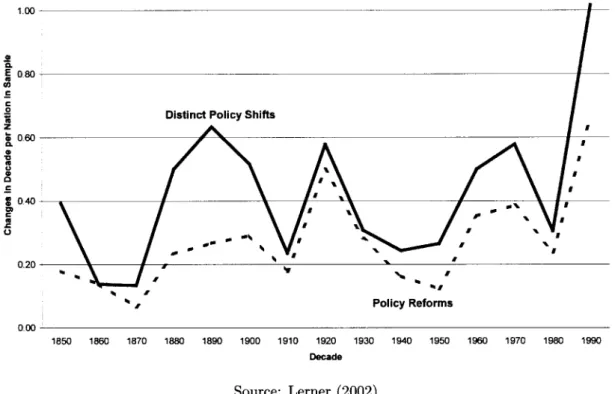
Figure 2 shows the number of events and policy changes during each decade,
normalized by the number of active countries at the beginning of the decade.
The author then measures how many patent applications residents of a country
where an event happened filled in Great Britain, in their own country and foreign
Figure 2: Number of changes in patent policy over time. The sample consists of the
sixty largest countries (by gross domestic product) at the end of 1997, observed from
1850 (or the date of inception as an independent entity) to 1999. The chart presents
the number of policy reforms, as well as that of distinct policy shifts, in each decade,
normalized by the number of active countries in the sample at the beginning of the
decade.
1.00
0.20
Policy Reforms
0.00-1850 1860 1870 1880 1890 1900 1910 1920 1930 1940 1950 1960 1970 1980 1990
Decade
Source: Lerner (2002)
counted, when it is possible to determine their number without other types of prizes.
Lerner (2002) found data on domestic and foreign applications in the country for
145 event windows and British application data for 171 windows. These windows
are periods from five years before to five years after policy change.
The author collected information about population of countries, per capita GDP
and occurrence of war during more than 3 months within the country affecting more
than 10% of its territory, or changes of more than 10% in population or área of the
country caused by changes in a country's borders.
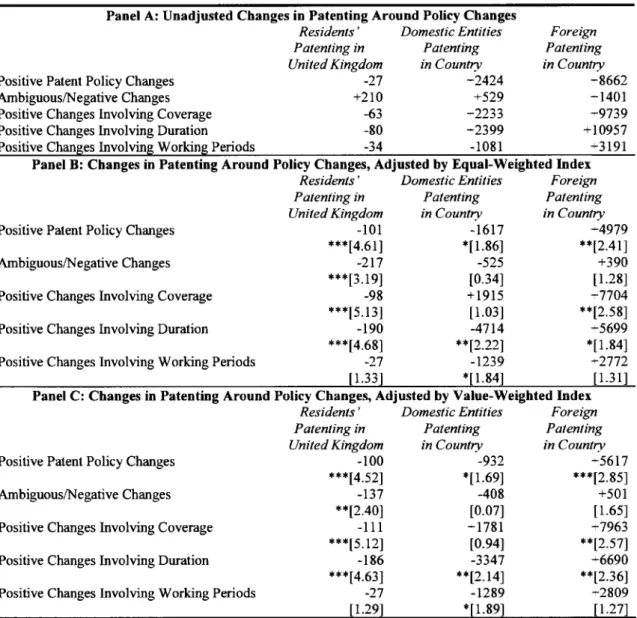
Panei A from table 1 shows changes in patent fillings from two years before to
two years after a policy change. Missing observations are replaced by data from one
or three years before or after to raise the number of observations.
Observations are divided into two groups according to the type of policy change.
Table 1: Impact of a change in patent policy on patenting activity. The sample
consists of 177 changes in patent policy between 1852 and 1998 in 60 nations. Panei
A displays the change in the number of unadjusted patent applications filed from
two years before the event to two years after the event by domestic entities residents
of the country undertaking the policy change in Great Britain and in the country
undertaking the change, and foreign entities filling in the country undertaking the
change. In Paneis B and C, these changes are shown net of equal-weighted and
value-weighted indexes of patenting in the ten nations with the longest time series
of application data. Underneath each adjusted change, the absolute t-statistic of
the difference of the change from zero is displayed. In ali tests, each observation is
weighted by the inverse of its standard deviation of the annual change in patenting
from 20 to five years before the policy change.
Panei A: Unadjusted Changes in Patenting Around Policy Changes
Residents' Domestic Entities Foreign
Patenting in Patenting Patenting
United Kingdom in Country in Country
Positive Patent Policy Changes -27 -2424 -8662
Ambiguous/Negative Changes +210 +529 -1401
Positive Changes Involving Coverage -63 -2233 ^-9739
Positive Changes Involving Duration -80 -2399 +10957
Positive Changes Involving Working Periods 234 -1081 +3191
Panei B: Changes in Patenting Around Policy Changes, Adjusted by Equal-Weighted Index
Residents' Domestic Entities Foreign
Patenting in Patenting Patenting
United Kingdom in Country in Country
Positive Patent Policy Changes -101 -1617 -4979
***[4.61] *[1.86] **[2.41]
Ambiguous/Negative Changes -217 -525 +390
[3.19] [0.34] [1.28]
Positive Changes Involving Coverage -98 +1915 -7704
***[5.13] [1.03] **[2.58]
Positive Changes Involving Duration -190 -4714 -5699
***[4.68] **[2.22] *[1.84]
Positive Changes Involving Working Periods -27 -1239 +2772
[1.33] *[1.84] [1.31]
Panei C: Changes in Patenting Around Policy Changes, Adjusted by Value-Weighted Index
Residents' Domestic Entities Foreign
Patenting in Patenting Patenting
United Kingdom in Country in Country
Positive Patent Policy Changes -100 -932 -5617
***[4.52] *[1.69] ***[2.85]
Ambiguous/Negative Changes -137 -408 +501
**[2.40] [0.07] [1.65]
Positive Changes Involving Coverage -111 -1781 +7963
***[5.12] [0.94] **[2.57]
Positive Changes Involving Duration -186 -3347 6690
***[4.63] **[2.14] **[2.36]
Positive Changes Involving Working Periods -27 -1289 -2809
fl .29] *[1.89] fl.27]
* - Significant at the 10% confidence levei; ** = significant at the 5% levei; *** = significant at the 1% levei.
Changes that increased patent protection (64%) constitute a group and changes
that are either ambiguous (12%) or diminished patent protection (24%) constitute
another group.
Domestic and foreign applications increased in countries that enhanced patent
protection, while British fillings did not. But these numbers are not controlled by
the propensity to patent in the period.
The same data is reported on paneis B and C adjusted by two indexes used to
capture trends. These indexes use data from the ten nations with the longest time
series of patent application data. First one assigns equal weight to every nation, and
second weights each observation by patent applications. The adjusted observations
are computed by
A+2-A_2-
(5-1)
A represents the number of fillings and / represents the levei of the index.
After adjustment, a change in policy that strengthened patents caused the decline
of patent applications by residents of the country where the change took place both
in the country itself and in Great Britain while foreign patent raised. Changes in fill
ings had much lower magnitude when policy changes were ambiguous or
protection-reducing.
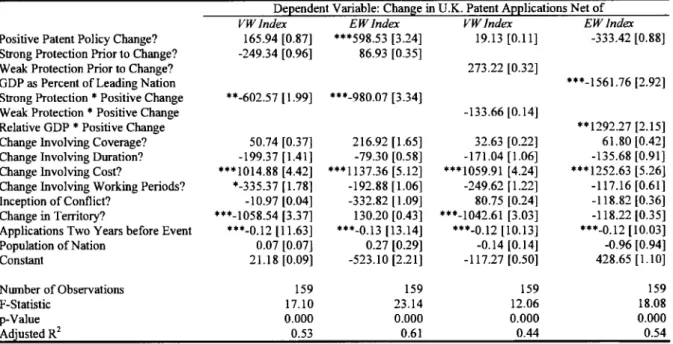
Table 1 also shows results for the three most frequent types of changes:
enhance-ments of patenfs coverage , length of patents and length of the working period.
These changes represent 56%, 50% and 21% respectively of the total of changes.
Lerner (2002) also reports the statistical significance of these changes following
a method used in finance literature. The author calculates standard deviations of
changes in patent applications from 20 years before to 5 years before the policy
change and then weighted t-tests and regression analyses by the inverse of standard
deviation. This method shows that the fali of patent fillings by residents in response
to an increase in patents protection is significant. The increase in patent applications
by foreigners is also significant which suggest that the set of changes is significant.
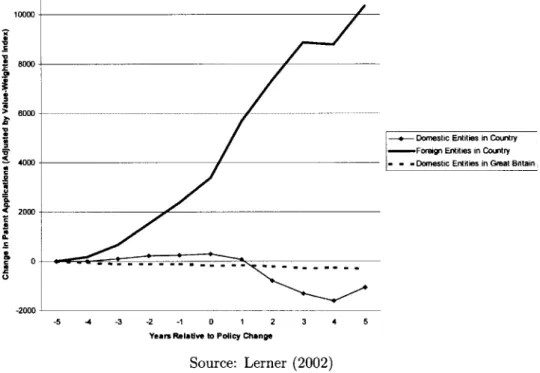
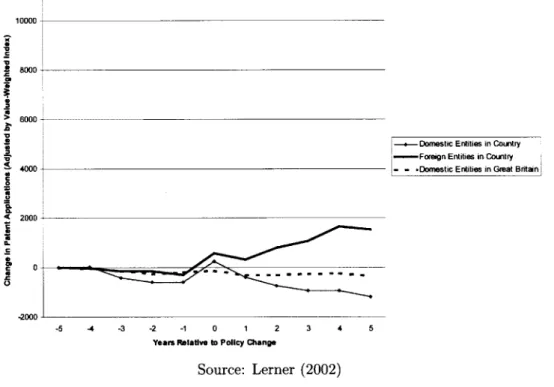
Figure 3 shows average change in patent fillings around changes that increase
patent protection and figure 4 shows average for other policy modifications. They
confirm what table 1 reports.