Acquisition System that Facilitates Resistance to
Calprotectin-mediated Zinc Sequestration
M. Indriati Hood1, Brittany L. Mortensen1, Jessica L. Moore2,3, Yaofang Zhang1, Thomas E. Kehl-Fie1, Norie Sugitani3,4, Walter J. Chazin3,4,5, Richard M. Caprioli2,5, Eric P. Skaar1*
1Department of Pathology, Microbiology and Immunology, Vanderbilt University, Nashville, Tennessee, United States of America,2Mass Spectrometry Research Center, Vanderbilt University, Nashville, Tennessee, United States of America,3Department of Chemistry, Vanderbilt University, Nashville, Tennessee, United States of America, 4Center for Structural Biology, Vanderbilt University, Nashville, Tennessee, United States of America,5Department of Biochemistry, Vanderbilt University, Nashville, Tennessee, United States of America
Abstract
Acinetobacter baumanniiis an important nosocomial pathogen that accounts for up to 20 percent of infections in intensive care units worldwide. Furthermore,A. baumannii strains have emerged that are resistant to all available antimicrobials. These facts highlight the dire need for new therapeutic strategies to combat this growing public health threat. Given the critical role for transition metals at the pathogen-host interface, interrogating the role for these metals inA. baumannii physiology and pathogenesis could elucidate novel therapeutic strategies. Toward this end, the role for calprotectin- (CP)-mediated chelation of manganese (Mn) and zinc (Zn) in defense againstA. baumanniiwas investigated. These experiments revealed that CP inhibitsA. baumanniigrowthin vitrothrough chelation of Mn and Zn. Consistent with thesein vitrodata, Imaging Mass Spectrometry revealed that CP accompanies neutrophil recruitment to the lung and accumulates at foci of infection in a murine model ofA. baumanniipneumonia. CP contributes to host survival and control of bacterial replication in the lung and limits dissemination to secondary sites. Using CP as a probe identified anA. baumannii Zn acquisition system that contributes to Zn uptake, enabling this organism to resist CP-mediated metal chelation, which enhances pathogenesis. Moreover, evidence is provided that Zn uptake across the outer membrane is an energy-dependent process inA. baumannii. Finally, it is shown that Zn limitation reverses carbapenem resistance in multidrug resistantA. baumannii underscoring the clinical relevance of these findings. Taken together, these data establish Zn acquisition systems as viable therapeutic targets to combat multidrug resistantA. baumanniiinfections.
Citation:Hood MI, Mortensen BL, Moore JL, Zhang Y, Kehl-Fie TE, et al. (2012) Identification of anAcinetobacter baumanniiZinc Acquisition System that Facilitates Resistance to Calprotectin-mediated Zinc Sequestration. PLoS Pathog 8(12): e1003068. doi:10.1371/journal.ppat.1003068
Editor:Ralph R. Isberg, Tufts University School of Medicine, United States of America
ReceivedJuly 8, 2012;AcceptedOctober 18, 2012;PublishedDecember 6, 2012
Copyright:ß2012 Hood et al. This is an open-access article distributed under the terms of the Creative Commons Attribution License, which permits unrestricted use, distribution, and reproduction in any medium, provided the original author and source are credited.
Funding:This work was supported by R56AI091771 from the National Institutes of Health to E.P.S. E.P.S. is a Burroughs Wellcome Fund Investigator in the pathogenesis of infectious diseases. M.I.H. was supported by an International Student Research Fellowship through Howard Hughes Medical Institute and by Public Health Service award T32 GM07347 from the National Institute of General Medical Studies for the Vanderbilt Medical-Scientist Training Program. T.E.K. was supported by a post-doctoral fellowship from the American Heart Association. J.L.M was supported by Vanderbilt Chemical Biology Interface training program (T32GM008320). R.M.C. acknowledges the support of NIH/NIGMS 8P41GMI03391-2 (formerly NIH/NCRR 1P41RR031461-01). The funders had no role in study design, data collection and analysis, decision to publish, or preparation of the manuscript.
Competing Interests:The authors have declared that no competing interests exist. * E-mail: [email protected]
Introduction
Acinetobacter baumanniiis an opportunistic pathogen of growing importance in the hospital setting. Responsible for up to 20 percent of infections in intensive care units worldwide,A. baumannii
is particularly problematic due to its propensity to acquire antibiotic resistance determinants [1–6]. Moreover, the resistance ofA. baumanniito common disinfectants and ability to survive for long periods on dry surfaces make it difficult to eradicate from the hospital environment [7–10]. Current multidrug resistance rates range from 48–85% of isolates, with the greatest burden in Asia and Eastern Europe [1–5]. Pan resistance is likewise emerging, suggesting that more clinicians will soon be faced with infections for which no effective antimicrobial therapies remain [11–15]. Clearly, it is imperative to develop new antimicrobial strategies to combat this emerging threat.
defense in the lung have not been described. In the case of A. baumannii, mechanisms for iron acquisition through siderophore biosynthesis and transport machinery have been identified [25– 30]; however the mechanisms for acquiring other metals, such as Mn and Zn, remain to be uncovered.
Calprotectin (calgranulin A/B, MRP 8/14) (CP) is a member of the S100 class of EF-hand proteins consisting of a heterodimer of S100A8 and S100A9. CP is an important inflammatory marker and exhibits antimicrobial activity through the chelation of Mn and Zn [21,31–33]. As a result, CP has been implicated in defense against a variety of bacterial and fungal pathogens [20–24]. CP comprises up to 50% of the neutrophil cytoplasmic protein content; therefore CP accumulates at sites of infection [34]. Neutrophils are a critical component of the innate response toA. baumanniiinfection suggesting that CP may play a role in defense againstA. baumannii in vivo [35,36]. Herein, we demonstrate that CP is abundantly expressed in the murine lung following infectious challenge and that this protein is involved in protection againstA.
baumanniipneumonia and dissemination to other organs. Using CP as a probe uncovered a number of genes required for resistance to Mn and Zn limitation and enabled the discovery of a Zn acquisition system inA. baumannii.This system is expressed in low Zn environments, required for Zn acquisition, and important for colonization of the lung. Finally, we show that an inability to acquire Zn reduces Zn-dependent antibiotic resistance mecha-nisms, increasing the sensitivity ofA. baumanniito clinically relevant antimicrobials.
Results
CP contributes to defense againstA. baumanniiinfection As a first step toward evaluating the role for CP during A. baumanniiinfection, growth inhibition assays were performed with increasing concentrations of CP in growth media as described in the Materials and Methods (Figure 1a). In these conditions, CP inhibitsA. baumanniigrowth with an IC50of approximately 60mg/ ml. Importantly, the inhibitory effect of CP is completely reversed by the addition of excess Mn and Zn. Moreover, a variant of CP in which the Mn and Zn binding sites are mutated is unable to inhibit
A. baumannii growth (Figure S1) [22]. Finally, CP exposure reduces intracellular accumulation of Mn and Zn, but not Fe, consistent with a role for CP in sequestering Mn and Zn away from A. baumannii (Figure 1b). Taken together, these results establish that CP inhibitsA. baumanniigrowth through chelation of Mn and Zn.
In order to define the contribution of CP to defense againstA. baumanniipneumonia, we first determined whether CP is present in lungs of mice infected with A. baumannii. CP expression was measured using matrix-assisted laser desorption/ionization Imag-ing Mass Spectrometry (MALDI IMS).In situvisualization of CP by MALDI IMS has been previously characterized by our laboratory where CP is identified by the signal at m/z 10,165 corresponding to S100A8 [20,37]. These experiments revealed that CP is not detectable by MALDI IMS in the lungs of uninfected wildtype C57BL/6 mice. In contrast, a robust signal for
m/z10,165 is observed in the lungs of wildtype mice infected with
A. baumannii, demonstrating that CP is abundantly expressed in the lungs at 36 hours post infection (hpi) (Figure 2a). S100A92/2 mice, which are functionally CP-deficient, do not exhibit a signal at m/z 10,165, establishing the specificity of these analyses (Figure 2a) [38]. To confirm that the failure to detect calprotectin
Author Summary
Acinetobacter baumanniiis a bacterium responsible for an increasing number of infections in the hospital setting. These infections are particularly challenging because most strains of A. baumannii are resistant to commonly used antibiotics. Unfortunately, there is relatively little known about this organism and how it causes disease, making it difficult to identify new drug targets. In order to address this problem we examined the role for nutrient manga-nese (Mn) and zinc (Zn) in A. baumannii infections. We have determined that the host protein, calprotectin (CP), contributes to defense against A. baumannii pneumonia through chelation of nutrient Mn and Zn. Moreover, employing purified calprotectin as a probe allowed us to identify a Zn acquisition system in A. baumannii that is required for efficient Zn uptakein vitroand full
pathogen-esis in vivo. Finally, we demonstrate that inhibiting Zn
acquisition can reverse antibiotic resistance mechanisms that rely on Zn-dependent enzymes. Taken together, these results demonstrate the importance of Zn acquisition toA.
baumannii pathogenesis and antibiotic resistance,
estab-lishing Zn acquisition as a potential target for therapeutic development.
Figure 1. CP inhibitsA. baumanniigrowthin vitrothrough chelation of Mn and Zn.(A)A. baumanniigrowth in the presence of increasing concentrations of CP with (dashed lines) or without (solid lines) 25mM Mn and 25mM Zn added back. Data represent the average of three biological replicates. (B) Treatment with CP reduces intracellular Mn and Zn accumulation. ICP-MS analyses of intracellular Mn, Fe and Zn expressed as the relative ratio compared to intracellular Cu. **p,0.01, ***p,0.001 by two-way ANOVA.
in S100A92/2 mice is not due to insufficient tissue or a generalized diminished protein signal in these sections we analyzed the signal at m/z 5,679 whose abundance is not affected by infection (Figure 2b) [39]. This signal did not differ between wildtype and S100A92/2 mice demonstrating the biological relevance of the differential signal at m/z 10,165. Histological analyses of lung sections demonstrated robust inflammatory cell recruitment to the infected lungs in both wildtype and S100A92/2 mice (Figure 2c–f). However, in S100A92/2lungs, the infectious and inflammatory foci involve more of the total lung area and more alveoli are packed with neutrophils as compared to wildtype mice. Taken together, these data demonstrate that CP accumu-lation in the lungs of wildtype mice coincides with neutrophil accumulation at sites of infection.
To determine the contribution of CP to protection against bacterial pneumonia, the susceptibility of S100A92/2mice toA. baumannii infection was compared to that of wildtype C57BL/6 mice. Although A. baumannii rarely causes lethal infection in immunocompetent mice, S100A92/2 mice exhibit a significant increase in mortality over a 72-hour time course (Figure 2g). Consistent with this observation, bacterial burdens are significantly higher at 36 hpi in the lungs of S100A92/2 mice compared to wildtype (Figure 2h). Moreover, dissemination to secondary sites is also increased in CP-deficient mice as evidenced by an increase in bacterial burden in livers. A significant increase in bacterial burden was not observed at 72 hpi in S100A92/2mice suggesting that mice that survive to 72 hours are eventually able to control infection (Figure S2). These data implicate CP as an important component of the innate immune response to A. baumannii
pulmonary infections.
Identification of A. baumanniimutants with altered sensitivity to CP
The contribution of CP to defense againstA. baumanniiinfection suggests that A. baumannii requires Mn and/or Zn in order to maximally colonize the murine lung. Moreover, CP can serve as a valuable reagent to interrogate the contribution of Mn and Zn acquisition toA. baumanniiphysiology and pathogenesis. In order to determine the impact of Mn and Zn limitation onA. baumannii
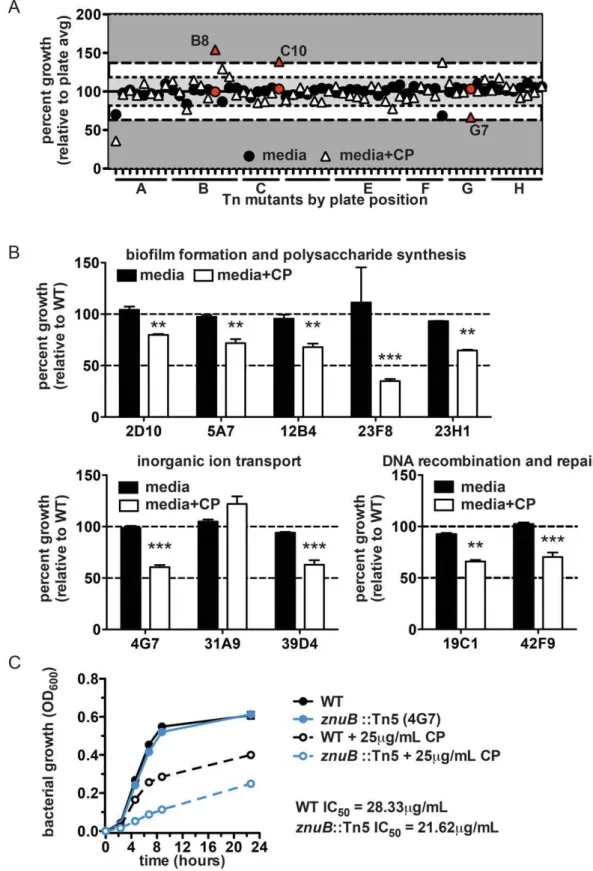
physiological processes, a transposon library was screened to identify mutants with either increased or decreased resistance to CP (Figure 3a). Approximately 4000 mutants were screened and 40 were selected whose growth was significantly different from wildtype in the presence of CP, but unchanged compared to wildtype in the absence of CP. Interestingly, a majority of the mutants cluster into a few common functional categories based on the annotations of the proteins encoded by the disrupted genes (Figure 3b and Table 1). These categories include biofilm formation and polysaccharide production, inorganic ion transport, and DNA replication or repair suggesting that these processes are involved in defense against CP.
Identification of a Zn uptake system inA. baumannii
In one mutant, 4G7, the transposon disrupts A1S_0143, which is annotated as encoding the permease component of a previously
unstudied ABC family Zn transporter. Consistent with a role for A1S_0143 in Zn transport, disruption of this gene by transposon integration leads to increased sensitivity to CP (Figure 3c). A1S_0143 encodes a protein with similarity to ZnuB, a permease involved in Zn uptake that is found in several other bacteria [40– 43]. ZnuB is typically part of an ABC-family transporter where ZnuC is the cognate ATPase and ZnuA is the periplasmic substrate-binding protein [40–43]. A1S_0144 and A1S_0146 encode an ATPase and a periplasmic binding protein similar to ZnuC and ZnuA, respectively (Figure 4a). Based on these observations and data presented below, we designate A1S_0143 as
A. baumannii znuB.Notably, the znuABC genes are present in all available sequenced A. baumanniigenomes (data not shown). To eliminate the potential for polar effects on neighboring genes caused by transposon integration, we generated a targeted deletion mutant in whichznuB was replaced by an in-frame copy of the kanamycin resistance gene, aph(DznuB).DznuB was used for all subsequent experiments.
Since CP chelates both Mn and Zn, we first determined whetherDznuBis more sensitive to Mn or Zn chelation by CP. CP growth inhibition assays were repeated withDznuBin CP growth medium. CP growth medium was chosen over the transposon screening medium since this medium allows for better titration of the Zn and Mn concentrations allowing for differentiation between the effects of Zn- and Mn-chelation on DznuB. Wildtype and
DznuBexhibited similar growth levels and were not inhibited by CP when either Zn alone or Zn and Mn are added back to CP growth media (Figure 4b and Figure S3). In contrast, when only Mn was added back to CP growth media, CP significantly inhibited the growth of DznuB. The observation that growth of
DznuB cannot be rescued by supplementation with Mn alone confirms that this mutant is sensitive to Zn limitation by CP. It was noted that even in the absence of CP, both wildtype andDznuB
exhibited reduced growth in media alone compared to media supplemented with Mn and Zn (Figure S4). This suggests that the basal Mn and Zn levels in the media are insufficient to support growth of wildtype above that of DznuB, regardless of CP exposure. Consistent with this hypothesis, DznuB exhibited impaired growth compared to wildtype in rich media (LB) in the presence of the Zn-selective chelator, TPEN (Figure 4c). Moreover, the growth defect of the mutant was completely rescued by the addition of excess Zn, further supporting the role for ZnuB in Zn acquisition (Figure 4c). Finally, providing a full-length copy ofznuB in transrescues the TPEN sensitivity ofDznuB, allowing growth at nearly wildtype levels (Figure 4d).
Regulation ofznuBin Zn-limiting conditions
The expression of bacterial high affinity transition metal transporters must be tightly regulated since transition metals can be toxic at high levels. Repression of metal uptake systems under nutrient replete conditions is frequently accomplished through metal-responsive transcriptional regulators like those in the Fur (ferric uptake regulator) family of transcriptional regulators. These regulators bind to target DNA sequences when bound to their cognate metal ligand to repress transcription. To determine m/z5,67965 Da in uninfected wildtype (left) and infected wildtype (middle) or S100A92/2 (right) mice. (C–F) Hematoxylin and eosin stained histological sections taken from lungs harvested at 36 hpi from mice infected withA. baumannii. (C, E) Wildtype C57BL/6. (D, F) S100A92/2. Scale bars equal 500mm (C–D) and 50mm (E–F). Images are representative of sections taken from three mice for each genotype. (G) Survival of wildtype or CP-deficient mice following infection withA. baumannii. Data were combined from three independent experiments with 8–16 mice per group in each experiment. **p,0.01 as determined by Gehan-Breslow-Wilcoxon Test. (H) Bacterial burden in lungs and livers of wildtype or CP-deficient mice 36 hpi withA. baumannii. Data were averaged from three independent experiments with 5–10 mice per group in each experiment. **p,0.01 as determined by Student’sttest.
Figure 3. Transposon library screen to identify bacterial processes affected by CP treatment.(A) Bacterial growth from a representative plate of mutants cultured in media alone or media with 40mg/ml CP. Data for wells in which no bacterial growth was observed in either condition have been omitted. Red symbols indicate mutants selected for secondary screening (see Materials and Methods). (B) Growth of selected mutants relative to wildtype bacteria cultured in media alone or media containing 40mg/ml CP. Mutants are classified according to the predicted functional category of the gene disrupted by the transposon. **p,0.01, ***p,0.001 for relative growth in the presence of CP compared to media alone, as determined by two-way ANOVA. (C) Growth curves comparing wildtypeA. baumanniiandznuB::Tn5 in the presence or absence of 25mg/ml CP. IC50 values were determined as described in the Materials and Methods.
whether znuB is under similar transcriptional control in A. baumannii, we first cloned the promoter for the znu operon upstream of a gene encoding GFP. Both wildtype andDznuBwere then transformed with the plasmid carrying the znu reporter (pznuGFP) and grown in LB with or without the addition of TPEN or Zn. Wildtype bacteria exhibited increased fluorescence upon increasing concentrations of TPEN (Figure 4e). Similarly,DznuB
demonstrated increasing fluorescence with increasing Zn chela-tion, although the basal level of GFP expression at all TPEN concentrations was higher in DznuB as compared to wildtype. Moreover,DznuB exhibited a greater increase in fluorescence at high concentrations of TPEN. Importantly, with the addition of excess Zn, the fluorescence observed forDznuBcould be restored to levels equivalent to the basal levels observed in wildtype bacteria (Figure 4f). These results establish that the znu operon is up-regulated in Zn-limiting conditions and thatDznuBexperiences Zn starvation at higher Zn concentrations than wildtype.
A potential mechanistic explanation for the Zn-regulated nature of znu was provided by the discovery of a putative Zur (Zinc uptake regulator) orthologue neighboring these genes (Figure 5a).
Based on data described below, we refer to this gene as theA. baumannii zur.Zur is a member of the Fur family of transcriptional regulators and in other bacteria Zur mediates Zn-dependent repression of a number of genes including Zn uptake systems [40,41,44–48]. To determine if theA. baumanniiZur binds Zn, we performed a 4-(2-pyridylazo)-resorcinol (PAR) assay to measure Zur-mediated Zn binding. This assay is based on the principle that PAR exhibits a peak absorbance at approximately 410 nm in its free form, while this peak shifts to 495 nm upon Zn binding. Addition of a Zn binding protein to PAR-Zn leads to a reduction in the peak at 495 nm and an increase in the peak at 410 nm. When increasing concentrations of purified Zur were added to PAR-Zn, the Zn-bound peak at 495 nm decreased while the peak at 410 nm increased, establishing thatA. baumanniiZur binds to Zn
in vitro(Figure 5b).
Zur is a Zn-dependent repressor that binds to a 19 bp consensus sequence in the presence of Zn to repress transcription of a number of genes including those involved in Zn uptake [45–49]. The intragenic region betweenznuAand zurwas searched for a possible Zur-binding site using the consensus sequence fromc
-Table 1.Transposon mutants with altered sensitivity to CP.
Mutant ID Locus tag Description Phenotype Insert type
PDL05G12 A1S_2148 flavin reductase-like protein; putative acetyl-CoA synthetase/AMP-(fatty) acid ligase
resistant intergenic
PDL31A10 A1S_0352 hypothetical protein resistant intergenic
PDL02D10 A1S_2505; A1S_2506 hypothetical protein (110 bp 59); putative GGDEF family protein (290 bp 39)
sensitive intergenic
PDL23H1 A1S_2841; A1S_2842 putative type 4 fimbrial biogenesis protein FimT (not present in the SEED); Acetyl-CoA C-acyltransferase
sensitive intergenic
PDL15F1 A1S_3277 putative pirin-like protein sensitive intergenic
PDL03F9 A1S_0367 glutathione-regulated potassium-efflux system protein (K(+)/H(+) antiporter) (KefB)
resistant intragenic
PDL03H9 A1S_0367 glutathione-regulated potassium-efflux system protein (K(+)/H(+) antiporter)
resistant intragenic
PDL03H10 A1S_0367 glutathione-regulated potassium-efflux system protein (K(+)/H(+) antiporter)
resistant intragenic
PDL05D12 A1S_0196 Long-chain-fatty-acid-CoA ligase resistant intragenic
PDL06C3 A1S_3463 Cro-like protein (pAb1) resistant intragenic
PDL26D12 A1S_2040 putative phage integrase resistant intragenic
PDL31A11 A1S_1053 hypothetical protein resistant intragenic
PDL31A9 A1S_0118 hypothetical protein resistant intragenic
PDL11C6 A1S_3142 putative membrane protein resistant intragenic
PDL04G7 A1S_0143 high affinity Zn transport protein sensitive intragenic
PDL06H4 A1S_2477 isocitrate dehydrogenase sensitive intragenic
PDL09F4 A1S_0076 aconitate hydratase sensitive intragenic
PDL05A7 A1S_0430 Putative glycosyltransferase sensitive intragenic PDL19C1 A1S_2588 Holliday junction DNA helicase RuvB sensitive intragenic
PDL22A12 A1S_0023 putative malic acid transport protein sensitive intragenic
PDL23E2 A1S_3472 DNA replication protein (pAB2) sensitive intragenic
PDL23F8 A1S_0060 hypothetical protein sensitive intragenic
PDL12B4 A1S_0749 BfmS sensitive intragenic
PDL42C3 A1S_3352; A1S_3353 putative OHCU decarboxylase; putative transthyretin-like protein precursor
sensitive intragenic
PDL42F9 A1S_0696 putative MutT/nudix family protein sensitive intragenic
PDL39D4 A1S_0118 hypothetical protein sensitive intragenic
Proteobacteria [48]. This search yielded a possible Zur-binding sequence within 100 bp of the znuA translational start site (Figure 5a). Since a second candidate Zur binding site was not identified in the region between znuA and zur, it is likely that binding at this sequence leads to repression of both znuA and
zurznuCB. To determine if Zur binds to this putative Zur box in a Zn-dependent manner, electrophoretic mobility shift assays were performed using purified Zur and oligonucleotides corresponding to the sequences shown inFigure 5a. When Zur is mixed with target DNA in the presence of excess Zn, the target DNA exhibits a shift in molecular weight consistent with Zur binding (Figure 5c). This shift is not observed when DNA corresponding to an intragenic region of znuAis used (Figure 5d). Moreover, addition of EDTA eliminated Zur binding to the target DNA,
demonstrating that DNA binding is Zn-dependent (Figure 5e). Taken together, these data demonstrate that Zur is a Zn-binding protein that binds to the promoter ofznuAandzurznuCBin a Zn-dependent manner.
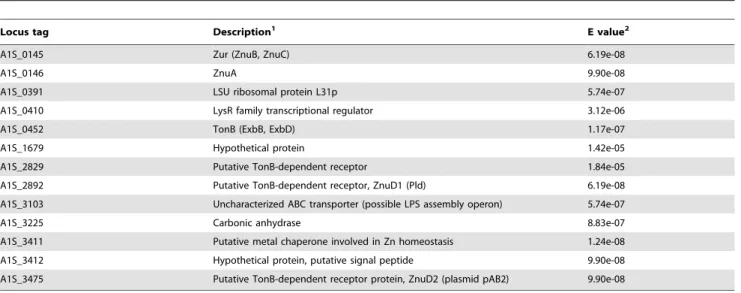
Using the putative A. baumannii zur box sequence, we next conducted a BLAST search against theA. baumanniigenome in order to identify additional candidate Zur-regulated genes (Figure 5f and Table 2). These putative Zur-regulated genes were further validated by searching for sequence motifs within their 59flanking sequences. The latter analysis, which employed the MEME analysis tool, independently identified the Zur box in a majority of the genes analyzed. Based on these results a list of putative Zur-regulated genes was constructed (Table 2). A number of the predicted Zur-regulated genes inA. baumanniiare Figure 4. Contribution ofznuBto growth in Zn-limiting conditions. (A) Schematic representation of the genomic context adjacent to A1S_0143. (B) CP growth inhibition assays comparing wildtype withDznuB. Bacteria were cultured in CP growth media in the presence of increasing concentrations of CP with or without addition of 25mM Zn, 25mM Mn or both 25mM Zn and 25mM Mn. Data for 100mg/ml CP are presented as the percent growth relative to bacterial growth without CP. Data are the average of three independent experiments with at least three biological replicates each. (C) Comparison of the effect of 25mM TPEN on inhibition of wildtype andDznuBwith or without addition of excess (50mM) Zn. (D) Complementation of the sensitivity ofDznuBto 20mM TPEN by providing a wildtype copy ofznuB in trans. Data are representative of three independent experiments with at least three biological replicates in each. *p,0.05, **p,0.01, ***p,0.001 as determined by one-way ANOVA. (E–F) Assessment ofznupromoter activity in the presence of increasing concentrations of TPEN (E) or Zn (F) using a GFP reporter. GFP activity is expressed as relative fluorescence where the intensity of the signal is normalized to the optical density of the culture.
regulated by Zur in other bacteria. These include the ribosomal L31 protein, a carbonic anhydrase and the Znu system [44,47,48,50] (Figure 5g). While the functional significance of Zur regulation has been elucidated for some of these genes, in many cases the function of the encoded proteins and their roles in Zn homeostasis have not been defined. Interestingly,A. baumannii
Ab17978 encodes two predicted TonB-dependent receptors with highly conserved Zur-binding sequences located within their predicted promoters. One of these genes, A1S_2892 is encoded within the chromosome, while A1S_3475 is encoded within one of this strain’s native plasmids. Respectively, these transporters are 41–42 percent identical and 58–61 percent similar, to ZnuD, a Zur-regulated receptor involved in Zn and heme transport inN. meningitidis[51]. Based on this sequence conservation and putative Zur-regulation, we have designated these genes as A. baumannii znuD1 (A1S_2892) and znuD2 (A1S_3475). A third TonB-dependent receptor was also identified; however, the predicted protein does not share significant sequence conservation with ZnuD.
To determine whether these candidate Zur-regulated genes are expressed under Zn-limiting conditions,A. baumanniiwas grown in LB or LB supplemented with the Zn-chelator, TPEN, at a concentration of 10mM. This concentration was selected because at this concentration of TPENDznuBbegins to exhibit decreased growth compared to wildtype. This suggests that the Znu system is required for optimal growth at 10mM TPEN and is therefore likely to be induced under these conditions in wildtype bacteria. Consistent with this hypothesis, transcripts for znuA, znuB, znuC, znuD1and znuD2 were all increased in TPEN-containing media
compared to media without TPEN (Figure 5h). Up-regulation of
znuABC,znuD1, andznuD2under Zn-limiting conditions supports the hypothesis that these genes are involved in Zn acquisition.
The outer membrane of Gram-negative bacteria represents a significant permeability barrier for ions and small molecules. In many bacteria, transport of transition metal ions across the outer membrane is thought to occur by diffusion through non-selective porins. However, the expression of two TonB-dependent receptors inA. baumanniiunder Zn-limiting conditions suggests that transport of Zn across the outer membrane of this organism may be an energy-dependent process similar to the case in N. meningitidis
[51,52]. Transport through TonB-dependent receptors requires the TonB-ExbB-ExbD system, which harnesses energy from the proton motive force generated at the inner membrane to facilitate transport across the outer membrane. Interestingly,A. baumannii
encodes two predicted TonB-ExbB-ExbD systems. One of these systems appears to be under transcriptional control by Zur, based on the presence of a Zur-binding consensus sequence within the
tonBpromoter (Figure 5g). We have designated the putative Zur-regulated system TonB1-ExbB1-ExbD1, based on its location within the chromosome relative to the position of the predicted Fur-regulated system. Although TonB1-ExbB1-ExbD1 was previ-ously shown to be up-regulated in the presence of the iron chelator 2,2-dipyridyl, we sought to determine whether Zn-limiting conditions induce expression of the tonB1exbB1exbD1 operon [53]. In the presence of 10mM TPEN, the tonB gene is up-regulated 4- to 5-fold supporting a model whereby translocation of Zn across the outer membrane is an energy-dependent process in
A. baumannii(Figure 5h).
Figure 5. Genetic characterization of a putative Zn uptake system inA. baumannii.(A) Schematic representation of the genomic locus containingznuAand thezurznuCBoperon. The sequence corresponding to a putative zur box is shown. (B) PAR assay measuring Zn binding by Zur. Spectral scans of solutions containing 10mM PAR without Zn (black line), with Zn (blue line) or with Zn and increasing concentrations of Zur (green lines) are shown. (C–D) EMSA assays measuring binding of Zur to Zur target DNA (C) or negative control DNA (D) in the presence of Zn. (E) EMSA assay demonstrating loss of Zur binding to target DNA in the presence of increasing concentrations of EDTA. Arrow indicates mobility of shifted band. (F) Consensus sequence for theA. baumanniiZur box. (G) Predicted Zur-regulated genes and their predicted Zur boxes. (H) Expression analyses of genes predicted to be involved in Zn uptake across the outer (znuD1,znuD2,TonB1) and inner (znuA,znuB,znuC) membranes. Asterisks indicate relative expression that is statistically greater than one, where 1-fold indicates no change in expression in TPEN treated bacteria compared to untreated bacteria. *p,0.05, **p,0.01 as determined by one samplettest using a reference value of one.
doi:10.1371/journal.ppat.1003068.g005
Table 2.Locus tags and descriptions of predicted Zur-regulated genes.
Locus tag Description1 E value2
A1S_0145 Zur (ZnuB, ZnuC) 6.19e-08
A1S_0146 ZnuA 9.90e-08
A1S_0391 LSU ribosomal protein L31p 5.74e-07
A1S_0410 LysR family transcriptional regulator 3.12e-06
A1S_0452 TonB (ExbB, ExbD) 1.17e-07
A1S_1679 Hypothetical protein 1.42e-05
A1S_2829 Putative TonB-dependent receptor 1.84e-05
A1S_2892 Putative TonB-dependent receptor, ZnuD1 (Pld) 6.19e-08
A1S_3103 Uncharacterized ABC transporter (possible LPS assembly operon) 5.74e-07
A1S_3225 Carbonic anhydrase 8.83e-07
A1S_3411 Putative metal chaperone involved in Zn homeostasis 1.24e-08
A1S_3412 Hypothetical protein, putative signal peptide 9.90e-08
A1S_3475 Putative TonB-dependent receptor protein, ZnuD2 (plasmid pAB2) 9.90e-08
1Description of the predicted protein encoded at the indicated locus. If additional genes are predicted to be part of the same transcriptional unit, their encoded proteins are indicated in parentheses.
ZnuB contributes to the pathogenesis ofA. baumannii
pulmonary infections
To define the contribution of the Znu system to pulmonary infections, we first examined znu promoter activity in both wildtype and S100A92/2 mice infected with WT::pznuGFP. In both wildtype and S100A92/2mice we observed strong promoter activity as evidenced by GFP signal within lungs harvested at 36 hpi (Figure 6a–f and Figure S5). Although in both wildtype and S100A92/2mice we detected strong GFP signal, the overall increased bacterial burden in S100A92/2mice led to greater total signal in these sections. These data demonstrate that theznugenes are expressedin vivoand thatA. baumanniiis Zn starved in the lung. Furthermore, these data imply that even in the absence of CP, the host sequesters Zn away fromA. baumanniisuggesting the presence of additional mechanisms for Zn withholding in the vertebrate lung.
To determine the direct contribution of ZnuB toA. baumannii
pathogenesis, wildtype and S100A92/2 mice were co-infected with an equal mixture of wildtype and DznuB and bacterial burdens were quantified at 36 hpi in lungs and livers. WildtypeA. baumanniisignificantly outcompetesDznuBfor colonization of the lungs of both wildtype and CP-deficient mice (Figure 6g). Notably,DznuB was only detected in the livers of two mice (10 percent) following intranasal infection (Figure 6h and Figure S6). Moreover, dissemination of DznuB to the liver is partially rescued in S100A92/2 mice. A similar competition infection comparing wildtype A. baumannii to a strain containing a
kanamycin resistant cassette in an unrelated gene did not reveal a similar defect, demonstrating that the presence of the kanamycin marker alone is not responsible for the observed phenotype (data not shown). These data suggest that CP-mediated Zn-chelation is critical to limit bacterial dissemination from the primary site of lung infection. Taken together, the results of thein vivo studies demonstrate that Zn acquisition through ZnuB contributes toA. baumannii pathogenesis. Notably, no significant difference was observed when comparing wildtype andDznuBin mono-infections (Figure S6B–C).
Zn chelation reverses carbapenem resistance in MDRA. baumannii
One of the few remaining antibiotic classes available for the treatment ofA. baumanniiinfections is the carbapenems. However, carbapenem resistance is becoming increasingly common primar-ily through dissemination of genes encoding carbapenem hydro-lyzing enzymes or carbapenemases [54,55]. Interestingly, many of these carbapenemases are metalloenzymes that require Zn for their hydrolyzing activity [56,57]. This raises the possibility that Zn limitation may serve as a valuable adjunct to carbapenem therapy by decreasing carbapenemase activity. To test this hypothesis, we determined the imipenem MIC against the carbapenem resistant clinical isolate, AB0057, in the presence or absence of 25mM TPEN. Treatment with TPEN reduces the imipenem MIC to below the clinical breakpoint for imipenem resistance inA. baumanniiand this effect is reversed by addition of
Figure 6. Contribution of the Znu system to pathogenesisin vivo.(A–F)In vivoGFP expression driven by theznupromoter. Frozen sections of lungs harvested at 36 hpi from wildtype (A–C) or S100A92/2(D–F) mice infected with WT::pznuGFP and stained with DAPI. Arrowheads in the merged images indicate bacteria expressing GFP. (G–H) Competition infection between wildtype andDznuB. Bacterial burden in lungs (G) and livers (H) of mice co-infected with wildtypeA. baumanniiandDznuB. Red symbols indicate CFU below the limit of detection. *p,0.05, **p,0.01, *** p,0.001 as determined by one-way ANOVA.
excess Zn (Figure 7a). As a control, these experiments were performed with the fluoroquinolone antibiotic, levofloxacin. In AB0057, levofloxacin resistance is mediated by mutations within
gyrA(DNA topoisomerase IIA) andparC(DNA topoisomerase IV) and therefore should not be reversed by Zn chelation [58]. The levofloxacin MIC was either unchanged or slightly increased by Zn limitation and remained above the breakpoint for clinically defined resistance (Figure 7b). These results highlight Zn limitation as a possible mechanism to combat carbapenem resistance inA. baumannii.
Discussion
Transition metals occupy an essential niche within biological systems. The essentiality of transition metals to invading bacterial pathogens has been exploited by vertebrate hosts as an innate defense strategy. Most work in the area of nutritional immunity has focused on iron sequestration as a mechanism of host defense; however, it is now appreciated that nutritional immunity includes strategies to withhold other essential metals such as Mn and Zn [17,59]. We have demonstrated that Mn and Zn chelation by CP inhibitsA. baumanniigrowthin vitro.We have also determined that CP is abundant in the lungs ofA. baumannii-infected mice where it contributes to defense againstA. baumannii pulmonary infections. Moreover, we have used CP to elucidate physiological processes that are disrupted by Mn and Zn chelation by screening a transposon library for mutants with increased or decreased susceptibility to CP. Using this screen we identified a Zn acquisition system in A. baumanniiand defined its Zn-dependent regulation and its roles in Zn uptake and pathogenesis.
As summarized above, utilizing CP as a probe has uncovered the ZnuABC Zn uptake system inA. baumannii. A targeted deletion ofznuBis more sensitive to CP and other Zn chelators, particularly in the presence of excess Mn. Notably, the phenotype of theznuB
mutant can be rescued by addition of excess Zn, suggesting thatA. baumannii possesses an additional mechanism to transport Zn across the inner membrane. Although we did not identify additional inorganic ion transporters in the analysis of the putative Zur regulon, it is possible that Zn is transported through a low affinity or non-specific transporter. Based on the observation that excess Mn potentiates the effects of Zn chelation onDznuB, it is also possible that Zn acquisition in this mutant depends on an
inner membrane Mn transporter. In this case, the presence of excess Mn would occupy Mn transport systems, further reducing Zn acquisition byDznuB.
Elucidation of the A. baumannii Zur regulon identified genes encoding two putative ZnuD orthologues and a TonB system. These genes were all up-regulated in Zn-limiting conditions. Although it was previously thought that transition metal ions such as Zn2+and Mn2+freely diffuse through non-selective porins, the
identification of ZnuD in Neisseria spp. suggests that in some bacteria, transport of Zn across the outer membrane may be an energy-dependent process [51].A. baumanniistrain 17978 has two putative ZnuD orthologues, one encoded on the chromosome and a second on a plasmid. Moreover,A. baumanniiencodes a TonB/ ExbB/ExbD system that is up-regulated in low Zn conditions suggesting that this energy-generating system may be dedicated to Zn import. An energy generating system that is activated upon Zn starvation provides compelling evidence for an energy-dependent mechanism of Zn transport across the outer membrane. However, it is not yet known whether ZnuD transports free or chelated Zn. ZnuD fromN. meningitidis contributes to heme acquisition when expressed inE. coli[52]. This finding suggests that ZnuD is either a heme transporter that is up-regulated in low Zn conditions, or that ZnuD transports more than one substrate. If the latter is true, ZnuD may transport Zn in a chelated form analogous to the siderophore systems used to transport iron. It remains to be determined whether either of the ZnuD transporters in A. baumanniidirectly transports Zn or heme.
In addition to the role for ZnuB in Zn acquisition and resistance to CPin vitro,this protein also contributes to pathogenesisin vivo.
Specifically, co-infection with wildtype demonstrates thatDznuBis less able to compete with wildtypein vivo. Notably, in the lung,
DznuBexhibits reduced competitive fitness in both wildtype and CP-deficient mice, suggesting that other factors in addition to CP may contribute to Zn limitation within the lung. In contrast, the ability ofDznuB to disseminate past the primary site of infection was almost completely abrogated during co-infection with wild-typeA. baumanniiin wildtype mice. However, in CP-deficient mice,
DznuBdisseminated efficiently to the liver where bacterial burdens for the mutant approached those for wildtype bacteria. These data suggest that while CP is an important contributor to innate immunity in the lung, CP may be more important in defending
Figure 7. Effect of Zn chelation on resistance to imipenem and levofloxacin in an MDR isolate ofA. baumannii.Bacterial growth measured at 24 hours in LB medium in the presence of increasing concentrations of imipenem (A) or levofloxacin (B) and 25mM TPEN, with or without addition of excess Zn. Data for concentrations near and above the clinical breakpoints for resistance are shown.
against dissemination to secondary sites like the liver. Previous studies have demonstrated an important role for CP in limiting bacterial replication and abscess formation in the liver duringS. aureussystemic infections [20]. This finding implicates CP as being critical to limit replication in the liver. However, it remains to be determined for A. baumannii infections whether CP inhibits bacterial survival in the bloodstream or whether CP is important for protecting against colonization of the liver itself.
Vertebrate hosts have evolved elegant mechanisms to withhold essential metals from invading pathogens. Likewise, bacterial pathogens have evolved efficient means to acquire metals from their vertebrate hosts. Based on these important roles for transition metals at the pathogen-host interface, bacterial metal acquisition systems represent possible targets for therapeutic development. The observation that Zn limitation reverses imipenem resistance in a carbapenemase-producing clinical isolate suggests that Zn chelation itself or therapies directed against bacterial Zn acquisition systems may be viable strategies to use in combination with existing antimicrobial compounds. Given the dire need for new antibiotics effective against MDR A. baumannii, combination strategies like these may be critical in battling this important public health threat.
Materials and Methods
Ethics statement
All experiments involving animals were reviewed and approved by the Institutional Animal Care and Use Committee of Vanderbilt University. All experiments were performed according to NIH guidelines, the Animal Welfare Act, and US Federal law.
Bacterial strains and reagents
All experiments were performed usingA. baumanniistrain ATCC 17978 (Ab17978) or its derivatives unless otherwise noted. The transposon mutant library was constructed using the EZ-Tn5 transposome system (Epicentre) as described previously [60]. A. baumanniistrain AB0057 was a gift from Robert Bonomo and is a carbapenemase-producing strain with an imipenem MIC of
.12mg/ml [58]. Chemicals and antibiotics were purchased from Sigma unless otherwise noted. Recombinant human calprotectin was used for allin vitroexperiments and was expressed and purified as described previously [20]. All experiments involving liquid cultures were performed at 37uC with shaking at 180 rpm unless otherwise specified.
In vitrogrowth inhibition assays with calprotectin Overnight cultures ofA. baumanniiwere diluted 1:20 in Chelex-treated RPMI (ChxRPMI) without metals added back and incubated for 1 hour at 37uC. Following incubation, the cultures were further diluted 1:50 in CP growth media, which consists of 20 percent CP buffer (20 mM Tris, pH 7.5, 100 mM NaCl, 10 mM
b-mercaptoethanol, 3 mM CaCl2), and 80 percent ChxRPMI to which was added 0.1 mM CaCl2, 1 mM MgSO4 and 10mM FeSO4, with increasing concentrations of CP (0–400mg/ml). In some assays, Mn and/or Zn were also added at the indicated concentrations. Bacteria were incubated at 37uC and growth was monitored at 1- to 2-hour intervals throughout the time course. Bacterial growth in the presence of CP was normalized to growth without CP and dose-response curves were generated by non-linear regression analyses. IC50 values were obtained from the best-fit curves of data obtained after 10–12 hours of culture.
ICP-MS analyses of intracellular Zn concentrations Bacteria were cultured overnight in ChxRPMI with 0.1 mM CaCl2, 1 mM MgSO4and 10mM FeSO4added. Bacteria were
sub-cultured 1:20 in fresh ChxRPMI for 1 hour. The bacteria were then sub-cultured 1:50 into 10 mL CP growth media with 0 or 37.5mg/ml CP and 50mM Mn and incubated for approxi-mately 6 hours (OD600= 0.6). Bacteria were then pelleted by centrifugation (10 minutes, 6,000g), washed twice with water and transferred to Teflon vials. Bacterial pellets were dried by incubation at 50uC overnight then digested by boiling in nitric acid for 6 hours at 130uC.
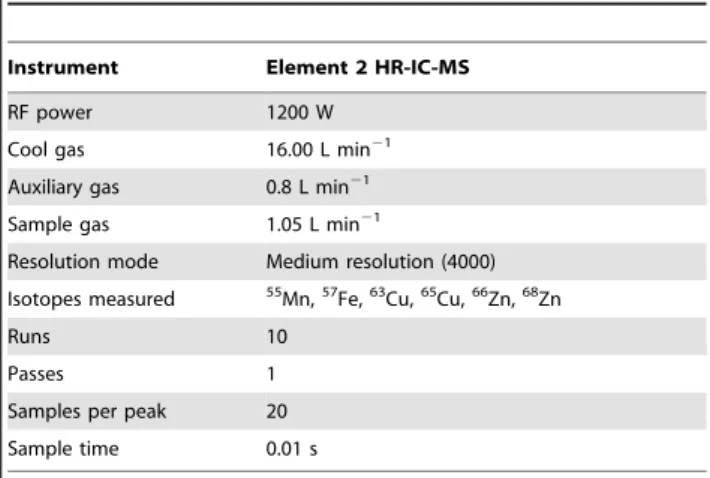
Elemental quantification was performed on the Thermo Element 2 HR-ICPMS (Thermo Fisher Scientific, Bremen, Germany) coupled with ESI auto sampler (Elemental Scientific, Omaha, NE). The HR-ICPMS is equipped with a PFA microflow nebulizer (Elemental Scientific, Omaha, NE), a double channel spray chamber (at room temperature), a magnetic sector followed by an electric sector, and a second electron multiplier. The sample uptake was achieved through self-aspiration via 0.25 mm ID sample probe and sample capillary. The operation parameters are listed inTable 3.
Results were normalized to the dry weight of the sample measured prior to analysis. Quantities of Mn, Zn and Fe were then normalized to Cu as an internal reference since Cu levels were not altered by CP treatment (data not shown).
A. baumanniiinfections
Wildtype C57BL/6 mice were obtained from Jackson Labora-tories. S100A92/2 mice were a gift from Wolfgang Nacken (Institute of Experimental Dermatology, University of Mu¨nster, 48149 Mu¨nster, Germany). All of the infection experiments were approved by the Vanderbilt University Institutional Animal Care and Use Committee.In vivostudies utilized the murine model ofA. baumanniipneumonia previously developed in our laboratory with a few modifications [60]. Briefly, mice were infected with 3– 56108CFUA. baumanniiin 50ml PBS. At the indicated times post infection mice were euthanized and CFU were enumerated in lungs and livers following tissue homogenization and plating on bacterial growth medium. We initially performed time course studies comparing male C57BL/6 mice with S100A92/2mice for their susceptibilities to A. baumannii infection to determine the optimal age at which to perform experiments (data not shown). Based on these studies, 9–10 week-old male mice were used for subsequent experiments. For infections comparing wildtype and
DznuB, bacteria were cultured in RPMI instead of LB. For co-infections, equal numbers of wildtype andDznuBwere mixed to yield a total of 161010CFU/ml and mice were infected with 50ml of the combined mixture. At 36 or 72 hours post infection (hpi),
Table 3.HR-ICP-MS parameters.
Instrument Element 2 HR-IC-MS
RF power 1200 W
Cool gas 16.00 L min21
Auxiliary gas 0.8 L min21
Sample gas 1.05 L min21
Resolution mode Medium resolution (4000)
Isotopes measured 55Mn,57Fe,63Cu,65Cu,66Zn,68Zn
Runs 10
Passes 1
Samples per peak 20
Sample time 0.01 s
mice were euthanized and differential bacterial counts were determined in lungs and livers by plating organ homogenates on LB agar or LB agar supplemented with 40mg/ml kanamycin. To calculate the competitive index, the ratio of DznuB to wildtype bacteria recovered from lungs and livers was divided by the input ratio. When no bacteria (either wildtype, DznuB or both) were recovered, the number of recovered bacteria was set at the limit of detection for the assay (approximately 600 CFU/g for lungs and 200 CFU/g for livers). For histological analyses lungs were inflated with 1 ml of 10 percent formalin, fixed, embedded and stained as described previously [60]. For Imaging Mass Spectrometry and GFP reporter assays, mice were infected as described above with wildtype bacteria or WT::pznuGFP (described below). Upon sacrifice, lungs were perfused with a 1:1 mixture of water and Optimal Cutting Temperature (OCT) compound (TissueTek). Lobes were marked using dye-based drawing ink, and snap frozen using a mixture of hexanes and dry ice. Organs were stored at
280uC until ready for use.
Imaging mass spectrometry of infected and uninfected lungs
Trifluoroacetic acid (TFA) and Sinapinic Acid were purchased from Sigma-Aldrich Chemical Co. (St. Louis, MO, USA). HPLC-grade acetonitrile, Ammonium bicarbonate powder, and technical grade hexanes were purchased from Fisher Scientific (Pittsburgh, PA, USA). OCT was purchased from VWR International (Suwanee, GA, USA). Dye-based drawing ink was purchased from Higgins Ink (Chartpak Inc. Leeds, MA, USA). Phosphate Buffered Saline (106) was purchased from Life Technologies Corporation (Grand Island, NY, USA).
Frozen lung tissue was cut into 10mm thick sections at220uC using a cryostat (Leica Microsystems, Bannockburn, IL, USA) and thaw mounted onto an indium-tin oxide (ITO) coated glass slide (Delta Technologies, Loveland, CO, USA). Mounted tissue sections were washed to remove excess lipids and salts using sequential chilled solutions of phosphate buffered saline, 100 mM ammonium bicarbonate, and 95 percent ethanol, all performed cold. Sinapinic acid matrix was prepared at 20 mg/ml in 1:1 acetonitrile:water with 0.1% TFA. Matrix was applied to tissue using a Portrait 630 (Labcyte, Sunnyvale, CA, USA) acoustic robotic microspotter. Matrix was applied in a block pattern with each spot being 200mm in diameter and spaced 250mm apart center to center, using three passes of fifteen 170 pL drops.
Spotted arrays were imaged using a Bruker Autoflex Speed time-of-flight mass spectrometer (Bruker Daltonics, Billerica, MA, USA) in linear positive–ion mode equipped with a SmartBeam laser (Nd:YAG, 355 nm). Detector voltage gain was set to 2910 volts. Spectra were collected at each spot as a sum of 400 laser shots in 50 shot steps. The laser repetition rate was 1,000 Hz, first and second ion source voltages were 19.47 kV and 17.82 kV respectively with a delay time of 350 ns and a lens voltage of 6 kV. Measured mass range was from 3,000–27,000 Daltons. Spectra were analyzed using Fleximaging 3.0 Software (Bruker Daltonics) and were normalized to total ion current. Ion density maps were extracted.
Transposon mutant library screen
A transposon library was constructed using the EZ-Tn5 transposome system as described previously [60]. Since growth of wildtype bacteria is significantly attenuated in ChxRPMI without Mn or Zn added back, the growth conditions were modified for the primary screen in order to facilitate rapid screening of over 4000 mutants. Mutants were inoculated directly from frozen stocks into LB and incubated at 37uC overnight.
Bacteria were then sub-cultured at a 1:20 dilution in ChxRPMI for 1 hour at room temperature. Following the 1-hour subculture, bacteria were diluted 1:50 into 96-well plates containing 100ml of CP screening media, which consisted of 50 percent RPMI (not chelex-treated) without supplemental metals and 50 percent CP (40mg/ml) in CP buffer. The plates were incubated at 37uC with shaking at 180 rpm for 10–12 hours, and growth was monitored by measuring the optical density of the cultures at 600 nm. Mutants whose growth in the presence of CP differed by more than two standard deviations from the plate average were selected for further analysis. The phenotypes of the selected mutants were confirmed by repeating the inhibition assay as described above for the primary screen in triplicate cultures. Only mutants that exhibited growth comparable to wildtype in media without CP but whose growth in the presence of CP differed significantly from that of wildtype bacteria were selected for insert identification. The transposon insertion sites were determined by inverse PCR or by sequencing directly from chromosomal DNA using primers KAN-1 (59- ACCTACAACAAAGCTCTCATCAACC - 39) and KAN-2 (59- CTACCCTGTGGAACACCTACATCT - 39).
Construction ofDznuB
Approximately 1000 bp of flanking DNA sequence was amplified from the immediate 59 and 39 regions surrounding
znuB. The kanamycin resistance gene aph was amplified from pUCK1 and the three PCR products were stitched by overlap extension PCR as described previously [61]. This PCR product was cloned into pCR2.1 (Invitrogen) and sequence verified. The product was then re-amplified and the resulting linear DNA product was transformed into Ab17978 to generate an in-frame allelic replacement ofznuBwithaph. Transformants were selected on LB agar supplemented with 40mg/ml kanamycin. The resulting colonies were screened for integration of the kanamycin cassette into the correct locus using locus-specific primers that anneal outside the region contained within the knock out construct.
In vitrogrowth inhibition assays with TPEN
Overnight bacterial cultures were sub-cultured 1:20 in fresh LB for 1 hour followed by a 1:50 back dilution into LB containing various concentrations of tetrakis-(2-pyridylmethyl)ethylenedia-mine (TPEN) (0–100mM) with or without addition of 100mM ZnSO4. Bacterial growth was assessed over approximately 24 hours. Data from the 12-hour time point, which are representative of the trends in bacterial growth over the full time course, are shown. Data were averaged from at least three biological replicates and statistical significance was determined by one-way ANOVA.
Complementation of the TPEN sensitivity ofDznuB
A vector for complementation was constructed by first amplifying the region separating znuA and zurznuCB by PCR using primers ZnuPro1 (59 – CCGAATTCGACAGACCAT-CAATTAGTAATAGC – 39) and ZnuPro2 (59 – CCGAATT-CAAGAACTCATCATAGACATAACCTC – 39). The resulting product was cloned into the EcoRI site of theA. baumannii:E. coli
empty vector, pznuPro, and the complementation vector, pznuB, were each introduced intoDznuBby electroporation. In addition, the empty vector was also transformed into wildtype bacteria to serve as an additional control. For growth assays, bacteria were grown overnight in LB+500mg/ml ampicillin with aeration at 37uC, and the next morning, overnight bacterial cultures were sub-cultured 1:50 in fresh LB+500mg/ml ampicillin for an additional hour. These cultures were then re-seeded 1:100 into LB+500mg/ml ampicillin and containing various concentrations of TPEN (0–80mM) on a 96-well plate. Bacterial growth was assessed by OD600over 24 hours with aeration at 37uC. Data are presented from the 12-hour time point, which are representative of the trends in bacterial growth over the full time course. Statistical significance was determined by one-way ANOVA.
Construction of aznureporter and measurement of GFP expression
The gene encoding GFP was sub-cloned from pMU125 into the BamHI and SalI sites of pznuPro to generate pznuGFP, which was subsequently introduced into wildtype andDznuBby electropora-tion. Empty pWH1266 was included as a control. The resulting strains, designated as WT::pWH1266, WT::pznuGFP, and
DznuB::pznuGFP were cultured in LB with increasing tions of TPEN as described above or with increasing concentra-tions of Zn (0–1000mM) and GFP fluorescence was measure using a BioTeq plate reader with excitation and emission filters set for 395 and 509 nm, respectively. GFP fluorescence was normalized to bacterial growth, and data from approximately 9 hours of growth are shown. Data were averaged from three biological replicates.
Identification of a putative Zur-binding consensus sequence and Zur-regulated genes
The intergenic region betweenznuAandzur was searched for possible Zur binding motifs using the consensus 19 bp zur box (AATGTTATAWTATAACATT) derived from the analysis of 13 genes from several gamma-Proteobacteria [48]. BLAST analysis was then employed to search for thisA. baumanniizur box in the Ab17978 genome. Once possible Zur-regulated genes were identified, 59 flanking sequences from each gene were searched for motifs using the Multiple Em for Motif Elicitation (MEME) tool [62]. The search parameters were limited to search for motifs on the forward strand only and to motifs ranging from 12 to 50 nucleotides in length. This search independently identified the putative zur box motifs from the majority of genes analyzed. Each of the zur box sequences was then entered into WebLogo 2.0 to generate a sequence logo that graphically represents the degree of sequence conservation at each nucleotide position [63].
Zur expression and purification
A. baumannii zurwas PCR amplified using primers 16762 (59 -CCGCTCGAGTTAGCGAGCTGTGCGG-39) and 16764 (59 -CCGCTCGAGGTTATGTCTATGATGAGTTCTTGC-39) and cloned into pET15b (Novagen) in frame with the N-terminal 6xHis tag.E. coliBL21(DE3) cells were transformed with the Zur expression vector and grown at 37uC to an OD600of 0.6 before induction with 0.5 mM IPTG. Following induction, bacteria were maintained at 37uC for an additional 6 hours. Cells were harvested by centrifugation at 6000g and resuspended in lysis buffer (50 mM NaH2PO4, 300 mM NaCl, 20 mM imidazole, 1 mg/ml lysozyme). Cells were lysed by five passes through an EmulsiFlex homogenizer (Aventin, Inc., Ottawa, ON) at 20,000 psi. Following disruption the lysates were centrifuged at
8,0006gto remove unlysed cells and debris. Insoluble material was separated by ultracentrifugation at 100,0006gfor 1 hour at 4uC. The resulting supernatants were applied to a Ni: NTA column pre-equilibrated with lysis buffer. The column was washed with approximately 20 bed volumes of wash buffer (50 mM NaH2PO4, 300 mM NaCl, 25 mM imidazole) followed by sequential washes with increasing concentrations of imidazole (50 mM, 100 mM, 150 mM, 175 mM, 200 mM, 225 mM and 250 mM). Zur eluted free from contaminating proteins in buffer containing between 200 and 250 mM imidazole. CaCl2was added to the eluted sample to a final concentration of 2.5 mM. Removal of the His tag was achieved by thrombin cleavage. Briefly, two units of restriction grade thrombin (Novagen) were added and the sample was cleaved and dialyzed overnight at 4uC into buffer containing 20 mM Tris-HCl, pH 8.0, 150 mM NaCl and 2.5 mM CaCl2.
PAR assay for Zn binding
Zn binding by Zur was determined using the Zn-binding dye PAR. Free PAR exhibits a peak absorbance at approximately 410 nm, which shifts to 500 nm upon Zn binding. To determine if Zur binds Zn, increasing concentrations (0mM–4mM) of purified Zur were added to solutions containing 10mM PAR and 5mM Zn in 50 mM HEPES, pH 8.0. Spectra were obtained for free PAR and PAR bound to Zn as controls, which were compared to the spectra obtained in the presence of Zur. A decrease in the absorbance at 500 nm, together with an increase in the absorbance at 410 nm indicates binding of Zn by Zur.
Electrophoretic mobility shift assays
EMSA probes were generated from primers zur1 (59 – CGAAGCATGTTATAATATAACAAAGTTAC – 39) and zur2 (59-GTAACTTTGTTATATTATAACATGCTTCG – 39) for theznuA/zurznuCB Zur box or zurneg1 (59 – GTTACAAAAA-TACCTAAGATTAATCGAAT – 39) and zurneg2 (59– ATTC-GATTAATCTTAGGTATTTTTGTAAC – 39) for the intragen-ic sequence from znuA that served as a negative control. Each primer was incubated at 65uC for 10 min then incubated in a water bath that was allowed to slowly equilibrate from 65uC to room temperature. Increasing concentrations of purified Zur (0– 2500 nM) were incubated with 250 nM of the probes described above in EMSA buffer (20 mM Tris-HCl, pH 8.0, 50 mM KCl, 1 mM DTT, 5% glycerol and 100mM ZnCl2) for 20 min at room temperature. Following incubation, 20ml of each sample was loaded onto 4% polyacrylamide gels and electrophoresed for 30 min at 100 V. The gels were stained with SYBR green (Invitrogen) and visualized on an Alpha Imager gel documentation system using UV light. In order to test whether Zn chelation could eliminate Zur binding to target DNA, 250 nM of Zur target DNA was incubated with 1250 nM Zur in EMSA buffer with increasing concentrations of EDTA (0–2500mM). EDTA was chosen as a chelator for these assays since it has higher solubility in water than TPEN.
Expression analyses
Madison, WI). PCR was performed using 10 ng cDNA template (0.01 ng template for 16S rRNA). Control reactions were performed on RNA samples without reverse transcriptase treat-ment. These reactions did not yield detectable signal. Sequences for the primers used in these analyses are shown in Table 4. Data were analyzed from at least three biological replicates after normalizing to 16S rRNA. Data from TPEN treated samples are presented as the fold-induction relative to untreated samples.
In vivoGFP reporter activity
Frozen lungs of mice infected with wildtype or WT::pznuGFP were sectioned as described above and stained with DAPI (0.01 ng/ml) for 30 minutes at room temperature. Sections were washed with PBS, and coverslips were sealed over the sections using clear nail polish. The sections were visualized using an Olympus BX60 microscope. Images were captured with an Olympus DP71 camera using DP Controller and analyzed using DP Manager software.
Imipenem and levofloxacin inhibition assays
Bacteria were cultured in LB overnight then sub-cultured 1:1000 in LB containing 25mM TPEN and either imipenem (0–20mg/ml) or levofloxacin (0–25mg/ml). Where indicated, ZnSO4was added to a final concentration of 25mM. Bacteria were cultured for 24 hours while the optical densities of the cultures were monitored at 600 nm. Minimum inhibitory concentrations were determined as the concentration in the first well in which no bacterial growth was observed. MICs were comparable for each of the antibiotics in LB as compared to Mueller Hinton Broth (data not shown).
Supporting Information
Figure S1 A. baumannii growth in the presence of increasing concentrations of CP (solid lines) orDSI/SII, a variant of CP that no longer binds Mn and Zn (dashed lines). Black indicates no Mn or Zn added, while orange indicates 25mM Mn and 25mM Zn added back. Data represent the average of three biological replicates.
(TIF)
Figure S2 Bacterial burdens in lungs of wildtype and S100A92/
2 mice harvested at 72 hpi with A. baumannii. Each symbol
represents one animal. Only data from mice surviving to 72 hours are shown. The data were combined from two independent experiments with at least 10 mice per experiment per genotype. (TIF)
Figure S3 CP growth inhibition assays comparing wildtype withDznuB. Bacteria were cultured in CP growth media in the presence of increasing concentrations of CP without supplemen-tation (A) or with addition of 25mM Zn (B), 25mM Mn (C) or both 25mM Zn and 25mM Mn (D). Data are presented as the percent growth relative to bacterial growth without CP. Curve fit was performed using a non-linear regression with variable slope. Curves are not drawn for WT+Mn and WT+Zn and Mn because these data are not converged and therefore the same curve fit parameters could not be used. Data are the average of three independent experiments with at least three biological replicates each.
(TIF)
Figure S4 Growth curve analyses of wildtype and DznuB
cultured in CP growth media with (orange) or without (black) added Mn and Zn. Data are averaged from at least three biological replicates. Error bars, which may be obscured by the symbols in some cases, represent one standard deviation from the mean.
(TIF)
Figure S5 In vivo GFP expression driven by the znupromoter. Frozen sections of lungs harvested at 36 hpi from wildtype (A–D) or S100A92/2 (E–H) mice infected with WT::pznuGFP and stained with DAPI. Sections from lungs of mice infected with wildtype bacteria without the pznuGFP plasmid (I–L) are shown for comparison.
(TIF)
Figure S6 (A) Competitive indices of DznuB compared to wildtype A. baumannii in lungs and livers of wildtype and S100A92/2 mice. Each symbol represents one animal. Red symbols indicate mice in which the competitive index was determined by setting the recovered CFU forDznuB at the limit of detection since there were no recoverable CFU of DznuB in these mice. (B–C) Bacterial burdens from monoinfections in lungs (B) and livers (C) of wildtype and S100A92/2mice harvested at 36 hpi with either wildtype (black symbols) or DznuB (open symbols) A. baumannii.Each symbol represents one animal. The data were combined from two independent experiments with 5–10 mice per experiment per genotype.
(TIF)
Acknowledgments
We thank members of the Skaar laboratory for critical review of the manuscript. We thank Luis Actis (Miami University) for providing A.
baumannii: E. coli shuttle vectors and Robert Bonomo (Case Western
Reserve University) for providingA. baumanniistrain AB0057.
Author Contributions
Conceived and designed the experiments: MIH EPS. Performed the experiments: MIH BLM JLM YZ TEK. Analyzed the data: MIH BLM JLM YZ EPS. Contributed reagents/materials/analysis tools: NS WJC RMC EPS. Wrote the paper: MIH EPS.
Table 4.Primers used for qPCR.
Target gene Primer sequences
znuA GAGTACGTTAGGTTGGAGTCAGG
GGTCATCCGTTAAGGCACC
znuB TGGCACATGGAACCTTACTTG AACACTGACACCGAGTTGAGC
znuC CATCTCATAGTCTTCCTTTACGG TGTGAGGTCTGCTATTGTGAGG
znuD1 CAAGTTGCATTACGTGTTGAGG TATGGACTAACTCAATACGCCC
znuD2 AATATGGAGGTGGAGCATCTG GCGTACCTAATCTTGACTCTGC
tonB1 GTCATCACGGCACTAATTGCG GACTTGGAATACCGCTGCTACG