Within-host Competition Does Not Select for
Virulence in Malaria Parasites; Studies with
Plasmodium yoelii
Hussein M. Abkallo1,2, Julie-Anne Tangena1,3, Jianxia Tang1, Nobuyuki Kobayashi2, Megumi Inoue1, Augustin Zoungrana1, Nick Colegrave4, Richard Culleton1*
1Malaria Unit, Institute of Tropical Medicine, Nagasaki University, Nagasaki, Japan
2Laboratory of Molecular Biology of Infectious Agents, Graduate School of Biomedical Sciences, Nagasaki University, Nagasaki, Japan,3Laboratory of Entomology, Wageningen University, Wageningen, The Netherlands,4Institute of Evolutionary Biology, School of Biological Sciences, University of Edinburgh, Edinburgh, United Kingdom
Abstract
In endemic areas with high transmission intensities, malaria infections are very often com-posed of multiple genetically distinct strains of malaria parasites. It has been hypothesised that this leads to intra-host competition, in which parasite strains compete for resources such as space and nutrients. This competition may have repercussions for the host, the par-asite, and the vector in terms of disease severity, vector fitness, and parasite transmission potential and fitness. It has also been argued that within-host competition could lead to se-lection for more virulent parasites. Here we use the rodent malaria parasitePlasmodium yoeliito assess the consequences of mixed strain infections on disease severity and para-site fitness. Three isogenic strains with dramatically different growth rates (and hence viru-lence) were maintained in mice in single infections or in mixed strain infections with a genetically distinct strain. We compared the virulence (defined as harm to the mammalian host) of mixed strain infections with that of single infections, and assessed whether competi-tion impacted on parasite fitness, assessed by transmission potential. We found that mixed infections were associated with a higher degree of disease severity and a prolonged infec-tion time. In the mixed infecinfec-tions, the strain with the slower growth rate was often responsi-ble for the competitive exclusion of the faster growing strain, presumably through host immune-mediated mechanisms. Importantly, and in contrast to previous work conducted withPlasmodium chabaudi, we found no correlation between parasite virulence and trans-mission potential to mosquitoes, suggesting that within-host competition would not drive the evolution of parasite virulence inP. yoelii.
Author Summary
Malaria infections are very often composed of multiple strains of malaria parasites. It is thought that these strains may compete for resources such as space and nutrients within
OPEN ACCESS
Citation:Abkallo HM, Tangena J-A, Tang J, Kobayashi N, Inoue M, Zoungrana A, et al. (2015) Within-host Competition Does Not Select for Virulence in Malaria Parasites; Studies with Plasmodium yoelii. PLoS Pathog 11(2): e1004628. doi:10.1371/journal.ppat.1004628
Editor:James W. Kazura, Case Western Reserve University, UNITED STATES
Received:August 6, 2014
Accepted:December 14, 2014
Published:February 6, 2015
Copyright:© 2015 Abkallo et al. This is an open access article distributed under the terms of the
Creative Commons Attribution License, which permits unrestricted use, distribution, and reproduction in any medium, provided the original author and source are credited.
Data Availability Statement:All relevant data are within the paper and its Supporting Information files
Funding:This work was supported by the JSPS Grant-in-Aid for Scientific Research Nos. 24255009 and 25870525 (RC), and a Naito Foundation Natural Science Scholarship, Japan (to RC). The funders had no role in study design, data collection and analysis, decision to publish, or preparation of the manuscript.
the host. Here we show that such“within-host competition”has repercussions for the vir-ulence of the malaria infection, so that infections composed of multiple strains are more virulent in terms of disease severity, than single strain infections containing the constitu-ent parasites. Following from this, it has been proposed that as such competition would fa-vour those parasites with faster growth rates, then these parasites would be selected in nature when within-host competition is common. We show, however, that this is not nec-essarily the case, as parasites with faster growth rates in the mammalian host were no more successful at transmitting to mosquitoes than parasites with slower growth rates. These results show that a reassessment of our current understanding of the role of within-host competition in the selection of virulence in malaria parasites is required.
Introduction
Malaria is caused by a diverse group of parasites composed of at least six species of the genus Plasmodium. Genetic diversity within these species is high, with multiple strains often co-infecting the same host, and is driven and maintained by mutation and through recombination between strains. Concomitant infection of hosts, both man and mosquitoes, with multiple spe-cies and/or strains is a common occurrence in endemic areas [1–3]. Such infections may result from the bites of multiply infected mosquitoes or from the bites of multiple mosquitoes har-bouring different species or strains. Co-infecting species or strains interact during their life cy-cles and such interactions may lead to intra-host competition with repercussions for the host, the parasite, and the vector in terms of disease severity, vector fitness, and parasite transmission potential and fitness.
Within-host interactions between different parasite genotypes have been observed in both empirical human [4,5] and rodent [6] malaria studies, and these have often been observed to result in modulations of parameters such as infection dynamics (suppression or enhancement of a particular strain or species in a mixed infection) and virulence (harm caused to the host). A series of experiments performed exclusively with strains of the rodent malaria parasite Plas-modium chabaudi, suggested that faster growing strains gained a competitive advantage over slower growing strains [7], in that they often dominated mixed strain infections in terms of proportional numbers of parasites, and sometimes competitively excluded the slower growing strain at some point during the infection. This has been interpreted as suggesting that within-host competition could lead to the selection of virulence within a parasite population.
The effects of competition between parasites on disease pathology is of particular relevance in malaria, as understanding the links between parasite genetic and disease severity will allow an understanding of how interventions, such as drugs and vaccines, that reduce parasite diver-sity will impact human health. There are conflicting theories as to how the presence of multiple strains (and/or species) of malaria parasites in an infection impact on disease. Reports from malaria endemic regions suggest that it is possible that disease pathology may be exacerbated by within-host competition [8] but also that it can result in decreased parasite burden and may protect against some clinical outcomes of disease [9–14].
virulence. Virulence (defined as“harm to the host”) is often, but not always, linked to replica-tion rate, with more virulent strains growing and replicating faster in the host than less virulent strains. Virulence differences can occur as a result of inherent genetic differences between strains, and/or through the influence of environmental factors, the most relevant of which to a parasite is the condition of the host [21]. It has been proposed that the evolution of virulence is driven by within-host competition between strains of malaria parasites in mixed infections [7, 22]. This theory is based on the idea that faster multiplying parasites out-compete others in a mixed infection and therefore transmit more successfully to the vector.
The consequences of within-host competition during the mosquito stage development of malaria parasites for both the vector and the parasite are very poorly understood. This is par-tially due to the fact that there is little understanding of how malaria parasite infection influ-ences mosquito fitness. Some reports associate malaria parasite infection with decreased survival and reproduction of mosquitoes [23–29], others find no effect [30] while there is also evidence to suggest that that malaria infection increases longevity in mosquitoes due to a trade-off with decreasing reproduction [31]. These contradictions notwithstanding, many lab-based and field studies have convincingly established thatPlasmodiumcauses pathological changes not only in their vertebrate hosts, but also in insect vectors. This is particularly evident during earlier stages ofPlasmodiuminfection in the mosquito whereby ookinetes penetrate mosquito midgut epithelium (physical damage) and provoke physiological stress [32]. As a re-sult, the mosquito launches an immune response to curb the infection, which is an energetically demanding process [33], hence reduced fitness. In addition, meta-analyses suggest that malaria parasites reduce mosquito fitness and survival [34]. Overall,Plasmodiuminfection is generally considered to be harmful to their mosquito hosts. What effect competition between parasite species and/or strains has on the pathology of the mosquito stages of malaria infections is largely unknown.
Here we use the rodent malaria parasitePlasmodium yoeliito explore the consequences of within-host competition on disease severity and parasite fitness (including transmission poten-tial) between isogenic parasite strains with varying degrees of virulence.
Results
Mixed strain parasite infections are more virulent than single strain
infections
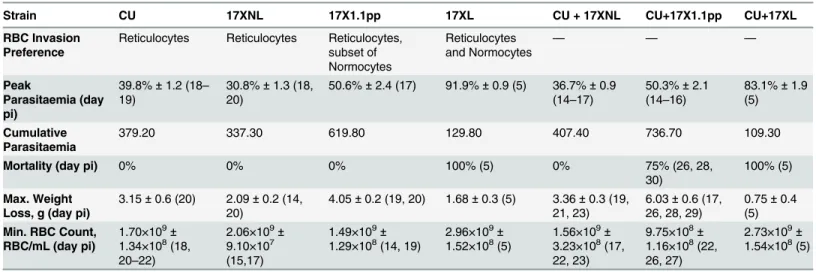
Infection parameters for all single and mixed infections are summarised inTable 1. Of the three strains, only the virulent strain (17XL) causes death of mice in single strain infections. In mice infected with this strain, death occurs early in the infection, by day 5 post-infection. Nei-ther of the avirulent strains (17XNL and CU) or the intermediately virulent strain (17X1.1pp) cause host mortality at any time, and infections self-clear within 30 days.
for infections involving the virulent strain were only analysed up to day 5, after which point all mice had died.
Both avirulent/avirulent (CU+17XNL) and avirulent/intermediately virulent (CU+17X1.1pp) strain mixed infections were characterised by protracted parasitaemia and prolonged chronicity of disease compared to their constituent strains growing in single strain infections. The mixed strain infections resulted in higher parasitaemia than either of the constituent strains in single infections late on in the infection (treatment by time interaction term, L = 306.28, df = 50, P<0.0001, and L = 579.48, df = 50, P<0.0001,Fig. 1, Panels A and B). For the avirulent/
virulent (CU+17XL) mixed strain infections, the course of infection followed that of the most virulent constituent strain (Fig. 1Panel C, treatment by time interaction term, L = 111.69, DF = 8, P<0.001). Strikingly, infection with the avirulent/intermediately virulent mixture
re-sulted in 75% host mortality infection late in the infection (Log-rank test,χ2= 8.165, df = 2,
p= 0.0169,Fig. 1Panel E), and this was associated with the inability to clear parasites from the blood.
In order to compare the virulence (here defined as pathological harm to the host) of mixed strain infections to that of single strain infections, we measured the red blood cell (RBC) densi-ty, and weight of mice daily throughout the course of the infections (Fig. 1, panels G-I and J-L, respectively), sampling ceasing when parasites were no longer visible in the blood by microsco-py, or when mice succumbed to infection.
Mixed infections of avirulent/avirulent (CU + 17XNL) resulted in lower RBC density and greater weight loss compared to either of the constituent strains in single infections during the latter stages of the infection (Fig. 1, Panels G, L = 97.90, DF = 86, P = 0.0004 and J, L = 131.38, DF = 86, P<0.0001), a phenomenon consistent with the prolonged chronicity of the mixed
in-fection parasitaemia. In the avirulent/intermediately virulent (CU + 17X1.1pp) mixed infec-tion, this effect was more pronounced, with dramatic and significantly lower RBC count (Fig. 1, panel H, L = 228.75 DF = 86, P<0.0001) and significantly greater weight loss (Fig. 1,
panel K, L = 171.70 DF = 86, P<0.0001) compared to single strain infections, This weight loss
Table 1. Infection parameters for single and mixed strain infections.
Strain CU 17XNL 17X1.1pp 17XL CU + 17XNL CU+17X1.1pp CU+17XL
RBC Invasion Preference
Reticulocytes Reticulocytes Reticulocytes, subset of Normocytes Reticulocytes and Normocytes — — — Peak Parasitaemia (day pi)
39.8%±1.2 (18–
19)
30.8%±1.3 (18, 20)
50.6%±2.4 (17) 91.9%±0.9 (5) 36.7%±0.9 (14–17)
50.3%±2.1 (14–16)
83.1%±1.9 (5)
Cumulative Parasitaemia
379.20 337.30 619.80 129.80 407.40 736.70 109.30
Mortality (day pi) 0% 0% 0% 100% (5) 0% 75% (26, 28,
30)
100% (5)
Max. Weight Loss, g (day pi)
3.15±0.6 (20) 2.09±0.2 (14,
20)
4.05±0.2 (19, 20) 1.68±0.3 (5) 3.36±0.3 (19,
21, 23)
6.03±0.6 (17,
26, 28, 29)
0.75±0.4
(5) Min. RBC Count,
RBC/mL (day pi)
1.70×10⁹±
1.34×10⁸(18,
20–22)
2.06×10⁹±
9.10×10⁷
(15,17)
1.49×10⁹±
1.29×10⁸(14, 19) 2.96×10 9±
1.52×10⁸(5) 1.56×10 9±
3.23×10⁸(17,
22, 23)
9.75×10⁸±
1.16×10⁸(22,
26, 27)
2.73×10⁹±
1.54×10⁸(5)
Peak parasitaemia; Mean (±SEM) of highest parasitaemia, Cumulative parasitaemia; Mean of area under curve of the parasitaemia curve in single and mixed infections. Maximum Weight loss is the Mean (±SEM) of maximum weight lost by the infected mice. Minimum RBC count is the Mean (±SEM) of least Red Blood Cell number per mL of blood. Days post infections are given in parentheses. Data were generated from groups of 4 mice, and are representative of two independent repeat experiments.
and reduction in RBC density occurred in the latter part of the infection, reflecting the signifi-cantly higher parasitaemia of the mixed infection group during this period. Single infections of the most virulent strain (17XL) result in acute anaemia and dramatic weight loss early in the infection, and this pattern is also observed in the mixed strain infection containing this strain plus an avirulent strain (CU + 17XL) (Fig. 1, Panels I and L).
Mixed strain infections do not generally result in significantly different
numbers of infected mosquitoes or oocyst burdens than their constituent
single strain infections
In order to determine whether mixed strain infections infect more mosquitoes and result in higher oocyst burdens than single strain infections, we allowedA. stephensimosquitoes to feed on mice with single or mixed strain infections. As transmissibility varies dramatically through-out an infection, we allowed mosquitoes to feed at two separate time points; on day 3 post-Figure 1. Parasitaemia (Panels A-C), percentage survival (D-F), red blood cell density (G-I) and weight change (J-L) of mice infected with avirulent (CU and 17XNL), intermediately virulent (17X1.1pp) and virulent (17XL) strains ofPlasmodium yoelii yoeliiin single or in mixed infections.Data points indicate the mean value for 4 mice per experimental group.†indicates the time points at which individual mice died. Data are representative of two independent experiments.
infection, when the oocyst conversion rate (OCR, the number of oocysts produced per gameto-cyte) is at its highest inP. yoeliiinfections (R. Culleton, unpublished observations), and on day 4 post-inoculation when OCR is lower.
We observed no significant differences in the numbers of gametocytes produced in single strain infections compared to mixed strain infections, with the exception of the mixed infection composed of the avirulent CU and the intermediately virulent 17X1.1pp on day 3 pi, which contained significantly fewer gametocytes than the single 17X1.1pp infection (S1 Fig.).
All infections, regardless of virulence or whether mixed or single, resulted in a lower per-centage of mosquitoes infected and lower oocyst burdens following feeding on day 4 pi com-pared to day 3 pi (Fig. 2). For the single infections, the greatest percentages of infected mosquitoes (mean, n = 4 mice) were found in those that had fed on CU (100%) or 17X1.1pp (100%), followed by those fed on 17XNL (70.5%) and 17XL (56.2%). The highest mean day 3 pi oocyst burdens were recorded for 17X1.1pp (105 oocysts per infected mosquito, p.i.m), fol-lowed by CU (96 oocysts p.i.m), 17XNL (17 oocysts p.i.m), and 17XL (10 oocysts p.i.m). This pattern was similar on day 4 pi, when the highest percentage of infected mosquitoes was achieved by 17X1.1pp (74.5%), followed by CU (65.6%), 17XNL (19.5%) and 17XL (8.3%), with associated mean oocyst burdens of 13, 8, 3, and 2 oocysts p.i.m, respectively. There was, therefore, no positive correlation between virulence and transmission potential.
To test for differences in transmission potential (defined as the percentage of mosquitoes carrying one or more oocyst following blood feeding on infected mice) between mixed and sgle infections, we fitted a generalised linear mixed model, with treatment and day and their in-teraction as fixed factors, and mouse as a random factor to account for the repeated measures on each mouse. Since infection is a binary trait, we fitted a binomial error structure. Models
Figure 2. Transmission success of strains ofPlasmodium yoelii yoeliiin single and mixed strain infections. Panels A, BandCshow the numbers of oocysts per mosquito fed on mice infected with CU (avirulent), 17XNL (avirulent), 17X1.1pp (intermediately virulent) and 17XL (virulent) either in single or in mixed infections on days 3 and 4 post-inoculation. Error bars indicate the standard error of the mean. Twenty mosquitoes were allowed to feed on each mouse, and those that were gravid after 7 days were considered blood-fed and included in the analysis.Panels D, EandF; the mean percentage of mosquitoes infected with at least one oocyst following feeding on each of the strains in single or mixed infections. Error bars indicate the standard error of the mean for mosquitoes fed on groups of 4 mice. Data are representative of two independent experiments.*= P<0.05,**= P<0.005,***= P<0.001
were fitted using the glmer function in R with Likelihood ratio tests used to compare models with different fixed effects.
In mixed infections containing two avirulent (CU + 17XNL), There was no significant inter-action between day and treatment, (L = 2.231, df = 2, P>0.05), whilst treatment affected the
proportion infected on both days (L = 12.369, df = 2, P = 0.002, with 17XNL infecting fewer mosquitos than either CU or the mixture (Fig. 2, Panel D).
For the mixed infection containing one avirulent and one intermediately virulent strain (CU + 17X1.1pp), again, there was no indication of an interaction (L = 4.75, df = 2, P>0.05).
Infection was lower on day 4, than on day 3 (L = 30.545, df = 1, P<0.001), but there was no
ef-fect of treatment (L = 0.2656, df = 2, p>0.05,Fig. 2, Panel E).
When mosquitoes fed on mice infected with the avirulent/virulent (CU + 17XL) mixed in-fection, the effect of treatment on infection depended on day (L = 6.681, df = 2, P<0.05), with
CU having higher infectivity than both other treatments on day 4, and than 17XL on day 3, (Fig. 2, Panel F).
In summary, mixed infections did not infect significantly different percentages of mosqui-toes than one of the constituent strains (CU, the most successful transmitter), with the excep-tion of the CU+17XL infecexcep-tion when mosquitoes fed on day 4 of the infecexcep-tion. In this case, there were significantly fewer mosquitoes infected than in the CU single infection.
To analyse oocyst number, we used a general linear mixed model with day and treatment as fixed factors, and mouse as a random factor. Data was logged prior to analysis to meet the as-sumptions of homogeneity of variance.
In mixed infections containing two avirulent (CU + 17XNL), there was a significant effect of treatment on oocyst numbers (treatment main effect, F2,9= 13.71, p = 0.002), with CU
pro-ducing more oocysts that the mixture and 17XNL propro-ducing less. There were fewer oocysts on day 4 than day 3 (F1,9= 78.01, p<0.001), but the effect of treatment was consistent on both
days (F2,9= 0.781, p = 0.4868). Post-hoc tests revealed that the mixed infection produced
sig-nificantly more oocysts than 17XNL (P = 0.0031), but oocyst numbers did not differ signifi-cantly from CU in a single infection (Fig. 2, Panel A).
In the mixed infection composed of an avirulent and an intermediately virulent parasite (CU+17X1.1pp), there were no significant differences in the numbers of oocysts produced by the mixed infection compared to the constituent strain single infections (Fig. 2, Panel B).
When an avirulent and a virulent parasite strain co-infect a host (CU + 17XL), thee
numbers of oocysts produced in mosquitoes fed on single strain and mixed infections is signifi-cantly different (treatment main effect, F2,9= 18.28, p<0.0001), with CU producing more
oo-cysts than the mixture and 17XL producing less. There were fewer oooo-cysts on day 4 than day 3 (F1,9= 52.14, p<0.001), but the effect of treatment was consistent on both days (F2,9= 3.42,
p = 0.0787). Post-hoc tests revealed that CU differs significantly from the mixture (P = 0.003), but for 17XL the difference is marginally non-significant (Fig. 2, Panel C).
Parasite virulence and competitive ability of blood stage parasites are
not linked in mixed infections of
P. yoelii
virulent (17X1.1pp) parasites, the intermediately virulent strain completely dominates the in-fection from day 4 pi until day 14 pi, during which period no avirulent parasites could be de-tected. However, this situation is dramatically reversed from day 16 pi, when the avirulent parasite re-emerges, and completely dominates the infection from day 20 until the infection is cleared, completely competitively excluding the intermediately virulent strain (Fig. 3, panel B). In the case of the mixed infection composed of a virulent (17XL) and an avirulent (CU) para-site, the virulent parasite completely dominates the infection from day 4 pi, competitively ex-cluding the avirulent parasite, as all mice die due to the infection on day 5 pi (Fig. 3, panel C). We next compared the numbers of parasites produced by each strain (in terms of parasite density, defined as the number of parasites per mL of blood at a particular time-point) throughout the course of single infections, with the numbers produced when in competition Figure 3. The relative proportions of strains ofPlasmodium yoelii yoeliiin mixed strain infections throughout the course of infections in mice (Panels A-C), and the parasite densities of the strains in single and mixed infections (Panels D-G). Panels A, BandCshow the relative proportions of the avirulent CU strain in combination with the avirulent 17XNL strain, the intermediately virulent 17X1.1pp and the virulent strain 17XL respectively. Individual data points are mean proportions of 4 mice per group. The parasite density (number of asexual stage parasites per mL of blood) of the avirulent strain CU in a single infection is compared to the parasite density of this strain when in competition with the other strains inPanel D; that of avirulent 17XNL in a single infection or in competition with CU inPanel E; the intermediately virulent 17X1.1pp in a single infection or in competition with CU inPanel F; the virulent 17XL in a single infection or in competition with CU inPanel G. Strains in brackets indicate the competing strain. Error bars indicate the standard error of the mean of 4 mice per group. Data are representative of two independent experiments.
with another strain. The avirulent strain CU is competitively supressed by all strains during the first 20 days of the infection, with competitive suppression strongest when in competition with the virulent strain (17XL) (mice die at day 5 pi), followed by the intermediate strain
(17X1.1pp) and suppression mildest when in competition with the avirulent strain (17XNL). When in competition with the avirulent (17XNL) and the intermediately virulent (17X1.1pp) strains, competitive suppression ceases at day 20 pi, and competitive release occurs, with CU parasite densities reaching higher levels than in single infections (Fig. 3, Panel D). Thus, over the course of an infection in which CU is mixed with a strain of the same or higher virulence, both competitive suppression and facilitation occur.
The avirulent parasite 17XNL is not supressed in competition with CU compared to growth in single infections during the first 16 days of the infection, after which time it suffers competi-tive suppression (Fig. 3, panel E). A similar trend is seen with the intermediately virulent 17X1.1pp strain, which is completely unaffected by the presence of CU in mixed infections up to day 16, from which point on it suffers from competitive suppression (Fig. 3, panel F). The virulent 17XL strain is completely unaffected by the presence of an avirulent competitor (CU) in a mixed infection throughout the 5 days during which mice survive (Fig. 3, panel G).
Parasite virulence is not linked to the transmission capacity of strains in
single infections or in mixed infections
We measured the relative proportion of each of the strains in mixed infections in mosquitoes using qPCR on DNA extracted from mosquitoes with known numbers of oocysts, and com-pared the adjusted number of oocysts per strain (total number of oocysts multiplied by the frequency of the strain measured by qPCR) to the numbers produced in single infections. This analysis was performed on oocyst DNA extracted from mosquitoes fed on mice at days 3 and 4 pi.
We fitted a general linear mixed model, with infection treatment and day fitted as fixed fac-tors, and mouse fitted as a random factor nested within treatment. Adjusted oocyst number was log transformed to meet homogeneity of variance assumptions. For the mixed infection containing the virulent parasite 17XL, as there was very little transmission on day 4, we were unable to use a general linear model, and t-tests were used in its place.
The avirulent clone CU was significantly less successful at transmitting to mosquitoes in mixed infections with all competing strains on day 3 pi (F3,12= 7.78, P = 0.0038), when
trans-mission capacity is at its peak in theP. yoelii/Mus musculus/Anopheles stephensimalaria system. The effect of infection treatment differed for the two days (TreatmentDay interac-tion, F3,12= 3.68, P<0.0433) with CU not producing significantly differing numbers of
oo-cysts in single compared to mixed infections on day 4 (Fig. 4, panel A). Importantly, the virulence of the competing clone had no effect on the degree of competitive suppression of transmission potential.
The transmission of the avirulent parasite 17XNL was severely and significantly reduced in mixed infections compared to single infections on both days 3 and 4 (F1,9= 30.48, P = 0.0004,
Fig. 4, panel B). The intermediately virulent strain 17X1.1pp suffered a less drastic and not sta-tistically significant reduction in transmission success through competition with the avirulent strain CU on day 3 pi and there was no difference on day 4 (Fig. 4, panel C). Finally, the trans-mission of virulent strain 17XL to mosquitoes was severely and significantly reduced in the presence of an avirulent competitor on day 3 pi (Student’s two-tailed t-test, t = 3.282, df = 64, P = 0.0017), and completely abrogated on day 4 pi (Fig. 4, panel D).
fertilization in the mosquito midgut (i.e. oocysts) for each parasite strain either in single infec-tions (Fig. 5, panel A), or in competition with the other strains (Fig. 5, panel B). The CU strain exhibits the highest fitness in single infections, followed by the intermediately virulent
17X1.1pp, the avirulent 17XNL, and finally the virulent 17XL. All strains are negatively affected by competition, with 17XL and 17XNL particularly severely compromised when in competi-tion with CU. The CU strain is least affected by the presence of 17XL followed by 17X1.1pp and 17XNL.
In order to test whether infections with avirulent parasite are infectious to mosquitoes dur-ing the latter stages of the infection, we allowed mosquitoes to feed on mice infected with 17XNL on day 18. We found that these mosquitoes were infected with oocysts following feed-ing, and so transmission is possible during the latter stages of infection, at least with this strain.
Finally, we assessed whether the proportion of strains measured in oocysts was representa-tive of the proportion of strains inoculated into mice during mosquito feeding. We found a good correlation between the proportions of strains in oocysts, and the proportions in the blood of mice in infections resulting from inoculation of sporozoites from tested mosquitoes (S2 Fig.).
Figure 4. Adjusted mean number of oocysts per infected mosquito of strains ofPlasmodium yoelii yoeliiderived from mosquitoes fed on mice harbouring single strain or mixed strain infections on days 3 and 4 post-inoculation.Oocyst numbers are given for strain CU when in competition with all other strains (Panel A), for 17XNL in competition with CU (B), for 17X1.1pp in competition with CU (C) and for 17XL in competition with CU (D). Error bars indicate the standard error of the mean for 4 mice per group, and data are representative of two independent experiments.*= P<0.05,**= P<0.005,*** = P<0.001
Discussion
The consequences of within-host competition on disease severity in the mammalian host Mixed strain malaria parasite infections, in which multiple genetically distinct parasites co-infect the same host, are common in nature, and are probably more common than single-clone infections, certainly in regions with relatively high transmission rates [4,10,37,38,39,40,41, 42,43]. It is becoming increasing clear that malaria parasites co-infecting the same host inter-act with each other [43–45]. The consequences of these interactions for disease severity have been the subject of a limited number of field studies, some of which report that disease severity increases with increasing parasite genetic diversity within infections [46–48]. The general con-sensus from these studies is that co-infections result in competition between strains, and this competition can lead to increased virulence of co-infections compared with single clone infec-tions [22].
Our results indicate that simultaneous inoculation with two genetically distinct strains of P. yoeliiresult in infections that are more virulent than single-clone infections composed of ei-ther of the co-infecting strains. Virulence in this case was measured by assessing host weight loss, RBC density and parasitaemia. This was true when the co-infections were composed of two avirulent strains or one avirulent and one intermediately virulent strain. When infections contained a very virulent strain and an avirulent strain, then the virulence of the co-infection was not significantly different from the virulence of the co-infection caused by the viru-lent strain. In this case, however, the viruviru-lent strain causes very severe disease, and host death within five days, making measurement of any possible increased virulence in a co-infection very difficult. Co-infections always resulted in infections that were either more virulent than each of the constituent strains, or which were as virulent as the most virulent of the constituent strains; we did not observe any protective effects of co-infection on host disease severity.
Our results show that in experiments with the rodent malaria parasiteP. yoelii, mixed infec-tions cause more harm to the host than single infecinfec-tions, a phenomenon also observed in natu-ral human infections withP. falciparum[46–48]. If we extrapolate from these experiments and assume that mixed strain infections are, in general, more harmful than single clone infections, then a case may be made for the implementation of malaria control measures that aim to Figure 5. Relative fitness of avirulent (CU and 17XNL), intermediately virulent (17X1.1pp) and virulent (17XL) strains ofPlasmodium yoelii yoeliiin single (Panel A) or in mixed (B) infections.Fitness coefficients were derived from the numbers of oocysts produced by each clone in mixed and single infections. For single strain infections (A), the fitness of 17XNL, 17XL and 17X1.1pp are given relative to that of the fittest strain, CU. In mixed infections, the fitness of each clone in the presence of a competitor or competitors is given relative to its fitness in a single strain infection (B).
reduce parasite genetic diversity. Of course, most existing interventions such as drug treatment and anti-mosquito measures do exactly this; reduce parasite genetic diversity by reducing para-site prevalence rates. Extrapolation from rodent malaria parapara-sites comes, however, with the usual caveats, and it should be mentioned that many field reports do not find any correlation between parasite genetic diversity (most commonly measured by the“multiplicity of infection”
(MOI) index), and disease severity [49–54], and some find a negative correlation [55,56]. It may also be the case that many field-based studies consider chronic malaria infections, whereas acute infections are considered in rodent malaria studies. There are also, of course, problems and difficulties with the interpretation of field-based surveys that do not apply to lab-oratory based experiments in which conditions can be carefully controlled and confounding factors minimised.
Within-host competition and the evolution of virulence
It has been argued, on the basis of numerous experiments performed exclusively withP. cha-baudi, that within-host competition leads to the selection of virulent malaria parasites [7,22, 57–60]. This theory relies on the assumption that the“virulent”parasite (typically, the one with the fastest growth rate) outcompetes the less virulent parasites in the mammalian host, and then, crucially, is more successful at transmitting to mosquitoes, and subsequently into an-other mammalian host, than the less virulent parasites. Our results do not support this assump-tion. Firstly, the most virulent strain in a mixed infection does not always out-compete the least virulent. In the case of a mixed infection between an intermediately virulent and an aviru-lent parasite, it was ultimately the aviruaviru-lent parasite that was responsible for the competitive exclusion of the intermediate virulence parasite. We hypothesise that the strain that dominates the infection during the acute phase (the first 7 days of the infection), is subsequently targeted by a stronger strain-specific immune response than the competing strain, leading to the com-petitive release of the less virulent clone later on in the infection. Crucially, we found that P. y. yoeliiinfections are infectious to mosquitoes during the latter stages of such infections, fol-lowing the competitive exclusion of the most virulent strain. In the case of a mixed infection with a highly virulent strain, the avirulent strain was competitively excluded by the fifth day of the infection, at which point the death of the host occurred, effectively restricting the transmis-sion of both the virulent and avirulent parasites to the first five days of the infection.
Secondly, we found no correlation between the virulence of a parasite and its transmission ability in single infections, with the avirulent strain (CU) resulting in the highest proportion of mosquitoes infected, and the highest number of oocysts per infected mosquitoes, than any of the other strains. Based on the transmission success of the clones in single infections, a fitness co-infection was derived which reflects the transmissibility of the strains on days three and four post-infection when transmissibility is at its highest inP. y. yoelii. This revealed that CU (avirulent) had the highest fitness in single infections, followed by 17X1.1pp (intermediately virulent), 17XNL (avirulent), and finally, the highly virulent 17XL. Furthermore, these relative finesses were calculated for only days three and four of the infections, and, as we found that transmission to mosquitoes was successful during the chronic phase of infection on the day on which it was tested, it is likely that the true relative fitness of the virulent 17XL is much lower than our estimates, as it kills the host on the fifth day of infection.
suffered the largest cost of competition with the avirulent CU strain, followed by the virulent 17XL, and the intermediately virulent 17X1.1pp. The avirulent strain CU was least affected by competition with the virulent XL, and most adversely affected by competition with the aviru-lent 17XNL.
From these results we can infer that virulence is linked neither to competitive ability nor‘ fit-ness’as measured through the ability of strains to transmit through mosquitoes in this species of malaria parasite, directly contradicting previous studies withP. chabaudi[7,22], calling into question the validity of extrapolating general principles of the importance of within-host com-petition as a driver of the evolution of virulence from one parasite species to another. Malaria parasite species differ hugely in many important phenotypes, some of which, such as the timing of gametocytogenesis, will affect the evolutionary repercussions of within-host competition. Considering, for example, the cases ofP. falciparumandP. vivax, the two most prevalent of the malaria parasites that infect humans, it may be reasonable to postulate that the evolution of P. vivaxstrains might be less influenced by within-host competition thanP. falciparum, due to the former species’propensity for producing gametocytes early on in infections [61], before the influence of inter-strain within-host competition would manifest.
In summary, previous experiments withP. chabaudihave appeared to show that within-host competition would drive the evolution of virulence; our results withP. yoeliicontradict this, and this discrepancy is probably best explained by phenotypic differences between the spe-cies with respect to the timing of gametocyte production. We urge caution, therefore, when ex-trapolating the results of experiments dependent on variable phenotypic traits with one species of malaria parasite to any other.
The fact that our experiments withP. yoeliiyield contrasting results to those performed withP. chabaudihighlights the importance of parasite biology when considering informative models for the evolution of various traits, including virulence. Extrapolation from one species to another is problematic when parasite biology varies greatly between species. Furthermore, as host-parasite interactions are of crucial importance in these types of studies, it should be em-phasized that the rodent malaria parasites are not, naturally, parasites ofMus musculus, but rather ofGrammomys surdasterandThamnomys rutilans(Reviewed in [62]), and that the typi-cal pathologitypi-cal outcomes of malaria parasite infections in these natural hosts is very different from that observed in laboratory mice. This point is illustrated further by studies showing that the outcome of within-host competition can be significantly different depending on the labora-tory mouse strain used [59].
In summary, mixed strain infections ofP. yoeliiwere found to cause more severe disease in mice than single infections of the constituent strains. There was no apparent increase in the in-fectivity of mixed infections to mosquitoes, and mixed infections did not result in greater oo-cyst burdens per infected mosquito. Within-host competition generally led to a reduction in parasite fitness, the degree of which varied between strains. Importantly, we found no evidence that virulent strains were more competitive than less virulent strains, and conclude that, in the case ofP. y. yoelii, within-host competition would not lead to the selection of virulent strains.
Materials and Methods
Ethics statement
Parasites and hosts
We used four strains of rodent malaria parasitePlasmodium yoelii yoelii, three of which are phenotypically distinct lines that are isogenic except for polymorphisms at those loci that con-fer virulence [63]. These arePlasmodium yoelii yoelii17XNL (wild-type, non-virulent) [64], P. y. yoelii17XL (virulent) [64], andP. y. yoelii17X1.1pp (intermediate virulence) [65], and a genetically unrelated strainP. y. yoeliiCU, which is of wild-type, non-virulent phenotype [65]. Eight-week old female CBA mice (SLC Inc., Shizuoka, Japan) were housed at 26°C and fed on maintenance diet with 0.05% para-aminobenzoic acid (PABA)-supplemented water to assist with parasite growth.Anopheles stephensimosquitoes, used in the transmission experiments, were housed in a temperature and humidity controlled insectary at 24°C and 70% humidity, adult flies being maintained on 10% glucose solution supplemented with 0.05% PABA.
Virulence and competitive ability
To address the question of whether within-host competition leads to increased virulence, we infected groups of mice with either of the strains on their own or together with a competitor strain. Densities of each strain in mixed infection were monitored using strain-specific real-time quantitative PCR [59,66], replication rates were measured by asexual parasitaemia and virulence was quantified through monitoring anaemia, live-weight loss [67] and host mortality.
Seven experimental groups of four mice each were set up to understand the effects of inter-actions between different parasite strains on the host and to compare the fitness of a strain in single versus mixed strain infections. Four of these groups were each singly-infected by i.v inoc-ulation with CU, 17XNL, 17X1.1pp, or 17XL parasites (1 × 10⁶parasitised erythrocytes in 0.1mL). The remaining three groups each received a total of 2 × 10⁶parasites comprising a mixture of equal numbers of CU + 17XNL, CU + 17X1.1pp, and CU +P. yoelii17XL. Inocula were prepared by taking blood from the tail vein of the donor mouse and diluting it in medium suitable for parasite maintenance (50% heat-inactivated foetal calf serum, 50% Ringer’s solu-tion [27 mM KCl, 27 mM CaCI2, 0.15 M NaCI], with 20 units of heparin/ml mouse blood) to
the appropriate concentration for the inoculum size. The requisite volume of blood was calcu-lated from the blood cell density and parasitaemia in donor mice counted immediately before experimental sub-inoculations.
To accurately quantify the proportion of each strain used in the mixed strain infections, DNA was later extracted from a sample of each inoculum for real-time quantitative PCR (qPCR) analysis. Mouse red blood cell (RBC) densities and live-body weights were monitored as indicators of virulence. RBC densities were measured using a Coulter Counter (Beckman Coulter, Florida) from a 1:40,000 dilution of 2μl sample of tail blood in Isoton (Beckman Coul-ter, Florida) solution. Parasite replication rate was assessed for 30 days by counting the propor-tion of RBCs infected by asexual parasites (parasitaemia) on Giemsa’s solution-stained thin blood smears from tail vein blood. Densities of gametocytes, the blood stage parasites that are transmissible to mosquitoes, were obtained by counting the number of RBCs containing ma-ture gametocytes (distinguishable from asexual parasites by their morphology and presence of pigment as detected by polarized light) in the same thin blood smears used for counting asexual parasites. Asexual parasite density and gametocyte density were calculated from the product of RBC density and parasitaemia or gametocytaemia. Parasite densities in mixed strain infections were measured at specific time-points from day 1 to day 30 p.i using strain-specific qPCR from DNA prepared from 10-µl tail blood samples which were collected daily into physiological cit-rate saline solution, spun down and the pellet stored at−80°C prior to DNA extraction. The
Mosquito transmission
To assess whether the outcome of the within-host competition was a determinant of transmis-sion success, we fed mosquitoes on mice infected with either single or mixed infections. Trans-mission was measured by density of sexual forms, gametocytes, in the blood, the proportion of mosquitoes infected after taking a blood-meal from the mouse, and the numbers of oocysts present on infected mosquito midguts. The number of oocysts produced and the proportions of mosquitoes that were infected were also used as indicators of vector fitness.
Twenty femaleAnopeheles stephensimosquitoes (seven- to eleven-days post-emergence) were allowed to take blood meal from anaesthetised and immobilised mice in both single and mixed infections groups on day 3 p.i and the same was repeated with a fresh group of 20 mos-quitoes day 4 p.i. Groups of mosmos-quitoes that had fed on the same mouse were housed in indi-vidual pots. Seven to eight days post-feed, mosquitoes were immobilised and their midguts dissected to determine the number of oocysts and the percentage of oocyst-infected mosqui-toes. To quantify the proportion of each strain in mixed-strain infections, mosquito midguts from the mixed-infection groups were suspended in PBS, spun down and the pellet stored at−80°C before DNA extraction and subsequent qPCR.
DNA extraction and real time quantitative PCR (qPCR)
The proportion of co-infecting strains in mixed infections was determined by using qPCR mea-surement of the copy number of parasite’s MSP-1 gene. The MSP-1 gene, located on chromo-some 8 [68] contains regions of high sequence polymorphism between clones that facilitate the design of allele-specific primers that can act as clone-specific genetic markers. DNA was ex-tracted from infected mouse blood and infected mosquito midguts using EZ1 DNA investiga-tor kit (Qiagen) according to manufacturer’s instruction. The extracted DNA was used for qPCR using the Power SYBR Green PCR kit (Applied Biosystems, UK) on a 7500 Real Time PCR system (Applied Biosystems, UK). Copy numbers of parasitemsp-1were quantified with reference to a standard curve generated from known numbers of plasmids containing the same gene sequence.Plasmodium yoeliiCUmsp1andP. yoelii17Xmsp1were amplified as previous-ly described [69]. Description of the use of quantitative microsatellite markers to measure the proportions of parasites carrying markers linked to the putative genetic driver of virulence in mice and mosquitoes is given inS1 Text.
Estimation of parasite fitness
Fitness coefficients were determined for the four strains based on the numbers of oocysts pro-duced per mosquito that fed on mice infected with each of the strains on days 3 and 4 post-inoculation. The mean number of oocysts observed on the mid-guts of mosquitoes fed on mice with infections of the various strains averaged between days 3 and 4 were taken as an infectivity index. These were then standardized against the strain with the highest infectivity (CU), so that CU had a fitness coefficient of 1. In mixed infections, the proportion of each strain was deter-mined by qPCR, and the“adjusted number of oocysts”calculated for each strain (number of oocysts multiplied by the strain frequency):
Fitness coefficient = mean number of oocysts per mosquito fed on strain X (day 3 + 4) / mean number of oocysts per mosquito fed on strain CU (day 3 + 4)
Statistical analyses
for each analysis are given in the relevant results section. All experiments were subject to full independent repeats with the exception of the experiment in which infectious mosquitoes were allowed to feed on naïve mice in order to measure whether parasite strain proportions present in mosquito oocysts were indicative of the proportions observed in mice following transmis-sion, which were performed once.
Supporting Information
S1 Fig. Gametocyte density of single and mixed strain infections on day 3 (Panel A) and Day 4 (Panel B) post inoculation of mice with 1 × 10⁶blood stagePlasmodium yoelii yoelii
parasites.Error bars indicate the standard error of the mean for groups of 4 mice. Gametocyte density was calculated by multiplying gametocytaemia by red blood cell density.
(TIF)
S2 Fig. In order to determine whether the parasite strain proportion measured in oocysts reflects the proportions inoculated into mice following the bites of infectious mosquitoes, we allowed five female mosquitoes to bite naïve mice 16 days after they were fed on infected mice.We then measured the proportions of genetic material from parental clones in the result-ing infections. This analysis was performed usresult-ing both qPCR (Panels A, B and C), measuring the proportions of themsp1gene, and microsatellite typing using a marker closely linked to the gene known to control virulence differences between these strains (Panels D, E and F). Bars in-dicate the proportion of each strain measured in individual mice.Panels AandDshow pro-portions in mice prior to mosquito feeding.Panels BandEshow the proportions of the strains measured in the oocysts of mosquitoes fed on those mice.Panels C and Fshow the proportions of strains measured in mice 5 days after being bitten by those mosquitoes.
(TIF)
S1 Text. A description of the additional methodology used to generateS2 Fig. (DOCX)
Author Contributions
Conceived and designed the experiments: RC. Performed the experiments: HMA JAT JT MI AZ RC. Analyzed the data: HMA JAT RC NC. Contributed reagents/materials/analysis tools: RC NK. Wrote the paper: HMA JAT RC NC.
References
1. Beier MS, Schwartz IK, Beier JC, Perkins P V, Onyango F, et al. (1988) Identification of malaria species by ELISA in sporozoite and oocyst infected Anopheles from western Kenya. Am J Trop Med Hyg 39: 323–327. PMID:3056055
2. Snounou G, Pinheiro L, Gonçalves A, Fonseca L, Dias F, et al. (n.d.) The importance of sensitive detec-tion of malaria parasites in the human and insect hosts in epidemiological studies, as shown by the analysis of field samples from Guinea Bissau. Trans R Soc Trop Med Hyg 87: 649–653. doi:10.1016/ 0035-9203(93)90274-T
3. Arez AP, Palsson K, Pinto J, Franco AS, Dinis J, et al. (1997) Transmission of mixed malaria species and strains by mosquitoes, as detected by PCR, in a study area in Guinea-Bissau. Parassitologia 39: 65–70. PMID:9419850
4. Richie TL (1988) Interactions between malaria parasites infecting the same vertebrate host. Parasitolo-gy 96 (Pt 3): 607–639. doi:10.1017/S0031182000080227PMID:3043327
6. Snounou G, Bourne T, Jarra W, Viriyakosol S, Brown KN (1992) Identification and quantification of ro-dent malaria strains and species using gene probes. Parasitology 105 (Pt 1: 21–27. doi:10.1017/ S0031182000073649PMID:1359498
7. De Roode JC, Pansini R, Cheesman SJ, Helinski MEH, Huijben S, et al. (2005) Virulence and competi-tive ability in genetically diverse malaria infections. Proc Natl Acad Sci U S A 102: 7624–7628. doi:10. 1073/pnas.0500078102PMID:15894623
8. Griffiths EC, Pedersen AB, Fenton A, Petchey OL (2011) The nature and consequences of coinfection in humans. J Infect 63: 200–206. doi:10.1016/j.jinf.2011.06.005PMID:21704071
9. Black J, Hommel M, Snounou G, Pinder M (1994) Mixed Infections with Plasmodium falciparum and P malariae and fever In malaria. Lancet 343: 1095. doi:10.1016/S0140-6736(94)90203-8PMID: 7909108
10. Bruce MC, Macheso A, Kelly-Hope LA, Nkhoma S, McConnachie A, et al. (2008) Effect of transmission setting and mixed species infections on clinical measures of malaria in Malawi. PLoS One 3: e2775. doi:10.1371/journal.pone.0002775PMID:18648666
11. Alifrangis M, Lemnge MM, Moon R, Theisen M, Bygbjerg I, et al. (1999) IgG reactivities against recom-binant Rhoptry-Associated Protein-1 (rRAP-1) are associated with mixed Plasmodium infections and protection against disease in Tanzanian children. Parasitology 119 (Pt 4: 337–342. doi:10.1017/ S0031182099004825PMID:10581610
12. Luxemburger C, Ricci F, Nosten F, Raimond D, Bathet S, et al. (1997) The epidemiology of severe ma-laria in an area of low transmission in Thailand. Trans R Soc Trop Med Hyg 91: 256–262. doi:10.1016/ S0035-9203(97)90066-3PMID:9231189
13. Maitland K, Williams TN, Bennett S, Newbold CI, Peto TEA, et al. (1996) The interaction between Plas-modium falciparum and P. vivax in children on Espiritu Santo island, Vanuatu. Trans R Soc Trop Med Hyg 90: 614–620. doi:10.1016/S0035-9203(96)90406-XPMID:9015495
14. Price RN, Nosten F, Luxemburger C, van Vugt M, Phaipun L, et al. (1997) Artesunate/mefloquine treat-ment of multi-drug resistant falciparum malaria. Trans R Soc Trop Med Hyg 91: 574–577. doi:10.1016/ S0035-9203(97)90032-8PMID:9463672
15. Babiker HA, Charlwood JD, Smith T, Walliker D (1995) Gene flow and cross-mating in Plasmodium fal-ciparum in households in a Tanzanian village. Parasitology 111 (Pt 4: 433–442. doi:10.1017/ S0031182000065938PMID:11023407
16. Babiker HA, Ranford-Cartwright LC, Currie D, Charlwood JD, Billingsley P, et al. (1994) Random mat-ing in a natural population of the malaria parasite Plasmodium falciparum. Parasitology 109 (Pt 4: 413–421. doi:10.1017/S0031182000080665PMID:7800409
17. Huber W, Haji H, Charlwood JD, Certa U, Walliker D, et al. (1998) Genetic characterization of the malar-ia parasite Plasmodium falciparum in the transmission from the host to the vector. Parasitology 116 (Pt 2: 95–101. doi:10.1017/S0031182097002138PMID:9509019
18. Paul RE, Packer MJ, Walmsley M, Lagog M, Ranford-Cartwright LC, et al. (1995) Mating patterns in malaria parasite populations of Papua New Guinea. Science 269: 1709–1711. doi:10.1126/science. 7569897PMID:7569897
19. Taylor LH, Walliker D, Read AF (1997) Mixed-genotype infections of malaria parasites: within-host dy-namics and transmission success of competing clones. Proc Biol Sci 264: 927–935. doi:10.1098/rspb. 1997.0128PMID:9225482
20. Taylor LH, Walliker D, Read AF (1997) Mixed-genotype infections of the rodent malaria Plasmodium chabaudi are more infectious to mosquitoes than single-genotype infections. Parasitology 115 (Pt 2: 121–132. doi:10.1017/S0031182097001145PMID:10190168
21. Culleton R, Carter R (2012) Genetic Mapping of Virulence in Rodent Malarias. In: Sibley L, Howlett B, Heitman J, editors. Evolution of Virulence in Eukaryotic Microbes. Wiley-Blackwell. pp. 269–284. 22. Bell AS, de Roode JC, Sim D, Read AF (2006) Withhost competition in genetically diverse malaria
in-fections: parasite virulence and competitive success. Evolution 60: 1358–1371. doi:10.1554/05-611.1 PMID:16929653
23. Ferguson HM, Mackinnon MJ, Chan BH, Read AF (2003) Mosquito mortality and the evolution of malar-ia virulence. Evolution 57: 2792–2804. doi:10.1111/j.0014-3820.2003.tb01521.xPMID:14761058 24. Hacker CS, Kilama WL (1974) The relationship between plasmodium gallinaceum density and the
fe-cundity of Aedes aegypti. J Invertebr Pathol 23: 101–105. doi:10.1016/0022-2011(74)90079-2PMID: 4819576
26. Hogg JC, Hurd H (1995) Malaria-induced reduction of fecundity during the first gonotrophic cycle of Anopheles stephensi mosquitoes. Med Vet Entomol 9: 176–180. doi:10.1111/j.1365-2915.1995. tb00175.xPMID:7787226
27. Hogg JC, Hurd H (1997) The effects of natural Plasmodium falciparum infection on the fecundity and mortality of Anopheles gambiae s. l. in north east Tanzania. Parasitology 114 (Pt 4: 325–331. doi:10. 1017/S0031182096008542PMID:9107019
28. Hurd H, Carter V, Nacer A (2005) Interactions between malaria and mosquitoes: the role of apoptosis in parasite establishment and vector response to infection. Curr Top Microbiol Immunol 289: 185–217. PMID:15791957
29. Hurd H, Grant KM, Arambage SC (2006) Apoptosis-like death as a feature of malaria infection in mos-quitoes. Parasitology 132 Suppl: : S33–S47. doi:10.1017/S0031182006000849PMID:17018164 30. Gamage-Mendis AC, Rajakaruna J, Weerasinghe S, Mendis C, Carter R, et al. (n.d.) Infectivity of
Plas-modium vivax and P. falciparum to Anopheles tessellatus; relationship between oocyst and sporozoite development. Trans R Soc Trop Med Hyg 87: 3–6. doi:10.1016/0035-9203(93)90396-8
31. Vezilier J, Nicot A, Gandon S, Rivero A (2012) Plasmodium infection decreases fecundity and in-creases survival of mosquitoes. Proc R Soc B Biol Sci 279: 4033–4041. doi:10.1098/rspb.2012.1394 32. Maier WA, Becker-Feldman H, Seitz HM (1987) Pathology of malaria-infected mosquitoes. Parasitol
Today 3: 216–218. doi:10.1016/0169-4758(87)90063-9PMID:15462959
33. Vernick KD, Oduol F, Lazzaro BP, Glazebrook J, Xu J, et al. (2005) Molecular genetics of mosquito re-sistance to malaria parasites. Curr Top Microbiol Immunol 295: 383–415. PMID:16265899
34. Ferguson HM, Read AF (2002) Why is the effect of malaria parasites on mosquito survival still unre-solved? Trends Parasitol 18: 256–261. doi:10.1016/S1471-4922(02)02281-XPMID:12036738 35. Pollitt LC, Reece SE, Mideo N, Nussey DH, Colegrave N (2012) The problem of auto-correlation in
par-asitology. PLoS Pathog 8: e1002590. doi:10.1371/journal.ppat.1002590PMID:22511865
36. R Development Core Team (2014) R: A language and environment for statistical computing. R Founda-tion for Statistical Computing, Vienna, Austria. R Found Stat Comput Vienna, Austria.
37. Imwong M, Nakeesathit S, Day NPJ, White NJ (2011) A review of mixed malaria species infections in anopheline mosquitoes. Malar J 10: 253. doi:10.1186/1475-2875-10-253PMID:21880138
38. Genton B, D’Acremont V, Rare L, Baea K, Reeder JC, et al. (2008) Plasmodium vivax and mixed infec-tions are associated with severe malaria in children: a prospective cohort study from Papua New Guin-ea. PLoS Med 5: e127. doi:10.1371/journal.pmed.0050127PMID:18563961
39. Bruce MC, Galinski MR, Barnwell JW, Donnelly CA, Walmsley M, et al. (2000) Genetic diversity and dy-namics of plasmodium falciparum and P. vivax populations in multiply infected children with asymptom-atic malaria infections in Papua New Guinea. Parasitology 121 (Pt 3: 257–272. doi:10.1017/
S0031182099006356PMID:11085246
40. Read AF (2001) The Ecology of Genetically Diverse Infections. Science (80-) 292: 1099–1102. doi:10. 1126/science.1059410
41. Zimmerman PA, Mehlotra RK, Kasehagen LJ, Kazura JW (2004) Why do we need to know more about mixed Plasmodium species infections in humans? Trends Parasitol 20: 440–447. doi:10.1016/j.pt. 2004.07.004PMID:15324735
42. Hastings IM, Nsanzabana C, Smith TA (2010) A comparison of methods to detect and quantify the markers of antimalarial drug resistance. Am J Trop Med Hyg 83: 489–495. doi:10.4269/ajtmh.2010. 10-0072PMID:20810808
43. Regev-Rudzki N, Wilson DW, Carvalho TG, Sisquella X, Coleman BM, et al. (2013) Cell-cell communi-cation between malaria-infected red blood cells via exosome-like vesicles. Cell 153: 1120–1133. doi: 10.1016/j.cell.2013.04.029PMID:23683579
44. Pollitt LC, Mideo N, Drew DR, Schneider P, Colegrave N, et al. (2011) Competition and the evolution of reproductive restraint in malaria parasites. Am Nat 177: 358–367. doi:10.1086/658175PMID: 21460544
45. Reece SE, Drew DR, Gardner A (2008) Sex ratio adjustment and kin discrimination in malaria para-sites. Nature 453: 609–614. doi:10.1038/nature06954PMID:18509435
46. Kiwuwa MS, Ribacke U, Moll K, Byarugaba J, Lundblom K, et al. (2013) Genetic diversity of Plasmodi-um falciparPlasmodi-um infections in mild and severe malaria of children from Kampala, Uganda. Parasitol Res 112: 1691–1700. doi:10.1007/s00436-013-3325-3PMID:23408340
48. Rout R, Mohapatra BN, Kar SK, Ranjit M (2009) Genetic complexity and transmissibility of Plasmodium falciparum parasites causing severe malaria in central-east coast India. Trop Biomed 26: 165–172. PMID:19901903
49. Conway DJ, Greenwood BM, McBride JS (1991) The epidemiology of multiple-clone Plasmodium fal-ciparum infections in Gambian patients. Parasitology 103 Pt 1: 1–6. doi:10.1017/
S0031182000059217PMID:1682870
50. Durand R, Ariey F, Cojean S, Fontanet A, Ranaivo L, et al. (2008) Analysis of circulating populations of Plasmodium falciparum in mild and severe malaria in two different epidemiological patterns in Mada-gascar. Trop Med Int Health 13: 1392–1399. doi:10.1111/j.1365-3156.2008.02156.xPMID:18803610 51. Kun JF, Schmidt-Ott RJ, Lehman LG, Lell B, Luckner D, et al. (n.d.) Merozoite surface antigen 1 and 2
genotypes and rosetting of Plasmodium falciparum in severe and mild malaria in Lambaréné, Gabon. Trans R Soc Trop Med Hyg 92: 110–114. doi:10.1016/S0035-9203(98)90979-8
52. Nielsen MA, Staalsoe T, Kurtzhals JAL, Goka BQ, Dodoo D, et al. (2002) Plasmodium falciparum vari-ant surface vari-antigen expression varies between isolates causing severe and nonsevere malaria and is modified by acquired immunity. J Immunol 168: 3444–3450. doi:10.4049/jimmunol.168.7.3444PMID: 11907103
53. Mayengue PI, Kalmbach Y, Issifou S, Kremsner PG, Ntoumi F (2007) No variation in the prevalence of point mutations in the Pfcrt and Pfmdr1 genes in isolates from Gabonese patients with uncomplicated or severe Plasmodium falciparum malaria. Parasitol Res 100: 487–493. doi: 10.1007/s00436-006-0287-8PMID:17096149
54. A-Elbasit IE, ElGhazali G, A-Elgadir TME, Hamad AA, Babiker HA, et al. (2007) Allelic polymorphism of MSP2 gene in severe P. falciparum malaria in an area of low and seasonal transmission. Parasitol Res 102: 29–34. doi:10.1007/s00436-007-0716-3PMID:17768641
55. Amodu OK, Oyedeji SI, Ntoumi F, Orimadegun AE, Gbadegesin RA, et al. (2008) Complexity of the msp2 locus and the severity of childhood malaria, in south-western Nigeria. Ann Trop Med Parasitol 102: 95–102. doi:10.1179/136485908X252340PMID:18318931
56. Robert F, Ntoumi F, Angel G, Candito D, Rogier C, et al. (n.d.) Extensive genetic diversity of Plasmodi-um falciparPlasmodi-um isolates collected from patients with severe malaria in Dakar, Senegal. Trans R Soc Trop Med Hyg 90: 704–711. doi:10.1016/S0035-9203(96)90446-0
57. Schneider P, Bell AS, Sim DG, O’Donnell AJ, Blanford S, et al. (2012) Virulence, drug sensitivity and transmission success in the rodent malaria, Plasmodium chabaudi. Proc Biol Sci 279: 4677–4685. doi: 10.1098/rspb.2012.1792PMID:23015626
58. De Roode JC, Helinski MEH, Anwar MA, Read AF (2005) Dynamics of multiple infection and within-host competition in genetically diverse malaria infections. Am Nat 166: 531–542. doi:10.1086/491659 PMID:16224719
59. De Roode JC, Culleton R, Cheesman SJ, Carter R, Read AF (2004) Host heterogeneity is a determi-nant of competitive exclusion or coexistence in genetically diverse malaria infections. Proc Biol Sci 271: 1073–1080. doi:10.1098/rspb.2004.2695PMID:15293862
60. Wargo AR, de Roode JC, Huijben S, Drew DR, Read AF (2007) Transmission stage investment of ma-laria parasites in response to in-host competition. Proc Biol Sci 274: 2629–2638. doi:10.1098/rspb. 2007.0873PMID:17711832
61. Baker DA (2010) Malaria gametocytogenesis. Mol Biochem Parasitol 172: 57–65. doi:10.1016/j. molbiopara.2010.03.019PMID:20381542
62. Culleton RL, Abkallo HM (2014) Malaria parasite genetics: doing something useful. Parasitol Int. doi: 10.1016/j.parint.2014.07.006
63. Yoeli M, Hargreaves B, Carter R, Walliker D (1975) Sudden increase in virulence in a strain of Plasmo-dium berghei yoelii. Ann Trop Med Parasitol 69: 173–178. PMID:1098585
64. Pattaradilokrat S, Cheesman SJ, Carter R (2008) Congenicity and genetic polymorphism in cloned lines derived from a single isolate of a rodent malaria parasite. Mol Biochem Parasitol 157: 244–247. doi:10.1016/j.molbiopara.2007.10.011PMID:18068827
65. Inoue M, Tang J, Miyakoda M, Kaneko O, Yui K, et al. (2012) The species specificity of immunity gener-ated by live whole organism immunisation with erythrocytic and pre-erythrocytic stages of rodent malar-ia parasites and implications for vaccine development. Int J Parasitol 42: 859–870. doi:10.1016/j. ijpara.2012.07.001PMID:22846785
66. Cheesman SJ, de Roode JC, Read AF, Carter R (2003) Real-time quantitative PCR for analysis of ge-netically mixed infections of malaria parasites: technique validation and applications. Mol Biochem Parasitol 131: 83–91. doi:10.1016/S0166-6851(03)00195-6PMID:14511807
68. Carlton JM., Vinkenoog R, Waters AP, Walliker D (1998) Gene synteny in species of Plasmodium. Mol Biochem Parasitol 93: 285–294. doi:10.1016/S0166-6851(98)00043-7PMID:9662712