www.atmos-chem-phys.net/16/7373/2016/ doi:10.5194/acp-16-7373-2016
© Author(s) 2016. CC Attribution 3.0 License.
Typical synoptic situations and their impacts on the wintertime air
pollution in the Guanzhong basin, China
Naifang Bei1,2, Guohui Li2, Ru-Jin Huang2,3, Junji Cao2, Ning Meng1, Tian Feng1,2, Suixin Liu2, Ting Zhang2, Qiang Zhang4, and Luisa T. Molina5
1School of Human Settlements and Civil Engineering, Xi’an Jiaotong University, Xi’an, China 2Key Laboratory of Aerosol Chemistry and Physics, SKLLQG, Institute of Earth Environment, Chinese Academy of Sciences, Xi’an, China
3Laboratory of Atmospheric Chemistry, Paul Scherrer Institute (PSI), 5232 Villigen, Switzerland 4Department of Environmental Sciences and Engineering, Tsinghua University, Beijing, China 5Molina Center for the Energy and the Environment, La Jolla, CA, USA
Correspondence to:Naifang Bei ([email protected]) and Guohui Li ([email protected])
Received: 12 September 2015 – Published in Atmos. Chem. Phys. Discuss.: 15 January 2016 Revised: 27 May 2016 – Accepted: 31 May 2016 – Published: 14 June 2016
Abstract. Rapid industrialization and urbanization have caused severe air pollution in the Guanzhong basin, north-western China, with heavy haze events occurring frequently in recent winters. Using the NCEP reanalysis data, the large-scale synoptic situations influencing the Guanzhong basin during wintertime of 2013 are categorized into six types to evaluate the contribution of synoptic situations to the air pollution, including “north-low”, “southwest-trough”, “southeast-high”, “transition”, “southeast-“southwest-trough”, and “inland-high”. The FLEXPART model has been utilized to demonstrate the corresponding pollutant transport patterns for the typical synoptic situations in the basin. Except for “southwest-trough” and “southeast-high” (defined as favor-able synoptic situations), the other four synoptic conditions (defined as unfavorable synoptic situations) generally facil-itate the accumulation of air pollutants, causing heavy air pollution in the basin. In association with the measurement of PM2.5(particulate matter with aerodynamic diameter less
than 2.5 µm) in the basin, the unfavorable synoptic situations correspond to high PM2.5 mass concentrations or poor air
quality and vice versa. The same analysis has also been ap-plied to winters of 2008–2012, which shows that the basin was mainly influenced by the unfavorable synoptic situations during wintertime leading to poor air quality. The WRF-CHEM model has further been applied to simulate the se-lected 6 days representing the typical synoptic situations
dur-ing the wintertime of 2013, and the results generally show a good agreement between the modeled distributions and vari-ations of PM2.5 and the corresponding synoptic situations,
demonstrating reasonable classification for the synoptic situ-ations in the basin. Detailed meteorological conditions, such as temperature inversion, low-level horizontal wind speed, and planetary boundary layer, all contribute to heavy air pol-lution events in the basin under unfavorable synoptic con-ditions. Considering the proportion of occurrence of unfa-vorable synoptic situations during wintertime, reduction of emissions is the optimum approach to mitigate the air pollu-tion in the Guanzhong basin.
1 Introduction
2014; Guo et al., 2014; Han et al., 2014; Zhang et al., 2015; Yang et al., 2015). Guanzhong basin is located in the north-west of China, nestled between the Qinling Mountains in the south and the Loess Plateau in the north. The unique topog-raphy facilitates the accumulation of air pollutants and, with the fast-growing industries and city expansions, heavy air pollution frequently engulf the basin (e.g., Cao et al., 2009; Shen et al., 2011).
Numerous studies have demonstrated that the meteoro-logical conditions play an important role in the formation, transformation, diffusion, transport, and removal of the atmo-spheric pollutants (e.g., Seaman, 2000; Solomon et al., 2000; de Foy et al., 2005, 2006; Bei et al., 2008, 2010, 2012, 2013). When the emissions of pollutants remain invariable, trans-formations in the chemical state of the atmosphere are prin-cipally determined by the meteorological conditions. Recent advances in understanding the role of meteorological condi-tions in the air pollution formation in China have mainly con-centrated in the regions of Beijing–Tianjin–Hebei, the Pearl River Delta, and the Yangtze River Delta (e.g., Wu et al., 2008, 2013; Wang et al., 2009; Q. H. Zhang et al., 2010; Gao et al., 2011; Zhang et al., 2012; H. Wang et al., 2014; L. Wang et al., 2014; Zhang et al., 2015). Wang et al. (2009) have shown that O3 decrease at a Beijing rural site during the 2008 Olympics is attributed to the favorable meteorolog-ical condition compared with the same period in 2006 and 2007. Q. H. Zhang et al. (2010) have proposed that, dur-ing the 2008 Olympics, the atmospheric visibility improve-ments are likely caused by the decrease of atmospheric rela-tive humidity compared to the same period in the previous 5 years. Using a coupled meteorology–chemistry model, Gao et al. (2011) have further pointed out that meteorological conditions are as important as emission controls in reducing aerosol concentrations in Beijing during the 2008 Olympics. Wu et al. (2008) have performed analysis of the typical haze and clean weather processes over the Pearl River Delta in 2004 and 2005; they found that the regional haze formation is highly correlated to the regional calm wind process while the cleaning process is influenced by the strong advection transport. Additionally, Wu et al. (2013) have classified two typical weather conditions associated with poor air quality over the Pearl River Delta, including the warm period before a cold front and the subsidence period controlled by a tropical cyclone during two intensive observations in 2004 and 2006. L. Wang et al. (2014) have demonstrated that recirculation and regional transport, along with poor diffusion conditions and high humidity favorable for hygroscopic growth of sec-ondary aerosols, caused the extremely high levels of PM2.5
in Beijing during January 2013. Zhang et al. (2015) have also suggested that the weak transport/diffusion was an important factor for the haze occurrences.
The circulation-based classification is an approach to iden-tify synoptic weather categories through determining the cir-culation types from sea level pressure, geopotential height, or wind fields (Huth et al., 2008). Since the meteorological
fields that affect the air quality are generally closely interre-lated and strongly controlled by the synoptic-scale circula-tion, the circulation classification has been extensively used in environmental studies, especially in the middle and high-latitude regions where local weather conditions are mainly determined by the day-to-day synoptic circulation variability (e.g., Jacobeit, 2010; Huth et al., 2008). For example, Bei et al. (2013) have classified the typical synoptic situations and the associated plume transport patterns in the US-Mexico border region along the Pacific Ocean, and they found that the plume transport directions are generally consistent with the prevailing wind directions at 850 hPa. However, only a few studies have been performed to investigate the synop-tic weather classification in China (Huth et al., 2008). Cheng et al. (2001) have demonstrated that high O3concentrations in Taiwan are related to anticyclone synoptic systems and a tropical low-pressure system moving from the south of Tai-wan. Recent studies have also indicated that the developing and different parts of an anticyclonic system play an impor-tant role in regulating air quality (Chen et al., 2008; Wei et al., 2011). However, the above-mentioned studies are all based on case studies during a short period using subjective procedure. Zhang et al. (2012) have verified the relationship between surface circulation pattern and air quality in Bei-jing and the surrounding areas over 10 years using a synop-tic approach based on an objective classification procedure (Philipp et al., 2010). The results have demonstrated that sig-nificant differences exist in the local meteorology and foot-prints of 48 h backward trajectories among various circula-tion types, and synoptic-scale circulacircula-tions are the principal drivers of day-to-day variations in pollutant concentrations over Beijing and surrounding areas during the emission con-trol period.
Previous studies have examined the composition, charac-teristics, and sources of the atmospheric pollutants in the Guanzhong basin (e.g., Cao et al., 2009, 2012; Shen et al., 2010, 2011). However, few studies have been performed to comprehensively explore the relationship between air pollu-tion and the meteorological condipollu-tions at both synoptic and local scales in this area. Therefore, it is imperative to exam-ine the role of the specific meteorological conditions in the formation of heavy air pollution in this area to support design and implementation of emission control strategies.
intro-duced in Sect. 2. The main results are presented in Sect. 3. Conclusions and discussions are given in Sect. 4.
2 Data, models, and methodology 2.1 Meteorological and PM2.5data
The National Centers for Environmental Prediction (NCEP) final operational global gridded analysis (FNL) (1◦
×1◦) is
used to categorize the large-scale synoptic weather systems influencing the Guanzhong basin during the period from 2008 to 2013 through the subjective procedure (introduced in Sect. 2.3). The geopotential height and wind fields at 850 hPa are applied to identify the synoptic situations that affect the plume transport patterns in the basin.
Continuous daily PM2.5 measurements have been
per-formed at the Institute of Earth Environment, Chinese Academy of Sciences (IEECAS) in Xi’an, China, since 2003. Additionally, since January 2013, China’s Ministry of Envi-ronmental Protection (China MEP) has commenced releas-ing the real-time hourly concentrations of PM2.5. A total of
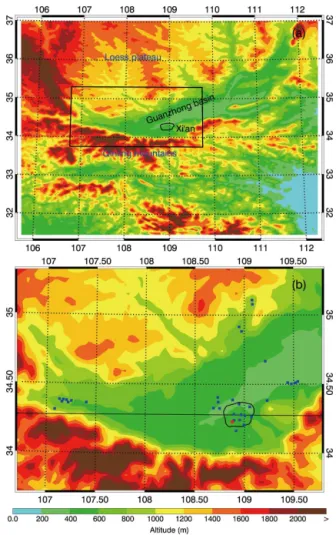
33 monitoring sites are distributed in the Guanzhong basin (Fig. 1b). The daily PM2.5measurement at IEECAS site from
2008 to 2012 and the hourly PM2.5measurement released by
China MEP from 2013 to 2014 are used to validate the cat-egorized synoptic situations influencing the basin. The real-time PM2.5used in this study can be accessed at the website
http://106.37.208.233:20035/. One can also access the his-toric profile of observed ambient pollutants through visiting http://www.aqistudy.cn/ (Ministry of Environmental Protec-tion, 2013a, b).
2.2 FLEXPART-WRF and WRF-CHEM models In order to analyze the corresponding pollutant transport pat-terns under the typical categorized synoptic situations, the FLEXPART model is employed to calculate the forward La-grangian particle dispersion (Stohl et al., 1998; Fast and Easter, 2006), which is driven by the output from the WRF model (Skamarock et al., 2008). The FLEXPART model is set up with releases of 6000 computational particles within a grid cell of 10 km×10 km×0.02 km centered at Xi’An
ur-ban area in the morning. Tracer particles are released con-tinuously from 04:00 to 10:00 BJT (Beijing time) of the day, and traced until 04:00 BJT of next day. For the convenience, all the time used hereafter is BJT. The WRF model adopts one grid with horizontal resolution of 3 km and 35 sigma levels in the vertical direction. The grid cells used for the domain are 201×201 (Fig. 1a). The selected 6 days,
rep-resenting six categorized typical synoptic situations of the Guanzhong basin during wintertime of 2013, are simulated. They are initialized at 20:00 BJT on each day and integrated for 36 h. The NCEP FNL analysis data (1◦
×1◦) are used
to produce the initial and boundary conditions for the WRF model. The physical process parameterization schemes used
Figure 1. (a) WRF and WRF-CHEM model simulation domain with topography and(b)geographic distributions of ambient moni-toring stations. In panel(b), the blue filled squares are the ambient monitoring sites, the red filled circle is the IEECAS site, and the cross line is the position of the cross section shown in Fig. 7. The color contour in both panels denotes the terrain height.
in simulations included the Grell–Devenyi ensemble scheme for cumulus scheme (Grell and Devenyi, 2002), the WRF Single Moment (WSM) three-class microphysics (Hong et al., 2004), and Mellor–Yamada–Janjíc (MYJ) TKE scheme (Janjic, 2002) for the planetary boundary layer (PBL) pro-cesses.
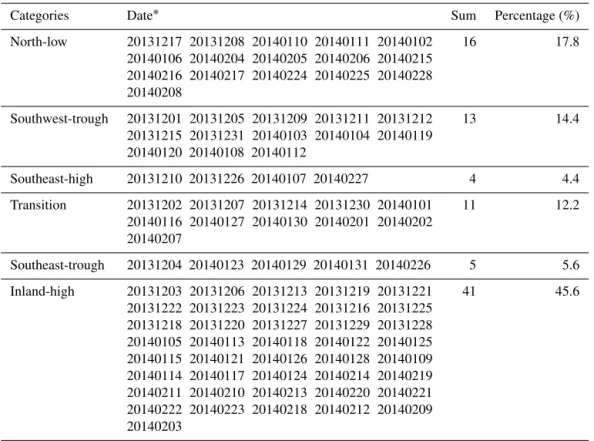
Table 1.Synoptic categories influencing the Guanzhong basin during the wintertime of 2013.
Categories Date∗ Sum Percentage (%)
North-low 20131217 20131208 20140110 20140111 20140102 20140106 20140204 20140205 20140206 20140215 20140216 20140217 20140224 20140225 20140228 20140208
16 17.8
Southwest-trough 20131201 20131205 20131209 20131211 20131212 20131215 20131231 20140103 20140104 20140119 20140120 20140108 20140112
13 14.4
Southeast-high 20131210 20131226 20140107 20140227 4 4.4
Transition 20131202 20131207 20131214 20131230 20140101 20140116 20140127 20140130 20140201 20140202 20140207
11 12.2
Southeast-trough 20131204 20140123 20140129 20140131 20140226 5 5.6
Inland-high 20131203 20131206 20131213 20131219 20131221 20131222 20131223 20131224 20131216 20131225 20131218 20131220 20131227 20131229 20131228 20140105 20140113 20140118 20140122 20140125 20140115 20140121 20140126 20140128 20140109 20140114 20140117 20140124 20140214 20140219 20140211 20140210 20140213 20140220 20140221 20140222 20140223 20140218 20140212 20140209 20140203
41 45.6
∗The format of date is YYYYMMDD, in which YYYY, MM, and DD represent year, month, day, respectively.
the WRF-CHEM model using ISORROPIA (“equilibrium” in Greek, here referred to as an improved thermodynamic equilibrium aerosol model) version 1.7 (http://nenes.eas. gatech.edu/ISORROPIA/). The secondary organic aerosol (SOA) formation is simulated using a non-traditional SOA model including the volatility basis-set modeling method in which primary organic components are assumed to be semi-volatile and photochemically reactive and are distributed in logarithmically spaced volatility bins (Li et al., 2011a). De-tailed description of the WRF-CHEM model can be found in Li et al. (2010, 2011a, b, 2012). The meteorological setup in the WRF-CHEM model simulations is same as those in the WRF model, except that the spin-up time of the WRF-CHEM model is 1 day. The chemical initial and boundary condi-tions for the WRF-CHEM model simulacondi-tions are interpolated from the 6 h output of a global chemical transport model for O3and related chemical tracers (MOZART) (Horowitz et al., 2003). The anthropogenic emission inventory developed by Zhang et al. (2009) is used in the study, including contribu-tions from agriculture, industry, power, residential and trans-portation sources. The MEGAN model developed by Guen-ther et al. (2006) is used to calculate online biogenic emis-sions.
2.3 Classification method
Figure 2. Composite distributions of winds and geopotential heights on 850 hPa at 08:00 BJT for the categories of(a) “north-low”, (b)“southwest-trough”,(c)“southeast-high”,(d)“transition”,(e)“southeast-trough”, and(f)“inland-high”. The red filled circle is Xi’an. The orange shading represents the terrain height over 1500 m.
“southwest-trough” for the day, otherwise it is classified as “inland-high”. Additionally, the occurrence of precipitation is not considered yet in the categorization, which can effi-ciently wash out pollutants in the atmosphere. Therefore, it is worth noting that, on different days which are grouped into the same category, the pollutants behavior might be quite dif-ferent due to the weather system transition or precipitation occurrence.
3 Results
NCEP FNL reanalysis data, the model output from the FLEXPART model, and the PM2.5 measurements in the
Guanzhong basin are used to explore the typical meteorolog-ical synoptic situations and the corresponding plume trans-port patterns. Using the model output from the WRF-CHEM model, we have further investigated the local meteorological conditions, including the PBL height, low-level wind speed,
and inversion layer, and their potential impacts on the air pol-lution formation process in the basin.
3.1 Classification of the typical synoptic situations and the corresponding pollutant transport patterns
Figure 3.Distributions of winds and geopotential heights on 850 hPa at 08:00 BJT on(a)16 February 2014 (“north-low”),(b)19 January 2014 (“southwest-trough”),(c)26 December 2013 (“southeast-high”),(d)2 December 2013 (“transition”),(e)23 January 2014 (“southeast-trough”), and(f)23 December 2013 (“inland-high”). The red filled circle is Xi’an. The orange shading represents the terrain height over 1500 m.
45.6 %, respectively, indicating that the “inland-high” is the dominant wintertime synoptic situation influencing the Guanzhong basin.
For discussion convenience, the following 6 days are se-lected to represent the above six typical synoptic situations: (1) 16 February 2014 (“north-low”), (2) 19 January 2014 (“southwest-trough”), (3) 26 December 2013 (“southeast-high”), (4) 2 December 2013 (“transition”), (5) 23 Jan-uary 2014 (“southeast-trough”), and (6) 23 December 2013 (“inland-high”). For the selection process, 3 days are first chosen for every category. The FLEXPART-WRF and WRF-CHEM models are then used to simulate the pollutants trans-port pattern and PM2.5variations and distributions on the 3
selected days in each category. In general, the simulation re-sults from the two models are similar in the same category, but uncertainties still exist, caused by the weather system transition or occurrence of precipitation. Finally, the most
Figure 4.Twenty-four-hour plume transport patterns initialized from 04:00 BJT on(a)16 February 2014 (“north-low”),(b)19 January 2014 (“southwest-trough”),(c)26 December 2013 (“southeast-high”),(d)2 December 2013 (“transition”),(e)23 January 2014 (“southeast-trough”), and (f)23 December 2013 (“inland-high”). The gray contour denotes the terrain height. The color dots represent the released particles at different time.
“southeast-high” (Fig. 3c), the basin is located in the south-east of the high at 850 hPa, which originates the prevalent northeasterly or northwesterly winds, transporting the pol-lutants outside of the basin and remarkably improving the air quality. When the basin is situated in the transition area between the trough in the north and the high in the south on 850 hPa, the synoptic situation is defined as “transition” (Fig. 3d). The prevailing winds over the basin are generally westerly, but the west wind is significantly attenuated by the topography in the basin and often transformed to be calm or disordered. The atmospheric pollutants are subject to be transported to the east of the basin but are more likely to be trapped in the basin, causing heavy air pollution. Addi-tionally, under the condition of “transition”, the meteorolog-ical fields in the basin are also coordinately adjusted with the development of the trough in the north and the high in the south on 850 hPa. Under the condition of “southeast-trough” (Fig. 3e), the basin is affected by the trough on 850 hPa in the northwest, and the southwest wind is dominant aloft. The weak south winds and convergence formed in front of the trough tend to withhold the air pollutants in the basin,
significantly deteriorating the air quality. For “inland-high” (Fig. 3f), the basin is controlled by the inland high at 850 hPa, and the prevailing wind is varied over the basin, depending on the detailed location of the high. The situation of weak winds, subsidence, and the stable stratification facilitates the accumulation of atmospheric pollutants, often causing severe air pollution in the basin.
Figure 4 displays the 24 h plume transport patterns initial-ized from 04:00 BJT during the above-mentioned 6 represen-tative days. The particles released in the morning in the urban area of Xi’an are generally transported within the PBL. Ap-parently, the particles can be transported outside of the basin only in the case of “southwest-trough” and “southeast-high” and the improvement of air quality in the basin is anticipated. For the remaining four synoptic categories, most of the re-leased particles ramble in the basin, indicating buildup of the air pollutants.
qual-ity in the Guanzhong basin. The other four kinds of synop-tic situations (“north-low”, “transition”, “southeast-trough”, and “inland-high”, defined as unfavorable synoptic situations hereafter) are generally favorable for the accumulation of the air pollutants either in horizontal or vertical directions, ex-cept in the case of the “north-low” with strong winds or pre-cipitation or the “southeast-trough” with strong vertical mix-ing.
Figure 5 displays the average diurnal cycle of observed PM2.5 mass concentrations at 33 monitoring sites in the
Guanzhong basin under the six synoptic categories during the wintertime of 2013. The favorable synoptic situations consis-tently correspond to low PM2.5mass concentrations or
rela-tively good air quality and vice versa. Under the unfavorable synoptic situations, the observed average PM2.5 mass
con-centrations generally range from 150 to 250 µg m−3, showing that the basin has experienced heavy air pollution. The PM2.5
mass concentrations for “north-low” are lower than those un-der the other three unfavorable synoptic situations, which is caused by the possible occurrence of precipitation in “north-low”. For example, the synoptic patterns on 4–5 February 2014 are categorized as “north-low”, but the observed aver-age PM2.5mass concentrations are less than 90 µg m
−3 be-cause of the precipitation washout during these 2 days. Al-though the favorable synoptic situations facilitate the evac-uation of air pollutants in the basin, the observed average PM2.5mass concentrations still exceed 35 µg m
−3, indicating that the air quality in the basin barely reaches the “excellent” level. It should be noted that exceptional days exist beyond the six synoptic situations, demonstrating the complexity of atmospheric circulations.
Using the same method deployed in 2013, we have fur-ther classified the large-scale synoptic situations of the win-tertime in the Guanzhong basin for the period from 2008 to 2012. The above-mentioned six typical synoptic situa-tions influencing the Guanzhong basin during the winter-time from 2008 to 2012 are summarized in Table 2. Fig-ure 6 displays the daily mean PM2.5mass concentration
av-eraged during the six typical synoptic situations from 2008 to 2012 at the IEECAS site. The percentage of total un-favorable synoptic situations during 2008 to 2012 is about 85 %, and corresponding daily PM2.5 mass concentrations
exceed 200 µg m−3 (Fig. 6), indicating significant contribu-tion from the large-scale meteorological condicontribu-tions to the poor air quality in the basin. The “inland-high” dominates the synoptic situation in association with the poor air quality in the basin, with contribution around 43 %. The favorable sit-uations constitute about 15 % of the synoptic situation in the basin, which is anticipated to flush the basin and significantly improve the air quality. However, the observed daily PM2.5
mass concentrations during the favorable situations still ex-ceed 75 µg m−3and fail to reach the “good” level, indicating massive local emissions of pollutants and considerable con-tributions of background dust transported from Loess Plateau in the north.
Figure 5.Diurnal cycle of observed PM2.5mass concentrations
av-eraged over 33 monitoring sites in the Guanzhong basin under the six synoptic categories during the wintertime of 2013.
Figure 6.Daily mean PM2.5mass concentration average during the
six typical synoptic situations from 2008 to 2012 at the IEECAS site.
3.2 Local meteorological conditions on the selected 6 days and their impact on the air quality
The results of the FLEXPART model only explain the direct impact of the meteorological fields on the plume transport process since chemical processes are not considered in the model. The WRF-CHEM model is therefore used to simulate the air quality in the Guanzhong basin on the selected 6 days corresponding to the above-mentioned six typical synoptic situations.
Table 2.Days and percentage of the six types of synoptic situations influencing the Guanzhong basin during the wintertime from 2008 to 2012.
Categories North Southwest Southeast Transition Southeast Inland low trough high trough high
2008 14 8 2 15 11 40
2009 17 6 6 14 18 29
2010 14 10 8 8 6 41
2011 16 6 10 5 3 52
2012 22 9 1 15 13 31
Sum 83 39 27 57 51 193
Percentage (%) 18.4 8.7 6.0 12.7 11.3 42.9
Figure 7.Vertical distributions of temperature, wind vectors, and PBL height along the cross line denoted in Fig. 1b at 09:00 and 15:00 BJT on (a)16 February 2014 (“north-low”),(b)19 January 2014 (“southwest-trough”),(c)26 December 2013 (“southeast-high”),(d)2 De-cember 2013 (“transition”),(e)23 January 2014 (“southeast-trough”), and(f)23 December 2013 (“inland-high”). The black filled rectangle represents the urban area of Xi’an, China.
Qinling Mountains) has important impacts on the low-level wind fields inside the basin. Under unfavorable synoptic sit-uations, the winds inside the basin are remarkably attenuated due to the influence of the terrain, favorable for trapping the air pollutants formed in the basin. In addition, at 09:00 BJT, temperature inversions in the case of unfavorable synoptic situations also impede the development of PBL, decreasing the diffusion of air pollutants in the vertical direction. At
pollu-tants inside the basin due to inefficient horizontal transport and impeded vertical diffusion, leading to heavy air pollution in the basin. In the case of favorable synoptic situations, the strong horizontal wind (19 January 2014) or active vertical motion (26 December 2013) efficiently diffuse the pollutants in the horizontal or vertical directions and the high PBL also expedites the vertical exchange of air pollutants in the basin; thus good air quality is expected.
In order to investigate the detailed local meteorologi-cal conditions over the Guanzhong basin during the above-mentioned 6 days, we have further analyzed the low-level (below 850 hPa) horizontal wind speed and PBL height av-eraged over the Guanzhong basin (the avav-eraged domain in-dicated in Fig. 1). Figure 8 shows the time evolutions of the area averaged low-level wind speed and PBL height over the basin on the selected 6 days. In general, under favorable syn-optic situations, the occurrence of strong horizontal winds speeds up the evacuation of pollutants, such as on 19 Jan-uary 2014, the average wind speed is around 8 m s−1. In ad-dition, the daily average PBL height exceeds 500 m, facilitat-ing the pollutants dispersion in the vertical direction. How-ever, under the unfavorable conditions, except on 2 Decem-ber 2013, the weak horizontal winds inefficiently disperse the pollutants; i.e., the horizontal wind speed is about 2 m s−1on 23 December 2013. The low PBL also suppresses the ver-tical dispersion in the basin. On 2 December 2013 (“transi-tion”), the basin is influenced by the trough in the north and the high in the south on 850 hPa, and the variation of mete-orological conditions inside the basin is determined by the development of the trough and the high. From early morn-ing to noontime, the wind gradually gets stronger, indicatmorn-ing the deepening of the trough in the north and possible vent-ing of pollutants from the basin. The increasvent-ing winds in the evening also induce high PBL, enhancing the pollutants mix-ing in the vertical direction. In general, the synoptic pattern influencing the basin experience the transition from “inland-high” to “southwest-trough”, so that the pollutants accumu-lated in the basin in the morning have potentials to be trans-ported outside of the basin in the afternoon/evening, depend-ing on the deependepend-ing of the trough in the north at 850 hPa.
Figure 9 presents the observed and simulated spatial dis-tributions of near-surface PM2.5 mass concentrations along
with the modeled wind fields in the Guanzhong basin at 09:00 and 15:00 BJT on the selected 6 days. The calcu-lated patterns of PM2.5 mass concentrations are generally
consistent with the observation over the ambient monitor-ing sites on those days. Under the favorable situations, the strong northern or northwestern winds have commenced to evacuate the air pollutants accumulated during nighttime at 09:00 BJT (Fig. 8b and c), and the whole basin becomes clean at 15:00 BJT. In case of unfavorable situations, the near-surface winds in the basin are weak or calm and fre-quently disordered, which facilitates the accumulation of air pollutants, causing heavy air pollution. The modeled and observed PM2.5 mass concentrations exceed 150 µg m
−3 at
Figure 8. Temporal variations of the area averaged low-level (a)wind speeds and(b)PBL height over the basin on 16 Febru-ary 2014 (“north-low”), 19 JanuFebru-ary 2014 (“southwest-trough”), 26 December 2013 (“southeast-high”), 2 December 2013 (“tran-sition”), 23 January 2014 (“southeast-trough”), and 23 December 2013 (“inland-high”).
most of the monitoring sites. Particularly, on 23 December 2013 (“inland-high”), the basin experienced severe air pol-lution with the PM2.5mass concentrations exceeding 250 or
even 500 µg m−3at the monitoring sites. On 23 January 2014 (“southeast-trough”), the near-surface south winds over Qin-ling Mountains are not weak, but, apparently, the warm and humid air from the south does not significantly influence the wind fields in the basin. Unfortunately, the south winds over the Qinling Mountains carry the warm air aloft the basin, causing temperature inversion and further hindering the dif-fusion of air pollutants in the vertical direction (Fig. 6e). Therefore, under the condition of “southeast-trough”, the whole basin seems to be sealed and is often severely polluted; i.e., the 5-year average filter measured PM2.5mass
concen-tration exceeds 300 µg m−3at the IEECAS site (Fig. 5). Fig-ure 10 presents the comparison of observed and predicted diurnal profiles of the PM2.5mass concentrations averaged
over the monitoring sites in the Guanzhong basin on the se-lected 6 days. The WRF-CHEM model generally captures well the observed diurnal variations of the PM2.5mass
con-centrations, but the model simulations tend to underesti-mate the PM2.5concentrations when the levels are high. The
model biases are mainly from the uncertainties of anthro-pogenic emissions and meteorological field simulations. The model often underestimates the observed PM2.5 mass
observa-Figure 9.Pattern comparison of simulated vs. observed near-surface PM2.5mass concentrations at 09:00 and 15:00 BJT on(a)16 February
2014 (“north-low”),(b)19 January 2014 (“southwest-trough”),(c)26 December 2013 (“southeast-high”),(d)2 December 2013 (“transi-tion”),(e)23 January 2014 (“southeast-trough”), and(f)23 December 2013 (“inland-high”). Colored squares: PM2.5observations; color
contour: PM2.5simulations; black arrows: simulated surface winds.
Figure 10.Comparison of observed and predicted diurnal profiles of the PM2.5 mass concentrations averaged over the monitoring
sites in the Guanzhong basin on (a) 16 February 2014 (“north-low”),(b) 19 January 2014 (“southwest-trough”),(c)26 Decem-ber 2013 (“southeast-high”),(d)2 December 2013 (“transition”), (e) 23 January 2014 (“southeast-trough”), and (f) 23 December 2013 (“inland-high”).
tion. According to Fig. 9f, the simulated northeast winds are subject to pushing the plume to the south of the basin, caus-ing the model underestimation compared to measurements. Under favorable synoptic situations, the average PM2.5mass
concentrations over the monitoring sites are significantly de-creased from the early morning to the late afternoon, and the air quality can reach a good level during daytime. However, under the conditions of unfavorable synoptic situations, the average PM2.5mass concentrations do not decrease as much
or even increase in the afternoon when the PBL well devel-ops. The unfavorable synoptic situations generally induce the stagnant circumstances, retaining the air pollutants inside the basin. In the afternoon with the peak of sunlight, the elevated air pollutants, including the precursors of secondary aerosols, cause the rapid formation of secondary aerosols, such as ni-trate and SOA, compensating the decrease of PM2.5 mass
concentrations due to the development of the PBL. Further-more, high levels of aerosols in the low-level atmosphere also scatter the solar radiation and reduce the surface tempera-ture, suppressing the development of the PBL. So the forma-tion of secondary aerosols and the aerosol radiaforma-tion feedback likely lead to high PM2.5mass concentrations in the
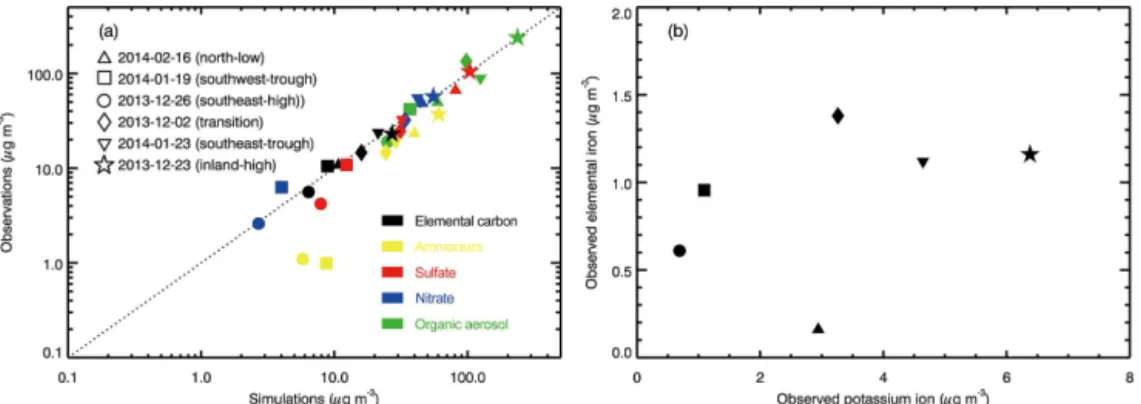
Figure 11.Scatter plot of(a)the measured vs. modeled daily mean mass concentration of aerosol constituents and(b)the elemental iron with potassium measured by filter samples at IEECAS site on the selected 6 days.
mass concentration of major aerosol constituents at IEECAS site on the selected 6 days. The filter-measured organic car-bon is scaled by a factor of 1.8 to compare with the simu-lated organic aerosol (Carlton et al., 2010). The WRF-CHEM model performs reasonably well in simulating daily mean sulfate, ammonium, organic aerosols, and elemental carbon. However, the model consistently overestimates the observed ammonium aerosol mass concentration. The filter measure-ments show that the PM2.5 in the basin contains abundant
potassium, sodium, and calcium ions which are originated from biomass burning or dust and are able to preferentially replace the ammonium ions (Shen et al., 2009, 2011). Fig-ure 11b shows the scatter plot of the elemental iron with potassium measured by filter samples at the IEECAS site on the selected 6 days. In general, the elemental iron is pri-marily originated from dust and the potassium is mainly at-tributed by biomass burning. Under unfavorable conditions, the potassium concentration exceeds 3 µg m−3, showing con-siderable amount of biomass burning. Except on 16 February the elemental iron concentration is also high, ranging from 0.5 to 1.5 µg m−3, likely caused by the local production or long-range transport from Loess Plateau (Long et al., 2016). On 16 February the trace precipitation did not wash out pol-lutants efficiently but did moisten the ground surface in the basin, hindering the dust production. In the WRF-CHEM simulations, the contributions of potassium, sodium, and cal-cium ions are not considered due to lack of available emis-sions inventories; thus when there is sufficient ammonia con-centration in the atmosphere, this can lead to overestimation of ammonium aerosols. In general, the simulated PM2.5
pat-terns and variations on the selected 6 days are consistent with the corresponding synoptic situations.
4 Conclusions and discussions
In the present study, the typical synoptic situations influenc-ing the Guanzhong basin durinfluenc-ing wintertime have been inves-tigated to evaluate their potential impacts on the air quality
in the basin by using NCEP reanalysis data, aerosol measure-ments, and simulations by the FLEXPART, WRF, and WRF-CHEM models. The results show that the synoptic situations significantly contribute to the air pollution in the basin during wintertime.
Based on the NCEP reanalysis data, the large-scale syn-optic situations influencing the Guanzhong basin during the wintertime of 2013 are categorized into six types, which are “north-low”, “southwest-trough”, “southeast-high”, “transi-tion”, “southeast-trough”, and “inland-high”. The FLEX-PART trajectory model has been utilized to examine the cor-responding pollutant transport patterns for the typical synop-tic situations in the basin. The pollutants are transported out-side of the basin under “southwest-trough” and “southeast-high”, which are defined as favorable synoptic situations. The remaining four types of synoptic conditions, defined as unfavorable synoptic situations, are subject to pollutant ac-cumulation in the basin, causing heavy air pollution. In as-sociation with the PM2.5 measurements released by China
MEP, the low PM2.5level or good air quality generally
cor-respond to the favorable synoptic situations and vice versa in the basin.
Analysis of the large-scale synoptic situations of the win-tertime during 2008 to 2012 shows that unfavorable synoptic situations constitute about 85 % of the winter days, indicat-ing significant contribution from the large-scale meteorologi-cal conditions to the poor air quality in the Guanzhong basin. In addition, the percentage of “inland-high” is around 42 %, which is the most frequent synoptic situation associated with poor air quality in the basin.
The WRF-CHEM model has been further used to simulate the selected 6 days representing the typical synoptic situa-tions during the wintertime of 2013, and the results show that the modeled PM2.5distribution and variations are generally
de-tailed meteorological conditions, including temperature in-version, low-level horizontal wind speed, and PBL height, are also analyzed for the selected days. Under unfavorable synoptic situations, temperature inversion, weak low-level wind, and low PBL do not facilitate the dispersion of pol-lutants in the basin. In contrast, under the favorable synoptic situations, strong horizontal winds and high PBL efficiently vent the air pollutants from the basin.
During wintertime, 5-year filter PM2.5measurements from
2008 to 2012 and the PM2.5measurements released by China
MEP in 2013 and 2014 all show that the Guanzhong basin has experienced heavy air pollution. Even under favorable synoptic situations, the observed PM2.5mass concentrations
have barely reached the “excellent” level due to massive lo-cal emissions of air pollutants and the background dust trans-ported from Loess Plateau. Thus, considering the proportion of occurrence of unfavorable synoptic situations during win-tertime, reduction of emissions is a feasible method to reduce the air pollution in the Guanzhong basin.
Given that the categorization of synoptic situations are made at 850 hPa that influence the Guanzhong basin, poten-tial uncertainties still exist in the classification results. More quantitative studies are needed in the future to improve the synoptic situation classification. Further, the analysis using local meteorological observations on ground surfaces and in-side the PBL is also imperative for investigating the role of the local meteorological conditions during severe pollution events.
5 Data availability
The real-time O3, NO2, and PM2.5 are accessible to the
public on the website http://106.37.208.233:20035/. One can also access the historic profile of observed ambient pollutants through visiting http://www.aqistudy.cn/.
Acknowledgements. Naifang Bei is supported by the National Nat-ural Science Foundation of China (nos. 41275101 and 41430424) and the Fundamental Research Funds for the Central Universities of China. Guohui Li is supported by “Hundred Talents Program” of the Chinese Academy of Sciences and the National Natural Science Foundation of China (no. 41275153).
Edited by: R. Volkamer
References
Bei, N., de Foy, B., Lei, W., Zavala, M., and Molina, L. T.: Using 3DVAR data assimilation system to improve ozone simulations in the Mexico City basin, Atmos. Chem. Phys., 8, 7353–7366, doi:10.5194/acp-8-7353-2008, 2008.
Bei, N., Lei, W., Zavala, M., and Molina, L. T.: Ozone predictabili-ties due to meteorological uncertainpredictabili-ties in the Mexico City basin using ensemble forecasts, Atmos. Chem. Phys., 10, 6295–6309, doi:10.5194/acp-10-6295-2010, 2010.
Bei, N., Li, G., and Molina, L. T.: Uncertainties in SOA simula-tions due to meteorological uncertainties in Mexico City dur-ing MILAGRO-2006 field campaign, Atmos. Chem. Phys., 12, 11295–11308, doi:10.5194/acp-12-11295-2012, 2012.
Bei, N., Li, G., Zavala, M., Barrera, H., Torres, R., Grutter, M., Gutiérrez, W., García, M., Ruiz-Suarez, L. G., Ortinez, A., Gui-tierrez, Y., Alvarado, C., Flores, I., and Molina, L. T. : Mete-orological overview and plume transport patterns during Cal-Mex 2010, Atmos. Environ., 70, 477–489, 2013.
Binkowski, F. S. and Roselle, S. J.: Models-3 Community Multi-scale Air Quality (CMAQ) model aerosol component: 1. Model description, Journal of Geophysical Research, J. Geophys. Res., 108, 4183, doi:10.1029/2001JD001409, 2003.
Cao, J. J., Zhu, C. S., Chow, J. C., Waston, J. G., Han, Y. M., Wang, G., Shen, Z., and An, Z.: Black carbon relationships with emis-sions and meteorology in Xi’an, China, Atmos. Res., 94, 194– 202, 2009.
Cao, J. J., Wang, Q. Y., Chow, J. C., Watson, J. G., Tie, X., Shen, Z., Wang, P., and An, Z: Impacts of aerosol compositions on visibil-ity impairment in Xi’an, China, Atmos. Environ., 59, 559–566, 2012.
Carlton, A. G., Bhave, P. V., Napelenok, S. L., Edney, E. O., Sar-war, G., Pinder, R. W., Pouliot, G. A., and Houyoux, M.: Model Representation of Secondary Organic Aerosol in CMAQv4.7, Environ. Sci. Technol., 44, 8553–8560, doi:10.1021/es100636q, 2010.
Chan, C. K. and Yao, X.: Air pollution in mega cities in China, Atmos. Environ., 42, 1–42, 2008.
Chen, Z., Cheng, S., Li, J., Guo, X., Wang, W., and Chen, D.: Re-lationship between atmospheric pollution processes and synoptic pressure patterns in Northern China, Atmos. Environ., 42, 6078– 6087, 2008.
Cheng, W. L., Pai, J. L., Tsuang, B. J., and Chen, C. L.: Synop-tic patterns in relation to ozone concentrations in West-Central Taiwan, Meteorol. Atmos. Phys., 78, 11–21, 2001.
de Foy, B., Caetano, E., Magaña, V., Zitácuaro, A., Cárdenas, B., Retama, A., Ramos, R., Molina, L. T., and Molina, M. J.: Mexico City basin wind circulation during the MCMA-2003 field cam-paign, Atmos. Chem. Phys., 5, 2267–2288, doi:10.5194/acp-5-2267-2005, 2005.
de Foy, B., Varela, J. R., Molina, L. T., and Molina, M. J.: Rapid ventilation of the Mexico City basin and regional fate of the urban plume, Atmos. Chem. Phys., 6, 2321–2335, doi:10.5194/acp-6-2321-2006, 2006.
Fang, M., Chan, C. K., and Yao, X. H.: Managing air quality in a rapidly developing nation: China, Atmos. Environ., 43, 79–86, 2009.
Fast, J. and Easter, R.: A Lagrangian Particle Dispersion Model Compatible with WRF, 2006. 7th WRF Users Workshop, NCAR, 19–22 June 2006, Boulder, Colorado, USA, 2006.
Gao, Y., Liu, X., Zhao, C., and Zhang, M.: Emission controls ver-sus meteorological conditions in determining aerosol concentra-tions in Beijing during the 2008 Olympic Games, Atmos. Chem. Phys., 11, 12437–12451, doi:10.5194/acp-11-12437-2011, 2011. Grell, G. A. and Devenyi, D.: A generalized approach to pa-rameterizing convection combining ensemble and data as-similation techniques, Geophys. Res. Lett., 29, 38-1–38-4, doi:10.1029/2002GL015311, 2002.
Grell, G. A., Peckham, S. E., Schmitz, R., McKeen, S. A., Wilczak, J., and Eder, B.: Fully coupled “online” chemistry within the WRF model, Atmos. Environ., 39, 6957–6975, 2005.
Guenther, A., Karl, T., Harley, P., Wiedinmyer, C., Palmer, P. I., and Geron, C.: Estimates of global terrestrial isoprene emissions using MEGAN (Model of Emissions of Gases and Aerosols from Nature), Atmos. Chem. Phys., 6, 3181–3210, doi:10.5194/acp-6-3181-2006, 2006.
Guo, S., Hu, M., Zamora, M. L., Peng, J., Shang, D., Zheng, J., Du, Z., Wu, Z., Shao, M., Zeng, L., Molina, M. J., and Zhang, R.: Elucidating severe urban haze formation in China, P. Natl. Acad. Sci. USA, 111, 17373–17378, 2014.
Han, S., Wu, J., Zhang, Y., Cai, Z., Feng, Y., Yao, Q., Li, X., Liu, Y., and Zhang, M.: Characteristics and formation mechanism of a winter hazeefog episode in Tianjin, China, Atmos. Environ., 98, 323–330, 2014.
Hong, S.-Y., Dudhia, J., and Chen, S.-H.: A revised approach to ice microphysical processes for the bulk parameterization of clouds and precipitation, Mon. Weather Rev., 132, 103–120, 2004. Horowitz, L. W., Waters, S., Mauzerall, D. L., Emmons, L. K.,
Rasch, P. J., Tie, X., Lamarque, J.-F., Schultz, M. G., Tyndall, G. S., Orlando, J. J., and Brasseur, G. P.: A global simulation of tropospheric ozone and related tracers: Description and eval-uation of MOZART, version 2, J. Geophys. Res., 108, 4784, doi:10.1029/2002JD002853, 2003.
Huang, R. J., Zhang, Y. L., Bozzetti, C., Ho, K. F., Cao, J. J., Han, Y. M., Dällenbach, K. R., Slowik, J. G., Platt, S. M., Canonaco, F., Zotter, P., Wolf, R., Pieber, S. M., Bruns, E. A., Crippa, M., Ciarelli, G., Piazzalunga, A., Schwikowski, M., Abbaszade, G., Schnelle-Kreis, J., Zimmermann, R., An, Z. S., Szidat, S., Bal-tensperger, U., EI Haddad, I., and Prévôt, A. S. H.: High sec-ondary aerosol contribution to particulate pollution during haze events in China, Nature, 514, 218–222, 2014.
Huth, R., Beck, C., Philipp, A., Demuzere, M., Ustrnul, Z., Cahynová, M., Kyselý, J., and Tveito, O. E.: Classifications of at-mospheric circulation patterns, Ann. NY Acad. Sci., 1146, 105– 152, 2008.
Jacobeit, J.: Classifications in climate research, Phys. Chem. Earth, 35, 411–421, 2010.
Janjic, Z. I.: Nonsingular implementation of the Mellor-Yamada level 2.5 scheme in the NCEP Meso Model, NCEP Office Note, 437, College Park, MD, USA, 61 pp., 2002.
Li, G., Lei, W., Zavala, M., Volkamer, R., Dusanter, S., Stevens, P., and Molina, L. T.: Impacts of HONO sources on the photochem-istry in Mexico City during the MCMA-2006/MILAGO Cam-paign, Atmos. Chem. Phys., 10, 6551–6567, doi:10.5194/acp-10-6551-2010, 2010.
Li, G., Bei, N., Tie, X., and Molina, L. T.: Aerosol ef-fects on the photochemistry in Mexico City during MCMA-2006/MILAGRO campaign, Atmos. Chem. Phys., 11, 5169– 5182, doi:10.5194/acp-11-5169-2011, 2011a.
Li, G., Zavala, M., Lei, W., Tsimpidi, A. P., Karydis, V. A., Pan-dis, S. N., Canagaratna, M. R., and Molina, L. T.: Simulations of organic aerosol concentrations in Mexico City using the WRF-CHEM model during the MCMA-2006/MILAGRO campaign, Atmos. Chem. Phys., 11, 3789–3809, doi:10.5194/acp-11-3789-2011, 2011b.
Li, G., Lei, W., Bei, N., and Molina, L. T.: Contribution of garbage burning to chloride and PM2.5 in Mexico City, Atmos. Chem.
Phys., 12, 8751–8761, doi:10.5194/acp-12-8751-2012, 2012. Liu, X. G., Li, J., Qu, Y., Han, T., Hou, L., Gu, J., Chen, C., Yang,
Y., Liu, X., Yang, T., Zhang, Y., Tian, H., and Hu, M.: Formation and evolution mechanism of regional haze: a case study in the megacity Beijing, China, Atmos. Chem. Phys., 13, 4501–4514, doi:10.5194/acp-13-4501-2013, 2013.
Long, X., Li, N., Tie, X., Cao, J., Zhao, S., Huang, R., Zhao, M., Li, G., and Feng, T.: Urban dust in the Guanzhong Basin of China, part I: A regional distribution of dust sources retrieved using satellite data, Sci. Total Environ., 541, 1603–1613, 2016. Ministry of Environmental Protection, China (China MEP): Air
Quality Observation Real-time Release Platform of MEP Data Center, available at: http://106.37.208.233:20035/ (last access: 14 June 2016), 2013a.
Ministry of Environmental Protection, China (China MEP): On-line Monitoring and Analysis Platform of China Air Quality, available at: http://www.aqistudy.cn/ (last access: 14 June 2016), 2013b.
Penner, J. P., Andreae, M., Annegarn, H., et al.: Aerosols, their di-rect and indidi-rect effects, in: Climate Change 2001: The Scientific Basis. Contribution of Working Group I to the Third Assessment Report of the Intergovernmental Panel on Climate Change, edited by: Houghton, J. T., Ding, Y., Griggs, D. J., Noguer, M., Van der Linden, P. J., Dai, X., Maskell, K., and Johnson, C. A., Cam-bridge University Press, CamCam-bridge, UK, 289–348, 2001. Philipp, A., Bartholy, J., Beck, C., Erpicum, M., Esteban, P.,
Fet-tweis, X., Huth, R., James, P., Jourdain, S., and Kreienkamp, F.: COST733CAT-a database of weather and circulation type classi-fications, Phys. Chem. Earth, 35, 360–373, 2010.
Pope III, C. A. and Dockery, D. W.: Health effects of fine particulate air pollution: lines that connect, J. Air Waste Manage., 56, 709– 742, 2006.
Seaman, N. L.: Meteorological modeling for air-quality assess-ments, Atmos. Environ., 34, 2231–2259, 2000.
Shen, Z., Cao, J., Arimoto, R., Han, Z., Zhang, R., Han, Y., Liu, S., Okuda, T., Nakao, S., and Tanaka, S.: Ionic composition of TSP and PM2.5 during dust storms and air pollution episodes at Xi’an, China, Atmos. Environ., 43, 2911–2918, 2009.
Shen, Z. X., Cao, J. J., Arimoto, R., Han, Y., Zhu, C., Tian, J., and Liu, S.: Chemical characteristics of fine particles (PM1) over Xi’an, China, Aerosol Sci. Tech., 44, 461–472, 2010.
Shen, Z. X., Cao, J. J., Liu, S. X., Zhu, C., Wang, X., Zhang, T., Xu, H., and Hu, T.: Chemical composition of PM10and PM2.5
col-lected at ground level and 100-m during a strong winter-time pol-lution episode in Xi’an, China, J. Air Waste Manage., 61, 1150– 1159, 2011.
Solomon, P., Cowling, E., Hidy, G., and Furiness, C.: Comparison of scientific findings from major ozone field studies in North America and Europe, Atmos. Environ., 34, 1885–1920, 2000. Stohl, A., Hittenberger, M., and Wotawa, G.: Lagrangian particle
dispersion model FLEXPART against large scale tracer experi-ment data, Atmos. Environ., 32, 4245–4264, 1998.
Wang, H., Xu, J., Zhang, M., Yang, Y., Shen, X., Wang, Y., Chen, D., and Guo, J.: A study of the meteorological causes of a pro-longed and severe haze episode in January 2013 over central-eastern China, Atmos. Environ., 98, 146–157, 2014.
Wang, L., Zhang, N., Liu, Z., Sun, Y., Ji, D., and Wang, Y.: The Influence of Climate Factors, Meteorological Conditions, and Boundary-Layer Structure on Severe Haze Pollution in the Beijing-Tianjin-Hebei Region during January 2013, Adv. Mete-orol., 2014, 1–14, 2014.
Wang, Y., Hao, J., McElroy, M. B., Munger, J. W., Ma, H., Chen, D., and Nielsen, C. P.: Ozone air quality during the 2008 Beijing Olympics: effectiveness of emission restrictions, Atmos. Chem. Phys., 9, 5237–5251, doi:10.5194/acp-9-5237-2009, 2009. Wei, P., Cheng, S., Li, J., and Su, F.: Impact of boundary-layer
anti-cyclonic weather system on regional air quality, Atmos. Environ., 45, 2453–2463, 2011.
Wu, D., Liao, G., Deng, X., Bi, X., Tan, H., Li, F., Jiang, C., Xia, D., and Fan, S.: Transport Condition of Surface Layer Under Haze Weather over the Pearl River Delta, J. Appl. Meteor. Sci., 19, 1–9, 2008 (in Chinese).
Wu, M., Wu, D., Fan, Q., Wang, B. M., Li, H. W., and Fan, S. J.: Observational studies of the meteorological characteristics associated with poor air quality over the Pearl River Delta in China, Atmos. Chem. Phys., 13, 10755–10766, doi:10.5194/acp-13-10755-2013, 2013.
Yang, Y., Liu, X., Qu, Y., Wang, J., An, J., Zhang, Y., and Zhang, F.: Formation mechanism of continuous extreme haze episodes in the megacity Beijing, China, in January 2013, Atmos. Res., 155, 192–203, 2015.
Zhang, J., Mauzerall, D. L., Zhu, T., Liang, S., Ezzati, M., and Remais, J. V.: Environmental health in China: progress towards clean air and safe water, The Lancet, 375, 1110–1119, 2010. Zhang, J. P., Zhu, T., Zhang, Q. H., Li, C. C., Shu, H. L., Ying, Y.,
Dai, Z. P., Wang, X., Liu, X. Y., Liang, A. M., Shen, H. X., and Yi, B. Q.: The impact of circulation patterns on regional trans-port pathways and air quality over Beijing and its surroundings, Atmos. Chem. Phys., 12, 5031–5053, doi:10.5194/acp-12-5031-2012, 2012.
Zhang, Q., Streets, D. G., Carmichael, G. R., He, K. B., Huo, H., Kannari, A., Klimont, Z., Park, I. S., Reddy, S., Fu, J. S., Chen, D., Duan, L., Lei, Y., Wang, L. T., and Yao, Z. L.: Asian emis-sions in 2006 for the NASA INTEX-B mission, Atmos. Chem. Phys., 9, 5131–5153, doi:10.5194/acp-9-5131-2009, 2009. Zhang, Q., Quan, J., Tie, X., Li, X., Liu, Q., Gao, Y., and Zhao,
D.: Effects of meteorology and secondary particle formation on visibility during heavy haze events in Beijing, China, Sci. Total Environ., 502, 578–584, 2015.
Zhang, Q. H., Zhang, J. P., and Xue, H. W.: The challenge of im-proving visibility in Beijing, Atmos. Chem. Phys., 10, 7821– 7827, doi:10.5194/acp-10-7821-2010, 2010.