Asymmetries in
e
þe
!
f
f
processes at ILC for models with an extra neutral vector boson
Z
0E. C. F. S. Fortes,*J. C. Montero,†and V. Pleitez‡
Instituto de Fı´sica Teo´rica–Universidade Estadual Paulista R. Dr. Bento Teobaldo Ferraz 271, Barra Funda Sa˜o Paulo - SP, 01140-070, Brazil
(Received 12 May 2010; published 9 December 2010)
Many extensions of the standard model predict the existence of extra neutral vector bosons, generically referred asZ0. This boson may be discovered at the LHC but in this case it will be necessary to study the respective parameters in order to discriminate to which model it belongs to. This is a task for a much clean lepton linear collider as the future International Linear Collinear. In this paper we develop an exemplary study of the capability of several asymmetries on and offZ0peak in discriminating among those extensions with (almost) no ambiguities.
DOI:10.1103/PhysRevD.82.114007 PACS numbers: 13.66.Hk, 12.60.Cn, 14.70.Pw
I. INTRODUCTION
Among the most motivated extensions of the standard model (SM) are those in which the gauge symmetries of the model are extended by at least one extraUð1Þ factor, probably, a remnant of unknown physics at higher energy scales. In fact, these sorts of models arise, for example, in grand unified theories inspired, or not, in superstring, left-right (LR) models, and supersymmetric models [1,2]. An interesting feature of these models is the existence of extra neutral vector bosons, generically denoted by Z0, which may be manifested at the TeV scale, implying a rich phe-nomenology in the hadron and future lepton colliders [3,4]. These bosons appear also in models of dynamical symme-try breaking, Little Higgs models, models with extra di-mensions, or even through the Stueckelberg mechanism which avoids the Higgs mechanism for generating the mass for the Z0 boson [5]. If they do exist they can be discovered at the LHC but this will only be the first step: next it will be necessary to discriminate model that better fits all the measured parameters as its mass, its partial and total widths, and its couplings to the known fermions, etc. The detailed study of these properties can be done at a linear collider like the International Linear Collinear (ILC). Concerning the quantum numbers related to the Abelian factors, the options are numerous but some most motivated ones involve the baryon (B), total lepton (L), or lepton family (Li), numbers, or combinations of some of them. However, it is still possible that they are related with an exotic charge (X). In particular, it is interesting that the extra local Uð1Þ symmetry is related to B L since
Uð1ÞB L is an automatic global symmetry of the degrees
of freedom of the SM, i.e., without right-handed neutrinos, and it is also anomalous [6]. It is possible to gauge this symmetry when an appropriate number of right-handed neutrinos is introduced, in order to make this symmetry anomaly free. Moreover, the energy scale in which the new
Uð1ÞB Lsymmetry is broken is related to the generation of
the light neutrino masses through the seesaw mechanism. The simplest way to implementB Las a gauge symme-try is by adding just an extraUð1Þfactor, which generator may, or may not, commute with the Uð1ÞY generators. In the first case, the electric charge operator has also a component on this factor, and in the second one, the electric charge operator is the same as in the SM, i.e., it has no component on the extraUð1Þsymmetry. We call the former sort of models ‘‘flipped,’’ as the models in Ref. [7], and ‘‘secluded’’ models the latter ones [8], and an example (nonsupersymmetric) is in Ref. [9]. Although usually this extra symmetry is related to a grand unified theory, from the phenomenological point of view, we can build models in this simplest way, independently of their origin, and study their properties in lepton or hadron colliders.
In general, the masses of the new neutral vector boson must be in the order of few TeV, or be very weakly coupled to the known matter, in order to maintain consistency with the present phenomenology. This boson may be discovered at the LHC, but in order to study its respective parameters a linear leptonic collider, like the proposed ILC [10,11], is better suited. Below, we will show that the study of several asymmetries, on- and off- the Z0 peak, in this type of collider can be used to discriminate among the different models which have this extra neutral vector boson. Among the most studied models in the literature are those based on theE6 grand unified theory group and left-right symmetry
groups [12], and also those in which an extra Uð1ÞB L
factor is added, as those discussed above.
The outline of this paper is as follows. In Sec.IIwe give a general discussion of the models whose details are pre-sented in Secs. II A andII B,E6 and left-right symmetric
models are summarized in Sec. II C. Our results and dis-cussions appear in Sec.III, and the conclusions in Sec.IV. Exact analytical expressions for the neutral current coef-ficients defined in Eq. (1), for the flipped model are given in the AppendixA, while in AppendixBwe show the partial decay widths of the neutral vector boson mass eigenstates, denoted byZ1;2.
II. THE MODELS
Here we will consider extensions of the electroweak standard model in which there are twoUð1Þgauge factors, i.e., these models are based on the SUð2ÞLUð1Þ1 Uð1Þ2 gauge symmetries. In general, there is a mixing
between the two Abelian gauge bosons in the kinetic term and in the mass term [13]; however, we will work in a basis in which the kinetic term, at the tree level, is already diagonal, and the mixing between the two neutral vector bosons may appear, or not, in the mass term.
Below we will denote Z and Z0 the symmetry eigen-states, and Z1 and Z2 the mass eigenstates. However, if the mixing between Z andZ0 is small, then ZZ
1 and Z0Z
2. It is possible, as in the secluded pure B L
model that Z1Z and Z2 Z0. We will parameterize
the neutral currents in terms of the mass eigenstate fields as follows [14]:
LNC¼ g
2cW
X
i
ci½ðgi
V giA5ÞZ1
þ ðfi
V fAi5ÞZ
2ci: (1)
The couplings ofZ1with fermions are defined asgV ¼
ð1=2ÞðgLþgRÞ and gA¼ ð1=2ÞðgL gRÞ, where gL and
gR are the dimensionless coupling constants of the left-(right-) handed fermions. Similar definitions exist for the
fV,fA andfL,fRcouplings related toZ2.
In this paper we present a detailed study of several asymmetries in models which have an extra neutral vector boson Z0 in the context of a linear leptonic collider. We show that the measurement of these asymmetries will allow the determination of the parameters related to the extra neutral vector bosons, if they are discovered at LHC, and the possibility to distinguish the models from each other.
A. The flippedUð1ÞB L model
The first model is based on the following electroweak gauge symmetry [7]:
SUð2ÞLUð1ÞY0Uð1ÞB L!SUð2ÞLUð1ÞY!Uð1Þem;
(2)
where Y0 is chosen to obtain the hypercharge Y of the standard model, given by Y¼Y0þ ðB LÞ. Thus, in this case, the electric charge operatorQis given by
Q
e ¼I3þ
1
2½Y0þ ðB LÞ: (3)
There are several versions of this model depending on the lepton number attributed to the right-handed neutrinos, see Ref. [7] for details. Here we will consider a model in which we add one right-handed neutrino per generation, nR, ¼e,,, and a complex scalar singlet,, to the usual representation content of the SM. The quantum numbers of the degrees of freedom for the model are given in Table I
of Ref. [7]. The baryon number assignment is as usual. The scalar sector consists of a Higgs doublet¼ ð’þ’0ÞTand
the singlet . The neutral gauge bosons W3, BY0, and BB L, corresponding to theSUð2ÞL,Uð1ÞY0, andUð1ÞB L
gauge factors, respectively, are mixtures of the photon,A,
and two massive neutral bosons,Z1, andZ2, fields. Denoting h’0
i ¼v=pffiffiffi2, the Higgs doublet vacuum ex-pectation value (VEV) v246 GeV, and hi ¼u= ffiffiffi
2
p
, the VEV of the neutral scalar singlet, the interesting parts of the covariant derivative are
v2
8 ð gW
3 þg0B
Y0Þ2þ
u2
8 ðg0Y0B
Y0 gB LY0 B B LÞ2;
(4)
and we will choose Y0
¼ 2 since for the scalar singlet Y0
¼ ðB LÞ. Notice that in this case the right-handed
neutrinos may obtain a renormalizable Majorana mass term; if we had chosen Y0
¼ 1, only dimension five
Majorana mass terms would be allowed and for Y0 >2
the singlet couples to right-handed neutrinos only through higher dimension operators. The square mass ma-trix for the neutral vector bosons in theW3,BY0,BB Lbasis
is given by
M2
neutral¼g2u2
v2=4 t0v2=4 0 t0v2=4 t02
ð1þv2=4
Þ t0tB L
0 t0t
B L t2B L
0
B @
1
C A;
(5)
where we have definedt0¼g0=g,tB L ¼gB L=gandv ¼ v=u; andDetM2
neutral¼0as must be.
The exact mass eigenvalues are: zero for the photon field, and
M2 1;2 ¼
g2u2
8 ðA
ffiffiffiffiffiffiffiffiffiffiffiffiffiffiffiffiffiffiffiffiffiffiffiffiffiffi
A2 16Bv2
p
Þ; (6)
for the two massive vector fields; where we have defined
A¼4ðt02
þt2
B LÞ þ ð1þt02Þv2; B¼t02ð1þt2
B LÞ þt2B L:
(7)
In the approximation v 1 the mass eigenvalues are given by
M2 1 g2
v2
4
1þ t0
2t2 B L t02þt2
B L t04
4c2 W
v2
¼g
2v2
4c2 W
1 t0
4v2
4
;
M2
2 g2u2ðt02þt2B LÞ
1þ t0
4
4ðt02þt2 B LÞ2
v2; (8)
where we have used Eq. (10) below in the first line of Eq. (8) showing explicitly that at the order v2=u2 there is not
The relation among theUð1Þcharges is
g2 e2 ¼1þ
1
t02þ
1
t2 B L
; (9)
and the electroweak mixing angle is given by
t2 W ¼
t02t2 B L t02
þt2 B L
; s2 W ¼
t02t2 B L t02
ð1þt2
B LÞ þt2B L ; (10)
where t2
W tan2W g2Y=g2, etc. Notice that since g2=g2
Y ¼1=t02þ1=t2B L, wheregY is the standard model Uð1ÞY coupling constant, it means that
t02
¼ t
2 W
1 t2W t2
B L
; t2 B L ¼
t2 W
1 t2W t02
; (11)
which implies thatg0,g
B L> gY ¼e=cosW ¼gtanW.
For the eigenvectors, we find that the one corresponding to the zero mass eigenvalue, the photon, is independent of the VEV structure, and is given exactly by
A ¼ 1
ð1þ 1 t02þt21
B LÞ 1=2
1;1
t0;
1
tB L
; (12)
while for the massive ones, that we will write explicitly only in the case whenuv, the normalized eigenvectors are
Z1 cW
ðt02þt2 B LÞ
ð ðt02
þt2
B LÞ; t0t2B L; t02tB LÞ; (13)
Z2 1
ðt02þt2 B LÞ1=2
ð0; t0; t
B LÞ: (14)
Only in this approximation these eigenvectors are indepen-dent of the VEVs.
The neutral current couplings of Z1;2 with the known fermions are parameterized as in Eq. (1). The exact coef-ficients,gi
V;AandfV;Ai , that are given in AppendixA, were
calculated by using the full analytical expressions forZ1;2. Below, we shown them in the approximationv2
1. The couplings of the neutrinos are
g V
1 2þ
t02
ðt02
þ2t2 B LÞ
8ðt02
þt2 B LÞ2
v2;
g A
1 2
t04
8ðt02
þt2 B LÞ2
v2;
f V
t02
þ2t2 B L
2t0t B L
sW t0 3t
B L
8ðt02þt2 B LÞ2
1
sWv 2;
f A
t0
2tB LsW
t03t B L
8ðg02
þt2 B LÞ2
1
sWv
2: (15)
For the case of the charged leptons we have
gl V
1 2þ2s
2 W
t02
ðt02 2t2 B LÞ
8ðt02þt2 B LÞ2
v2; gl
A gA
fl V
1 2
t02 2t2 B L t0tB L sW þ
t03t B L
8ðt02
þt2 B LÞ2
1 4s2
W sW
v2;
fl A
t0
2tB L
1þ t0
2t2 B L
4ðt02þt2 B LÞ2s2W
v2s
W: (16)
In the quark sector we obtain, for theu-like quarks
gu V 1 2 4 3s 2 Wþ
t02
ð3t02 2t2 B LÞ
24ðt02þt2 B LÞ2
v2; gu
A glA;
fu V
3t02 2t2 B L
6t0t B L
sW þ t0
24tB L
ð5t02t2
B L 3t2ðt02þt2B LÞÞsWv2;
fu A
t0
2tB L
1þ t0
2t2 B L
4ðt02þt2 B LÞ2s2W
v2s
W; (17)
and, for thed-like quarks
gd V 1 2þ 2 3s 2 W
t02ð3t02þ2t2 B LÞ
24ðt02
þt2 B LÞ2
v2; gd AglA;
fd V
3t02þ2t2 B L
6t0t B L
sWþ t0
24ðt02þt2
B LÞ2tB L
ð t02t2
B Lþ3t2ðt02þt2B LÞÞsWv2; fdA fuA:
(18)
We see from Eqs. (15)–(18) that thegV;A couplings are that of the SM, at the tree level, plus corrections that are suppressed by the v2 factor, i.e., for t0 andt
B L fixed if
v!0,gV;Ago to the tree level standard model expressions and the couplingsfV;A depend only onsW; g0, andg
B L.
B. The secludedUð1Þzmodel
The other electroweak model is based on the gauge symmetry
SUð2ÞLUð1ÞYUð1Þz!SUð2ÞLUð1ÞY !Uð1Þem;
(19)
whereY is the weak hypercharge, andQis given as usual
Q
e ¼I3þ
1
2Y: (20)
In this case the electric charge has no component inUð1Þz.
Depending on theUð1Þzcharge of the Higgs scalar we can
have several versions of this model [9]. There exist other solutions to the anomaly cancellation equations if a second Higgs doublet is introduced [15].
The scalar doublet H carries Y ¼ þ1, as usual. In addition, the model has a neutral complex scalar singlet
’carrying only theUð1Þzcharge which is equal toþ2. We
use againhH0i ¼v= ffiffiffi 2
p
andh’i ¼u= ffiffiffi 2
p
In this model the mass square matrix for the neutral gauge bosons arises from the terms
g2v 2
8 ðW
3 tWBY zHtzBzÞ2þg2 u2
8 ðz’tzB
zÞ2 (21)
in the covariant derivatives; we have defined tW ¼gY=g
and tz¼gz=g. Here we will assume z’¼2 and not z’¼1as in Ref. [9]. We will considerzH ¼0only, since in this caseUð1ÞzUð1ÞB L. In this case, the mass square
of the two neutral vector bosons are
M2 1 ¼14g
2
ð1þt2
WÞv2M2Z; M22 ¼g2t2zu2 ¼g2zu2;
(22)
andgi
V;Aare exactly the same as the standard model at the
tree level,fi
A¼0, and thefVs are given by
f
V ¼fVl ¼ 3fuV ¼ 3fVd ¼tzcW ¼gz cW
g : (23)
Notice that the Z2 couples universally with all fermions
with strengthgzsince the factorcW=gappears only due to the parametrization in Eq. (1). Notice that whenzH ¼0,tz
is in facttB L.
C.E6 and left-right symmetric models
The other models that we will consider here are those in which the electroweak effective gauge symmetries are
SUð2ÞLUð1ÞYUð1ÞXand also the left-right symmetric
model. In the former models, the chargeX is related to a grand unified theory in which the model is embedded, for instance, in E6 models if the following breaking chain
occurs:
E6 !SOð10Þ Uð1Þ!SUð5Þ Uð1Þc Uð1Þ
!SUð3Þ SUð2ÞLUð1ÞYUð1ÞX; (24)
with Uð1ÞX¼Uð1Þcos þUð1Þcsin , when ¼0, =2, arctanð ffiffiffiffiffiffiffiffi
5=3 p
Þ we have, respectively, the pure
Uð1Þ, Uð1Þc, and Uð1Þ model. Next, we consider the
effective model based on SUð2ÞLUð1ÞYUð1ÞX
origi-nated from the breaking of the SUð2ÞLSUð2ÞR Uð1ÞB Lleft-right symmetric modelgL¼gR. The respec-tive coefficientsfV andfAare shown in TableI[16].
III. RESULTS
Here we will compare the models described in Secs.II A,II B, andII C, by calculating the several asym-metries, defined below, in eþe !ff processes at the TeV energy scale, i.e., typical energies of the ILC. We also show the prediction of the SM contributions to these asymmetries. The partial decay widths for bothZ1 andZ2
bosons were calculated, see Appendix B, and the cross sections were obtained by using COMPHEP 4.5.1 in which the models have been implemented. We will use the masses for the Z2 given by Eqs. (6) and (22) of the flipped and
secluded models, respectively, and choose the value of the parameters for both models in such a way that the masses ofZ2 are the same in the models: i.e., equal to 1 TeV. For
the case of E6 and LR symmetric models the total decay widths were obtained from those of [16] but with aZ2mass
of 1 TeV.
Concerning the mass of the extra neutral vector boson, here denoted by Z2, there are several constraints coming
from direct search at hadron colliders as the Tevatron [17] and from the electroweak precision tests at LEP2, and low-energy neutral current experiments [12]. However, none of them have considered the flipped model. In this model we have not used the Z Z0 mixing angle because it is a function of the other parameters of the model and, for this reason, it is not a free parameter anymore. See AppendixA. According to Ref. [12] electroweak precision tests imply a lower limit of 442 GeV on theZ2 mass while
there is no limit coming from Tevatron and LEP2. The secluded model has universal vector couplingsfV, hence Z2 behaves as a heavy photon. The effective Z2
interactions that are added to the standard model Lagrangian are of the sort þ
VV, in the notation of
Ref. [18]. For these effective interactions the strongest constraint comes from measurements of eþe !l lþ above theZpeak at the LEP2 and they imply [15]
TABLE I. Vector and axial-vector couplings of the Z2 in E6 inspired models. The values ¼0,=2,arctanð pffiffiffiffiffiffiffiffi5=3Þ, correspond toZ0
,Z0c andZ0models, respectively. It is also shown
the respective couplings in the left-right model.
E6 LR
Fermion fV fA fV fA
Neutrinos 43pcffiffi6þ ffiffiffiffi
10
p
s
24 ¼fV
1
4LR ¼fV
Leptons pcffiffi6
c
2pffiffi6þ ffiffiffiffi
10
p
s
12
1 2LR
LR
4
LR
4
u-quarks 0 2cpffiffi6þ
ffiffiffiffi
10
p
s
12
1 6LRþ
LR
4
LR
4
d-quarks pcffiffi6
c
2pffiffi6þ ffiffiffiffi
10
p
s
12
1 6LR
LR
4
LR
M2 2
g2 z
4ðþVVÞ
2; (25)
whereþVVis the energy scale at which new physics would appears having vector couplings to the SM leptons. LEP2 foundþ
VV¼21:7 TeV, see Table 8.13 of [19]. Then the
constraintM2=gz>6 TeVarises [15]. There are also
con-straints from precision tests using the oblique parameters; however, they include only the degrees of freedom of the SM [20]. However, in the present models there are also right-handed neutrinos which contributions can enhance or diminish those parameters. Other theoretical analysis con-sider models like the secludedB Lwith three parame-ters,M2,gz, andk, wherekdenotes a mixing in the kinetic
term [21]. However, we have worked both models in a basis in which the k parameter has been already trans-formed away. For simplicity, in this work we useZ2masses
of 1 TeV, just for illustrating the possible behavior of the models when they are compared to each other through the study of several asymmetries. Thus, we will chose the free parameters of the modelsg0, g
B L and the VEVuin the
flipped model, andgzanduin the secluded one, in such a
way that theZ2 mass is the same in both models. For the
other models we have used the parameters shown in Table I. On the other hand, in the ILC with center of mass energy of 1 TeV, 6–20 TeV resonances may still be discovered by their virtual effects [22].
A. Decay widths
The total Z2 decay width is given by T2 ¼3ð þ
RRþ llþ ddÞ þ2 uuþ ttþ WW þ P
i Z1Hi. The
partial decay widths Z1H
i for scalar masses of some
hundred GeV are negligible and WW is different from
zero only in the flipped model. For the secluded model, at the tree level and also at the 1-loop level,ZZ1 and Z0Z
2; thus,Z0has no couplings with theWbosons and Z1does not couple to right-handed neutrinos and neither to the scalar singlet. In this work, we will also consider that, in the flipped model, the Z2 decay in two right-handed
neutrinos are kinematically forbidden. Below we will cal-culate several asymmetries using a set of values for the parameters in these models. First, let us say in what con-ditions the several observables and pseudo-observables were calculated.
For the flipped B L model of Sec. II A we use the following inputs: gB L ¼0:6132, g0¼0:44, u¼
1324:4 GeV andv¼246 GeV. We have also used¼
1=127:9ands2
W ¼0:231 22[11]. The totalZ2decay width
is TZ2 ¼18:85 GeV, and the most important branching ratios are 3BRðZ2 !Þ 42:92%, 3BðZ2 !l lþÞ
16:17%, 2BRðZ2 !uuÞ 3:83%, 3BðZ2!ddÞ
32:49%, BðZ2!ttÞ 1:51%, and BRðZ2!WþW Þ
3:07%. As we said before, the partial decay widths BRðZ2!ZH1;2Þ are negligible (H1 is the neutral scalar
which is almost a doubletmH1 ¼115 GeV, andH2 is the
neutral scalar which is almost singlet [7] and we have assumedmH2¼484:73 GeV.)
For the secludedB L model of Sec.II Bwe use two inputs:gz¼0:2, andu¼5 TeV, and the other parameters
are as in the flipped model. With these parameters we obtain M2¼1 TeV. The values of the neutral current
coupling constants, from Eq. (23), are also shown in Table II. In this model the partial widths are 3BR
ðZ2 !Þ 37:51%, 3BRðZ2 !l lþÞ 37:51%,
2BRðZ2 !uuÞ 8:34%, 3BRðZ2!ddÞ 12:50%, and
BRðZ2 !ttÞ 4:14%. The values that we have used for
the mass ofH2 are the same as in the previous model.
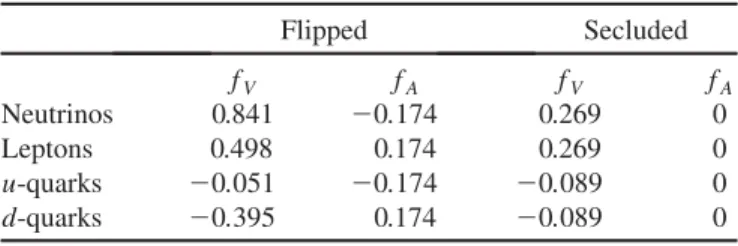
The values of fV;A for the inputs for the flipped and secluded models are shown in TableII. In both models, as noted in the case of the secluded model in Ref. [23], the leptonic branching ratios of theZ2are greater than those of
theZof the SM (which are about 10%). For the Z0
, Z0c, Z0 and LR models we have the total
widths (in GeV): 16.07, 8.73, 9.60, and 25.73, respectively, for aZ0 mass of 1 TeV, and the couplings can be obtained from Table I using ¼0, ¼=2, and ¼
arctanð pffiffiffiffiffiffiffiffi5=3Þ for the Uð1Þ, Uð1Þc, and Uð1Þ TABLE II. Values for the neutral coupling constants fV;A in
the flipped and secluded models for the value of the parameters that are shown in the text.
Flipped Secluded
fV fA fV fA
Neutrinos 0.841 0:174 0.269 0
Leptons 0.498 0.174 0.269 0
u-quarks 0:051 0:174 0:089 0
d-quarks 0:395 0.174 0:089 0
FIG. 1 (color online). Evolution of theZ2decay width with its
mass.
models, respectively, andLR¼
ffiffiffi 2
p
for the LR symmetric model [16].
In theB L flipped model theZ2 total decay width is
larger than in the secluded one. We consider partial decay widths with and without leading QED and QCD corrections i.e., for the case of QED, there is a factor1þ ð3=4Þ
ðQfÞ2for charged fermions, and1
þsðM2
ZÞ=(QCD) for
the light quarks, in the final states, see Leike in Ref. [3,4], but for the top quark we used sðm2tÞ. No electroweak
corrections have been considered, and the asymmetries were calculated in the Born approximation. The evolution of the total decay width of theZ2withM2, in both models, is shown in Fig. 1. The total Z2 decay widths with
and without QED and QCD corrections are shown in TableIII.
It is well known that in the SM theZcouplings to left and right fermions are different, and this implies several asymmetries that were measured by LEP and SLAC Large Detector with high precision [24]. The same happens in models with extra electrically neutral vector bosons. However, the secluded B L model has a heavy vector boson which couples to fermions only through vector couplings. As we said before, it behaves like a heavy photon, but it also has interference with the photon and
Z, and its effects are visible in the asymmetries. Although we have calculated the asymmetries for all the quarks, we only show in the figures the forward-backward asymmetry for the top quark final states. Before showing the analysis of the asymmetries we consider the cross sections.
B. Cross sections and the number of events
We study the production of the extra neutral gauge bosons Z2 with mass of 1 TeV in the context of the ILC,
which is supposed to start working with an energy of 0.5 TeV, and a possible energy upgrade to 1 TeV is being planned. Here we show the cross sections and the number of events only for the flipped and secluded models. This is because the flipped model, as we have considered here, has not been studied in the literature, and the most similar model that has already been well studied is the secluded one. We have imposed cuts: the invariant mass has to be greater than 100 GeV, and the cosine of the angle between the incoming and the outgoing fermions obeys 0:99<
cos <0:99.
At ILC, the combination of high energy and high lumi-nosity per bunch gives rise to beam-beam interaction like disruption, beamstrahlung and coherent pair production [25]. We will also try to give an estimation of the beam-strahlung effects, which are the main source of beam related backgrounds. The energy loss due to beamstrahlung is, for the ILC, approximately equivalent to the initial state radia-tion. Thus, we have to include them in our calculations. In our simulations, we have considered for each two beams that a bunch has rms dimensionsy ¼5:7 nmhigh,x¼
655 nmwide and horizontal beam sizez¼300m, and contains21010particles according to Ref. [26].
For all the calculations, we have used the exact neutral current couplings given in Appendix A for the flipped model, and Eq. (23) for the secluded model. We show in TableIItheir respective numerical values, for the parame-ters given in Sec. III A. We use kinematic constraints when necessary and we have neglected the mass for all the fermions, except for the top quark, and we have also used the unitary gauge.
The expected integrated luminosity for the ILC in the first four years of running is500 fb 1. In our simulations
we consider an integrated luminosity of 100 fb 1 in a TABLE III. Total Z2 widths, in GeV, for the flipped and
secluded models without (no radiative corrections [nrc]) and with (radiative corrections [rc]) radiative corrections using the inputs given in the text.
Nrc Rc Variation (%)
Flipped (1) 18.85 19.13 1.46%
Secluded (1) 2.12 2.14 0.93%
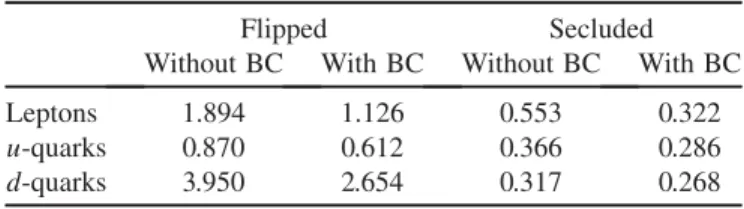
TABLE IV. Total cross sections (in pb) foreþe !ff with
f¼,,u-,d-like fermions in the flipped and secluded models, with and without BC, at theZ2peak.
Flipped Secluded
Without BC With BC Without BC With BC
Leptons 1.894 1.126 0.553 0.322
u-quarks 0.870 0.612 0.366 0.286
d-quarks 3.950 2.654 0.317 0.268
FIG. 2 (color online). Cross sections for theeþe !ff
year [27]. The total cross sections (pb) given in TableIVare shown with and without beamstrahlung corrections (BC). The flipped model if compared to the secluded one has a higher number of events, by a factor 10. We can realize that the beamstrahlung effect decreases the cross section in the region around theZ2peak, as we can see from Figs.2and3.
We can also see from these figures that the secluded model (mainly without beamstrahlung corrections) has cross sec-tions near theZ2 peak, with leptons in the final state, that
are larger than the cross section for quarks. However, these features depend on the chosen parameter values.
C. Asymmetries
In this subsection we show the results of several asymmetries for the models considered in the previous section. The considered asymmetries are the forward-backward, right, polarization, mixed left-right-forward-backward (LRFB), and mixed forward-backward-polarization asymmetries. The cross sections for elementary particles contain terms coming from inter-actions among all bosons,, Z,Z0. Thus, we have three terms of resonance and three terms of interference of
Z, Z0 andZ Z0. The behavior of the asymme-tries depends on the relative magnitude of these terms, which in turn depend on the energy scale.
The forward-backward asymmetry for the fermionsi ein the final states, is defined as
Ai FB¼
R1
0dzðdi=dzÞ
R0
1dzðdi=dzÞÞ
R1
1dzðdi=dzÞ
i F iB
i ;
(26)
whereiis the cross section of the processeþe !fifi andz¼cos, where is the angle between the arriving electron and the final state fermion. The latter expression definesi
FðBÞ.
The left-right asymmetry is defined as
Ai LR¼
ðeþe
L !fifiÞ ðeþeR !fifiÞ ðeþe !f
ifiÞ
i L iR
i ;
(27)
where eLðRÞdenote the left- (right-) handed longitudinally polarized electrons. We are neglecting the lepton masses and assuming 100% of polarization. The latter expressions definei
LðRÞ.
The polarization asymmetry is defined as
Ai pol¼
i R iL
i ; (28)
where now the subscripts refer to the helicities outgoing fermion. It was already measured at LEP [28], by studying the polarization of theþ in some decay channels like: ! , , and !l l. At ILC this
asym-metry can be measured also for tt final states in the channelst!bWþ!blþ
l,bud,bcs[4,29].
TheLRFBasymmetry is defined as
Ai LRFB ¼
ði
F iBÞL ðiF iBÞR
i ; (29)
this combined asymmetry can lead to a statistical precision that is equivalent to the unpolarized forward-backward asymmetry, depending on the level of polarization achieved.
There is another mixed asymmetry, the polarized forward-backward double asymmetry, Ai
FBðpolÞ, which is
defined as follows [24]:
Ai
FBðpolÞ ¼ð i
R iLÞF ðiR iLÞB
i ; (30)
where ði
LÞF denotes the cross section in the forward
direction, with the fermion in the final state,fi, left-handed polarized for theeþe !f
ifiprocess, etc.
D. Discussion
Since we are neglecting the lepton masses, the asymme-tries for þ and þ are the same, but we have labeled them differently to point out that the forward-backward and left-right asymmetries can be measured by detecting muons, and asymmetries involving polarization can only be measured by detecting the decay product polarizations. On the other hand, for observables involving the top quark we take its mass into account. The asymme-tries involving polarization in the latter case will be show elsewhere.
The asymmetries that we consider in this work can be used to discriminate some of the models, but in some cases some ambiguities remain. Their behavior depends on the values of the neutral couplingsfV;Ain each model. TheE6
models, Uð1Þ, Uð1Þc and Uð1Þ, have fuV¼0, Uð1Þc
has also fl
V¼0, and the left-right symmetric model has FIG. 3 (color online). Same as in Fig.2in the secluded model.
fl
V ¼0 if LR¼
ffiffiffi 2
p
. On the other hand, the B L se-cluded model has fA¼0 for all fermions. In Figs. 4–9
we show the asymmetries in the context of the models considered above, and in TableVwe show their values at theZ2peak.
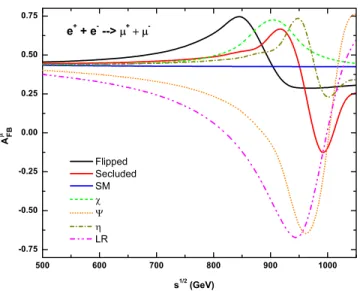
In Fig.4we show the forward-backward asymmetry for muons in the final state. The LR and theUð1Þc models can
be easily discriminated from the other ones:Uð1Þ,Uð1Þ,
secluded, and flipped models, and we also note that both of them present a similar behavior. The same asymmetry with the top quark in the final state, see Fig.5, allows to distinguish the LR from theUð1Þc model and, both of them
from the secluded, flipped, and theUð1Þmodels.
The left-right asymmetry is shown in Figs. 6. We see from that figure that the flipped and theUð1Þmodels have
similar behavior and, that the secluded, Uð1Þc, and LR
models are difficult to discriminate even from the SM contribution. TheUð1Þhas a different behavior. Forpffiffiffis>
800 GeVit can be distinguished from the other models. For the polarization asymmetry, see Fig.7, we have only considered massless fermions and, because of the univer-sality of the coupling constants, this asymmetry is just the left-right asymmetry with a minus sign when the final states are leptons.
The LRFBasymmetry is shown in Fig.8. The qualita-tive behavior of this asymmetry is similar to the behavior
FIG. 4 (color online). Forward-backward asymmetry for the eþe ! þ in the flipped, secluded, Uð1Þ
;c; and LR
models. We also show the SM contribution.
FIG. 5 (color online). Forward-backward asymmetry for the eþe !ttprocess in the flipped, secluded, Uð1Þ;c; and LR models.
FIG. 6 (color online). Left-right asymmetry for the eþe ! þ in the flipped, secluded, Uð1Þ
;c; and LR models. We
also show the SM contribution.
FIG. 7 (color online). Polarization asymmetry for theeþe ! þ in the flipped, secluded, Uð1Þ
;c; and LR models. We
of polarization asymmetry in Fig.7however, the respective values for theLRFBasymmetry are smaller than those of the polarization asymmetry in Fig. 7. On the peak the
LRFBasymmetry is equal toð3=4ÞAPol.
Next, we analyze the forward-backward polarized asym-metry that is shown in Fig.9. From it we see that the flipped and theUð1Þmodels can be discriminated from theUð1Þ
but the other models present signal almost equal of that of the SM. This asymmetry gives the same information of left-right asymmetry and considering absolute values we can also say that it also gives the same information of polarization and LRFBmixed asymmetry.
Finally, in TableVwe show the values of the asymme-tries at theZ2 peak. If the measured values are compatible
with zero, they will be in favor of the secluded,Uð1Þc and
LR models. For any values different from zero, the models flipped, theUð1Þor theUð1Þwill be favored.
Some of the asymmetries considered above were also studied as functions ofM2in Ref. [30].
IV. CONCLUSIONS
If a new neutral vector boson exists with a mass of the order of TeVs it could be discovered at the LHC. If this happens, the next task will be to measure its parameters, i.e., its mass, spin, couplings to fermions, etc. Some of these parameters may be obtained by measuring asymme-tries like those considered in this paper, on or/and off peak. Different models will have different behavior for these asymmetries, at least in some range of pffiffiffis
. In this paper we have shown that this, in fact, happens with the models we have considered above. Our main results are the calcu-lation of cross sections, decay widths, and asymmetries in the Born approximation for the flipped and secluded mod-els. The asymmetries, have also been calculated in E6
inspired and left-right symmetric models. The flipped and secluded considered here have at least an extra heavy scalar and three right-handed heavy neutrinos, and the LR model has besides the right-handed neutrinos, several sca-lar fields. Hence, in these models these degrees of freedom have to be taken into account when calculating the respec-tive radiarespec-tive corrections. However, the extra parameters in the models are not known at present and thus it is not worth carrying out those calculations. Notwithstanding, some corrections are more general like those of QED and QCD, which in these models are the same of the SM, and we have taken them into account. On the other hand, it is always important to know what is the value of a given observable in a particular model, at least at the tree level. Only then can we appreciate the importance of the radiative corrections.
FIG. 8 (color online). Combined LRFB asymmetry for the eþe ! þ in the flipped, secluded, Uð1Þ
;c; and LR
models. We also show the SM contribution.
FIG. 9 (color online). Combined FBðPolÞasymmetry for the eþe ! þin the flipped, secluded,Uð1Þ
;c; and LR
mod-els. We also show the SM contribution.
TABLE V. Values of the several asymmetries at theZ2peak,pffiffiffis¼1 TeV.
Flipped Secluded Uð1Þ Uð1Þc Uð1Þ LR SM
AðFB0;Þ 0.293 2:6510 4 0.479 4:8
10 3 0.272 12:6
10 3 0.425
A0
LR 0.621 3:1610 4 0:798 0:54810 3 0:593 1:410 3 0.064
A0ðpolÞ 0:621 0:31610 4 0:798 0:54810 3 0.593 1:410 3 0:064
A0
LRFB 0:466 0:14810 4 0:598 0:25910 3 0.445 0:710 3 0:030
A0
FBðpolÞ 0.466 0:14810 4 0.598 0:25910 3 0:445 0:710 3 0.030
As we said before, the flipped model as we have con-sidered here has not been studied in the literature; thus, we have given more details and have compared it with a model which is very similar with it: the secluded model. Both models have similar quantum numbers and degrees of freedom. In particular, we note that the secluded model near the Z2 peak has cross sections ðe eþ !ffÞ for
charged leptons larger than the cross section for quarks. The Z2 decay widths are very different in each model
and are larger in the flipped one. For asymmetries it is not necessary to be at the Z2 peak, here at 1000 GeV.
The presence of a heavy Z2 may be detected well before the peak, allowing also the discrimination of each model.
APPENDIX A: THE FERMION-VECTOR BOSON INTERACTIONS IN THE
FLIPPED MODEL
We will parameterize the neutral current couplings of a fermion ci as in Eq. (1) where the exact expressions forZ1 andZ2 are used in defininggiV;A andfiV;A. We also
show them in the approximation v 1 in the text, see Eqs. (15)–(18).
The couplings of the neutrinos are
g V ¼
1 2
ffiffiffiffiffiffiffiffiffiffiffiffiffiffiffiffiffiffiffiffiffiffiffiffiffiffiffiffiffiffiffi
t02þt2 B L
2BðC D ffiffiffiffi
X
p Þ
s
½Eþ ð1 t02
ÞpffiffiffiffiX;
g A¼
1 2
ffiffiffiffiffiffiffiffiffiffiffiffiffiffiffiffiffiffiffiffiffiffiffiffiffiffiffiffiffiffiffi
t02þt2 B L
2BðC DpffiffiffiffiXÞ
s
½D ð1þt02Þ ffiffiffiffi
X p ; f V ¼ 1 2 ffiffiffiffiffiffiffiffiffiffiffiffiffiffiffiffiffiffiffiffiffiffiffiffiffiffiffiffiffiffiffi
t02
þt2 B L
2BðCþDpffiffiffiffiXÞ
s
½E ð1 t02Þ ffiffiffiffi
X p ; f A¼ 1 2 ffiffiffiffiffiffiffiffiffiffiffiffiffiffiffiffiffiffiffiffiffiffiffiffiffiffiffiffiffiffiffi
t02
þt2 B L
2BðCþD ffiffiffiffi
X
p Þ
s
½Dþ ð1þt02Þ ffiffiffiffi
X
p
: (A1)
For the case of the charged leptons,
gl V ¼
1 2
ffiffiffiffiffiffiffiffiffiffiffiffiffiffiffiffiffiffiffiffiffiffiffiffiffiffiffiffiffiffiffi
t02
þt2 B L
2BðC D ffiffiffiffi
X
p Þ
s
½E 32t02t2
B Lþ ð1 t02Þ
ffiffiffiffi
X
p ;
gl
A¼ gA;
fl V ¼
1 2
ffiffiffiffiffiffiffiffiffiffiffiffiffiffiffiffiffiffiffiffiffiffiffiffiffiffiffiffiffiffiffi
t02
þt2 B L
2BðCþD ffiffiffiffi
X
p Þ
s
½E 32t02t2
B L ð1 t02Þ
ffiffiffiffi
X
p ;
fl
A¼ fA: (A2)
In the quark sector we obtain, for theu-like quarks:
gu V¼
1 6
ffiffiffiffiffiffiffiffiffiffiffiffiffiffiffiffiffiffiffiffiffiffiffiffiffiffiffiffiffiffi
t02þt2 B L
2BðC DpffiffiffiffiXÞ
s
½Fþ3ð1 t02Þ ffiffiffiffi
X
p
; gu A¼gA;
fu V¼
1 6
ffiffiffiffiffiffiffiffiffiffiffiffiffiffiffiffiffiffiffiffiffiffiffiffiffiffiffiffiffiffi
t02
þt2 B L
2BðCþDpffiffiffiffiXÞ
s
½F 3ð1 t02Þ ffiffiffiffi
X
p
; fu A¼fA:
(A3)
and, for thed-like quarks:
gd V¼
1 6
ffiffiffiffiffiffiffiffiffiffiffiffiffiffiffiffiffiffiffiffiffiffiffiffiffiffiffiffiffiffi
t02
þt2 B L
2BðC D ffiffiffiffi
X
p Þ
s
½Fþ32t02t2 B L
þ3ð1 t02
ÞpffiffiffiffiX; gd
A¼ gA;
fd V¼
1 6
ffiffiffiffiffiffiffiffiffiffiffiffiffiffiffiffiffiffiffiffiffiffiffiffiffiffiffiffiffiffi
t02
þt2 B L
2BðCþD ffiffiffiffi
X
p Þ
s
½Fþ32t02t2
B L 3ð1 t02Þ
ffiffiffiffi
X
p ;
fd
A¼ fA: (A4)
Where we have defined
C¼ ð1þt02Þ½16ðt02þt2
B LÞ2þ8ðt04 BÞv2þ ð1þt02Þ2v4; D¼4ðt04 BÞ þ ð1þt02Þ2v2;
E¼4ðt04þBÞ þ8t02t2
B L ð1 t04Þv2; F¼12ðt04
þBÞ 40t02t2
B L 3ð1 t04Þv2;
X¼A2 16Bv2: (A5)
andA,Bare defined in Eq. (7).
The couplings of the charged fermions to the photon are as usual. Notice also that, in Eq. (1) all fermionsciare still symmetry eigenstates, therefore, the neutral currents coupled toZ1 andZ2 are flavor conserving.
ACKNOWLEDGMENTS
E. C. F. S. Fortes was supported by FAPESP under Contract No. 2007/59398-2; J. C. Montero and V. Pleitez were partially supported by CNPq under Contract Nos. 302102/2008-6 (J. C. M.) and 302102/2008-6 (V. P.). We also would like to thank an anonymous referee for valuable comments which improved this paper from the submitted version.
APPENDIX B: PARTIALZ1;2 DECAY WIDTHS
In both models the partial widths of the neutral vector bosonsZ1 andZ2, respectively, are given by
Z1!fifi ¼
NcGFM2 Z1
6 ffiffiffi 2
p ½ðgi
VÞ2þ ðgiAÞ2
ffiffiffiffiffiffiffiffiffiffiffiffiffiffiffiffiffiffiffiffiffi
1 4 m
2 i M2 Z1 v u u t
1þ2 m
2 i M2 Z1
½ðgi
VÞ2 2ðgiAÞ2
½ðgi
VÞ2þ ðgiAÞ2
MZ1; (B1)
and
Z2!fifi ¼
NcGFM2 Z1
6 ffiffiffi 2
p ½ðfi
VÞ2þ ðfiAÞ2
ffiffiffiffiffiffiffiffiffiffiffiffiffiffiffiffiffiffiffiffiffi
1 4 m
2 i M2 Z2 v u u t
1þ2 m
2 i M2 Z2
½ðfi
VÞ2 2ðfAiÞ2
½ðfi
VÞ2þ ðfAiÞ2
MZ2; (B2)
where for the sake of clarity we have used hereMZ1 M1
couplings of theZ2boson to the SM fermions, and theMZ2
mass as well, depend on g0, gB L,g, and v. Only when
v1will all of them depend only on the gauge coupling constants. In the secluded modelfA¼0, and we have
sec Z2!fifi ¼
NcGFMZ21
6pffiffiffi2 ðf
i VÞ2
ffiffiffiffiffiffiffiffiffiffiffiffiffiffiffiffiffiffiffiffiffi
1 4 m
2 i M2 Z2
v u u t
1þ2 m
2 i M2 Z2
MZ2:
(B3)
Recall that only for thetquark, the fermion mass was taken into account in (B1)–(B3).
Finally, in the flipped model theZ1;2ðpÞWþðk
þÞW ðk Þ vertices are given by
igF1;2½g ðkþ k Þþgðp kþÞ
þg ðk pÞ; (B4)
with all momenta incoming and where we have defined
F1¼
A 2ð1þt02
Þv2
þ ffiffiffiffi
X
p
ffiffiffiffiffiffiffiffiffi 2Yþ
p ;
F2¼
A 2ð1þt02
Þv2 ffiffiffiffi
X
p
ffiffiffiffiffiffiffiffiffi 2Y
p ; (B5)
withXdefined in Eq. (A5), and we have defined
Y¼ ð1þt02
Þ½16ðt02
þt2
B LÞ2 8ðB t04Þv2
þ ð1þt02
Þ2v4
pffiffiffiffiX½4ðB t04
Þ ð1þt02
Þ2v2
;
(B6) where A,Bwere defined in Eq. (7) andX in (A5). At the tree level, in the secluded model, the vertex Z1WþW is
the same as those of ZWþW in the SM, and the vertex Z2WþW does not exist. Notice that whenv!0there is
no mixing between ZandZ0; thus,Z
2 does not decay to WþW at tree level andF
2 ¼0. In theE6inspired models
there is also noZ2WþW interaction at the tree level.
Finally, the Higgs vertices are the same as in Ref. [31].
[1] P. Langacker, Rev. Mod. Phys. 81, 1199 (2009) and references therein.
[2] E. Ellwanger, C. Hugonie, and A. M. Teixera,Phys. Rep.
496, 1 (2010).
[3] For earlier references see F. Del Aguila, Acta Phys. Pol. B 25, 1317 (1994); J. L. Hewett and T. G. Rizzo,Phys. Rep.
183, 193 (1989);
[4] A. Leike,Phys. Rep.317, 143 (1999).
[5] B. Ko¨rs and P. Nath,Phys. Lett. B586, 366 (2004). [6] G. ’t Hooft,Phys. Rev. Lett.37, 8 (1976).
[7] J. C. Montero and V. Pleitez, Phys. Lett. B 675, 64 (2009).
[8] J. Erler, P. Langacker, and T. Li,Phys. Rev. D66, 015002 (2002).
[9] T. Appelquist, B. A. Dobrescu, and A. R. Hopper, Phys. Rev. D68, 035012 (2003).
[10] E. Commandoet al.,Phys. Rep.299, 1 (1998); K. Abeet al.,
arXiv:hep-ph/0109166; R. D. Heueret al.,arXiv:0106315; A. Djouadiet al.(Eds.),arXiv:0709.1893.
[11] G. Weiglein et al. (LHC/LC Study Group), Phys. Rep.
426, 47 (2006).
[12] J. Erler, P. Langacker, S. Munir, and E. Rojas, J. High Energy Phys. 08 (2009) 017;
[13] F. del Aguila, M. Masip, and M. Perez-Victoria, Nucl. Phys.B456, 531 (1995); P. H. Chankowski, S. Pokorski, and J. Wagner,Eur. Phys. J. C47, 187 (2006).
[14] C. Amsleret al.(PDG Collaboration),Phys. Lett. B667, 1 (2008).
[15] M. Carena, A. Daleo, B. A. Dobrescu, and T. M. P. Tait,
Phys. Rev. D70, 093009 (2004).
[16] M. Dittmar, A.-S. Nicollerat, and A. Djouadi,Phys. Lett. B583, 111 (2004).
[17] A. Abulencia et al. (CDF Collaboration), Phys. Rev. Lett. 96, 211801 (2006); T. Aaltonen et al. (CDF Collaboration),Phys. Rev. Lett.102, 091805 (2009). [18] E. J. Eichten, K. D. Lane, and M. E. Peskin, Phys. Rev.
Lett.50, 811 (1983).
[19] LEP Collaboration,arXiv:hep-ex/0312023.
[20] G. Cacciapaglia, C. Csa´ki, G. Marandella, and A. Strumia,
Phys. Rev. D74, 033011 (2006).
[21] E. Salvioni, G. Villadoro, and F. Zwirner,J. High Energy Phys. 11 (2009) 068.
[22] K. Deschet al.,arXiv:hep-ph/0411159.
[23] L. Basso, A. Belyaev, S. Moretti, and C. H. Shepherd-Themistocleous, Phys. Rev. D 80, 055030 (2009); L. Basso, A. Belyaev, S. Moretti, and G. M. Pruna,J. High Energy Phys. 10 (2009) 006.
[24] LEP Collaboration and SLD Collaboration, Phys. Rep. 427, 257 (2006).
[25] D. V. Schroeder, Ph.D. thesis, Stanford University [Institution Report No. SLAC-371, 1990 (unpublished)]. [26] H. Yamamoto,J. Phys. Soc. Jpn.76, 111014 (2007). [27] The overall parameters of the ILC can be found inhttp://
www.fnal.gov/directorate/icfa/LC_parameters.pdf. [28] E. Etzion, Ph.D. thesis, Tel-Aviv University [arXiv:
hep-ex/9606011].
[29] M. Arai, N. Okada, K. Smolek, and V. Sˇima´k, Acta Phys. Pol. B40, 93 (2009).
[30] S. Godfrey,Search Limits for Extra Neutral Gauge Bosons at High Energy Lepton Colliders, Summer Study on New Directions for High Energy Physics—Snowmass96, Snowmass, CO, 1996(unpublished).
[31] W. Emam, and S. Khalil, Eur. Phys. J. C 52, 625 (2007).