Balance and plantar cutaneous
sensitivity functional
assessment in
community-dwelling elderly
Summary
Onivaldo Bretan 1, Rafael Martins Pinheiro 2, José
Eduardo Corrente 3
1 Senior assistant professor, adjunct professor. 2 Graduate student of General Basis of Surgery, physical therapist.
3 Senior assistant professor, biostatistician.
Botucatu Medical School, “Julio de Mesquita Filho” Paulista State University. Send correspondence to: Onivaldo Bretan - Rua Petúnia 180 Botucatu SP 18603-502.
Tel/fax: (0xx14) 3811-6256 / 3811-6081 - E-mail: [email protected]
Paper submitted to the BJORL-SGP (Publishing Management System – Brazilian Journal of Otorhinolaryngology) on May 5, 2009; and accepted on September 21, 2009. cod. 6398
I
mpaired balance is one of several factors that increase an elderly’s susceptibility to falls. Balance assessment can be performed using postural tests and plantar cutaneous sensitivity tests. Aim: To assess balance disorders and loss of plantar cutaneous sensitivity in the elderly and look for association between these alterations. Materials and Methods: A descriptive cross-sectional study involving 45 elderly submitted to the Berg Balance Scale (BBS) and the plantar sensitivity test with nylon monofilament. We used chi-square and Fisher’s exact tests, and ROC curves were created in order to study the sensitivity and specificity of BBS. Results: Two and 4 individuals showed balance and cutaneous sensation disorders, respectively. There was a significant association between the complaint of impaired balance and loss of skin sensitivity (p = 0.047), and there was a reasonable agreement (Kappa: 0.6457) between the BBS and the sensorial test. A significant association was also found among 6 of the 14 BBS tasks and the sensitivity test. Conclusion: Most of the elderly living independently in the community showed normal balance and plantar cutaneous sensation. When impaired, these functions appeared associated in a way that if the tests are performed together, the accuracy of the evaluation of the balance increases.Keywords: elderly, posture, public health.
ORIGINAL ARTICLE Braz J Otorhinolaryngol.
INTRODUCTION
A fall is an event that occurs in a large percentage of the elderly; it causes fear of further falls, thus limiting daily activities. It is also a cause of significant morbidity and mortality.1-3 The Berg balance scale (BBS) and Tinetti’s
mobility score are functional clinical tests of balance used to assess the risk of falls in the elderly during their daily activities.4-7 The BBS is more sensitive and specific, and
is a reliable tool for measuring balance quantitatively in community-dwelling elderly persons.7-10 It is an easy test to
apply and makes it possible to directly evaluate the functio-nal relevance of any change.9,11 The BBS has been validated
for the Brazilian context.12 Scores and results vary widely in balance and risk of fall studies in community-dwelling elderly persons when using the BBS. This is due in part to biases incurred by authors when selecting subjects with different characteristics; individuals may have complaints of unbalance, systemic or neurologic diseases, use of drugs that act on the central nervous system, more elderly subjects, or specific exclusion criteria for the test.1,5,7,8,13
Studies have shown a correlation between altered plantar sensitivity and balance disorders among individuals with complaints of sensitivity, patients with neurologic or systemic disease - especially diabetes mellitus - in elderly subjects or not.10,14,15 Plantar skin sensitivity decreases
signi-ficantly in healthy elderly persons; an association between loss of sensitivity and unbalance has been demonstrated in subjects with no complaints of insensitivity or unba-lance.16-18 Studies on the association between balance and
plantar sensitivity have generally applied sensitivity and balance laboratory tests with the Semmes-Weinstein nylons monofilaments,19-21 which are used mostly by clinicians and
dermatologists. Monofilaments are sensitive and specific, and ideal as time-saving low-cost screening easily appli-cable in any setting.18,19 There are no published reports
on a joint study of plantar skin sensitivity and balance in community-dwelling elderly persons that will have applied a balance functional test and nylon monofilaments, with no prior selection of subjects with complaints, diseases or factors leading to unbalance or altered plantar skin sensitivity.
The purpose of this study was to investigate the occurrence of unbalance and altered plantar sensitivity in community-dwelling elderly persons, by applying the BBS and nylon monofilaments. A second aim was to verify any association among test results and to note whether using both tests jointly could provide a more precise evaluation of balance.
SERIES AND METHOD
A cross-sectional descriptive study of cases compri-sing 45 elderly subjects of both sexes was carried out to
evaluate balance in community-dwelling subjects. These subjects were part of an elderly population clinical study that presented voluntarily upon request. The assessment was made randomly, according to the order of arrival. Exclusion criteria were: aged below 60 years, using any support for walking, orthopedic conditions of the lower limbs, diseases that affected gait, inability to understand instructions, major visual difficulty, a recent stroke, or transient ischemic attack. The institutional review board approved this study (number 2088/2006). Subjects signed a free informed consent form.
The BBS was applied as a functional balance eva-luation test.5,9 It consists of 14 tasks similar to activities of
daily life. Scores range from 0 (inability to carry out tasks without help) to 4 (ability to carry out tasks independen-tly). The maximum score is 56 points; a 45 cutoff point was defined.9 This 45-point score separates subjects with
a tendency to fall from those without.7
Plantar skin sensitivity was evaluated with a Sem-mes-Weinstein monofilament number 5.07; it generates a 10-g pressure when applied on the surface of the foot.14,15,18
The reasons for using this monofilament number have been previously described.21 The sensitivity of evaluation
technique applied in this study was 97% and the specificity was 83% for lack of perception in four or more points to identify loss of protective sensitivity.21
The statistical analysis was aimed to check for any associations among variables for the plantar skin sensitivity test, question on unbalance and falls, and the BBS values; the chi-square test or Fischer’s exact test were used, as appropriate. Reasons for use, the level and significance were 5% probability or the corresponding p-value. ROC curves were drawn based on BBS scores and the variables relating to questions on unbalance and falls within the last 12 months to increase the sensitivity of cut-off points. The number of subjects reporting unbalance and falls within the past 12 months was taken as the gold standard for calculations.
RESULTS
the elderly subjects. Systemic medication was used by 75% of subjects, and current or previous depression was reported by 18% of subjects.
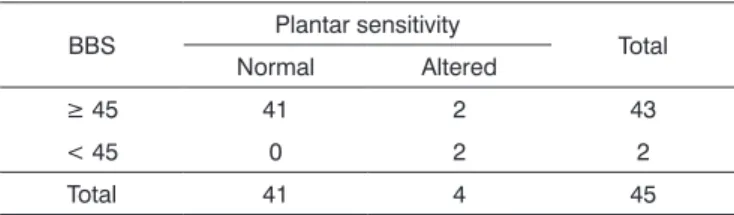
Association studies of subjects complaining of un-balance or falls in the previous year and the plantar sensi-tivity test have shown statistical significance in relation to “unbalance” (p = 0.047). Among 45 subjects, 14 reported unbalance, of which three had altered plantar sensitivity. Table 2 shows the distribution of subjects according to the BBS cutoff point chosen initially and skin sensitivity. The cohort score (45) revealed that 43 subjects scored ≥ 45, and 2 subjects scored < 45 - about 5% of the elderly subjects. The kappa coefficient showed reasonable agre-ement between the BBS and the plantar sensitivity test.
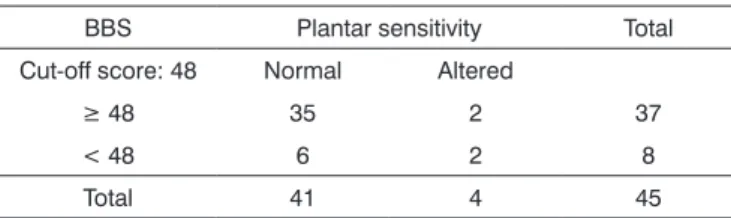
The ROC curve took into account the BBS scores and the number of subjects reporting unbalance, and showed that 48 was a more relevant score for 0.677 spe-cificity and 0.714 sensitivity. There were 37 subjects with scores ≥ 48 and 8 with scores < 48. The kappa coefficient, however, showed low agreement between tests. The ROC curve on the BBS scores and the number of subjects re-porting falls showed that 49 was the most relevant scores for a 0.677 specificity and a 0.714 sensitivity. There were 37 subjects with scores ≥ 49 and 8 with scores < 49. The
kappa coefficient showed poor agreement among the tests (Table 3). An overview showed that plantar sensitivity was altered in subjects with scores above or below the cutoff points 45, 48 and 49.
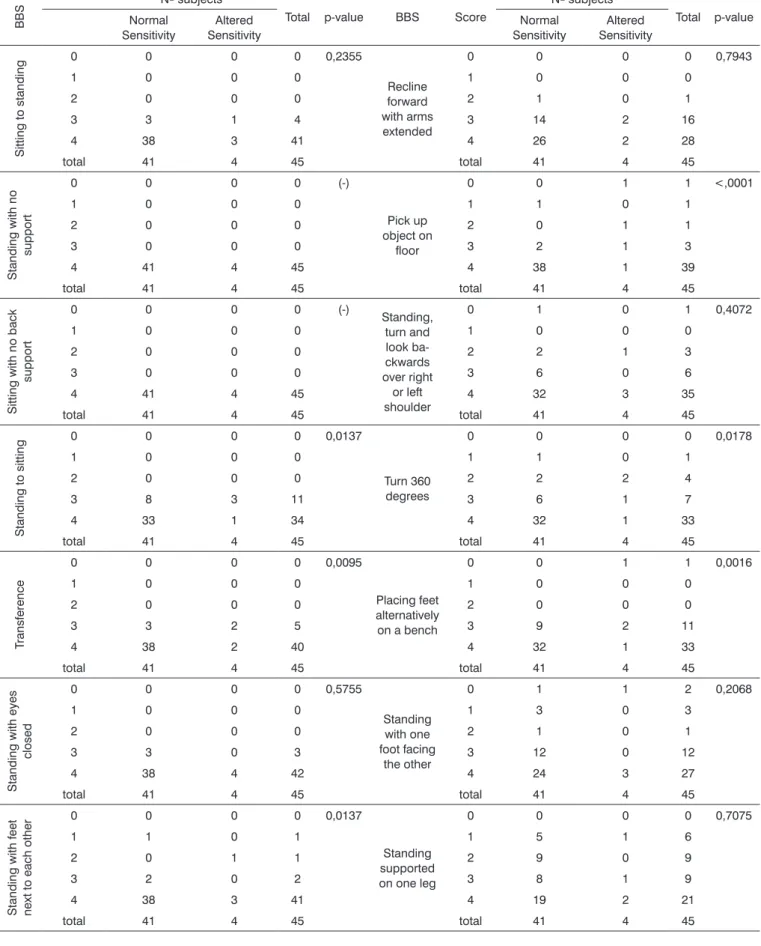
Association studies between BBS and plantar sen-sitivity were done by confronting the scores of each one of the 14 tasks with the number of points in the sensitivity test. Table 4 shows that there were statistically significant results in 6 of 14 tasks (BBS); this means that a positive association with the plantar sensitivity test was found in 40% of tasks.
Table 1. Clinical and social & demographic data (n=45).
Male 21 (47%)
Female 24 (53%)
Age (mean ± standard deviation) 73 ± 8,05
Cut-off point in the BBS (mean ± standard deviation) 48,89 ± 3,51
Subjects with one or more systemic diseases 40
Subjects with altered plantar skin sensitivity 4 (9%)
YES %
Do you have high blood pressure? 26 58
Do you have diabetes? 6 13
Do you have high blood cholesterol? 13 23
Do you have heart disease? 10 22
Have you had an infarction? 3 7
Have you had a stroke? 0 0
Do you have kidney disease? 3 7
Do you use medication? 34 75
Are you or have you been depressed? 8 18
Do you have lung disease? 7 15
Do you have problems with vision? 32 71
Have you had any severe infection? 2 14
Have you had vertigo? 17 38
Do you have unbalance? 14 31
Have you fallen at any time in the past? 19 42
Table 2. Distribution of subjects according to the BBS scores and
the plantar skin sensitivity test (cut-off score: 45).
BBS Plantar sensitivity Total Normal Altered
≥ 45 41 2 43
< 45 0 2 2
Total 41 4 45
DISCUSSION
The number of elderly subjects reporting systemic conditions, falls, unbalance, vertigo, problems with vision, and use of systemic medication was high in our clinical assessment, and was close to other published results.1,8,15,22
Each one of these disorders is an independent predictor of risk of falls.1,15,18,19 In this study, the number of subjects
with BBS scores below 45 was small; the mean was about 49, close to the scores of control group elderly subjects in studies on the risk of falls.7,8,11
Plantar skin sensitivity studies in several systemic and neurologic diseases show a wide range of values in the different evaluation methods used by the authors. Such values were at least 100% higher compared to control group results.14,15 Diabetes mellitus is the most frequent
cause of loss of sensitivity due to peripheral neuropathy; about 50% of diabetics aged over 60 years have loss of the protective plantar sensitivity due to neuropathy.14,15,23 It
has also been demonstrated that loss of plantar sensitivity in apparently healthy elderly subjects with no complaints is due to subclinical peripheral neuropathy.22,23 Baseline
clinical data available in the present study only allow us to suggest diabetes (found in 13% of subjects) on the one hand, and the low mean age, on the other, as the most important factors; these are possibly accountable for the low number of sensory changes found in the sample.
Calculation of BBS specificity and sensitivity relative to the percentage of subjects complaining of unbalance and falls revealed cut-off points of 48 and 49 respectively. However, agreement between both tests was low, although good agreement was attained with the previously defined
cut-off point, which was considered more appropriate for this study. Poor agreement in the complaint unbalance in a way conflicts with the significant association found between unbalance and loss of plantar sensitivity; it di-verges from a study showing that altered BBS scores and complaints of unbalance are predictors of falls.8 In this
study, not only was plantar skin sensitivity associated with a complaint of unbalance, but there was also an association between BBS and plantar sensitivity results. This study revealed a previously unpublished close relation between balance and sensitivity after confronting the scores of each one of 14 BBS tasks with plantar sensitivity tests.
A single pilot study came close to our assessment; it applied the Tinetti functional mobility test and monofila-ments in 12 diabetics of different ages in urban and rural-dwelling communities.15 The authors found altered balance
and decreased plantar sensitivity respectively in 40% and 100% of 7 urban dwellers and in 18% and 67% of 5 rural dwellers. The significant difference and the small num-ber of subjects in both studies suggest a need for further investigation with larger samples to confirm these results. Studies on balance in elderly subjects that have focused on specific health issues (physical, mental and others) have generated useful data. Non-directed studies, however, are also important to learn about unbalance in the elderly as a whole to support public policies for preventing falls and providing rehabilitation of balance measures.
This study showed that the tests applied above are good assessment tools. Routine and periodic observation of balance and sensitivity is desirable, since falls become more frequent with age; about 30% of individuals aged from entre 65 and 74 years and 40% of individuals aged 75 years or more are affected.22,24,25 Clinical healthcare
professionals should be attentive to the risk of falls in their patients and refer them to balance specialists.
A limitation of this study - aside from the small sample size - was the method used to make contact with the subjects. It is possible that only younger and healthier individuals, with controlled diseases and independent li-ves, may have presented.26 More encompassing studies are
required to generalize these results. A second limitation of this study was the impossibility of carrying out a vestibular assessment, which would have been important not only due to a significant number of subjects responding posi-tively to the question on vertigo, but mainly because this complaint is common in the elderly.27 A correlation
betwe-en otoneurology assessmbetwe-ent data and the presbetwe-ent results could further our understanding of the events observed. However, operational difficulties, including the scheduled time for completing the population study, made further investigation impossible. It should be emphasized that studies on unbalance that aim to investigate one or more of its multiple causes should take into account the signi-ficant incidence of vestibular diseases among the elderly,
Table 3. Distribution of subjects reporting unbalance and falls
accor-ding to the BBS score and the plantar skin sensitivity test.
UNBALANCE
BBS Plantar sensitivity Total
Cut-off score: 48 Normal Altered
≥ 48 35 2 37
< 48 6 2 8
Total 41 4 45
Kappa coefficient = 0.2437 (95% confidence interval: 0-0.6058)
FALL
BBS Plantar sensitivity Total
Cut-off score: 49 Normal Altered
≥ 49 35 2 37
< 49 6 2 8
Total 41 4 45
Table 4. Association between the BBS and the plantar sensitivity test (n = 45).
BB
S Nº subjects
Total p-value BBS Score
Nº subjects
Total p-value Normal
Sensitivity
Altered Sensitivity
Normal Sensitivity
Altered Sensitivity
Sitting to standing
0 0 0 0 0,2355
Recline forward with arms extended
0 0 0 0 0,7943
1 0 0 0 1 0 0 0
2 0 0 0 2 1 0 1
3 3 1 4 3 14 2 16
4 38 3 41 4 26 2 28
total 41 4 45 total 41 4 45
Standing with no
support
0 0 0 0 (-)
Pick up object on
floor
0 0 1 1 <,0001
1 0 0 0 1 1 0 1
2 0 0 0 2 0 1 1
3 0 0 0 3 2 1 3
4 41 4 45 4 38 1 39
total 41 4 45 total 41 4 45
Sitting with no back
support
0 0 0 0 (-)
Standing, turn and look ba-ckwards over right
or left shoulder
0 1 0 1 0,4072
1 0 0 0 1 0 0 0
2 0 0 0 2 2 1 3
3 0 0 0 3 6 0 6
4 41 4 45 4 32 3 35
total 41 4 45 total 41 4 45
Standing to sitting
0 0 0 0 0,0137
Turn 360 degrees
0 0 0 0 0,0178
1 0 0 0 1 1 0 1
2 0 0 0 2 2 2 4
3 8 3 11 3 6 1 7
4 33 1 34 4 32 1 33
total 41 4 45 total 41 4 45
T
ransference
0 0 0 0 0,0095
Placing feet alternatively on a bench
0 0 1 1 0,0016
1 0 0 0 1 0 0 0
2 0 0 0 2 0 0 0
3 3 2 5 3 9 2 11
4 38 2 40 4 32 1 33
total 41 4 45 total 41 4 45
Standing with eyes
closed
0 0 0 0 0,5755
Standing with one foot facing
the other
0 1 1 2 0,2068
1 0 0 0 1 3 0 3
2 0 0 0 2 1 0 1
3 3 0 3 3 12 0 12
4 38 4 42 4 24 3 27
total 41 4 45 total 41 4 45
Standing with feet next to each other
0 0 0 0 0,0137
Standing supported on one leg
0 0 0 0 0,7075
1 1 0 1 1 5 1 6
2 0 1 1 2 9 0 9
3 2 0 2 3 8 1 9
4 38 3 41 4 19 2 21
and always count on the support of an otoneurologist, as in the present study.
CONCLUSION
Elderly community-dwelling subjects with inde-pendent lives for the most part have normal plantar skin sensitivity. Subjects with postural disorders in which these functions are altered may be assessed more accurately by associating functional balance tests with plantar sensitivity tests.
REFERENCES
1. Tinetti ME, Speechley M, Ginter SF. Risk factors for falls among elderly persons living in the community. N Engl J Med. 1988;319:1701-7. 2. Tinetti ME, Richman D, Powell L. Falls afficacy as a measure of fear
of falling. J Gerontol Psy Sci. 1990;45:239-43.
3. Tinetti ME, Williams CS. The effect of falls and falls injuries on func-tioning in community-dwelling older persons. J Gerontol Med Sci. 1998;53:M112-M119.
4. Tinetti ME. Performance oriented assessment of mobility problems in elderly patients. J Am Geriatr Soc. 1986;34:119-26.
5. Berg KD, Wood-Dauphinee S, Williams JI, Gayton D. Measuring balance in the elderly. Preliminary development of an instrument. Physiother Can. 1989;41:304-10.
6. Baloh W, Ying SM, Jacobson KM. A longitudinal study of gait and ba-lance dysfunction in normal older people. Arch Neurol. 2003;60:835-9. 7. Chiu AYY, Au-Ye Ung SSY, LO SK. A comparison of four functional
tests in discriminating fallers from non-fallers in older people. Disabil Rehabil. 2003;25:45-50.
8. Shumway-Cook A, Baldwin M, Polissar NL, Gruber W. Predicting the probability for falls in a community-dewelling older adults. Phys Ther. 1997;77:812-8.
9. Berg KO, Wood-Dauphinee S, Williams JI, Maki B. Measuring ba-lance in the elderly: validation of an instrument. Can J Pub Health. 1992;83(S2):S7-S11.
10. Lynch EA, Hillier SC, Stiller K, Campanella RR, Fisher PM. Sensory retraining of the lower limb after acute stroke: a randomized con-trolled pilot trial. Arch Phys Med Rehabil. 2007;88:1101-7.
11. O’Brien K, Pickles B, Culmam E. Clinical measures of balance in community-dwelling elderly female fallers and non-fallers. Physiother Can. 1998;50:212-7.
12. Myamoto ST, Lombard Jr I, Berg KO, Ramos LR, Natour J. Brazilian version of the Berg balance scale. Braz J Med Biol Res. 2004;37: 1411-21.
13. Gazzola JM, Perracini MR, Ganança MM, Ganança FF. Fatores asso-ciados ao equilíbrio funcional em idosos com disfunção vestibular crônica. Braz J Otorhinolaryngol. 2006;72:683-90.
14. Simmons RW, Richardson C, Pozos R. Postural stability of diabetics patients with and without cutaneous sensory deficit in the foot. Diabetes Res Clin Pract. 1997;36:153-60.
15. Conner-Kerr T, Templeton MS. Chronic falls risk among aged indi-viduals with type 2 diabetes. Ostomy Wound Manag. 2002;48:28-35. 16. Lord SR, Ward JA. Age associated differences in sensorymotor function
and balance in community dwelling women. Age ageing. 1994;23: 452-60.
17. King MB, Judge JO, Wolfson L. Functional base of support decrease with age. J Gerontol Med Sci. 1994;49:M258-63.
18. Meyer PF, Oddsson LI, De Luca CJ. Reduced plantar sensitivity alters postural responses to lateral perturbations of balance. Exp Brain Res. 2004;157:526-36.
19. Perry SD. Evaluation of age related plantar surface insensitivity and onset of advanced insensitivity in olders adults using vibratory and touch sensation tests. Neurosci Lett. 2006;392:62-7.
20. Valk GD, Sonnaville JJDE, Houtum W, Heine RJ, Eijk JTM, Bouter LM, Bertelsmann F. The Assessment of diabetic polyneuropathy in daily clinical practice: reproducibility and validity of Semmes-Weinstein monofilaments examination and clinical and neurological examina-tion. Muscle & Nerve. 1997;20:116-8.
21. Armstrong DG, Lavery LA, Vela SA, Quebedeaux TL, Fleishli JG. Chosing a practical screening instrument to identify patients at risk for diabetic foot ulceration. Arch Intern Med. 1998;158:289-92. 22. Richardson JK, Ashton-Miller. Peripheral neuropathy. An often
over-loowed cause of falls in the elderly. Post Grad Med. 1996;99:161-72. 23. Thomson FJ, Masson EA, Boulton AJ. The clinical diagnosis of sensory
neuropathy in elderly people. Diabetes Med. 1993;10:843-6. 24. Nevitt MC, Cummings SR, Hudes ES. Risk factors for injuries falls: a
prospective study. J Gerontol Med Sci. 1991;46:M164-70.
25. O’Loughlin JL, Robitaille Y, Boivin JF, Suissa S. Incidence of and risk factors for falls and injuries falls among the community-dwelling elderly. Am J Epidemiol. 1993;137:342-54.
26. Maciel ACC, Guerra RO. Limitação functional e sobrevida em idosos de comunidade. Rev Assoc Med Bras. 2008;54:347-52.