ACPD
10, 45–68, 2010Amine exchange into ammonium bisulfate
and ammonium nitrate nuclei
B. R. Bzdek et al.
Title Page
Abstract Introduction
Conclusions References
Tables Figures
◭ ◮
◭ ◮
Back Close
Full Screen / Esc
Printer-friendly Version
Interactive Discussion
Atmos. Chem. Phys. Discuss., 10, 45–68, 2010 www.atmos-chem-phys-discuss.net/10/45/2010/ © Author(s) 2010. This work is distributed under the Creative Commons Attribution 3.0 License.
Atmospheric Chemistry and Physics Discussions
This discussion paper is/has been under review for the journal Atmospheric Chemistry and Physics (ACP). Please refer to the corresponding final paper in ACP if available.
Amine exchange into ammonium bisulfate
and ammonium nitrate nuclei
B. R. Bzdek, D. P. Ridge, and M. V. Johnston
Department of Chemistry & Biochemistry, University of Delaware, Newark, DE, USA
Received: 10 December 2009 – Accepted: 13 December 2009 – Published: 5 January 2010
Correspondence to: M. V. Johnston ([email protected])
ACPD
10, 45–68, 2010Amine exchange into ammonium bisulfate
and ammonium nitrate nuclei
B. R. Bzdek et al.
Title Page
Abstract Introduction
Conclusions References
Tables Figures
◭ ◮
◭ ◮
Back Close
Full Screen / Esc
Printer-friendly Version
Interactive Discussion Abstract
The exchange kinetics and thermodynamics of amines for ammonia in small (1–2 nm diameter) ammonium bisulfate and ammonium nitrate clusters were investigated using electrospray ionization Fourier transform ion cyclotron resonance mass spectrometry (FT-ICR-MS). Ammonium salt clusters were reacted with amine gas at constant pres-5
sure to determine the kinetics of exchange. The reverse reactions, where aminium salt clusters reacted with ammonia gas, were also studied, and no substitution of am-monia for amine was observed. Gibbs free energy changes for these substitutions
were determined to be highly exothermic, −7 kJ/mol or more negative in all cases.
Uptake coefficients (reaction probabilities) were found to be near unity, implying that
10
complete exchange of ammonia in small salt clusters by amine would be expected to occur within several seconds to minutes in the ambient atmosphere. These results sug-gest that if salt clusters are a component of the sub-3 nm cluster pool, they are likely to be aminium salts rather than ammonium salts, even if they were initially formed as ammonium salts.
15
1 Introduction
New particle formation (NPF) has been linked to the production of cloud condensa-tion nuclei (CCN) (Lihavainen et al., 2003; Kerminen et al., 2005; Laaksonen et al.,
2005), which can affect global climate. Predictions of the contribution of boundary layer
(BL) particle formation to global and regional distributions of CCN suggest that NPF is 20
an important contributor to the global aerosol number budget (Spracklen et al., 2006, 2008). A recent synthesis of field studies observed that NPF increased pre-existing CCN number concentrations by a factor of 3.8 (Kuang et al., 2009). One reason for the apparent importance of NPF to CCN production is the unexpectedly high growth rates associated with these newly formed particles, which increase the probability that these 25
ACPD
10, 45–68, 2010Amine exchange into ammonium bisulfate
and ammonium nitrate nuclei
B. R. Bzdek et al.
Title Page
Abstract Introduction
Conclusions References
Tables Figures
◭ ◮
◭ ◮
Back Close
Full Screen / Esc
Printer-friendly Version
Interactive Discussion
particles may grow to∼100 nm and serve as CCN. A better understanding of how new
particles form and grow is imperative in order to better model aerosol climate effects.
There is evidence to suggest that amines may play an important role in the formation and/or growth of nanoparticles. Amines have been observed in the particle phase dur-ing NPF events in Finland (Makela et al., 2001) and Mexico (Smith et al., 2008). Recent 5
fieldwork by our group has found that the amount of nitrogen observed in nanoparticles in both urban and coastal aerosol is too large to come from ammonium salts alone, in-directly implicating amines as a substantial source of particulate nitrogen (Zordan et al., 2008). A volatility study of newly-formed particles found that nearly all nucleation
mode particles have a nonvolatile core up to 280◦C, suggesting that these particles
10
did not consist of sulfuric acid, ammonium sulfate, and water alone (Ehn et al., 2007). Another field study of aerosol from a bovine source observed that nitric acid appeared to form salts preferentially with amines rather than ammonia (Sorooshian et al., 2008). Finally, a recent study in Riverside, CA indicated that amines were strongly correlated with nitrate and sulfate during the summertime, suggesting the presence of aminium 15
nitrate and sulfate salts (Pratt et al., 2009).
Modeling studies suggest that amines may enhance sulfuric acid-water nucleation in the atmosphere. For instance, one group modeled the structure and formation thermo-dynamics of neutral and ionic dimer clusters of sulfuric acid or bisulfate with ammonia
or amine and observed that amines appear to bind more strongly to H2SO4 or HSO−4,
20
suggesting that amines may be more important than ammonia in enhancing both neu-tral and ion-induced sulfuric acid-water nucleation in the atmosphere (Kurten et al., 2008). Another recent modeling study suggested that amines may be an important contributor to organic salt formation in the atmosphere (Barsanti et al., 2009).
Amines have multiple sources, including animal husbandry (Hutchinson et al., 1982; 25
Rabaud et al., 2003; Schade and Crutzen, 1995), biomass burning (Lobert et al., 1991), the marine environment (Facchini et al., 2008; Van Neste et al., 1987), neu-tralization of smokestack emissions (Koornneef et al., 2008; Thitakamol et al., 2007),
ACPD
10, 45–68, 2010Amine exchange into ammonium bisulfate
and ammonium nitrate nuclei
B. R. Bzdek et al.
Title Page
Abstract Introduction
Conclusions References
Tables Figures
◭ ◮
◭ ◮
Back Close
Full Screen / Esc
Printer-friendly Version
Interactive Discussion
waste incineration (Leach et al., 1999), and car exhaust (Cadle and Mulawa, 1980; Westerholm et al., 1993). Amine concentrations near animal husbandry operations, arguably the most important amine source, can reach greater than 1 ppb (Ngwabie et al., 2007; Schade and Crutzen, 1995) and have been observed in excess of 100 ppb (Rabaud et al., 2003). However, amine concentrations are generally 2–3 orders of 5
magnitude below that of ammonia, so when considering the importance of amines versus ammonia in NPF, one must take into account typical ambient levels of these species. Therefore, an understanding of the kinetics and thermodynamics of substi-tution of amine for ammonia in ammonium salt particles would be beneficial to our understanding of the composition of newly formed particles.
10
The displacement of ammonia in ammonium sulfate by monomethylamine (MMA) in ammonium sulfate particles has been studied previously (Murphy et al., 2007). Recent work in our group has examined the substitution of trimethylamine (TMA) for ammonia in ammonium nitrate particles with a median diameter of 300 nm (Lloyd et al., 2009).
We observed substitution of TMA for NH3 in ammonium nitrate particles as well as
15
substitution of NH3 for TMA in trimethylaminium nitrate particles. However, the
parti-cle size distribution was rather large (∼20–500 nm), and the effect of particle size on
uptake is unknown. Additionally, neither of these two studies rigorously examined the thermodynamics or kinetics of exchange. The work presented herein systematically examines several small molecular clusters of ammonium bisulfate and ammonium ni-20
trate and their reactions with MMA, dimethylamine (DMA), and TMA. The diameters of these clusters are on the order of 1–2 nm, placing them in the size range of the sub-3 nm neutral cluster pool continuously present in the atmosphere (Kulmala et al., 2007). Therefore, the results of this work are directly relevant to the composition of salt nuclei in the atmosphere.
25
ACPD
10, 45–68, 2010Amine exchange into ammonium bisulfate
and ammonium nitrate nuclei
B. R. Bzdek et al.
Title Page
Abstract Introduction
Conclusions References
Tables Figures
◭ ◮
◭ ◮
Back Close
Full Screen / Esc
Printer-friendly Version
Interactive Discussion 2 Experimental
Charged ammonium bisulfate clusters were introduced to a 7T Bruker Apex Qe Fourier transform ion cyclotron resonance mass spectrometer (FT-ICR-MS) operating in the positive mode by electrospray of a 0.5 mM solution of ammonium sulfate (Aldrich) in 50/50 methanol/water. Electrospray produced an array of ammonium bisulfate clusters 5
of different sizes. Ions of a specific cluster of interest were mass selected and
accu-mulated in a quadrupole. Ions were then transferred to the ICR cell, where they were allowed to react to completion with a constant pressure of amine gas (DMA and TMA: Matheson Tri-Gas) that was introduced to the ICR cell via a leak valve. The reverse reaction, exposure of an aminium salt cluster to ammonia gas, was also studied. A so-10
lution of aminium sulfate (0.5 mM in 50/50 methanol/water) was made by mixing equal proportions of solutions of 2.0 mM amine (MMA: Sigma-Aldrich; DMA and TMA: Fluka)
in 50/50 methanol/water and 1.0 mM H2SO4(Fisher) in 50/50 methanol/water. Charged
aminium bisulfate clusters were introduced to the instrument by electrospray of this so-lution and were allowed to react with ammonia gas (Matheson Tri-Gas). Soso-lutions that 15
contained both aminium and ammonium sulfate were made, and ammonium bisulfate clusters partially substituted with amine were isolated and reacted with both amine and ammonia gas in order to more directly study later substitutions. The same procedure was performed for ammonium nitrate (Aldrich). Aminium nitrate solution was made by combining equal proportions of 2.0 mM amine and 1.0 mM nitric acid (Fisher).
20
A mass spectrum of ions in the trap can be obtained at a specific trapping time. FT-ICR-MS provides high accuracy mass-to-charge (m/z) measurements, which allow for unique elemental formulae to be assigned to reactant and product ions. A plot of ion abundance as a function of trapping time (reaction profile) reveals the progress of the sequential substitution reactions. In some of the more exothermic reactions, the 25
reactant molecule induces a more complicated decomposition rather than displacing a single ligand. These minor reaction-induced decomposition channels increase in
ACPD
10, 45–68, 2010Amine exchange into ammonium bisulfate
and ammonium nitrate nuclei
B. R. Bzdek et al.
Title Page
Abstract Introduction
Conclusions References
Tables Figures
◭ ◮
◭ ◮
Back Close
Full Screen / Esc
Printer-friendly Version
Interactive Discussion
ligands. The induced decompositions are not enhanced by adding unreactive argon collision gas. With the exception of one case (ammonium nitrate with TMA),
reaction-induced decomposition was too small to affect the quantitative kinetic analysis of the
predominant simple displacements. The data were fit to the kinetic models using the simplex method of non-linear fitting embodied in the Solver function of the Microsoft 5
Excel program.
Obtaining second-order rate constants required knowledge of the absolute pressure of gas in the ICR cell. However, the ICR cell pressure reading given by the ionization
gauge did not correspond to the true gas pressure in the cell because of effects
associ-ated with the external magnetic field and the polarizability of the gas being measured. 10
The absolute gas pressure was determined by the equation
PTrue=Pgauge×Kmagnet×
α
N2
αgas
(1)
wherePTrueis the true ICR cell pressure,Pgaugeis the pressure reading on the ionization
gauge, Kmagnet is an empirical correction factor for the effect of the magnet on the
pressure reading, andαis the polarizability of a gas. The ionization gauge is calibrated
15
for N2, so to obtain the pressure for another gas, the ratio of the polarizability of N2 to
the polarizability of the gas used is required (Bartmess and Georgiadis, 1983).
3 Results and discussion
3.1 Reaction rate constants and free energy changes
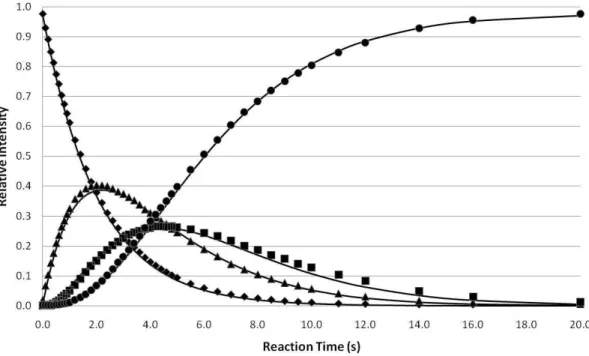
Figure 1 presents a typical reaction profile and statistical fit for substitution of amine 20
for ammonia in an ammonium salt cluster, in this case the reaction of DMA gas with
[(NH4)3(HSO4)2]+, the “3-2” ammonium bisulfate cluster. Because the pressure of DMA
gas was maintained at a constant level during the experiment, pseudo-first order kinet-ics may be assumed. A linear dependence of the pseudo-first order rate constant on
ACPD
10, 45–68, 2010Amine exchange into ammonium bisulfate
and ammonium nitrate nuclei
B. R. Bzdek et al.
Title Page
Abstract Introduction
Conclusions References
Tables Figures
◭ ◮
◭ ◮
Back Close
Full Screen / Esc
Printer-friendly Version
Interactive Discussion
reactant gas pressure was confirmed by varying (e.g. doubling) the gas pressure. The observed change in the pseudo-first order rate constants increased linearly with pres-sure as expected. The data were fit to equations obtained by assuming sequential pseudo-first order reactions. For example, the three step mechanism in Eq. (2) for re-actions of the 3-2 ammonium bisulfate cluster involves rate constants proportional to 5
the fixed pressure of DMA.
[(NH4)3(HSO4)2]+ k1
−→[(NH4)2(HDMA)(HSO4)2]+
k2
−→[(NH4)(HDMA)2(HSO4)2]+
k3
−→[(HDMA)3(HSO4)2]+
(2)
This mechanism gives rise to Eqs. (3)–(5) for the time-dependent concentrations of the reactants, intermediates, and product.
A1=A0e−k1t (3)
10
A2= k1A0
k2−k1
e−k1t−e−k2t
(4)
A3=k1k2A0 e
−k1t (k2−k1)(k3−k1)
+ e
−k2t (k1−k2)(k3−k2)
+ e
−k3t (k1−k3)(k2−k3)
!
, (5)
wheretis the reaction time (seconds);A0is the relative intensity of [(NH4)3(HSO4)2]+
at t=0; A1, A2, and A3 are the relative intensities of [(NH4)3(HSO4)2]+,
[(NH4)2(HDMA)(HSO4)2]+, and [(NH4)(HDMA)2(HSO4)2]+ at timet, respectively; and 15
k1,k2, andk3are the pseudo-first order rate constants for each respective substitution
of amine for ammonia.
Fitting these equations simultaneously to the data gives pseudo-first order rate con-stants for each successive substitution. As a check of the procedure, ammonium bisul-fate clusters partially substituted with DMA were produced by electrospray of a solution 20
ACPD
10, 45–68, 2010Amine exchange into ammonium bisulfate
and ammonium nitrate nuclei
B. R. Bzdek et al.
Title Page
Abstract Introduction
Conclusions References
Tables Figures
◭ ◮
◭ ◮
Back Close
Full Screen / Esc
Printer-friendly Version
Interactive Discussion
given in supplementary information: http://www.atmos-chem-phys-discuss.net/10/45/ 2010/acpd-10-45-2010-supplement.pdf. In each case, the pseudo-first order rate con-stants obtained from the partially substituted clusters were within experimental error of the rate constants determined from the reaction profile of original ammonium bisulfate cluster. The averages and standard deviations of all data for each substitution in the 5
3-2 cluster are given in Table 1.
In order to calculate a second order rate constant (kII), one must divide the
pseudo-first order rate constant (kI) by the pressure of gas in the cell:
kII= kI
Pgas (6)
Values for the second order rate constants are also provided in Table 1. It is impor-10
tant to note that while the error associated with the second-order rate constant is 30%, the uncertainty associated with the pseudo-first order rate constants is relatively small
(<10%). The larger error results from an uncertainty of 20% assigned to the
mea-surement of the absolute pressure rather than imprecision in our observed reaction rates.
15
To probe the reverse reaction, 3-2 dimethylaminium bisulfate clusters were
intro-duced to the ICR cell and allowed to react with gaseous NH3. However, no reaction
was observed even when the gas pressure was increased as high as possible and the reaction time extended to as long a period as possible. Therefore, only upper limits of rates for this reaction could be obtained. These values were estimated by multiplying 20
the baseline noise in the mass spectrum by a factor of three and setting that equal to the intensity of the product substituted cluster and are provided in Table 1.
Thermodynamic values, or limits on thermodynamic values, were determined from
the second order rate constants. The equilibrium constant,K, for the reaction is given
by 25
K=kII,forward
kII,reverse
(7)
ACPD
10, 45–68, 2010Amine exchange into ammonium bisulfate
and ammonium nitrate nuclei
B. R. Bzdek et al.
Title Page
Abstract Introduction
Conclusions References
Tables Figures
◭ ◮
◭ ◮
Back Close
Full Screen / Esc
Printer-friendly Version
Interactive Discussion
and the Gibbs free energy change,∆G, is given by:
∆G=−RTlnK (8)
whereR is the gas constant andT is temperature (298 K).
Table 1 gives K and ∆G values for substitution of DMA for NH3 in the 3-2
ammo-nium bisulfate cluster. Clearly substitution of amine for ammonia is thermodynamically 5
favorable; upper limits of∆Gvalues are quite negative.
3.2 Uptake coefficients (reaction probabilities)
Determination of an uptake coefficient for a reaction requires knowledge of the
colli-sion rate. The collicolli-sion rate between an ion and a (polar) molecule can be estimated in one of two ways. The capture collision model (Ridge, 2003) assumes an ion-induced 10
dipole force between the ion (salt cluster) and molecule (reactant gas). As a result of this force, capture, a spiral inward towards zero separation, will occur at some criti-cal impact parameter resulting in a collision between the two species. The spiraling trajectories become less important as the ion and/or molecule involved in the collision increase in size or as the relative velocity between the two increases. In these cases, 15
the ion and molecule are more likely to impact each other before the attractive force significantly deflects their trajectories, and the collision rate is better approximated by a hard sphere model. However, for the range of conditions used in this work (small
clusters with collision radii≤10 ˚A; low velocities), we expect that the capture collision
model is the more appropriate approach. 20
The capture collision rate constant as parameterized by Su and Chesnavich (1982),
kSC, is calculated from the ratiokSC/kL. The Langevin rate constant,kL, is given by
kL=2.342Z
α′ µ′
1/2
×10−9cm3molecule−1s−1 (9)
ACPD
10, 45–68, 2010Amine exchange into ammonium bisulfate
and ammonium nitrate nuclei
B. R. Bzdek et al.
Title Page
Abstract Introduction
Conclusions References
Tables Figures
◭ ◮
◭ ◮
Back Close
Full Screen / Esc
Printer-friendly Version
Interactive Discussion
the colliding molecule, andµ′is the reduced mass of the colliding pair in atomic mass
units. The capture collision rate constant can then be determined by
kSC=kSC
kL ×kL (10)
wherekSC/kLis given by
kSC
kL =0.9754+
τ/√2+0.5092
10.526 0< τ <2
p
2 (11)
5
kSC
kL =0.62+0.3371τ 2
p
2< τ (12)
andτis a dimensionless parameter described by the equation
τ=85.11µ′
D
1
α′T
1/2
(13)
whereµ′Dis the dipole moment of the molecule in Debye (D) andT is the temperature
in K. In general, Eq. (11) was appropriate when an amine gas was used, while Eq. (12) 10
was appropriate for reaction with ammonia gas.
Uptake coefficients (γ) were determined by the equation
γ= kII
kcollision (14)
Table 1 provides collisional rate constants and uptake coefficients for both the
substi-tution of DMA for NH3in 3-2 ammonium bisulfate and the substitution of NH3 for DMA
15
in 3-2 dimethylaminium bisulfate. Since the reverse reaction was not observed, only
upper estimates of uptake coefficients were possible.
ACPD
10, 45–68, 2010Amine exchange into ammonium bisulfate
and ammonium nitrate nuclei
B. R. Bzdek et al.
Title Page
Abstract Introduction
Conclusions References
Tables Figures
◭ ◮
◭ ◮
Back Close
Full Screen / Esc
Printer-friendly Version
Interactive Discussion 3.3 Bisulfate clusters
The procedures described above were performed for bisulfate clusters of several diff
er-ent sizes and compositions. Not only were ammonium bisulfate clusters investigated,
but also the substitution of one amine for another in different aminium bisulfate clusters
was studied so as to determine the favorability of one amine versus another in a bisul-5
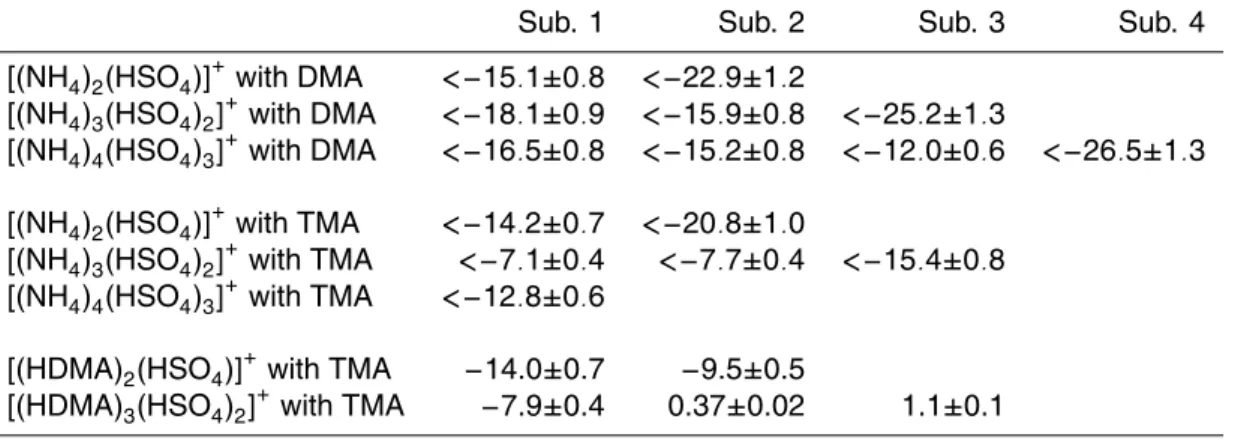
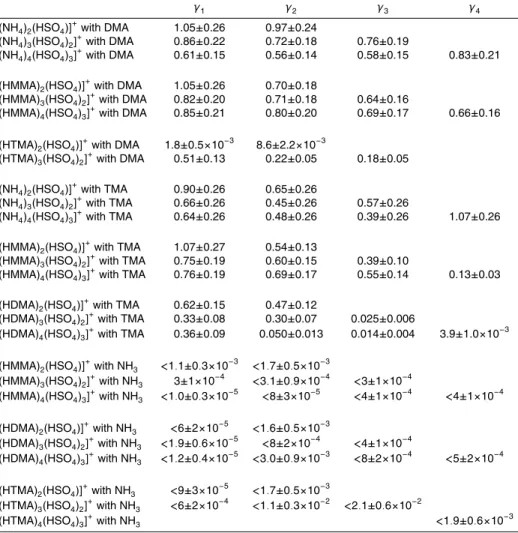
fate salt. ∆Gvalues for substitution in bisulfate clusters are provided in Table 2, while
uptake coefficients for these reactions are provided in Table 3.
It is evident based on ∆G values that substitution of amine for ammonia is highly
favorable. Since the reverse reaction (substitution of ammonia for amine) was not
ob-served, only upper limits for∆Gwere determined. However, in the case of substitution
10
of TMA for DMA in dimethylaminium bisulfate, both the forward and reverse reactions
were observed, so actual∆Gvalues were determined. One general conclusion based
on these thermodynamic results is that reaction is favorable when substitution occurs
by a more polarizable species. Table 4 provides proton affinity and enthalpy of solvation
values for ammonia and the aliphatic amines. By comparing∆Gvalues to proton affinity
15
differences, it appears that proton affinity is a good guide for determining the
favora-bility of substitution in most cases. However, since measurements were not absolute
for the ammonium bisulfate clusters, exactly how good of a guide proton affinity values
may be is uncertain, but initial substitution of TMA for DMA in 2-1 dimethylaminium
bisulfate gives a ∆G value (14.0±0.7 kJ/mol) close to the difference in proton affinity
20
between DMA and TMA (20 kJ/mol). However, in the 3-2 dimethylaminium bisulfate cluster, substitution of TMA for DMA becomes unfavorable after the first substitution, which is what would be predicted based on enthalpy of solvation values. DMA solvates better than TMA; therefore, based on enthalpy of solvation values, substitution should be unfavorable. The unfavorability may also be due to steric interactions between TMA 25
and the cluster as well as the loss of one hydrogen bond that occurs upon substitution
of TMA. Therefore, while proton affinity may be a good predictor for initial substitution,
ACPD
10, 45–68, 2010Amine exchange into ammonium bisulfate
and ammonium nitrate nuclei
B. R. Bzdek et al.
Title Page
Abstract Introduction
Conclusions References
Tables Figures
◭ ◮
◭ ◮
Back Close
Full Screen / Esc
Printer-friendly Version
Interactive Discussion
An examination of the uptake coefficients for bisulfate clusters agrees with this
analy-sis. In the case of ammonium bisulfate clusters reacting with amine, uptake coefficients
are close to unity, indicating that substitution occurs near the collision rate. The same is true for monomethylaminium bisulfate with both DMA and TMA. In general, the first substitution occurred the fastest. Subsequent substitutions, while still quite fast, were 5
slightly slower. This behavior can be explained by collisions of amine with the cluster occurring in places where substitution had already occurred, resulting in no net reac-tion. In the case of trimethylaminium bisulfate reacting with DMA, substitution in the
2-1 cluster is unfavorable, which would be predicted based on proton affinity values.
For the 3-2 cluster, though, substitution is observed, which would be predicted based 10
on enthalpy of solvation values. Overall, later substitutions in a cluster occurred more quickly when reacting with DMA than TMA, likely due to steric hindrance with TMA.
3.4 Nitrate clusters
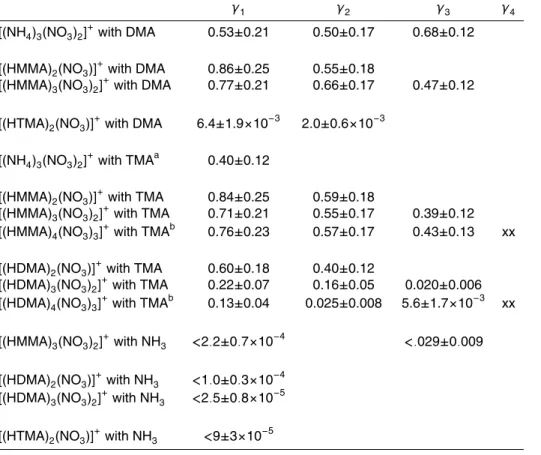
Substitution kinetics and thermodynamics were also investigated for nitrate clusters. Thermodynamic results are provided in Table 5; kinetic results are provided in Ta-15
ble 6. In general, nitrate clusters were more difficult to study than bisulfate clusters.
Ammonium nitrate volatilizes at low temperatures, so obtaining a stable ion signal for one cluster was a challenging problem. Clusters also appeared to be less strongly bound, so energetic substitutions in some cases introduced moderate to significant cluster dissociation. Significant cluster dissociation was evident for the 3-2 ammo-20
nium nitrate cluster reacting with TMA; however this cluster appeared to dissociate to the analogous 2-1 cluster at a rate close to collision rate. Additionally, both the 4-3 monomethylaminium and dimethylaminium nitrate clusters appeared to dissociate
upon their final substitution with TMA. Rate constants (and, therefore, uptake coeffi
-cients) were not ascertained for the final substitution because these species were not 25
observed. However, it appears that substitution did occur for this step, as significant cluster dissociation was observed at this point in the reaction, which is the opposite of what is normally observed upon the final substitution (that is, virtually no cluster
ACPD
10, 45–68, 2010Amine exchange into ammonium bisulfate
and ammonium nitrate nuclei
B. R. Bzdek et al.
Title Page
Abstract Introduction
Conclusions References
Tables Figures
◭ ◮
◭ ◮
Back Close
Full Screen / Esc
Printer-friendly Version
Interactive Discussion
sociation is observed). Overall, results from nitrate clusters were in agreement with
results from bisulfate clusters. Of particular note is that∆Gvalues for the substitution
of TMA for DMA in 2-1 dimethylaminium nitrate are in agreement within experimental
error to the∆Gvalues for the analogous substitution in dimethylaminium bisulfate.
Therefore, it appears that amines displace ammonia at or near collision rate for small 5
bisulfate and nitrate clusters. Initial substitution is generally favorable when a species with higher proton affinity displaces one with lower proton affinity.
3.5 Reaction of ions vs. neutrals
It should be noted that in order to study these small clusters using mass spectrometry, they must exist as charged species. Nonetheless, we expect that these results would 10
also apply to neutral clusters, which appear to be dominant in the atmosphere (Kulmala et al., 2007). Within one specific cluster size, there generally were no large (i.e. order
of magnitude) differences in the observed rate constants from one substitution to the
next, which would be indicative of charge playing an important role in the reaction. Additionally, the differences in substitution rate constants for clusters of different sizes 15
(i.e. 2-1 ammonium bisulfate vs. 3-2 ammonium bisulfate vs. 4-3 ammonium bisulfate) were minimal. If charge were playing an important role in these reactions, significant
differences from one size cluster to the next would be apparent; however, this was not
observed, again suggesting charge played a minimal role in these reactions.
4 Atmospheric implications
20
The results of this work have important atmospheric implications. These clusters have diameters that are about 1–2 nm, which fall into the size range of the stable pool of clusters that has been implicated in new particle formation (Kulmala et al., 2007). For a 1-nm diameter cluster exposed to an ambient amine level of 1 ppb, i.e. near an amine
source, the collision rate would be on the order of 30 s−1. Based on the near unity
ACPD
10, 45–68, 2010Amine exchange into ammonium bisulfate
and ammonium nitrate nuclei
B. R. Bzdek et al.
Title Page
Abstract Introduction
Conclusions References
Tables Figures
◭ ◮
◭ ◮
Back Close
Full Screen / Esc
Printer-friendly Version
Interactive Discussion
take coefficients measured in this work, complete conversion of ammonium to aminium
in the cluster would be expected to occur in less than a second. If the ambient amine concentration were in the low ppt level, i.e. further away from an amine source, com-plete conversion still would be expected within several seconds to minutes. These results suggest that if salt clusters are a component of the sub-3 nm cluster pool, they 5
are likely to be aminium salts rather than ammonium salts, even if they were initially formed as ammonium salts. Ammonium salt clusters would be expected to persist only when 1) the formation rate of new clusters exceeds the cluster collision rate with amine or 2) the growth rate of a cluster by collision with ammonia exceeds the cluster colli-sion rate with amine. The concept of rapid, complete convercolli-sion of ammonium salts 10
to aminium salts applies only to relatively small clusters. As the cluster size increases, the corresponding surface to volume ratio decreases and the time required to achieve complete conversion becomes excessively long.
Acknowledgements. The authors gratefully acknowledge the assistance of Jeffrey M. Sprag-gins with FT-ICR experimental details. BRB acknowledges a graduate fellowship from the
Uni-15
versity of Delaware Center for Critical Zone Research. This research was supported by NSF Grant No. CHE-0808972.
References
Barsanti, K. C., McMurry, P. H., and Smith, J. N.: The potential contribution of organic salts to new particle growth, Atmos. Chem. Phys., 9, 2949–2957, 2009,
20
http://www.atmos-chem-phys.net/9/2949/2009/.
Bartmess, J. E. and Georgiadis, R. M.: Empirical methods for determination of ionization gauge relative sensitivities for different gases, Vacuum, 33, 149–153, 1983.
Cadle, S. H. and Mulawa, P. A.: Low-molecular weight aliphatic amines in exhaust from catalyst-equipped cars, Environ. Sci. Technol., 14, 718–723, 1980.
25
Ehn, M., Pet ¨aj ¨a, T., Birmili, W., Junninen, H., Aalto, P., and Kulmala, M.: Non-volatile residuals of newly formed atmospheric particles in the boreal forest, Atmos. Chem. Phys., 7, 677–684,
ACPD
10, 45–68, 2010Amine exchange into ammonium bisulfate
and ammonium nitrate nuclei
B. R. Bzdek et al.
Title Page
Abstract Introduction
Conclusions References
Tables Figures
◭ ◮
◭ ◮
Back Close
Full Screen / Esc
Printer-friendly Version
Interactive Discussion 2007,
http://www.atmos-chem-phys.net/7/677/2007/.
Facchini, M. C., Decesari, S., Rinaldi, M., Carbone, C., Finessi, E., Mircea, M., Fuzzi, S., Moretti, F., Tagliavini, E., Ceburnis, D., and O’Dowd, C. D.: Important source of marine secondary organic aerosol from biogenic amines, Environ. Sci. Technol., 42, 9116–9121,
5
2008.
Hutchinson, G. L., Mosier, A. R., and Andre, C. E.: Ammonia and amine emissions from a large cattle feedlot, J. Environ. Qual., 11, 288–293, 1982.
Kerminen, V. M., Lihavainen, H., Komppula, M., Viisanen, Y., and Kulmala, M.: Direct observa-tional evidence linking atmospheric aerosol formation and cloud droplet activation, Geophys.
10
Res. Lett., 32, L14803, doi:10.1029/2005GL023130, 2005.
Koornneef, J., van Keulen, T., Faaij, A., and Turkenburg, W.: Life cycle assessment of a pul-verized coal power plant with post-combustion capture, transport and storage of CO2, Int. J. Greenh. Gas Con., 2, 448–467, 2008.
Kuang, C., McMurry, P. H., and McCormick, A. V.: Determination of cloud condensation nuclei
15
production from measured new particle formation events, Geophys. Res. Lett., 36, L09822, doi:10.1029/2009GL037584, 2009.
Kulmala, M., Riipinen, I., Sipila, M., Manninen, H. E., Petaja, T., Junninen, H., Dal Maso, M., Mordas, G., Mirme, A., Vana, M., Hirsikko, A., Laakso, L., Harrison, R. M., Hanson, I., Le-ung, C., Lehtinen, K. E. J., and Kerminen, V. M.: Toward direct measurement of atmospheric
20
nucleation, Science, 318, 89–92, 2007.
Kurt ´en, T., Loukonen, V., Vehkam ¨aki, H., and Kulmala, M.: Amines are likely to enhance neu-tral and ion-induced sulfuric acid-water nucleation in the atmosphere more effectively than ammonia, Atmos. Chem. Phys., 8, 4095–4103, 2008,
http://www.atmos-chem-phys.net/8/4095/2008/.
25
Laaksonen, A., Hamed, A., Joutsensaari, J., Hiltunen, L., Cavalli, F., Junkermann, W., Asmi, A., Fuzzi, S., and Facchini, M. C.: Cloud condensation nucleus production from nucleation events at a highly polluted region, Geophys. Res. Lett., 32, L06812, doi:10.1029/2004GL022092, 2005.
Leach, J., Blanch, A., and Bianchi, A. C.: Volatile organic compounds in an urban airborne
en-30
vironment adjacent to a municipal incinerator, waste collection centre and sewage treatment plant, Atmos. Environ., 33, 4309–4325, 1999.
ACPD
10, 45–68, 2010Amine exchange into ammonium bisulfate
and ammonium nitrate nuclei
B. R. Bzdek et al.
Title Page
Abstract Introduction
Conclusions References
Tables Figures
◭ ◮
◭ ◮
Back Close
Full Screen / Esc
Printer-friendly Version
Interactive Discussion 2010), CRC Press/Taylor Francis, Boca Raton, FL, 2010.
Lihavainen, H., Kerminen, V. M., Komppula, M., Hatakka, J., Aaltonen, V., Kulmala, M., and Viisanen, Y.: Production of “potential” cloud condensation nuclei associated with atmo-spheric new-particle formation in northern Finland, J. Geophys. Res.-Atmos., 108, 4782, doi:10.1029/2003JD003887, 2003.
5
Lloyd, J. A., Heaton, K. J., and Johnston, M. V.: Reactive uptake of trimethylamine into ammo-nium nitrate particles, J. Phys. Chem. A, 113, 4840–4843, 2009.
Lobert, J. M., Scharffe, D. H., Hao, W., Kuhlbusch, T. A., Warneck, P., and Crutzen, P. J.: Ex-perimental evaluation of biomass burning emissions: Nitrogen and carbon containing com-pounds, in: Global Biomass Burning: Atmospheric, Climatic and Biospheric Implications,
10
edited by: Levine, J. S., MIT Press, Cambridge, MA, 1991.
Makela, J. M., Yli-Koivisto, S., Hiltunen, V., Seidl, W., Swietlicki, E., Teinila, K., Sillanpaa, M., Koponen, I. K., Paatero, J., Rosman, K., and Hameri, K.: Chemical composition of aerosol during particle formation events in boreal forest, Tellus B, 53, 380–393, 2001.
Moffet, R. C., de Foy, B., Molina, L. T., Molina, M. J., and Prather, K. A.: Measurement of
am-15
bient aerosols in northern Mexico City by single particle mass spectrometry, Atmos. Chem. Phys., 8, 4499–4516, 2008,
http://www.atmos-chem-phys.net/8/4499/2008/.
Murphy, S. M., Sorooshian, A., Kroll, J. H., Ng, N. L., Chhabra, P., Tong, C., Surratt, J. D., Knip-ping, E., Flagan, R. C., and Seinfeld, J. H.: Secondary aerosol formation from atmospheric
20
reactions of aliphatic amines, Atmos. Chem. Phys., 7, 2313–2337, 2007, http://www.atmos-chem-phys.net/7/2313/2007/.
Ngwabie, N. M., Schade, G. W., Custer, T. G., Linke, S., and Hinz, T.: Volatile organic compound emission and other trace gases from selected animal buildings, Landbauforsch. Volk., 57, 273–284, 2007.
25
Pratt, K. A., Hatch, L. E., and Prather, K. A.: Seasonal volatility dependence of ambient particle phase amines, Environ. Sci. Technol., 43, 5276–5281, 2009.
Rabaud, N. E., Ebeler, S. E., Ashbaugh, L. L., and Flocchini, R. G.: Characterization and quantification of odorous and non-odorous volatile organic compounds near a commercial dairy in California, Atmos. Environ., 37, 933–940, 2003.
30
Reinard, M. S., Adou, K., Martini, J. M., and Johnston, M. V.: Source characterization and identification by real-time single particle mass spectrometry, Atmos. Environ., 41, 9397– 9409, 2007.
ACPD
10, 45–68, 2010Amine exchange into ammonium bisulfate
and ammonium nitrate nuclei
B. R. Bzdek et al.
Title Page
Abstract Introduction
Conclusions References
Tables Figures
◭ ◮
◭ ◮
Back Close
Full Screen / Esc
Printer-friendly Version
Interactive Discussion Ridge, D. P.: Ion-Molecule Collision Theory, in: The Encyclopedia of Mass Spectrometry, edited
by: Armentrout, P. B., Elsevier, San Diego, CA, 1–8, 2003.
Schade, G. W. and Crutzen, P. J.: Emission of aliphatic amines from animal husbandry and their reactions: Potential source of N2O and HCN, J. Atmos. Chem., 22, 319–346, 1995. Smith, J. N., Dunn, M. J., VanReken, T. M., Iida, K., Stolzenburg, M. R., McMurry, P. H., and
5
Huey, L. G.: Chemical composition of atmospheric nanoparticles formed from nucleation in Tecamac, Mexico: Evidence for an important role for organic species in nanoparticle growth, Geophys. Res. Lett., 35, L04808, doi:10.1029/2007GL032523, 2008.
Sorooshian, A., Murphy, S. M., Hersey, S., Gates, H., Padro, L. T., Nenes, A., Brechtel, F. J., Jonsson, H., Flagan, R. C., and Seinfeld, J. H.: Comprehensive airborne characterization of
10
aerosol from a major bovine source, Atmos. Chem. Phys., 8, 5489–5520, 2008, http://www.atmos-chem-phys.net/8/5489/2008/.
Spracklen, D. V., Carslaw, K. S., Kulmala, M., Kerminen, V.-M., Mann, G. W., and Sihto, S.-L.: The contribution of boundary layer nucleation events to total particle concentrations on regional and global scales, Atmos. Chem. Phys., 6, 5631–5648, 2006,
15
http://www.atmos-chem-phys.net/6/5631/2006/.
Spracklen, D. V., Carslaw, K. S., Kulmala, M., Kerminen, V. M., Sihto, S. L., Riipinen, I., Merikanto, J., Mann, G. W., Chipperfield, M. P., Wiedensohler, A., Birmili, W., and Li-havainen, H.: Contribution of particle formation to global cloud condensation nuclei con-centrations, Geophys. Res. Lett., 35, L06808, doi:10.1029/2007GL033038, 2008.
20
Su, T. and Chesnavich, W. J.: Parametrization of the ion-polar molecule collision rate constant by trajectory calculations, J. Chem. Phys., 76, 5183–5185, 1982.
Thitakamol, B., Veawab, A., and Aroonwilas, A.: Environmental impacts of absorption-based CO2 capture unit for post-combustion treatment of flue gas from coal-fired power plant, Int. J. Greenh. Gas Con., 1, 318–342, 2007.
25
Van Neste, A., Duce, R. A., and Lee, C.: Methylamines in the marine atmosphere, Geophys. Res. Lett., 14, 711–714, 1987.
Westerholm, R., Li, H., and Almen, J.: Estimation of aliphatic amine emissions in automobile exhausts, Chemosphere, 27, 1381–1384, 1993.
Zordan, C. A., Wang, S., and Johnston, M. V.: Time-resolved chemical composition of individual
30
ACPD
10, 45–68, 2010Amine exchange into ammonium bisulfate
and ammonium nitrate nuclei
B. R. Bzdek et al.
Title Page
Abstract Introduction
Conclusions References
Tables Figures
◭ ◮
◭ ◮
Back Close
Full Screen / Esc
Printer-friendly Version
Interactive Discussion Table 1. Data summary for the substitution of DMA for NH3 in the 3-2 ammonium bisulfate
cluster and for the substitution of NH3for DMA in the 3-2 dimethylaminium bisulfate cluster.
Substitution with DMAa Pseudo-first order Second order rate constant K ∆G(kJ/mol) Collisional Rate Constant Uptake Coefficient rate constant (s−1) (cm3molecule−1s−1) (cm3molecule−1s−1) (γ) [(NH4)3(HSO4)2]+ 0.49
±0.03 1.1±0.3×10⁻⁹ >1500
±600 <−18.1±0.9 1.3±0.3×10⁻⁹ 0.86
±0.26
→[(NH4)2(HDMA)(HSO4)2]+
[(NH4)2(HDMA)(HSO4)2]+ 0.41±0.02 9.3±3.0×10− 10
>620±250 <−15.9±0.8 1.3±0.3×10⁻⁹
0.72±0.22
→[(NH4)(HDMA)2(HSO4)2]+
[(NH4)(HDMA)2(HSO4)2]+ 0.43±0.03 9.7±3.0×10⁻¹⁰ >26000
±10000 <−25.2±1.3 1.3±0.3×10⁻⁹ 0.76
±0.23
→[(HDMA)3(HSO4)2]+ Substitution with NHb
3 Pseudo-first order Second order rate constant K ∆G (kJ/mol) Collisional Rate Constant Uptake Coefficient rate constant (s−1
) (cm3molecule−1 s−1
) (cm3molecule−1 s−1
) (γ) [(HDMA)3(HSO4)2]+ <5
±3×10⁻⁴ <3.8
±1.1×10⁻¹⁴ <4
±2 (×10−5) >25.2
±1.3 2.0±0.4×10⁻⁹ <3.8
±1.1×10⁻⁴
→[(NH4)(HDMA)2(HSO4)2]+
[(NH4)(HDMA)2(HSO4)2]+ <1.8±0.8×10− 3 <
1.5±0.5×10⁻¹² <
1.6±6 (×10−3
) >15.9±0.8 2.0±0.4×10⁻⁹ <
7.6±2.3×10⁻⁴
→[(NH4)2(HDMA)(HSO4)2]+
[(NH4)2(HDMA)(HSO4)2]+ <9±2×10⁻⁴ <7.5±2.3×10⁻¹³ <7±3 (×10−4) >18.1±0.9 2.0±0.4×10⁻⁹ <1.9±0.6×10⁻⁵
→[(NH4)3(HSO4)2]+
a
Pressure: 1.2±0.2×10⁻⁸torr
bPressure: For [(HDMA)
3(HSO4)2]+: 3.7±0.7×10⁻⁷torr; For [(NH
4)(HDMA)2(HSO4)2]+and [(NH4)2(HDMA)(HSO4)2]+: 3.4±0.7×10⁻⁸torr
ACPD
10, 45–68, 2010Amine exchange into ammonium bisulfate
and ammonium nitrate nuclei
B. R. Bzdek et al.
Title Page
Abstract Introduction
Conclusions References
Tables Figures
◭ ◮
◭ ◮
Back Close
Full Screen / Esc
Printer-friendly Version
Interactive Discussion Table 2.∆Gvalues (kJ/mol) for the substitution reactions of bisulfate clusters.
Sub. 1 Sub. 2 Sub. 3 Sub. 4
[(NH4)2(HSO4)]+with DMA <−15.1±0.8 <−22.9±1.2
[(NH4)3(HSO4)2]+with DMA <−18.1±0.9 <−15.9±0.8 <−25.2±1.3
[(NH4)4(HSO4)3]+with DMA <−16.5±0.8 <−15.2±0.8 <−12.0±0.6 <−26.5±1.3
[(NH4)2(HSO4)]+with TMA <−14.2±0.7 <−20.8±1.0
[(NH4)3(HSO4)2]+with TMA <−7.1±0.4 <−7.7±0.4 <−15.4±0.8 [(NH4)4(HSO4)3]+with TMA <−12.8±0.6
[(HDMA)2(HSO4)]+with TMA −14.0±0.7 −9.5±0.5
ACPD
10, 45–68, 2010Amine exchange into ammonium bisulfate
and ammonium nitrate nuclei
B. R. Bzdek et al.
Title Page
Abstract Introduction
Conclusions References
Tables Figures
◭ ◮
◭ ◮
Back Close
Full Screen / Esc
Printer-friendly Version
Interactive Discussion Table 3.Uptake coefficients for the substitution reactions of bisulfate clusters.
γ1 γ2 γ3 γ4
[(NH4)2(HSO4)]+with DMA 1.05±0.26 0.97±0.24
[(NH4)3(HSO4)2]+with DMA 0.86±0.22 0.72±0.18 0.76±0.19
[(NH4)4(HSO4)3]+with DMA 0.61±0.15 0.56±0.14 0.58±0.15 0.83±0.21
[(HMMA)2(HSO4)]+with DMA 1.05±0.26 0.70±0.18
[(HMMA)3(HSO4)2]+with DMA 0.82±0.20 0.71±0.18 0.64±0.16
[(HMMA)4(HSO4)3]+with DMA 0.85±0.21 0.80±0.20 0.69±0.17 0.66±0.16
[(HTMA)2(HSO4)]+with DMA 1.8±0.5×10⁻³ 8.6
±2.2×10⁻³
[(HTMA)3(HSO4)2]+with DMA 0.51±0.13 0.22±0.05 0.18±0.05
[(NH4)2(HSO4)]+with TMA 0.90
±0.26 0.65±0.26
[(NH4)3(HSO4)2]+with TMA 0.66±0.26 0.45±0.26 0.57±0.26
[(NH4)4(HSO4)3]+with TMA 0.64±0.26 0.48±0.26 0.39±0.26 1.07±0.26
[(HMMA)2(HSO4)]+with TMA 1.07
±0.27 0.54±0.13
[(HMMA)3(HSO4)2]+with TMA 0.75±0.19 0.60±0.15 0.39±0.10
[(HMMA)4(HSO4)3]+with TMA 0.76±0.19 0.69±0.17 0.55±0.14 0.13±0.03
[(HDMA)2(HSO4)]+with TMA 0.62
±0.15 0.47±0.12
[(HDMA)3(HSO4)2]+with TMA 0.33±0.08 0.30±0.07 0.025±0.006
[(HDMA)4(HSO4)3]+with TMA 0.36±0.09 0.050±0.013 0.014±0.004 3.9±1.0×10⁻³
[(HMMA)2(HSO4)]+with NH3 <1.1±0.3×10⁻³ <1.7
±0.5×10⁻³
[(HMMA)3(HSO4)2]+with NH
3 3±1×10−
4 <3.1
±0.9×10⁻⁴ <3 ±1×10⁻⁴
[(HMMA)4(HSO4)3]+with NH3 <1.0±0.3×10− 5 <
8±3×10⁻⁵ <
4±1×10⁻⁴ <
4±1×10⁻⁴
[(HDMA)2(HSO4)]+with NH3 <6±2×10− 5 <
1.6±0.5×10⁻³
[(HDMA)3(HSO4)2]+with NH3 <1.9±0.6×10⁻⁵ <8±2×10⁻⁴ <4±1×10⁻⁴
[(HDMA)4(HSO4)3]+with NH3 <1.2±0.4×10⁻⁵ <3.0±0.9×10⁻³ <8±2×10⁻⁴ <5±2×10⁻⁴
[(HTMA)2(HSO4)]+with NH3 <9±3×10⁻⁵ <1.7±0.5×10⁻³
[(HTMA)3(HSO4)2]+with NH3 <6±2×10⁻⁴ <1.1±0.3×10⁻² <2.1±0.6×10⁻²
[(HTMA)4(HSO4)3]+with NH3 <1.9±0.6×10⁻³
ACPD
10, 45–68, 2010Amine exchange into ammonium bisulfate
and ammonium nitrate nuclei
B. R. Bzdek et al.
Title Page
Abstract Introduction
Conclusions References
Tables Figures
◭ ◮
◭ ◮
Back Close
Full Screen / Esc
Printer-friendly Version
Interactive Discussion Table 4.Proton affinity and enthalpy of solvation values for NH3and the aliphatic amines (Lide,
2010).
Proton Affinity (kJ/mol) Enthalpy of Solvation (kJ/mol)
NH3 853.6 −35.4
MMA 899.0 −45.3
DMA 929.5 −53.1
ACPD
10, 45–68, 2010Amine exchange into ammonium bisulfate
and ammonium nitrate nuclei
B. R. Bzdek et al.
Title Page
Abstract Introduction
Conclusions References
Tables Figures
◭ ◮
◭ ◮
Back Close
Full Screen / Esc
Printer-friendly Version
Interactive Discussion Table 5.∆Gvalues (kJ/mol) for the substitution reactions of nitrate clusters.
Sub. 1 Sub. 2 Sub. 3
[(NH4)3(NO3)2]+ with DMA <−24.2±1.2 [(HDMA)2(NO3)]+with TMA −13.7±0.7 −9.9±0.5
ACPD
10, 45–68, 2010Amine exchange into ammonium bisulfate
and ammonium nitrate nuclei
B. R. Bzdek et al.
Title Page
Abstract Introduction
Conclusions References
Tables Figures
◭ ◮
◭ ◮
Back Close
Full Screen / Esc
Printer-friendly Version
Interactive Discussion Table 6.Uptake coefficients for the substitution reactions of nitrate clusters.
γ1 γ2 γ3 γ4
[(NH4)3(NO3)2]+with DMA 0.53±0.21 0.50±0.17 0.68±0.12
[(HMMA)2(NO3)]+with DMA 0.86±0.25 0.55±0.18
[(HMMA)3(NO3)2]+with DMA 0.77±0.21 0.66±0.17 0.47±0.12
[(HTMA)2(NO3)]+with DMA 6.4±1.9×10⁻³ 2.0
±0.6×10⁻³
[(NH4)3(NO3)2]+with TMAa 0.40±0.12
[(HMMA)2(NO3)]+with TMA 0.84±0.25 0.59±0.18
[(HMMA)3(NO3)2]+with TMA 0.71±0.21 0.55±0.17 0.39±0.12 [(HMMA)4(NO3)3]+with TMA
b
0.76±0.23 0.57±0.17 0.43±0.13 xx
[(HDMA)2(NO3)]+with TMA 0.60±0.18 0.40±0.12
[(HDMA)3(NO3)2]+with TMA 0.22±0.07 0.16±0.05 0.020±0.006 [(HDMA)4(NO3)3]+with TMA
b
0.13±0.04 0.025±0.008 5.6±1.7×10⁻³ xx
[(HMMA)3(NO3)2]+with NH3 <2.2±0.7×10⁻⁴
<.029±0.009
[(HDMA)2(NO3)]+with NH3 <1.0±0.3×10− 4
[(HDMA)3(NO3)2]+with NH3 <2.5±0.8×10− 5
[(HTMA)2(NO3)]+with NH3 <9±3×10− 5
a
Breakup of the 3-2 cluster to the 2-1 cluster was quite significant. The uptake coefficient represents the rate of cluster breakup to the 2-1 cluster compared to the collisional rate constant.
b
ACPD
10, 45–68, 2010Amine exchange into ammonium bisulfate
and ammonium nitrate nuclei
B. R. Bzdek et al.
Title Page
Abstract Introduction
Conclusions References
Tables Figures
◭ ◮
◭ ◮
Back Close
Full Screen / Esc
Printer-friendly Version
Interactive Discussion Fig. 1.Reaction profile and statistical fit for the reaction of the 3-2 ammonium bisulfate cluster
with DMA. The shapes are experimental data: diamonds represent 0 DMA exchanged, triangles represent 1 DMA exchanged, squares represent 2 DMA exchanged, and circles represent 3 DMA exchanged. Solid lines are the statistical fits.