Submitted 31 August 2015 Accepted 29 October 2015 Published26 November 2015
Corresponding author Ning Gu, guning [email protected]
Academic editor Mandeep Mehra
Additional Information and Declarations can be found on page 12
DOI10.7717/peerj.1412
Copyright 2015 Chen et al.
Distributed under
Creative Commons CC-BY 4.0
OPEN ACCESS
TLR4 Asp299Gly (rs4986790)
polymorphism and coronary artery
disease: a meta-analysis
Rui Chen1, Ning Gu2, Ying Gao1and Wei Cen1
1The First Clinical College, Nanjing University of Chinese Medicine, Nanjing, Jiangsu, China 2Department of Cardiology, The Third Affiliated Hospital of Nanjing University of Chinese
Medicine, Nanjing, Jiangsu, China
ABSTRACT
Background.Previous studies have shown conflicting results on the association between toll-like receptor 4 (TLR4) Asp299Gly (rs4986790) polymorphism and coronary artery disease (CAD). The aim of this study was to evaluate the influence of TLR4 Asp299Gly polymorphism on CAD risk, CRP level and the number of stenotic coronary arteries, as well as to investigate whether G allele carriers would benefit more from statin treatment.
Methods.PubMed, EMBASE, and CNKI databases were searched until May 2015. All the statistical tests were performed using R version 3.1.2. Odds ratio (OR) and 95% confidence interval (CI) were used to assess the association between TLR4 Asp299Gly polymorphism and CAD risk, the number of stenotic vessels, and the incidence of cardiovascular events according to statin-treated patients. Weighted mean difference (WMD) was calculated for the association between Asp299Gly and CRP level.
Results.Overall, 12 case-control studies with 10,258 cases and 5,891 controls were included, and no association of TLR4Asp299Gly polymorphism with CAD was found (G allele vs. A allele: OR=0.97, 95% CI [0.81–1.17],P=0.75; AA vs. GG+ AG: OR=0.97, 95% CI [0.80–1.18],P=0.76; GG vs. AG+AA: OR=1.08, 95% CI [0.57–2.02],P=0.82; AG vs. AA+GG: OR=1.03, 95% CI [0.85–1.25],P=0.74). Also, no association was noted between Asp299Gly and CRP level (WMD= −0.10, 95% CI [−0.62, 0.41],P=0.69). Furthermore, no synergistic effect of statin and 299Gly was reported (Statin AA vs. Statin AG/GG: OR=1.12, 95% CI [0.41–3.09],
P=0.82).
Discussion.This meta-analysis suggests no association of TLR4 Asp299Gly polymor-phism with CAD and CRP level. It is further indicated that the G allele carriers may not benefit more from statin treatment. Further studies should include large sample size and high-quality literature to understand this issue in depth.
Subjects Cardiology, Evidence Based Medicine, Internal Medicine
Keywords Coronary artery disease, Polymorphism, C-reactive protein, Statin, Stenosis, Toll-like receptor 4, Asp299Gly
INTRODUCTION
(Ross, 1999;Libby, Lichtman & Hansson, 2013). Moreover, as a pattern recognition receptor of the innate immune system, toll-like receptor 4 (TLR4) expression is increased in human atherosclerotic lesions (Edfeldt et al., 2002). Various ligands (e.g., lipopolysaccharide (LPS), heat shock protein (HSP), minimally oxidized low-density lipoprotein (mmLDL), fibrino-gen) can bind to TLR4, and then myeloid differentiation factor 88 (MyD88)-dependent or MyD88-independent signal pathway is activated, resulting in inappropriate immune activation, which consequently contributes to the onset and rupture of AS plaques (Dekker et al., 2010;Miller et al., 2012).
Human TLR4 is located in 9q32-q33 region, and contains three exons. TLR4 activity and function seem to be modulated by genetic variations, especially single nucleotide polymorphisms (SNPs) (Balistreri et al., 2009). Asp299Gly (+896A/G, rs4986790) is one of the only two SNPs in TLR4 that have a frequency greater than 5% in humans (Balistreri
et al., 2009); the other is Thr399Ile (+1196C/T, rs4986791) and a high degree of linkage
disequilibrium (LD) exists between them. As most of the variations, Asp299Gly is in the leucine-rich repeat (LRR) domain of Exon 3 which is associated with the recognition of pathogen-associated molecular patterns (PAMPs) (e.g., mmLDL) (Smirnova et al., 2000). Because of a glycine residue substituting for aspartic acid at amino acid position 299 (nucleotide substitution 896A>G), the extracellular domain of TLR4 is changed, leading to an attenuate signal pathway, blunted response to inhaled LPS, decreased production of inflammatory cytokines (Arbour et al., 2000), and reduced risk of the progression of atherosclerosis (Kiechl et al., 2002). Numerous studies have focused on the association between the Asp299Gly TLR4 polymorphism and CAD. Some reports suggested a protective effect of TLR4 Asp299Gly on CAD (Boekholdt et al., 2003;Ameziane et al., 2003;Kolek et al., 2004;Balistreri et al., 2004;Berg et al., 2009). In contrast, one study found that men with the 299Gly TLR4 genotype had an increased risk of myocardial infarction (MI) (Edfeldt et al., 2004), while other reports showed no obvious association between 299Gly and CAD (Morange et al., 2004;Zee et al., 2005;Koch et al., 2006;O’Halloran et al., 2006;Nebel et al., 2007;Beijk et al., 2010;Dˇzumhur et al., 2012;Mart´ınez-R´ıos et al., 2013;
Golovkin et al., 2014;Guven et al., 2015). Based on these, many studies have investigated the relationship between the severity of coronary artery stenosis and Asp299Gly, and obtained inconsistent results (Boekholdt et al., 2003;Yang, Holloway & Ye, 2003;Hernesniemia et al., 2006;Dˇzumhur et al., 2012;Guven et al., 2015). Furthermore, based on the direct anti-inflammatory effect of statin (Crisby et al., 2001;Ridker et al., 2009)Boekholdt et al. (2003)stated that 299Gly can affect the efficacy of statin in preventing cardiovascular events, and thus the carriers of the variant allele benefit significantly from statin treatment; however, the same phenomenon was not found in other reports (Kolek et al., 2004;
Beijk et al., 2010). The issue whether a synergistic effect of statin and 299Gly exists is still controversial. In addition, C-reactive protein (CRP) serves as a useful biomarker of inflammatory diseases, and is also considered as an independent risk factor to predict first and recurrent cardiovascular events; its level with TLR4 Asp299Gly has gained enormous attention (Kiechl et al., 2002;Edfeldt et al., 2004;Kolek et al., 2004;Netea et al., 2004;
Hernesniemia et al., 2006;Beijk et al., 2010). In other words, a number of studies have
been carried out on Asp299Gly and CAD, and the results are quite inconsistent. Thus, a
meta-analysis is needed for further insights into the association between TLR4 Asp299Gly and the CAD risk, the CRP level and the number of stenotic coronary arteries; and to investigate whether a synergistic effect between statin and 299Gly exists.
MATERIALS AND METHODS
Literature researchThis meta-analysis followed the Preferred Reporting Items for Systematic Reviews and Meta-analyses (PRISMA) statement (Moher et al., 2010). PubMed, EMBASE, and CNKI databases were used to search relevant articles within a range of published years from January 1, 2000 to May 30, 2015. The full search strategy (for PubMed) about the association between TLR4 Asp299Gly polymorphism and CAD was as follows: “Toll-like receptor-4 or TLR4” AND “coronary heart disease or CHD or coronary artery disease or CAD or cardiovascular disease or CVD or myocardial infarction or MI” AND “polymorphism or variant.” The full search strategy about the association of Asp299Gly polymorphism with CRP level was as follows: “Toll-like receptor-4 or TLR4” AND “coronary heart disease or CHD or coronary artery disease or CAD or cardiovascular disease or CVD or myocardial infarction or MI” AND “polymorphism or variant” AND “CRP or C-reactive protein.” For the study of the synergistic effect between statin and 299Gly, the following search strategy was used: “Toll-like receptor-4 or TLR4” AND “coronary heart disease or CHD or coronary artery disease or CAD or cardiovascular disease or CVD or myocardial infarction or MI” AND “polymorphism or variant” AND “statin.” To avoid missing articles, the references cited in the research papers and review articles were examined as well.
Inclusion and exclusion criteria
The inclusion criteria for the studies about the association between TLR4 Asp299Gly polymorphism and CAD were as follows: (a) published case–control studies, and the control group should be the population without CAD; (b) clear diagnosis criteria of CAD; (c) studies supplied the number of individual genotypes in CAD cases and controls; (d) sufficient data for estimating an odds ratio (OR) or weighted mean difference (WMD) with 95% confidence interval (CI); (e) written in English or Chinese. The inclusion criteria for the studies about the association of TLR4 Asp299Gly polymorphism with CRP level, the number of stenosis coronary arteries, and the incidence of cardiovascular events with statin treatment were as follows: (a) integrated data; (b) sufficient data for estimating an odds ratio (OR) or weighted mean difference (WMD) with 95% confidence interval (CI); (c) measurement data had definite unit; (d) written in English or Chinese.
All reviews, case reports, animal studies and reports with incomplete data were excluded.
Data extraction and quality assessment
author, year of publication, ethnicity, region, disease category, sample size, sex ratio, the number of allele and genotype counts of cases and controls, the frequencies of AA and AG/GG genotypes in patients with one, two, or three coronary arteries with>50% stenosis, the frequencies of AA and AG/GG genotypes in the patients with or without the incidence of cardiovascular events according to statin treatment, and the CRP level in AA and AG/GG groups. Whether these studies were in Hardy–Weinberg equilibrium (HWE) was also recorded (P<0.05 was considered as a significant deviation from HWE). Quality assessment of studies included in the meta-analysis was conducted by two authors using the Newcastle–Ottawa Scale (NOS) (Wells et al., 2011). Scores were given for subject selection (i.e., adequateness of the case definition, representativeness of the cases, selection of controls, and definition of controls) and the comparability of the groups (i.e., comparability of cases and controls on the basis of the design or analysis) as well as measurement of exposure (i.e., ascertainment of exposure, same method of ascertainment for cases and controls, and non-response rate). NOS scores ranged from 0 to 9. Studies with a NOS score≥6 were considered to be of high quality.
Statistical analysis
This meta-analysis used four gene models: allelic model (G allele vs. A allele), dominant model (AA vs. GG+AG), recessive model (GG vs. AG+AA) and super-dominant model (AG vs. AA+GG), to explore the association between the CAD risk and TLR4 Asp299Gly polymorphism. In addition, OR and 95% CI were calculated to assess the association between Asp299Gly and CAD risk, the number of stenotic vessels, and the incidence of cardiovascular events according to statin treatment; WMD was calculated for the association between Asp299Gly and CRP level.
Heterogeneity among studies was evaluated using the Cochran’s Q statistic and the
I2 statistic (P<0.10 andI2>50% indicated evidence of heterogeneity) (Higgins &
Thompson, 2002). If no heterogeneity in the data existed, the fixed-effects model was used; otherwise the random-effects model was used (Mantel & Haenszel, 1959;DerSimonian
& Laird, 1986). Subgroup analysis (based on the type of CAD) and meta-regression were
performed to explore the source of heterogeneity. In order to evaluate the stability of the results, sensitivity analysis was used, which meant omitting one study at a time, and then compared to show whether a significant difference existed between the former and the latter results. Furthermore, Begg’s funnel plot and Egger’s regression test were used to test publication bias (P<0.05 was considered the representative of statistically significant publication bias) (Begg & Mazumdar, 1994;Egger et al., 1997). At last, cumulative meta-analysis was applied to reflect dynamic changes in the results according to different publication years. The statistical analyses were performed using metafor 1.9-5 (R 3.1.2).
RESULTS
Association between Asp299Gly and CAD Study characteristics
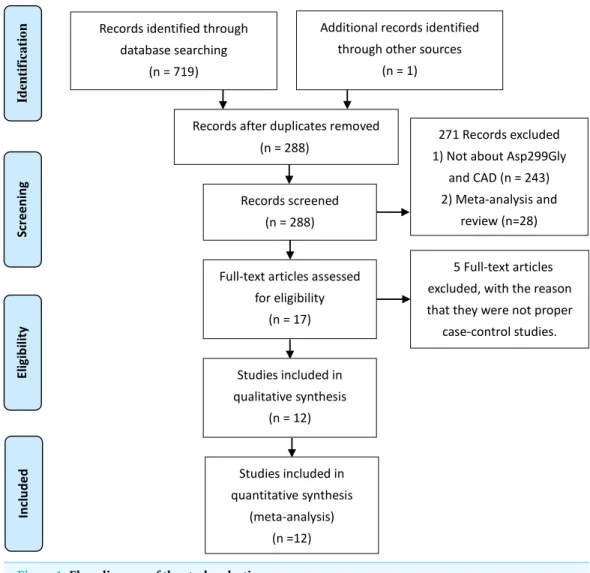
According to the PRISMA-statement flow diagram (Fig. 1), 17 full-text articles were assessed for eligibility, five (Boekholdt et al., 2003;Kolek et al., 2004;Holloway, Yang &
Figure 1 Flow diagram of the study selection process.
Ye, 2005;Hernesniemia et al., 2006;Beijk et al., 2010) of which were excluded, because they were not proper case-control studies, despite being of high quality. Finally, 12 articles (NOS score>6) (Ameziane et al., 2003;Balistreri et al., 2004;Edfeldt et al., 2004;Morange
et al., 2004;Zee et al., 2005;Koch et al., 2006;O’Halloran et al., 2006;Nebel et al., 2007;
Dˇzumhur et al., 2012;Mart´ınez-R´ıos et al., 2013;Golovkin et al., 2014;Guven et al., 2015) were included with 10,258 cases and 5,891 controls. Most of the studies were conducted on Caucasian populations. The main characteristics of the studies are listed inTable 1.
Meta-analysis results of overall study
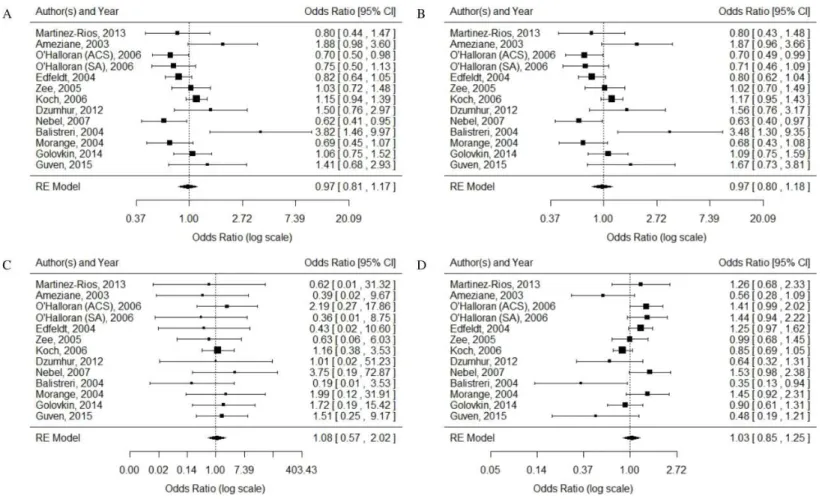
The heterogeneity of each gene model was as follows: allelic model (G allele vs. A allele):PQ=0.0019,I2=61.34%; dominant model (AA vs. GG+AG):PQ=0.0021,
Table 1 Characteristics of studies about the association between Asp299Gly and CAD.
Study Year Ethnicity Region Disease
category
Sample size(ca/co)
Sex ratio (m/f)
Cases Controls HWE
AA AG GG Sex
ratio(m/f)
AA AG GG Sex
ratio(m/f)
Martinez-Rios 2013 Mexican Mexico ACS 457/283 570/170 425 32 0 368/89 267 16 0 202/81 Y
Ameziane 2003 Caucasian France ACS 183/216 353/46 169 14 0 160/23 187 28 1 193/23 Y
ACS 1,048 182 7
O’Halloran 2006 Caucasian Ireland 1,598/386 1,457/527 1,232/366 343 42 1 225/161 Y
SA 307 54 0
Edfeldt 2004 Caucasian Sweden MI 1,164/1,508 1,838/834 1,038 126 0 821/343 1,374 133 1 1,017/491 Y
Zee 2005 Caucasian US MI 370/695 1,065/0 323 46 1 370/0 605 87 3 695/0 Y
Koch 2006 Caucasian Germany MI 3,657/1,211 3,385/1,483 3,283 360 14 2,772/885 1,069 138 4 613/598 Y
Dzumhur 2012 Caucasian Croatia MI 119/120 171/68 104 15 0 81/38 98 22 0 90/30 Y
Nebel 2007 Caucasian Germany MI 606/323 929/0 521 82 3 606/0 293 30 0 323/0 Y
Balistreri 2004 Caucasian Italy MI 105/182 287/0 100 5 0 105/0 155 23 4 182/0 Y
Morange 2004 Caucasian France CAD 247/490 737/0 211 35 1 247/0 439 50 1 490/0 Y
Golovkin 2014 Caucasian Russia CAD 702/300 797/205 599 98 4 558/144 253 46 1 239/61 Y
Guven 2015 Turks Turkey CAD 150/150 149/151 140 7 3 76/74 134 14 2 73/77 Y
Notes.
ACS, acute coronary syndrome; MI, myocardial infarction; CAD, coronary artery disease; HWE, Hardy–Weinberg equilibrium; Y, yes; N, no; Sample size(ca/co), Sample size(cases/controls); Sex ratio(m/f), Sex ratio(male/female).
Chen
et
al.
(2015),
P
eerJ
,
DOI
10.7717/peerj.1412
Figure 2 Forest plots of the association between TLR4 gene Asp299Gly polymorphism and CAD in different genetic models.(A) allelic model: G allele vs. A allele; (B) dominant model: AA vs. GG+AG; (C) recessive model: GG vs. AG+AA; (D) super-dominant model: AG vs. AA+GG.
CI [0.80–1.18],P=0.76; GG vs. AG+AA: OR=1.08, 95% CI [0.57–2.02],P=0.82; AG vs. AA+GG: OR=1.03, 95% CI [0.85–1.25],P=0.74. Overall, no association of TLR4 Asp299Gly polymorphism with CAD was observed. The results are shown inFig. 2.
Heterogeneity analysis
The heterogeneity could not be effectively removed after subgroups were divided based on the different types of CAD. No association of Asp299Gly with CAD type was noted. To explore the source of heterogeneity further, meta-regression was used. It was found that ethnicity, region, disease category, sex ratio (male/female), and sample size ratio (cases/controls) were not the source of heterogeneity in all the models. In the allelic model, the frequency of A/G allele in the control group could explain 56.35% ofI2, which meant part of the source of heterogeneity was explored. However, in the dominant model and the super-dominant model, the frequency of genotypes in the case group could explain 56.86% and 63.65% ofI2respectively.
Sensitivity analysis
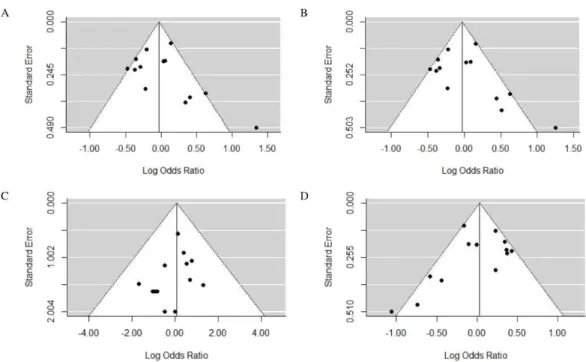
Figure 3 Funnel plots of the association between TLR4 gene Asp299Gly polymorphism and CAD in different genetic models.(A) allelic model: G allele vs. A allele; (B) dominant model: AA vs. GG+AG; (C) recessive model: GG vs. AG+AA; (D) super-dominant model: AG vs. AA+GG.
Publication bias
Funnel plots (Fig. 3) intuitively reflected the publication bias. The results of Egger’s regression test were as follows:P=0.25 for G allele vs. A allele,P=0.25 for AA vs. GG
+AG,P=0.37 for GG vs. AG+AA,P=0.16 for AG vs. AA+GG. Funnel plots with good symmetry andPvalue>0.05 indicated no publication bias in the study.
Cumulative meta-analysis
According to the order of published years, cumulative meta-analysis was performed, and it was found that OR value and 95% CI tended to be stable, and 95% CI gradually narrowed, as shown inFig. 4.
Association between Asp299Gly and the number of stenotic coro-nary arteries
No association was found between the genotype frequency and the number of coronary arteries with>50% stenosis. Details are shown inArticle S1.
Association between Asp299Gly and CRP level Study characteristics
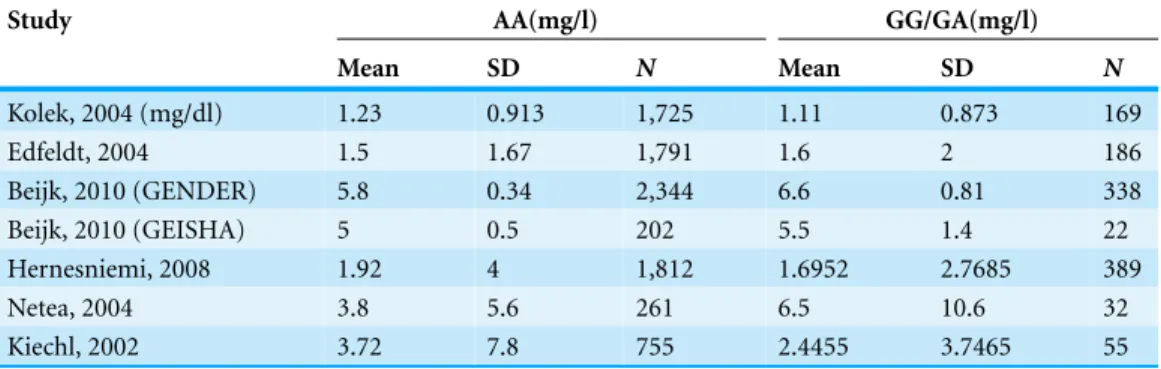
Six reports (Kiechl et al., 2002;Edfeldt et al., 2004;Kolek et al., 2004;Netea et al., 2004;
Hernesniemia et al., 2006;Beijk et al., 2010) were included, in which the CRP levels of
different genotypes (AA, AG/GG) were recorded using median and interquartile ranges or
¯
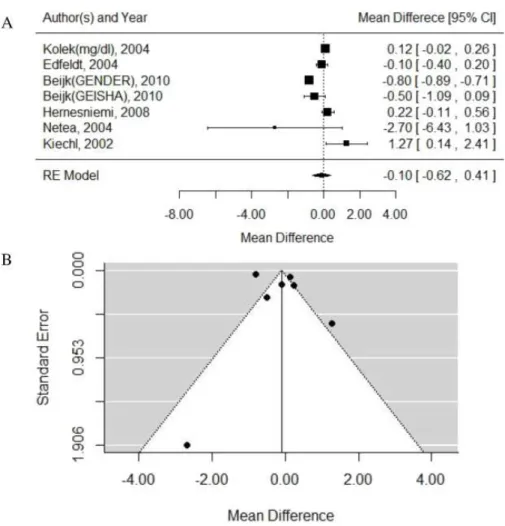
x±s. According to the method provided by an article (Hozo, Djulbegovic & Hozo, 2005), median and interquartile ranges were converted intox¯±s for the convenience of statistics. Details are shown inTable 2.
Figure 4 Cumulative meta-analysis of the association between TLR4 gene Asp299Gly polymorphism and CAD in different genetic models.(A) allelic model: G allele vs. A allele; (B) dominant model: AA vs. GG+AG; (C) recessive model: GG vs. AG+AA; (D) super-dominant model: AG vs. AA+GG.
Table 2 Characteristics of studies about the association between Asp299Gly and CRP level.
Study AA(mg/l) GG/GA(mg/l)
Mean SD N Mean SD N
Kolek, 2004 (mg/dl) 1.23 0.913 1,725 1.11 0.873 169
Edfeldt, 2004 1.5 1.67 1,791 1.6 2 186
Beijk, 2010 (GENDER) 5.8 0.34 2,344 6.6 0.81 338
Beijk, 2010 (GEISHA) 5 0.5 202 5.5 1.4 22
Hernesniemi, 2008 1.92 4 1,812 1.6952 2.7685 389
Netea, 2004 3.8 5.6 261 6.5 10.6 32
Kiechl, 2002 3.72 7.8 755 2.4455 3.7465 55
Meta-analysis results
Test for heterogeneity:PQ<0.0001,I2=96.20%, random-effects model was used. WMD
= −0.10, 95% CI [−0.62–0.41].P=0.69. Egger test:P=0.77.
Figure 5 Forest and Funnel plots of the association between TLR4 gene Asp299Gly polymorphism and CRP level.(A) Forest plot; (B) Funnel plot.
different measurement methods for CRP. Due to the lack of raw data, we couldn’t know all measurement methods of CRP, namely, we couldn’t remove the heterogeneity, so the persuasion of this result was limited.
Synergistic effect of statin and Asp299Gly
No synergistic effect of statin and 299Gly was found. Details are shown inArticle S2.
DISCUSSION
The worldwide distribution of G allele is closely related to the ethnic groups, which might be the result of differences in environmental pressure during human migration (Ferwerda
et al., 2007;Ferwerda et al., 2008). TLR4 Asp299Gly polymorphism is rather rare in Asian
populations (Lin et al., 2005;Nakada et al., 2005;Kim et al., 2008;Yuan et al., 2010), while 6%–14% of the Caucasian population is positive for Asp299Gly (Balistreri et al., 2009). For this reason, previous studies were mainly carried out in Europe. To clarify the relationship between CAD and Asp299Gly more effectively, it is worth mentioning that in the present meta-analysis, reports about Asp299Gly from Mexican and Turkish populations were
included for more reliable studies. This meta-analysis showed no association between Asp299Gly and CAD. Subsequent subgroup analysis and sensitivity analysis, as well as the study on the association between Asp299Gly and the number of stenotic coronary arteries all confirmed this conclusion. This result was also consistent with the conclusions of the other two previous meta-analyses (Zhang et al., 2012;Yin et al., 2014).
In addition, CRP, a nonspecific acute phase protein, is a useful biomarker of inflam-mation. It is also considered as an independent risk factor to predict first and recurrent cardiovascular events such as MI or stroke (Kaptoge et al., 2012;Wennberg et al., 2012). Furthermore, in a randomized trial, statin therapy significantly reduced the incidence of major cardiovascular events among people without hyperlipidemia but with elevated CRP level (Ridker et al., 2008), which further supported the anti-inflammatory effect of statin. Thus, the present meta-analysis analyzed the association of Asp299Gly with CRP level, and explored whether G allele carriers could benefit more from statin treatment. It showed no obvious association between Asp299Gly and CRP level, and G allele carriers could not benefit more from statin treatment. However, the conclusion was underpowered due to the insufficient number of articles included and large heterogeneity of this meta-analysis. Hence, future studies should include large sample size and high quality literature to understand this issue in depth.
This meta-analysis has certain limitations as follows: first, CAD is influenced by multiple genetic mutations (Enquobahrie et al., 2008), so some interaction among genetic variations might exist widely. For example, some articles (Morange et al., 2004;Vainas et al., 2006) considered the synergistic effect of TLR4/Asp299Gly and CD14/C-260T, and one of them
(Vainas et al., 2006) found that the carriers with TLR4 G allele/CD14 TT genotype, rather
than each SNP individually, were associated with the atherosclerotic disease. Also, some reports (Boekholdt et al., 2003;Edfeldt et al., 2004;Koch et al., 2006;Guven et al., 2015) were available about the combination effect of TLR4/Asp299Gly and TLR4/Thr399Ile. So, it can be speculated that the interaction among SNPs in TLR4 and TLRs and other signal molecules may exist. Some literature suggests that the analysis of a number of polymorphic genetic markers is more informative than the analysis of a single polymorphism (Olivieri
et al., 2006); however, this meta-analysis did not involve the interaction among SNPs.
Second, CAD is a multifactorial disease, and its incidence and development are closely related to environmental and life-style factors. Hence, a small contribution of a SNP to CAD might be obscured by the presence of various dominant risk factors (Incalcaterra et al., 2013). Patients with CAD with different gender, age, and life-style have different pathophysiological characteristics (Edfeldt et al., 2004;Olivieri et al., 2006;Incalcaterra et
al., 2010). Some articles have considered the influence of these factors, while othershave
In conclusion, this meta-analysis suggested no association of TLR4 Asp299Gly polymorphism with CAD and CRP level. Moreover, the findings indicated that the G allele carriers might not benefit more from statin treatment. However, these results should be confirmed by conducting more high-quality studies in future.
ACKNOWLEDGEMENTS
We thank Zhibin Quan (School of Computer Science and Engineering, Southeast University) for technical discussion.
ADDITIONAL INFORMATION AND DECLARATIONS
Funding
This work was supported by the National Natural Science Foundation of China (No. 81173399). The funders had no role in study design, data collection and analysis, decision to publish, or preparation of the manuscript.
Grant Disclosures
The following grant information was disclosed by the authors: National Natural Science Foundation of China: 81173399.
Competing Interests
The authors declare there are no competing interests.
Author Contributions
• Rui Chen conceived and designed the experiments, performed the experiments, analyzed the data, contributed reagents/materials/analysis tools, wrote the paper, prepared figures and/or tables, reviewed drafts of the paper.
• Ning Gu conceived and designed the experiments, performed the experiments, reviewed
drafts of the paper.
• Ying Gao analyzed the data, reviewed drafts of the paper.
• Wei Cen wrote the paper, reviewed drafts of the paper.
Data Availability
The following information was supplied regarding data availability: The research in this article did not generate any raw data.
Supplemental Information
Supplemental information for this article can be found online athttp://dx.doi.org/ 10.7717/peerj.1412#supplemental-information.
REFERENCES
Ameziane N, Beillat T, Verpillat P, Chollet-Martin S, Aumont MC, Seknadji P, Lamotte M, Lebret D, Ollivier V, Prost D. 2003.Association of the Toll-like receptor 4 gene Asp299Gly polymorphism with acute coronary events.Arteriosclerosis, Thrombosis, and Vascular Biology
23:61–64DOI 10.1161/01.ATV.0000101191.92392.1D.
Arbour NC, Lorenz E, Schutte BC, Zabner J, Kline JN, Jones M, Frees K, Watt JL, Schwartz DA. 2000.TLR4 mutations are associated with endotoxin hyporesponsiveness in humans.Nature
Genetics25:187–191DOI 10.1038/76048.
Balistreri CR, Candore G, Colonna-Romano G, Lio D, Caruso M, Hoffmann E, Franceschi C, Caruso C. 2004.Role of Toll-like receptor 4 in acute myocardial infarction and longevity.The
Journal of the American Medical Association292:2339–2340DOI 10.1001/jama.292.19.2339.
Balistreri CR, Colonna-Romano G, Lio D, Candore G, Caruso C. 2009.TLR4 polymorphism and aging: implications for the pathophysiology of age-related disease.Journal of Clinical
Immunology29:406–415DOI 10.1007/s10875-009-9297-5.
Begg CB, Mazumdar M. 1994.Operating characteristics of a rank correlation test for publication bias.Biometrics50:1088–1101DOI 10.2307/2533446.
Beijk MAM, Boekholdt SM, Rittersma SZH, Pons D, Zwinderman AH, Doevendans PAF, Tio RA, Tijssen JGP, Jukema JW, De Winter RJ. 2010. Toll-like receptor 4 gene polymorphisms show no association with the risk of clinical or angiographic restenosis after percutaneous coronary intervention. Pharmacogenet Genomics 20:544–552
DOI 10.1097/FPC.0b013e32833d7b29.
Berg KK, Madsen HO, Garred P, Wiseth R, Gunnes S, Videm V. 2009.The additive contribution from inflammatory genetic markers on the severity of cardiovascular disease.Scandinavian
Journal of Immunology691:36–42DOI 10.1111/j.1365-3083.2008.02187.x.
Boekholdt SM, Agema WRP, Peters RJG, Zwinderman AH, Wall EE, Reitsma PH, Kastelein JJP, Jukema JW, on behalf of the REgression GRowth Evaluation Statin Study (REGRESS) Study Group. 2003.Variants of toll-like receptor 4 modify the efficacy of statin therapy and the risk of cardiovascular events.Circulation107:2416–2421DOI 10.1161/01.CIR.0000068311.40161.28.
Crisby M, Nordin-Fredriksson G, Shah PK, Yano J, Zhu J, Nilsson J. 2001.Pravastatin treatment increases collagen content and decreases lipid content, inflammation, metalloproteinases, and cell death in human carotid plaques: implications for plaque stabilization.Circulation
103:926–933DOI 10.1161/01.CIR.103.7.926.
Dekker WK, Cheng C, Pasterkamp G, Duckers H. 2010.Toll like receptor 4 in atherosclerosis and plaque destabilization.Atherosclerosis209:314–320DOI 10.1016/j.atherosclerosis.2009.09.075.
DerSimonian R, Laird N. 1986.Meta-analysis in clinical trials.Controlled Clinical Trials7:177–188
DOI 10.1016/0197-2456(86)90046-2.
Dˇzumhur A, Zibar L, Wagner J, ˇSimundi´c T, Dembi´c Z, Barbi´c J. 2012.Association studies of gene polymorphisms in toll-like receptors 2 and 4 in Croatian patients with acute myocardial infarction.Scandinavian Journal of Immunology75:517–523
DOI 10.1111/j.1365-3083.2012.02681.x.
Edfeldt K, Bennet AM, Eriksson P, Frosteg˚ard J, Wiman B, Hamsten A, Hansson GK, Faire U, Yan ZQ. 2004.Association of hypo-responsive toll-like receptor 4 variants with risk of myocardial infarction.European Heart Journal25:1447–1453DOI 10.1016/j.ehj.2004.05.004.
Edfeldt K, Swedenborg J, Hansson GK, Yan ZQ. 2002.Expression of toll-like receptors in human atherosclerotic lesion: a possible pathway for plaque activation.Circulation105:1158–1161
Egger M, Davey Smith G, Schneider M, Minder C. 1997.Bias in meta-analysis detected by a simple, graphical test.British Medical Journal315:629–634DOI 10.1136/bmj.315.7109.629.
Enquobahrie DA, Smith NL, Bis JC, Carty CL, Rice KM, Lumley T, HindorffLA, Lemaitre RN, Williams MA, Siscovick DS, Heckbert SR, Psaty BM. 2008.Cholesterol ester transfer protein, interleukin-8, peroxisome proliferator activator receptor alpha, and toll-like receptor 4 genetic variations and risk of incident nonfatal myocardial infarction and ischemic stroke.The
American Journal of Cardiology101:1683–1688DOI 10.1016/j.amjcard.2008.02.052.
Ferwerda B, McCall MB, Alonso S, Giamarellos-Bourboulis EJ, Mouktaroudi M, Izagirre N, Syafruddin D, Kibiki G, Cristea T, Hijmans A, Hamann L, Israel S, ElGhazali G,
Troye-Blomberg M, Kumpf O, Maiga B, Dolo A, Doumbo O, Hermsen CC, Stalenhoef AFH, Van Crevel R, Brunner HG, Oh DY, Schumann RR, De La R ´ua C, Sauerwein R, Kullberg BJ, Van der Ven AJAM, Van der Meer JWM, Netea MG. 2007.TLR4 polymorphisms, infectious diseases, and evolutionary pressure during migration of modern humans.Proceeding
of the National Academy of Science of the United States of America 104:16645–16650
DOI 10.1073/pnas.0704828104.
Ferwerda B, McCall MB, Verheijen K, Kullberg BJ, Van der Ven AJAM, Van der Meer JWM, Netea MG. 2008.Functional consequences of toll like receptor 4 polymorphisms.Molecular
Medicine14:346–352DOI 10.2119/2007-00135.Ferwerda.
Golovkin AS, Ponasenko AV, Khutornaya MV, Kutikhin AG, Salakhov RR, Yuzhalin AE, Zhidkova II, Barbarash OL, Barbarash LS. 2014.Association of TLR and TREM-1 gene polymorphism with risk of coronary artery disease in a Russian population.Gene550:101–109
DOI 10.1016/j.gene.2014.08.022.
Guven M, Ismailoglu Z, Batar B, Unal S, Onaran I, Karadag B, Ongen Z. 2015.The effect of genetic polymorphisms of TLR2 and TLR4 in Turkish patients with coronary artery disease.
Gene568:99–102DOI 10.1016/j.gene.2014.12.047.
Hernesniemia J, Lehtim¨aki T, Rontu R, Islam MS, Eklund C, Mikkelsson J, Ilveskoski E, Kajander O, Goebeler S, Viiri LE, Hurme M, Karhunen PJ. 2006.Toll-like receptor 4 polymorphism is associated with coronary stenosis but not with the occurrence of acute or old myocardial infarctions.Scandinavian Journal of Clinical and Laboratory Investigation
66:667–675DOI 10.1080/00365510600933011.
Higgins JP, Thompson SG. 2002.Quantifying heterogeneity in a meta-analysis.Statistics in
Medicine21:1539–1558DOI 10.1002/sim.1186.
Holloway JW, Yang IA, Ye S. 2005.Variation in the toll-like receptor 4 gene and susceptibility to myocardial infarction.Pharmacogenet Genomics15:15–21
DOI 10.1097/01213011-200501000-00003.
Hozo SP, Djulbegovic B, Hozo I. 2005.Estimating the mean and variance from the median, range, and the size of a sample.BMC Medical Research Methodology5:13
DOI 10.1186/1471-2288-5-13.
Incalcaterra E, Accardi G, Balistreri CR, Caimi G, Candore G, Caruso M, Caruso C. 2013.
Pro-inflammatory genetic markers of atherosclerosis.Current Atherosclerosis Reports
15:329DOI 10.1007/s11883-013-0329-5.
Incalcaterra E, Caruso M, Balistreri CR, Candore G, Lo Presti R, Hoffmann E, Caimi G. 2010.
Role of genetic polymorphisms in myocardial infarction at young age.Clinical Hemorheology
and Microcirculation46:291–298DOI 10.3233/CH-2010-1353.
Kaptoge S, Di AE, Pennells L, Wood AM, White IR, Gao P, Walker M, Thompson Ar, Sarwar N, Caslake M, Butterworth AS, Amouyel P, Assmann G, Bakker SJL, Barr ELM,
Barrett-Connor E, Benjamin EJ, Bj¨orkelund C, Brenner H, Brunner E, Clarke R, Cooper JA, Cremer P, Cushman M, Dagenais GR, D’Agostino RB, Dankner R, Davey-Smith G, Deeg D, Dekker JM, Engstr¨om G, Folsom AR, Fowkes FGR, Gallacher J, Gaziano JM, Giampaoli S, Gillum RF, Hofman A, Howard BV, Ingelsson E, Iso H, Jørgensen T, Kiechl S, Kitamura A, Kiyohara Y, Koenig W, Kromhout D, Kuller LH, Lawlor DA, Meade TW, Nissinen A, Nordestgaard BG, Onat A, Panagiotakos DB, Psaty BM, Rodriguez B, Rosengren A, Salo-maa V, Kauhanen J, Salonen JT, Shaffer JA, Shea S, Ford I, Stehouwer CDA, Strandberg TE, Tipping RW, Tosetto A, Wassertheil-Smoller S, Wennberg P, Westendorp RG, Whincup PH, Wilhelmsen L, Woodward M, Lowe GDO, Wareham NJ, Khaw KT, Sattar N, Packard CJ, Gudnason V, Ridker PM, Pepys MB, Thompson SG, Daneshm J. 2012.C-reactive protein, fibrinogen, and cardiovascular disease prediction.The New England Journal of Medicine
367:1310–1320DOI 10.1056/NEJMoa1107477.
Kiechl S, Lorenz E, Reindl M, Wiedermann CJ, Oberhollenzer F, Bonora E, Willeit J,
Schwartz DA. 2002.Toll-like receptor 4 polymorphisms and atherogenesis.The New England
Journal of Medicine347:185–192DOI 10.1056/NEJMoa012673.
Kim YS, Hwang YJ, Kim SY, Yang SM, Lee KY, Park IB. 2008.Rarity of TLR4 Asp299Gly and Thr399Ile polymorphisms in the Korean population.Yonsei Medical Journal49(1):58–62
DOI 10.3349/ymj.2008.49.1.58.
Koch W, Hoppmann P, Pfeufer A, Schomig A, Kastrati A. 2006.Toll-like receptor 4 gene polymorphisms and myocardial infarction: no association in a Caucasian population.European
Heart Journal27:2524–2529DOI 10.1093/eurheartj/ehl231.
Kolek MJ, Carlquist JF, Muhlestein JB, Whiting BM, Horne BD, Bair TL, Anderson JL. 2004.
Toll-like receptor 4 gene Asp299Gly polymorphism is associated with reductions in vascular inflammation, angiographic coronary artery disease, and clinical diabetes.American Heart
Journal148:1034–1040DOI 10.1016/j.ahj.2004.05.049.
Libby P, Lichtman AH, Hansson GK. 2013. Immune effector mechanisms im-plicated in atherosclerosis: from mice to humans. Immunity 38:1092–1104
DOI 10.1016/j.immuni.2013.06.009.
Lin YC, Chang YM, Yu JM, Yen JH, Chang JG, Hu CJ. 2005.Toll-like receptor 4 gene C119A but not Asp299Gly polymorphism is associated with ischemic stroke among ethnic Chinese in Taiwan.Atherosclerosis180:305–309DOI 10.1016/j.atherosclerosis.2004.12.022.
Mantel N, Haenszel W. 1959.Statistical aspects of the analysis of data from retrospective studies of disease.Journal of the National Cancer Institute22:719–748.
Mart´ınez-R´ıos MA, Vargas-Alarc ´on G, Vallejo M, Cruz-Martinez E, P´erez-M´endez O,
Medina-Andrade ´A, Torre-Garc´ıa MD, Pe˜na-Duque MA, Fragoso JM. 2013.Toll-like receptor 4 gene polymorphisms and acute coronary syndrome: no association in a Mexican population.
Archivos de Cardiolog´ıa de M´exico83(4):257–262DOI 10.1016/j.acmx.2013.09.001.
Miller YI, Choi SH, Wiesner P, Bae YS. 2012.The SYK side of TLR4: signaling mechanisms in response to LPS and minimally oxidized LDL.British Journal of Pharmacology167(5):990–999
DOI 10.1111/j.1476-5381.2012.02097.x.
Moher D, Liberati A, TetzlaffJ, Altman DG, PRISMA Group. 2010.Preferred reporting items for systematic reviews and meta-analyses: the PRISMA statement.Annals of Internal Medicine
151(4):264–269DOI 10.7326/0003-4819-151-4-200908180-00135.
heart disease: the PRIME Study. European Journal of Human Genetics12:1041–1049
DOI 10.1038/sj.ejhg.5201277.
Murray CJL, Vos T, Lozano R, Naghavi M, Flaxman AD, Michaud C, Ezzati M, Shibuya K, Salomon JA, Abdalla S, Aboyans V, Abraham J, Ackerman I, Aggarwal R, Ahn SY, Ali MK, AlMazroa MA, Alvarado M, Anderson HR, Anderson LM, Andrews KG, Atkinson C, Baddour LM, Bahalim AN, Barker-Collo S, Barrero LH, Bartels DH, Bas´a˜nez MG, Baxter A, Bell ML, Benjamin EJ, Bennett D, Bernab´e E, Bhalla K, Bhandari B, Bikbov B, Abdulhak AB, Birbeck G, Black JA, Blencowe H, Blore JD, Blyth F, Bolliger I, Bonaventure A, Boufous S, Bourne R, Boussinesq M, Braithwaite T, Brayne C, Bridgett L, Brooker S,
Brooks P, Brugha TS, Bryan-Hancock C, Bucello C, Buchbinder R, Buckle G, Budke CM, Burch M, Burney P, Burstein R, Calabria B, Campbell B, Canter CE, Carabin H, Carapetis J, Carmona L, Cella C, Che P, Charlson F, Chen HL, Cheng ATA, Chou D, Chugh SS,
Coffeng LE, Colan SD, Colquhoun S, Colson KE, Condon J, Connor MD, Cooper LT, Corriere M, Cortinovis M, Vaccaro KC, Couser W, Cowie BC, Criqui MH, Cross M, Dabhadkar KC, Dahiya M, Dahodwala N, Damsere-Derry J, Danaei G, Davis A, Leo DD, Degenhardt L, Dellavalle R, Delossantos A, Denenberg J, Derrett S, Jarlais DCD, Dharmaratne SD, Dherani M, Diaz-Torne C, Dolk H, Dorsey ER, Driscoll T, Duber H, Ebel B, Edmond K, Elbaz A, Ali SE, Erskine H, Erwin PJ, Espindola P, Ewoigbokhan SE, Farzadfar F, Feigin V, Felson DT, Ferrari A, Ferri CP, F`evre EM, Finucane MM,
Flaxman S, Flood L, Foreman K, Forouzanfar MH, Fowkes FGR, Fransen M, Freeman MK, Gabbe BJ, Gabriel SE, Gakidou E, Ganatra HA, Garcia B, Gaspari F, Gillum RF, Gmel G, Gonzalez-Medina D, Gosselin R, Grainger R, Grant B, Groeger J, Guillemin F, Gunnell D, Gupta R, Haagsma J, Hagan H, Halasa YA, Hall W, Haring D, Haro JM, Harrison JE, Havmoeller R, Hay RJ, Higashi H, Hill C, Hoen B, Hoffman H, Hotez PJ, Hoy D, Huang JJ, Ibeanusi SE, Jacobsen KH, James SL, Jarvis D, Jasrasaria R, Jayaraman S, Johns N, Jonas JB, Karthikeyan G, Kassebaum N, Kawakami N, Keren A, Khoo JP, King CH, Knowlton LM, Kobusingye O, Koranteng A, Krishnamurthi R, Laden F, Lalloo R, Laslett LL, Lathlean T, Leasher JL, Lee YY, Leigh J, Levinson D, Lim SS, Limb E, Lin JK, Lipnick M, Lipshultz SE, Liu W, Loane M, Ohno SL, Lyons R, Mabweijano J, MacIntyre MF, Malekzadeh R. 2012.
Disability adjusted life years DALYs for 291 diseases and injuries in 21 regions, 1990–2010: a systematic analysis for the Global Burden of Disease Study. Lancet 380:2197–2223
DOI 10.1016/S0140-6736(12)61689-4.
Nakada TA, Hirasawa H, Oda S, Shiga H, Matsuda KI, Nakamura M, Watanabe E, Abe R, Hatano M, Tokuhisa T. 2005.Influence of toll-like receptor 4, CD14, tumor necrosis factor, and interleukine-10 gene polymorphisms on clinical outcome in Japanese critically ill patients.
Journal of Surgical Research129:322–328DOI 10.1016/j.jss.2005.05.020.
Nebel A, Flachsbart F, Sch¨afer A, Nothnagel M, Nikolaus S, Mokhtari NEE, Schreiber S. 2007.
Role of the toll-like receptor 4 polymorphism Asp299Gly in longevity and myocardial infarction in German men.Mechanisms of Ageing and Development128:409–411
DOI 10.1016/j.mad.2007.04.001.
Netea MG, Hijmans A, Wissen S, Smilde TJ, Trip MD, Kullberg BJ, De Boo T, Van der Meer JWM, Kastelein JJP, Stalenhorf AFH. 2004.Toll-like receptor-4 Asp299Gly polymorphism does not influence progression of atherosclerosis in patients with familial hypercholesterolaemia.European Journal of Clinical Investigation342:94–99
DOI 10.1111/j.1365-2362.2004.01303.x.
O’Halloran AM, Stanton A, O’Brien E, Shields DC. 2006.The impact on coronary artery disease of common polymorphisms known to modulate responses to pathogens.Annals of Human
Genetics70:934–945DOI 10.1111/j.1469-1809.2006.00281.x.
Olivieri f, Antonicelli R, Cardelli M, Marchegiani F, Cavallone L, Mocchegiani E, Franceschi C. 2006.Genetic polymorphisms of inflammatory cytokines and myocardial infarction in the elderly.Mechanisms of Ageing and Development127:552–559DOI 10.1016/j.mad.2006.01.013.
Ridker PM, Danielson E, Fonseca FAH, Genest J, Gotto Jr AM, Kastelein JJ, Koenig W, Libby P, Lorenzatti AJ, MacFadyen JG, Nordestgaard BG, Shepherd J, Willerson JT, Glynn RJ, JUPITER Study Group. 2008.Rosuvastatin to prevent vascular events in men and women with elevated C-reactive protein.The New England Journal of Medicine359:2195–2207
DOI 10.1056/NEJMoa0807646.
Ridker PM, Danielson E, Fonseca FAH, Genest Jr J, Gotto AM, Kastelein JJP, Koenig W, Libby P, Lorenzatti AJ, MacFadyen JG, Nordestgaard BG, Shepherd J, Willerson JT, Glynn RJ, on behalf of the JUPITER Trial Study Group. 2009.Reduction in C-reactive protein and LDL cholesterol and cardiovascular event rates after initiation of rosuvastatin: a prospective study of the JUPITER trial.Lancet373:1175–1182DOI 10.1016/S0140-6736(09)60447-5.
Ross R. 1999.Atherosclerosis-an inflammatory disease.The New England Journal of Medicine
340:115–126DOI 10.1056/NEJM199901143400207.
Smirnova I, Poltorak A, Chan EK, McBride C, Beutler B. 2000. Phylogenetic variation and polymorphism at the toll-like receptor 4 locus TLR4. Genome Biology 1(1): research002-research002.10DOI 10.1186/gb-2000-1-1-research002.
Vainas T, Stassen FRM, Bruggeman CA, Welten RJTJ, Van den Akker LHJM, Kitslaar PJEHM, Pe˜na AS, Morr´e SA. 2006.Synergistic effect of Toll-like receptor 4 and CD14 polymorphisms on the total atherosclerosis burden in patients with peripheral arterial disease.Journal of Vascular
Surgery44:326–332DOI 10.1016/j.jvs.2006.04.035.
Wells GA, Shea B, O’Connell D, Peterson J, Welch V, Losos M, Tugwell P. 2011. The Newcastle-Ottawa Scale (NOS) for assessing the quality of nonrandomised studies in
meta-analyses. Ottawa Health Research Institute.Available athttp://www.ohri.ca/programs/
clinical epidemiology/oxford.asp/(accessed 20 October 2011).
Wennberg P, Wensley F, Di Angelantonio E, Johansson L, Boman K, Rumley A, Lowe G, Hallmans G, Danesh J, Jansson JH. 2012.Haemostatic and inflammatory markers are independently associated with myocardial infarction in men and women.Thrombosis Research
129:68–73DOI 10.1016/j.thromres.2011.05.015.
Yang IA, Holloway JW, Ye S. 2003.TLR4 Asp299Gly polymorphism is not associated with coronary artery stenosis.Atherosclerosis170:187–190DOI 10.1016/S0021-9150(03)00286-7.
Yin YW, Sun QQ, Hua AM, Liu HL, Wang Q, Zhang BB. 2014. Toll-like receptor 4 gene
Asp299Gly polymorphism in myocardial infarction: a meta-analysis of 15,148 subjects.Human
Immunology75:163–169DOI 10.1016/j.humimm.2013.11.005.
Yuan M, Xia J, Ma L, Xiao B, Yang QD. 2010.Lack of the toll-like receptor 4 gene polymorphisms Asp299Gly and Thr399Ile in a Chinese population.International Journal of Neuroscience
120:415–420DOI 10.3109/00207451003778736.
Zee RYL, Hegener HH, Gould J, Ridker PM. 2005.Toll-like receptor 4 Asp299Gly gene polymorphism and risk of atherothrombosis.Stroke36:154–157
DOI 10.1161/01.STR.0000149948.31879.f0.
Zhang K, Zhang LS, Zhou B, Wang YY, Song YP, Rao L, Zhang L. 2012.Lack of association between TLR4 Asp299Gly polymorphism and atherosclerosis: evidence from meta-analysis.