Approximate Earthquake Analysis for Regular
Base Isolated Buildings Subjected to Near Fault
Ground Motions
Leblouba Moussa (IAENG Member)
∗Zerzour Ali
†Abstract—An approximate earthquake modal anal-ysis of base isolated regular buildings (AMA-BI) sub-jected to near fault ground motions is developed and presented in this paper. The basis of this procedure benefits from two important properties of base iso-lated structures; the concentrated nonlinearity at the base isolation level and the fact that the base isola-tion and the superstructure behave as two bodies in contact with discontinuity at the isolation layer. The AMA-BI treats the base as it is; a nonlinear system, and the superstructure as elastic. This latter can be decomposed into subsystems so that when superposed and combined with the response of the base they give an overall behavior and response very close to that ob-tained when using the nonlinear time history analysis (NLTHA) of the base isolated structure. An example of application is treated to evaluate the accuracy of the procedure.
Keywords: Base Isolation, Superstructure, Nonlinear-ity, Modal Analysis, Near Fault
1
Introduction
Now, evident is the performance of structures mounted on an isolation system during earthquakes. The isolation system deflects the seismic energy so that will not be transferred to the superstructure. The benefits gained by using such technique are substantial and can be itemized after Stanton and Roeder (1991) [13] as:
• Reduced floor accelerations and interstory drifts;
• Reduced (or no) damage to structural elements;
• Better protection of buildings’ contents;
• Concentration of nonlinear, large deformation be-havior into one group of elements (the isolation bear-ings and dampers).
∗Manuscript received March 5, 2010. Accepted March 14, 2010.
This work was supported in part by the Algerian Ministry of Higher Education and Scientific Research. Leblouba Moussa is with the High National School of Public Works, Algiers Algeria 16051. (corresponding author mobile: +213 667 897 968; e-mail: [email protected]).
†Zerzour Ali is with the High National School of Public Works,
Algiers Algeria 16051. (e-mail: [email protected]).
The last item highlights an important inherent property of a well selected and designed isolation system. The su-perstructure may remain elastic under these conditions and most deformations occur at the isolation level, so that the structure’s expensive contents and equipments remain intact from minim damages. However, the chal-lenge is how to select the appropriate isolation system parameters. Several design and analysis methods were proposed, but a common problem arise in the complex-ity of implementation that require an extensive effort to be performed. Therefore, we are interested in developing simple but efficient procedures that lead to an appropri-ate design with minimum effort.
Based on the above itemized seismic isolation features, an approximate earthquake modal analysis procedure (AMA-BI) is developed and illustrated through exam-ples.
2
Approximate Earthquake Modal
Anal-ysis (AMA-BI)
2.1
Uncoupled Equations of Motion
The matrix form of differential equations governing the response of a MDOF base isolated structure (see figure 1) to earthquake induced ground motion are as follows:
MU¨ +CU˙ +KU =−M R(¨ug(t) + ¨xb) (1)
RTMU¨ +R(¨u
g(t) + ¨xb)
+mb(¨ug(t) + ¨xb) +f = 0 (2)
Eq. 1 corresponds to the superstructure while Eq. 2 cor-responds to the base isolation level, whereM andK are the mass and lateral stiffness matrices of the superstruc-ture,R is the vector of earthquake influence coefficients. The damping matrix C would not be needed in the ap-proximate modal analysis of earthquake response (AMA-BI); instead modal damping ratios suffice.
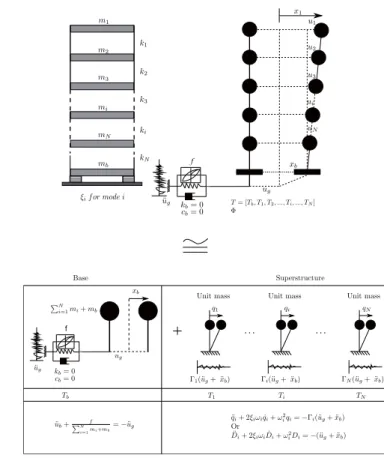
Figure 1: MDOF base isolated structure
from Eq.2, this gives:
¨
xb+
f Mtot
=−¨ug(t) (3)
where Mtot = Ms+mb; Ms is the total mass of the
superstructure andmb is the base mass.
The procedure consists to solve Eq.3 for ¨xb that will be
added to the ground motion acceleration to constitute a new excitation for the superstructure to determine finally the total response quantities of interest.
Figure 2 illustrates the AMA-BI procedure for MDOF base isolated systems. The MDOF system is equivalent to combination of the response of the total mass Mtot
mounted on the isolation system subjected to the earthquake acceleration ¨ug(t) and series of SDF systems
pinned at their bases having unit mass and natural periods Ti subjected to the excitation (¨ug(t) + ¨xb).
Shown in the same illustration are the equations to be solved for each subsystem and the corresponding vibration properties. The modal matrix for the MDOF base isolated structure is denoted by Φ while that for the superstructure is denoted Φsup, their shapes are
depicted in figure 3. The use of the modal matrix Φsup
(Φsup = Φ(1 : N,1 : N)) instead of the modal matrix
computed using M and K is due to the fact that we have to keep the nodal motion shapes. In addition, the natural frequencies (or natural periodsTi) used for the
superstructure (Ω2
sup = Ω
2
(2 : N + 1,2 : N + 1) are those calculated using the mass matrix of the whole structure and its corresponding stiffness matrix after elimination of the first entry (first period) which is the isolation period, the rest is taken as the periods of the SDF systems constituting the superstructure. The floor displacements relative to the baseui are computed as a
superposition of the modal contributions as follows:
Figure 2: AMA-BI procedure for MDOF base isolated structures
Figure 3: Determination of Φsupand Ω2supthe modal and
U = ΦsupQ where Q= ⎛ ⎜ ⎜ ⎜ ⎜ ⎜ ⎜ ⎝ q1 q2 . . . qN ⎞ ⎟ ⎟ ⎟ ⎟ ⎟ ⎟ ⎠ = ⎛ ⎜ ⎜ ⎜ ⎜ ⎜ ⎜ ⎝
Γ1D1
Γ2D2
. . .
ΓNDN
⎞ ⎟ ⎟ ⎟ ⎟ ⎟ ⎟ ⎠
and U = ⎛ ⎜ ⎜ ⎜ ⎜ ⎜ ⎜ ⎝ u1 u2 . . . uN ⎞ ⎟ ⎟ ⎟ ⎟ ⎟ ⎟ ⎠
Γi is the modal participation factor, which is a measure
of the degree of to which the ith mode participates in
the response of the superstructure, and it is described as follows:
Γi=
φT
sup iM R
φT
sup iM φsup i
Furthermore, the modal floor displacements relative to the base are combined to compute the total response us-ing the base displacement and the transformation matrix, Ψ: X = ⎧ ⎪ ⎪ ⎪ ⎪ ⎪ ⎪ ⎪ ⎪ ⎨ ⎪ ⎪ ⎪ ⎪ ⎪ ⎪ ⎪ ⎪ ⎩ x1 x2 . . . xN xb ⎫ ⎪ ⎪ ⎪ ⎪ ⎪ ⎪ ⎪ ⎪ ⎬ ⎪ ⎪ ⎪ ⎪ ⎪ ⎪ ⎪ ⎪ ⎭ = Ψ ⎧ ⎪ ⎪ ⎪ ⎪ ⎪ ⎪ ⎪ ⎪ ⎨ ⎪ ⎪ ⎪ ⎪ ⎪ ⎪ ⎪ ⎪ ⎩ u1 u2 . . . uN xb ⎫ ⎪ ⎪ ⎪ ⎪ ⎪ ⎪ ⎪ ⎪ ⎬ ⎪ ⎪ ⎪ ⎪ ⎪ ⎪ ⎪ ⎪ ⎭
where Ψ =
Φsup [1]
[0] 1
The same procedure as done for displacements determina-tion is to be followed for floor acceleradetermina-tions computadetermina-tion:
¨
U = ΦsupQ¨ where ¨Q=
⎛ ⎜ ⎜ ⎜ ⎜ ⎜ ⎜ ⎝ ¨ q1 ¨ q2 . . . ¨ qN ⎞ ⎟ ⎟ ⎟ ⎟ ⎟ ⎟ ⎠ = ⎛ ⎜ ⎜ ⎜ ⎜ ⎜ ⎜ ⎝
Γ1D¨1
Γ2D¨2
. . .
ΓND¨N
⎞ ⎟ ⎟ ⎟ ⎟ ⎟ ⎟ ⎠
and ¨U = ⎛ ⎜ ⎜ ⎜ ⎜ ⎜ ⎜ ⎝ ¨ u1 ¨ u2 . . . ¨ uN ⎞ ⎟ ⎟ ⎟ ⎟ ⎟ ⎟ ⎠
Therefore the floor accelerations relative to the ground are then computed as a superposition of the above calculated quantities: ¨ X = ⎧ ⎪ ⎪ ⎪ ⎪ ⎪ ⎪ ⎪ ⎪ ⎨ ⎪ ⎪ ⎪ ⎪ ⎪ ⎪ ⎪ ⎪ ⎩ ¨ x1 ¨ x2 . . . ¨ xN ¨ xb ⎫ ⎪ ⎪ ⎪ ⎪ ⎪ ⎪ ⎪ ⎪ ⎬ ⎪ ⎪ ⎪ ⎪ ⎪ ⎪ ⎪ ⎪ ⎭ = Ψ ⎧ ⎪ ⎪ ⎪ ⎪ ⎪ ⎪ ⎪ ⎪ ⎨ ⎪ ⎪ ⎪ ⎪ ⎪ ⎪ ⎪ ⎪ ⎩ ¨ u1 ¨ u2 . . . ¨ uN ¨ xb ⎫ ⎪ ⎪ ⎪ ⎪ ⎪ ⎪ ⎪ ⎪ ⎬ ⎪ ⎪ ⎪ ⎪ ⎪ ⎪ ⎪ ⎪ ⎭
Forces in each floor are computed from the total floor accelerations as follows:
F =MTX¨tot; ¨Xtot=Ru¨g(t) + ¨x and R= (1 1...1)T
whereMT is the mass matrix of the structure including
the base.
It should be noted that in the solution of Eq.3 the total mass of the structure is to be adjusted so that the isola-tion period resulted is equal to the first period determined from the solution of the eigenproblem characterizing the whole structure. For 2DOF base isolated structures (one story + base level) the transformation matrix is different from that given for MDOF systems and is described as follows:
Ψ =
1
Mtot 1
0 1
2.2
Six-Story Structure with Lead-Rubber
Bearing Isolation System
The analysis of a six-story reinforced concrete base iso-lated structure with LRB isolation system is considered. The 3D, plan and elevation views are shown in figure 4. The reinforced concrete superstructure is designed to re-sist lateral loads using column elements. The vertical axis of centers of mass is offset from the geometric center of the structure from inducing a mass eccentricity of 17cm
in the Y direction. The uncoupled translational period of the superstructure Ts = 0.64 sec. in both X and Y
directions for a complete three-dimensional representa-tion andTs= 0.39sec. in bothX and Y directions for
a three-dimensional shear representation assuming rigid floors. Damping of 5% of critical is used for the super-structure in all the modes.
The LRB isolation system designed based on practical parameters. The average isolation yield strength Qy is
set 5%W, where W is the total weight of the structure
W = 13560.47kN. The yield displacement uy is set to
1cm. The postyield stiffness is determined based on an isolation periodTb of 2sec.
Table 1: Selected components of CDMG suite of earthquakes
Earthquake PGA (g) PGV (cm/sec.) PGD (cm) El Centro 1979 (Array#6 station) 230o
0.436 108.709 55.165
Loma Prieta 1989 (Hollister station) 90o
0.178 30.891 20.418
Loma Prieta 1989 (Lexington Dam station)90o
0.409 94.982 25.814
Landers 1992 (Lucerne valley station) Long. 0.703 25.718 8.824 Northridge 1994 (Newhall station) 90o
0.583 74.841 17.595
Petrolia 1992 (Petrolia station) 90o
0.662 89.454 30.577
Northridge 1994 (Sylmar station) 90o
0.604 76.936 15.217
Landers 1992 (Yermo station) 360o
0.151 29.032 22.779
CMb 0.17 m
2 m
X Y
c) Plan view Base
Floor 1 Floor 2 Floor 3 Floor 4 Floor 5 Roof
Lead−Rubber Bearings
b) Elevation (XX) a) 3D View
Figure 4: Six-story reinforced concrete structure on lead-rubber bearing isolation system
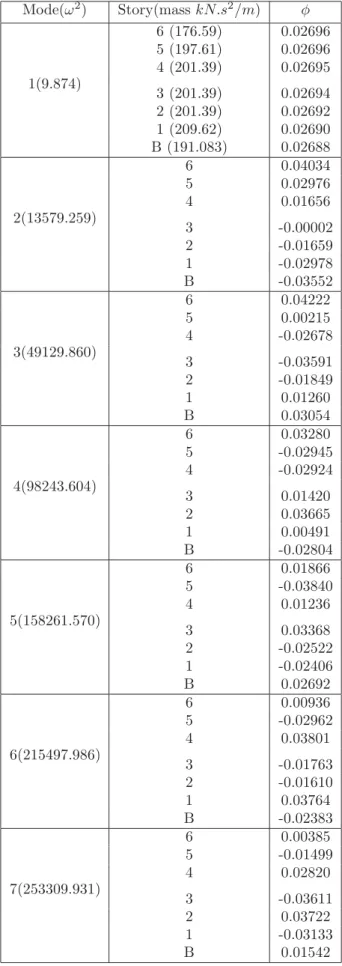
by summation of column stiffnesses in theX direction. The AMA-BI implies introduction of mass matrix, modal and spectral matrices in addition to the rest of inherent inputs (see section 2.1), they are given in table 2 (units: kN, m, s).
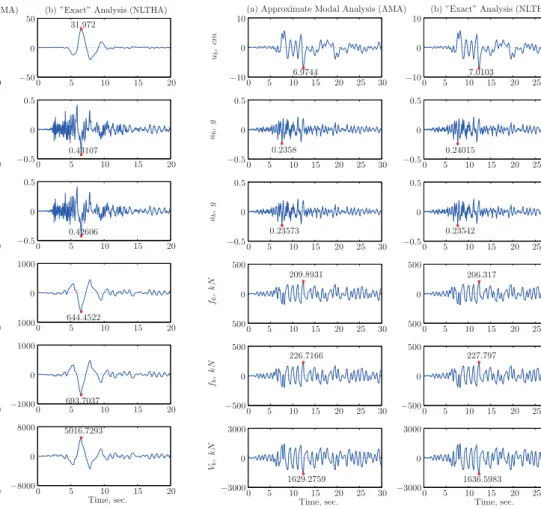
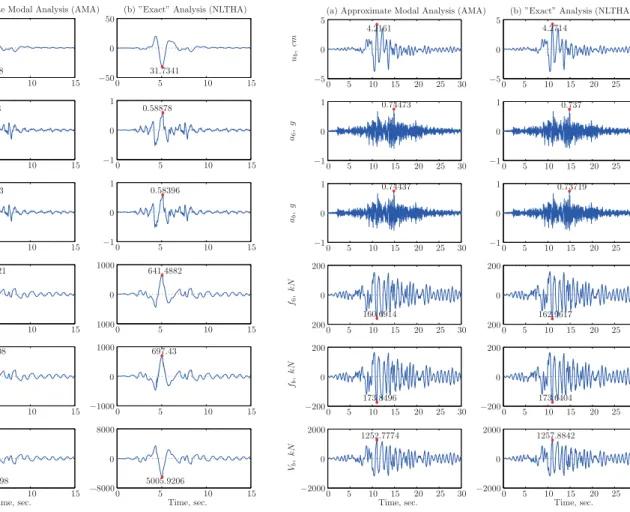
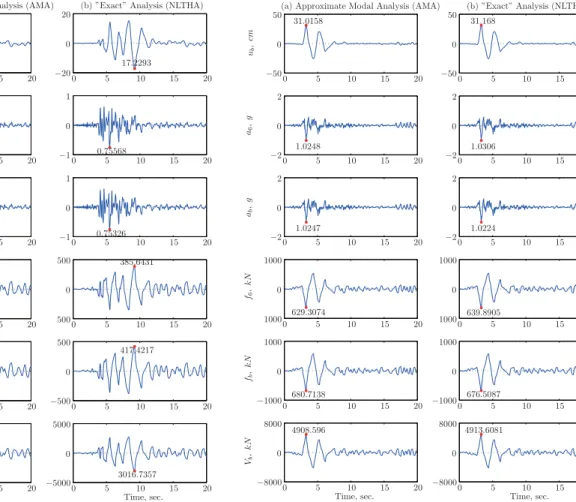
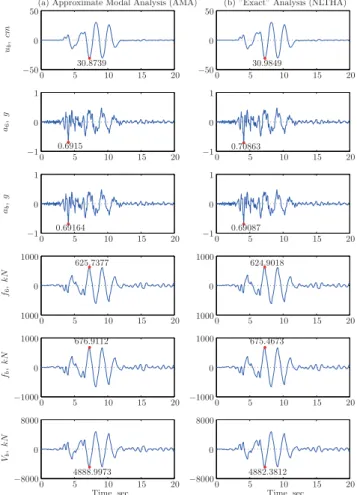
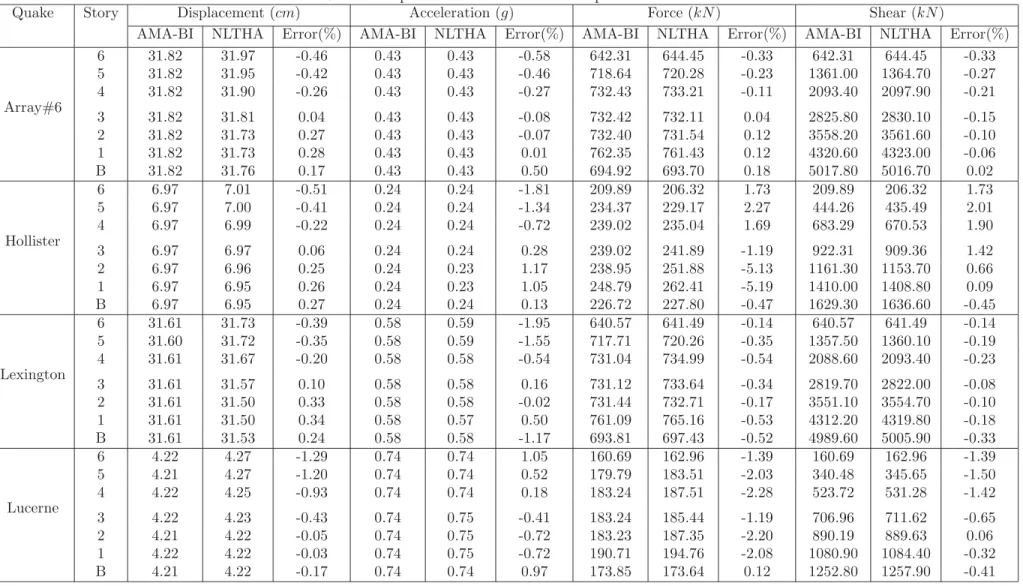
To test the AMA-BI procedure, the response of the six-story reinforced base isolated structure (figure 4) to the eight components (table 1), was determined using two methods: (1) rigorous nonlinear time history analysis by solving the governing coupled equations of motion; and (2) the AMA-BI procedure. Such a comparison for roof displacement, roof and base accelerations, roof and base forces and base shear force is presented in figures 5 to 12. The peak response values due to the induced ground mo-tions in theX direction are shown in tables 3 and 4 with the corresponding errors in the AMA-BI.
2.3
Discussion
The AMA procedure which is based on uncoupling the equations of motion gave results very close to that ob-tained when using NLTHA with negligible errors that even could happen to any comparison between two computer programs that use the rigorous NLTHA (e.g. ETABS and 3D-BAIS). Also, the AMA predicted accu-rately the shape of peak floor forces distribution through-out the hight of the structure.
The large errors in floor forces occurred when the struc-ture is subjected to the Loma Prieta, Hollister 90o
com-ponent, but still under 5% which can also be neglected, but lets interpret it: the isolation system works better under sever ground motions with large peak velocities; the yield strength achieves its higher value under higher velocity ([7],[8],[10]), if an earthquake has lower peak ve-locity (which is the case of Loma Prieta, Hollister 90o)
the isolation system do not perform properly as should be, the indirect result in this case is that the AMA-BI pre-dicts peak responses with larger errors since the approx-imate procedure was developed mainly benefiting from the isolation property.
Time, sec. Time, sec.
(a) Approximate Modal Analysis (AMA) (b) ”Exact” Analysis (NLTHA)
ub , cm a6 , g ab , g f6 , k N fb , k N Vb , k N 31.824 31.972 0.42856 0.43107 0.42819 0.42606 642.3116 644.4522 694.9226 693.7037 5017.7912 5016.7293 0 0 0 0 0 0 0 0 0 0 0 0 5 5 5 5 5 5 5 5 5 5 5 5 10 10 10 10 10 10 10 10 10 10 10 10 15 15 15 15 15 15 15 15 15 15 15 15 20 20 20 20 20 20 20 20 20 20 20 20 −50 −50 0 0 0 0 0 0 0 0 0 0 0 0 50 50
−0.5 −0.5
−0.5 −0.5
0.5 0.5
0.5 0.5
−1000 −1000 1000 1000 1000 1000 1000 1000 −8000 −8000 8000 8000
Figure 5: Comparison of response histories obtained by NLTHA and AMA-BI for the six-story structure with LRB subjected to El Centro 1979, Array#6
Time, sec. Time, sec.
(a) Approximate Modal Analysis (AMA) (b) ”Exact” Analysis (NLTHA)
ub , cm a6 , g ab , g f6 , k N fb , k N Vb , k N 6.9744 7.0103 0.2358 0.24015 0.23573 0.23542 209.8931 206.317 226.7166 227.797 1629.2759 1636.5983 0 0 0 0 0 0 0 0 0 0 0 0 5 5 5 5 5 5 5 5 5 5 5 5 10 10 10 10 10 10 10 10 10 10 10 10 15 15 15 15 15 15 15 15 15 15 15 15 20 20 20 20 20 20 20 20 20 20 20 20 25 25 25 25 25 25 25 25 25 25 25 25 30 30 30 30 30 30 30 30 30 30 30 30 −10 −10 0 0 0 0 0 0 0 0 0 0 0 0 10 10
−0.5 −0.5
−0.5 −0.5
0.5 0.5
0.5 0.5
−500 −500 500 500 500 500 500 500 −3000 −3000 3000 3000
Time, sec. Time, sec.
(a) Approximate Modal Analysis (AMA) (b) ”Exact” Analysis (NLTHA)
ub , cm a6 , g ab , g f6 , k N fb , k N Vb , k N 31.6098 31.7341 0.5773 0.58878 0.57713 0.58396 640.5721 641.4882 693.8108 697.43 4989.6198 5005.9206 0 0 0 0 0 0 0 0 0 0 0 0 5 5 5 5 5 5 5 5 5 5 5 5 10 10 10 10 10 10 10 10 10 10 10 10 15 15 15 15 15 15 15 15 15 15 15 15 −50 −50 0 0 0 0 0 0 0 0 0 0 0 0 50 50 −1 −1 −1 −1 1 1 1 1 −1000 −1000 1000 1000 1000 1000 1000 1000 −8000 −8000 8000 8000
Figure 7: Comparison of response histories obtained by NLTHA and AMA-BI for the six-story structure with LRB subjected to Loma Prieta, Lexington 90o
Time, sec. Time, sec.
(a) Approximate Modal Analysis (AMA) (b) ”Exact” Analysis (NLTHA)
ub , cm a6 , g ab , g f6 , k N fb , k N Vb , k N 4.2161 4.2714 0.74473 0.737 0.74437 0.73719 160.6914 162.9617 173.8496 173.6404 1252.7774 1257.8842 0 0 0 0 0 0 0 0 0 0 0 0 5 5 5 5 5 5 5 5 5 5 5 5 10 10 10 10 10 10 10 10 10 10 10 10 15 15 15 15 15 15 15 15 15 15 15 15 20 20 20 20 20 20 20 20 20 20 20 20 25 25 25 25 25 25 25 25 25 25 25 25 30 30 30 30 30 30 30 30 30 30 30 30 −5 −5 0 0 0 0 0 0 0 0 0 0 0 0 5 5 −1 −1 −1 −1 1 1 1 1 −200 −200 200 200 200 200 200 200 −2000 −2000 2000 2000
Time, sec. Time, sec.
(a) Approximate Modal Analysis (AMA) (b) ”Exact” Analysis (NLTHA)
ub , cm a6 , g ab , g f6 , k N fb , k N Vb , k N 17.1378 17.2293 0.75434 0.75568 0.75425 0.75326 386.0223 385.6431 417.6491 417.4217 3013.8248 3016.7357 0 0 0 0 0 0 0 0 0 0 0 0 5 5 5 5 5 5 5 5 5 5 5 5 10 10 10 10 10 10 10 10 10 10 10 10 15 15 15 15 15 15 15 15 15 15 15 15 20 20 20 20 20 20 20 20 20 20 20 20 −20 −20 0 0 0 0 0 0 0 0 0 0 0 0 20 20 −1 −1 −1 −1 1 1 1 1 −500 −500 500 500 500 500 500 500 −5000 −5000 5000 5000
Figure 9: Comparison of response histories obtained by NLTHA and AMA-BI for the six-story structure with LRB subjected to Northridge, Newhall 90o
Time, sec. Time, sec.
(a) Approximate Modal Analysis (AMA) (b) ”Exact” Analysis (NLTHA)
ub , cm a6 , g ab , g f6 , k N fb , k N Vb , k N 31.0158 31.168 1.0248 1.0306 1.0247 1.0224 629.3074 639.8905 680.7138 676.5087 4908.596 4913.6081 0 0 0 0 0 0 0 0 0 0 0 0 5 5 5 5 5 5 5 5 5 5 5 5 10 10 10 10 10 10 10 10 10 10 10 10 15 15 15 15 15 15 15 15 15 15 15 15 20 20 20 20 20 20 20 20 20 20 20 20 −50 −50 0 0 0 0 0 0 0 0 0 0 0 0 50 50 −2 −2 −2 −2 2 2 2 2 −1000 −1000 1000 1000 1000 1000 1000 1000 −8000 −8000 8000 8000
Time, sec. Time, sec.
(a) Approximate Modal Analysis (AMA) (b) ”Exact” Analysis (NLTHA)
ub , cm a6 , g ab , g f6 , k N fb , k N Vb , k N 30.8739 30.9849 0.6915 0.70863 0.69164 0.69087 625.7377 624.9018 676.9112 675.4673 4888.9973 4882.3812 0 0 0 0 0 0 0 0 0 0 0 0 5 5 5 5 5 5 5 5 5 5 5 5 10 10 10 10 10 10 10 10 10 10 10 10 15 15 15 15 15 15 15 15 15 15 15 15 20 20 20 20 20 20 20 20 20 20 20 20 −50 −50 0 0 0 0 0 0 0 0 0 0 0 0 50 50 −1 −1 −1 −1 1 1 1 1 −1000 −1000 1000 1000 1000 1000 1000 1000 −8000 −8000 8000 8000
Figure 11: Comparison of response histories obtained by NLTHA and AMA-BI for the six-story structure with LRB subjected to Northridge, Sylmar 90o
Time, sec. Time, sec.
(a) Approximate Modal Analysis (AMA) (b) ”Exact” Analysis (NLTHA)
ub , cm a6 , g ab , g f6 , k N fb , k N Vb , k N 7.9441 8.0102 0.20427 0.20891 0.20371 0.20011 225.4669 227.8539 243.9131 243.3898 1760.6819 1761.958 0 0 0 0 0 0 0 0 0 0 0 0 5 5 5 5 5 5 5 5 5 5 5 5 10 10 10 10 10 10 10 10 10 10 10 10 15 15 15 15 15 15 15 15 15 15 15 15 20 20 20 20 20 20 20 20 20 20 20 20 25 25 25 25 25 25 25 25 25 25 25 25 30 30 30 30 30 30 30 30 30 30 30 30 35 35 35 35 35 35 35 35 35 35 35 35 40 40 40 40 40 40 40 40 40 40 40
40 −10
−10 0 0 0 0 0 0 0 0 0 0 0 0 10 10
−0.5 −0.5
−0.5 −0.5
0.5 0.5
0.5 0.5
−500 −500 500 500 500 500 500 500 −3000 −3000 3000 3000
the application of the NLTHA takes more than 180 sec-onds.
Also, the reader may be referred to the paper [12] where has been presented a response spectrum analysis pro-cedure (RSA-BI) which constitutes the particular case when the AMA-BI is specialized for peak responses. This procedure is based on a response spectrum developed for base isolated buildings (were called in the paper ”SIRS” or Seismic Isolation Response Spectrum). The idea of construction of the SIRS was initiated by Zayas etal [14] for friction pendulum system, after; Ryan and Chopra [10] have developed the theory to include other systems and structures. The RSA-BI was found to give consistent peak response values when compared against results of the NLTHA, hence, it can replace the existent theory of linearization that uses the effective stiffness and effective damping.
References
[1] Anil K. Chopra,Dynamics of Structures Theory and Applications to Earthquake Engineering. (2nd Edi-tion). New Jersey, Prentice Hall, 2005.
[2] A. Mokha, M.C. Constantinou, and A.M. Reinhorn
Teflon Bearings in Aseismic Base Isolation: Exper-imental Studies and Mathematical Modeling. State University of New York, Buffalo, 1988; Technical Re-port NCEER-88-0038, 6.1–6.4.
[3] A.M. Reinhorn, S. Nagarajaiah, M.C. Constranti-nou, P. Tsopelas and R. Li,3D-BASIS: Version 2.0 Computer Program for Nonlinear Dynamics Analy-sis of Three Dimensional Base Isolated Structures. State University of New York, Buffalo, 1994; Tech-nical Report NCEER-95-0018.
[4] Datafit, version 8.2.79. Oakdale Engineering,
RC133, 1995/2006; Oakdale, PA 15071, USA.
[5] Dr Finely and A. Charney, NONLIN v6.0 Computer Program, FEMA, Advanced Structural Concepts, Golden, Colorado.
[6] Farzad Naeim and James M.Kelly,Design of Seismic Isolated Structures: From Theory to Practice. New York, John Wiley and Sons, Inc., 1999.
[7] Gianmario Benzoni and Chiara Casarotti, Perfor-mance of Lead-Rubber and Sliding Bearings under Different Axial Load and Velocity Conditions. Re-port No.SRMD2006/05-rev3, Department of Struc-tural Engineering University of California, San Diego, La Jolla, California 2008.
[8] James M. Kelly and Shakhzod M. Takhirov, An-alytical and Numerical Study on Buckling of Elas-tomeric Bearings with Various Shape Factors. port No. EERC.04/03, Earthquake Engineering
Re-search Center, College of Engineering, University of California at berkeley, 2004.
[9] Jangid, Parametric Study of Base Isolated Struc-tures. In Advances in structural engineering, Mul-tiscience Publishing Co Ltd., 2002;5(2):113–122.
[10] Keri L. Ryan and Anil K. Chopra, Estimating the response of base isolated buildings including torsion, rocking and axial load effects. Earthquake Engineer-ing Research Center, Berkeley, California, 2005; Re-port No. UCB/EERC 2005-01, 8–20, 86–91.
[11] Leblouba Moussa, Base isolated buildings: Para-metric dynamic analysis and computer simula-tions. Technical University of Civil Engineering, Bucharest, 2008; Report No. 2/2008, Chapters 3–6.
[12] Leblouba Moussa, Marioua Aissa, Estimating the Seismic Response of Base Isolated Buildings Through a Response Spectrum Analysis Procedure. Computational Methods in Structural Dynamics and Earthquake Engineering, COMPDYN 2009, Rhodes, Greece, 22–24 June 2009;
[13] Marvin W.Halling, Investigation of base-isolated structures during recent earthquakes and computer simulations utilizing near-source long-period ground motions. Earthquake Engineering Research Labora-tory, California Institute of Technology, Pasadena, California, 2005; Report No. EERL 95-09, 6–7.
Table 2: Eigenvalues and Eigenvectors of the structure Mode(ω2
) Story(masskN.s2
/m) φ
6 (176.59) 0.02696 5 (197.61) 0.02696 4 (201.39) 0.02695 1(9.874)
3 (201.39) 0.02694 2 (201.39) 0.02692 1 (209.62) 0.02690 B (191.083) 0.02688 6 0.04034 5 0.02976 4 0.01656 2(13579.259)
3 -0.00002 2 -0.01659 1 -0.02978 B -0.03552 6 0.04222 5 0.00215 4 -0.02678 3(49129.860)
3 -0.03591 2 -0.01849 1 0.01260 B 0.03054 6 0.03280 5 -0.02945 4 -0.02924 4(98243.604)
3 0.01420 2 0.03665 1 0.00491 B -0.02804
6 0.01866 5 -0.03840 4 0.01236 5(158261.570)
3 0.03368 2 -0.02522 1 -0.02406 B 0.02692
6 0.00936 5 -0.02962 4 0.03801 6(215497.986)
3 -0.01763 2 -0.01610 1 0.03764 B -0.02383
6 0.00385 5 -0.01499 4 0.02820 7(253309.931)
Table 3: Peak response results of AMA-BI compared with NLTHA
Quake Story Displacement (cm) Acceleration (g) Force (kN) Shear (kN)
AMA-BI NLTHA Error(%) AMA-BI NLTHA Error(%) AMA-BI NLTHA Error(%) AMA-BI NLTHA Error(%)
6 31.82 31.97 -0.46 0.43 0.43 -0.58 642.31 644.45 -0.33 642.31 644.45 -0.33
5 31.82 31.95 -0.42 0.43 0.43 -0.46 718.64 720.28 -0.23 1361.00 1364.70 -0.27
4 31.82 31.90 -0.26 0.43 0.43 -0.27 732.43 733.21 -0.11 2093.40 2097.90 -0.21
Array#6
3 31.82 31.81 0.04 0.43 0.43 -0.08 732.42 732.11 0.04 2825.80 2830.10 -0.15
2 31.82 31.73 0.27 0.43 0.43 -0.07 732.40 731.54 0.12 3558.20 3561.60 -0.10
1 31.82 31.73 0.28 0.43 0.43 0.01 762.35 761.43 0.12 4320.60 4323.00 -0.06
B 31.82 31.76 0.17 0.43 0.43 0.50 694.92 693.70 0.18 5017.80 5016.70 0.02
6 6.97 7.01 -0.51 0.24 0.24 -1.81 209.89 206.32 1.73 209.89 206.32 1.73
5 6.97 7.00 -0.41 0.24 0.24 -1.34 234.37 229.17 2.27 444.26 435.49 2.01
4 6.97 6.99 -0.22 0.24 0.24 -0.72 239.02 235.04 1.69 683.29 670.53 1.90
Hollister
3 6.97 6.97 0.06 0.24 0.24 0.28 239.02 241.89 -1.19 922.31 909.36 1.42
2 6.97 6.96 0.25 0.24 0.23 1.17 238.95 251.88 -5.13 1161.30 1153.70 0.66
1 6.97 6.95 0.26 0.24 0.23 1.05 248.79 262.41 -5.19 1410.00 1408.80 0.09
B 6.97 6.95 0.27 0.24 0.24 0.13 226.72 227.80 -0.47 1629.30 1636.60 -0.45
6 31.61 31.73 -0.39 0.58 0.59 -1.95 640.57 641.49 -0.14 640.57 641.49 -0.14
5 31.60 31.72 -0.35 0.58 0.59 -1.55 717.71 720.26 -0.35 1357.50 1360.10 -0.19
4 31.61 31.67 -0.20 0.58 0.58 -0.54 731.04 734.99 -0.54 2088.60 2093.40 -0.23
Lexington
3 31.61 31.57 0.10 0.58 0.58 0.16 731.12 733.64 -0.34 2819.70 2822.00 -0.08
2 31.61 31.50 0.33 0.58 0.58 -0.02 731.44 732.71 -0.17 3551.10 3554.70 -0.10
1 31.61 31.50 0.34 0.58 0.57 0.50 761.09 765.16 -0.53 4312.20 4319.80 -0.18
B 31.61 31.53 0.24 0.58 0.58 -1.17 693.81 697.43 -0.52 4989.60 5005.90 -0.33
6 4.22 4.27 -1.29 0.74 0.74 1.05 160.69 162.96 -1.39 160.69 162.96 -1.39
5 4.21 4.27 -1.20 0.74 0.74 0.52 179.79 183.51 -2.03 340.48 345.65 -1.50
4 4.22 4.25 -0.93 0.74 0.74 0.18 183.24 187.51 -2.28 523.72 531.28 -1.42
Lucerne
3 4.22 4.23 -0.43 0.74 0.75 -0.41 183.24 185.44 -1.19 706.96 711.62 -0.65
2 4.21 4.22 -0.05 0.74 0.75 -0.72 183.23 187.35 -2.20 890.19 889.63 0.06
1 4.22 4.22 -0.03 0.74 0.75 -0.72 190.71 194.76 -2.08 1080.90 1084.40 -0.32
B 4.21 4.22 -0.17 0.74 0.74 0.97 173.85 173.64 0.12 1252.80 1257.90 -0.41
World
Congress
on Engineering
2010 Vol II
U.K.
ISSN:
2078-0966 (Online)
Table 4: Peak response results of AMA-BI compared with NLTHA (continued)
Quake Story Displacement (cm) Acceleration (g) Force (kN) Shear (kN)
AMA-BI NLTHA Error(%) AMA-BI NLTHA Error(%) AMA-BI NLTHA Error(%) AMA-BI NLTHA Error(%)
6 17.14 17.23 -0.53 0.75 0.76 -0.18 386.02 385.64 0.10 386.02 385.64 0.10
5 17.13 17.22 -0.48 0.75 0.75 0.14 431.91 429.35 0.60 817.93 814.99 0.36
4 17.14 17.19 -0.31 0.75 0.75 0.25 440.19 437.16 0.69 1258.10 1252.10 0.48
Newhall
3 17.14 17.14 -0.04 0.75 0.75 0.06 440.18 440.75 -0.13 1698.30 1691.50 0.40
2 17.14 17.11 0.17 0.75 0.76 -0.22 440.17 445.82 -1.27 2138.50 2135.40 0.15
1 17.14 17.10 0.18 0.75 0.76 -0.28 458.17 464.09 -1.28 2596.60 2599.30 -0.10
B 17.14 17.11 0.12 0.75 0.75 0.13 417.65 417.42 0.06 3013.80 3016.70 -0.10
6 31.02 31.17 -0.49 1.02 1.03 -0.57 629.31 639.89 -1.65 629.31 639.89 -1.65
5 31.01 31.15 -0.46 1.02 1.03 -0.56 703.92 715.54 -1.62 1333.20 1355.40 -1.64
4 31.01 31.10 -0.28 1.02 1.03 -0.36 717.48 724.81 -1.01 2050.70 2080.20 -1.42
Petrolia
3 31.01 30.99 0.06 1.02 1.02 0.13 717.46 714.70 0.39 2768.20 2794.90 -0.96
2 31.01 30.91 0.32 1.02 1.02 0.50 717.42 706.73 1.51 3485.60 3501.70 -0.46
1 31.01 30.91 0.33 1.02 1.02 0.51 746.79 735.44 1.54 4232.40 4237.10 -0.11
B 31.01 30.95 0.19 1.02 1.02 0.22 680.71 676.51 0.62 4908.60 4913.60 -0.10
6 30.87 30.99 -0.36 0.69 0.71 -2.42 625.74 624.90 0.13 625.74 624.90 0.13
5 30.87 30.97 -0.32 0.69 0.70 -1.40 700.04 701.59 -0.22 1325.60 1325.70 -0.01
4 30.87 30.92 -0.16 0.69 0.69 -0.47 713.42 715.94 -0.35 2039.10 2041.50 -0.12
Sylmar
3 30.87 30.83 0.14 0.69 0.69 0.67 713.42 714.18 -0.11 2752.50 2755.60 -0.11
2 30.87 30.75 0.37 0.69 0.68 1.49 713.43 711.65 0.25 3465.90 3467.20 -0.04
1 30.87 30.75 0.39 0.69 0.68 1.19 742.57 739.75 0.38 4208.40 4206.90 0.04
B 30.87 30.78 0.28 0.69 0.69 0.11 676.91 675.47 0.21 4889.00 4882.40 0.14
6 7.94 8.01 -0.83 0.20 0.21 -2.22 225.47 227.85 -1.04 225.47 227.85 -1.04
5 7.94 8.00 -0.78 0.20 0.21 -1.80 252.23 254.43 -0.86 477.70 482.23 -0.94
4 7.94 7.99 -0.54 0.20 0.21 -0.90 257.08 258.30 -0.47 734.78 740.50 -0.77
Yermo
3 7.94 7.95 -0.04 0.20 0.20 0.28 257.08 256.63 0.18 991.86 997.13 -0.53
2 7.94 7.91 0.35 0.20 0.20 0.69 257.07 255.47 0.63 1248.90 1252.60 -0.30
1 7.94 7.91 0.37 0.20 0.20 1.17 267.59 265.99 0.60 1516.50 1518.60 -0.14
B 7.94 7.93 0.14 0.20 0.20 1.80 243.91 243.39 0.21 1760.70 1762.00 -0.07
World
Congress
on Engineering
2010 Vol II
U.K.
ISSN: