ACPD
11, 15551–15572, 2011Relativistic electron beams
M. F ¨ullekrug et al.
Title Page
Abstract Introduction
Conclusions References
Tables Figures
◭ ◮
◭ ◮
Back Close
Full Screen / Esc
Printer-friendly Version Interactive Discussion
Discussion
P
a
per
|
Dis
cussion
P
a
per
|
Discussion
P
a
per
|
Discussio
n
P
a
per
|
Atmos. Chem. Phys. Discuss., 11, 15551–15572, 2011 www.atmos-chem-phys-discuss.net/11/15551/2011/ doi:10.5194/acpd-11-15551-2011
© Author(s) 2011. CC Attribution 3.0 License.
Atmospheric Chemistry and Physics Discussions
This discussion paper is/has been under review for the journal Atmospheric Chemistry and Physics (ACP). Please refer to the corresponding final paper in ACP if available.
Relativistic electron beams above
thunderclouds
M. F ¨ullekrug1, R. Roussel-Dupr ´e2, E. M. D. Symbalisty3, J. J. Colman4,
O. Chanrion5, S. Soula6, O. van der Velde7, A. Odzimek8, A. J. Bennett9,
V. P. Pasko10, and T. Neubert5
1
University of Bath, Centre for Space and Atmospheric Research, Department of Electronic and Electrical Engineering, Bath, UK
2
SciTech Solutions, Melbourne, Florida, USA 3
Atmospheric, Earth and Environment Sciences Division, Los Alamos National Laboratory, Los Alamos, New Mexico, USA
4
Kirtland Airforce Base, USAF AFMC AFRL/RVBXP, New Mexico, USA 5
National Space Institute, Technical University of Denmark, Copenhagen, Denmark 6
Laboratoire d’A ´erologie, Universit ´e de Toulouse, Toulouse, France. 7
Department of Electrical Engineering, Universitat Polit `ecnica de Catalunya, Terrassa, Spain 8
ACPD
11, 15551–15572, 2011Relativistic electron beams
M. F ¨ullekrug et al.
Title Page
Abstract Introduction
Conclusions References
Tables Figures
◭ ◮
◭ ◮
Back Close
Full Screen / Esc
Printer-friendly Version Interactive Discussion
Discussion
P
a
per
|
Dis
cussion
P
a
per
|
Discussion
P
a
per
|
Discussio
n
P
a
per
|
9
Passive Sensing, Met Office, Exeter, UK
10
Department of Electrical Engineering, Pennsylvania State University, Pennsylvania, USA
Received: 25 April 2011 – Accepted: 18 May 2011 – Published: 20 May 2011
Correspondence to: M. F ¨ullekrug ([email protected])
ACPD
11, 15551–15572, 2011Relativistic electron beams
M. F ¨ullekrug et al.
Title Page
Abstract Introduction
Conclusions References
Tables Figures
◭ ◮
◭ ◮
Back Close
Full Screen / Esc
Printer-friendly Version Interactive Discussion
Discussion
P
a
per
|
Dis
cussion
P
a
per
|
Discussion
P
a
per
|
Discussio
n
P
a
per
|
Abstract
Non-luminous relativistic electron beams above thunderclouds are detected by radio remote sensing with low frequency radio signals from ∼40–400 kHz. The electron beams occur∼2–9 ms after positive cloud-to-ground lightning discharges at heights be-tween∼22–72 km above thunderclouds. The positive lightning discharges also cause 5
sprites which occur either above or before the electron beam. One electron beam was detected without any luminous sprite occurrence which suggests that electron beams may also occur independently. Numerical simulations show that the beamed electrons partially discharge the lightning electric field above thunderclouds and thereby gain a mean energy of ∼7 MeV to transport a total charge of ∼10 mC upwards. The impul-10
sive current associated with relativistic electron beams above thunderclouds is directed downwards and needs to be considered as a novel element of the global atmospheric electric circuit.
1 Introduction
Sprites (Neubert et al., 2008; F ¨ullekrug et al., 2006; Rakov and Uman, 2003; Sentman 15
et al., 1995; Franz et al., 1990) and gigantic jets (Cummer et al., 2009; Su et al., 2003; Pasko et al., 2002) are luminous streamer (Luque and Ebert, 2009; Pasko et al., 1998) and leader (Riousset et al., 2010; Krehbiel et al., 2008; Pasko and George, 2002) dis-charges resulting from conventional breakdown in the middle atmosphere. Sprites may also be associated with electron beams resulting from relativistic runaway breakdown 20
within or above thunderclouds (Østgaard et al., 2008; Inan, 2005; Smith et al., 2005; Roussel-Dupr ´e and Gurevich, 1996; Fishman et al., 1994). The newly-recognised run-away breakdown mechanism (Gurevich and Zybin, 2005; Gurevich et al., 1992) inside thunderclouds (Shao et al., 2010; Dwyer et al., 2009) can initiate at∼1/10 of the con-ventional breakdown electric field threshold (Marshall et al., 1995) and requires a pop-25
ACPD
11, 15551–15572, 2011Relativistic electron beams
M. F ¨ullekrug et al.
Title Page
Abstract Introduction
Conclusions References
Tables Figures
◭ ◮
◭ ◮
Back Close
Full Screen / Esc
Printer-friendly Version Interactive Discussion
Discussion
P
a
per
|
Dis
cussion
P
a
per
|
Discussion
P
a
per
|
Discussio
n
P
a
per
|
electron avalanche growth (Gurevich et al., 2003). The population of seed particles must be above the runaway threshold of∼10 keV or more, depending on the strength of the electric field, and could originate from ∼1015–1016eV cosmic rays (Gurevich et al., 2009; Gurevich and Zybin, 2005) or thermal runaway in leader and/or streamer tips (Celestin and Pasko, 2011; Colman et al., 2010; Moss et al., 2006). The runaway 5
avalanche can result in a population of electrons with energies as high as tens of MeV inside the thundercloud (Shao et al., 2010; Dwyer et al., 2009; Gurevich et al., 1992). Whether relativistic electron beams can also occur above thunderclouds is currently not known (Østgaard et al., 2008; Inan, 2005; Smith et al., 2005; Roussel-Dupr ´e and Gure-vich, 1996; Fishman et al., 1994) even though narrow beams of relativistic electrons 10
are now routinely observed in space (Briggs et al., 2011; Cohen et al., 2010; Carlson et al., 2009; Dwyer et al., 2008). Relativistic electron beams are occasionally associ-ated with sprites as inferred from radio remote sensing with low frequency radio signals from∼40–400 kHz (F ¨ullekrug et al., 2010). These radio signals are analyzed here in detail to determine the height of relativistic electron beams above thunderclouds and 15
to determine the associated charge transfer through the middle atmosphere.
2 The mesocale convective system, lightning discharges and sprites
Thunderstorms and lightning activity in southern Europe have recently attracted special interest because numerous sprites are observed with video cameras above thunder-clouds which regularly develop during the summer months from the beginning of May 20
to mid-September (Soula et al., 2009; Neubert et al., 2008). For example, several thundercloud cells initiated over the Bay of Biscay and northern Spain in the late af-ternoon on 30 August 2008. The thunderstorms migrated northward through France and merged to an exceptional mesoscale convective system during the night until it decayed away in the late morning hours when reaching the English Channel which 25
ACPD
11, 15551–15572, 2011Relativistic electron beams
M. F ¨ullekrug et al.
Title Page
Abstract Introduction
Conclusions References
Tables Figures
◭ ◮
◭ ◮
Back Close
Full Screen / Esc
Printer-friendly Version Interactive Discussion
Discussion
P
a
per
|
Dis
cussion
P
a
per
|
Discussion
P
a
per
|
Discussio
n
P
a
per
|
brightness temperature recorded on board the Meteosat Second Generation (MSG) satellite at 01:45 UTC (Fig. 1). The convective core of the thunderstorm reached a height of ∼12 km with cloud top temperatures as cold as ∼−64 C◦. Many negative
lightning discharges cluster in the convective core which is surrounded by some posi-tive lightning discharges reported by the French lightning detection system M ´et ´eorage 5
at the time when Meteosat scanned the electrified thundercloud from 01:50 UTC to 02:00 UTC.
One particular positive lightning discharge at 01:52:59.524 UTC (46.54◦N, 0.48◦E)
with a peak current of ∼47.1 kA causes a sprite discharge above the thundercloud (Fig. 2) which is observed with a video camera located on the top of Pic du Midi in the 10
French Pyr ´en ´ees (42.93◦N, 0.14◦E, 2877 m elev.) and another video camera located in
Sant Vicenc¸ de Castellet in North-Eastern Spain (41.67◦N, 1.86◦E, 193 m elev.). The
sprite discharge consists of the main body of the sprite surrounded by three columni-form sprites at distances up to∼20 km. The main body of the sprite extends upwards from∼60 km to∼85 km height as triangulated by use of the two video cameras. The 15
sprite tendrils extend downwards from∼60 km to∼50 km below the main body of the sprite.
The sprite luminosity curve is delayed by∼3–6 ms with respect to the causative pos-itive lightning discharge (Fig. 3) as evidenced by high speed (20 kHz) recordings with a photometer located at Pic du Midi and vertical electric field recordings with a wide-20
band digital radio receiver (F ¨ullekrug, 2010) located near Bath in South-West England of the United Kingdom (51.35◦N, 2.29◦W). The sprite causing positive cloud-to-ground
lightning discharge causes a strong burst of electromagnetic radiation which spans the entire frequency range of the radio receiver. A large fraction of this electromagnetic energy is deposited in the narrow frequency range from∼5-16 kHz which is typical for 25
ACPD
11, 15551–15572, 2011Relativistic electron beams
M. F ¨ullekrug et al.
Title Page
Abstract Introduction
Conclusions References
Tables Figures
◭ ◮
◭ ◮
Back Close
Full Screen / Esc
Printer-friendly Version Interactive Discussion
Discussion
P
a
per
|
Dis
cussion
P
a
per
|
Discussion
P
a
per
|
Discussio
n
P
a
per
|
range from∼5–16 kHz which is untypical for conventional lightning discharges. The first radiation burst coincides with the sprite luminosity and the second radiation burst shortly follows the sprite luminosity. Both radiation bursts are thought to be caused by electron beams above the thundercloud resulting from relativistic runaway breakdown (F ¨ullekrug et al., 2010).
5
3 Relativistic electron beams
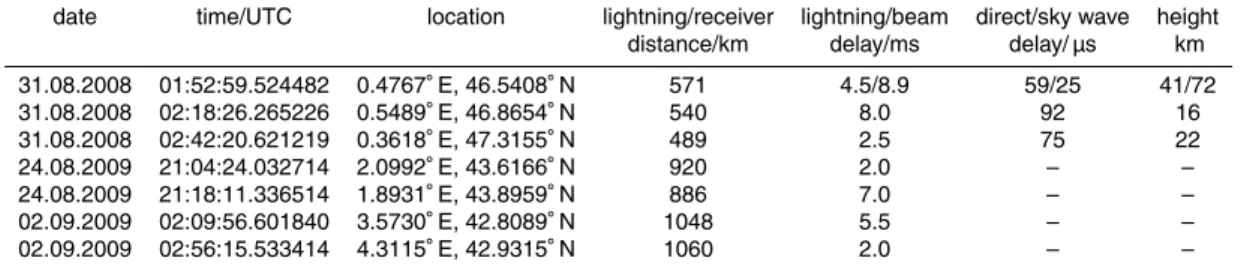
Seven similar untypical broadband bursts of electromagnetic radiation following sprite producing lightning discharges have been collected during sprite observations in the years 2008 and 2009 (Table 1). In these two years, a total of ∼140 sprite observa-tions have been examined such that the occurrence rate of the electromagnetic radi-10
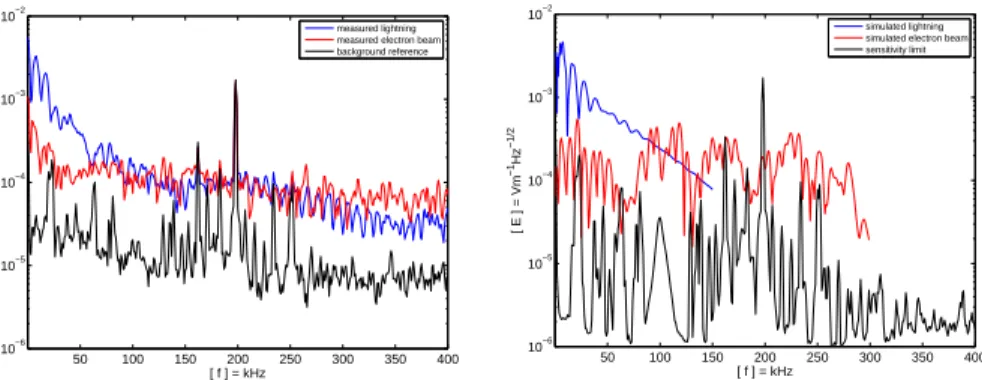
ation bursts is ∼5 %. These bursts all occured ∼2–9 ms after sprite causing positive cloud-to-ground lightning discharges. The average spectrum of the seven bursts is rel-atively flat at frequencies<40 kHz when compared to the average spectrum of their parent lightning discharges (Fig. 4, left). This is consistent with simulations of vir-gin air high frequency breakdown. The spectral amplitudes of the broadband electro-15
magnetic radiation bursts are as small as∼100 µ Vm−1Hz−1/2 in the frequency range from∼40-400 kHz, but still∼1–2 orders of magnitude above an average background spectrum which is recorded 10 ms prior to the causative lightning discharges for ref-erence (Fig. 4, left). This background spectrum exceeds the ultimate sensitivity limit of the wideband digital radio receiver∼1–2 µVm−1Hz−1/2 by ∼1 order of magnitude 20
(Fig. 4, right). Superimposed on the sensitivity limit of the receiver are the omni-present low-frequency, or long-wave, radio transmitters in this frequency range, e.g., the United Kingdom radio clock at 60 kHz (the former Rugby MSF signal, now transmit-ted from Anthorn), France Inter at 162 kHz, Europe 1 at 183 kHz, and BBC radio 4 at 198 kHz. These radio transmitters have a typical narrow bandwidth of∼10–12 kHz and 25
ACPD
11, 15551–15572, 2011Relativistic electron beams
M. F ¨ullekrug et al.
Title Page
Abstract Introduction
Conclusions References
Tables Figures
◭ ◮
◭ ◮
Back Close
Full Screen / Esc
Printer-friendly Version Interactive Discussion
Discussion
P
a
per
|
Dis
cussion
P
a
per
|
Discussion
P
a
per
|
Discussio
n
P
a
per
|
Numerical simulations of relativistic electron beams above thunderclouds predict the-oretically broadband bursts of electromagnetic radiation with a flat spectrum following sprite producing lightning discharges (F ¨ullekrug et al., 2010) in agreement with our experimental observations. These model calculations solve kinetic particle equations on the microscopic scale and Maxwell’s equations on the macroscopic scale simulta-5
neously. The causative lightning continuing current drains charge from the thunder-cloud which exposes the area above the thunderthunder-cloud to a quasi-static electric field. When this electric field exceeds the runaway breakdown threshold and a coinciding stratospheric cosmic ray shower (Roussel-Dupr ´e et al., 1998) produces sufficient ener-getic seed electrons, an electron avalanche above the thundercloud is initiated which 10
quickly develops into an upward propagating relativistic electron beam. The beamed electrons partially discharge the lightning electric field and thereby gain a mean energy of∼7 MeV with a spread of ∼6 MeV while carrying a total charge of∼10 mC upward as inferred from the comparison between the measured and simulated electron beam spectrum (Fig. 4, left and right). Impulsive changes of this downward current from the 15
electron beam result in the observed bursts of electromagnetic radiation a few ms after the causative lightning discharge.
The initial lightning discharge and the subsequent electron beam launch electromag-netic waves which can propagate on several paths from the source location to the radio receiver. These propagation paths can be inferred from a detailed analysis of the ob-20
served electromagnetic radiation bursts. The burst of electromagnetic radiation from the lightning discharge is composed of two consecutive pulses which are delayed by ∼102 µs (Fig. 5, upper panel). The first pulse results from the electromagnetic wave which propagates from the lightning discharge to the receiver along the surface of the Earth and is denoted ground wave. The second pulse results from the electro-25
ACPD
11, 15551–15572, 2011Relativistic electron beams
M. F ¨ullekrug et al.
Title Page
Abstract Introduction
Conclusions References
Tables Figures
◭ ◮
◭ ◮
Back Close
Full Screen / Esc
Printer-friendly Version Interactive Discussion
Discussion
P
a
per
|
Dis
cussion
P
a
per
|
Discussion
P
a
per
|
Discussio
n
P
a
per
|
wave propagation simulations with Finite-Difference-Time-Domain (FDTD) modeling. Electromagnetic waves with two or more ionospheric reflections are more strongly at-tenuated and they are not detected above the background level of the interfering radio transmitters.
The burst of electromagnetic radiation from the electron beam at ∼4.4 ms is also 5
composed of two consecutive pulses which are delayed by∼59 µs (Fig. 5, lower panel). The first pulse results from the direct wave which propagates at an angle to the receiver and is denoted direct wave. The second pulse results from the electromagnetic wave which is reflected from the ionosphere and is denoted sky wave. The time delay be-tween the direct wave and the sky wave determines the height of the electron beam 10
to be∼41 km for the known ionospheric height of∼90 km (Fig. 6). The electron beam is therefore located well above the thundercloud which terminates at an altitude of ∼12 km. The burst of electromagnetic radiation at∼8.9 ms emanates from a height of ∼72 km and could result from the same electron beam or another independent second electron beam. If the observed radiation burst is interpreted to emanate from the same 15
electron beam, the beam would propagate with an average velocity of ∼7000 km/s through the middle atmosphere as inferred from the difference between the two emis-sion heights∼31 km and the corresponding time delay∼4 ms. The heights of two more electron beams associated with other sprite discharges during the same night are de-termined to be∼16 km and∼22 km, both of which are well above the thundercloud. 20
4 Discussion
A sensitivity analysis of the height determination methodology reveals that a variation of the observed time delay by∼1 µs corresponds to a ∼1 km vertical height variation such that the height of the electron beam can be determined in a very accurate way. If the observed time delay is interpreted as a variation in the distance between the source 25
ACPD
11, 15551–15572, 2011Relativistic electron beams
M. F ¨ullekrug et al.
Title Page
Abstract Introduction
Conclusions References
Tables Figures
◭ ◮
◭ ◮
Back Close
Full Screen / Esc
Printer-friendly Version Interactive Discussion
Discussion
P
a
per
|
Dis
cussion
P
a
per
|
Discussion
P
a
per
|
Discussio
n
P
a
per
|
sensitivity analysis was performed to determine the optimum distance between the lightning discharge and the radio receiver which maximizes the signals of the ground and sky wave. This distance was found to be ∼300–400 km such that at larger dis-tances, it becomes increasingly difficult to distinguish the ground and sky wave from the background noise of the interfering radio transmitters. Finally, all lightning discharges 5
with a peak currentIp
>30 kA reported by M ´et ´eorage from 00:00–04:00 UTC on 31
August 2008, have been investigated. Only one additional electromagnetic radiation burst with a flat spectrum from ∼40-400 kHz could be found which is similar to the three examples reported here. The burst follows ∼5 ms after two consecutive posi-tive lightning discharges at 01:29:09.785 and .786 UTC. This singular observation is 10
indicative of a non-luminous relativistic electron beam without any sprite occurrence as evidenced by the two video cameras. The preliminary result suggests that lightning discharges may also cause relativistic electron beams above thunderclouds without producing sprites because the relativistic breakdown threshold is only ∼1/10 of the conventional breakdown threshold. It is also possible that the observed electromag-15
netic radiation bursts are related to secondary sprite processes sometimes observed above thundercloud tops (Pasko, 2010; Marshall and Inan, 2007; Moudry, 2003). How-ever, these processes remained sub-visual in the optical observations reported in this work, and it is not clear why such a hypothetical process would emit low frequency electromagnetic radiation while the sprite itself does not. It is interesting to note that 20
the low frequency electromagnetic radiation reported here can be observed in space as a result of its transionospheric propagation (F ¨ullekrug et al., 2011, 2009) and it may be associated with high frequency electromagnetic radiation (Parrot et al., 2008).
5 Summary
In summary, relativistic electron beams above thunderclouds have been detected si-25
ACPD
11, 15551–15572, 2011Relativistic electron beams
M. F ¨ullekrug et al.
Title Page
Abstract Introduction
Conclusions References
Tables Figures
◭ ◮
◭ ◮
Back Close
Full Screen / Esc
Printer-friendly Version Interactive Discussion
Discussion
P
a
per
|
Dis
cussion
P
a
per
|
Discussion
P
a
per
|
Discussio
n
P
a
per
|
Both results suggest that non-luminous electron beams and luminous sprites indepen-dently discharge lightning electric fields in the middle atmosphere. The observed rel-ativistic electron beams above thunderclouds occur simultaneously with ∼5 % of all optically observed sprites and they are thus very rare. The small number of pho-tons possibly emanating from non-luminous relativistic electron beams and sub-visual 5
streamers may be identified in future studies by combining more sensitive optical ob-servations with interferometric radio recordings to map the low-frequency radio sky above thunderclouds. However, the relativistic electron beams are a new form of im-pulsive energy transfer between thunderclouds and the middle atmosphere which need to be considered as a novel element in the global atmospheric electric circuit (Rycroft 10
and Odzimek, 2010; Rycroft, 2006; Rycroft et al., 2000).
6 Methods
The Meteosat Second Generation satellite measures the thermal infrared radiation of the Earth from 10.5-12.5µm with a Ritchey-Chr ´etien telescope connected to a HgCdTe detector. This passive imaging radiometer is calibrated with two black bodies at 290 K 15
and 340 K and it scans the full Earth disk every 15 minutes. The optical camera system on Pic du Midi consists of a wide-angle, low-light, video camera and a high-speed pho-tometer mounted on a pan-tilt unit. The camera is equipped with a 16 mm, f 1.40 lens with a field of view of 31◦and it has an exposure time of 40 ms for one image. The
pho-tometer counts photon emissions at a sampling rate of 20 kHz with a time resolution of 20
50 ms. The camera system is synchronized to UTC with a Global Positioning Satellite (GPS) receiver with an absolute timing accuracy <1 ms. The optical camera system in Sant Vicenc¸ de Castellet is a Watec 902H2 equipped with a 12 mm, f 0.8 lens with a field of view of 31◦ and an exposure time of 20 ms. The French lightning detection
system M ´et ´eorage covers southwestern Europe and the western Mediterranean Sea. 25
ACPD
11, 15551–15572, 2011Relativistic electron beams
M. F ¨ullekrug et al.
Title Page
Abstract Introduction
Conclusions References
Tables Figures
◭ ◮
◭ ◮
Back Close
Full Screen / Esc
Printer-friendly Version Interactive Discussion
Discussion
P
a
per
|
Dis
cussion
P
a
per
|
Discussion
P
a
per
|
Discussio
n
P
a
per
|
<4 km, and timing accuracy<1 ms. The wideband digital radio receiver near Bath in the UK measures the vertical electric field strength by use of a capacitive probe with a sampling frequency of 1 MHz, frequency response from∼4 Hz to ∼400 kHz, ampli-tude resolution of ∼35 µV, and timing accuracy of ∼12 ns. Numerical simulations of relativistic electron beams are performed with the transient, multimaterial, compress-5
ible, fluid dynamics code CAVEAT which was adapted to solve the electromagnetic equations and their effect on the electron and ion populations in a self-consistent way on the Los Alamos National Laboratory supercomputer facility. The Finite-Diff erence-Time-Domain (FDTD) method dynamically solves Maxwell’s equations on a spatial grid using equivalent vertical current sources representing the relativistic electron beam and 10
the causative lightning discharge and propagates the full wave radio electromagnetic fields to the wideband digital radio receiver.
Acknowledgements. This work was sponsored by the Natural Environment Research Council
(NERC) under grant NE/H024921/1 and the Science and Technology Facilities Council (STFC) under grant PP/E0011483/1. V.P.P. was supported by Aeronomy and Physical and Dynamical
15
Meteorology Programs of the US National Science Foundation. The International Space Sci-ence Institute (ISSI) kindly supported and hosted the Coupling of Atmospheric Regions with Near-Earth Space (CARNES) team meetings which stimulated this work.
References
Briggs, M., Connaughton, V., Wilson-Hodge, C., Preece, R., Fishman, G., Kippen, R., Bhat, P.,
20
Paciesas, W., Chaplin, V., Meegan, C., von Kienlin, A., Greiner, J., Dwyer, J., and Smith, D.: Electron-positron beams from terrestrial lightning observed with Fermi GBM, Geophys. Res. Lett., 38, 1–5, doi:10.1029/2010GL046259, 2011. 15554
Carlson, B., Lehtinen, N., and Inan, U.: Observations of terrestrial gamma-ray flash elec-trons, in: Coupling of thunderstorms and lightning discharges to near-Earth space, edited
25
ACPD
11, 15551–15572, 2011Relativistic electron beams
M. F ¨ullekrug et al.
Title Page
Abstract Introduction
Conclusions References
Tables Figures
◭ ◮
◭ ◮
Back Close
Full Screen / Esc
Printer-friendly Version Interactive Discussion
Discussion
P
a
per
|
Dis
cussion
P
a
per
|
Discussion
P
a
per
|
Discussio
n
P
a
per
|
Celestin, S. and Pasko, V.: Energy and fluxes of thermal runaway electrons produced by expo-nential growth of streamers during the stepping of lightning leaders and in transient luminous events, J. Geophys. Res., 116, 1–14, doi:10.1029/2010JA016260, 2011. 15554
Cohen, M., Inan, U., Said, R., Briggs, M., Fishman, G., Connaughton, V., and Cummer, S.: A lightning discharge producing a beam of relativistic electrons into space, Geophys. Res.
5
Lett., 37, 1–4, doi:10.1029/2010GL044481, 2010. 15554
Colman, J., Roussel-Dupr ´e, R., and Triplett, L.: Temporally self-similar electron distribution functions in atmospheric breakdown: The thermal runaway regime, J. Geophys. Res., 115, 1–17, doi:10.1029/2009JA014509, 2010. 15554
Cummer, S., Li, J., Han, F., Lu, G., Jaugey, N., Lyons, W., and Nelson, T.: Quantification of the
10
troposphere-to-ionosphere charge transfer in a gigantic jet, Nature Geoscience, 2, 617–620, doi:10.1038/NGEO607, 2009. 15553
Dwyer, J., Grefenstette, B., and Smith, D.: High-energy electron beams launched into space by thunderstorms, Geophys. Res. Lett., 35, 1–5, doi:10.1029/2007GL032430, 2008. 15554 Dwyer, J., Uman, M., and Rassoul, H.: Remote measurements of thundercloud electrostatic
15
fields, J. Geophys. Res., 114, 1–19, doi:10.1029/2008JD011386, 2009. 15553, 15554 Fishman, G., Bhat, P., Mallozzi, R., Horack, J., Koshut, T., Kouveliotou, C., Pendleton, G.,
Meegan, C., Wilson, R., Paciesas, W., Goodman, S., and Christian, H.: Discovery of intense gamma-ray flashes of atmospheric origin, Science, 264, 1313–1316, 1994. 15553, 15554 Franz, R., Nemzek, R., and Winckler, J.: Television image of a large upward electrical discharge
20
above a thunderstorm system, Science, 249, 48–51, 1990. 15553
F ¨ullekrug, M.: Wideband digital low-frequency radio receiver, Measurement Science and Tech-nology, 21, 1–9, doi:10.1088/0957-0233/21/1/015901, 2010. 15555
F ¨ullekrug, M., Mareev, E., and Rycroft, M. (eds.): Sprites, elves and intense lightning dis-charges, Springer, Dordrecht, The Netherlands, 2006. 15553
25
F ¨ullekrug, M., Parrot, M., Ash, M., Astin, I., Williams, P., and Talhi, R.: Transionospheric at-tenuation of 100 kHz radio waves inferred from satellite and ground based observations, Geophys. Res. Lett., 36, 1–4, 2009. 15559
F ¨ullekrug, M., Roussel-Dupr ´e, R., Symbalisty, M. D., Chanrion, O., Odzimek, A., van der Velde, O., and Neubert, T.: Relativistic runaway breakdown in low frequency radio, J. Geophys.
30
Res., 115, 1–10, doi:10.1029/2009JA014468, 2010. 15554, 15556, 15557
ACPD
11, 15551–15572, 2011Relativistic electron beams
M. F ¨ullekrug et al.
Title Page
Abstract Introduction
Conclusions References
Tables Figures
◭ ◮
◭ ◮
Back Close
Full Screen / Esc
Printer-friendly Version Interactive Discussion
Discussion
P
a
per
|
Dis
cussion
P
a
per
|
Discussion
P
a
per
|
Discussio
n
P
a
per
|
Phys., 11, 1–7, doi:10.5194/acp-11-1-2011, 2011. 15559
Gurevich, A. and Zybin, K.: Runaway breakdown and the mysteries of lightning, Physics Today, 58, 37–43, 2005. 15553, 15554
Gurevich, A., Milikh, G., and Roussel-Dupr ´e, R.: Runaway electron mechanism of air break-down and preconditioning during a thunderstorm, Phys. Lett. A, 165, 463–468, 1992. 15553,
5
15554
Gurevich, A., Duncan, L., Karashtin, A., and Zybin, K.: Radio emission of lightning initiation, Phys. Lett. A, 312, 228–237, doi:10.1016/S0375-9601(03)00511-5, 2003. 15554
Gurevich, A., Mitko, G., Antonova, V., Chubenko, A., Karashtin, A., Kryukov, S., Naumov, A., Pavljuchenko, L., Ptitsyn, M., Ryabov, V., Shalamova, S., Shepetov, A., Shlyugaev, Y.,
Vil-10
danova, L., and Zybin, K.: An intracloud discharge caused by extensive atmospheric shower, Phys. Lett. A, 373, 3550–3553, doi:10.1016/j.physleta.2009.07.085, 2009. 15554
Inan, U.: Gamma rays made on Earth, Science, 307, 1054–1055, 2005. 15553, 15554
Jacobson, A., Shao, X., and Holzworth, R.: Full-wave reflection of lightning long-wave radio pulses from the ionospheric D region: Comparison with midday observations of broadband
15
lightning signals, J. Geophys. Res., 115, 1–12, doi:10.1029/2009JA014540, 2010. 15557 Krehbiel, P., Riousset, J., Pasko, V., Thomas, R., Rison, W., Stanley, M., and Edens,
H.: Upward electrical discharges from thunderstorms, Nature Geosci., 1, 233–237,
doi:10.1038/ngeo162, 2008. 15553
Luque, A. and Ebert, U.: Emergence of sprite streamers from screening-ionization waves in the
20
lower ionosphere, Nature Geosci., 2, 757–760, doi:10.1038/NGEO662, 2009. 15553 Marshall, R. and Inan, U.: Possible direct cloud-to-ionosphere current evidenced by
sprite-initiated secondary TLEs, Geophys. Res. Lett., 34, 1–4, doi:10.1029/2006GL028511, 2007. 15559
Marshall, T., McCarthy, M., and Rust, W.: Electric field magnitudes and lightning initiation in
25
thunderstorms, J. Geophys. Res., 100, 7097–7103, 1995. 15553
Moss, G., Pasko, V., Liu, N., and Veronis, G.: Monte Carlo model for analysis of thermal run-away electrons in streamer tips in transient luminous events and streamer zones of lightning leaders, J. Geophys. Res., 111, 1–37, doi:10.1029/2005JA011350, 2006. 15554
Moudry, D.: The dynamics and morphology of sprites, Fairbanks, Alaska, PhD thesis at
Univer-30
sity of Alaska Fairbanks, 2003. 15559
ACPD
11, 15551–15572, 2011Relativistic electron beams
M. F ¨ullekrug et al.
Title Page
Abstract Introduction
Conclusions References
Tables Figures
◭ ◮
◭ ◮
Back Close
Full Screen / Esc
Printer-friendly Version Interactive Discussion
Discussion
P
a
per
|
Dis
cussion
P
a
per
|
Discussion
P
a
per
|
Discussio
n
P
a
per
|
O., Soula, S., Berg, P., Boberg, F., Thejll, P., Christiansen, B., Ignaccolo, M., F ¨ullekrug, M., Verronen, P., Montanya, J., and Crosby, N.: Recent results from studies of electric discharges in the mesosphere, Surveys in Geophysics, 29, 71–137, doi:10.1007/s10712-008-9043-1, 2008. 15553, 15554
Østgaard, N., Gjesteland, T., Stadsnes, J., Connell, P., and Carlson, B.: Production altitude
5
and time delays of the terrestrial gamma flashes: Revisiting the Burst and Transient Source Experiment spectra, J. Geophys. Res., 113, 1–14, doi:10.1029/2007JA012618, 2008. 15553, 15554
Parrot, M., Inan, U., Lehtinen, N., Blanc, E., and Pincon, J.: HF signatures of powerful lightning recorded on DEMETER, J. Geophys. Res., 113, 1–7, doi:10.1029/2008JA013323, 2008.
10
15559
Pasko, V.: Recent advances in theory of transient luminous events, J. Geophys. Res., 115, 1–24, doi:10.1029/2009JA014860, 2010. 15559
Pasko, V. and George, J.: Three-dimensional modeling of blue jets and blue starters, J. Geo-phys. Res., 107, 1–16, doi:10.1029/2002JA009473, 2002. 15553
15
Pasko, V., Inan, U., and Bell, T.: Spatial structure of sprites, Geophys. Res. Lett., 25, 2123– 2126, 1998. 15553
Pasko, V., Stanley, M., Mathews, J., Inan, U., and Wood, T.: Electrical discharge from a thun-dercloud top to the lower ionosphere, Nature, 416, 152–154, 2002. 15553
Rakov, V. and Uman, M.: Lightning, physics and effects, Cambridge University Press,
Cam-20
bridge, 2003. 15553
Riousset, J., Pasko, V., and Bourdon, A.: Air-density-dependent model for analysis of air heat-ing associated with streamers, leaders, and transient luminous events, J. Geophys. Res., 115, 1–22, doi:10.1029/2010JA015918, 2010. 15553
Roussel-Dupr ´e, R. and Gurevich, A.: On runaway breakdown and upward propagating
dis-25
charges, J. Geophys. Res., 101, 2297–2311, 1996. 15553, 15554
Roussel-Dupr ´e, R., Symbalisty, E., Taranenko, Y., and Yukhimuk, V.: Simulations of high-altitude discharges initiated by runaway breakdown, J. Atmos. Sol-Terr. Phys., 60, 917–940, 1998. 15557
Rycroft, M.: Electrical processes coupling the atmosphere and ionosphere: An overview, J.
30
Atmos. Sol-Terr. Phys., 68, 445–456, doi:10.1016/j.jastp.2005.04.009, 2006. 15560
Rycroft, M. and Odzimek, A.: Effects of lightning and sprites on the ionospheric potential,
at-ACPD
11, 15551–15572, 2011Relativistic electron beams
M. F ¨ullekrug et al.
Title Page
Abstract Introduction
Conclusions References
Tables Figures
◭ ◮
◭ ◮
Back Close
Full Screen / Esc
Printer-friendly Version Interactive Discussion
Discussion
P
a
per
|
Dis
cussion
P
a
per
|
Discussion
P
a
per
|
Discussio
n
P
a
per
|
mospheric electric circuit, J. Geophys. Res., 115, 1–18, doi:10.1029/2009JA014758, 2010. 15560
Rycroft, M., Israelsson, S., and Price, C.: The global atmospheric electric circuit, solar activity and climate change, J. Atmos. Sol.-Terr. Phys., 62, 1563–1576, 2000. 15560
Said, R., Inan, U., and Cummins, K.: Long-range lightning geolocation using a VLF radio
5
atmospheric waveform bank, J. Geophys. Res., 115, 1–19, doi:10.1029/2010JD13863, 2010. 15555
Sentman, D., Wescott, E., Osborne, D., Hampton, D., and Heavner, M.: Preliminary results from the Sprites94 aircraft campaign: 1. Red sprites, Geophys. Res. Lett., 22, 1205–1208, 1995. 15553
10
Shao, X., Hamlin, T., and Smith, D.: A closer examination of terrestrial gamma-ray flash-related lightning processes, J. Geophys. Res., 115, 1–8, doi:10.1029/2009JA014835, 2010. 15553, 15554
Smith, D., Lopez, L., Lin, R., and Barrington-Leigh, C.: Terrestrial gamma-ray flashes observed up to 20 MeV, Science, 307, 1085–1088, doi:10.1126/science.1107466, 2005. 15553, 15554
15
Soula, S., Van der Velde, O., Montany `a, J., Neubert, T., Chanrion, O., and Ganot,
M.: Analysis of thunderstorm and lightning activity associated with sprites observed
during the EuroSprite campaigns: Two case studies, Atmos. Res., 91, 514–528,
doi:10.1016/j.atmosres.2008.06.017, 2009. 15554
Su, H., Su, R., Chen, A., Wang, Y., Hsiao, W., Lai, W., Lee, L., Sato, M., and
Fukun-20
ACPD
11, 15551–15572, 2011Relativistic electron beams
M. F ¨ullekrug et al.
Title Page
Abstract Introduction
Conclusions References
Tables Figures
◭ ◮
◭ ◮
Back Close
Full Screen / Esc
Printer-friendly Version Interactive Discussion
Discussion
P
a
per
|
Dis
cussion
P
a
per
|
Discussion
P
a
per
|
Discussio
n
P
a
per
|
Table 1.Observations of several electron beams associated with sprite occurrences. The date, time, and location of the causative lightning discharges are reported by the French lightning de-tection system M ´et ´eorage. The distances between the lightning discharges and the wideband
digital radio receiver in South-West England vary between∼490–1060 km. The
electromag-netic radiation bursts from the lightning discharge and the consecutive electron beam exhibit
time delays from∼2–9 ms. The time delays between the direct wave and the sky wave from the
electron beam can only be determined for distances up to∼500 km as a result of the larger
sig-nal to noise ratio of the electromagnetic recordings. The observed time delays from∼25–92 µs
indicate that all the electron beams are located at heights between∼16–72 km, well above the
top of the thundercloud at∼12 km (Fig. 1).
date time/UTC location lightning/receiver lightning/beam direct/sky wave height distance/km delay/ms delay/ µs km
31.08.2008 01:52:59.524482 0.4767◦E, 46.5408◦N 571 4.5/8.9 59/25 41/72
31.08.2008 02:18:26.265226 0.5489◦E, 46.8654◦N 540 8.0 92 16
31.08.2008 02:42:20.621219 0.3618◦E, 47.3155◦N 489 2.5 75 22
24.08.2009 21:04:24.032714 2.0992◦E, 43.6166◦N 920 2.0 – –
24.08.2009 21:18:11.336514 1.8931◦E, 43.8959◦N 886 7.0 – –
02.09.2009 02:09:56.601840 3.5730◦E, 42.8089◦N 1048 5.5 – –
ACPD
11, 15551–15572, 2011Relativistic electron beams
M. F ¨ullekrug et al.
Title Page
Abstract Introduction
Conclusions References
Tables Figures
◭ ◮
◭ ◮
Back Close
Full Screen / Esc
Printer-friendly Version Interactive Discussion
Discussion
P
a
per
|
Dis
cussion
P
a
per
|
Discussion
P
a
per
|
Discussio
n
P
a
per
|
Fig. 1. A meso-scale convective system is located over France and reaches an area of
∼400×400 km2at 01:45 UTC on 31.08.2008 as inferred from the cloud top infrared brightness
temperature. Many negative lightning discharges (circles) cluster in the∼12 km (Tmin=−64 C◦)
ACPD
11, 15551–15572, 2011Relativistic electron beams
M. F ¨ullekrug et al.
Title Page
Abstract Introduction
Conclusions References
Tables Figures
◭ ◮
◭ ◮
Back Close
Full Screen / Esc
Printer-friendly Version Interactive Discussion
Discussion
P
a
per
|
Dis
cussion
P
a
per
|
Discussion
P
a
per
|
Discussio
n
P
a
per
|
Fig. 2. The main body of the sprite extends upwards from∼60–85 km height and the tendrils
of the sprite extend downwards from∼60–50 km as triangulated by use of two video cameras
from Pic du Midi in the French Pyr ´en ´ees (42.9◦N, 0.1◦E) and Sant Vicenc¸ de Castellet in
North-Eastern Spain (41.7◦N, 1.9◦E). The sprite body is surrounded by three columniform sprites
at distances up to ∼20 km. The panels on the top and right hand side indicate the relative
ACPD
11, 15551–15572, 2011Relativistic electron beams
M. F ¨ullekrug et al.
Title Page
Abstract Introduction
Conclusions References
Tables Figures
◭ ◮
◭ ◮
Back Close
Full Screen / Esc
Printer-friendly Version Interactive Discussion
Discussion
P
a
per
|
Dis
cussion
P
a
per
|
Discussion
P
a
per
|
Discussio
n
P
a
per
|
−100 −5 0 5 10 15
50 100 150
count
photometer
−10 −5 0 5 10 15
−100 0 100
[ E ] = mV/m
5 − 16 kHz
−10 −5 0 5 10 15
−200 0
200 40 − 400 kHz
[ t ] = ms
[ E ] = mV/m
sprite
lightning
lightning electron beams
Fig. 3.The sprite luminosity occurs∼3–6 ms after the causative positive lightning discharge at
0 ms (upper panel) as observed from Pic du Midi with a high-speed photometer. The lightning
discharge emits a burst of electromagnetic radiation in the frequency range from∼5–16 kHz
(middle panel) which is recorded with a wideband digital radio receiver in South-West England
(51.3◦N, 2.3◦W). Two consecutive bursts of electromagnetic radiation in the frequency range
∼40–400 kHz occur at∼4.4 ms and∼8.9 ms (bottom panel). These bursts are thought to be
ACPD
11, 15551–15572, 2011Relativistic electron beams
M. F ¨ullekrug et al.
Title Page
Abstract Introduction
Conclusions References
Tables Figures
◭ ◮
◭ ◮
Back Close
Full Screen / Esc
Printer-friendly Version Interactive Discussion
Discussion
P
a
per
|
Dis
cussion
P
a
per
|
Discussion
P
a
per
|
Discussio
n
P
a
per
|
50 100 150 200 250 300 350 400 10−6
10−5 10−4 10−3
10−2
[ f ] = kHz
[ E ] = Vm
−1
Hz
−1/2
measured lightning measured electron beam background reference
50 100 150 200 250 300 350 400 10−6
10−5
10−4 10−3
10−2
[ f ] = kHz
[ E ] = Vm
−1
Hz
−1/2
simulated lightning simulated electron beam sensitivity limit
Fig. 4. The average spectra of electron beams (red lines) and their causative lightning
dis-charges (blue lines) on the left compare well with the theoretical simulations on the right.Left:
The average spectrum of the seven measured electron beams (Table 1) is relatively flat at
frequencies<40 kHz (red line) when compared with the average spectrum of their causative
lightning discharges (blue line). The lightning and electron beam spectra are∼1–2 orders of
magnitude larger than the average background spectrum (black line) which is recorded 10 ms
prior to the causative lightning discharges for reference. Right: The simulated electron beam
spectrum is relatively flat at frequencies <40 kHz (red line) when compared with the
simu-lated spectrum of the causative lightning discharge (blue line). The simusimu-lated spectra are
∼2–3 orders of magnitude larger than the sensitivity limit of the wideband digital radio receiver
∼1–2 µVm−1Hz−1/2which is inferred from time intervals without any bursts of electromagnetic
ACPD
11, 15551–15572, 2011Relativistic electron beams
M. F ¨ullekrug et al.
Title Page
Abstract Introduction
Conclusions References
Tables Figures
◭ ◮
◭ ◮
Back Close
Full Screen / Esc
Printer-friendly Version Interactive Discussion
Discussion
P
a
per
|
Dis
cussion
P
a
per
|
Discussion
P
a
per
|
Discussio
n
P
a
per
|
−400 −200 0 200 400
[ E ] = mV/m
−150 −100 −50 0 50 100 150 200 250
−200 −100 0 100 200
[ t ] = µs
[ E ] = mV/m
lightning
electron beam
102 µs sky wave ground wave
59 µs sky wave direct wave
Fig. 5.The burst of electromagnetic radiation from the lightning discharge is composed of two
consecutive pulses which are delayed by∼102 µs (upper panel). The first pulse results from the
electromagnetic wave which propagates along the surface of the Earth to the receiver (ground wave). The second pulse results from the electromagnetic wave which is reflected from the ionosphere (sky wave). The burst of electromagnetic radiation from the electron beam is also
composed of two consecutive pulses (lower panel). The short time delay of∼59 µs indicates
ACPD
11, 15551–15572, 2011Relativistic electron beams
M. F ¨ullekrug et al.
Title Page
Abstract Introduction
Conclusions References
Tables Figures
◭ ◮
◭ ◮
Back Close
Full Screen / Esc
Printer-friendly Version Interactive Discussion
Discussion
P
a
per
|
Dis
cussion
P
a
per
|
Discussion
P
a
per
|
Discussio
n
P
a
per
|
20 40 60 80 100
[ h ] = km
ionosphere
lightning receiver
ground wave
∆ t = 102 µs sky wave
0 100 200 300 400 500 600
20 40 60 80 100
[ d ] = km
[ h ] = km
ionosphere
lightning electron beam
receiver direct wave
∆ t = 59 µs sky wave sprite
Fig. 6.The time delay of∼102 µs between the ground wave and the sky wave from the lightning
discharge indicates that the reflecting ionosphere is located at a height of∼90 km (upper panel).
The time delay of∼59 µs between the direct wave and the sky wave from the electron beam
indicates that the electron beam is located at a height of∼41 km (lower panel). The electron