A Novel Multi Exponentiation Method
Raveen R. Goundar
∗Abstract—The efficiency and security of most ellip-tic curve cryptosystems are based on multi exponenti-ation, such as the verification process in elliptic curve digital signature algorithm. Simultaneous methods are considered to be the most efficient for multi ex-ponentiation. In this paper, we propose a method to construct an addition chain for simultaneous multi ex-ponentiation, which has never been considered in the literature before. We discuss the strategy for the two dimension case,b1eb
2f and assume that such strategy could be generalize for arbitrary cases.
Keywords: Addition chain, Fibonacci sequence, golden ratio, elliptic curve cryptosystems.
1
Introduction
Most elliptic curve cryptosystems [6, 8] require compu-tations of several exponentials with distinct bases and distinct exponents which are termed as multi exponentia-tion. The computation of each exponentiation separately and multiplying the result at the end could be very costly. In such case, simultaneous methods are considered to be more efficient for multi exponentiation. The conventional simultaneous multi exponentiation method is known as Shamir’s trick [1]. It is dependable on binary repre-sentation of exponents and utilizes square-and-multiply method, hence susceptible to simple power analysis at-tack (SPA), recently discovered by kocher [7]. It has been suggested by Byrne et al. [2] that the use of doubling-free addition chain can provide resistant to SPA attack, hence we will consider it in our case. Note that addition chain involving one doubling that is numeral 2 is unaffected by SPA attack since it is a necessary computation in almost all exponentiations in elliptic curve cryptosystems. The use of addition chain for simultaneous multi exponenti-ation has never been considered in the literature before. Conventionally, addition chains are not suitable for vari-able exponents and fixed bases but only suitvari-able for fixed exponent and variable bases [9, 5]. In this paper, we will propose a novel method for simultaneous multi exponen-tiation using addition chain.
We will extend the previously proposed golden ratio addition-subtraction chain (GRASC) method [3] to suit the computation of multi exponentiation for our purpose. We will term it as simultaneous golden ratio addition
∗Graduate School of Mathematics and Information Science,
Kochi University, Japan. Email: [email protected] Manuscript Submitted: October 9, 2007.
chain method or SGRAC method in short. We will con-sider computation of two dimension case, that isb1eb2f
whereb1,b2are element of an abelian group ande, f ∈Z.
We assume that such strategy could be generalize for ar-bitrary cases.
The rest of this paper is organized as follows. In sec-tion 2, we give brief overview on addisec-tion chains and Fi-bonacci sequence. We also review the GRASC method. In section 3, we discuss the SGRAC method and state its algorithm. Later we propose a multi exponentiation algorithm based on SGRAC method. In section 4, we discuss our experimental results.
2
Background
In this section, we briefly state some classic definitions used in the study of addition chains and an overview on Fibonacci sequence. More details could be cited from [1, 4].
Definition 1 An addition chain computing an integer
k is given by two sequences v = (v0, . . . , vℓ) and w = (w1, . . . , wℓ) such that v0 = 1, vℓ = k , vi = vr +
vs, for all1 ≤i≤ℓwith respect towi = (r, s)and0 ≤
r, s≤i−1.The length of the addition chain is ℓ.
Definition 2 An addition-subtraction chain is similar to an addition chain except that the coordinatevi=vr+vs
is replaced byvi=vr+vs orvi=vr−vs.
Definition 3 The Fibonacci sequence is defined as
Fn=Fn−1+Fn−2 forn≥2 whereF0= 0 andF1= 1.
The Fibonacci sequence has many properties [4, 10] we recall one here, by stating the following Binet’s Formula.
Theorem 1 Binet’s Formula:
Fn=
φn
−(1−φ)n √
5 , ∀n∈N, whereφ= 1+√5
2 is the positive root of the real polynomial X2
From the above theorem it is easy to deduce the following classical result.
lim n→∞
Fn
Fn−1
=φ , (1)
whereφis a golden ratio, also called a golden section.
2.1
Review on GRASC Method [3]
Here we review the GRASC method for finding doubling-free short addition-subtraction chain by utilizing a precise golden ratio.
The GRASC method considers making chain starting from the last term, which is the inputkand aims to fol-low a Fibonacci pattern using the fact from equation (1). Hence, it tries to maintain a near golden ratio value be-tween two succeeding terms. It begins by letting
u0 = k ,
u1 = [u0×φ−1],
ui = ui−2−ui−1fori= 2,3, . . . (2)
Here ui denotes the reverse of vi that is, ui = vℓ−i. If continued with the procedure (2), ui will exponentially deviate from (ui−1 ×φ−1) as i increases. In order to
overcome this problem, a parameter MAXIMALGAP is introduced, such that the above procedure (2) terminates whenever
|ui−(ui−1×φ−1)|> MAXIMALGAP orui
ui−1
2 .
In such case, a new ui is defined to be the nearest in-teger of (ui−1×φ−1). Then procedure (2) is resumed
with ui−1 and new ui as the initial terms. The old ui is included in the chain between ui−1 and new ui, as a consequence there is a gapgj=|oldui−newui|, which is included in the storage. Note that, subtraction is involved whenever oldui<newui. Another parameter LOWER-BOUND is introduced to cease the procedure (2) when
ui ≤ LOWERBOUND. The storage initially consists of 1,2, and 3. Latergj’s are included in the storage. Once the execution of procedure (2) is ceased, the last twoui’s of the chain is included in the storage. Thus, using the storage, a short addition chain is found randomly without using doubling, except for numeral 2. Finally, this chain is joined to the third lastui of the previous chain result-ing in a moderately short addition-subtraction chain for the given inputk. Note that the storage capacity is de-pendent on the experimentally selected values of the two parameters.
3
Simultaneous golden ratio addition
chain method (SGRAC method)
In the case of multi exponentiation, such as computa-tion ofbe0
1 b
f0
2 , we shall follow the GRASC method with ui = e0x1+f0x2 as an input. We pair the exponents
with variables x1 and x2 to distinguish between them.
We select a suitable parameters, MAXIMALGAP and LOWERBOUND of the formeix1+fix2. We compare
the coefficients of each variables while checking the con-ditions given by the parameters. If either of the coef-ficients does not satisfy the condition, we take the re-quired actions as mentioned in GRASC method. Note that SGRAC method will include negative numbers as the storage, that is a gapgj =(oldui−newui) is included in the storage contrary to GRASC method which only in-cludes absolute values ofgj’s. Hence, the exponentiation based on SGRAC method involves addition (multiplica-tion) throughout the process. The Algorithm 1 explains the SGRAC method in detail.
Algorithm 1SGRAC method Input: Exponentse0andf0.
Output: w={w0, . . . , wℓ},G={g1, . . . , gj, s1, s2},
SACx1,SACx2 andm.
1. MAXIMALGAP←choose a suitable parameter 2. LOWERBOUND←choose a suitable parameter 3. φ−1
←−1+√5 2
4. u0←e0x1+f0x2 (x1andx2 are variables) 5. u1←[u0×φ−1]
6. u2←u0−u1 7. v={u0, u1, u2}
8. S={1x1,1x2,2x1,2x2,3x1,3x2} 9. m={0,0}
10. G=∅
11. i←2 12. j←1
13. whileui>LOWERBOUNDdo
14. if|ui−(ui−1×φ−1)|>MG orui ui−1
2 then 15. mi= 1, mi+1= 0
16. m←m∪ {mi, mi+1} 17. i←i+ 1
18. ui←[ui−2×φ−1] 19. v←v∪ {ui} 20. ui+1←ui−2−ui 21. v←v∪ {ui+1} 22. gj←(ui−ui+1) 23. G←G∪ {gj} 24. j←j+ 1 25. i←i+ 1 26. else
27. mi= 0
28. m←m∪ {mi} 29. i←i+ 1 30. ui←ui−2−ui−1 31. v←v∪ {ui} 32. S←S∪ {ui−1, ui} 33. mi= 2, mi+1= 2 34. m←m∪ {mi, mi+1} 35. max←j
36. ifei>LOWERBOUNDthen 37. S←S∪ {fi−1x2}
38. s1←fix2,s2←(fi−1x2−fix2) 39. G←G∪ {s1, s2}
40. SACx2 ←Short addition chain using absolute
values of allx2terms inGandS 41. j←max+ 1
42. Repeat step 13 to step 32 for thex1 terms only 43. SACx1 ←Short addition chain using absolute
values of allx1terms inGandS 44. v←v∪SACx1
46. else
47. S←S∪ {ei−1x1}
48. s1←eix1,s2←(ei−1x1−eix1) 49. G←G∪ {s1, s2}
50. SACx1←Short addition chain using absolute
values of allx1terms inGandS 51. j←max+ 1
52. Repeat step 13 to step 32 for thex2 terms only 53. SACx2←Short addition chain using absolute
values of allx2terms inGandS 54. v←v∪SACx2
55. Allmi’s are zero inSACx2
56. G←reverse the elementsgj’s inGand rename it in increasing order starting from numeral 1
57. v←reverse the arrangements of elements invand rename in increasing order starting fromv0 tovℓ 58. m←reverse the arrangements of elements inmand
rename in increasing order starting fromm0 tomℓ 59. w←is a set containing index for the computation of
eachviinv
60. returnw={w0, . . . , wℓ},G={g1, . . . , gj, s1, s2},
SACx1,SACx2 andm
Note that in Algorithm 1, ui = eix1 +fix2 and the
symbol MG represents the MAXIMALGAP.
Example 1. Evaluate Algorithm 1 for the input
exponentse0= 90287 andf0= 1835008.
In order to differentiate between the two exponents values, we introduce two variables x1 and x2. We
experimentally selected suitable values for the LOWER-BOUND and the MAXIMALGAP to be 10x1+ 10x2and
6x1+ 6x2, respectively. Note that we will be comparing
the coefficients of either x1 or x2 while checking the
conditions using the two parameters. In the following, we will denoteui =eix1+fix2 fori ≥0. We begin by
letting
u0 = e0x1+f0x2= 90287x1+ 1835008x2, m0= 0
u1 = [u0×φ−1] = 55800x1+ 1134097x2, m1= 0
u2 = u0−u1= 34487x1+ 700911x2, m2= 0
u3 = u1−u2= 21313x1+ 433186x2, m3= 0
u4 = u2−u3= 13174x1+ 267725x2, m4= 0
u5 = u3−u4= 8139x1+ 165461x2, m5= 0
u6 = u4−u5= 5035x1+ 102264x2, m6= 0
u7 = u5−u6= 3104x1+ 63197x2, m7= 1
sinceu7 does not satisfy the condition|u7−(u6×φ−1)|<
6x1+6x2, therefore we utilize an inverse of a golden ratio
to get the nextui. That is
u8 = [u6×φ−1] = 3112x1+ 63203x2. m8= 0
There exist a gap,g1=u7−u8=−8x1−6x2, which we
include in the storageS. We continue by letting
u9 = u6−u8= 1923x1+ 39061x2, m9= 0
u10 = u8−u9= 1189x1+ 24142x2, m10= 0
u11 = u9−u10= 734x1+ 14919x2, m11= 0
u12 = u10−u11= 455x1+ 9223x2, m12= 0
u13 = u11−u12= 279x1+ 5696x2, m13= 0
u14 = u12−u13= 176x1+ 3527x2, m14= 1
since u14 does not satisfy the condition|u14 − (u13 × φ−1)
| <6x1+ 6x2, therefore we utilize an inverse of a
golden ratio to get the nextui. That is
u15 = [u13×φ−1] = 172x1+ 3520x2. m15= 0
There exist a gap,g2=u14−u15= 4x1+ 7x2, which we
include in the storageS. We continue by letting
u16 = u13−u15= 107x1+ 2176x2, m16= 0
u17 = u15−u16= 65x1+ 1344x2, m17= 0
u18 = u16−u17= 42x1+ 832x2, m18= 0
u19 = u17−u18= 23x1+ 512x2, m19= 0
u20 = u18−u19= 19x1+ 320x2, m20= 2
u21 = u19−u20= 4x1+ 192x2. m21= 2
We stop the above continuous procedure atu21, since the
coefficient ofx1in u21 transcends the coefficient ofx1in
the LOWERBOUND. We include e20x1 = 19x1 in the
storageS.
We let s1 denote e21x1 = 4x1 and s2 denote e20x1 − e21x1 = 15x1. We include s1 and s2 in G. Henceforth,
we will only considerx2terms and resume the above
pro-cess. We let
u22 = f20x2−f21x2= 128x2, m22= 1
sinceu22 does not satisfy the condition|f22x2−(f21x2× φ−1)
| <6x2, therefore we utilize an inverse of a golden
ratio to get the nextui. That is
u23= [f21x2×φ−1] = 119x2. m23= 0
There exist a gap,g3=u22−u23= 9x2, which we include
in the storageS. We continue by letting
u24 = f21x2−u23= 73x2, m24= 0
u25 = u23−u24= 46x2, m25= 0
u26 = u24−u25= 27x2, m26= 0
u27 = u25−u26= 19x2, m27= 0
u28 = u26−u27= 8x2. m28= 0
We stop the above process atu28, since it transcends the
given LOWERBOUND= 10x2. Hence, we include the
last twox2terms, that is 19x2and 8x2, in the storageS.
We haveG={g1=−8x1−6x2, g2= 4x1+7x2, g3= 9x2, s1 = 4x1, s2 = 15x1}. Now we reverse the
arrange-ments of gj’s in G and rename it in the increasing order starting with numeral 1. Hence, we have
G={g1= 9x2, g2= 4x1+ 7x2, g3=−8x1−6x2, s1 = 4x1, s2 = 15x1}. Considering the storage S, we
have S = {1x1,1x2,2x1,2x2,3x1,3x2,19x1,19x2,8x2}.
Now, using absolute values of all elements inG and S, we shall construct a short addition chain for x1 terms
andx2 terms, separately.
First, we shall consider constructing doubling-free short addition chain including absolute values of allx1
terms inGand S. We will denote it asSACx1. Hence, we have
{1x1,2x1,3x1,19x1,4x1,8x1,4x1,15x1}.
Excluding the repeated terms and rearrangement results
{1x1,2x1,3x1,4x1,8x1,15x1,19x1}.
It follows that 1x1+ 2x1 → 3x1, 1x1+ 3x1 → 4x1,
5x1+ 10x1→15x1 and 4x1+ 15x1→19x1. Hence, the
following results theSACx1.
1→2→3→4→5→8→10→15→19.
Next, we shall consider constructing doubling-free short addition chain including absolute values of all x2 terms
inGandS. We will denote it asSACx2. Hence, we have
{1x2,2x2,3x2,19x2,8x2,9x2,7x2,6x2}.
Excluding the repeated terms and rearrangement results
{1x2,2x2,3x2,6x2,7x2,8x2,9x2,19x2}.
It follows that 1x2+ 2x2 → 3x2, 2x2+ 3x2 → 5x2,
1x2+ 5x2 →6x2, 1x2+ 6x2 →7x2, 1x2+ 7x2 →8x2,
1x2+ 8x2→9x2, 2x2+ 9x2→11x2 and 8x2+ 11x2 →
19x2. Hence the following results the SACx2.
1→2→3→5→6→7→8→9→11→19.
Finally, we join SACx2 at u26 to complete the overall chain fore0x1+f0x2. Note that the oldu27and oldu28
will be replaced with the ones inSAC2. The continuation
of the chain will be denoted asu27= 19x2,u28= 11x2, u29= 9x2,u30= 8x2,u31= 7x2,u32= 6x2,u33= 5x2, u34= 3x2,u35 = 2x2,u36= 1x2. Note thatmi= 0 for
i= 27, . . . ,36 .
We reverse the arrangements of mi’s and rename it in the increasing order starting from 0 to 36. That is
m={0,0,0,0,0,0,0,0,0,0,0,0,0,0,1,2,2,0,0,0,0,0,1,0,0,0,0,0,
0,1,0,0,0,0,0,0,0}.
The setv contains all the ui’s of the above chain where
v = {u0, u1, . . . , u36}. We reverse the arrangements of
elements invand rename it in the increasing order start-ing fromv0to v36. Hence, we have v={v0, v1, . . . , v36}
wherevi=uℓ−i for alli.
Next, we let either wi = (j, k) or wi = (k) to denote the index of vi’s involved in the computation of each vi in v. This could be found from the above chain. Hence, we have
w={w0, w1= (0,0), w2= (0,1), . . . , w36= (34,35)}.
Algorithm 2Multi-exponentiation using SGRAC method Input: b1, b2are elements of an abelian group ande0,f0∈Z. Output: The elementbe0
1 b f0
2 . Precomputation (SGRAC method)
1. w={w0, . . . , wℓ},G={g1, . . . , gj, s1, s2},SACx1,
SACx2 andm
2. b1←x1,b2←x2
3. Compute all elements inGusingSACx1
andSACx2, store it inG
Main loop
4. if (step 44 of Alg. 1 holds) then 5. v0←b11
6. else 7. v0←b12 8. j←1 9. r←1
10. for i= 1 to ℓ
11. if mi= 0 then
12. vi←vj×vk [wi= (j, k)] 13. else if mi= 1 then
14. vi←gj×vk [wi= (k)] 15. j←j+ 1
16. else
17. vi←vj×vk×sr [wi= (j, k)] 18. r←r+ 1
19. returnvℓ
Example 2. Evaluate Algorithm 2 for the inputs
e0 = 90287, f0 = 1835008 and b1, b2 as elements of an
abelian group.
Precomputation: (SGRAC method)
1. We havew={w0, w1= (0,0), w2= (0,1), . . . , w36=
(34,35)},G,SACx1,SACx2 andmfrom Example 1 . 2. We replace x1 by b1 andx2 by b2 for all elements in G.
3.Then using SACx1 and SACx2, we compute all the elements inGand again store it inG.
Hence, we get G = {g1 = b92, g2 = b41b 7 2, g3 = b−8
1 b− 6
2 , s1=b41, s2=b151 }.
The following results the evaluation stage. The step 44 of Algorithm 1 does not hold, therefore v0 = b2
1
. It follows that
m0= 0, w0= (−), v0=b21,
m1= 0, w1= (0,0), v1=v0×v0=b22,
m2= 0, w2= (0,1), v2=v0×v1=b23,
m3= 0, w3= (1,2), v3=v1×v2=b25,
m4= 0, w4= (0,3), v4=v0×v3=b26,
m5= 0, w5= (0,4), v5=v0×v4=b27,
m6= 0, w6= (0,5), v6=v0×v5=b28,
m7= 0, w7= (0,6), v7=v0×v6=b29,
m8= 0, w8= (1,7), v8=v1×v7=b211,
m10= 0, w10= (6,9), v10=v6×v9=b2 27
,
m11= 0, w11= (9,10), v11=v9×v10=b2 46
,
m12= 0, w12= (10,11), v12=v10×v11=b2 73
,
m13= 0, w13= (11,12), v13=v11×v12=b2 119
,
m14= 1, w14= (13), v14=g1×v13=b2 128
,
m15= 2, w15= (12,13), v15=v12×v13×s1=b1 4
b2 192
,
m16= 2, w16= (14,15), v16=v14×v15×s2=b1 19
b2 320
,
m17= 0, w17= (15,16), v17=v15×v16=b1 23
b2 512
,
m18= 0, w18= (16,17), v18=v16×v17=b1 42
b2 832
,
m19= 0, w19= (17,18), v19=v17×v18=b165b21344,
m20= 0, w20= (18,19), v20=v18×v19=b1 107
b2 2176
,
m21= 0, w21= (19,20), v21=v19×v20=b1 172
b2 3520
,
m22= 1, w22= (21), v22=g2×v21=b1 176
b2 3527
,
m23= 0, w23= (20,21), v23=v20×v21=b1279b25696,
m24= 0, w24= 22,23), v24=v22×v23=b1 455
b2 9223
,
m25= 0, w25= (23,24), v25=v23×v24=b1 734
b2 14919
,
m26= 0, w26= (24,25), v26=v24×v25=b1 1189
b2 24142
,
m27= 0, w27= (25,26), v27=v25×v26=b1 1923
b2 39061
,
m28= 0, w28= (26,27), v28=v26×v27=b1 3112
b2 63203
,
m29= 1, w29= (28), v29=g3×v28=b1 3104
b2 63197
,
m30= 0, w30= (27,28), v30=v27×v28=b1 5035
b2 102264
,
m31= 0, w31= (29,30), v31=v29×v30=b1 8139
b2 165461
,
m32= 0, w32= (30,31), v32=v30×v31=b1 13174
b2 267725
,
m33= 0, w33= (31,32), v33=v31×v32=b1 21313
b2 433186
,
m34= 0, w34= (32,33), v34=v32×v33=b1 34487
b2 700911
,
m35= 0, w35= (33,34), v35=v33×v34=b1 55800
b2 1134097
,
m36= 0, w36= (34,35), v36=v34×v35=b1 90287
b2 1835008
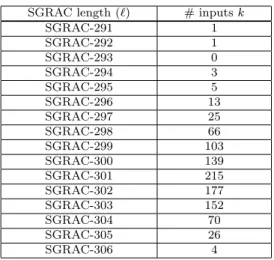
Table 1: The distribution of chains for 1000 randomly selected integerseandf of 160 bit.
SGRAC length (ℓ) # inputsk
SGRAC-291 1
SGRAC-292 1
SGRAC-293 0
SGRAC-294 3
SGRAC-295 5
SGRAC-296 13
SGRAC-297 25
SGRAC-298 66
SGRAC-299 103
SGRAC-300 139
SGRAC-301 215
SGRAC-302 177
SGRAC-303 152
SGRAC-304 70
SGRAC-305 26
SGRAC-306 4
Table 2: The distribution of MAXIMALGAP for 1000 randomly selected integerseand f of 160 bit.
MAXIMALGAP 5 6 7 8 9 10
# inputsk 51 98 100 81 137 93
MAXIMALGAP 11 12 13 14 15
# inputsk 103 88 75 100 74
Table 3: The distribution of LOWERBOUND for 1000 randomly selected integerseand f of 160 bit.
LOWERBOUND 4 5 6 7 8 9 10
# inputsk 115 77 102 87 86 79 71
LOWERBOUND 11 12 13 14 15 16 17
# inputsk 61 66 54 36 39 35 12
LOWERBOUND 18 19 20 21 22
# inputsk 23 14 15 20 8
Table 4: The distribution of storage for 1000 randomly selected integerseandf of 160 bit.
Storage capacity 16 17 18 19 20 21 22
# inputsk 60 59 33 7 1 1 15
Storage capacity 23 24 25 26 27 28 29 # inputsk 33 35 50 45 42 55 55
Storage capacity 30 31 32 33 34 35 36 # inputsk 68 71 71 79 89 70 61
4
Experimental Results
In this section, the experimental data due to K. Shiota, shows the factors necessitated in obtaining the best re-sults, that is the least chain length.
We carried out an experiment to analyze the two dimen-sion multi exponentiation based on SGRAC method us-ing a python programmus-ing language on 1.66 GHz Intel Core Duo processor. We randomly selected 1000 integers
eandf of 160 bits and set the searching range of the pa-rameters, LOWERBOUND to be between 2x1+ 2x2 to
22x1+22x2and MAXIMALGAP to be between 5x1+5x2
to 15x1+ 15x2. It took 209 trials to obtain chains of
lengths between 291 to 306 as shown on Table 1. On average it took about 2.89 seconds to find each chain. The Table 2 , 3 and 4 shows the distribution of MAXI-MALGAP, LOWERBOUND and the storage that gives the least chain length, respectively. The average chain length is found to be 301 and the average storage capac-ity is found to be 26. The conventional Shamir’s trick uses 160 squaring operations and 82 multiplication oper-ation for two dimension case, where as multi exponenti-ation based on SGRAC method utilizes 301 multiplica-tion (best case). Hence, in comparison to Shamir’s trick method, the SGRAC method seems to be costly. How-ever for further work, reducing the length of the addition chain (SGRAC) can enhance the efficiency of the pro-posed multi exponentiation.
5
Conclusion
In this paper we have proposed a novel method for the si-multaneous computation of multi exponentiation, that is by employing addition chains. The experimental results for the two dimension case shows that SGRAC method gives an average chain of length 301 with average storage capacity of 26. Further work may include in reducing the chain length and the storage capacity in order to enhance further efficiency. We assume that SGRAC method could be further generalize to arbitrary cases.
References
[1] Avanzi, R.M., Cohen, H., Doche, C., Frey, G., Lange, T., Nguyen, K., and Vercauteren, F., Hand-book of Elliptic and Hyperelliptic Curve Cryptogra-phy,CRC Press, 2005.
[2] Byrne, A., Meloni, N., Crowe, F., Marnane, W.P., Tisserand, A., and Popovici, E.M., “SPA resis-tant Elliptic Curve Cryptosystem using Addition Chains”, International Conference on Information Technology-ITNG’07, pp.995-1000, 2007.
Addition-Subtraction Chain”,International Journal of Com-putational and Applied Mathematics, To appear.
[4] Knuth, D., “Fundamental Algorithms”, The Art of Computer Programming, volume 1, Addision-Wesley,(1981).
[5] Kobayashi, K., Morita, H., and Hakuta, M., “Multi Scalar-Multiplication Algorithm over Ellip-tic Curve”,IEICE Transactions on Information and Systems, E84-D, No.2, pp.271-276, 2001.
[6] Koblitz, N., “Elliptic curve cryptosystems”, Mathe-matics of Computation, 48(177):203-209, Jan. 1987.
[7] Kocher, P., Jaffe, J., and Jun, B., “Differential power analysis”, volume 1666 ofLecture Notes in Comput-ing Science, pages 388-397. Springer-Verlag, 1999.
[8] Miller, V.S., “Uses of elliptic curves in cryp-tography”, In H.C. Williams, editor, Advances in Cryptology-CRYPTO’85, volume 218 of Lec-ture Notes in Computing Science, pages 417-428. Springer-Verglag, 1986.
[9] Menezes, A.J., vanOorschot, P.C., and Vanstone, S.A., Handbook of Applied Cryptography, CRC Press, 1997.