New Approach to Develop Optimized
Sunscreens that Enable Cutaneous Vitamin D
Formation with Minimal Erythema Risk
Dieter Kockott1, Bernd Herzog2, Jörg Reichrath3, Kevin Keane4, Michael F. Holick4*
1UV-Technik, Hanau, Germany,2BASF Grenzach GmbH, Grenzach-Wyhlen, Germany,
3Universitätsklinikum des Saarlandes, Homburg/Saar, Germany,4Endocrinology, Diabetes and Nutrition, Department of Medicine, Boston University Medical Center, Boston, Massachusetts, United States of America
Abstract
Sunscreens protect the skin against erythemal radiation (Eer). But at the same time they
reduce the effective radiation dose (EVD) responsible for the formation of previtamin D in the
skin. The paper describes a calculation method for optimizing the ratio EVD/Eerbehind
sun-screens e.g. with SPF 5, 15 and 30 respectively. Taking into account that a majority of peo-ple in industrialized countries suffer from a shortage in vitamin D even in summer time, the ratio Evd/Eeris a new and important criterion for the quality of sunscreens. Furthermore the
exposure time tvdneeded per day for forming the equivalent of the recommended amount of
2000 IU of vitamin D per day for skin type 2 is estimated when sunscreens with different filter compositions are used.In vitroexperiments show a significant increase of the conversion of 7-dehydrocholesterol (7-DHC) to previtamin D when exposed to artificial solar radiation behind an experimental sunscreen optimized for previtamin D production compared to a commercial sunscreen having the same SPF.
Introduction
Solar ultraviolet radiation is responsible for erythema and represents the major environmental risk factor that contributes to the pathogenesis of non-melanoma skin cancer [1]. Conse-quently, strict UV-protection by using sunscreens and by other measures represents a funda-mental part of many skin cancer prevention campaigns [1–4]. However, we are in a dilemma, that strict UV-protection promotes vitamin D deficiency, that is associated with an increased risk for and an unfavourable outcome of many diseases [3,4]. Under most living conditions, at least 80% of the human body’s need in vitamin D has to be synthesized in the skin by the action of solar or artificial UV-B radiation, only a small amount of vitamin D is taken in by the diet [3,4]. Increasing evidence now supports the concept that vitamin D deficiency has enormous consequences for human health [3,4]. Recent assessments of the 25-hydroxyvitamin D (25 (OH)D) status concluded that about 40% of children and adults in the United States, Canada, Europe, Asia, India, South America and Australia are vitamin D deficient [3,4]. Besides mus-culo-skeletal consequences, that include rickets in children, osteomalacia, fractures, muscle
OPEN ACCESS
Citation:Kockott D, Herzog B, Reichrath J, Keane K, Holick MF (2016) New Approach to Develop Optimized Sunscreens that Enable Cutaneous Vitamin D Formation with Minimal Erythema Risk. PLoS ONE 11(1): e0145509. doi:10.1371/journal. pone.0145509
Editor:Michal Zmijewski, Medical University of Gdańsk, POLAND
Received:October 7, 2015
Accepted:December 4, 2015
Published:January 29, 2016
Copyright:© 2016 Kockott et al. This is an open access article distributed under the terms of the
Creative Commons Attribution License, which permits unrestricted use, distribution, and reproduction in any medium, provided the original author and source are credited.
Data Availability Statement:All relevant data are within the paper.
weakness and falls in older adults, a growing number of other acute and chronic illnesses including many types of cancer (breast, colon etc.), autoimmune diseases (e.g., type 1 diabetes, multiple sclerosis and rheumatoid arthritis), infectious diseases, neurocognitive dysfunction including Alzheimer’s disease, type 2 diabetes and cardiovascular disease have now been linked by epidemiological, observational and experimental studies associated with vitamin D defi-ciency [3,4]. As a result of this dilemma, there is at present an enormous need to develop opti-mized sunscreens that enable maximum cutaneous vitamin D formation with a given quantity of erythema protection described by the sun protection factor (SPF).
The sunscreen industry promotes sunscreens with so called broad band filter approaching more or less uniform spectral absorbance across the UV spectrum. This concept is useful for actions with unknown action spectra. In this paper we focus only on both erythema and vita-min D with corresponding action spectra. For this application the use of erythema effective irradiance and vitamin D effective irradiance is more specific.
The paper describes a new promising strategy to reach the goal of vitamin D optimized sun-screens that is based on a theoretical approach. With the spectral solar irradiance Eλ(λ), the
spectral transmittance T(λ) of a given sunscreen and both, the action spectrum of erythema
ser(λ) and the action spectrum of previtamin D formation svd(λ) in the skin, it is possible to cal-culate the effective irradiance Eer=
R
Eλ(λ) ser(λ) T(λ) dλfor erythema as well as the effective irradiance Evd=
R
Eλ(λ) svd(λ) T(λ) dλfor previtamin D formation in skin covered by a sun-screen. Sunscreens reduce necessarily both Eerand Evdon skin. But by choosing the right filter composition the ratio Evd/Eercan be optimized. The higher the ratio, the better is the sunscreen concerning the previtamin D production for a given protection against Eer.
The exposure time needed per day for forming the recommended amount of vitamin D depends on season, time of day, latitude and degree of skin pigmentation [4]. The topical appli-cation of a sunscreen with an SPF of 15 was reported to reduce the production of previtamin D in the skin by approximately 95% [5]. UV exposure of the whole human body by 1 MED for skin type 2 has been estimated to correspond to an oral intake of approximately 10000–20000 international units (IU) of vitamin D [4]. Although it has to be noted that there is still an ongo-ing debate concernongo-ing the daily requirement of vitamin D, it has been recommended by the Endocrine Practice Guidelines that adults need at least 1500–2000 IU vitamin D per day [6]. Thus, when knowing the spectral transmittance T(λ) of a sunscreen film on human skin, it is
possible to estimate the time it would take in the presence of a sunscreen to form the amount of vitamin D needed per day.
In this work different types of sunscreens are compared in terms of their protection against erythema effective irradiance and their ability to allow the formation of previtamin D. The action spectra for erythema ser(λ) [7] and for previtamin D formation in human skin sVD(λ) [8] and a standard spectrum of solar irradiance [9] are shown inFig 1. Even if there are some scientific discussions on the action spectrum for previtamin D formation in human skin we used the internationally accepted sVD(λ) as given by CIE [8].
For a given spectral irradiance Eλ(λ) of a light source the effective irradiance Eerfor ery-thema is defined by Eer=
R
Eλ(λ) ser(λ) dλand the effective irradiance EVDfor previtamin D
formation is defined by EVD=
R
Eλ(λ) sVD(λ) dλ. The curves inFig 2represent the spectral effective irradiances for erythema Eλ(λ) ser(λ) and for previtamin D formation Eλ(λ) sVD(λ) respectively if Eλ(λ) is the standard spectrum of solar radiation defined by COLIPA [9]
(COmite de LIasion des associations europeennes de l’industrie de la PArfumerie, des products cosmetiques et de toilette), today named Cosmetics Europe.
The calculation programme works as well for other spectral irradiances of solar radiation. But the differences are small because we focus on the ratio of previtamin D effective irradiance
roles of these authors are articulated in the‘author contributions’section.
EVDand erythema-effective irradiance Eer. The areas below the two curves inFig 2represent EVDand Eerrespectively. The ratio Evd/Eeris about 2. With other words: The previtamin D-effective irradiance of standard solar radiation is about twice the erythema D-effective irradiance.
Materials and Methods
For calculation of the spectral transmittance T(λ) of sunscreens with given filter compositions,
a simulation toolwww.basf.com/sunscreen-simulatorwas used and is available to the public
Fig 1. Action spectra for erythema and for previtamin D formation in human skin and standard solar spectral irradiance at the surface of the earth.
doi:10.1371/journal.pone.0145509.g001
[10,11,12]. The tool is based on the following elements: a database with UV spectra of the rele-vant UV filters (given as decadic molar extinction coefficients), a mathematical description of the irregularity profile of the sunscreen film on the skin, consideration of changes in UV filter concentration due to photoinstability, and consideration of formulation influences like the dis-tribution of the UV filters in the oil and water phase of an emulsion [13]. All calculated results are related to an application amount of 2 mg/cm2.
Examples of filter compositions were chosen to achieve sun protection factors (abbreviated as SPF) of 6, 15, and 30. According to a recommendation of the European Commission (EC), an SPF of 6 belongs to the class of“low protection”, an SPF of 15 to the“medium protection”
and an SPF of 30 to the“high protection”class. For each SPF four different types of spectral performance were constructed, with weak, intermediate, strong protection in the UV-A range and vitamin D optimized protection. The intermediate protection in the UV-A range means that the EC recommendation [13], which says that the ratio of UVA-PF/SPF should at least be 1/3 and the critical wavelength CW [14], at least 370 nm is fulfilled. For the case of low UV-A protection, the UVA-PF/SPF ratio is significantly lower, for that one of high UV-A protection or vitamin D optimized protection, it is far higher than 1/3.
In the following, abbreviations for the UV filter names, based on the international nomen-clature of cosmetic ingredients (INCI) will be used: Ethylhexylmethoxy cinnamate (EHMC), octocrylene (OCR), phenyl benzimidazole sulfonic acid (PBSA), ethylhexyl triazone (EHT), titanium dioxide (TiO2), butyl methoxy dibenzoyl methane (BMDBM), diethylamino hydroxy-benzoyl hexyl benzoate (DHHB), methylene bis-benzotriazolyl tetramethyl butylphenol (MBBT), and bis-ethylhexyloxy methoxyphenyl triazine (BEMT).
To confirm that these calculated theoretical values had some physiologic meaning i.e. could result in a sunscreen designed with ingredients that had UV absorption properties that would increase the UV-induced production of previtamin D3 anin vitrostudy was carried out. An
array of fluorescent lamps with high ultraviolet output simulating UV solar radiation was used to irradiate borosilicate ampoules containing the previtamin D precursor 7-dehydrocholesterol (7-DHC). The ampoules were placed beneath a flat layer of polyethylene food wrap transmis-sive at UV wavelengths to which was applied a uniform amount of 2 mg/cm² either SPF-15 Solar D (UV filter composition: 1.9% octocrylene, 1% homomenthyl salicylate, 1% ethylhexyl salicylate, 3% avobenzone, 7.3% Diethylamino hydroxybenzoyl hexyl benzoate, and 0.9% diethylhexyl syingylidenemalonate) or SPF-15 commercial sunscreen Neutrogena, one of the most popular sunscreens used in the US (UV filter composition: 5% octisalate, 7.5% octinoxate, and 3% oxybenzone), or control (no sunscreen). The ampoules were placed on a piece of black paper to prevent re-irradiation by reflection with a flat cold pack beneath the paper to stabilize temperature. Six ampoules were irradiated at a time, for 5, 10, 15, 20, 25, or 30 minutes. Ampoules contents were analyzed after irradiation by high performance liquid chromatogra-phy (HPLC). For further experimental details see ref. [15].
Results and Discussion
Table 1shows the compositions as well as the calculated values of SPF, Evd/Eerratio, UVA-PF, UVA-PF/SPF-ratio and critical wavelength CW [14] for four SPF 6 sunscreens, as explained above.
Fig 3shows the simulated spectral transmittances of sunscreen films referring to the four different types of UV filter compositions leading to SPF 6.
Table 2shows the compositions as well as the calculated values of SPF, Evd/Eerratio, UVA-PF, UVA-PF/SPF-ratio and critical wavelength CW [14] for four SPF 15 sunscreens.
Table 3shows the compositions and the calculated values of SPF, EVD/Eerratio, UVA-PF, UVA-PF/SPF ratio and critical wavelength CW [14] for four SPF 30 sunscreens.
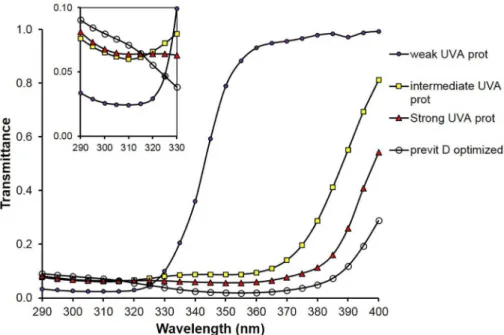
Fig 5shows the simulated spectral transmittances of sunscreen films referring to the four different types of UV filter compositions leading to SPF 30.
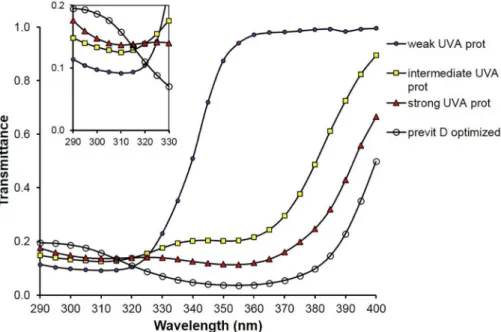
Tables1–3demonstrate that the ratio EVD/Eercan be optimized to the value of about 2 which is typical for specified solar radiation (seeFig 2) even if the SPF of the sunscreens remains the same. That means the transmittance of sunscreens for previtamin D-effective radi-ation is optimized at the same level of protection against erythema-effective radiradi-ation. The cor-responding Figs3–5show that those combinations of UV-absorbers are previtamin D
optimized which have a relative high transmittance in the short UV range combined with a low transmittance in the long UV range.
For practical applications of sunscreens not only the ratio EVD/Eeris of importance, but also the exposure time tVDneeded to get the recommended amount of vitamin D/day. Even a sun-screen having a ratio EVD/Eerof about 2 doesn’t make sense in practice if the exposure time tVD lasts e.g. 6 hours/day or more. The following estimate answers this question. It is known from scientific literature that whole body exposure of 1 MED = 250 J/m2erythemal radiant exposure for skin type 2 is equivalent to an oral intake of about 10000–20000 IU Vitamin D [4]. For maximum solar input (standard sun COLIPA in zenith, cloudless sky) it takes about 20
Table 1. UV filter compositions for SPF 6 with different levels of Evd/Eerratio and UV-A protection.
Type Filter Composition SPF Evd/Eer UVA-PF UVA-PF/SPF CW [nm]
1% EHT 3% EHMC 7.3 1.17 1.3 0.18 335
2 0.5% BEMT, 0.8% DHHB, 2.5% EHMC 7.4 1.75 3.4 0.46 370
3 0.6% EHMC, 1% MBBT, 1% BEMT, 1% DHHB 7.2 1.94 7.1 0.99 377
4 7,5% DHHB, 3% BMDBM 7.1 2.17 16.4 2.32 379
doi:10.1371/journal.pone.0145509.t001
Fig 3. Spectra of simulated UV transmittances of four SPF 6 sunscreens (compositions inTable 1) with weak, intermediate, strong UV-A and previtamin D optimized protective properties; small graph: transmittance scale enlarged in the spectral range from 290 to 330 nm.
minutes to get 1 MED. The recommended intake of vitamin D for adults ranges from 600 up to 2000 IU/day [5]. Thus to obtain 2000 IU/day equivalent the exposure time would be 1/5 x 20 min = 4 minutes when the unprotected skin is exposed to the above mentioned maximum solar input. Sunscreens attenuate the previtamin D effective radiation. By analogy with SPF we define an attenuation factor for previtamin D effective radiation AFVDas
AFvd¼ ð
R
ElðlÞsVDðlÞdlÞ=ð
R
ElðlÞsVDðlÞTðlÞdlÞ
(explanation of symbols seeIntroduction)
The estimated exposure time tVDfor getting an equivalent of the recommended vitamin D intake of 2000 IU/day is tVD= 4 min x AFVDwhen the protected skin is exposed to the above mentioned maximum solar input. The attenuation factors AFVDand the exposure times tVD for skin type 2 for the 4 types of sunscreens are given inTable 4.
Table 4includes the exposure times tVDfor getting the recommended equivalent of 2000 IU vitamin D/day. The exposure time tVDfor sunscreens e.g. with SPF = 30 are within the usual time frame of sun bathers.
Results ofin vitroexperiments as described in Materials and Methods are shown inFig 6.
A one-way analysis of variance was performed to test if the mean percent conversion to pre-vitamin D was different between the ampoules covered with SPF-15 Solar D and ampoules
Table 2. UV filter compositions for SPF 15 with different levels of Evd/Eerratio and UV-A protection.
Type Filter Composition SPF Evd/Eer UVA-PF UVA-PF/SPF CW [nm]
1 2% PBSA, 3.5% EHT, 6% EHMC 15.5 0.57 1.4 0.09 333
2 1.5% DHHB, 2% BEMT, 4.3% EHMC 15.6 1.71 6.4 0.41 370
3 2% MBBT, 2% BEMT, 2% BMDBM, 2.5% OCR 15.7 1.91 15.6 0.99 378
4 3% BMDBM, 3.1% MBBT, 10% DHHB 15.5 2.11 30.2 1.95 380
doi:10.1371/journal.pone.0145509.t002
Fig 4. Spectra of simulated UV transmittances of four SPF 15 sunscreens (compositions inTable 2) with weak, intermediate, strong UV-A and previtamin D optimized protective properties; small graph: transmittance scale enlarged in the spectral range from 290 to 330 nm.
covered with SPF-15 Neutrogena at each of the 5 time points. Significance was set at P<0.05. Data were analyzed using SAS statistical software (version 9.3; SAS Institute Inc, Cary, NC).
This study demonstrated an increase of the previtamin D production for the experimental optimized sunscreen by a factor of approximately 1.5 compared to the commercial sunscreen.
Having all relevant data needed available (spectral transmittance of the UV absorbers used in both sunscreens, of the spectral irradiance of the fluorescent lamp [15], of the spectral trans-mittance of the borosilicate ampoule, of the spectral transtrans-mittance of the polyethylene food wrap), we ran the calculation. The results are listed inTable 5.
Table 3. UV filter compositions for SPF 30 with different levels of Evd/Eerratio and UV-A protection.
Type Filter Composition SPF Evd/Eer UVA-PF UVA-PF/SPF CW [nm]
1 3% PBSA, 3% EHT, 3.5% TiO2, 10% EHMC 33.1 0.70 2.9 0.09 353
2 2% MBBT, 2.5% BEMT, 3% DHHB, 8% EHMC 33.2 1.68 2.3 0.37 374
3 2.2% PBSA, 3% BEMT, 4.5% MBBT, 4.5% DHHB 33.2 1.84 3.5 1.01 378
4 1.9% BEMT, 3% BMDBM, 7.4% MBBT, 10% DHHB 33.1 2.00 49.5 1.50 380
doi:10.1371/journal.pone.0145509.t003
Fig 5. Spectra of simulated UV transmittances of four SPF 30 sunscreens (compositions inTable 3) with weak, intermediate, strong UV-A and previtamin D optimized protective properties; small graph: transmittance scale enlarged in the spectral range from 290 to 330 nm.
doi:10.1371/journal.pone.0145509.g005
Table 4. Attenuation factors AFVDfor previtamin D- effective radiation, exposure times (tVD) for skin
type 2 needed per day for getting an equivalent of the recommended amount of 2000 IU vitamin D/day regarding 4 variations of sunscreens with SPF 6, 15 and 30, respectively.
Sunscreen Type SPF 6 15 30
1 AFVD, tVD [min] 10.7, 42.8 40.2, 160.8 67.0, 268
2 AFVD, tVD [min] 7,8, 31.2 16.2, 64.8 34.0, 136
3 AFVD, tVD[min] 7.2, 28.8 15.4, 61.6 33.1, 132.4
4 AFVD, tVD[min] 6.1, 23.1 13.7, 52.2 30.6, 116.6
The ratio of AFVDregarding the two sunscreens is 55.9/24.2 = 2.3. Thus the calculated ratio is higher than the measured ratio of about 1.5. However, in any case a significant increase in previtamin D production was experimentally observed when using sunscreens optimized for previtamin D production.
During sun exposure the skin produces of vitamin D3. Vitamin D3 can either enter the cir-culation and be metabolized in the liver and kidney to 1,25(OH)2D3 or it can undergo a variety of metabolic steps in the skin producing several novel secosteroids that exert antiproliferative, pro-differentiation and anti-inflammatory effects on cultured skin cells.[16] Sun exposure is the major source of vitamin D for most children and adults worldwide. It is also recognized that vitamin D deficiency and insufficiency is a major health problem that afflicts approxi-mately 40% and 60% of children and adults respectively. A major cause for this is the recom-mendation that no child or adult should ever be exposed to one direct ray of sunlight because of concern for increased risk for skin cancer. To avoid direct sun exposure widespread sun-screen use is implemented. However was not fully appreciated was that sunsun-screens are designed to efficiently absorbed radiation in the UVB range; an SPF of 30 absorbs 97.5%. The unin-tended consequence is that this radiation is also responsible for the cutaneous production of vitamin D. As a result an SPF of 30, properly applied, reduces the capacity of the skin to pro-duce vitamin D by 97.5%. There are several chemical compounds that are typically used in a sunscreen that efficiently absorbed varying wavelengths of UVB radiation. In theory the judi-cious choice of compounds that have less UV absorbing properties at wavelengths near the
Fig 6.In vitroconversion of 7-DHC to previtamin D after irradiation with simulated UV solar radiation.
Mean values +/- SE.
doi:10.1371/journal.pone.0145509.g006
Table 5. Calculated SPF, EVD/Eerand AFVDof both a commercially available sunscreen (Neutrogena) and an experimental sunscreen named Solar
D which was optimized to a low attenuation factor AFVD.
Sunscreen SPF (on label) SPF (Calculated) EVD/Eer AFVD
Neutrogena 15 17.6 1.06 55.9
Exp. sunscreen Solar D 15 12.3 2.08 24.2
peak action spectrum for previtamin D3 production i.e. 295 nm while retaining the ability to efficiently absorb the rest of the solar UVB radiation would provide a sunscreen that still had its anti-erythemal properties while permitting selective UVB radiation to be transmitted into the skin to produce previtamin D3. This manuscript describes a calculation method for opti-mizing a sunscreen for producing previtamin D3 and at the same time protecting against ery-thema. Solar D was designed with compounds with differing filter compositions to maximize previtamin D3 production while maintaining its sun protection for reducing erythema. When this sunscreen, that is rated as an SPF 15, was compared to a popular commercial sunscreen with the same SPF of 15, we observedin vitroa significant enhancement of as much as 50%as
much as 50% in the production of previtamin D3 occurred with the solar D sunscreen com-pared to the popular commercial one. Based on our previous observations thein vitroresults
can be directly translated to what would be expected when the sunscreens are used on human skin. [4,5] Therefore we have proof of principal that a sunscreen can be produced for optimiz-ing previtamin D3 production while retainoptimiz-ing its sun protection factor for reducoptimiz-ing erythema.
Acknowledgments
We appreciate the helpful suggestions and statistical analysis provided by Rana Mokhtar.
Author Contributions
Conceived and designed the experiments: BH DK MH JR KK. Performed the experiments: BH DK MH KK. Analyzed the data: BH DK MH JR KK. Contributed reagents/materials/analysis tools: BH DK MH. Wrote the paper: BH DK MH JR KK.
References
1. Mason RS, and Reichrath J. Sunlight vitamin D and skin cancer. Anticancer Agents Med Chem. 2013; 13(1), 83–97. PMID:23094924
2. Reichrath J. Skin cancer prevention and UV-protection: how to avoid vitamin D-deficiency? Br J Derma-tol. 2009; 161 Suppl 3, 54–60. doi:10.1111/j.1365-2133.2009.09450.xPMID:19775358
3. Holick M F. Vitamin D deficiency. N Engl J Med. 2007; 357(3), 266–281. PMID:17634462
4. Wacker M. and Holick MF. Sunlight and Vitamin D: A global perspective for health. Dermatoendocrinol. 2013; 5(1), 51–108. doi:10.4161/derm.24494PMID:24494042
5. Matsuoka L, Ide L, Wortsman J, MacLaughlin J and Holick MF. Sunscreens suppress cutaneous vita-min D3synthesis, J Clin Endocrinol Metab. 1987; 64, 1165–1168. PMID:3033008
6. Holick MF, Binkley NC, Bischoff-Ferrari HA, Gordon CM, Haley DA, Heaney RP, et al. Evaluation, treat-ment, and prevention of vitamin D deficiency: an Endocrine Society Clinical Practice Guideline. J Clin Endocrinol Metab 2011; 96(7):1911–30. doi:10.1210/jc.2011-0385PMID:21646368.
7. McKinlay AF and Diffey BL. A reference action spectrum for ultraviolet induced erythema in human skin. CIE J. 1987; 6, 17–22.
8. Action Spectrum for the Production of Previtamin D3in Human Skin (2006)CIE Technical Report174. 9. COLIPA SPF Test Method 1994.
10. Herzog B. and Osterwalder U. In Silico Determination of Topical Sun Protection. Cosm Sci Tech. 2011; 62, 1–8.
11. BASF Sunscreen Simulator. Available:http://www.basf.com/sunscreen-simulator.
12. Herzog B. Models for the calculation of sun protection factors and parameters characterizing the UVA protection ability of cosmetic sunscreens. In Colloids in Cosmetics and Personal Care 2008; Vol. 4. (Edited by Tadros T. F.), pp. 275–308. Wiley VCH, Weinheim.
13. European Commission Recommendation of 22. September 2006 On the Efficacy of Sunscreen Prod-ucts and the Claims made Relating thereto.Official Journal of the European UnionL 265, 39–43. 14. Diffey B. A Method for Brought Spectrum Classification of Sunscreens, Int J of Cosm Science. 1994;
15. Dabai NS, Pramyothin P, and Holick MF. The effect of ultraviolet radiation from a novel portable fluores-cent lamp on serum 25-hydroxyvitamin D3 levels in healthy adults with Fitzpatrick skin types II and III. Photodermatol Photoimmunol Photomed. 2012; 28(6), 307–311. doi:10.1111/phpp.12000PMID:
23126292