
*e-mail: [email protected]
Trabalho apresentado no 1º Congresso da Sociedade Brasileira em Materiais, Rio de Janeiro, Julho de 2002.
Modeling of Alkynes: Synthesis and Theoretical Properties
Renato Rossetoa, José Celso Torresa, Jordan Del Nerob*
aInstituto de Química, UNICAMP,
13083-970 Campinas - SP, Brazil
bDepartamento de Física, Universidade Federal do Pará,
66075-110 Belém - PA, Brazil
Received: October 18, 2002; Revised: March 11, 2003
In this paper we present the synthesis and simulation of alkynes derivatives. Semiempirical calculations were carried out for the ground and first excited states, including the spectroscopic properties of the absorption and emission (fluorescence and phosphorescence) spectra by INDO/S-CI and DNdM-INDO/S-CI methods with geometries fully optimized by PM3/CI. The fact that the theoretical spectra are in accord with the experimental absorption spectra gives us a new possible approach on how structure modifications could affect the non-linear optical proper-ties of alkynes.
Keywords: alkynes, synthesis,semiempirical/ci methods, theoretical absorption and emission spectra, experimental absorption spectra
tron acceptor group (III), electron donor and acceptor group (IV). C6H4N (pyridil) was used in place of the phenyl rings in alkynes VI and VII, and 1,3-diphenylbutadiyne (VIII) was studied to evaluate the extension of conjugated chain.
2. Methodology
All reactions were carried out under dry argon using standard Schlenk techniques. Solvents (diethylamine and triethylamine) were dried and distilled prior to use. Diphenylacetylene, phenylacetylene, 4-iodoaniline, 1-iodo-4-nitrobenzene, 4-iodoanisole, and 4-bromopyridine hydro-chloride were purchased from Aldrich Chemical Co send were used without further purification, and bis(triphenylphosphine)palladium(II) dichloride [PdCl2(PPh3)2] and cuprous iodide (CuI) were purchased from Strem Chemical, Inc.
UV-Vis spectra were obtained from CH2Cl2 and hexane so-lutions, in a 1 cm path length quartz cuvette, on a HP8452 spectrometer. Infrared spectra were recorded using NaCl cell in nujol on a Bomem MB-Series FT-IR spectrometer.
All compounds (I-VIII) were prepared and characterized as previously described10-13and the following is a typical example:
Alkyne II(para-aminodiphenylacetylene). To a mixture of 4-iodoaniline (0.97 g, 5 mmol) and phenylacetylene (0.65 ml, 6 mmol) was added [PdCl2(PPh3)2] (170 mg, 5% mol) and CuI (47 mg, 5% mol) in 30 ml a deaerated solu-tion of triethylamine. The reacsolu-tion mixture was stirred at room
1. Introduction
Alkynes have been identified as a promising way to pre-pare novel molecular, polymer carbon allotropes and car-bon-rich nanoarchitecture with unusual structural, electronic and optical properties1-4.
The use of the carbon-carbon triple bond as a linking unit between aromatic rings allows access to relatively rigid and simple scaffoldings that can be further elaborated by incor-porating a wide range of pendant functionalities on the aro-matic rings, which can promote electronic modifications and induced electronic delocalization in the compound4.
Juxtaposition of the alkyne entity and substituents appears to be interesting in several aspects: (a) two or more metal centers could be held in the same molecule5,6 for cooperative
effect in catalysis; (b) metal organic polymers could be de-rived from organometallic complexes containing these ligands7; (c) bridged dinuclear complexes could serve as
models for the investigation of metal-metal interactions8 or
the complexes may serve as nonlinear optical materials9.
elec-temperature for 6 h under Ar and the solvent was then re-moved under reduced pressure. The residue was purified by chromatography on silica using hexane: CH2Cl2 (4:1) as elu-ent. The compound was obtained as white needles, yield: 70%. For each of the structures of Table 1, the geometry was
completely optimized using the PM3/CI14 (Parametric
Method 3 with configuration interaction). All the PM3/CI
calculations were carried out with the MOPAC program15.
After the determination of the optimized geometry, the ab-sorption spectrum of each molecule was simulated by the INDO/S-CI (Intermediate Neglect of Differential Overlap/ Spectroscopic - Configuration Interaction)16-19, with
param-eters chosen to give the best description of the UV-NIS-Visible optical transitions20-23 and approximately 250
con-figurations were investigated for each molecule, including singlet and doublet states. In order to obtain the fluores-cence and phosphoresfluores-cence spectra, the ZINDO package was modified considering the geometry of the first excited states (singlet and triplet) in the description of the emis-sion. This approach is referred herein as DNdM-INDO/S-CI
calculation, and we have taken account from the first 10-UMOs (Unoccupied Molecular Orbitals) to the last 10-OMOs (Occupied Molecular Orbitals) and adopted the Mattaga-Nishimoto γ´s.
3. Results and Discussion
The UV-visible spectra of compounds I-VIII obtain in CH2Cl2 (Fig. 1) and hexane (Fig. 2) were very similar. In all cases absorption bands (ε ≅ 2.104 l/mol.cm) were observed
in the 250-400 nm range.
Considering alkyne I as the reference, a red shift of this band was observed in the spectra of II, III, IV and V, which was associated to the increasing electronic delocalization in the compound (see discussion below). In II and V (electron-donor groups) the shift was smaller than III (two groups NO2, electron-withdrawing). The biggest shift was observed for V due to an increase in the π-delocalization between two
dif-ferent substituents (NO2 and OCH3) in backbone of alkyne. The use of a moiety C5H4N in place of a C6H5 group, VI, did not lead to significant changes in the UV-vis spectrum when compared with I, thus indicating that the pyridil group does not have any influence in the alkyne electronic delocalization. The largest spectroscopical changes were observed for VII (which contains two pyridil groups) and VIII (containing an extended chain).
Table 1. Schematic structures of the alkynes investigated in this work.
Figure 2. Experimental UV-vis absorption spectra of alkynes I-VIII (Table 1) in hexane (see methodology).
Figure 5. Theoretical UV-vis spectra of molecules I to VIII (Table 1) calculated for optimized geometries by DNdM-INDO/S-CI (phos-phorescence spectra) by PM3/CI method.
Figure 4. Theoretical UV-vis spectra of molecules I to VIII (Ta-ble 1) calculated for optimized geometries by DNdM-INDO/S-CI (fluorescence spectra) by PM3/CI method.
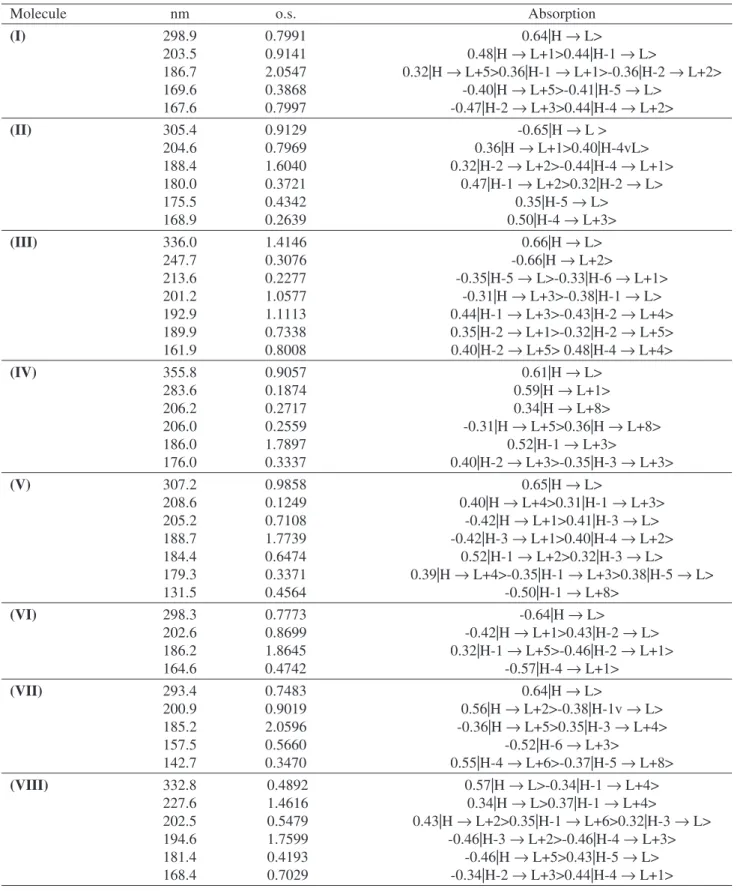
Table 2. Principal electronic UV-NIS-Vis absorption transitions as determined from INDO/S-CI calculations based on optimized ground-state geometry by PM3 for molecules I to VIII. (l/nm and o.s. represent the wavelength and the oscillator strength of the transition, respectively).
Molecule nm o.s. Absorption
(I) 298.9 0.7991 0.64|H → L>
203.5 0.9141 0.48|H → L+1>0.44|H-1 → L>
186.7 2.0547 0.32|H → L+5>0.36|H-1 → L+1>-0.36|H-2 → L+2>
169.6 0.3868 -0.40|H → L+5>-0.41|H-5 → L>
167.6 0.7997 -0.47|H-2 → L+3>0.44|H-4 → L+2>
(II) 305.4 0.9129 -0.65|H → L >
204.6 0.7969 0.36|H → L+1>0.40|H-4vL>
188.4 1.6040 0.32|H-2 → L+2>-0.44|H-4 → L+1>
180.0 0.3721 0.47|H-1 → L+2>0.32|H-2 → L>
175.5 0.4342 0.35|H-5 → L>
168.9 0.2639 0.50|H-4 → L+3>
(III) 336.0 1.4146 0.66|H → L>
247.7 0.3076 -0.66|H → L+2>
213.6 0.2277 -0.35|H-5 → L>-0.33|H-6 → L+1>
201.2 1.0577 -0.31|H → L+3>-0.38|H-1 → L>
192.9 1.1113 0.44|H-1 → L+3>-0.43|H-2 → L+4>
189.9 0.7338 0.35|H-2 → L+1>-0.32|H-2 → L+5>
161.9 0.8008 0.40|H-2 → L+5> 0.48|H-4 → L+4>
(IV) 355.8 0.9057 0.61|H → L>
283.6 0.1874 0.59|H → L+1>
206.2 0.2717 0.34|H → L+8>
206.0 0.2559 -0.31|H → L+5>0.36|H → L+8>
186.0 1.7897 0.52|H-1 → L+3>
176.0 0.3337 0.40|H-2 → L+3>-0.35|H-3 → L+3>
(V) 307.2 0.9858 0.65|H → L>
208.6 0.1249 0.40|H → L+4>0.31|H-1 → L+3>
205.2 0.7108 -0.42|H → L+1>0.41|H-3 → L>
188.7 1.7739 -0.42|H-3 → L+1>0.40|H-4 → L+2>
184.4 0.6474 0.52|H-1 → L+2>0.32|H-3 → L>
179.3 0.3371 0.39|H → L+4>-0.35|H-1 → L+3>0.38|H-5 → L>
131.5 0.4564 -0.50|H-1 → L+8>
(VI) 298.3 0.7773 -0.64|H → L>
202.6 0.8699 -0.42|H → L+1>0.43|H-2 → L>
186.2 1.8645 0.32|H-1 → L+5>-0.46|H-2 → L+1>
164.6 0.4742 -0.57|H-4 → L+1>
(VII) 293.4 0.7483 0.64|H → L>
200.9 0.9019 0.56|H → L+2>-0.38|H-1v → L>
185.2 2.0596 -0.36|H → L+5>0.35|H-3 → L+4>
157.5 0.5660 -0.52|H-6 → L+3>
142.7 0.3470 0.55|H-4 → L+6>-0.37|H-5 → L+8>
(VIII) 332.8 0.4892 0.57|H → L>-0.34|H-1 → L+4>
227.6 1.4616 0.34|H → L>0.37|H-1 → L+4>
202.5 0.5479 0.43|H → L+2>0.35|H-1 → L+6>0.32|H-3 → L>
194.6 1.7599 -0.46|H-3 → L+2>-0.46|H-4 → L+3>
181.4 0.4193 -0.46|H → L+5>0.43|H-5 → L>
Theoretical absorption spectra (TAS) for all alkynes in-vestigated in this work are shown in Fig. 3 for comparison. The simulations were performed using the ZINDO program. These spectra were obtained by describing each of the prin-cipal transitions using a suitably weighted Gaussian function normalised to the calculated oscillator strengths and the curves
presented were obtained from gaussian functions weighted (and normalized) by the oscillator strengths (o.s.). The ge-ometry obtained shows a backbone conformation and the most stable structures were found to be essentially planar.
The presence of the p-NH2 (II) results in a very similar
behavior on TAS. However two NO2 groups (III) lead to
a ≈ 40nm red shift in the main band and all bands
com-posed by HOMO to LUMO (|H → L>) transition. For alkyne
IV (Fig. 2(IV) and Table 2(IV)) a red 60 nm shift in the H → L> by the inclusion of composition NO2 and OCH3.
Two OCH3 groups (V) represent almost the same original
band of alkyne without pair donor-acceptor. The inclusions of Nitrogen atom in the phenyl ring (VII and VIII) don’t change the composition and position of the first absorption band. Another case is the alkyne with 2 triple bonds be-tween phenyl rings (VIII). In this case it is possible follow two propositions: (a) a red shift in the first |H → L>
transi-tion and (b) the inclusion of deep transitransi-tions as principal transitions, e.g., |H-1 → L+6> transition for VIII and in the
same region for I is |H → L+1> at region of 200 nm. Details
of the transitions are presented in Table 2.
We have carried out the DNdM-INDO/S-CI calculations to simulate the emission (fluorescence and
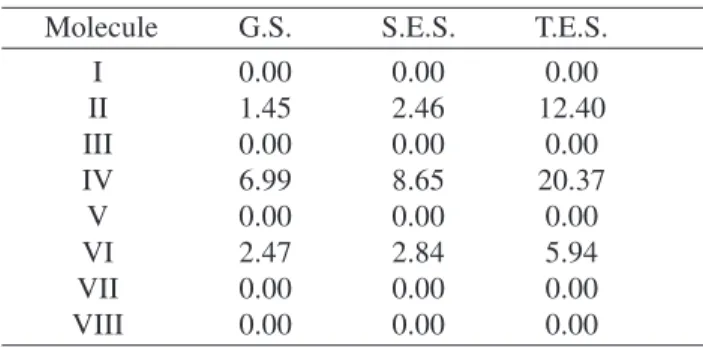
phosphores-Table 3. Dipole moment (in Debye) for neutral and excited (sin-glet and triplet) states of the alkynes presented in Table 1. (G.S., S.E.S. and T.E.S correspond to ground, singlet excited and triplet excited states, respectively).
Molecule G.S. S.E.S. T.E.S.
I 0.00 0.00 0.00
II 1.45 2.46 12.40
III 0.00 0.00 0.00
IV 6.99 8.65 20.37
V 0.00 0.00 0.00
VI 2.47 2.84 5.94
VII 0.00 0.00 0.00
VIII 0.00 0.00 0.00
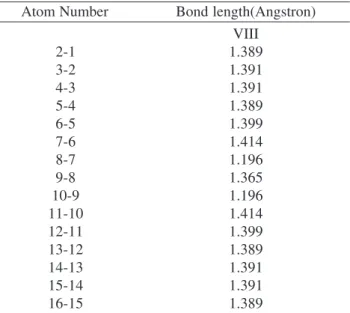
Table 4. Bond Length (Angstrons) of the alkynes molecules described by Table 1.
Atom Number Bond length (Angstron)
I II III IV V VI VII
2-1 1.389 1.389 1.388 1.387 1.389 1.389 1.394
3-2 1.391 1.391 1.400 1.400 1.398 1.391 1.353
4-3 1.391 1.391 1.400 1.400 1.405 1.391 1.352
5-4 1.389 1.389 1.388 1.387 1.385 1.389 1.394
6-5 1.399 1.399 1.399 1.400 1.397 1.399 1.399
7-6 1.415 1.414 1.415 1.413 1.414 1.415 1.414
8-7 1.195 1.195 1.195 1.195 1.195 1.195 1.194
9-8 1.415 1.414 1.415 1.413 1.414 1.414 1.414
10-9 1.399 1.399 1.399 1.401 1.401 1.399 1.399
11-10 1.389 1.386 1.388 1.384 1.385 1.394 1.394
12-11 1.391 1.402 1.400 1.405 1.405 1.353 1.353
13-12 1.391 1.403 1.400 1.399 1.398 1.353 1.352
14-13 1.389 1.386 1.388 1.389 1.390 1.394 1.394
15-12 - 1.428 1.498 1.378 1.380 -
-16-15 - - 1.214 1.406 1.406 -
-17-15 - - 1.214 - - -
-18-3 - - 1.498 - - -
-19-18 - - 1.214 - - -
-20-18 - - 1.214 - - -
-17-3 - - - 1.495 1.380 -
-18-17 - - - 1.215 1.406 -
-19-17 - - - 1.215 - -
Table 5. Bond Length (Angstrons) of the alkyne VIII described by Table 1.
Atom Number Bond length(Angstron)
VIII 2-1 1.389 3-2 1.391 4-3 1.391 5-4 1.389 6-5 1.399 7-6 1.414 8-7 1.196 9-8 1.365 10-9 1.196 11-10 1.414 12-11 1.399 13-12 1.389 14-13 1.391 15-14 1.391 16-15 1.389
Typical H-C bond = 1.095 ± 0.001
cence) spectra (theoretical emission spectra (=TES)) of alkynes. We follow the same TAS procedure and these spec-tra were obtained by broadening each of these principal spec- tran-sitions by a suitably weighted gaussian function normal-ized to the calculated oscillator strengths and the results are showed in Fig. 4 and Fig. 5. In all cases a significant Stokes shift is predicted. This scale effect (red shift for TES com-pared with TAS) was found mainly because the charge rearrangements of the molecules in the excited states.
Table III presents the dipole moment values of the mol-ecules studied. The unusually large values, predicted for the triplet excited state dipoles of molecules II and IVcan be understood in terms of the conformation differences for these alkynes. Note that for the ground state, the backbone geometries of these molecules presented only small modi-fications and it is shown in Tables 4 and 5.
4. Summary
Design of new materials is important to understand their physical and electronic properties and the alkynes molecules belong to this category. In this contribution, we have em-ployed a quantum chemistry methodology (DNdM-INDO/S-CI, INDO/S-CI and PM3-CI) to simulate the ground and the first excited states (singlet and triplet) of a series substituted diphenylacetylene molecules (I-VII) and a dyine (VIII). The last alkyne studied (VIII) gives us some insight of behavior of the inclusion different number of tri-ple bonds between the phenyl rings and a more comtri-plete investigation in this direct is in progress. The results pre-sented show us the possibility of improve the properties of
alkynes by chemical modifications that combine: (a) increase in the unsaturation and (b) modification of the acceptor/ donor properties of the susbtituents.
Acknowledgments
We thank the Brazilian agencies FAPESP, CAPES and CNPq for financial support.
References
1. Rosseto, R.; Vargas, M.D.; Del Nero, J. International Journal of Quantum Chemistry, accepted.
2. Bunz, U.H.F. Chem. Rev. v. 100, p. 1605, 2000.
3. Rosseto, R. Ph.D. Thesis, Universidade Estadual de
Campinas, São Paulo, Brazil, 2002.
4. Stang, P.J.; Diederich, F. Modern Acetylene Chemistry, eds, Weinheim, 1995.
5. Bunz, U.H.F.; Enkelmann, V.; Rader, J.Organometallics, v. 12, p. 4745, 1993.
6. Wiegelmann, J.E.C.; Bunz, U.H.F. Organometallics,
v. 12, p. 3792, 1993.
7. Jia, G.; Puddephatt, R.J.; Vittal, J.J.; Payne, N.C. Organometallics, v. 12, p. 263, 1993.
8. Bunel, E.E; Valle, L.; Jones, N.L.; Carroll, P.J.; Ganzalez, M.; Munoz, N.; Manriquez, J.M. Organometallics, v. 7, p. 789, 1988.
9. Whittall, I.R.; McDonagh, A.M.; Humphrey, M.G.; Samoc, M. Adv. Organomet. Chem., v. 43, p. 349, 1999. 10. Sonogashira, K.; Tohda, Y.; Hagihara, N. Tetrahedron
Lett., v. 16, p. 4467, 1975.
11. Yang, C.; Nolan, S.P. Organometallics, v. 21, p. 1020, 2002.
12. Torres, J.C.; Pilli, R.A.; Vargas, M.D.; Violante, F.A.; Garden, S.J.; Pinto, A.C. Tetrahedron, v. 58, p. 4487, 2002. 13. Brandsma, L. Preparative Acetylene Chemistry, Elsevier
Publishing Co., Amersterdam, 1971.
14. Dewar, M.J.S.; Thiel, W. J. Am. Chem. Soc., v. 99,
p. 4899, 1977.
15. Stewart, J.J.P. MOPAC Program Version 6 (QCEP 455). 16. Head, J.D.; Zerner, M.C. Chem. Phys. Lett., v. 122,
p. 264, 1985.
17. Head, J.D.; Zerner, M.C. Chem. Phys. Lett., v. 131, p. 359, 1986.
18. Anderson, W.P.; Edwards, W.D.; Zerner, M.C. Inorg.
Chem., v. 25, p. 2728, 1986.
19. Edwards, W.D.; Zerner, M.C. Theoret. Chim. Acta,
v. 72, p. 347, 1987.
20. Del Nero, J.; Laks, B. Synth. Met., v. 101, p. 440, 1999. 21. Del Nero, J.; Laks, B. Synth. Met., v. 101, p. 379, 1999. 22. Doretto, R.L.; Del Nero, J.; Laks, B. Synth. Met., v. 101,
p. 178, 1999.


![Optical Properties of MEH-PPV and MEH-PPV/ [6,6]-Phenyl C61-butyric Acid 3-ethylthiophene Ester Thin Films](data:image/gif;base64,R0lGODlhAQABAIAAAP///wAAACH5BAEAAAAALAAAAAABAAEAAAICRAEAOw==)