Zbornik Matice srpske za prirodne nauke / Proc. Nat. Sci, Matica Srpska Novi Sad,
¥110, 75—83, 2006
UDC 633.63:632.38
I r e n a S. D o š e n o v i ã1, S t e v a n G. R a d i v o j e v i ã1, D r a g i c a R. K a b i ã1, Ð u r a P. P a j i ã2,
K a t i c a Ÿ. Š k r b i ã3
1 Faculty of Technology, Center for Sugar Processing Bul. cara Lazara 1, Novi Sad, Serbia and Montenegro 2 DP Agricultural Station Ruma, Ÿeljezniåka 12
Ruma, Serbia and Montenegro
3 Institute of Agriculture Dr Petar Drezgiã DP p.o. Trg Svetog Dimitrija 22, Sremska Mitrovica Serbia and Montenegro
EVALUATION OF QUALITY OF SUGAR BEET GROWN
ON SOILS HIGHLY INFECTED WITH
RHIZOMANIA
*
ABSTRACT: A field trial study with sugar beet varieties having different resistances toRhizomaniawas conducted at two test sites in 2004. The field trials were located at Ru-ma (the Agricultural station) and at Sremska Mitrovica (the Institute of Agriculture). At both locations, twenty-one sugar beet varieties and a control variety (intolerant to the disea-se) were planted. The selected varieties were provided from several seed companies distri-buting seed material in Serbia.
At Ruma, the difference between the first-ranked variety Alvira (100.82 t/ha) and the control variety (61.63 t/ha) was 39.19 t/ha or 38.87%. But, significant variability in proces-sing quality within varieties and the control variety was observed. For example, the diffe-rence between root sugar contents of the first-ranked variety and the control one amounted to 4.64% absolute.
At Sremska Mitrovica, significant variability of the observed parameters within varie-ties was also found. The highest sugar yielding variety was Leila (15.66%) producing better results for 3.42% absolute in comparison to the control variety. This variety produced good stands for the other parameters, too.
KEY WORDS: processing quality,Rhizomania, root yield, sugar beet, sugar content, sugar yield
INTRODUCTION
The role of variety on yield and quality attributes in the production of all agricultural crops is very important. It is a known fact that cultivar yield depends on two groups of factors: a) variety and b) processing technology (K o
v a å e v, 1992). In Europe, many researchers have been involved in studies on quality performances (B u r b a and H a r l i n g, 2003) of sugar beet as well as in quality management in sugar beet cultivation (B u r b a and J a n s e n, 2000). The achieved root yields and sugar percentages have been significantly higher than those reported thirty years ago. But, during the last decade, drastic decline of yields and processing quality of sugar beet has been observed in Serbia due to many reasons: reduced economic ability of produceres, obsolete mechanization, inadequate cultivation techniques, occurence of soil-borne dise-ase — Rhizomania, etc. According to T o š i ã (1995), several tens of thou-sands of hectares have been affected by the disease in Serbia.
MATERIAL AND METHODS
Registered foreign and domestic varieties of sugar beet tolerant to rhizo-mania were studied in a trial conducted at two localities (Ruma and Sremska Mitrovica experiment stations). The study also included some varieties and hybrids considered for registration at the Federal Committee for Varieties. Su-gar beet seed material was obtained from local suSu-gar factories under the super-vision of the Committee members. The samples were coded. During the first decade of november, after harvest, experimental work and data processing were done, the samples decoded.
The experimental material comprised twenty-one varieties: Chiara, Leila, Rama and Bjanka, selected from the collection of KWS, Germany, then Me-rak, Libero, Esprit, Remos, Stru 2206 and Donna from the collection of Stru-be-Dieckmann, Germany, then Sofarizo, Dorotea and HI 0135 from the collec-tion of Hilleschog, Sweden, then Lion 06 YU and Ivona from the colleccollec-tion of Lion Seeds, England, then Opera, Porto and Concerto representing the collec-tion of Delitzsch, Germany and Aleksina-R and Alvira from the colleccollec-tion of Aleksinac, Serbia.
A foreign, Rhizomania intolerant variety was also planted as a control sample. Variety Rama was the standard reference.
The cultivars were planted in a randomized complete block experimental design with five replicates at each location. The size of experimental plots was 19,60 cm2. Quality tests were determined according to the standard methods used in sugar industry in Serbia.
Two-way analysis of variance (ANOVA) was used for the analysis of da-ta on the most imporda-tant quality parameters of sugar beet.
RESULTS
Results of micro-trials at Ruma
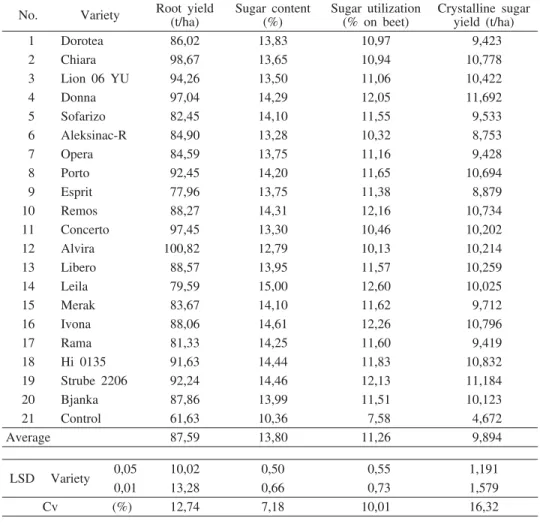
showed significant variability in root yield among varieties. For example, Al-vira had the highest root yield (100.82 t/ha) and the lowest root yield (61,63 t/ha) was recorded for the control sample (intolerant toRhizomania). Thus, the extreme difference in root yield between two cultivars was 39.19 t/ha or 38.87%. Significant differences in root yield were observed within other exa-mined varieties, too (Table 1).
Table 1: Results of sugar beet field trial at Ruma in 2004.
No. Variety Root yield(t/ha) Sugar content(%) Sugar utilization(% on beet) Crystalline sugaryield (t/ha)
1 Dorotea 86,02 13,83 10,97 9,423
2 Chiara 98,67 13,65 10,94 10,778
3 Lion 06 YU 94,26 13,50 11,06 10,422
4 Donna 97,04 14,29 12,05 11,692
5 Sofarizo 82,45 14,10 11,55 9,533
6 Aleksinac-R 84,90 13,28 10,32 8,753
7 Opera 84,59 13,75 11,16 9,428
8 Porto 92,45 14,20 11,65 10,694
9 Esprit 77,96 13,75 11,38 8,879
10 Remos 88,27 14,31 12,16 10,734
11 Concerto 97,45 13,30 10,46 10,202
12 Alvira 100,82 12,79 10,13 10,214
13 Libero 88,57 13,95 11,57 10,259
14 Leila 79,59 15,00 12,60 10,025
15 Merak 83,67 14,10 11,62 9,712
16 Ivona 88,06 14,61 12,26 10,796
17 Rama 81,33 14,25 11,60 9,419
18 Hi 0135 91,63 14,44 11,83 10,832
19 Strube 2206 92,24 14,46 12,13 11,184
20 Bjanka 87,86 13,99 11,51 10,123
21 Control 61,63 10,36 7,58 4,672
Average 87,59 13,80 11,26 9,894
LSD Variety 0,05 10,02 0,50 0,55 1,191
0,01 13,28 0,66 0,73 1,579
Cv (%) 12,74 7,18 10,01 16,32
The variation in sugar content was significant among the varieties at this locality. The average sugar content for this trial was 13.80% and it was a me-dium one considering the agroecological conditions in the year (Table 1).
Even greater variability among cultivars was recorded for other quality parameters. For example, sugar utilization (% calculated on beet), between the first-ranked Leila (12.60%) and control (7.58%) amounted up to 5.02% abso-lute or 39.84% relative (Table 1).
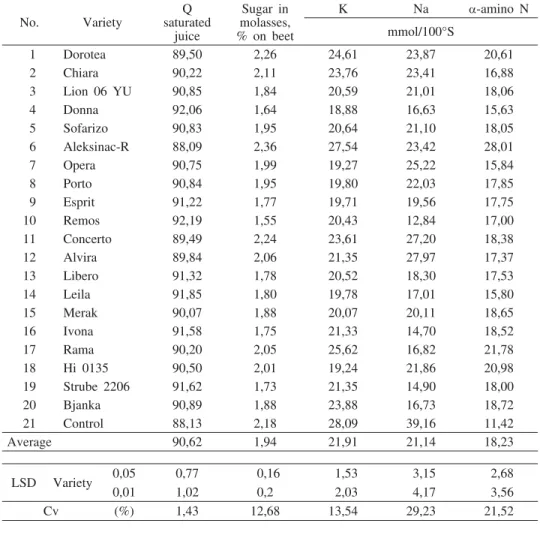
Extreme differences for other quality parameters were as follows: — coefficient of thick juice, 4.10,
— sugar content in molasses, 0.81% calculated on beet, — potassium content, 9.21 mmol/100°S,
— sodium content, 26.32 mmol/100°S,
— alpha-amino nitrogen content varied depending on the tolerance of cultivar to Rhizomania (Table 1a).
Table 1a: Results of sugar beet field trial at Ruma in 2004.
No. Variety saturatedQ juice
Sugar in molasses, % on beet
K Na a-amino N
mmol/100°S
1 Dorotea 89,50 2,26 24,61 23,87 20,61
2 Chiara 90,22 2,11 23,76 23,41 16,88
3 Lion 06 YU 90,85 1,84 20,59 21,01 18,06
4 Donna 92,06 1,64 18,88 16,63 15,63
5 Sofarizo 90,83 1,95 20,64 21,10 18,05
6 Aleksinac-R 88,09 2,36 27,54 23,42 28,01
7 Opera 90,75 1,99 19,27 25,22 15,84
8 Porto 90,84 1,95 19,80 22,03 17,85
9 Esprit 91,22 1,77 19,71 19,56 17,75
10 Remos 92,19 1,55 20,43 12,84 17,00
11 Concerto 89,49 2,24 23,61 27,20 18,38
12 Alvira 89,84 2,06 21,35 27,97 17,37
13 Libero 91,32 1,78 20,52 18,30 17,53
14 Leila 91,85 1,80 19,78 17,01 15,80
15 Merak 90,07 1,88 20,07 20,11 18,65
16 Ivona 91,58 1,75 21,33 14,70 18,52
17 Rama 90,20 2,05 25,62 16,82 21,78
18 Hi 0135 90,50 2,01 19,24 21,86 20,98
19 Strube 2206 91,62 1,73 21,35 14,90 18,00
20 Bjanka 90,89 1,88 23,88 16,73 18,72
21 Control 88,13 2,18 28,09 39,16 11,42
Average 90,62 1,94 21,91 21,14 18,23
LSD Variety 0,05 0,77 0,16 1,53 3,15 2,68
0,01 1,02 0,2 2,03 4,17 3,56
Cv (%) 1,43 12,68 13,54 29,23 21,52
Don-na (11.692 t/ha) performed higher crystalline sugar content by 7.020 t/ha or 60.04% relative in comparison to the control (4.672 t/ha).
Results of micro-trials at Sremska Mitrovica
The average root yield at this site was 78.64 t/ha. The variation in this parameter was statistically significant within the varieties. The most marked difference was recorded between the first-ranked variety (Chiara, 87.47 t/ha) and the control (53.68 t/ha) and it amounted up to 33.79 t/ha or 38.63% (Ta-ble 2).
Table 2: Results of sugar beet field trial at Sremska Mitrovica in 2004.
No. Variety Root yield(t/ha) Sugar content(%) Sugar utilization(% on beet) Crystalline sugaryield (t/ha)
1 Dorotea 76,52 14,40 11,42 8,732
2 Chiara 87,47 14,10 10,76 9,412
3 Lion 06 YU 84,62 15,00 11,90 10,070
4 Donna 82,03 15,28 12,35 10,133
5 Sofarizo 80,66 14,89 11,82 9,525
6 Aleksinac-R 80,43 14,53 11,20 9.006
7 Opera 73,71 15,34 12,33 9,084
8 Porto 80,80 14,80 11,80 9,534
9 Esprit 76,46 15,08 12,23 9,349
10 Remos 79,11 15,33 12,74 10,077
11 Concerto 86,73 14,33 11,01 9,548
12 Alvira 80,70 14,71 11,59 9,350
13 Libero 82,34 15,14 12,33 10,148
14 Leila 79,86 15,66 12,96 10,352
15 Merak 82,33 15,48 12,75 10,498
16 Ivona 67,37 15,45 12,74 8,588
17 Rama 75,04 15,31 12,33 9,253
18 Hi 0135 77,92 15,55 12,64 9,851
19 Strube 2206 82,01 15,57 12,81 10,507
20 Bjanka 81,74 15,14 12,14 9,921
21 Control 53,68 12,24 8,82 4,735
Average 78,64 14,92 11,94 9,413
LSD Variety 0,05 1,92 0,46 0,59 0,493
0,01 2,56 0,60 0,78 0,654
Cv (%) 9,22 5,52 8,65 10,12
— sugar content, 3.42% apsolute or 21.84% relative,
— sugar utilization, 4.14% calculated on beet or 31.94% relative (Table 2), — coefficient of thick juice, 3.97,
— sugar content in molasses, 0.83% calculated on beet, — potassium content, 11.25 mmol/100°S,
— sodium content, 23.62% mmol/100°S and alpha-amino nitrogen con-tent, too (Table 2a).
Table 2a: Results of sugar beet field trial at Sremska Mitrovica in 2004.
No. Variety saturatedQ juice
Sugar in molasses, % on beet
K Na a-amino N
mmol/100°S
1 Dorotea 89,20 2,38 26,39 22,07 22,73
2 Chiara 87,56 2,74 30,48 25,23 26,99
3 Lion 06 YU 88,81 2,50 26,45 20,90 26,59
4 Donna 89,49 2,33 25,80 17,58 25,79
5 Sofarizo 88,73 2,47 24,95 22,02 27,55
6 Aleksinac-R 87,25 2,73 31,45 20,58 32,85
7 Opera 89,49 2,41 23,32 21,86 23,98
8 Porto 88,84 2,40 25,76 20,07 27,90
9 Esprit 89,56 2,25 24,54 17,64 26,53
10 Remos 90,42 1,99 23,73 12,79 26,15
11 Concerto 87,54 2,72 28,80 24,76 29,30
12 Alvira 88,58 2,53 25.53 23,31 26,73
13 Libero 89,80 2,21 23,18 18,38 25,45
14 Leila 90,56 2,10 22,20 16,31 23,17
15 Merak 90,27 2,13 23,40 15,83 24,45
16 Ivona 90,39 2,11 24,76 14,41 23,65
17 Rama 89,27 2,38 28,68 15,23 26,79
18 Hi 0135 89,42 2,31 23,22 18,22 28,22
19 Strube 2206 89,88 2,16 24,95 13,80 27,66
20 Bjanka 89,08 2,40 27,59 17,26 27,17
21 Control 86,59 2,82 33,45 36,41 19,64
Average 89,08 2,38 26,13 19,75 26,16
LSD Variety 0,05 0,98 0,19 2,30 3,19 3,41
0,01 1,30 0,26 3,06 4,23 4,52
Cv (%) 1,47 11,74 13,21 28,51 13,90
DISCUSSION
The beet root yields achieved at both localities in 2004 were high and if averaged across varieties and sites the mean root yield amounted to 83.12 t/ha. But, the average root yield of the control sample (intolerant to Rhizomania) was 57.66% at both sites. Thus, root yield of the control variety has decreased by 25.46 t/ha or 30.63% relative. Similar results were reported by R a d i v o -j e v i ã et al. (2001).
The variability in beet sugar content averaged across varieties and sites and between mean values at both sites and mean value of the control amoun-ted up to 3.06% or 21.31% relative. M a r l e n d e r and R o v e r (1994) also reported significant effect of variety on sugar content (8.72% relative), but lower still comparing to the results of this experiment.
The values of the other quality parameters (sugar utilization, coefficient of saturated diffusion juice, sugar content in molasses, potassium and sodium content, alpha-amino nitrogen content) were significantly lower in comparison to the means at both sites. For example, sugar utilization for the first-ranked variety Leila, averaged across sites was 83.5% and for the control 72.5%. The obtained difference was 11.0% which is a very high value. This result is in ac-cordance with the findings of R i c h a r d - M o l a r d and C a r i a l l e (2001) proving that the selection of varieties tolerant to Rhizomania enables high yields and good processing quality of sugar beet.
Comparing the yields of crystalline sugar averaged across sites between the first-ranked (11.100 t/ha) and the control variety (4.703 t/ha), very high difference can be observed, 6.397 t/ha or 57.63%. But, higher yields of crystalline sugar could be achieved by increasing the yields of beet root as well (M a r l e n d e r, 1991).
CONCLUSION
The results of the study revealed significant variations in root and sugar yield within varieties having different tolerances to Rhizomania.
The established difference in root yield, averaged across sites, between the first-ranked (94.15 t/ha) and the control (57.66 t/ha) variety was 36.49 t/ha or 38.76%.
The most marked difference in location averages of sugar content bet-ween the first-ranked variety Leila (15.33%) and the control (11.30%) was 4.03% or 26.29% relative.
Very high difference in crystalline sugar content, averaged across sites was eshtablished between the first-ranked and the control variety and amoun-ted up to 6.397 t/ha or 57.63%.
AKNOWLEDGMENTS
REFERENCES
B u r b a, M., J a n s e n, R. (2000): History, current state and perspectives of sugar beet quality breeding — Part 1 and Part 2, Zuckerindustrie 125: 591—602, 803—814.
B u r b a, M., H a r l i n g, H. (2003):Assessment of beet quality from fixed sucrose/non-sucrose ratios (rendement factors) of molasses — Part 1 and Part 2, Zuckerindu-strie 128: 233—242, 508—513.
K o v a å e v, L. (1992):Sorta kao faktor poveãanja prinosa repe, Zbornik radova, Po-ljoprivredni fakultet — Institut za ratarstvo i povrtarstvo, Novi Sad, vol. 20, 193—201.
M a r l a n d e r, Bernward und R o v e r, Achim (1994):Einfluss von Sorte und Bestan-dessdichte auf. Ertrag und Qvalität von Zuckerruben — ein Beitrag zum Lichtkon-kurentz, Zuckerindustrie 119, Nr 1, 39—47.
M a r l a n d e r, Bernward (1991): Zuckerruben, UTE BERNHARDT — PATZOLD DRUCKEREI — NERLAG, STADTHAGEN, 1—137.
R a d i v o j e v i ã, S., O b r a d o v i ã, S., K a b i ã, D., D o š e n o v i ã, I., V i s l a v s k i, Lj., R o ÿ i ã, R. (2001): Biološko-tehnološke karakteristike zastupljenih sorti u proizvodnji šeãerne repe u 1999. godini, na zemljištu zaraÿenom rizomanijom, Be-ograd, Industrija šeãera — Hemijska industrija, vol. 55, Supple 1—2, 24—31. R i c h a r d - M o l a r d, Cariolle, M. (2001): Stress hidrique et abiotic et amelioration
genetique, Proc. 64 IIRB Congreess, June 2001, Bruges (B) 153—158.
T o š i ã, M. (1995): Rizomanija šeãerne repe, Društvo za zaštitu bilja Srbije, Beograd, 11—45.
OCENA TEHNOLOŠKOG KVALITETA ŠEÃERNE REPE UZGAJANE NA ZEMQIŠTU SA VISOKIM STEPENOM
PRISUSTVA RIZOMANIJE
Irena S. Došenoviã1, Stevan Ð. Radivojeviã1, Dragica R. Kabiã1, Ðura P. Pajiã2, Katica Ÿ. Škrbiã3
1 Tehnološki fakultet, Zavod za tehnologiju šeãera,
Bul. Cara Lazara 1, Novi Sad, Srbija i Crna Gora 2 DP Poqoprivredna stanica Ruma, Ÿeqezniåka 12,
Ruma, Srbija i Crna Gora
3 Poqoprivredni institut Dr Petar Drezgiã DP, p.o.,
Trg Svetog Dimitrija 22, Sremska Mitrovica, Srbija i Crna Gora
Rezime
Ustanovqena razlika u prinosu korena na mikroogledu u Rumi izmeðu prve po rangu (Alvira, 100,82 t/ha) i kontrole (61,63 t/ha) iznosila je 39,19 t/ha ili 38,87%. Meðutim, u pogledu tehnološkog kvaliteta šeãerne repe razlike su bi-le veoma izraÿene, u odnosu na kontrolu (netobi-lerantnu na rizomaniju). Prime-ra Prime-radi, utvrðena Prime-razlika u sadrÿaju šeãePrime-ra u repi izmeðu prvoPrime-rangiPrime-rane i kontrole iznosila je 4,64% apsolutnih.