Journal of Agricultural Sciences UDC: 633.63 : 631.816
Vol. 53, No2, 2008 Original scientific paper
INFLUENCE OF FERTILIZATION AND NITRATE-NITROGEN
POSITION IN SOIL PROFILE ON THE SUGAR BEET ROOT YIELD
AND QUALITY
G. Jañimoviñ1, B. Marinkoviñ1, J. Crnobarac1, Darinka Bogdanoviñ1, L. Kovaåev2 and D. Danojeviñ2
Abstract: Researches, which have lasted for two years, were carried out on
long-term trial field at Rimski Ãanåevi, Novi Sad, Serbia. In this trial, the eight fertilization variants of N, P2O5 and K2O increased amounts were studied. Sugar beet root and tops yields were determined, as well as the elements of technologi-cal sugar beet root quality. Based on these results, percentage of sugar utilization and refined sugar yield was defined. In the spring, before applying of N fertilizer, amount of nitrate nitrogen in the soil and its influence on yield and quality was determined.
The highest root yield in 2002 was produced at the variant N100P150K150, and in 2003 at the variant N150P150K150. However, in both years, referring to the variant N100P100K100, the differences were not statistically significant. Increas-ing of nitrogen amounts had negative effects on refined sugar yield. Amounts of NO3-N in the soil in spring, before sugar beet sowing, in 2002 had significant influence on root yield and refined sugar yield. In the year 2003, which was highly dry, high correlation ratio were gained between amounts of NO3 -N in the soil and root quality parameters, but it wasn't significant between nitrogen amounts and root and refined sugar yield.
Key words: sugar beet, fertilization, root yield, sugar yield, technological
quality
I n t r o d u c t i o n
Sugar beet has huge production of organic matter for which it must have ade-quate mineral nutrition amounts. Sugar beet fertilization is very specific because
1 Goran Jañimoviñ, M.Sc., assistant, [email protected], Branko Marinkoviñ, full prof., Jovan Crnobarac, full prof., Darinka Bogdanoviñ, full prof., Faculty of Agriculture, D. Obradoviña Square 8, 21000 Novi Sad.
84 G. Jañimoviñ et al.
beside the high root yield, the technological quality of root must be good as well. Between all elements of mineral nutrition, the highest influence on yield and qualitative beet properties has nitrogen. Negative effects, especially on sugar yield which can have nitrogen surplus, can be avoided by following and deter-mining its amounts and dynamics in soil. At the same time herewith the econom-ical and ecologeconom-ical fertilization aspects will be respected.
The main cause of these investigations was to explore the influence of NPK mineral nutrition at root yield and underground biomass as well as the influence on technological root properties.
Also, based on the amounts of soil nitrate-nitrogen before sowing and its dis-tribution in soil profiles we will try to determine its correlation dependency with root yield and quality.
Material and Methods
Researches have lasted for two years and they were conducted at stationary field trial at Institute of Field and Vegetable Crops -Novi Sad. The trial was designed by split-plot plan, in four repetitions. The main plots were 150 m2, with
eight fertilization variants by different amounts of N, P2O5 and K2O: Ø (control), N2P2, N2K2, N1P2K2, N2P2K2, N2P3K3, N3P2K2, N3P3K3 (where 1 =50, 2 =100, 3 =150 kg active matter of each nutrition element per hectare).
After extraction of a root, root samples were taken from all fertilization vari-ants to the end that determine technological root quality properties and next parameters were determined: sugar percentage, content of harmful nitrogen, K and Na, and based on these properties sugar utilization and refined sugar yield were valuated. Determination of technological root quality was done by standard methods in automatic beet laboratory “WENEMA”, in Institute for Field and Vegetable Crops at Rimski Ãanåevi, Novi Sad.
In the spring, before nitrogen fertilizers’ application, the content and distri-bution of soil mineral nitrogen was monitored. The soil samples were taken in layers from 30 cm, till the depth of 120 cm. The samples were analyzed on NO3 -N content by standard methods.
Water balance of sugar
beet, Rimski Ãanåevi Average values for RÃ (1963-2003)
Year
2002 2003
ETP (lm-2) 576 621 648
Precipitations (lm-2) 361 274 236
ETR (lm-2) 391 310 272
Deficit (lm-2) 185 311 376
Fertilization of sugar beet 85
Weather conditions in investigated years: Sugar beet yield and quality and seeded areas in our county are very variable from year to year. Besides the applied practical measures and economical reasons, the huge influences on the like fluctuations have the mutable weather conditions. By comparing the water balance elements (Bioclimatic method, Vu å i ñ; 1971) in observed years with
average values from Rimski Ãanåevi site, we can mark the very high values of potentially evapotranspiration (ETP) and higher precipitation deficit in a both years, in relation to a long-term period average.
The year 2002 was very dry. Percentage of real evapotranspiration (ETR) in relation to potentially (ETP) was only 50 %, and totally water deficit in relation to plants requirements was 311 lm-2. Year 2003 was climatic more unfavorable. Totally, during the vegetation period there was less precipitations for 125 lm-2 and at the same time the temperature was higher for 2.1 0C regarding to the multi-annual average. Plant water requirement (= ETP) in 2003 was 648 lm-2, and real ET was only 272 lm-2, while precipitation deficit was 376 lm-2. The highest water deficit during vegetative period was in June and August.
Results and Discussion
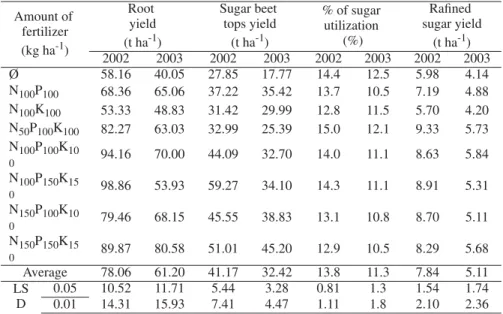
All fertilization variants have positive effects on root yield (tab. 1) with the exception of variant N100K100 during the year 2000. Average yield increasing for all variants was 39% in relation to control in 2002, and 60% in 2003, respec-tively.
Tab. 1. – Influence of different amounts of mineral fertilizers on root, tops and sugar yield
Amount of fertilizer (kg ha-1)
Root yield (t ha-1)
Sugar beet tops yield
(t ha-1)
% of sugar utilization
(%)
Rafined sugar yield
(t ha-1)
2002 2003 2002 2003 2002 2003 2002 2003
Ø 58.16 40.05 27.85 17.77 14.4 12.5 5.98 4.14
N100P100 68.36 65.06 37.22 35.42 13.7 10.5 7.19 4.88 N100K100 53.33 48.83 31.42 29.99 12.8 11.5 5.70 4.20 N50P100K100 82.27 63.03 32.99 25.39 15.0 12.1 9.33 5.73 N100P100K10
0 94.16 70.00 44.09 32.70 14.0 11.1 8.63 5.84
N100P150K15
0 98.86 53.93 59.27 34.10 14.3 11.1 8.91 5.31
N150P100K10
0 79.46 68.15 45.55 38.83 13.1 10.8 8.70 5.11
N150P150K15
0 89.87 80.58 51.01 45.20 12.9 10.5 8.29 5.68
Average 78.06 61.20 41.17 32.42 13.8 11.3 7.84 5.11 LS
D
0.05 10.52 11.71 5.44 3.28 0.81 1.3 1.54 1.74
86 G. Jañimoviñ et al.
The highest amounts of mineral fertilization didn’t produce significant increasing of fresh root yield. So in the 2002 year the highest yield was accom-plished with applying of 100 kgha-1 N, 150 kgha-1 P2O5 and 150 kgha-1 K2O. However, the root yield at this fertilization variant in relation to variant with by 100 kgha-1N, P2O5 and K2O, was higher, but that difference was not statistically significant. The highest NPK fertilizer amounts (by 150 kgha-1) in relation to medium (100 kgha-1NPK) even now produced lower root yield for 4.6 %. During the 2003 year the highest yield was accomplished at variant N150P150K150 and root yield differences were significant in relation to the all fertilization variants except N100P100K100. According to our results S a r i ñ and J o c i ñ (1977) refers
that the yield increasing with the fertilizer amounts bigger than 100kg ha-1 N, P2O5 and K2O is minimal.
In 2002 year increasing of the nitrogen amounts from 50 to 100 kgha-1, at the same level of P and K (P100K100), increased root yield for 14.5 % (increasing in relation to control was 62 %) which is statistically significant. The further increasing for 50 kgha-1 N decreased yield for 15.6 %, which is also statistically very significant. With the lowest nitrogen amounts (N50) in 2003, the root yield increased for 57 % in relation to control, which was high significant. By increas-ing nitrogen dose to 100 kgha-1 (variant N100P100K100) in relation to the previ-ous variant the yield was increased for 6.97 tha-1(11 %), however the difference wasn’t statistically significant. Additionally 50 kgha-1 of nitrogen (at variant N150P100K100) decreased root yield for 1.85 tha-1 (2.6 %), that also wasn’t statis-tically significant. The results of these investigations are in accordance with the results referred by L a w i n s k i and G r z e b i s z (2000), N e n a d i ñ et al. (2003),
M a r i n k o v i ñ et al. (2004).
Fertilization of sugar beet 87
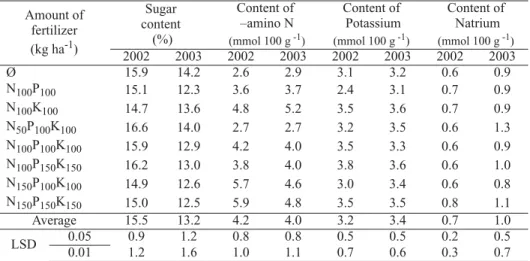
Tab. 2. – Influence of different amounts of mineral fertilizers on root technological quality
The highest sugar content (16.6 %) in 2002 year was accomplished by fertil-izing variant with the smallest nitrogen amount (N50P100K100), and at control variant in 2003. The smallest sugar content was gained at variants N100K100 and N100P100, while follows variants with the highest nitrogen amounts. Ã o l t y s -o v a (2003) also quoted that the highest nitrogen amounts significantly decreased
digestion (0,33 % averaged), and the refined sugar yield (for 0,38 %) in relation to unfertilized variant.
Intensively nitrogen fertilizing significantly influenced on increment of harmful nitrogen content in root: the highest content in 2002 have variants with the highest nitrogen amounts. In 2003 year the highest content of harmful nitro-gen was obtained at variant N100K100, but higher content had fertilizing variants by the highest nitrogen doses.As we expect, the smallest amount of harmful nitrogen has control variant and variant with the smallest N amount (50 kgNha1). In both years the highest percentage of sugar utilization was accomplished at the variant fertilized with the smallest nitrogen dose (N50P100K100) and at con-trol variant. Increasing of nitrogen dose from 50 to 100, in other words using of 150 kgha-1, causes significant decrease of sugar utilization.
Refined sugar yield in 2002 year was the highest at variant N50P100K100. Variants with the smallest refined sugar yield were control variant and N100K100. Increasing of nitrogen amount had negative effect on refined sugar yield. The smallest N dose gave the sugar yield for 700 kgha-1 higher than the medium and 630kg ha-1 higher yield than the highest N dose. The highest sugar yield in 2003 year was accomplished at the variants with the medium amounts of all three nutrition (N100P100K100).
In the spring, before nitrogen application, the amount of soil nitrate-nitrogen was monitored at all variants, as well as its influence on root yield and quality was determined by correlative analysis. The amount of NO3-N in the soil before
Amount of fertilizer (kg ha-1)
Sugar content
(%)
Content of –amino N
(mmol 100 g -1)
Content of Potassium
(mmol 100 g -1)
Content of Natrium
(mmol 100 g -1)
2002 2003 2002 2003 2002 2003 2002 2003
Ø 15.9 14.2 2.6 2.9 3.1 3.2 0.6 0.9
N100P100 15.1 12.3 3.6 3.7 2.4 3.1 0.7 0.9
N100K100 14.7 13.6 4.8 5.2 3.5 3.6 0.7 0.9
N50P100K100 16.6 14.0 2.7 2.7 3.2 3.5 0.6 1.3
N100P100K100 15.9 12.9 4.2 4.0 3.5 3.3 0.6 0.9
N100P150K150 16.2 13.0 3.8 4.0 3.8 3.6 0.6 1.0
N150P100K100 14.9 12.6 5.7 4.6 3.0 3.4 0.6 0.8
N150P150K150 15.0 12.5 5.9 4.8 3.5 3.5 0.8 1.1
Average 15.5 13.2 4.2 4.0 3.2 3.4 0.7 1.0
LSD 0.05 0.9 1.2 0.8 0.8 0.5 0.5 0.2 0.5
88 G. Jañimoviñ et al.
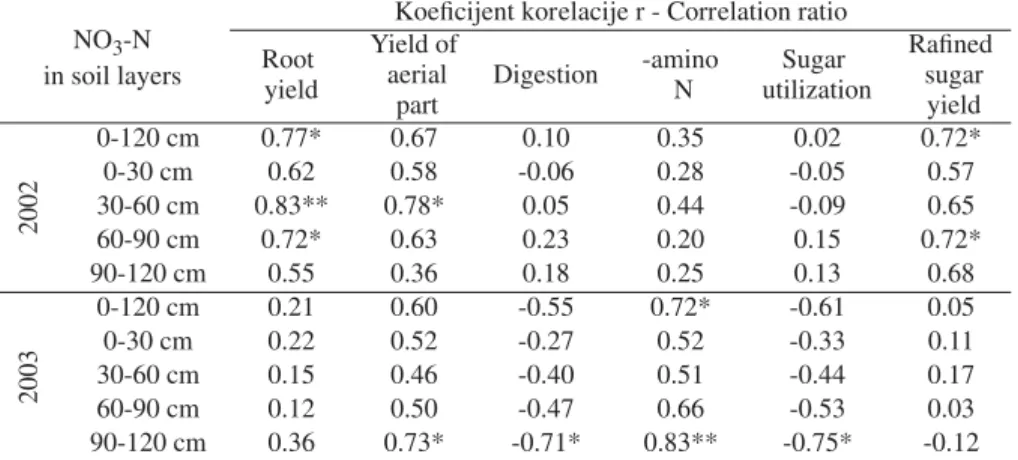
sugar beet sowing in 2002 significantly influenced on root and refined sugar yield (tab. 3).
Tab. 3. – Correlation coefficients between nitrat-nitrogen in soil and yield and some indices of technological quality of sugar beet
The biggest influence at root yield had the amount of NO3-N in the soil layer from 30-60 cm, (high significant correlation; r=0.83**), then in the layer 60-90 cm (r=0.72*). H a n a å k o v a (2003) obtained the high correlation between the
amount of mineral nitrogen in soil layer 0-60 cm and root yield. At sugar beet tops yield significant correlation obtained with the amount of NO3-N in layer 30-60 cm, while at refined sugar yield the biggest influence had NO3-N from soil layer 60-90 cm (r=0.72*). These results are in accordance with the results of M a r i n k o v i ñ et al. (1994). According to them, root yield is depending from
NO3-N which is situated in the layer 30-60 cm, while the correlation with the NO3-N amount in the layer 0-30 cm was negative.
During the spring 2003, the amount of NO3-N in soil layer from 90-120 cm had significant positive effect at beet tops yield (r=0.73*) and at -amino nitrogen content (r=0.83**). Effect at sugar content (r=-0.71*) and percentage of sugar utilization (r=-0.75*) were negative. The total amount of NO3-N (in the layer 0-120 cm) significantly influenced at increasing of -amino nitrogen. That plant ali-mentation isn’t dependent only by sum of available N aspects, but and of their distribution in soil profile, quote M a l e ã e v i ñ et al (1990).
C o n c l u s i o n
The highest amounts of mineral fertilizers didn’t produce at the same time the highest increase of root yield. The high dosage of all three mineral nutrients didn’t statistically sustainable. Intensively nitrogen fertilizing significantly influ-enced on increment of harmful nitrogen content in root as well as on decreasing sugar content.
NO3-N in soil layers
Koeficijent korelacije r - Correlation ratio Root
yield
Yield of aerial
part Digestion
-amino
N utilizationSugar
Rafined sugar yield
2002
0-120 cm 0.77* 0.67 0.10 0.35 0.02 0.72*
0-30 cm 0.62 0.58 -0.06 0.28 -0.05 0.57
30-60 cm 0.83** 0.78* 0.05 0.44 -0.09 0.65
60-90 cm 0.72* 0.63 0.23 0.20 0.15 0.72*
90-120 cm 0.55 0.36 0.18 0.25 0.13 0.68
2003
0-120 cm 0.21 0.60 -0.55 0.72* -0.61 0.05
0-30 cm 0.22 0.52 -0.27 0.52 -0.33 0.11
30-60 cm 0.15 0.46 -0.40 0.51 -0.44 0.17
60-90 cm 0.12 0.50 -0.47 0.66 -0.53 0.03
Fertilization of sugar beet 89
In both years the highest percentage of sugar utilization was accomplished at the variant fertilized with the smallest nitrogen dose (N50P100K100) and at con-trol variant. Increasing of nitrogen amount had negative effect on refined sugar yield.
Soil nitrate-nitrogen amounts and distribution have important influence at root yield and root quality traits, in the spring before sowing.
R E F E R E N C E S
1. H a n a å k o v a , E. (2003): Zmeny anorganickeho dusika v pode a ich vplyv na urodu a kvalitu repy cukrovej. V celoslovenska vedecka repar-ska konferencia, Nitra, Zbornik vedeckej konferencie z medzinarodnou uåastou, 176-179.
2. L a w i n s k i, H., G r z e b i s z , W. (2000): Estimation of the effect of
cul-tivation method and nitrogen rate on yield and quality of sugarbeet. Folia Universitatis Agriculturae Stetinensis, Agricultura, No.84, 251-256. 3. M a l e ã e v i ñ , M., B o g d a n o v i ñ , D a r i n k a ; S p a s o j e v i ñ , B.
(1990): Primena azota u proizvodnji pãenice na bazi utvrœivanja sadræaja nitrata u zemljiãtu (N-min metoda). Savremena poljoprivreda, Vol. 38, br. 5-6, 579-585.
4. M a r i n k o v i ñ , B., C r n o b a r a c , J., B a l e ã e v i ñ S v e t l a n a (1994): Proizvodnja ãeñerne repe sa osvrtom na preduseve i mineralnu ishranu. Zbornik radova, Institut za ratarstvo i povrtarstvo, Novi Sad, sv. 22, 507-519.
5. M a r i n k o v i ñ B., C r n o b a r a c J., J a ñ i m o v i ñ G. (2004): Œubrenje ãeñerne repe azotom, fosforom i kalijumom u funkciji prinosa i kvaliteta. “Zbornik radova”, Nauåni institut za ratarstvo i povrtarstvo, Novi Sad, Sveska 40, 373-378.
6. N e n a d i ñ , N., N e d i ñ , M., Æ i v a n o v i ñ , Lj., K o l a r i ñ , Lj., G u j a n -i å -i ñ , T. (2003): Effect of genotype on Sugar Beet Y-ield and Qual-ity. Journal of Agricultural Sciences, Vol. 48. No. 1, 1-9.
7. R e i n i e f e l d , E., B a u m g a r t e n , G. (1975): Verarbeitungseigen-schaften der Zuckerube in Abhagigkeit vom Sticksoffangebot. Zucker, 2, Hanover, 61-65.
8. S a r i ñ , M., J o c i ñ , B. (1977): Prouåavanje efekta mineralne ishrane ãeñerne repe. Savremena poljoprivreda, 11-12, 19-29.
9. Ã o l t y s o v a , B. (2003): Uåinok hnojenia na zmeny kvantitativnych a kvalitativnych parametrov repy cukrovej. V celoslovenska vedecka rep-arska konferencia, Nitra, Zbornik vedeckej konferencie z medzinarod-nou uåastou, 162-166.
10. Vu å i ñ , N. (1971): Bioklimatski koeficijenti i zalivni reæim biljaka – te-orija i praktiåna primena. Vodoprivreda, 6-8.
90 G. Jañimoviñ et al.
UTICAJ ŒUBRENJA I DISTRIBUCIJE NITRATNOG AZOTA
U PROFILU ZEMLJIÃTA NA PRINOS I KVALITET KORENA
ÃEÑERNE REPE
G. Jañimoviñ1, B. Marinkoviñ1, J. Crnobarac1, Darinka Bogdanoviñ1, L. Kovaåev2 i D. Danojeviñ2
R e z i m e
Dvogodiãnja istraæivanja uticaja rastuñih koliåina NPK hraniva na prinos i kvalitet korena ãeñerne repe izvedena su na stacionarnom poljskom ogledu na Rimskim Ãanåevima. U proleñe, pre primene N œubriva, prañena je koliåina nitratnog azota po slojevima zemljiãta, te njegov uticaj na navedena svojstva. U obe godine, razlika u prinosu korena postignutog pri najveñim koliåinama NPK hraniva nije bila statistiåki znaåajna u odnosu na varijantu N100P100K100. Pov-eñanje koliåine azota delovalo je negativno na prinos rafinisanog ãeñera. Koliåina NO3-N u zemljiãtu u proleñe pre setve u 2002. godini imala je znaåajan pozitivan uticaj na prinos korena i rafinisanog ãeñera. U izrazito suãnoj 2003. godini visoki koeficijenti korelacije dobijeni su izmeœu koliåine NO3-N u zemljiãtu i paramet-ara kvaliteta korena, ali nisu bili znaåajni izmeœu koliåine azota i prinosa korena i rafinisanog ãeñera.
Primljeno: 21 mart 2008 Odobreno: 10 jul 2008
1 mr Goran Jañimoviñ, asistent, dr Branko Marinkoviñ, red. prof., dr Jovan Crnobarac, red. prof., dr Darinka Bogdanoviñ, red. prof., Poljoprivredni fakultet Novi Sad, Trg D. Obradoviña 8, 21000 Novi Sad.