*Corresponding authors: Maryam Akbari Lakeh, Email:[email protected] Introduction
In the 21st century, education must build on its strengths to create a dynamic future. Achieving excellence is founded on a unique philosophy and purpose, and requires carefully developed plans for improvement, adopts innovative changes in educational practice, and regularly evaluates the attainment of goals and essential elements of the program.1
Programs must be evaluated, and those evaluators much reach an understanding of the extent they reach towards progress and products, and for making improvements to reach the ultimate beneits. Continuous improvement throughout all areas of the program is important.2
Educational administration refers to a range of professions, and one of them is program evaluation. This study has focused on educational program evaluation proposal writing. Improving an educational evaluation program is needed to accelerate organizational achievements.3
Program evaluation requires a team of educators, staff, and researchers in the development and improvement of educational programs through data-based inquiry. This team provides evaluation services including: evaluation design and
proposal writing, evaluation strategies, data collection and analysis, and reporting.2
Proposal writing is needed for grant mak ing, funding and planning.4 Planning bridges the current situation and our vision of the future. Thus we design the program evaluation, and plan it for implementation, then evaluate the outcomes for better plan ning in the evaluation cycle.5 In history, philosophical and ideological differences lead to diversity of evaluation approaches from "scientiically objective" (House, 1980) and Utilitarian evaluation approaches such as objective oriented, management oriented; to Intuitionist-Pluralist evaluations such as naturalistic and participant-oriented. Methodological backgrounds and preferences (quantitative and qualitative) also affect the evaluation and create different metaphors of evaluation. Then different evaluation programs begin responding to different needs. During the 1960-1990 eras, nearly sixty different proposals for how evaluations should be conducted were developed and circulated. Recent reviews have been done for development of evaluation models.6
Res Dev Med Educ, 2014, 3(1), 5-8
doi:10.5681/rdme.2014.003 http://journals.tbzmed.ac.ir/rdme
Educational Program Evaluation Model, From the Perspective of the
New Theories
Narrative Review Article
Soleiman Ahmady, Maryam Akbari Lakeh*, Simin Esmaeilpoor, Malihe Arab, Minoo Yaghmaei
Department of Medical Education, School of Medical Education, Shahid Beheshti University of Medical Sciences, Tehran, Iran
Article History:
Received: 1 Sep 2013 Accepted: 21 Feb 2014 ePublished: 29 May 2014
Keywords:
Evaluation models, Logic model, Educational evaluation theories
Introduction:This study is focused on common theories that inluenced the history of program evaluation and introduce the educational program evaluation proposal format based on the updated theory.
Methods: Literature searches were carried out in March-December 2010 with a combination of key words, MeSH terms and other free text terms as suitable for the purpose. A comprehensive search strategy was developed to search Medline by the PubMed interface, ERIC (Education Resources Information Center) and the main journal of medical education regarding current evaluation models and theories. We included all study designs in our study. We found 810 articles related to our topic, and inally 63 with the full text article included. We compared documents and used expert consensus for selection the best model.
Results: We found that the complexity theory using logic model suggests compatible evaluation proposal formats, especially with new medical education programs. Common components of a logic model are: situation, inputs, outputs, and outcomes that our proposal format is based on. Its contents are: title page, cover letter, situation and background, introduction and rationale, project description, evaluation design, evaluation methodology, reporting, program evaluation management, timeline, evaluation budget based on the best evidences, and supporting documents.
Conclusion: We found that the logic model is used for evaluation program planning in many places, but more research is needed to see if it is suitable for our context.
Abstract Article info
Ahmadyet al
Res Dev Med Educ, 2014, 3(1), 5-8 6 |
All of the evaluation approaches and models are applicable, and the new model does not reject them; rather, it completes them. The previous models are linear and product-based, but the newer ones are multidimensional and process-based. The new models consider the situation and background of the program. We know that in the previous models, the situation was not considered. Looking to the outcomes are other beneits of the new model.
In this study, we introduce the most com mon theories that inluenced the history of program evaluation. We then propose an educational program evaluation format based on newer theory. Our ultimate desire is to improve the educational situation.
Materials and Methods
Search Strategy
Literature searches were carried out during March-December 2010 with a combination of key words, MeSH terms and other free text terms as suitable for the purpose. A comprehensive search strategy was developed to search Medline by the PubMed interface and ERIC (Education Resources Information Center) on the current evaluation models and theories, compare documents and use experts’ consensus for selecting the best model. First we searched the literature for information about the current evaluation models and theories. In this step, the keywords were: program evaluation, educational program evaluation, proposal writing guidelines, evaluation program proposal format, effective evaluation program, evaluation metaphors and theo ries, evaluation models. Databases were searched, including Medline, PubMed, and ERIC. We also searched the four main journals of medical education: Academic Medicine, Medical Teacher, Journal of Medical Education and BMC Medical Ed ucation.
Study Selection
We included all study designs into our study. We assessed the strength of evidence of the current research by using methods established in the Evidence-Based Centers’ methods guide for effectiveness and comparative effectiveness reviews. We found 810 articles related to our topic, and inally 63 with the full-text article included.
Data Synthesis
We consider the heterogeneity in the studies and extract the characteristics of the educational evaluation program theory and models from the inal full-text articles. We summarized characteristics of the studies and used expert consensus to report study outcomes and the inal model.
Results
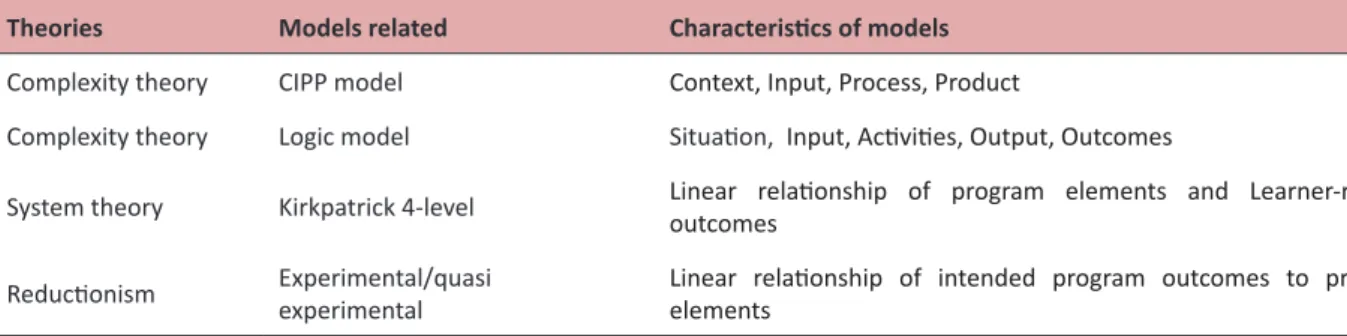
We found that philosophical differences have inluenced the development of common educational evaluation models. Reductionism, system theory, and complexity theory are the original theories that evaluation common models come from of them. Reductionism with a cause-effect approach creates several evaluation models with the pattern of research methodology, such as experimental/ quasi-experimental models. The components of the traditional evaluation projects proposals were used for
a long period of time, in which many universities were inluenced by this paradigm.7In traditional models, because of the historical effects, there was no attention to the processes, situation and other components that new models consider. The evidence said that they are useful for program excellence.
Despite all of reductionism’s great achievements, in the 21st century, Bertalanffy, a biologist who proposed a general system theory in the 1920s, created place for new educational evaluation mod els such as Kirkpatrick’s four level evalua tion models and newer than system theory,8 there is a compatible theory especially with medical education programs, the complexity theory. As we know, so many factors have an inluence on medical edu cation programs.9 In evaluation models based on complexity theory, the complex context and situation as a background of the activities is very important.10 Common evaluation
models based on this perspec tive are CIPP and logic model.7
One of the main steps for effective evalua tion program is program design. In this de sign, program planners describe the project for understanding of what would be done during the project implementation. Added clarity means that the best outcomes are achieved. Besides, a perfect description of the program and excellent clariication, support better funding.11 Among all of the models addressed above, many universities use the logic model for their educational program evaluation. In the history of logic models, we found that the logic model dates back to the 1970s, despite its new proposal. Joseph S. Wholey (1979) used the term “logic model” for the irst time in “Evaluation: Promise and Per formance”.12
Many varied types of logic models exist (Table 1). Before designing any program based on the logic model, we must know the existing beliefs and assumptions exist that inluence the project in every stage. These assumptions directly affect the inal results. The other important things consid ered that impact the program development is external factors and the environment. Dynamic interactions inside the program, between its elements, outside the program and between several systems around the program would be considered.
After that, the common components of a logic model are: A) Situation: important in stating the main problem and considering the background of the program from many dimensions, such as social, political, economical and so on.
Educational program evaluation model, from new theories
Res Dev Med Educ, 2014, 3(1), 5-8 | 7 The logic model considered the relation ships between
these components and also the impact of assumptions and beliefs and external factors surrounding the program. Our proposal format is based upon them and its topics are: title page, cover letter, situation and background, introduction
and rationale, project description, evaluation design, evaluation methodology, reporting, program evaluation management, timeline, evaluation budget based on the best evi dences and supporting documents.
Discussion
The most signiicant reason for any educational program like the other programs is change,7 and movement to the better situation. The most important responsibility of managers and program planners is planning the best design suitable for their own educational situation and based on the appropriate theories. Many universities in the world found that the logic model is useful for their evaluation program planning, but if it is to be suitable for our context, we need more research. Change and movement towards a better condition is important. But change management and need assessment for how change should occur is important, too.13 In this article, we proposed a proposal format based on the logic model. This is only a proposed format and its appropriateness for each context should be assessed if we think logically.
In order to provide a clear framework for evaluators, attention to the basic principles of proposal writing is essential. To achieve a better conclusion, it is important to give the proposed format to reviewers for com ments and advice. Regarding our proposed format, authors suggested expert panels for its applicability to decision-making. A pi lot study is also needed for the components of reliability and validity checking.14 Giv ing a good place for feedback
and relec tion on and in the evaluation program is the most important responsibility of the program planners when they start writing the proposal format.2
Using complexity theory models in complex educational contexts seems to be appropriate application. Because of the compatibility of the logic model components with current educational systems, consideration of this model is nice for educators and educational evaluation managers.15
The logic model is rooted within complex ity theory and theory of change. It uses components to describe the sequence of activities thought to bring about change and talk about the link between these ac tivities and the results of the program.16 In the logic model, besides identifying the main problem in current situation and context, determination of the ultimate out comes and choosing the best strategy for achieving the level of outcomes are con-sidered. It seems that the logic model is simple and more
applicable for today’s educational organizations.17
From the perspective of administrators, the logic model tries to implement change in the program. Good logic model preparation is possible with group thinking and con sensus. Action plans for logic model pro gram activities clarify the pathways through which the program would move.18
Preparing appropriate and measurable indicators for a logic model evaluation program is the key for a successful evaluation. Providing the indicators must be done with the participation and viewpoints of the main stakeholders of the program, such as learners, faculty members, etc.19
Conclusion
We can conclude that there is no standard format for the logic model. Each user can develop it for their own program based on the organizational context and needs. Stakeholder preferences should help to prepare a more appropriate logic model program format.20, 21
Acknowledgments
We dedicate our special thanks to ShahidBeheshti Medical University and 10 PhD students (2011 entries) of medical educa tion because of their active participation and expert opinions.
Competing interests
The authors declare that there is no conlict of interests.
References
1. Cook DA. Twelve tips for evaluating educational programs. Med Teach 2010;32:296–301.
2. Durning SJ, Hemmer P, Pangaro LN. The structure of program evaluation: an approach for evaluating a course, clerkship, or components of a residency or fellowship training program. Teach Learn Med 2007;19:308–18.
3. Durning SJ, Hemmer PA. Program evaluation. In: Ende J, editor. ACP teaching internal medicine. Philadelphia: American College of Physicians; 2010.
4. Norton J Kiritz. Program planning and proposal writing. The Grantsmanship Center, Inc. California:Original from the University of California; 2009.
Table 1. Comparison of evaluation models
Theories Models related Characterisics of models
Complexity theory CIPP model Context, Input, Process, Product
Complexity theory Logic model Situaion, Input, Aciviies, Output, Outcomes
System theory Kirkpatrick 4-level Linear relaionship of program elements and Learner-related
outcomes
Reducionism Experimental/quasi
experimental
Linear relaionship of intended program outcomes to program
Ahmadyet al
Res Dev Med Educ, 2014, 3(1), 5-8 8 |
5. Joseph S. Wholey, Harry P. Hatry, Kathryn E. Newcomer. Handbook of practical program evaluation. 2nd ed. USA: Willey;2004.
6. Daniel L. Stuflebeam, George F. Madaus, Thomas Kellaghan. Evalua-tion models. Viewpoints on educa¬tional and human services evaluation. 2nd ed. USA:Kluwer Academic Publishers;2000.
7. Frye AW, Hemmer PA. Program evaluation models and related theories: AMEE guide no. 67. Med Teach 2012;34(5):e288-99.
8. Bertalanffy L. The history and status of general systems theory. Acad Manage J 1972;15:407-426.
9. Geyer R, Mackintosh A, Lehmann K. What is complexity theory? Integrating ukand European social policy: the complexity of Europeanization. Abington: Radcliffe publishing;2005.
10. Stuflebeam D, Shinkield A. Evalua-tion theory, models, & applications. San Francisco: Jossey Bass/John Wiley & Sons, Inc;2007.
11. Guba EG, Lincoln YS. Effective evaluation: improving the usefulness of evaluation results through responsive and naturalistic approaches. San Francisco: Jossey-Bass; 1981.
12. Taylor-Powell E, Henert E. Developing a logic model: teaching and training guide. USA: University of wisconsin-extension, Program development and evaluation;2008.
13. Anderson D, Anderson LA. Beyond change management: advanced strat-egies for today’s transformational leaders. San Francisco: Jossey-Bass/Pfeiffer;2001.
14. Mayeske G. Life cycle program management and evaluation: An Heuristic approach. Parts 1 of 2. Washington, DC: Extension Service, USDA;1994.
15. Hernandez M. Using logic models and program theory to build outcome accountability. Education & Treatment of Children 2000; 23(1):24-41.
16. McLaughlin J, Jordan G. Logic models: A tool for telling your program’s performance story. Evaluating and Program Planning1999;22:65-72.
17. Pawson R, Tilley N. Realistic evaluation. Thousand Oaks, CA: Sage Publications;1997.
18. Rogers P. Causal models in program theory evaluation. In: Rogers P, Hacsi T PetrosinoA & Huebner T, editors. Program theory in evaluation: Challenges and opportunities, New Directions in Program Evaluation(87), 47-55. San Francisco, CA: Jossey-Bass Publishers;2000.
19. Scriven M. Evaluation thesaurus (p. 77). 4th ed. Newbury Park, CA: Sage Publications;1991.
20. Taylor-Powell E. Building capacity in evaluating outcomes. Madison, WI: University of Wisconsin-Extension, Cooperative Extension, Program Development and Evaluation;2008.