Members
Capital Markets Committee
Latin American Sustainable Finance Forum- LASFF
Engagement to
2
ACKNOWLEDGEMENTS
GVces Coordination
Mario Monzoni and Rachel Biderman
Realization
Latin American Sustainable Finance Forum- LASFF
Center for Sustainability Studies of Getulio Vargas Foundation (GVces)
Organization
Patrícia Berardi
Authors
Cinthia S. Gaban
Elisabeth Lerner
Maria Eugenia Buosi
Marcela Zonis
Paula Peirão
Patrícia Berardi
Renata Peregrino de Brito
Ricardo Rochman
Roberta Simonetti
3
The Latin American Sustainable Finance Forum – LASFF is an initiative of Fundação Getulio
Vargas and the International Finance Corporation (IFC) whose primary objective is to promote
sustainability practices in the financial sector.
Towards the end of 2008, the LASFF Capital Markets Committee – a working group of
professionals from banks, asset management firms and institutions linked to the Brazilian capital
market – developed a project designed to identify the practices adopted by publicly-traded
companies to eradicate slave labor and to notify the Brazilian stock market of the risks associated
with the problem of listed companies having commercial relations with suppliers that use slave
labor or degrading working conditions in their production chains.
The essence of the LASFF initiative is to generate knowledge about how companies handle the
matter of human rights – specifically the occurrence of slave labor in their production chains – and
how they manage their relations with suppliers to prevent these practices from perpetuating. It also
proposes to determine whether the companies conduct any monitoring to identify potential risks
that could impact their business and their activities. Furthermore, it aims to bring to the attention
of the Brazilian stock market that steps can be taken to ban these practices, by engaging suppliers,
running training programs, establishing contractual restrictions and even cancelling commercial
relations.
To achieve this goal, LASFF sent a Letter of Engagement and a questionnaire to all the companies
listed on BM&FBovespa, with the intention of finding out how they handle this matter – i.e.,
whether the companies grasp the severity, whether they are aware of the risks and whether they
adopt measures to eradicate existing practices.
From the investors’ perspective, a company associated with a problematic production chain runs
the risk of damaging its image, its reputation and its cash generation, which can all affect both its
intangible value and the price of its shares traded on the stock exchange in the case of commercial
and financial restrictions.
The Letter of Engagement emphasized the fact that slave labor is an unacceptable practice that is
4
This groundbreaking initiative on the stock market has had repercussions on the international
investment community, earning the support of signatory organizations of the PRI (Principles for
Responsible Investment)and member organizations of the UNEP-FI (United Nations Environment
Program – Finance Initiative) that promote socially responsible investment. This support allows
the results of this project to have implications globally.
History of the Initiative
The first step was to find out what constitutes slave labor in Brazil and under what circumstances
companies are identified by the Ministry of Labor and Employment and included in the Employers
Register required by the Act No540/2004, which identifies companies or individuals fined by
exploitation of slave labor. To this end, the committee sought support from those responsible for the
project preparation and monitoring of the registry in Brazil, namely the NGO Repórter Brasil, which
works in conjunction with the International Labour Organization (ILO) and the Ethos Institute of
Business and Social Responsibility. In preparation for the survey, Reporter Brazil held a seminar to raise
awareness about the issue for members of the LASFF committee.
Inquiries conducted in various production chains, such as sugarcane, corn, babaçu, beef, charcoal,
soybeans, lumber and cotton, revealed that stock market listed companies from different sectors
maintained commercial relations with suppliers included on the Employers Register Act
No540/2004.
On March 18, 2009, LASFF representatives officially released the “Letter of Engagement for the
Eradication of Slave Labor in Brazil” at the 2nd National Seminar of the Monitoring Committee for
the National Agreement to Eradicate Slave Labor in Brazil, which was held in BM&FBovespa’s
auditorium.
The letter clarified the objective of the initiative and requested that companies state their position
on the matter (see appendix I). To allow the responses to be compiled and to ensure that all the
points considered important by the group were addressed, a questionnaire was drafted with seven
questions:
1. What is the core activity of your company?
5
3. Does it intend to become a signatory within the next 12 months, with a team and budget assigned for this?
4. Is it aware of its exposure?
5. Does it periodically conduct assessments of the industries associated with its production chain? 6. How does it engage with suppliers and clients in combating slave labor?
7. What procedures are adopted should it identify companies using these practices?
In April 2009, the 565 stock exchange listed companies received (electronically) information on
this initiative, the Letter of Engagement and orientation on how to respond, together with the
brochure on the National Agreement. This correspondence was sent to the people in charge of
Investor Relations registered with BM&FBovespa. The material was sent again in May. After
these two attempts, however, only six companies had responded, and so a third attempt was made.
The response rate, nonetheless, remained extremely low.
In the second half of 2009, the committee decided to make another attempt, sending the
documents again electronically and contacting the Investor Relations departments of the
companies by telephone, in order to confirm the receipt and to ask whether the company was
interested in responding to the committee’s request. This strategy was directed only at listed
companies traded on the stock market, meaning that outfits such as Special Purpose Entities and
companies with shares traded on the over-the-counter market (SOMA) were excluded from the
sample, in this way reaching a total of 368 companies. This effort resulted in a considerably higher
number of responses (58), which raised the total number of responses to 64. Nevertheless, it is
striking that 83% (304) of the companies did not respond to the survey conducted by LASFF, as
6 83% 17%
Number of Responses
Did not respond Responded
Graph 1 – Number of responses, designed by authors.
Data Analysis
The data was analyzed in aggregate form. In addition to providing an impression of the Brazilian
market on the topic, the primary reason for the committee to conduct the survey was the
possibility of inducing a greater number of companies to assess this matter and even sign the
National Agreement to Eradicate Slave Labor in Brazil. The analysis of the responses reveals that
a considerable number of companies included or reinstated this matter on their discussion agenda.
Of the 64 responses received, 7 companies preferred not to respond to the survey and 3 responses
were discarded due to inconsistencies. The final sample, therefore, consisted of 54 companies that,
according to the stock market capitalization in September 2009, represented 52% of the total value
of tradable assets on BM&FBovespa.
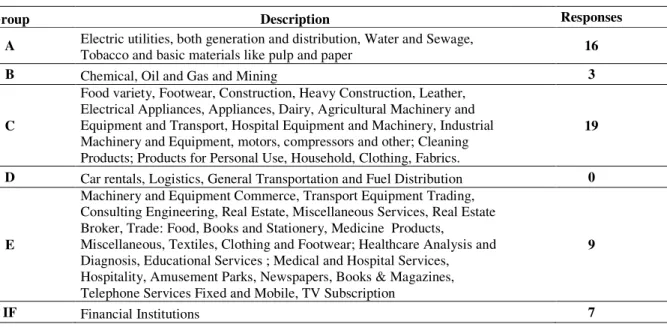
The companies were grouped according to their field of activity, using the sector classification
adopted by BM&FBovespa’s Corporate Sustainability Index (ISE), with some minor adjustments
(energy generation and distribution companies were classified as Group A and the Financial
Institutions Group only included banks).
7
Table 1 Sector Classification
Group Description Responses
A Electric utilities, both generation and distribution, Water and Sewage,
Tobacco and basic materials like pulp and paper 16
B Chemical, Oil and Gas and Mining 3
C
Food variety, Footwear, Construction, Heavy Construction, Leather, Electrical Appliances, Appliances, Dairy, Agricultural Machinery and Equipment and Transport, Hospital Equipment and Machinery, Industrial Machinery and Equipment, motors, compressors and other; Cleaning Products; Products for Personal Use, Household, Clothing, Fabrics.
19
D Car rentals, Logistics, General Transportation and Fuel Distribution 0
E
Machinery and Equipment Commerce, Transport Equipment Trading, Consulting Engineering, Real Estate, Miscellaneous Services, Real Estate Broker, Trade: Food, Books and Stationery, Medicine Products,
Miscellaneous, Textiles, Clothing and Footwear; Healthcare Analysis and Diagnosis, Educational Services ; Medical and Hospital Services, Hospitality, Amusement Parks, Newspapers, Books & Magazines, Telephone Services Fixed and Mobile, TV Subscription
9
IF Financial Institutions 7
Source: Designed by authors based on ISE’s classification.
Therefore, of the 54 valid responses included in the final sample of the survey, 16 companies were
placed in Group A, which consists of the electric utility sector – both generation and distribution –
water and sewage, cigarettes and tobacco, and basic materials such as pulp and paper. Group B
contains 3 companies in the chemicals, petroleum, gas and mining sectors. The highest response
rate was concentrated in Group C, which consists of the food, construction and industrial goods
sectors, among others. There were no representatives from Group D, which comprises vehicle
rental, general transportation and fuel distribution companies, while there were 9 responses in
Group E, from the telephone, commerce and distribution and health sectors, among others.
8
Graph 2 – Percentage distribution of companies by sector.
A 30%
5% B 35%
C E
17%
IF 13%
Sectors
Graph 2 – Sectors, designed by authors.
Analysis of the responses
The first intention of the project was to identify the representativeness of the signatory companies
of the National Agreement to Eradicate Slave Labor in Brazil. Of the total of 54 responses, 20
companies had already signed the Agreement in 2009, corresponding to 41.8% of the total value
of tradable assets on BM&FBovespa, according to the stock market capitalization in September
2009.
No 63% Yes
37%
Signatory
9
The next question was directed at the companies that have not yet signed the Agreement. It was
observed that the majority of the companies that participated in the movement proposed by
LASFF have this issue on their agenda, and some are analyzing the possibility of becoming
signatories within the next 12 months, while others have also set this as a goal. The committee
noted a concentration of positive responses, particularly in the Group A companies.
3%
26%
30% 41%
Possibility of Becoming a Signatory?
Did not respond No
Analyzing Yes
Graph 4 – Possibility of Becoming signatory of the National Agreement, designed by authors.
An important focus of this project was placed on the question concerning the risks to which the
companies are exposed, such as the risks of image, reputation, cash flow, attracting new
investments and share prices, among others.
4%
83% 7%
6%
Aware of your exposure?
Did not respond
Yes
No
Does not perceive exposure
10
The majority of the responding companies (83%) said they understood there is exposure to risk.
However, it is noteworthy that some companies still do not consider themselves exposed to risks
resulting from the potential identification of slave labor in their client or supply chain.
Another striking aspect of this analysis concerns the assessments conducted by the companies of
their respective production chains. Although most companies are aware they are exposed to risks,
24% had not, by the date they submitted their responses, conducted any type of assessment to
analyze the commitments and the practices of their partners, as shown in graph 6.
No 24%
Yes 76%
Conducts Assessments?
'
Graph 6 – Conducts Assessments, elaborated by the authors.
The questions were worded to invite open responses and, in many cases, the companies specified
11
24%
26%
4% 22%
15% 9%
Types of Assessment
Does not conduct assessment No description
Discloses Policy
Verifies Employers Register Act No540/2004 Monitoring
Several Actions
Graph 7 – Types of assessments, designed by authors.
It was noted that 4% of the companies disclose their policies only by presenting their Code of
Ethics, for example, upon hiring the supplier. Another 22% consult public sources such as the
Employers Registry of the Ministry of Labor and Employment or the Public Prosecutor’s Office.
Only 15% have a policy to monitor their partners, which indicates a greater understanding of the
potential risks. Meanwhile, a small group of companies (9%) takes a combination of actions: in
addition to checking the Employers Register Act No540/2004 of the Ministry of Labor and
Employment, they disclose their policies in advance, ask questions, monitor, and audit critical
suppliers. It is worth pointing out that a considerable percentage (24%) takes no steps whatsoever.
It was also noted that transparency is still quite rare in the relationships between companies and
their partners.
The survey also sought to identify how the companies engage with their partners. It was
understood that companies, even though they may not conduct an assessment of their production
chains, can perform some degree of engagement. For the purposes of this survey, active
engagement was considered disclosure and promotion of awareness-raising events with
stakeholders, alongside contractual clauses establishing legal penalties and a more careful
registration analysis consisting of audits and verification of compliance with legal requirements.
The simple disclosure of the company’s policy at the start of the relationship was considered a
12
Taking these active and passive forms of engagement into account, the companies were divided
into two groups (Graph 8).
No 48%
Yes 52%
Active Engagement
Graph 8 – Active and Passive Engagement, designed by authors.
Graph 9 presents the respective percentages for the different forms of engagement, in relation to
registration analysis, awareness-raising and observance of legal requirements for contracting, or a
combination of the alternatives.
4% 9%
22%
13% 22%
11%
19%
Engagement
Did not respond
Does not have implemented procedures
Discloses Policy, organizes and supports events
Contractual clauses (supplier or client)
Contractual clauses and several other actions (dicloses policy, supports events, active questioning)
Registration Analysis
Registration Analysis and other actions (discloses policy, supports and organizes events, conducts audits, verif ication of compliance with legal requirements)
Graph 9 – Engagement Practices, designed by authors.
13
Finally, the last question sought to identify the procedures that are adopted should potential cases
of slave labor be discovered in one of their partners (Graph 10).
2%
13% 3%
24%
15% 15%
28%
Types of Procedures Did not respond
No procedures
Investigation and Action Plans
Relationship suspension
Relationship suspension and several other actions (warning, investigation and legal actions)
Contract cancellation
Contract Cancellation and several other actions (warning,investigation and legal actions, complaint to the authorities)
Graph 10 – Type of procedure, designed by authors.
The data also show that, even among the companies that are aware of their exposure and that
engage in some way with their partners, a portion of 13% of the companies do not have any kind
of procedure established should an irregularity of this kind be discovered. The majority of the
companies (43%) rely on legal responses, such as contract cancellation.
Conclusions
This project was intended to provide an impression of how publicly-traded companies approach
the eradication of slave labor in their production chains and to bring the topic to the attention of
the stock market. Although the response rate was low and only 17% of the contacted companies
were included in the final sample, these companies represent 52% of the market in terms of stock
market capitalization. The low response rate can most likely be explained by the fact that the
inquiry into this topic is a new demand on the companies, even though it was made by a group
representing asset managers and important financial market agents.
As a positive point, a significant concern with the topic was expressed by the companies that
14
practices in their value chain. However, further examination of the issue reveals opportunities for
improvement.
Furthermore, although there is a perception of exposure to risk – 83% of companies said they were
aware of their exposure – the perception was that there was no significant active engagement.
Indeed, many of the companies stated that they relied only on contractual clauses or (passive)
disclosure of their policies, without taking any complementary steps to verify, monitor or raise
awareness.
Good engagement practices include proactive actions and attitude, ongoing processes of raising
awareness, dialogue, training and working together to effectively induce a greater number of
partners, suppliers and clients to assume this commitment. Companies engaged in this movement
ought to make a concerted effort to ban this unacceptable practice. This is a responsibility of every
link in the production and service chain.
One positive result of the movement proposed by the LASFF Capital Markets Committee has been
to contribute to the inclusion of the topic on the discussion agenda of companies, primarily those
that have not yet signed the National Agreement to Eradicate Slave Labor in Brazil.
The survey revealed, however, that there is a need for further engagement with Brazilian capital
market companies.
To lend continuity to this initiative, the committee suggests verifying in the medium-term whether
the companies have signed the Agreement and monitoring to what extent their practices change as
a result of this movement. The committee believes that the market, represented by investors,
consumers and society at large, will increasingly demand this kind of information and,
consequently, this discussion must move forward. It is important to emphasize that rejecting slave
labor is a key element of corporate responsibility and of respect for human rights, and that
15
APPENDIX I: Letter of Engagement
The Latin American Sustainability Finance Forum - LASFF is an initiative from GVces and IFC, which
aims to promote sustainable practices in Latin America’s financial sector. The efforts consist in forming
working groups to share experiences, generate knowledge and innovation. The capital markets group,
herein represented by its members, is responsible for discussing the introduction of social and
environmental criteria and corporate governance in the investment decision process.
In accordance to that, LASFF and the investor’s community, both Brazilian and international that are
concerned with these issues have identified the importance of proper monitoring of slave labor inside
companies and their supply chains, regardless of their industry or sector. All markets from factories, to
retail, wholesale and export, must be alerted about the existence of slave labor work-force in the
production chains of several products which are sold in the domestic and external markets.
Slave labor is unacceptable, is degrading to humanity and must be properly addressed by all companies,
not only regarding their own operations but also their suppliers’ and the entire production chain.
Involvement with slave labor in the supply chain creates consequences greater than the reputational risk,
such as the imposition of commercial and financial barriers, which directly impacts cash generation and
business value to shareholders.
As investors and professionals directly involved with the Brazilian capital market, we intend to promote
in our invested companies:
1 - A pro-active attitude to eradicate slave labor in their operations and their supply chain;
2 - Support to the Principles of Brazilian National Agreement to Eradicate Slave Labor in Brazil, a
Ethos Institute, International Labor Organization and NGO Reporter Brazil initiative, throughout their
adhesion or stimulating their suppliers adhesion;
3 - The application of effective monitoring mechanisms inside companies and their supply chain.
16
Labor indicates both awareness about its exposure to social risks, and responsibility before issues which
concerns its future business. In accordance to that, we would like to acknowledge this company’s
position regarding the three points raised above.
Please find attached a support material on the National Agreement to Eradicate Slave Labor.
We will be glad to assist you in case you have any doubts or questions regarding this letter or any
related issues.
How to Proceed
Your company just received this notice, which requests a position on the issue at hand. To do so,
you must first consult the National Agreement to Eradicate Slave Labor website
(http://www.reporterbrasil.org.br/pacto/conteudo/view/4) and then respond to LASFF at the given
email address [email protected], with reference to the following questions:
1. What is the core activity of your company?
2. Is your company a signatory of the National Agreement to Eradicate Slave Labor in Brazil? 3. Does it intend to become a signatory within the next 12 months, with a team and budget assigned for this?
4. Is it aware of its exposure?
5. Does it periodically conduct assessments of the industries associated with its production chain? 6. How does it engage with suppliers and clients in combating slave labor?
7. What procedures are adopted should it identify companies using these practices?
We declare that the information provided herein will be analyzed and disclosed in aggregate form.
In case an individual analysis is made, it will require the express permission of the company