A co m pariso n o f public and private
o bstructive sle e p apne a clinics
Disciplina de Medicina do Sono, Departamento de Psicobiologia,
Instituto do Sono, Universidade Federal de São Paulo, São Paulo, SP, Brasil A.I. Zonato, L.R. Bittencourt,
F.L. Martinho, P. Baiard, S.M. Togeiro, A.A. Benedito-Silva and S. Tufik
Abstract
The aim of the present study was to compare the clinical findings and polysomnography results obtained at public and private clin-ics in Brazil, the follow-up after diagnosis, and the therapeutic aspects related to continuous positive airway pressure. Patients who snore and who have obstructive sleep apnea were retrospec-tively divided into two groups, i.e., public clinic (N = 307) and private clinic (N = 317). Data concerning age, sex, body mass index (BMI), neck circumference, medical history, sleepiness scale, fol-low-up after diagnosis, and acceptance of continuous positive airway pressure therapy were collected. Mean age was 50 ± 12 (range: 15-80) for public patients and 48 ± 12 years (range: 19-91) for private patients. Mean BMI was 30 ± 6 (range: 19-67) for public patients and 31 ± 6 kg/m2 (range: 21-59) for private patients. The public clinic had a significantly higher frequency of women than the private clinic (M:F ratio of 2.0:1 and 6.9:1, respectively). The condition of private patients (apnea-hypopnea index = 31 ± 25) was more severe than that of public patients (apnea-hypopnea index = 25 ± 24 events/h; P = 0.0004). In the public and private clinics, 19 and 15% of patients were snorers, respectively, and 81 and 85% of them had sleep apnea. After diagnosis, follow-up was longer in the private group. The continuous positive airway pressure accep-tance was similar for both groups (32 vs 35%), but patients from the public clinic abandoned treatment more than private ones (65 vs 13%). Social status was significant in terms of the severity of obstructive sleep apnea age and gender distribution. Private pa-tients look for a diagnosis earlier in the course of the disease than public patients, adhere more to follow-up, and abandon continuous positive airway pressure treatment less than public patients do. Co rre spo nde nce
A.I. Zonato Instituto do Sono
Rua Napoleão de Barros, 925 04024-002 São Paulo, SP Brasil
Fax: + 55-11-5539-7905 E-mail: aizonato@ terra.com.br
This paper was presented at the 16th Congress of the European Sleep Research Society, Reykjavík, Iceland, June 3-7, 2002.
Research supported by AFIP-UNIFESP.
Publication supported by FAPESP.
Received January 27, 2003 Accepted November 4, 2003
Ke y words
•O bstructive sleep apnea •Social class aspects •Anthropometric aspects •Continuous positive
airway pressure
Intro ductio n
Obstructive sleep apnea (OSA) is consid-ered to be a medical and public health prob-lem in terms of its consequences for the cardiovascular system (high blood pressure and ischemic heart disease) and excessive
con-tinuous positive airway pressure (CPAP) (6). The use of CPAP is one of the most common treatments for patients with OSA since its efficacy for the improvement of quality of life has been well demonstrated (7,8). The clinical and polysomnography (PSG) fea-tures of OSA patients are well-known in the literature, as also are the indication of and compliance with nasal CPAP (9-11). Some individual aspects such as obesity, gender, age, ethnicity, smoking, and alcohol use are closely related to OSA (12-18). Demographic data, clinical findings, PSG features, and CPAP acceptance have not been previously compared between public and private clin-ics. Patients from these clinics mainly differ in economic status, a fact that can be highly relevant in terms of the principal treatment of sleep apnea considering the high cost of nasal CPAP.
We hypothesize that patients from public and private clinics differ not only in severity of apnea-hypopnea index (AHI) but also in social aspects that might influence treatment with nasal CPAP. The objectives of the pres-ent study were: 1) to compare clinical find-ings and PSG results between public and private clinics, and 2) to compare the follow-up after diagnosis of OSA and the therapeu-tic aspects related to nasal CPAP between these groups of patients in Brazil.
Mate rial and Me thods
Study subje cts
All data were retrospectively collected from patient charts at the Sleep Clinic of Universi-dade Federal de São Paulo, that attends pa-tients referred from the public university hos-pital and from a private clinic. A total of 624 adult snorers or OSA patients seen from 1997 to 2000 were divided into two groups, namely public clinic (N = 307) and private clinic (N = 317). The inclusion criterion was adult patients with OSA (including snorers without apnea) evaluated by PSG.
Clinical e valuation
Our Sleep Laboratory is a national refer-ence center staffed by a multidisciplinary group, and the physicians responsible for the respiratory sleep disorders use the same stan-dardized questionnaire to evaluate both pub-lic and private patients. The data collected from the charts were age, sex, body mass index (BMI), neck circumference, past and present medical history, Epworth Sleepiness Scale (ESS), follow-up after diagnosis, and acceptance of CPAP therapy. Medical his-tory included presence of hypertension, car-diovascular diseases (myocardial infarction, coronary heart disease, arrhythmia, heart fail-ure, and cerebrovascular accident), asthma, diabetes mellitus, hypothyroidism, nasal ob-struction, and nasal allergic symptoms (sneez-ing, nasal itch(sneez-ing, rhinorrhea).
Polysomnography monitoring
PSG was performed for one full night using a 13-channel SAC Oxford® system (version 10, Oxford Instruments, Inc., Tampa, FL, USA) for the determination of electro-cardiogram, oculogram, submental and an-terior tibialis electromyogram, nasal and oral airflow (measured with a thermistor), tho-racic and abdominal movements, body posi-tion, and oxygen saturation measured by pulse oximetry. The sleep stages were scored according to the Rechstaffen and Kales Manual (19), arousal according to ASDA recommendations (20), and respiratory events according to AASM (21) recommendations.
Statistical analysis
Windows software, release 5.1 (Statsoft Inc., 1997).
Re s ults
The data comparing public to private patients revealed a mean age of 50 ± 12 and 48 ± 12 years (P = 0.014), BMI of 30 ± 6 and 31 ± 6 kg/m2, neck circumference of 41 ± 5 and 43 ± 4 cm, respectively, with a predomi-nance of men in both groups, and with the private clinic having a higher percent of men than the public (87 and 67%, respectively, P < 0.0001) (Table 1). The public clinic had a significantly higher frequency of women than the private clinic, with male:female ratios of 2.0:1 for public clinic and 6.9:1 for private clinic. When the groups were divided ac-cording to age decade, the majority of pa-tients in both clinics were found to be con-centrated between the 4th and 5th decade (Figure 1). The groups differed significantly in the distribution of age decade, with more private than public patients in the 3rd decade and more public than private patients in the 6th decade. Considering the degrees of obe-sity, the public and private clinics were closely similar, and most patients were con-centrated in the mild and moderate catego-ries of obesity in both groups. Among all patients (snorers and OSA patients), the ba-sal PSG study showed a mean AHI of 25 ± 24 and 31 ± 25 events/h for the public and private clinics (P = 0.0004), respectively, and a lowest oxygen saturation of 78 ± 12 and 74 ± 13% (P = 0.0003). According to the sleep questionnaire, private patients were similar, with a mean ESS score of 12 ± 8 and 13 ± 6.
In the past medical history of the public and private groups, hypertension was the major health problem without a significant difference between groups, affecting 36% of public patients and 34% of private patients. Hypothyroidism, diabetes mellitus, asthma, and cardiovascular diseases were present at low frequency in both groups, and diabetes
Table 1. Anthropometric and polysomnography data, Epw orth Sleepiness Scale, and past medical history of private and public clinic patients.
Public clinic (N = 307) Private clinic (N = 317)
Age (years) 50 ± 12 48 ± 12*
BM I (kg/m2) 30 ± 6 31 ± 6
Neck circumference (cm) 41 ± 5 43 ± 4
Gender (% males:% females) 67:33 87:13*
ESS 12 ± 8 13 ± 6
Basal AHI (events/h) 25 ± 24 31 ± 25*
Low est O2 saturation (% ) 78 ± 12 74 ± 13*
Hypertension 36% 34%
Hypothyroidism 3% 2%
Diabetes mellitus 9% 3% *
Asthma 5% 6%
Cardiovascular diseases 6% 7%
AHI = apnea-hypopnea index; BM I = body mass index; ESS = Epw orth Sleepiness Scale; N = number of patients.
* P < 0.05 compared to public clinic patients (Mann-Whitney U-test and chi-square test).
P
e
rc
e
n
ta
g
e
o
f
p
a
ti
e
n
ts
40
35
30
25
20
15
10
5
0
2nd 3rd 4th 5th 6th >7th
Distribution according to decade of age
Public
Private
* *
Figure 1. Patient distribution betw een public and private clinics according to age (2nd: up to 29 years; 3rd: betw een 30 and 39 years; 4th: betw een 40 and 49 years; 5th: betw een 50 and 59 years; 6th: betw een 60 and 69 years; >7th: 70 years and over). * P = 0.019 for 3rd decade and P = 0.033 for 6th decade of age (chi-square test).
mellitus was more frequent among public clinic patients. The anthropometric and PSG data, ESS and medical history of both groups are summarized in Table 1.
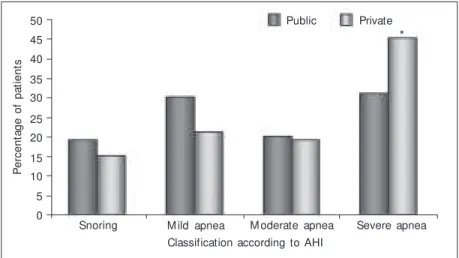
severe patients than the public clinic (P = 0.002; Figure 2). In the public and private clinics, 19 and 15% of patients, respectively, were considered to be snorers (AHI <5), and 81 and 85% of them had some degree of sleep apnea (AHI >5), representing the great majority in both groups, without a signifi-cant difference between them.
According to the charts, part of the pa-tients in each group had been questioned about nasal symptoms (obstruction or al-lergy), i.e., 67.1% of public patients (N = 209/307) and 74.4% of private patients (N = 236/317). Considering just patients who were questioned about nasal symptoms, 75.6% of those in the public group (N = 158/209) and
58.1% of those in the private group (N = 137/ 236; P = 0.001) reported a past history of nasal symptoms. Nasal obstruction was the most common symptom, followed by sneez-ing and nasal itchsneez-ing.
After diagnosis by PSG, the return for a new schedule was higher in the private group, 79 vs 68% (P = 0.002) (Table 2). A new PSG to evaluate CPAP titration and its therapeutic results was performed in 35% (107/307) of public patients and in 43% (N = 136/317) of private patients (P = 0.039). Among patients who performed CPAP titration, 32% in the public clinic and 35% in the private clinic started to use CPAP. The status of CPAP acceptance (i.e., patients who started to use nasal CPAP) was closely similar in both groups, but a large part of patients from the public clinic abandoned treatment (65 vs 13, P < 0.0001).
Among the patients using nasal CPAP, the public and private clinics differed in the severity of sleep apnea, with private patients being more severe than public ones, with AHI of 51 ± 23 and 42 ± 28 events/h (P = 0.009; Table 3). Patients using nasal CPAP did not differ in terms of symptoms of nasal obstruction or ESS score. Considering only the patients that stopped using CPAP, the difference between the two groups was about apnea severity but this difference was not statistically significant.
D iscussio n
The study outcome demonstrated that patients in the 4th and 5th decades of life predominated in both groups, but patients from the private clinic were slightly younger than those from the public clinic. According to the literature, OSA mainly occurs in middle-aged adults and tends to become worse and more prevalent with age (22,23). After the peak between the 4th and 5th cades of age, the distribution showed a de-cline in the frequency of patients over 60 years of age (Figure 1), a fact that may
P
e
rc
e
n
ta
g
e
o
f
p
a
ti
e
n
ts
50
45
40
35 30
25
20
15
Snoring M ild apnea M oderate apnea Severe apnea
Classification according to AHI
Private Public
10
5
0
Figure 2. Patient distribution according to AHI classification betw een public and private clinics (w ithout apnea: AHI <5; mild: AHI = 5-15; moderate: AHI = 15-30; severe: AHI >30 events/h). AHI = apnea-hypopnea index. * P = 0.002 compared to severe apnea public clinic patients (chi-square test).
Table 2. Comparison of follow -up after diagnosis and of CPAP impact betw een the public and private clinic patients.
Public clinic Private clinic Odds ratio
(N = 307) (N = 317) 95% CI (range)
Return after OSA diagnosis 68% (209/307) 79% (251/307)* 0.56 (0.38-0.81)
PSG w ith CPAP 35% (107/307) 43% (136/317)* 0.71 (0.50-0.99)
Started CPAP treatment 32% (34/107) 35% (47/136) 0.88 (0.40-1.56)
Stopped CPAP treatment 65% (22/34) 13% (6/47)* 12.52 (3.68-44.92)
CI = confidence interval; CPAP = continuous positive airw ay pressure; OSA = obstruc-tive sleep apnea; PSG = polysomnography.
* P < 0.05 compared to public clinic patients (chi-square test).
represent a low life expectancy for both groups. Lindberg et al. (12) observed this situation in a study of 2,668 men aged 30-69 years followed up for 10 years. The preva-lence of apnea in this series increased up to 50-60 years and was followed by a decrease thereafter. This situation reflects the need to diagnose patients with OSA at the youngest possible age for early treatment, with a pos-sible consequent change in the impact of mortality. The influence of OSA on mortal-ity was reported by some investigators and is related to the severity of apnea as well as to patient age (24-26). The probability of sur-vival is higher in less severe patients and age seems to influence mortality only in patients below the age of 50 according to the study by He et al. (24) and, just below the age of 60 according to the study by Lindberg et al. (26).
The typical patient with OSA is described as an overweight adult male and some stud-ies have shown the important influence of obesity (13,15). In our study, close to 88% of all patients in the public and private clinics were overweight. Most patients had a BMI between 26 and 40 kg/m2 and only a few of them had morbid obesity. The weight distri-bution was not influenced by social class in the patients studied.
As expected, a high predominance of males was noted in both groups, but the public clinic had a higher frequency of women than the private one, with respective M:F ratios of 2.0:1 for public clinic and 6.9:1 for private clinic. One hypothesis for the gender disparity observed between public and private patients in our study is that women from the private clinic may be under-diag-nosed, perhaps because they do not feel so comfortable to admit that they snore and so do not seek medical care. When the patients from the two clinics were classified accord-ing to gender and age, an interestaccord-ing distri-bution was observed (Figure 3). Considering the percentage of patients for each decade of age, there was a different distribution
be-tween men and women in the 3rd and 5th decades of life for public patients. Figure 3 shows an increase in the percentage of women from the 4th to the 5th decade of life, which might correspond to the menopausal period, when women present a higher incidence of sleep apnea. However, we did not observe the same occurrence in the distribution of private patients, with a difference being ob-served only in the 4th decade of life without an increase in the percentage of women
com-Figure 3. Patient distribution ac-cording to age and gender clas-sification for public (A) and pri-vate clinics (B) (2nd: up to 29 years; 3rd: betw een 30 and 39 years; 4th: betw een 40 and 49 years; 5th: betw een 50 and 59 years; 6th: betw een 60 and 69 years; >7th: 70 years and over). * P < 0.05 compared to w omen (chi-square test).
Table 3. Comparison of patients from public and private clinics w ho started to use CPAP.
Public clinic Private clinic
(N = 34) (N = 47)
AHI 42 ± 28 51 ± 23*
M ild apnea 6% (2) 2% (1)
M oderate apnea 41% (14) 11% (5)*
Severe apnea 53% (18) 87% (41)*
ESS 13 ± 6 14 ± 6
AHI of patients w ho 40 ± 28 56 ± 22
stopped using CPAP
AHI = apnea-hypopnea index; CPAP = continuous positive airw ay pressure; ESS = Epw orth Sleepi-ness Scale; N = number of patients.
* P < 0.05 compared to public clinic patients (M ann-Whitney U-test and chi-square test).
P e rc e n ta g e o f p a ti e n ts 35 ○ ○ ○ ○ ○ ○ ○ ○ ○ ○ ○ ○ ○ ○ ○ 30 25 20 15 10 5 0 ○ ○ ○ ○ ○ ○ ○ ○ ○○ ○ ○ ○ ○ ○ P e rc e n ta g e o f p a ti e n ts 35 30 25 20 15 10 5 0
Women M en
*
2nd 3rd 4th 5th 6th > 7th
2nd 3rd 4th 5th 6th > 7th
Distribution according to decade of age
*
* A
pared to the 3rd decade of life.
One question that has not been fully answered is why men are more prevalent than women. Could this be related to the pathology of OSA, to which men are more susceptible? Or could it be that women are not well diagnosed and we are missing them? Young et al. (27) have shown that current clinical indications to evaluate OSA are as appropriate for women as they are for men. Considering men and women with the same level of AHI, they did not find different reported symptoms between them, and snor-ing was the most sensitive and strongest predictor of sleep apnea for both sexes. The difference in prevalence between men and women seems to decrease during the post-menopausal period when weight gain and central obesity are observed, also associated with aging (28).
In the public and private clinics studied here, 15 to 19% of subjects had snoring without apnea (AHI <5) and 81 to 85% of them, i.e., the great majority in both groups, had some degree of sleep apnea (AIH >5). Considering the severity of OSA, private clinic patients had a more severe condition according to AIH and also to lowest O2 saturation. However, this cannot be explained by BMI because the groups had a closely similar BMI distribution, or by age since the most severe group comprised slightly younger patients. It was observed that the gender ratio was different between these two groups. Considering male and female AHI for both private (male AHI = 32 ± 25 and female AHI = 21 ± 21; P = 0.001) and public (male AHI = 28 ± 26 and female AHI = 19 ± 21; P = 0.0001) patients, it is possible to observe that women had a less severe condition in both groups. The fact that among public patients there was a higher proportion of women than among private patients, and women had a less severe condition can ex-plain, at least in part, why public patients had a less severe condition according to AHI. When past medical history was checked, the
only difference was a higher frequency of diabetes mellitus among public patients, pos-sibly related to the fact that public patients were older and so had a higher probability to develop diabetes mellitus. The only differ-ence that could infludiffer-ence the severity was that private patients included more males than public ones.
A past history of nasal symptoms was more frequent at both clinics, but was even more frequent in the public group (75.6 vs 58.1%), with more than half of all patients usually reporting some nasal problem. These data should be considered with caution since the numbers were collected retrospectively from the charts, where it was more likely that the physicians would record positive symp-toms more than negative ones. According to the literature, 21.9 to 66% of patients using nasal CPAP usually report some nasal symp-toms (29-32).In our study, nasal obstruction was the major problem for both clinics but was more frequent among private patients.
nasal CPAP. Among the patients who stopped using CPAP, public patients tended to show a milder degree of apnea than private pa-tients although the difference was nonsig-nificant. The fact that their illness was milder may explain, at least in part, why public patients abandoned CPAP more frequently than private patients.
Social status did not influence BMI, neck circumference or ESS, but was of clinical significance in terms of OSA severity (pa-tients from the private clinic had a more severe condition) and of gender distribution (the public clinic had three times more women than the private clinic). Also, private patients
were younger than public patients. Nearly 60% of both private and public clinics re-ported a past history of nasal symptoms. Obesity was highly prevalent in both clinics, but a minority of patients had morbid obesity. Considering the investigation and treat-ment of OSA, private patients sought a diag-nosis earlier than public ones, came back for follow-up more than public patients did, and abandoned CPAP treatment much less than public ones. Our data indicate that public health programs are needed to improve the use of nasal CPAP by less privileged social class patients and to reduce the occurrence of ineffective treatment.
Re fe re nce s
1. Nieto FJ, Young TB, Lind BK, Shahar E, Samet JM , Redline S, D’Agostino RB, New man AB, Lebow itz M D & Pickering TG (2000). Association of sleep disordered breathing, sleep apnea, and
hyper-tension in a large community based study. Journal of the American
M edical Association, 283: 1829-1836.
2. Peppard PE, Young T, Palta M & Skatrud J (2000). Prospective study of the association betw een sleep disordered breathing and
hyper-tension. New England Journal of M edicine, 342: 1378-1384.
3. Peker Y, Hedner J, Kraiczi H & Loth S (2000). Respiratory distur-bance index. An independent predictor of mortality in coronary
artery disease. American Journal of Respiratory and Critical Care
M edicine, 162: 81-86.
4. Lavie P (1983). Incidence of sleep apnea in a presumably healthy w orking population: a significant relationship w ith excessive
day-time sleepiness. Sleep, 6: 312-318.
5. Guilleminault C, Tilkian A & Dement WC (1976). The sleep apnea
syndromes. Annual Review of M edicine, 27: 465-484.
6. Kryeger M H (1992). M anagement of obstructive sleep apnea.
Clin-ics in Chest M edicine, 13: 481-492.
7. Wright J, Johns R, Watt I, M elville A & Sheldom T (1997). Health effects of obstructive sleep apnea and the effectiveness of continu-ous positive airw ay pressure: a systematic review of the research
evidence. British M edical Journal, 314: 851-860.
8. Beninati W & Sanders M H (2001). Optimal continuous positive airw ay pressure for the treatment of obstructive sleep
apnea-hypopnea. Sleep M edicine Review s, 5: 7-23.
9. Krieger J, Kurtz D, Petiau C, Sforza E & Trautmann D (1996). Long-term compliance w ith CPAP therapy in obstructive sleep apnea
patients and in snorers. Sleep, 19: S136-S143.
10. M eurice JC, Dore P, Paquereau J, Neau JP, Ingrand P, Chavagnat JJ & Patte F (1994). Predictive factors of long-term compliance w ith nasal continuous positive airw ay pressure treatment in sleep apnea
syndrome. Chest, 105: 429-433.
11. Pieters T, Collard P, Aubert G, Dury M , Delguste P & Rodenstein DO (1996). Acceptance and long-term compliance w ith nCPAP in
pa-tients w ith obstructive sleep apnoea syndrome. European
Respira-tory Journal,9: 939-944.
12. Lindberg E, Taube A, Janson C, Gisland T, Svärdsudd K & Boman
G (1998). A 10-year follow -up of snoring in men. Chest, 114:
1048-1055.
13. Bloom JW, Kaltenborn WT & Quan SF (1988). Risk factors in a general population for snoring. Importance of cigarette smoking and
obesity. Chest, 93: 678-683.
14. Jennum P & Sjøl A (1993). Snoring, sleep apnoea and cardiovascular
risk factors; the M ONCA II study. International Journal of
Epidemiol-ogy,22: 439-444.
15. Koskenvuo M , Partinen M , Kaprio J, Vuorinen H, Telakivi T, Kajaste S, Salmi T & Heikkila K (1994). Snoring and cardiovascular risk
factors. Annals of M edicine,26: 371-376.
16. Kripke DF, Ancoli-Israel S, Klauber M R, Wingard DL, M ason WJ & M ullaney DJ (1997). Prevalence of sleep-disordered breathing in
ages 40-64 years: a population-based survey. Sleep, 20: 65-76.
17. Ng TP, Seow A & Tan WC (1988). Prevalence of snoring and sleep breathing-related disorders in Chinese, M alay and Indian adults in
Singapore. European Respiratory Journal, 12: 198-203.
18. Redline S, Tischler PV, Hans M G, Tosteson TD, Strohl KP & Spry K (1997). Racial differences in sleep-disordered breathing in
African-Americans and Caucasians. American Journal of Respiratory and
Critical Care M edicine,155: 186-192.
19. Rechstaffen A & Kales A (1968). A M anual of Standardized
Termi-nology, Techniques and Scoring System for Sleep Stages of Human Subjects. Government Printing Office, Washington, DC, USA. 20. Atlas Task Force of the American Sleep Disorder Association
-ASDA Report (1991). EEG Arousals: scoring rules and examples.
Sleep, 15: 173-184.
21. The report of an American Academy of Sleep M edicine Task Force (1999). Sleep-related breathing disorders in adults: recommenda-tions for syndrome definition and measurement techniques in
clini-cal research. Sleep, 22: 667-689.
Effects of age on sleep apnea in men: I. Prevalence and severity.
American Journal of Respiratory and Critical Care M edicine, 157: 144-148.
23. Young T (1992). Age dependence of sleep disordered breathing. In:
Kuna ST, Surrat PM & Remmers JE (Editors), Sleep and Respiration
in Aging Adults. Elsevier, New York.
24. He J, Kryger M H, Zorick FJ, Conw ay W & Roth T (1988). M ortality
and apnea index in obstructive sleep apnea. Chest, 94: 9-14.
25. Lavie P, Herer P, Peled R, Berger I, Yoffe N, Zomer J & Rubin AH (1995). M ortality in sleep apnea patients: a multivariate analysis of
risk factors. Sleep, 18: 149-157.
26. Lindberg E, Janson C, Svärdsudd K, Gislason T, Hetta J & Boman G (1998). Increased mortality among sleepy snorers: a prospective
population based study. Thorax, 53: 631-637.
27. Young T, Hutton R, Finn L, Badr S & Palta M (1996). The gender bias in sleep apnea diagnosis. Are w omen missed because they have
different symptoms? Archives of Internal M edicine, 156:
2445-2451.
28. Gislason T, Benediktsdóttir B, Björnsson G, Kjeld M & Krist-bjarnarson H (1993). Snoring, hypertension and the sleep apnea syndrom e. An epidem iologic survey of m iddle-aged w om en.
Chest, 103: 1147-1151.
29. Kribbs NB, Pack AI, Kline LR, Smith PL, Schw artz AR, Schubert NM , Redline S, Henry JN, Getsy JE & Dinges DF (1993). Objective measurement of patterns of nasal CPAP use by patients w ith
ob-structive sleep apnea. American Review of Respiratory Disease,
147: 887-895.
30. Engleman HM , M artin SE & Douglas NJ (1995). Compliance w ith CPAP therapy in patients w ith the sleep apnoea/hypopnoea
syn-drome. Thorax, 49: 263-266.
31. Pépin JL, Leger P, Veale D, Langevin B, Robert D & Lévy P (1995). Side effects of nasal continuous positive airw ay pressure in sleep
apnea syndrome. Chest, 107: 375-381.
32. Baker J, Rose V & Ware C (1987). Obstructive sleep apnea:
thera-peutic compliance. Transactions of the American Clinical and