An Alternative Hypothesis for Special Relativity
Horst Eckardt
Alpha Institute for Advanced Study (AIAS) and Telesio-Galilei Association (TGA) E-mail: [email protected]
An alternative theory being analogous to Einstein’s special theory of relativity is pre-sented. While Einstein based his theory on the relativity principle of motion and con-stancy of the velocity of light, this theory assumes an absolute frame of reference and a general length contraction. Both concepts are taken from general relativity and applied to an asymptotically flat space. This results in a transformation group being differ-ent from the Lordiffer-entz transformation and a Eucledian addition theorem of velocitites. The results are in accordance with experiments and long known discrepancies between special relativity and experimental findings are resolved as well as paradoxa being in-troduced by Einstein’s original theory. Physical facts being unintelligible before can be interpreted in the light of the alternative theory.
1 Introduction
The theory of special relativity of Albert Einstein is essen-tially based on the constancy of the velocity of light in all iner-tial frames of reference. Einstein introduced this as a physical principle or axiom in order to explain the negative outcome of the experiments of Michelson and Morley who tried to prove the existence of a drift velocity of the earth in a hypothetical ether. However, in the last years a number of experiments came up showing that the velocity of light is not an incon-trovertible constant. For example Nimtz [5, 6] has realised a transfer of information by microwaves by speeds faster than light. His explanations are wound and based on quantum ef-fects (tunnelling) which should not appear in systems with exclusively macroscopic dimensions. Most convincing would be an explanation by classical physics which is also the ba-sis of electromagnetic signal transmission. Another impor-tant development is the re-interpretation of the Michelson-Morley experiments [10, 11] which show that they had not been evaluated in the right way. When doing this, earlier in-consistencies are resolved and an absolute motion of the earth against the space background is detected. This revolutionary insight has not been recognized in the scientific public so far. Therefore re-thinking about the concepts of special relativity is required.
A second fundament of modern physics is the principle of relativity. Besides the reasonable assumption that laws of nature work in the same way in all reference frames not being accelerated to one another, it is postulated that the transforma-tion between reference frames is always of the same form. It is assumed that all frames of reference be of equal kind. This consideration does not take into account that the universe is structured by masses which define reference points for phys-ical processes. The whole universe is impleted with gravi-tational and electromagnetic fields. This also holds for the “empty” ranges between galaxies and galaxy clusters since the particle density is non-vanishing in interstellar space to
today’s knowledge. So we can say that in certain areas of the cosmos we can neglect the influence of cosmic fields, but normally we use the visible beacons (earth, sun, centers of galaxies) to define reference frames. The cosmos as a whole is described by general relativity and Mach’s principle which states that the masses define the space. Without masses there is no space at all. Crothers [4] has pointed out that there is no smooth transition from general to special relativity:
“Special Relativity is merely an augmentation to Min-kowski space by the arbitrary insertion of mass and en-ergy into Minkowski space with the constrained kine-matic features of Minkowski space applied to those masses and energies”.
This view is corroborated by newer advanced theories like Einstein-Cartan-Evans theory [18] where space is not empty but filled with the background or “vacuum” potential. With-out potential there is no space, in accordance with Mach’s principle. So it should become clear that general relativity (or any similar advanced theory) is necessarily required to define a basis for all physics. One can abstract then from these foun-dations and concentrate on other problems, for example ex-periments of particle collisions, without taking care of these basic premises. When it comes to define the frames of refer-ence, however, the state of motion relative to the absolutely defined environment is important again.
motion to the space itself. Masses “swim” in this space and therefore reflect its movement. Conversely, the fields created by the masses determine the surrounding space in a fed-back manner. Both entities cannot be considered independently from each other.
In Einstein-Cartan-Evans theory, the covariance principle is the most general description base of physics, indicating that all laws of nature are independent of the coordinate system or reference frame. Our physical environment is defined by the objectively existing structure which is defined by masses, charges and fields. These are adequately described in an ob-jective manner by laws of nature being independent from sub-jective human receptions.
In this article we try to modify Einstein’s axioms of spe-cial relativity in such a way that constancy of light velocity is not required to be introduced axiomatically. It will be shown that this is an artifact of measurement. Instead of this ax-iom we demand for an absolute frame of reference. As a consequence, we will arrive at transformation laws similar to Einstein’s which depend on the absolute reference frame but change asymptotically to Einstein form in certain important application cases. In particular we will obtain a different ad-dition theorem of velocities allowing for superluminal speed. The well known Lorentz transformation and symmetry will evolve not to be valid in our new framework. A more gen-eral four-dimensional affine transformation will take its place which has mathematical group properties as well. We will end with a short discussion of the experiments mentioned it this introduction in the light of the new theory.
2 Problems in experimental proofs of Special Relativity
In the well-known experiment of Michelson and Morley, which was repeated several times at the beginning of the twentieth century (see a review in [11]), it was apparently shown that the velocity of lightcis the same in all directions relative to the earth orbit. This was considered to be a proof that this velocity is a general constant in nature under all cir-cumstances. We will critically analyse this in the following.
Firstly we have to comment that this is valid only in spe-cial relativity, i.e. for unacceletated motion. In general rela-tivitycdepends on the gravitational field (or on all fields in case of unified field theories). This dependence is well proven experimentally. Therefore we should state that constancy of
cis only valid in vacuo with neglection of all fields.
Secondly we inspect the way in which measurements of the speed of light were done. These were carried out by in-terferometers where the runtime of light rays was compared between rays having been reflected in different directions. If there is a directional dependence on propagation speed, a characteristic interferometric pattern should occur if the ap-paratus is rotated. Within assumed experimental uncertain-ties, no such pattern was observed. Since the length of the apparatus was not changed it was concluded that the velocity
Fig. 1: Length contraction in experiments of Michelson Morley type.
of light was the same in all directions. What not has been considered in this explanation is the effect of length contrac-tion. According to Einstein’s special relativity, the measured length changes with the same factor as the measured time, if the frame of reference is changed by modifying relative speed between observer and object. For the experiments of Michelson-Morley type this means that the run-time of light as well as the interferometer length change, as soon as the apparatus is rotated relative to a hypothetical absolute direc-tion of modirec-tion (“ether wind”). The compression factor is the same for length and time, therefore we obtain for two direc-tions with lengthlandl0and run-timetandt0:
c = lt = lt00 =const: (1)
According to Fig. 1 the number of wave trains is the same irrespective of the compression factor. No wonder the value ofcis constant. This type of experiments does not prove the details of the Lorentz transformation.
Fig. 2: Speed of earth orbit (reproduction from [10]) in km/s, de-termined from various Michelson interferometer experiments (1)– (4) and COBE (5): (1) Michelson-Morley (noon observations), (2) Michelson-Morley (18h observations), (3) Illingworth, (4) Miller, Mt.Wilson, and finally in (5) the speed from the COBE satellite ob-servation of the CBR (Constant Background Radiation) microwave spectrum dipole term.
A third problem concerns the interpretation of length con-traction and time dilation. Originally Einstein believed that these changes are virtual, i.e. are only measured values of an observer moving relative to another system. The scales of the real objects never change. Later after upcoming of gen-eral relativity it became clear that scales have to change in reality because the gravitational field is real in the sense that it evokes real, measurable forces. So it was implicitly as-sumed that also the scale changes of special relativity have to be real. This however is a severe philosophical problem since two observers measuring the same object would obtain diff er-ent values for ider-entical physical properties of the object. This discrepancy has not been addressed in literature until today and reflects inconsistencies in the transition from general to special relativity.
3 Length contraction
Since length contraction is the central property of this theory as well as Einstein’s special relativity, we will give an expla-nation how this can be interpreted as a geometric property of fast moving circular or spherical objects. We assume a sim-ple model of matter where atoms are built from an atomic nucleus and orbiting electrons moving in spherical orbits. An observer may travel relative to such an atom with velocity
v, and the orbital tangential velocity of an electron may be
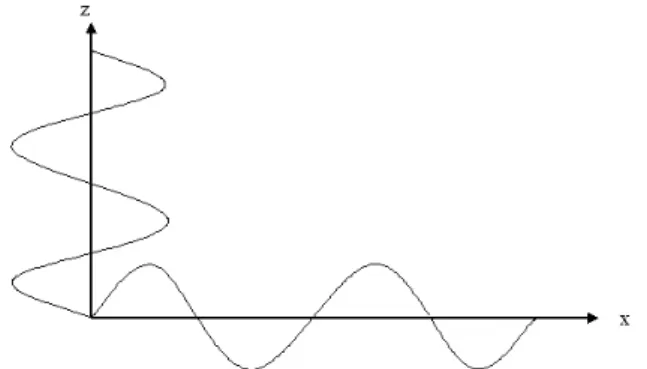
ve (near to speed of light). Then the observer sees the elec-tron moving on a curve which is a cycloid or trochoid, see Fig. 3. The form of the curve depends on the ratio of radii
a=b, whereais the radius of the “rolling” circle andbis the radius of the path of the electron. For the uniform velocityv we have
v = !a (2)
Fig. 3: Several forms of trochoids, also called common cycloid, cur-tate cycloid and prolate cycloid [19].
with!being the angular velocity of anglerotating in timet:
= !t : (3)
For thex andy coordinates the parameter form of the cycloid is given by
x = a b sin ; (4)
y = a b cos : (5)
In the rest frame of the atom we have
ve= !b (6)
for the rotating electron. This equation determines the angu-lar velocity!. The same ! has to be used in formula (2). The roll radiusais determined then by the relative velocity
v. If an observer tries to measure the diameter of a moving atom, he will see the reduced thickness of the cycloidal loop. Forv = vewe obtaina = b, the diameter goes to zero. For
v > vethere is only an unharmonic wave left and there is no measurable diameter of an atomic structure.
The diameter can be calculated quantitatively as follows. Thexvalues for the diameter are defined by a vertical tangent of the cycloid, i.e.
dx
d= 0 ; (7)
which is according to Eq. (4):
a b cos 0= 0 (8)
or
0= arccosab
: (9)
Inserting0into (4) gives for thexvalues where the di-ameter is being measured
x0= a arccosab
b
r
1 a2
b2 : (10)
Since we have
the valuex0describes the radius of the atom measured from an observer frame with relative speed v. The well-known square root term is contained in this expression. To obtain this term exclusively we have to tentatatively modify Eq. (4) by replacingaby another parametera1. Then we obtain from (10):
x0= a1 arccosab
b
r
1 ab22 (12)
and in the limita1 ! 0the observed radius of the atom be-comes
r = jx0j = b
r
1 a2
b2 ; (13)
which with help of (2) and (6) can be rewritten to
r = b s
1 vv22
e ; (14)
which is the experimentally found expression for length traction. So at least qualitatively we can explain length con-traction from the geometric effect of relative circular motion.
4 Special Relativity according to Einstein
We describe shortly the axiomatic foundation of special rel-ativity as given by H. Ruder [1]. All physical conclusions follow from the Lorentz transformation. This can be derived from three postulates or axioms:
1. Homogeneity and isotropy of space; 2. Principle of relativity;
3. Constancy of light velocity.
The first axiom is foundational for all physics. The three-dimensional space free of masses has no places which are sin-gled out from others and all directions are equivalent. From classical mechanics we know that these properties lead to the conservation laws of energy and angular momentum. Both statements are equivalent. Therefore axiom 1 is unsurrend-able.
The relativity principle states that all inertial frames are equivalent for describing the laws of physics. A difference by measurement is not detectable. The prerequisite is that a global, absolute reference frame does not exist. This is at variance with general relativity as well as newer experiments explained in section 2. The relativity principle would be valid only if space were exactly homogeneous, i.e. free of matter. Then, according to general relativity and Mach’s principle, the space would not exist at all. Therefore the relativity prin-ciple is a simplifying assumption which we will abandon in the following.
In the same way we do not claim absolute constancy of light velocity (c) in all reference frames. From general rela-tivity it follows that this velocity is not constant but dependent on the strength of the gravitational and other fields. One has
to negate this assumption even in special relativity as soon as optical refraction plays a role where the transmission speed of waves isv = c=nwithn being the index of refraction.
ccan only be considered to be a value of light propagation in vacuo with absence of fields of every kind. Another way of circumventing the a priori assumption of a constantc is to measure the transformation law for the proper time of fast moving systems. In this way the well-known Myon experi-ment can be interpreted for example [1]. It comes out that the transformation law can be cast in a mathematical form con-taining a constantcwhich “may have something to do” with light propagation in vacuo. We conclude that only the first axiom has withstood a critical analysis.
5 Modified Special Relativity according to this hypo-thesis
We will derive now the alternative theory resting upon the three fundamental assumptions:
1. Homogeneity and isotropy of space; 2. Existence of an absolute frame of reference; 3. Physical length contraction.
The first axiom has already been discussed. The second can be constituted by the fact that a more general theory, which does not presuppose inertial systems, allows a refer-encing system bound to the masses of the universe. Therefore it makes no sense to ignore this fact. If an absolute frame of reference is of physical relevance, it will have an effect. This is not so obvious from general relativity, because the gravi-tational field is no more effective outside the range of galax-ies. It would be more plausible to have a principle of close-ranging or local interaction. In this class of principles belong the ether theories. Already Einstein talked of an “ether space” which was immaterial to his opinion. Sometimes new ether theories come up as for example by Schmelzer [2] where the ether has the property of mediating the principle “actio= re-actio”. An absolute frame of reference can be related to this ether. It is analogous to a medium for sound waves and the concept of non-homogeneity and the refraction index of wave propagation are applicable. This shows that an ether concept can be added to general relativity, if not already existing in it. An attempt to incorporate it into technical applications was made by Meyl [3].
The ether concept is not necessary when we base our considerations on a unified field theory like Einstein-Cartan-Evans theory [18]. Then space itself is a medium which shows optical properties and a local structure which is de-fined by the vacuum or background potential. The new in-terpretation of Michelson-Morley experiments is compatible with this concept.
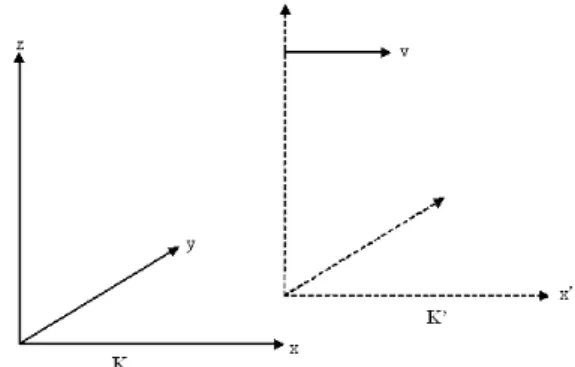
Fig. 4: Reference frames at rest (K) and with relative motion (K0).
interferometric experiments. If a body moves with velocity
v relative to the background, all lengths are shortened by a factor of
= r
1 v2
c2: (15)
This contraction is real and not an artifact of measurement. According to the considerations above this is an effect of rel-ative motion. This factor also appears in electrodynamics where it describes the transformation law between electro-magnetic fields. Matter exists on an electroelectro-magnetic basis. Consequently, this factor also appears in relativistic quan-tum mechanics. We will see in the next section that length contraction has an effect on time measurements so that local (“proper”) times of moving systems are impacted in the same way.
6 Derivation of the alternative theory
6.1 The transformation equations
In the following we will derive the transformation law be-tween different reference frames. We will first give the trans-formation law of special relativity in the most general case as described in [1]. The result of the first axiom can be used di-rectly because it is identical in Einstein’s and our theory. We define a coordinate systemKat rest and a systemK0moving with velocityvrelative toK. The systemK is the absolute rest frame as for example measured by experiment. Coordi-nate axes are chosen so that all axes betweenKandK0are in parallel, and motion is inxdirection of systemK. Then we can restrict consideration to one dimension. According to [1] the transformation law betweenK andK0 then has the general form
x0= b(v)(x vt) (16)
x = b0(v0)(x0+ v0t0) (17)
whereb(v)andb0(v0)are functions of the velocity. The second axiom has already been respected by assumingKto be at absolute rest. It should be noted thatvis not an arbitrary relative velocity between any two frames but the velocity be-tween the rest frame and another one.
Since the relativity principle is not valid it makes a diff er-ence if we transform from the resting to the moving system or backward. The functionsbandb0 therefore are different.
bis defined by length contraction according to the third ax-iom. Since length contraction is real there is no symmetry between both systems. All length scales in moving systems are larger than in the rest system. The lengthlof a moving system measured from the rest system then is
l0= l
r
1 vc22 : (18)
All scales are shrinking, i.e. for measuring the same length (the measured value read from a scale) inK0 more scale units have to be used than inKif measurement is done whenK0 flies by inK. The lengthl(in units ofK orK0 respectively) transforms then as
l0= ql
1 v2
c2
(19)
and the functionbfrom (16) is defined by
b = q 1
1 v2
c2
: (20)
By backtransformation fromK0 toKwe have to obtain the original length again, therefore
b0= b 1=
r
1 vc22 : (21)
If K0 moves with v, observed from K, then K moves with v observed fromK0. This is the only place where the relativity principle remains valid. The sign ofv however does not play a role in (20). The reversal of the sign ofvhas already been taken into account in Eqs. (16, 17). Therefore we can assumev = v0in the following.
As already mentioned, the length contraction also leads to a change in time scales as we can see from insertion of (16) into (17) (or vice versa) with regard ofbandb0:
t0= bt = q t
1 v2
c2
: (22)
In total we arrive at the complete non-symmetric set of transformation equations
x0= qx vt
1 v2
c2
; (23)
t0= q t
1 v2
c2
x = (x0+ vt0)
r
1 vc22 ; (25)
t = t0
r
1 vc22 : (26)
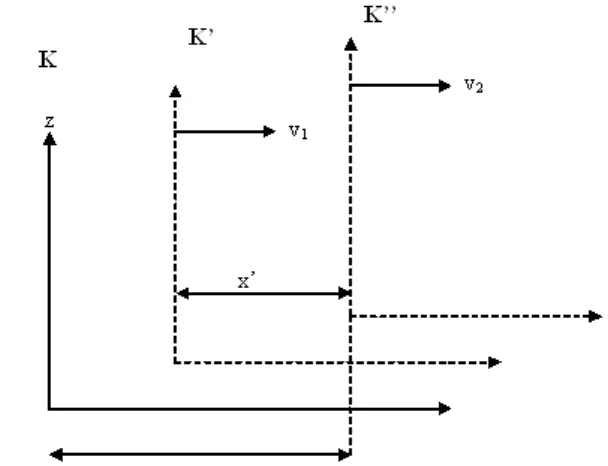
So far we have considered only two inertial frames with one of them being at (absolute) rest. In case of several frames moving arbitrary to one another, none of them can be assumed to be the rest frame. Let us define two framesK0 andK00 whose coordinate origins move with speedsv1andv2relative to the rest frameK. then we have for the length contraction in both frames:
l0= ql
1 v21 c2
; (27)
l00= ql
1 v22 c2
: (28)
Setting them in relation to each other directly gives
l0
l00 =
s c2 v2
2
c2 v2 1
(29)
or
l00= l0
s c2 v2
1
c2 v2
2 : (30)
Only in casev1 << v2this approximately results in the expression being know from special relativity:
l00= ql0
1 v22 c2
; (31)
wherev2 is approximately the relative velocity between fra-mesK0 andK00. To derive the complete transformation law betweenK0andK00we first write the transformation of both frames from the rest frame:
x0 = qx v1t
1 v12 c2
; (32)
t0 = q t
1 v12 c2
; (33)
x00 = qx v2t
1 v22 c2
; (34)
t00= q t
1 v22 c2
: (35)
Mutual insertion then gives the direct transformation
Fig. 5: Reference frames for addition theorem of velocities.
K0! K00as well as the reverse transformationK00! K0:
x00= (x0 (v
2 v1)t0)
s c2 v2
1
c2 v2 2 ;
(36)
t00= t0
s c2 v2
1
c2 v2 2 ;
(37)
x0= (x00+ (v
2 v1)t00)
s c2 v2
2
c2 v2
1 ; (38)
t0= t00
s c2 v2
2
c2 v2 1 :
(39)
Thus we have arrived at the general transformation laws between arbitrary frames of reference. For the back trans-formation the square root terms change to their inverse, and the sign of thevt term changes. These expressions cannot be reduced to a simple dependence on the speed difference
v = v2 v1. They depend on the absolute speeds of the inertial systems against the rest frame. Space and time coor-dinates transform with the same factor.
6.2 The addition theorem of velocities
We consider three coordinate systemsK,K0andK00. Frame
K0 is moving with velocity v
1 relative to the rest frame K andK00with velocityv2relative toK0. We will compute now with which velocityv3thenK00moves relative toK(Fig. 5). At timet = t0 = t00 = 0all three coordinate origins shall coincide, so we have
x = v3t ; (40)
x0= v
2t0: (41)
yield the connection betweenx(x0; t0)andt(t0):
x = (x0+ v 1t0)
r
1 vc212 = (v2t0+ v1t0)
r
1 vc122 ; (42)
t = t0
r 1 v12
c2 : (43)
By applying (40) the resulting velocity ofK00is
v3=xt = v1+ v2: (44)
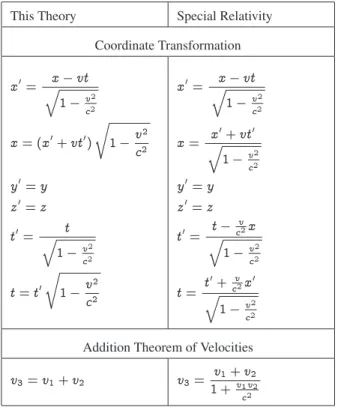
This is the addition theorem. The velocities add as vectors, in contrast to special relativity where we have the Einsteinian addition theorem (see Table 1). According to the latter, the sum of two velocities cannot exceed velocity of light. In this theory velocities add as vectors as in the Galilean transforma-tion. The experimental consequences will be discussed in the subsequent section.
Now let’s consider how velocities transform between fra-mes directly. We assume that inK0andK00 the same moment (for example of a mass) is measured locally by the ve-locities
v0= x0
t0 (45)
and
v00= x00
t00 : (46)
By inserting (36, 37) into (46) we find
v00 = v0 (v
2 v1) : (47)
Velocities transform according to the Galilean transfor-mation. In particular there is no limiting velocity.
7 Consequences
7.1 Comparison with Special Relativity
Both theories show a high degree of similarity, but there are some essential differences (see Table 1). In Einsteinian rel-ativity the transformations are the same in both directions which is a consequence of the relativity principle. In the al-ternative theory the contraction factor reverses. This follows from the fact that this theory is based on an absolute frame of reference. This will be further discussed below.
There is a principal difference in the time transformations. In the alternative theory time is stretched by the same factor as length. In Einstein’s relativity there is an additional term con-taining the space coordinate. So there is a coupling between space and time which ensures the basic axiom of constancy ofc. In our theory space and time are decoupled, leading to a different metric. The coupling between space and time co-ordinates can be interpreted as follows. Consider two clocks in the rest frame, one at the coordinate origin and the other at locationx = x0,y = 0,z = 0. In Einstein’s theory clocks
This Theory Special Relativity
Coordinate Transformation
x0= x vtq 1 v2
c2
x0= x vtq 1 v2
c2
x = (x0+ vt0)
r
1 vc22 x = xq0+ vt0
1 v2
c2
y0= y y0= y
z0= z z0= z
t0= q t 1 v2
c2
t0= qt cv2x
1 v2
c2
t = t0
r
1 vc22 t = qt0+cv2x0
1 v2
c2
Addition Theorem of Velocities
v3= v1+ v2 v3= v1 +1+ vv1v22
c2
Table 1: Comparison of theories.
must be synchronized. When the first clock registers an event atx = 0,t = 0, this will be seen atx0 only after a delay which for light signals ist0 = x0=c. This delay of the mea-suring process is “built in” into special relativity and explains the appearance of the term(v=c2)x0 in the time transforma-tiont(t0)in Table 1.
of all speeds including the signal transmission speed and rel-ative frame speed. This is because we do not assume Lorentz invariance in each frame as Tangherlini did. Compared with the experiments of Cahill, our results are in accordance with them, but Tangherlini’s are not.
Also in special relativity there is no real need for integrat-ing signal transmission times into the transformation formu-las. In addition, there are signal transmission speeds smaller thanc, therefore it cannot be seen why experiments carried out with transmission velocitycshould play a dominant role. If the space distance between clocks is known (and it can be measured of course), there is no problem to calculate the time of events at the other clock positions. This is like introducing time zones around the globe. We exactly know what time it is in other parts of the world without making any measure-ment. Occurrence of events at the same time can be defined by using the time of the rest frame.
While the Lorentz transformation represents a rotation in fourdimensional space, the transformation introduced by this theory has lower symmetry, it can be considered to be an affine mapping, i.e. a translation with stretching of scales. The transformation exhibits group properties as does the Lo-rentz transformation. This is shown in Appendix A in detail. We therefore conclude that the transformation introduced in this work can be used similarly to the Lorentz transformation as a basic property of higher developed theories, for example general relativity.
7.2 Comparison with known problems of Einsteinian theory
There are several interpretation problems in conventional spe-cial relativity. When comparing two frames being in mo-tion to one another, the length rods of the other system ap-pear shortened, seen from the system where the observer re-sides. This follows from the symmetry of the transformation law (Lorentz transformation). When the speed of one sys-tem is adopted to that of the other syssys-tem, the difference in rod length disappears. At least Einstein has assumed that the scale change is a measuring artifact and not real.
Time dilation is regarded differently. In the well known twin paradoxon it is assumed that the integral taken over the coordinate time is identical to the real elapsed time, the scale change is considered to be a real effect as is done in general relativity. There is a contradiction in the interpretation. Con-trary to this, the alternative theory assumes the scale changes always to be real. Since all length changes are related to the rest frame, there is no “symmetry” between measurements when one moving system measures quantities in another. For the twin paradoxon this means that the twin having higher absolute speed ages faster than the other one. Both twins can calculate the age of the other twin and come to the same re-sult. All contradictions are removed.
The change of the time coordinate deserves further
com-ments. As is generally known the Lorentz transformation is a rotation in four dimensions, therefore the length of vectors is an invariant as can be expressed by
x2+ y2+ z2 c2t2= x02+ y02+ z02 c2t02: (48) From this the differential invariance condition of the Min-kowski metric follows:
dx2+dy2+dz2 c2dt2= dx02+dy02+dz02 c2dt02: (49) To the knowledge of the author, experimental tests of spe-cial relativity, however, are not based on the invariance prin-ciple but on the coordinate transformations where the proper time of a moving system is computed by integrating the equa-tion
d = dt r
1 v2
c2 : (50)
Considering the time transformation for special relativity in Table 1, this equation should generally read
d =dt cv2dx r1 vc22 : (51)
It is questionable if this formula ever has been tested ex-perimentally. Experimenters always used setups where the simplified Eq. (50) was sufficient. These types of checks of special relativity have been made with very high precision. For testing the Lorentz transformation thoroughly, however, use of Eq. (51) would be required.
We conclude this section with a hint to relativistic me-chanics which is also based on Eq. (50). Therefore the alter-native theory gives the same results as special relativity, as far as the lab system can be identified within sufficient precision with the absolutely resting system. When experiments with light are performed, this is the case. Relativistic mechanics would look differently if experiments were performed in a fast moving lab relative to earth.
7.3 Comparison with newer experiments and final re-marks
confirmations are required. There are certain measurements of Marinov [15, 16] which seem not to be consistent with Cahill’s results, but it is not clear if the evaluation method of Marinov is compatible with that of Cahill and this work.
The concept of the refraction index can be used to produce superluminal processes by deploying special optical media with a refraction indexn < 1. Obviously, the experiments of Nimtz [5, 6], who has transmitted audio data with super-luminal speed, can be explained in this way. Since the input data (a symphony of Mozart) was recognized as such after the transmission, it is clear that useful signals can be transmitted with such a speed. The old argument that a “phase velocity”
v > c cannot transport any information no longer holds. Thus our above statements are corroborated that a global time can be defined experimentally. Thornhill [14], and later Cahill [13], have further shown that Maxwell’s equations, which are taken as an irrevocable proof that the Lorentz transform is in-corporated in nature, can be formulated Galilei-invariant. Ad-vanced theories like Einstein-Cartan-Evans theory [18] intro-duced a background potential and optical properties of space itself. Einstein’s area is overcome. We conclude with a cita-tion from Cahill [13]:
“The Special Relativity formalism asserts that only rel-ative descriptions of phenomena between two or more observers have any meaning. In fact we now under-stand that all effects are dynamically and observation-ally relative to an ontologicobservation-ally real, that is, detectable dynamical 3-space. Ironically this situation has always been known as an “absolute effect”. The most extraor-dinary outcome of recent discoveries is that a dynami-cal 3-space exists, and that from the beginning of Phys-ics this has been missed — that a most fundamental aspect of reality has been completely overlooked”.
Appendix A: Proof of group properties
The transformation equations can be written in vector form with four-dimensional vectors and a transformation matrix:
0 B @ x00 y00 z00 t00 1 C A= 0 B @ 0 0
0 1 0 0
0 0 1 0
0 0 0
1 C A 0 B @ x0 y0 z0 t0 1 C A (A-1) with := r
c2 v2 1
c2 v2
2 ; := v2 v1:
(A-2)
This is — in contrast to the Lorentz transformation — not a rota-tion in 4-space but a linear transformarota-tion (stretching) with a trans-lation. The determinant is2, not unity as for the Lorentz transfor-mation. Straight lines remain in parallel. The inverse transformation of (A-1) is
0 B @ x0 y0 z0 t0 1 C A= 0 B @
1 0 0 1
0 1 0 0
0 0 1 0
0 0 0 1
1 C A 0 B @ x00 y00 z00 t00 1 C A (A-3)
as can be verified by multiplication of both matrices. To compare this with the Lorentz transformation we rewrite above Eqs. (A-1, A-3) with Minkowski coordinates, i.e. with an imaginary time
coor-dinate: 0 B @ x00 y00 z00 ict00 1 C
A=T
0 B @ x0 y0 z0 ict0 1 C A (A-4) with T= 0 B @
0 0 i
0 1 0 0
0 0 1 0
0 0 0
1 C A (A-5) and := r
c2 v2 1
c2 v2
2 ; := v
2 v1
c : (A-6)
Then we have in analogy to above:
T 1=
0 B @
1 0 0 i 1
0 1 0 0
0 0 1 0
0 0 0 1
1 C
A (A-7)
The set of transformationsT (; )is a commutative group. This is proven in the following by examining the group axioms.
1. Completeness We define
1:= r
c2 v2 1
c2 v2
2 ; 1:= v
2 v1
c ; (A-8)
2:= r
c2 v2 3
c2 v2
4 ; 2:= v
4 v3
c : (A-9)
Then we find for the concatenation of two transformations by matrix multiplication:
T (1; 1) T (2; 2) = T (12; 1+ 2) : (A-10)
2. Neutral element
The neutral element of the group is the unit matrix.
3. Inverse element
For each T (; ) there is an inverse transformation T 1=
= T ( 1; ).
4. Associativity
The law of associativity for the matrix multiplication holds:
T (1; 1)T (2; 2) T (3; 3)=
=T (1; 1) T (2; 2)T (3; 3) :
(A-11)
5. Commutativity
From Eq. (A-10) directly follows
T (1; 1) T (2; 2) = T (2; 2) T (1; 1): (A-12)
So the group axioms have been proven.
References
1. Ruder H. and M. Die Spezielle Relativit¨atstheorie. Vieweg-Verlag, 1993.
2. Schmelzer I. General ether theory. arXiv: gr-qc/0001101.
3. Meyl K. Elektromagnetische Umweltvertr¨aglichkeit. Teil 3: Umdruck zum informationstechnischen Seminar. Indel-Verlag, 2003.
4. Crothers S.J. On certain conceptual anomalies in Einstein’s the-ory of relativity.Progress in Physics, 2008, v. 1, 52–57.
5. Nimtz G. Tunneln mit Uberlichtgeschwindigkeit.¨ DLR Nachrichten, 1998, v. 90.
6. Nimtz G. Evanescent modes ar not necessarily Einstein causal. The European Physical Journal, 1999, v. B7, 523.
7. Tangherlini F.R. The velocity of light in uniformly moving frame. PhD Thesis, Stanford Univ., Sept. 1958, 135 pages.
8. Tangherlini F.R. An inroduction to the General Theory of Rel-ativity.Suppl. Nuovo Cim., 1961, Ser. X, v. 20, 1–86.
9. Malykin G.B. Frank Robert Tangherlini — the founder of an alternative relativistic kinematics (on the occasion of his 85th birthday).Progress in Physics, 2009, v. 1, L9–L14.
10. Cahill R.T., Kitto K. Michelson-Morley experiments revisited and the Cosmic Background Radiation preferred frame. Ape-iron, 2003, v. 10(2), 104–117.
11. Cahill R.T. A new light-speed anisotropy experiment: absolute motion and gravitational waves detected.Progress in Physics, 2006, v. 4, 73–92.
12. Cahill R.T. The Roland De Witte 1991 experiment (to the mem-ory of Roland De Witte).Progress in Physics, 2006, v. 3, 60–65.
13. Cahill R.T. Unravelling Lorentz covariance and the spacetime formalism,Progress in Physics, 2008, v. 4, 19–24.
14. Thornhill C.K. Real and apparent invariants in the transforma-tion of the equatransforma-tions governing wave-motransforma-tion in the general flow of a general fluid.Proc. R. Soc. Lond. A, 1993, 442, 495–504.
15. Marinov S. Measurement of the laboratory’s absolute velocity. General Relativity and Gravitation, 1980, v. 12(1), 57–66.
16. Marinov S. Repetition of Silvertooth’s experiment for measur-ing the aether drift.Speculations in Science and Technology, 1989, v. 12(3), 187–179.
17. Robitaille P.-M. On the origins of the CMB: insight from the COBE, WMAP, and Relikt-1 satellites. Progress in Physics, 2007, v. 1, 19–23.
18. Evans M.W. Generally covariant unified field theory. Abramis, 2005–2009, vols. 1–6; see also http://www.aias.us
![Fig. 3: Several forms of trochoids, also called common cycloid, cur- cur-tate cycloid and prolate cycloid [19].](https://thumb-eu.123doks.com/thumbv2/123dok_br/16406585.194056/3.892.92.435.134.357/forms-trochoids-called-common-cycloid-cycloid-prolate-cycloid.webp)